Most startups have no shortage of ambition. What they’re short on is focus.
OGSM works exceptionally well for startups because it forces strategic focus on a single page — one objective, three to five goals, a handful of clear strategies, and the measures to track them. For a resource-constrained team, that’s not a limitation. It’s the whole point. A well-built startup OGSM replaces lengthy business plans with a living document your whole team can execute from day one.
Here’s how to build one — adapted specifically for the realities of an early-stage or fast-growing business.
Why Startups Avoid Strategy (And Why That’s a Mistake)
The most common objection to strategic planning in startups is speed. Things change too fast. The market shifts. The product pivots. Writing a strategy feels like a waste of time when everything is in flux.
There’s some truth in this — but it misses something important. The problem isn’t strategy. The problem is the wrong kind of strategy.
A 40-page business plan is the wrong kind. It takes weeks to write, goes out of date immediately, and nobody reads it twice. But that’s not what OGSM is.
OGSM is a one-page strategic plan. It takes a few hours to build with your founding team, fits on a single slide, and can be updated in minutes when circumstances change. It doesn’t slow you down. It gives you the clarity to move faster — because everyone on the team knows exactly what they’re optimising for.
The startups that struggle aren’t the ones that plan too much. They’re the ones that move fast in too many directions at once.
Why OGSM Is Particularly Well-Suited to Startups
OGSM has several features that make it especially effective for early-stage businesses.
It’s short. One page forces ruthless prioritisation. You can’t fit everything on one page, which means you have to decide what matters most. That decision is the strategy.
It’s visual. The OGSM is structured as a table — objective at the top, goals and strategies and measures aligned across a single row structure. The entire team can see the plan at a glance. No scrolling through slides. No hunting for the relevant paragraph.
It links ambition to action. The OGSM connects your objective (where you’re going) directly to the initiatives your team works on every week. That connection is what most startup planning lacks. The mission is inspiring but the Monday morning to-do list feels disconnected from it. OGSM closes that gap.
It’s easy to update. When your assumptions change — and in a startup, they will — you update the relevant line of the OGSM and re-share it. A one-page plan adapts in minutes. A 40-page business plan doesn’t.
How to Adapt OGSM for a Startup Context
The standard OGSM structure works well for startups with one adjustment: be more comfortable with uncertainty in your goals and measures early on, and expect to revisit them more frequently than an established business would.
Here’s how to approach each element.
The Objective should describe the future state you’re building toward — not what you do today, but where you’re heading. Keep it to one sentence. Make it specific enough to be meaningful, but broad enough to survive a product pivot. Good startup objectives often describe the problem you’re solving and the customer you’re serving, not just the revenue you want to hit.
The Goals should be 3 to 5 quantitative targets for the next 12 months. In a startup, at least one of these will almost certainly be a revenue or growth target. Others might cover customer acquisition, product milestones, team building, or runway. Be honest with yourself: a goal you can’t measure isn’t a goal, it’s a wish.
The Strategies are where most startups underinvest. A strategy isn’t “grow our customer base.” That’s a goal. A strategy is the specific approach you’ll take: “Grow our customer base by partnering with three complementary SaaS platforms to reach their existing user communities.” The more specific you can be, the more useful the strategy becomes as a decision-making tool — helping your team say no to the things that don’t fit.
The Measures — covering both the metrics you track and the initiatives you’ll execute — should be lean. A startup OGSM typically has two to three initiatives per strategy, not ten. Pick the ones that move the needle. Everything else is noise.
What a Startup OGSM Looks Like in Practice
Here’s a simplified example for an early-stage B2B SaaS startup:
Objective: Become the go-to project management tool for freelance creative agencies by delivering a beautifully simple platform that saves them five hours of admin per week.
Goals:
€500K ARR by December
200 paying customers by Q3
NPS score of 50+ by Q2
Churn rate below 5% monthly
Strategy 1: Win the freelance agency segment by focusing all marketing and product development on their specific workflow needs. Measures: 3 agency partnerships signed, 50 case studies published, product roadmap reviewed quarterly with 5 agency customers
Strategy 2: Drive acquisition through content and community, not paid ads. Measures: 10,000 monthly blog visitors by Q4, 1 active community forum launched, 2 guest posts per month on agency-focused publications
This is a real plan. It fits on one page. The whole founding team can point to it and say: this is what we’re doing and why.
Three Mistakes Startups Make With OGSM
Mistake 1: Setting too many goals. More than five goals dilutes focus. Pick the three to five numbers that genuinely indicate your startup is on the right trajectory, and track those obsessively.
Mistake 2: Writing vague strategies. “Build brand awareness” is not a strategy. “Build brand awareness by publishing two founder-led LinkedIn articles per week targeting our ICP” is. The test: can someone on your team look at a strategy and know exactly what to do on Monday morning?
Mistake 3: Building it in isolation. The OGSM only works if the team that needs to execute it had a hand in creating it. Even in a founding team of two, build it together. The conversation is as valuable as the document.
Start With the Template, Not a Blank Page
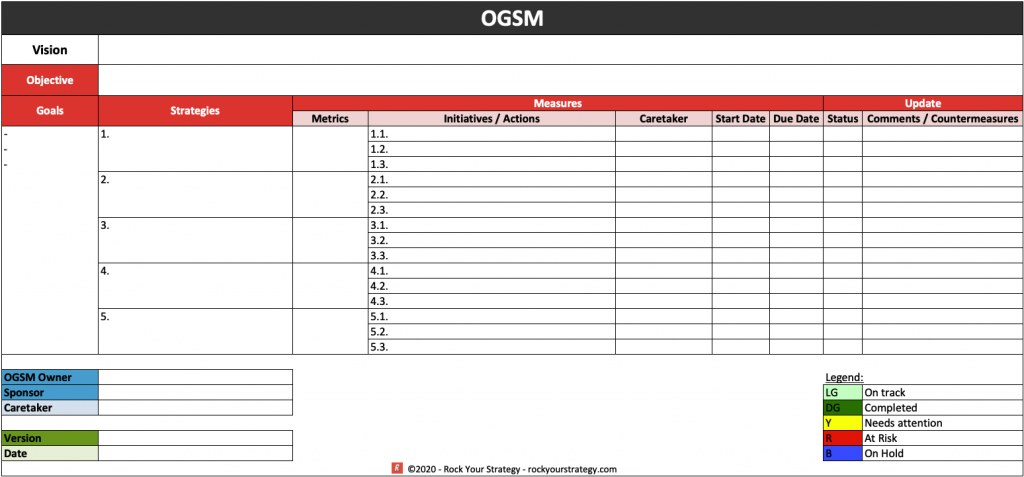
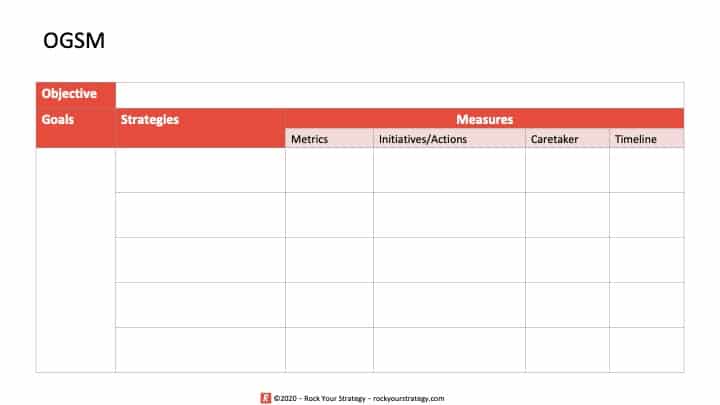
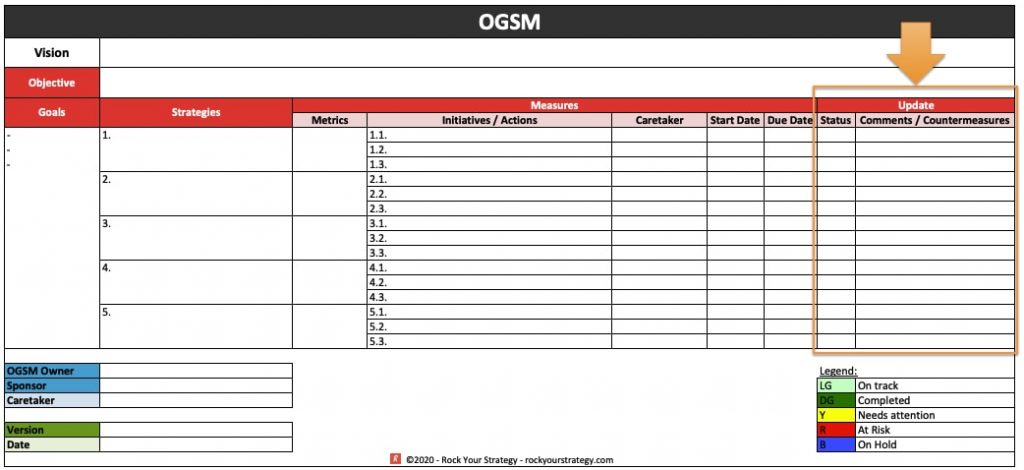
If you want to build your startup OGSM quickly, the fastest way to start is with a structured template that gives you the right layout from the beginning. Our OGSM Template for PowerPoint and OGSM Template for Excel are designed to get you from blank page to complete strategic plan in a single working session.
And if you want to see the framework in action before you build your own, our OGSM examples show how real businesses — from a small Italian restaurant to a B2B company — have used it to build plans that actually get executed.
Two of the most popular strategic frameworks in business today. One right answer for your situation.
OGSM is the stronger choice when you need a complete strategic plan that covers both what you want to achieve and how you’ll get there — typically over a 1 to 3 year horizon. OKRs are better suited to teams running fast, short goal-setting cycles — usually quarterly — without needing the full strategic context layer. The key practical difference: OGSM includes an explicit strategy; OKRs do not.
Here’s a full breakdown of both frameworks — how they work, where they shine, where they fall short, and how to decide which one is right for your business.
What Is OGSM?
OGSM stands for Objectives, Goals, Strategies, and Measures. It’s a one-page strategic planning framework that captures your entire business strategy in a single, structured document — from the qualitative ambition at the top to the specific actions and metrics at the bottom.
The four components work together in a deliberate hierarchy:
Objective — a qualitative statement describing where you want to go
Goals — 3 to 5 quantitative targets that define what success looks like
Strategies — the specific approaches you’ll take to achieve those goals
Measures — the metrics and initiatives that tell you whether your strategies are working
OGSM was developed in the 1950s and has been used by large multinationals — Procter & Gamble, Unilever, Mars, and many others — to align strategy across complex organisations. Today it’s just as effective for small businesses and individual teams as it is for global corporations.
What Are OKRs?
OKRs stands for Objectives and Key Results. The framework was developed by Andy Grove at Intel in the 1970s, then popularised at Google by investor John Doerr in the late 1990s. Since then it has become the framework of choice in Silicon Valley and the broader startup world.
An OKR consists of two parts:
Objective — an inspiring, qualitative statement of what you want to achieve
Key Results — typically 3 to 5 measurable outcomes that define what achieving the objective looks like
OKRs are usually set quarterly, reviewed regularly, and graded at the end of each cycle. The framework is designed to move fast: set ambitious targets, execute quickly, learn, and reset.
OGSM vs OKR: The Key Differences
Both frameworks start with an objective. After that, they diverge significantly.
1. Strategy vs Results
This is the most important difference. OGSM includes an explicit layer for strategies — the specific approaches, choices, and methods you’ll use to achieve your goals. OKRs skip this layer entirely. An OKR tells you what you want to achieve and how you’ll measure success, but not how you’ll actually get there.
For businesses that need to make real strategic choices — which markets to enter, which customer segments to prioritise, which capabilities to build — the absence of a strategy layer in OKRs is a genuine limitation.
2. Time Horizon
OGSM is designed for medium to long-term strategic planning — typically one to three years. It gives your organisation a stable north star to execute against over time.
OKRs are built for speed. Most organisations run OKRs on a quarterly cycle, which makes them excellent for execution but less suited to long-term strategic direction.
3. Comprehensiveness
An OGSM is a complete strategic plan. It answers the fundamental questions of business strategy in one document: Where are we going? What does success look like? How will we get there? How will we know we’re on track?
OKRs answer the first two and the last, but leave the third — the “how” — undefined. This works well for organisations where strategy is set separately and OKRs are used purely as an execution and alignment tool.
4. Origin and Culture
OGSM has roots in classic corporate planning and is most commonly used in large, established organisations — particularly in consumer goods, pharma, and professional services.
OKRs emerged from the tech world and are deeply embedded in startup culture. They reflect a philosophy of ambition, experimentation, and rapid iteration that suits fast-growing companies better than a methodical annual planning process.
5. Cascade
Both frameworks can cascade through an organisation — from company level to department to team to individual. OGSM cascades through the strategy layer: each department or team writes its own OGSM that aligns with the strategies above it. OKRs cascade through the key results: a company-level key result becomes the objective for the team below.
In practice, OGSM cascades are more structured and strategic; OKR cascades are faster and more flexible.
When to Choose OGSM
OGSM is the right choice if:
You need a complete strategic plan, not just a goal-setting tool
Your planning horizon is one year or longer
You need to align a team or organisation around both direction and execution
You’re in a more established business where strategic choices and trade-offs matter
You want a single document your entire leadership team can read, debate, and commit to
You need to cascade strategy clearly from the top down
When to Choose OKRs
OKRs are the right choice if:
Your organisation moves fast and needs to reset goals frequently
Strategy is already set and you need a rigorous execution and accountability tool
You’re in a startup or tech company where quarterly cycles fit naturally
You want individual contributors to set their own OKRs aligned to company objectives
You prefer a lighter, more agile framework over a comprehensive strategic plan
Can You Use Both Together?
Yes — and some organisations do. A common approach is to use OGSM for the annual strategic plan (the “what” and “how” over 12 months) and OKRs for the quarterly execution layer within each strategy.
In this model, the OGSM gives you strategic direction and stability. The OKRs give each team a focused, time-bound set of outcomes to drive in the next 90 days. The two frameworks reinforce each other rather than compete.
The risk to watch out for: complexity. Running both frameworks at once requires discipline and clear governance. If the OGSM and OKRs aren’t explicitly connected, teams end up with two sets of priorities that quietly pull in different directions.
Which Should You Choose?
If you’re building or refreshing a strategic plan for your business, OGSM will serve you better. It forces you to make real strategic choices, not just set targets — and that discipline is what separates strategies that get executed from plans that gather dust.
If you already have a clear strategy in place and your primary challenge is execution and team alignment at a fast pace, OKRs are a powerful complement.
When in doubt, start with OGSM. It gives you everything OKRs give you — a clear objective, measurable goals, and a way to track progress — plus the strategic layer that OKRs leave out.
Ready to Build Your OGSM?
If OGSM sounds like the right fit, the best place to start is a clean, ready-to-use template. Our OGSM Template for PowerPoint and OGSM Template for Excel are built for exactly this — a structured, professional framework you can populate in a single session and share with your team immediately.
Still not sure which framework is right for you? Read What Is OGSM? for a deeper look at the methodology, or explore our OGSM examples to see it in action.
Most B2B SaaS strategies collapse under the weight of too many priorities. Product wants to ship features. Sales wants more leads. Finance wants CAC under control. The OGSM framework forces you to resolve that tension on a single page — before it resolves itself in the wrong direction.
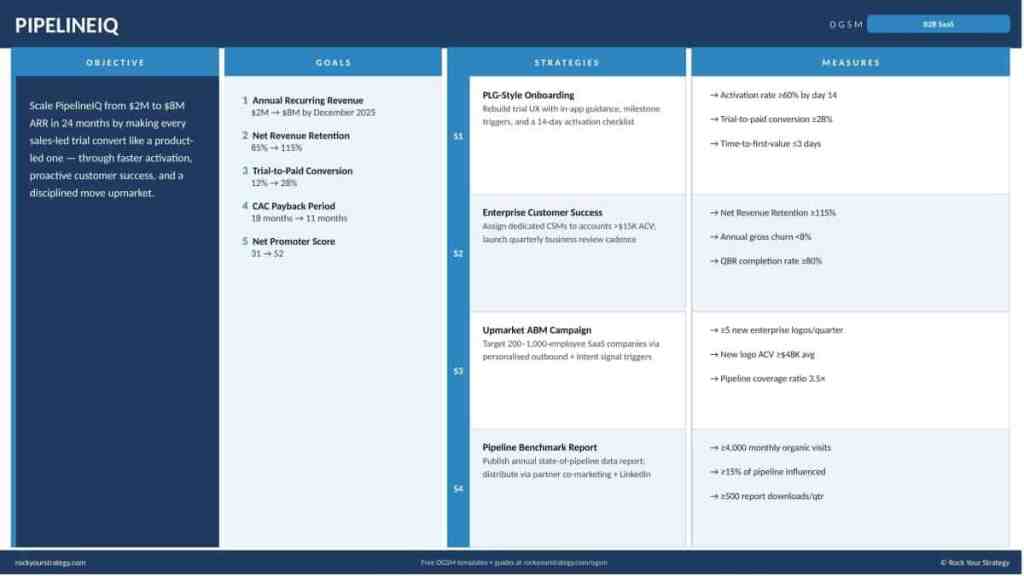
This example shows how a fictional B2B SaaS company — PipelineIQ, a pipeline analytics platform for mid-market sales teams — used the OGSM methodology to align their leadership team around a clear path from $2M to $8M ARR. The numbers, company, and details are illustrative. The strategic logic is real.
PipelineIQ is a B2B SaaS company that helps mid-market sales teams visualize pipeline health, forecast revenue more accurately, and identify deals at risk before they slip. They integrate with Salesforce and HubSpot and sell primarily to VP Sales and RevOps leaders at companies with 50–500 employees.
At the time of this OGSM, PipelineIQ has reached $2M ARR with strong product-market fit signals — high NPS, good retention among customers who fully onboard — but inconsistent trial-to-paid conversion and a growing gap between SMB and enterprise performance. The leadership team needs to decide where to concentrate resources for the next 12 months.
The PipelineIQ OGSM
Objective
Become the leading pipeline analytics platform for mid-market B2B sales teams by accelerating product-led growth and deepening enterprise retention.
Goals
Goals translate the objective into measurable outcomes. PipelineIQ chose five metrics that collectively define what success looks like at the end of the 12-month period.
Goal
Current
Target
Annual Recurring Revenue (ARR)
$2M
$8M
Net Revenue Retention (NRR)
102%
≥115%
Trial-to-paid conversion rate
9%
≥18%
CAC payback period
18 months
≤12 months
Net Promoter Score (NPS)
38
≥50
Strategies
Strategies are the 3–5 high-impact choices that determine where PipelineIQ concentrates its resources. Each is written as a “what-by-how” statement — specific enough to exclude things they won’t do.
Strategy 1: Accelerate trial-to-paid conversion by redesigning the onboarding flow around a fast time-to-value milestone
PipelineIQ’s data shows that users who reach their first “pipeline health score” within 72 hours of signup convert at 3x the rate of those who don’t. The strategy is to rebuild the onboarding sequence around this milestone — removing friction, adding guided prompts, and making the health score the first thing every trial user sees.
Strategy 2: Increase NRR by building a structured customer success motion for accounts above $15K ARR
Churn is concentrated in the $10K–$20K ARR band, typically from accounts that never fully adopted the forecasting module. A dedicated CS motion — quarterly business reviews, adoption scoring, and expansion playbooks — will address this before it compounds.
Strategy 3: Move upmarket into the $20K–$60K ACV segment by targeting RevOps leaders at Series B–D companies through account-based outreach
Mid-market accounts have lower churn, higher NPS, and more expansion potential than SMBs. PipelineIQ will build an ABM programme targeting 200 high-fit accounts per quarter, led by outbound sequences from a newly hired senior AE.
Strategy 4: Build category authority by publishing the annual B2B Pipeline Benchmark Report as the definitive industry reference
Owned research creates durable inbound demand and shortens sales cycles. PipelineIQ will survey 500+ sales leaders, publish findings in Q2, and use the report as the cornerstone of their content and PR strategy for the year.
Measures
Measures define how each strategy will be tracked and executed. For each strategy, PipelineIQ identified 2–3 Key Metrics (the numbers that define success) and 2–3 Actions (the concrete initiatives that will move those numbers).
Survey 500 sales leaders (Q1); Publish with PR push (Q2); Content distribution plan (Q2)
What Makes This OGSM Work
Three things stand out about PipelineIQ’s OGSM that are worth noting for your own strategy work.
The objective resolves a real tension. PipelineIQ could have written a generic objective about “becoming a market leader.” Instead, they named the two specific mechanisms driving growth — product-led growth and enterprise retention — which immediately signals to the team where resources will flow and where they won’t.
The goals are genuinely constraining. An NRR target of ≥115% is not a stretch goal bolted onto an existing plan. It forces a structural change: you can’t hit 115% NRR without a real CS motion. The goal drives the strategy, not the other way around.
The strategies make explicit trade-offs. Strategy 3 targets Series B–D companies specifically — not “all upmarket segments.” Strategy 4 commits to one owned research asset rather than a broad content calendar. These exclusions are as important as the inclusions.
OGSM vs. OKR: Which Framework Works Better for SaaS?
This is a question that comes up often in SaaS leadership teams, especially those that have previously used OKRs.
OGSM
OKR
Output format
One page, full strategy visible at once
Nested list of objectives and key results by team
Strategic choices
Explicit — strategies define what you will and won’t do
Implicit — key results may point in different directions
Execution link
Measures connect each strategy to specific actions and owners
Key results tracked separately; initiatives often disconnected
Cadence
Annual with quarterly measure reviews
Quarterly cycles with annual reset
Best suited for
Full business strategy alignment (board to team)
Team-level goal-setting and performance tracking
Many SaaS companies find that OGSM works better at the business unit or company level precisely because it forces the strategic trade-off conversation. OKRs can sit alongside it at the team or individual level for execution tracking.
Build Your Own OGSM
Use our pre-formatted OGSM templates to build your own one-page strategy. Available for Microsoft PowerPoint (for leadership presentations) and Microsoft Excel (for building, tracking, and updating your plan). Both are fully editable and immediately downloadable.
Strategy has always demanded two things most people are short on: time and objectivity.
You can use AI to build your OGSM at every stage — from drafting your SWOT and stress-testing your objective, to generating strategic options and identifying the right KPIs. Feed an AI tool like ChatGPT or Claude the right context, ask the right questions, and you’ll compress hours of strategic thinking into minutes — without sacrificing quality.
That’s the short version. The rest of this guide shows you exactly how to do it at each step, with practical prompts you can copy and use right now.
First: What AI Is (And Isn’t) Good for in Strategy
Before diving into the how, it helps to be clear about the what.
AI is genuinely good at generating options quickly, structuring and stress-testing ideas, summarising large amounts of information, drafting text, and challenging your thinking with alternative perspectives.
AI is not good at knowing your business the way you do, replacing strategic judgment, validating data it hasn’t seen, or making decisions on your behalf.
The best way to think about it: AI is a fast, well-read sparring partner. It has read everything, remembers everything, and is always available. But it hasn’t lived through your last five years of business. You bring the context. It brings the horsepower.
With that framing in mind, here’s how to use it across each stage of your OGSM.
Step 1: Use AI to Sharpen Your Situational Analysis
Every good OGSM starts before the OGSM itself — with a clear-eyed assessment of where you stand today. That typically means a SWOT analysis, a PESTEL scan, or a review of your competitive position.
This is where AI earns its keep immediately.
Rather than starting with a blank page, give an AI tool like ChatGPT or Claude the key facts about your business — your industry, size, markets, main products or services, and the biggest challenge you’re facing — and ask it to draft a starting-point SWOT. You won’t use the output directly, but it will surface angles you hadn’t considered and give you something concrete to react to, which is always faster than building from scratch.
Try this prompt:
“I run a [type of business] with [X employees] operating in [markets/geographies]. Our main products/services are [X]. We are currently facing [challenge]. Draft a SWOT analysis for my business, and for each point, explain the strategic implication in one sentence.”
Review the output critically. Cross out what doesn’t fit, add what it missed, and you’ll find you’ve completed a quality situational analysis in a fraction of the usual time.
You can apply the same logic to a PESTEL analysis. Ask AI to scan the macro-environment of your industry for political, economic, social, technological, environmental, and legal factors. It won’t know your local context, but it will catch trends you may have overlooked — especially in fast-moving areas like regulation or technology.
Step 2: Use AI to Draft and Test Your Objective
Your OGSM Objective is the most important sentence in your entire strategic plan. It needs to be inspiring, clear, and grounded — and it often takes several rounds of iteration to get right.
AI is useful here in two ways: drafting and stress-testing.
For drafting, describe your ambition in plain language and ask AI to turn it into a crisp strategic objective.
Try this prompt:
“Based on this business context: [paste your context]. Here is my current draft objective for our strategy: [paste it]. Please rewrite this as a sharp, inspiring strategic objective in one sentence. Then give me two alternative versions — one more ambitious, one more conservative.”
For stress-testing, ask AI to challenge what you’ve written.
“Here is our strategic objective: [paste it]. What are the top three weaknesses or blind spots in this objective? What is it not saying that it probably should?”
This kind of challenge is exactly what a good strategy coach would give you in a workshop — and it’s available instantly, at any time.
Step 3: Use AI to Benchmark and Validate Your Goals
Your OGSM Goals translate your qualitative objective into 3 to 5 measurable, quantitative targets. The question most people struggle with isn’t what to measure — it’s what numbers to aim for.
AI can help you benchmark.
“We are a [type of company] in [industry]. We want to grow revenue from [X] to [Y] in [timeframe]. Is this growth rate realistic compared to industry benchmarks? What typical growth rates do companies like ours achieve, and what are the key drivers?”
AI will give you a directional answer based on its training data. It won’t have access to your specific market’s most recent figures, so treat the output as a calibration tool rather than gospel. But it will quickly tell you whether your goals are realistic, stretched, or timid — and that alone is worth the conversation.
Step 4: Use AI to Generate Strategic Options
This is arguably the most powerful use of AI in your OGSM process. When it comes to defining your Strategies — the “how” of your plan — most teams default to the same playbook they’ve used before.
AI breaks that pattern. It has been exposed to thousands of strategic frameworks, case studies, and industry examples, and it can generate a wide range of strategic options quickly. Your job is to filter, refine, and stress-test.
Try this prompt:
“Given this strategic objective [paste it] and these goals [paste them], generate 8 to 10 potential strategies for achieving them. For each strategy, describe it in one sentence using the format: ‘[Verb] [what] by [how]’. Then rate each strategy on a scale of 1 to 5 for both impact and feasibility.”
You won’t use all 8 to 10 options. But the exercise will almost certainly surface one or two angles your team hadn’t considered — and that’s exactly what makes it valuable.
Step 5: Use AI to Define the Right Measures
The Measures column of your OGSM — covering both Metrics (what you track) and Initiatives (what you do) — is where most strategic plans either come to life or fall apart. The biggest risk is choosing measures that are easy to track rather than measures that actually tell you whether your strategies are working.
Here AI can act as a useful check.
“Here is our strategy: [paste it]. What are the best leading and lagging indicators to measure whether this strategy is succeeding? Give me 3 to 5 specific KPIs, and for each one, explain why it matters and what a good result looks like.”
Leading indicators tell you whether you’re on track before the results arrive. Lagging indicators confirm what happened after the fact. A good OGSM uses both — and AI can help you design that balance.
The Three Mistakes to Avoid
Using AI in strategy is still new territory for most businesses, and a few common mistakes are worth calling out.
Mistake 1: Taking the first output at face value. AI generates plausible-sounding content quickly, but “plausible” is not the same as “right.” Always treat the first draft as a starting point, not a finished product. Push back, ask follow-up questions, and test the assumptions.
Mistake 2: Skipping the team conversation. AI is a tool for you, not a replacement for your team’s input. A strategy created in isolation — even a well-crafted one — rarely gets executed well. Use AI to prepare better material for your team discussions, not to skip them.
Mistake 3: Using generic prompts. The quality of your AI output is directly tied to the quality of your input. The more specific context you give — industry, company size, specific challenge, desired format — the more useful the response. Generic prompts produce generic answers.
Putting It All Together
Here is a simple workflow to use AI across a full OGSM build:
Situational Analysis — Use AI to draft your SWOT and PESTEL as a starting point for team discussion.
Objective — Use AI to sharpen your draft and stress-test your thinking.
Goals — Use AI to benchmark your targets against industry norms.
Strategies — Use AI to generate a broad range of options, then filter with your team.
Measures — Use AI to identify the right KPIs and design your leading/lagging indicator mix.
At every step, you’re using AI to do the heavy lifting on the first draft — so your time and your team’s energy goes into the judgment calls that only humans can make.
Start With the Right Foundation
If you want to put this into practice, the best place to start is with a clean, well-structured OGSM template. Our OGSM Template for PowerPoint and OGSM Template for Excel give you the framework to capture everything your AI-assisted analysis surfaces — and to turn it into a one-page strategic plan your whole team can work from.
AI accelerates the thinking. The OGSM gives it structure. Together, they make for a faster, sharper, and more actionable strategy.
And if you would rather run the whole thing as one process than assemble it prompt by prompt, the OGSM Strategy Builder is a Claude Skill that facilitates all eight phases — diagnosis through review — and hands you the finished one-pager in HTML, Excel, PowerPoint and PDF. Here is what that session looks like, phase by phase.
Want to go deeper on OGSM? Read What Is OGSM? or explore our full library of OGSM examples for inspiration.
Creating a marketing plan can seem overwhelming, but it doesn’t have to be. With the right framework and approach, you can create an effective marketing plan that aligns with your business goals and objectives.
Creating a strong marketing plan is crucial to the success of any business. Using the OGSM methodology aligns the marketing plan with the overall business objective and goals and details clear strategies and measures for successful implementation.
In this article, we’ll walk you through the OGSM methodology, which stands for Objectives, Goals, Strategies, and Measures, how to apply it to effective marketing plans and provide relevant examples for each element of the plan.
What is a marketing plan?
Before we dig in, what is a marketing plan anyway and why do I need one? A marketing plan is a comprehensive document that outlines a company’s marketing efforts including how to achieve business goals such as increasing sales, expanding the customer base, and launching new products.
The benefits of a marketing plan therefore include aligning marketing goals with business objectives, identifying potential opportunities and threats, allocating resources effectively, and measuring the success of marketing efforts. In other words, by creating a killer marketing plan, you can stay ahead of your competition and achieve your desired business goals.
OK, so how do we go about creating a killer marketing plan using the OGSM methodology?
The first step in creating a killer marketing plan is to define your objective. Objectives are the big picture goals you want to achieve with your marketing plan. These could include increasing sales, expanding your customer base, or launching a new product. To define your objectives, ask yourself:
What is my business’s mission and vision, and how can my marketing plan support these?
What are the top three to five goals I want to achieve with my marketing plan?
When you are clear on your mission and goals, write an objective statement using the “what-by-how” method. The “what-by-how” method includes in one statement both what you aim to achieve and clarity how you are going to achieve it.
Example:
Let’s say you’re the marketing manager for a fashion brand whose vision includes becoming the most desired online fashion brand. Your objectives might include increasing brand awareness, driving more traffic to your online store, and boosting sales. Your marketing plan should support these objectives and align with your brand’s mission and vision.
Your Objective could read:
Become the most desired online fashion brand by increasing brand awareness, driving more traffic to our online store, and boosting sales.
Once you’ve defined your objective, the next step is to set specific, measurable goals that support your objectives. Goals should be specific, measurable, achievable, relevant, and time-bound (SMART).
For example, if your objective is to increase sales, a SMART goal could be to increase sales by 10% in the next quarter. To set your goals, ask yourself:
What specific metrics do I want to achieve with my marketing plan?
How will I measure my progress toward these metrics?
Example:
Continuing with the fashion brand example, let’s say your objective is to boost sales. Your SMART goals could include
increasing online sales by 15% in the next six months,
With your objective and goals in place, it’s time to develop your marketing strategies. Strategies are the actions you will take to achieve your goals. Your strategies should be specific, actionable, and aligned with your goals. To develop your strategies, ask yourself:
What specific tactics will I use to achieve my goals?
How will I allocate my resources (budget, time, etc.) to support my strategies?
Aim to select no more than 3-5 specific initiatives in order to allocate your resources to the most effective activities. Similar to your objective statement, consider writing your strategies using the “what-by-how” method to make them as specific and actionable as possible.
Example:
For the fashion brand, your strategies could include
Raise brand awareness by launching a new influencer marketing campaign,
Increase website traffic by optimizing your website for search engines, and
Boost web traffic conversion rates by creating targeted email campaigns.
You could allocate your resources as follows: 50% of your budget to influencer marketing, 30% to website optimization, and 20% to email campaigns.
Finally, it’s essential to measure the effectiveness of your marketing plan to determine whether you’re on track to achieving your objective and goals. Measures are the specific metrics you will use to evaluate the success of the strategies in your marketing plan. To define your measures, ask yourself:
What metrics will I use to track the effectiveness of my marketing plan?
How will I use this data to make informed decisions and adjust my marketing plan as needed?
Select specific metrics for each of your strategies or initiatives. While the strategies are qualitative statements, the metrics should be quantifiable data and figures.
Example:
For the fashion brand, your measures could include
tracking website traffic,
conversion rates,
email open rates and click-through rates, and
social media engagement.
You could use this data to make informed decisions about which strategies are working and adjust your marketing plan as needed.
Creating a killer marketing plan using the OGSM methodology takes time and effort, but it’s well worth it in the end. Using a template can help you get started and accelerate your progress. Here are templates for Excel and Powerpoint to give you a leg up:
OGSM Template for Excel
Pre-formatted, easy-to-use OGSM template for Microsoft Excel.
By aligning your marketing plan with your business objectives, setting SMART goals, developing actionable strategies, and tracking your progress with specific measures, you can create a successful marketing plan for your business.
As you spring into action, plan ahead to regularly review the effectiveness of your marketing plan and to make needed adjustments to keep you on track. Read more about regular reviews here. Rock on!
There are various different types of strategies and many different strategy tools. But which type of strategy is best suited for the OGSM model?
OGSM can be used for various types of strategies, including but not limited to business strategy, marketing strategy, operations strategy, and human resources strategy.
In general, OGSM can be applied to any situation where an organization wants to define and achieve specific outcomes and goals. Let’s explore this further but first clarify what is OGSM?
The OGSM Model
OGSM stands for Objectives, Goals, Strategies, and Measures. It is a management framework that helps organizations define and align their objectives, goals, strategies, and measures in a structured and organized manner. It enables organizations to clearly articulate their desired outcomes and the actions required to achieve them.
The benefits of using OGSM include:
Clarity of purpose: OGSM provides a clear understanding of what the organization wants to achieve and the steps it needs to take to get there.
Alignment of efforts: OGSM ensures that everyone in the organization is working towards the same goals and objectives, fostering better teamwork and collaboration.
Improved decision making: OGSM provides a framework for setting and tracking key performance indicators, enabling organizations to make informed decisions and adjust their strategies as needed.
Increased accountability: OGSM makes it easier to hold individuals and teams accountable for achieving specific goals and objectives.
Better prioritization: OGSM helps organizations prioritize their efforts and allocate resources more effectively, leading to improved efficiency and better outcomes.
Business strategy: OGSM can help businesses define their objectives, set goals, and determine the strategies and measures necessary to achieve their desired outcomes.
Marketing strategy: OGSM can be used to create a structured approach to marketing campaigns, including defining objectives, setting goals, and determining the strategies and measures needed to achieve desired outcomes.
Operations strategy: OGSM can be used to optimize operational processes and procedures, including defining objectives, setting goals, and determining the strategies and measures necessary to achieve desired outcomes.
Human resources strategy: OGSM can be used to develop and implement human resources policies and practices, including defining objectives, setting goals, and determining the strategies and measures necessary to achieve desired outcomes.
Supply chain strategy: OGSM can be used to optimize supply chain and logistics processes, including defining objectives, setting goals, and determining the strategies and measures necessary to achieve desired outcomes.
OGSM for Marketing Strategy
Let’s look at marketing strategies in more detail. OGSM can be a useful tool for developing and implementing a marketing strategy. Here is an example:
Objectives: In the OGSM framework, objectives represent the long-term outcomes that a marketing campaign aims to achieve. For example, an objective for a marketing campaign could be to increase brand awareness among target audiences.
Goals: Goals are specific, measurable, and time-bound targets that support the objectives of a marketing campaign. For example, a goal for the objective mentioned above could be to increase brand awareness by 10% in the next six months.
Strategies: Strategies are the high-level plans for how to achieve the goals set for a marketing campaign. For example, a strategy for the goal mentioned above could be to implement an influencer marketing campaign that reaches the target audience through social media.
Measures: Measures are the metrics used to track the progress and effectiveness of a marketing campaign. For example, a measure for the strategy mentioned above could be the number of followers gained on social media channels as a result of the influencer marketing campaign.
By using OGSM, organizations can create a comprehensive and structured approach to marketing campaigns, ensuring that all efforts are aligned and focused on achieving specific, measurable outcomes. Additionally, by tracking measures, organizations can regularly assess the effectiveness of their marketing strategies and make adjustments as needed to ensure they stay on track to meet their goals.
How to get started with OGSM?
Adopting OGSM can be a straightforward process. Here’s how you can get started:
Define the objective: Start by defining the overall objective for your organization or for a specific initiative. The objective should be a qualitative statement about the desired future state of your business or initiative. Learn more about setting objectives here.
Set goals: Next, set goals that support your objectives. These goals should be SMART (specific, measurable, achievable, relevant, and time-bound) targets that help you achieve your objective. Learn more about setting effective goals here.
Determine strategies: Based on your goals, determine the strategies you will use to achieve them. These strategies should be high-level plans that outline the steps you will take to achieve your goals. Learn more about choosing the right strategies here.
Identify measures: Identify the measures that you will use to track the progress and effectiveness of your strategies. These measures should be quantifiable metrics that help you assess the success of your efforts. Learn more about effective measures here.
Implement and monitor: Implement your strategies and regularly monitor and assess your progress using the measures you have identified. Adjust your strategies as needed to ensure that you are on track to achieve your goals. Learn more about strategy execution here.
Review and refine: Regularly review and refine your OGSM plan to ensure that it remains relevant and effective. Learn more about conducting regular reviews here.
It’s important to keep in mind that OGSM is a flexible framework, and you can adjust it to fit the specific needs of your organization. The key is to ensure that your objectives, goals, strategies, and measures are aligned and support each other.
If you are like me then you may also be wondering if there is a better way to drive strategy execution and achieve business results. When I first came across OKRs and OGSM, I was wondering what’s the difference between OKR and OGSM and which one should I apply? Here’s what I found out.
OKR and OGSM are both goal-setting methodologies that help companies execute their strategies but they differ in scope, timeframe and format.
Let’s explore these differences and their similarities to help you choose which one to apply. I’ll add examples and templates below.
Difference between OKR and OGSM
Before we jump into the details, let’s first find out what OKR and OGSM are.
OKR stands for Objectives and Key Results.
OGSM is short for Objectives, Goals, Strategies, and Measures.
In the OKR methodology, the Objective describes what you want to achieve usually over a monthly or quarterly timeframe and the Key Results describe what achievement would look like.
In the OGSM approach, the Objective and the Goals jointly describe what you aim to achieve and the Strategies and Measures give clarity how you aim to achieve it.
Hence, both OKR and OGSM are goal-setting methodologies that help companies execute their strategies following Peter Drucker’s idea of management by objectives. While OGSM is said to go back to Japanese automotive manufacturers who brought the approach to the United States, OKRs were first implemented at Hewlett-Packard and popularized by their application at Intel and later Google.
Nowadays, OGSM is famously adopted at major consumer staples such as P&G and Coca-Cola, while OKRs are widely practiced in many technology companies and start-ups across the world.
Despite their similarities, there are 3 major differences between OKR and OGSM: scope, timeframe and format.
1. Scope
The first major difference is in scope.
OGSM is well suited for describing strategic plans for large and small businesses alike. The approach is typically applied and aligned top-down from the corporate or business level to individual divisions, product lines, or teams.
OKRs seem better suited for individual and team-level goal-setting. They are often created and aligned bottom-up.
2. Timeframe
The second key difference is in the timeframe or time horizon.
OGSM applies well to longer term strategic plans (over 3-5 years) or annual operating plans (1 year). The objective, goals, strategies, and measures are chosen in line with this longer timeframe.
Once the OGSM is developed, the focus is on implementation and execution. Course adjustments or modifications to the OGSM are made as needed in annual or quarterly reviews.
OKRs typically describe shorter term goals and key results. Objectives and key results are often set quarterly or monthly and aligned accordingly. Once all key results are achieved, new objectives and key results are set.
The application of OKRs is therefore more dynamic and OKRs change more frequently.
3. Format & Terminology
The third and most obvious difference lies in the format of the goal setting approach.
OGSM describes in detail the objective, goals, strategies, and measures. Objectives are words, goals are numbers. Strategies are words, measures are numbers. The OGSM is thereby more elaborate in describing, aligning and quantifying where the business is heading and how it aims to get there. The plan is summarized on a handy, single page overview.
OKRs on the other hand typically describe the objective in qualitative terms and then jump straight to detailed key results which may be qualitative or quantitative. Often no more than 3-5 key results are chosen to define the objective. OKR is therefore simpler in its approach.
The following table illustrates the difference in format and compares the terminology.
OKR
OGSM
Objective
Objective
Goals
Strategies
Key Results
Measures
When analyzing and applying OGSM and OKR, many more detailed differences will become apparent. For the purpose of identifying the key differences and helping to choose which approach to apply, I find that those three distinctions were most critical.
What are advantages and disadvantages of OKR and OGSM?
While both OKR and OGSM are goal setting methodologies, due to their differences in scope, timeframe and format, they each have unique advantages and disadvantages.
Advantages & disadvantages of OKR
The advantages and disadvantages of OKR are summarized in the following table.
Advantages
Disadvantages
– Quick to create and apply bottom-up – Easily adjusted and changed – Can facilitate performance management and feedback
– Lacks the longer term context – Doesn’t describe how to achieve key results – Bottom-up OKR definition can make alignment across company tricky
Advantages & disadvantages of OGSM
The advantages and disadvantages of OGSM are summarized in the following table.
Advantages
Disadvantages
– Simple one-page overview creates clarity about overall business plan – Clearly aligns goals (“what”) with actions (“how”) – Guides execution and follow-through – Highly versatile: can be applied for large & small businesses, organizations and non-work projects
– Not easily changed or adjusted short-term – Requires strong leadership buy-in – Company wide cascading can be perceived as cumbersome and overly bureaucratic if not well managed
One additional advantage of OGSM is that the simple one-page business plan format lends itself well for communication of the business strategy with your team. This is however also an advantage of the OKR methodology as well.
When should I apply OKR or OGSM?
OKRs work well for individuals and teams and when your timeframe to achieve your objectives is rather short such as 1-3 months.
OKRs are thereby particularly well suited for highly dynamic environments where change occurs quickly and where the organization has to remain agile to adapt. This is why many start-ups and technology companies apply OKRs.
OGSM provides a more robust structure which makes it more suitable for overall strategic plans or annual operating plans. While OGSM are well suited for larger companies, they also provide strong guidance for smaller businesses and entrepreneurs.
Tip: OKRs and OGSM can of course be applied in combination. The OGSM can be used to set the overall vision and direction of the company with clear financial goals, strategies and measures. These can be broken down into quarterly OKRs. The OKRs then help to drive quarterly execution in alignment with the strategies and measures.
What are examples of OKR and OGSM?
Applying the OGSM methodology is not difficult. Here are examples to show how to use the OGSM methodology in practice.
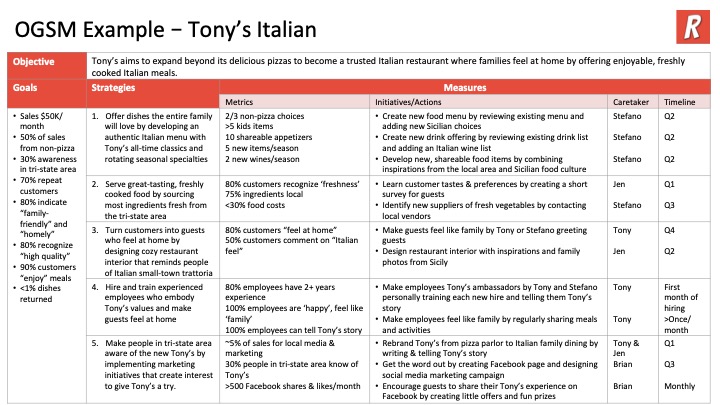
Tony’s Italian OGSM
Tony’s Italian is a fictional story about how Tony turned his pizza parlour into a family restaurant. The example shows how to apply OGSM to a small consumer business. Click here to read the full story of how Tony goes through the strategy process and captures his insights and strategic decisions in the OGSM. Or find the OGSM below.
Tony’s Italian OGSM Example
Florian’s Fasteners OGSM
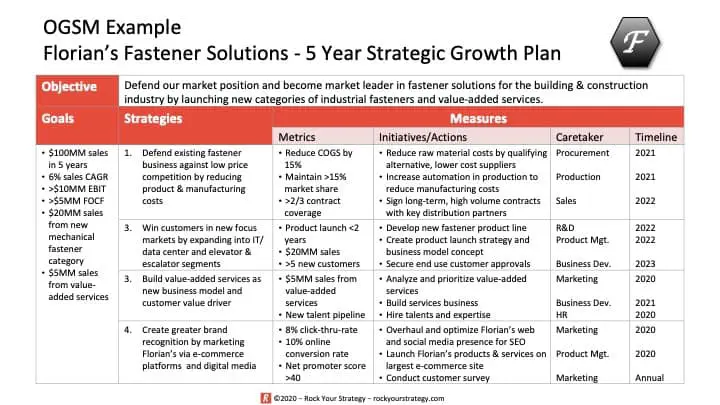
Florian’s Fasteners tells the fictional story of a small B2B business that turned around its fortunes after a strategic review. Click here to read Florian’s story or find the OGSM below.
Florian’s OGSM Example
Examples of OKR
For examples of the OKR methodology, I can really recommend the resources at www.whatmatters.com.
John Doerr, author of the excellent book “Measure What Matters”, and his team go into lots of details and practical examples.
Where can I find OGSM templates?
Here are templates of the OGSM to get you started. Click on the following links to download PDF copies of the simpler Microsoft PowerPoint template or the more sophisticated Microsoft Excel template.
OGSM Template in PowerPoint
OGSM Template for Microsoft Excel
If you’d like to learn more about how to use these templates to create your OGSM, check out this article.
And before you go, check out our jam-packed Resource page with more tools and templates to help you simplify your strategy and achieve excellent results. Rock on!
You have developed your strategy and are ready to implement. However to do so effectively, you want to make sure your team understands what your business strategy is all about and what is expected of them. Here are 12 effective ways to communicate your strategy to employees.
Team meeting
Townhall
Strategy conference
Virtual meeting / webinar
One-on-one meeting
Informal conversations
Video recording
Story / fairytale
Strategy handbook
Strategy board
Regular strategy newsletter
Use a one-page strategy framework
Great, that’s a handsome list. Now let’s dig deeper and learn more about how you can use these ways to get your message across. Before we do so, why is it so important to effectively communicate the strategy?
Importance of effective strategy communication
Your people are the engine behind your business. It’s the people that move your business forward. It’s the people that help you achieve your objectives and implement your strategy. It is therefore critical that your people understand the direction of the business and what is expected of them.
Unfortunately, the reality is that in many organizations the strategy is not clear.
According to a recent survey by Bridges Business Consultancy, a staggering 67% of strategies fail during implementation1. And the number 1 reason for failure is… (drum roll, please)… poor communication! A similar study conducted by the Economist Intelligence Unit found that communication surrounding strategic initiatives and communication of the overall strategy were among the top barriers for effective strategy implementation2.
Effective communication of a strategy is critical because there is a direct link between clarity of the strategy and its effective execution. This makes intuitive sense. When all rowers in a boat know in which direction to paddle, the boat is more likely to pick up speed and reach its destination.
Simply defined, the business strategy describes the set of choices the business makes to achieve its objective and goals. For the strategy to be effectively implemented, clarity about the vision, mission, and objectives of the business throughout the organization is essential.
So, here are 12 creative ways – in no particular order – to communicate your strategy to your employees to make sure that the people in your business know where the business is heading.
Team meeting
The team meeting is the classic approach to communicating important information such as the strategy of the business.
The team meeting is typically an in-person meeting of a group of people who know each other well and closely work with each other. Team meetings are typically held at regular intervals. Some teams meet daily, weekly or on a monthly basis.
Strategy discussion in team meeting
Team sizes can vary of course from a few people to a couple of dozen people. Regardless, team meetings are typically intimate settings with a level of trust established among team members. Team meetings are therefore good opportunities for strategy communication.
Depending on your team norms and culture, you may choose to present the strategy to the team or have a detailed discussion. The team setting is excellent however, because its setting allows for an intimate dialogue about the strategy, what it means for the business and what it means for your team.
Take as much time as you need for this discussion. Ensure that there is an opportunity to ask questions and clarify concerns. It must be the objective of the discussion to create clarity and understanding about the strategy. Conclude the team meeting when all questions are asked and everyone can state the strategy in their own words.
Consider using visual aids, props, stories or other means discussed in this article to make the strategy discussion in your team meeting as engaging and memorable as possible.
Town Hall Meetings
The town hall meeting is typically a communication session with a larger audience in which a group of people is consulted or informed on a topic of interest. According to Wikipedia, the town hall format originates from colonial era North America, when politicians communicated with their constituents on matters related to the community or new policies and regulations. The town hall format has meanwhile been popularized by politicians and business leaders around the globe.
Example of a small townhall meeting
The exact format, length, venue, and purpose of town hall meetings may vary. Town hall meetings are great for strategy communication because the business leader can directly address the entire company or a large group of employees. The format allows for interaction, debate, question & answer, and clarification.
The communication of the strategy during a town hall meeting could take the form of a presentation with subsequent Q&A session. The business leader or the senior leadership team can directly address the team and be available for questions and comments.
This way the organization can hear the strategy and its purpose directly from the most senior leaders instead of reading about it or hearing it cascaded through the hierarchy. This could greatly enhance the level of understanding of the strategy.
Strategy conference
The strategy conference is typically a high level meeting of the most senior members of an organization. The aim of a strategy conference is to communicate the strategy and also work out further details about its implementation. The purpose of a strategy conference is to involve its participants in the discussion and detailing of the strategy.
The strategy conference can be a powerful way of disseminating the strategy as it involves a large number of people in its creation and implementation. This creates buy-in and commitment. It also gives members of the organization the opportunity to help shape the strategy and with it the future of the business.
People participating in a strategy conference
Imagine the strategy conference to be a multi-day meeting at an offsite location. It may include formal presentations and speeches. It may also include workshops and break-out sessions.
The most effective strategy conferences have an overall theme or purpose and constitute a mix of sessions and formats.
The strategy conference should have a closing session in which the results of the conference are presented and discussed.
I have personally participated at several such strategy conferences on global, regional, and national levels. The conferences typically included 50-100 participants and covered longer-term strategic objectives and annual operating plans. The conferences I attended mixed formal speeches with informal discussions, casual encounters and team-building sessions.
Especially the latter part of informal and casual sessions were important in reaching the employees, setting the tone and making things fun and engaging. I can only recommend it!
Virtual meeting / webinar
A virtual meeting or webinar is similar to a town hall – except that it’s not held in person but online. The purpose is however the same. It’s a large group meeting to communicate the strategy directly from the leaders to the employees while providing a forum for questions and clarifications.
There are many online platforms nowadays that support such virtual meetings. There are for example, Microsoft Teams, Zoom, and Webex. All of these platforms allow for participants to dial in by computer or by phone and to share and view presentations.
Participating in a video conference
In addition, a technology I find particularly compelling to complement virtual meetings is Slido available on www.slido.com. Slido allows participants to ask their questions via a designated website or app. The questions can be collected, ranked and answered one-by-one in turn.
What’s particularly compelling on Slido is that participants have the choice to identify themselves or ask questions anonymously. In my experience the option of anonymity takes away some people’s barrier to raising questions. Slido also allows for polling and quizzing of participants and thereby creates a whole different meeting experience. Highly recommended!
One-on-one meetings
As the name suggests, one-on-one meetings are small, intimate sessions between two persons. Often less formal in nature, these are typical interactions between managers and employees or between peers.
Because of the intimate, private setting, one-on-ones can mark an effective occasion to provide in-depth information about the strategy, additional (potentially confidential) information or subject-matter specific information. It is also a good occasion to clarify specific questions or seek commitment from important individuals.
One-on-one meeting
I have often used one-on-one meetings to follow up on larger team communications and to address specific questions related to specific persons or topics. For example, I may follow up with a person who had a particular question in a town hall or I may clarify with the leader of a strategic initiative what exactly is expected of him or her.
In one-on-ones, I try to make sure that the other person is comfortable and feels free to raise any question or comment by establishing a trustful, relaxed atmosphere.
One word of caution: one-on-ones are not effective for strategy communication in the absence of an overall communication. Not only would it be inefficient to address a larger team or organization one by one. The team would also not have the benefit of hearing the same message, using the same words at the same time. So I’d use one-on-ones only in combination with one or multiple means of team communication.
Informal conversations
Informal conversations are casual encounters among two or more people outside of formal work settings. These can be joint meals, such as lunches or dinners, social events, or simply the proverbial watercooler or elevator chats.
The thing is that informal conversations typically take place among family members and friends or persons with a strong, trustful bond. The hallmark of an informal conversation is a high level of openness and vulnerability, frankness and candor. Because informal talks are less concerned with upkeeping of formality and professionalism, communication is often more emotional and direct. It is in these conversations that information is shared in its purest and often most honest form.
Informal gathering after work
The trust needed for informal conversations is of course not built in an instant. I do not walk up to a person and say “let’s have an informal conversation”. It is when the trust exists that an informal conversation can take place. In such cases, it can be a great additional means of transporting sensitive, emotional and impactful information.
More importantly however, informal conversations are important opportunities to listen, seek feedback and clarify concerns.
As a leader in the business, be open and available for formal and informal communications alike to fully reach the people in your team. Capture their thoughts and their feelings when speaking about strategy and the direction of the business.
Story / Fairytale
“Once upon a time…” Didn’t we just love story time as children?
Good stories make us feel good and take us on a journey to… dare I say… a land far, far away. Stories are emotional. They capture our imagination and are very memorable.
Harvard professor Marshall Ganz explains in his work on Public Narrative that stories can create meaning in ways that connect human emotions and thereby move people to action4. Stories communicate in live experiences and not in abstract terms and principles. This makes information personable, relatable, and memorable.
We remember things better when we hear them in story form, also because the chemical oxytocin is released in our bodies when we hear a good story. That is the same chemical which is released when we feel trust, love, and kindness. That’s why good stories make us feel good.
In business likewise, storytelling can be a very effective means of communication.
So, turn your strategy into a story about your business. Imagine what it will look and feel like when your business reaches its destination and achieves its objectives. Write the story down and tell it during meetings, town halls or chance encounters.
And with your story, capture your audience and move people to action.
Video recording
Turn the story about your business and about your strategy into a video or a mini movie!
In education, researchers have found that including visual content in the learning and teaching curriculum can help students better engage with the materials, increase retention by 29-42%, and develop higher order thinking skills3. Visual learning begins when graphs, images, and illustrations appear alongside words, numbers, and text.
Visual-spatial learning, as it is called, doesn’t stop after school. In worklife, visual learning is just as important to capture complex information and subject matter. And business strategy can be such a complex topic.
Videos are a great way to make complex information more approachable and understandable. Video gives the opportunity to explain and visually depict information and tell a story. Video is thereby a powerful way to communicate to create understanding.
Record your own strategy video
But use video to communicate your strategy? Absolutely! Video communication does not need to be expensive and does not need to be complex. From creating a simple doodle to filming a story about your strategy, there are fun ways to make video content engaging and understandable.
Be creative! You might even be able to recruit your colleagues to act out what it may look like to succeed with your strategy. Short video clips may be sufficient to communicate the key aspects of your strategy.
There’s one more benefit of video. Once the video exists, it can be used time and again to reinforce key messages as well.
So, I think you can tell that I am a fan of video content. There is a reason why YouTube is so successful after all.
Strategy handbook
In an age dominated by digital communication, such as emails, PowerPoints, podcasts, and tweets (and might I highlight that you are likely reading this on your desktop computer or mobile device), we hold less and less physical books in our hands.
However there is something to be said about the pleasures and the impact of print.
Granted, print is costly and bad for the environment. All too often printed brochures are handled once and then filed and forgotten – or worse, neglected and tossed.
There are benefits however to reading on paper. According to a recent article summarizing several studies5, the benefits of printed books are numerous.
Reading in print helps absorb more information
Print is easier on the eyes
Print helps remain focused and become less distracted
Print simply amplifies the joy of reading
Summarize your strategy in a printed booklet
So when communicating strategy, consider including a printed handbook as part of your communication package.
A strategy handbook could take the form of a colorful, printed booklet that summarizes in easy to understand terms the most important aspects of your vision, your mission, your objectives and strategic choices.
A strategy handbook could also include background information, market insights, external references or inspirations, and your story. Again, there are no boundaries to your creativity and what a strategy handbook could look like. Make it visually appealing and a strong representation of your business and what you are looking to achieve.
Strategy board
Remember those good old pin boards in your office? Yes, those boards with pins that gave Pinterest its name. They seem from a different day and age, don’t they? Colorful pin boards in places where people come together can however be an attractive means to capture attention and communicate information.
What might a strategy board then look like?
Imagine a white board, black board or pin board in the cafeteria, pantry or break room of your workplace. Imagine this board holding information about your strategy, the direction of the business, its objectives, progress, and achievements. Not so hard to imagine…
Pinboard as communicator of priorities
Such a board could however be a very engaging communicator when frequently updated. Studies have shown that we tend to overlook information that is static and blends into our day-to-day routines. We notice however when things change in areas that are common and known to us. This is where a strategy board can be appealing.
Besides holding constant information such as the vision or mission statements of the business that tend to placate the walls of offices these days, a strategy board would enable updating and keeping employees current on latest developments in the business.
Again, be creative. Use color. Make content attractive. You may consider depicting the strategy in a visual way and keep updating and adding information as you implement and make progress.
And as a bonus idea, allow people to update the board with their contributions, achievements and ideas. That keeps the information current and engaging and makes people come back to check for updates.
Regular strategy newsletter
Although I wouldn’t recommend email as the primary means to communicate your strategy, a regular strategy newsletter would be an exception.
A regular monthly or quarterly email from the business leader highlighting the progress made on your journey to implement your strategy and deliver results could actually be quite powerful.
Such a newsletter could be an opportunity to reiterate what is important to the business and why it’s important. It could highlight specific achievements and give credit to teams and celebrate successes.
As often stated, implementing a strategy is a marathon and not a sprint. It is not uncommon though that a new strategy is presented with great fanfare and shortly afterwards the business returns to its daily routines and urgencies.
In that context a regular update straight from the business leader keeps the strategy implementation in perspective.
If you are considering to launch a regular newsletter, consider to include the following:
An overview of the strategic priorities
A dashboard highlighting key figures and progress with strategy implementation
A reminder why you are in business: I.e. your purpose, vision and mission
A visualization of the destination of your business
Highlights and achievements from the time period since the previous newsletter
Lowlights or challenges from the previous period and how they are being addressed
Outlook and priorities for the months ahead
A call to action: e.g. information or an illustration how colleagues can engage with the strategy and contribute to its achievement
A few candid, personal words from the business leader such as words of gratitude or a personal experience related to the strategy.
A strategy newsletter does not need to be long or a lot of work to create. The key is to regularly check-in on progress, engage with the team, and keep the strategy and its implementation top of mind.
After all, everything you do, should be tied directly or indirectly to the strategy and helping the company achieve its objectives.
Use a one-page strategy framework
In any and all of your strategy communication, simplify key aspects of your strategy into a concise and easy-to-understand summary. In my experience, nothing is more confusing and demotivating than a 100-page Powerpoint deck that goes into all the details.
On the contrary, a clean, concise overview that introduces key aspects of your strategy such as where you are headed and how you are going to get there creates clarity and engagement.
One strategy framework that can help to depict the entire strategy on a single page is the OGSM.
OGSM stands for Objective, Goals, Strategies, and Measures. It is a one-page business plan that shows what the business aims to achieve and how it’s going to achieve it.
OGSM Example: Tony’s Italian
The OGSM framework is both a methodology to create a strategic plan and also an effective tool to communicate the strategy and drive implementation. In short, the OGSM is a great way to simplify your strategy and deliver results.
Find tools & templates for OGSM and your strategic planning process here.
OGSM Examples
Find OGSM examples and inspirations for your own journey here.
Consider including the one-page OGSM framework in your communication package or hanging it on your strategy board.
Conclusion
These are our 12 creative ways to enhance communication of your strategy to your employees. A strategy well communicated is a strategy well understood. And with greater clarity and understanding, the organization has a greater chance to succeed at implementing the strategy and delivering results.
As I have learned during my many years in business, when it comes to strategy, you cannot over-communicate.
Now over to you. What additional creative ideas do you have to communicate your strategy? Let us know or drop a comment below. We’d love to hear from you.
Many Fortune 500 companies and many small businesses have successfully implemented the OGSM methodology to support their strategic process. Why? Because there are many benefits to using OGSM to simplify strategy and deliver results. Here are 13 ways the OGSM methodology can improve your strategy too.
→ Want the complete OGSM reference before diving in? The Complete OGSM Framework Guide covers all four components in depth, real-world examples by industry, a comparison to OKRs and the Balanced Scorecard, and step-by-step build instructions.
1. Simplicity
The OGSM is simple. The methodology uses a simple framework, easy language and a one-page overview to break down a sophisticated process into an approachable, simple format. This makes it easy to understand and easy to adopt.
2. Clarity
The OGSM makes strategy clear and transparent. As the OGSM depicts the strategy on a single page, there is no need to read a long strategy paper or a thick powerpoint deck to understand what the business or the organization is looking to achieve and how it will get there. The objectives, goals, strategies and measures can all be found at first glance. Clarity about strategic objectives is critical if you want to achieve them.
3. Quick to learn
The OGSM methodology is easily understood and quick to learn. You do not need to hire expensive consultants first to explain to your executive team or your project team how to develop a strategy or deploy the tool. The format and terminology are simple and basic concepts of the methodology can be learned quickly in order to be deployed effectively. (Besides, you have Rock Your Strategy to help you through the process ;-))
4. Easy to communicate
The OGSM can be easily communicated. Key to effective communication is connecting with your target audience to help them understand the key content of your message. Because the OGSM is simple, easy to understand and makes your strategy clear and transparent, it is a wonderful way to communicate your strategy.
5. Versatility
The OGSM is versatile. It can be used for long-term strategic plans with time horizons of 3-5 years or longer. It can be applied to annual operating plans or budget plans. It can be deployed for large or small-scale projects etc. etc. In essence, anytime you have an intended outcome and need to plan how to achieve it, OGSM could be your tool.
I have personally applied OGSM both for long-term strategic plans and for annual operating plans and I have seen it used to manage a project. All worked very well.
6. Engagement
The OGSM creates engagement. By definition, engagement is when people pledge their support, when they feel a legal or moral obligation to do something. Involving the team, receiving their input and obtaining their buy-in is important. But showing in the OGSM how the team can support implementing the strategy and achieving results creates true commitment.
7. Focus
The OGSM creates focus. Strategy is all about making choices and the process and the OGSM format force making choices. Choices which initiatives to prioritize and how to allocate resources to achieve your objectives and goals. I have found that choosing 3-5 strategies is optimal in order not to put all your eggs in one basket while directing your attention and capabilities towards those activities where you can have the biggest impact.
8. Alignment
The OGSM aligns all functions and stakeholders towards a common objective and goals and shows how each can contribute towards achieving them. This is important to ensure that all parts of an organization pull in the same direction. Nothing could be worse for an organization than to create conflicting priorities or diverging interests which lead to inefficient allocation of resources or outright internal competition. While internal competition can be good in some situations. It is poison if there are conflicting views about what the strategic priorities of the business are.
9. Cascading
The OGSM makes cascading strategies throughout the organization easier and more straightforward. With OGSM you can cascade the strategy vertically from e.g. company level to division level to team level. You can also easily cascade horizontally from business unit or product line to various organizational functions, such as marketing, sales, operations, HR etc.
10. Teamwork
The OGSM methodology encourages teamwork and works best when discussed in the team. Bringing your team together to discuss your strategy, analyze the current situation, debate strategic choices, and decide resource allocation ensures that the strategy is connected to the realities of the business and creates understanding and buy-in.
11. Execution
The OGSM format connects WHAT you aim to achieve, the objective and goals, with HOW you are going to achieve it, the strategies and measures. This builds the execution plan into the strategic plan. That means the organization knows how to achieve its goals and can focus on implementing the initiatives.
12. Review
The OGSM methodology lends itself very well for regular monthly and quarterly reviews to make sure you stay on track to achieving your targets. While the OGSM is built top down, the review is conducted bottom up beginning with the measures and the strategies. Regular check-ins keep you on target and allow timely course corrections if needed.
13. Results
The OGSM approach has proven time and again that it helps people deliver results. A plan without implementation is simply that – a plan. The OGSM creates transparency about what is important and encourages taking action to turn plan into reality. Regular reviews keep the team engaged and focused. Timely course-corrections keep the team on track and ultimately lead to results.
Conclusion
OGSM stands for objective, goals, strategies, and measures. It is a simple approach to strategic planning for longer term and shorter term plans alike. It’s a one-page format that describes what the business aims to achieve and how it is going to achieve it.
If you would like to learn more about the OGSM methodology, please click here. You may also browse our examples and tools & templates. If you have any questions, please don’t hesitate to drop us a note. We’d love to hear from you.
Templates
Find tools & templates for OGSM and your strategic planning process here.
OGSM Examples
Find OGSM examples and inspirations for your own journey here.
See OGSM in Action: Real-World Examples by Industry
The 13 reasons above explain why OGSM works. The best way to see those benefits in practice is to look at how different types of organizations use the framework to build focused strategies and drive real results. We’ve developed detailed examples across four industries that represent the most common strategic planning challenges today — from high-growth SaaS companies and AI startups to DTC brands and non-profits.
OGSM Example: B2B SaaS — how a pipeline analytics company aligned its leadership team around a clear path from $2M to $8M ARR, including PLG onboarding, enterprise customer success, and upmarket expansion strategies
OGSM Example: AI Startup — how a Series A document intelligence company used OGSM to make the transition from research-led organisation to a business with a repeatable sales motion and growing retention
OGSM Example: E-commerce / DTC Brand — how a sustainable home goods company built a profitable growth strategy by reducing paid acquisition dependence and investing in owned audience channels
OGSM Example: Non-Profit — how an education foundation aligned programmes, funding diversification, and impact measurement into one coherent three-year strategy
OGSM Example: Tony’s Pizza — the classic OGSM case study that illustrates all four components in a simple, memorable context
Convinced by these 13 reasons? The fastest way to start applying OGSM in your business is with a ready-made template. Download a pre-formatted, fully customizable OGSM Template for PowerPoint or OGSM Template for Excel from the Rock Your Strategy shop — and see for yourself why so many successful companies rely on OGSM to simplify strategy and deliver results.
I recently wrote about monthly OGSM reviews which are important, regular check-ins to make sure you are on track with executing your business plan. In addition, quarterly in-depth reviews are an effective complement to monthly reviews. But what’s the difference and why have them?
While monthly OGSM reviews are brief updates about execution progress, quarterly OGSM reviews are more thorough examinations of strategies and measures to confirm whether the business is on track to achieving its overall objective and goals.
Executing your strategy should be right among your top priorities as the business leader. And regular reviews are critical to following through. Here’s how you can go about it most effectively.
Quarterly OGSM Reviews
When using the OGSM methodology for your annual operating plan (AOP) or your 3-5 year strategy, it is important to conduct in-depth quarterly reviews to keep on track with execution.
The purpose of the quarterly review is to get an update on the progress of each strategic initiative on your business plan. This means that each Measure and Strategy are examined against their targets and that progress is made towards Objective and Goals as expected.
For the quarterly OGSM review, I therefore usually schedule a 2-3 hour session in the first month of the following quarter. A timeslot of 2-3 hours allows enough time to dive into detail for each initiative while not wasting valuable time. If you are overall on track, 2 hours might suffice. If you need more time for detailed reviews, go with 3 hours, maximum 4 hours.
During the meeting, each initiative owner provides an update on progress, milestones, challenges, and next steps. The initiative owners should review both the metrics and the actions taken. This is best prepared up front and shared as pre-read ahead of time. I am providing a template below that might be useful for this.
Begin with an overview of the entire OGSM and overall progress of the business against its objectives. Then go bottom up strategy by strategy to review first those initiatives that are behind expectations or require attention. Then go to those initiatives that are on track.
Pay particular attention to those initiatives that are facing challenges, have key milestones coming up, or require decisions or support from the leadership team.
For each initiative, discuss countermeasures and actions as appropriate. Agree on the follow up required. As during the monthly review, all actions are recorded with caretakers and timelines.
After reviewing each initiative, confirm that the overall path chosen is still the right one. The OGSM should never be carved in stone and the quarterly review is the time to revisit whether the chosen initiatives are still the right ones to move the business towards its overall objective and goals.
Consider to stop those initiatives that are not contributing to target achievement. Consider adding initiatives needed to get the business back on track. As during the OGSM creation, consider carefully the resources needed for new and old initiatives. Make sure there are clear caretakers, timelines and actions defined.
Finish the quarterly review meeting with a round of feedback and a review of the recorded action items.
Planning Ahead
In the monthly review article I suggested to plan out the 12 monthly reviews ahead of time. Go ahead and send out 12 recurring calendar invites directly in the beginning of the year. Thereby it’s in the calendar and everyone can plan ahead. It becomes a monthly staple.
Once a quarter, designate one of the monthly reviews as the larger quarterly review. I like to go for the first month of the following quarter, i.e. January, April, July, October. The reason is that quarterly figures are available and evenly spaced out, you have a chance for a deeper review every 3 months.
Extend the recurring invitations of those quarterly review dates from 60min to 2-3 hours as suggested above.
Preparation for the quarterly review
The best review meetings are those that are well prepared. Go into the quarterly update meeting with an updated OGSM document and a one-page update for each initiative. This requires that the OGSM document is updated by the caretaker prior to the meeting and that each initiative owner prepares a one-page update as well.
OGSM Document
On the OGSM document there are 2 columns that need to be updated. This includes the status field and a brief comment about target achievement incl. proposed actions or countermeasures (as necessary). See the following image.
For the status field, I typically use the following color-coded setting which has served me well:
Further explanation about each of these status colors as follows:
Color
Status
Description
Light Green (LG)
On Track
Item is in progress and on track to achieving it’s targets.
Dark Green (DG)
Completed
Item is done and targets are met.
Yellow (Y)
Needs Attention
Item needs attention by the organization or its senior team in order to stay on track and not fall behind.
Red (R)
At Risk
Item is at risk of missing its targets and needs urgent attention and action.
Blue (B)
On Hold
Item has been placed on hold, postponed or deprioritized.
Regarding the color-coding, I always emphasize that the status assessments are meant to be forward-looking and action-oriented and not punitive. A red color is not bad by itself. It does not mean that someone is getting fired. Encourage your team to use ‘yellow’ and ‘red’ statuses to signal that urgent action is needed.
Initiative One-Pagers
For each of the strategic initiatives, ask the initiative owners to prepare a one-page update about progress. This should include progress, milestones, challenges, and next steps. The following template might be useful.
You can find this project report template and other useful tools on our Tools & Templates page.
Ask the initiative owners to share these up front as pre-read. In my experience, review meetings are significantly more efficient and productive when there are no surprises in the meeting. Providing a pre-read up front allows everyone to be prepared and to direct the attention during the meeting to where it is most needed.
One comment about these one-pagers: preparing a one-page update sounds like a lot of administrative work. And yes, it is. It is up to you how you want to manage this. If you feel it’s over the top, then skip the one-pagers and concentrate on the OGSM document. I can however say from my own experience that the regular updating of a one-page initiative update gives additional legitimization and scrutiny to the initiative. Having led both OGSM reviews as business leader and OGSM initiatives as a project leader, I much appreciated the one-pagers as a situational snapshot similar to the balance sheet in an annual report.
What does the agenda of a quarterly review meeting look like?
The agenda of a quarterly review meeting looks similar in structure to the monthly review, however offers more time to go into detail for each of the strategies and measures. As noted above, a 2-3 hour meeting has served me well, which includes the senior business leaders and the owners of the strategies and measures.
This is what the agenda of a quarterly OGSM review meeting might look like.
Time
Topic
Caretaker
5 min
Welcome & opening statements
Business Leader
15 min
Review Financials & key Performance Indicators
Business Leader or OGSM Caretaker/facilitator
15 min
Review actions from previous OGSM review
OGSM caretaker/facilitator
90 min
Review strategies and measures Each initiative owner provides an update on progress, milestones, challenges, and next steps. Review initiatives ‘at risk’ and ‘need attention’ and discuss countermeasuresReview ‘on track’ initiatives and next stepsCheck for decisions, resource needs
Initiative owners (~10 min each)
15 min
Review progress towards overall objective and goals based on initiative updates
OGSM Caretaker/facilitator
15 min
Confirm actions from this OGSM review
Business Leader or OGSM Caretaker/facilitator
10 min
Feedback
Business Leader or OGSM Caretaker/facilitator
Meeting adjourned
Note that I added a 10min section on feedback to the end of the agenda. The purpose of this feedback session is to jointly assess the effectiveness of the review meeting and the progress of the initiatives. It’s meant to be brief and candid. Go around the room in round-robin style and give everyone a chance to speak. This has proven very useful in my experience to vastly improve the review meetings and keep the team engaged. Sometimes the real concerns only came out at the very end….
Feel free to copy this out and into the invitations of your quarterly OGSM review meetings. Or you can find a PDF copy of this meeting agenda and other useful on our Tools & Templates page here.
What happens after the Quarterly OGSM Review?
Once you have finished the quarterly review, send out the detailed meeting minutes to all participants and important stakeholders. Include the updated OGSM, any additional documents such as the initiative one-pagers, and most importantly the decisions and action items.
The initiative owners are then asked to implement their actions as agreed during the meeting. Follow up on the actions and the status of the initiatives in the next monthly review.
Tip: it has really benefited the businesses I have been a part of when the business leader follows up with initiative owners also “offline”. These may be informal check-ins or watercooler chats. These casual encounters are helpful to keep engaged, get a feel for progress and sometimes get more valuable information than during a formal meeting.
What’s the difference between Monthly & Quarterly OGSM Reviews?
I like to make a clear distinction between more thorough quarterly OGSM reviews and more frequent monthly OGSM reviews.
As described above, the purpose of the quarterly OGSM review is a more in-depth review of the OGSM to confirm whether the business is on track to achieving its overall objective and goals.
The purpose of the monthly OGSM review on the other hand is a more regular check-in to track execution and take corrective actions for those initiatives which are ‘at risk’ or ‘need attention’. The discussion is brief, candid and solution-oriented. The monthly OGSM review only takes about 60 minutes.
As during the quarterly review, all actions are recorded with caretakers and timelines.
Why conduct reviews at all?
Fair question! Why do we conduct reviews? And why so many? The whole point of making a plan is to know where you are going and to align your company’s resources behind the overall objective and goals of the business. So the review aims to establish that you are going in the right direction and that you are on track to achieving your targets!
In another article about the 11 secrets of strategy execution I have recently quoted a study that found that ⅔ of all strategies fail during implementation. That’s a staggering finding and a massive waste of resources.
Key reasons why strategies fail according to the quoted study are that the strategies aren’t clear, that they are ill communicated, that senior management is not behind them, and that execution is not part of the company culture.
Senior management led reviews of strategy execution are therefore critical for the following reasons:
OGSM reviews are an opportunity to regularly reinforce priorities and achieve clarity about the direction of the business
Senior leaders demonstrate that strategy execution is a priority and that they personally attend to execution
Regular reviews encourage taking action and following through on plans
Regular reviews offer the opportunity to celebrate wins, give exposure to successful projects, and provide support and encouragement to initiatives falling behind.
In my experience these are critical reasons for conducting regular monthly check-ins and in-depth quarterly reviews and vastly improve your odds at achieving your targets and delivering results.
How to create an OGSM for your business?
We have now been speaking about implementing your OGSM and keeping on track with your execution via quarterly review meetings. But how do you actually create an OGSM in the first place?
The purpose of the quarterly OGSM review is to ensure that the implementation of your plan is on track.
Schedule a 2-3 hour session (based on progress) and review each initiative and strategy. Each initiative owner provides an update on progress, milestones, challenges, and next steps. This should be prepared ahead of time.
The review includes an assessment of each strategy to confirm that the path chosen is still the right one to move the business towards its overall objectives.
If required, countermeasures are discussed and agreed on. All actions are recorded with caretakers and timelines.
What experiences have you made with your OGSM review? We’d be happy to learn about your best practices. Feel free to leave us a comment below. We’d love to hear from you.