
Non-profit strategy is harder than it looks. The mission is often clear. The activities are often many. The funding is often restricted to specific programmes. And the pressure to demonstrate impact to donors, foundations, and government partners creates a reporting burden that can crowd out strategic thinking entirely.
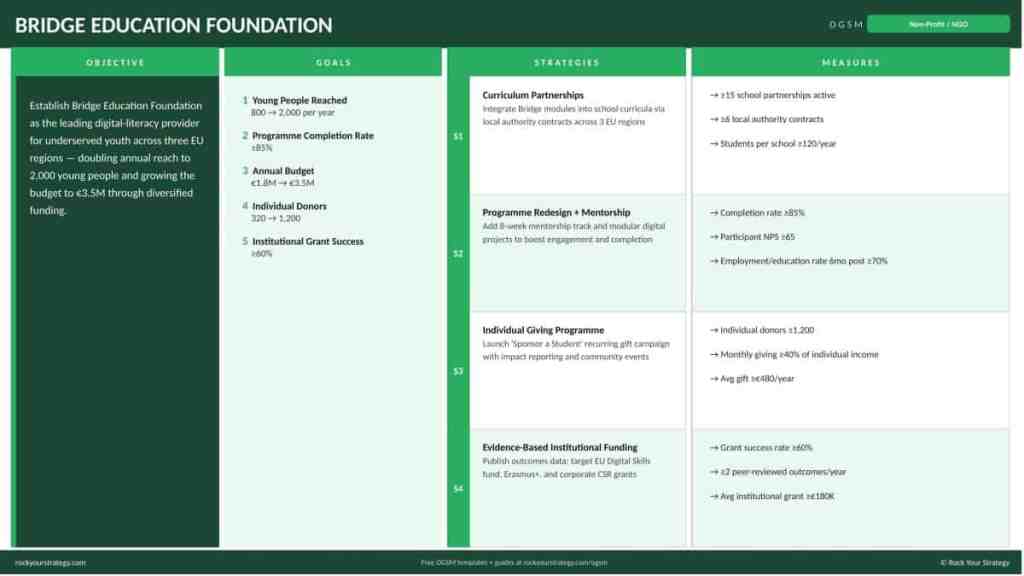
The OGSM framework is well-suited to non-profit contexts precisely because it creates alignment across programmes, funding sources, and staff — on a single page that everyone can read and understand. This example shows how a fictional education non-profit — the Bridge Education Foundation, an NGO focused on digital literacy for underserved youth — used the OGSM to align their leadership team and build a coherent three-year strategy. The organisation, numbers, and details are illustrative. The strategic challenges are real.
If you’re new to the OGSM framework, start with the Complete OGSM Framework Guide. If you’re ready to build, download our OGSM templates for PowerPoint and Excel.
About Bridge Education Foundation
The Bridge Education Foundation delivers digital literacy programmes to young people aged 12–18 in under-resourced secondary schools and community centres across three cities. Their flagship programme — Code Bridge — is a 12-week after-school coding and digital skills curriculum that has reached 2,400 young people since its founding. They also run a summer camp and a mentorship programme connecting graduates with working professionals in tech.
At the time of this OGSM, Bridge has an annual budget of €1.8M, a team of 14 (6 programme staff, 4 operations, 2 fundraising, 2 leadership), and funding from three corporate partners, two government grants, and a base of 340 individual donors. The core programme is strong — participant outcomes are well above sector benchmarks — but the organisation is over-reliant on two funding relationships and has not grown its reach in three years. The board wants a strategy that addresses both sustainability and scale.
The Bridge Education Foundation OGSM
Objective
Establish Bridge Education Foundation as a leading provider of digital literacy education for underserved youth by deepening programme impact, diversifying our funding base, and scaling our reach to 6,000 young people by 2028.
Goals
Bridge’s goals translate the three-year objective into measurable outcomes. They cover both mission impact (reach and programme quality) and organisational sustainability (funding diversification and financial resilience).
| Goal | Current | Target (3-year) |
|---|---|---|
| Young people reached per year | 800 | 2,000 |
| Programme completion rate | 74% | ≥85% |
| Annual budget | €1.8M | €3.5M |
| Largest funder as % of total income | 38% | ≤20% |
| Individual donor base | 340 | ≥1,200 |
Strategies
Strategies define where Bridge will concentrate its energy and resources over the three-year period. Each reflects a conscious choice, written as a “what-by-how” statement.
Strategy 1: Scale programme reach by partnering with 8 additional schools to deliver Code Bridge as part of the formal curriculum rather than only as after-school provision
After-school programming reaches motivated young people but misses many who can’t stay after school due to family commitments, transport, or part-time work. Embedding Code Bridge into curriculum time with partner schools — as an elective, a PSHE module, or a dedicated digital skills period — dramatically increases reach without proportionally increasing staff cost. Bridge will target schools where leadership already prioritises digital inclusion.
Strategy 2: Improve programme completion and outcomes by redesigning Code Bridge to include structured mentorship from week 4, based on what the data shows drives completion
Bridge’s data shows that participants who connect with a mentor in the first four weeks complete the programme at 91% vs. 61% for those who don’t. Currently, mentorship is introduced at week 8 and is inconsistently assigned. Moving structured mentor matching to week 4 and making it systematic — rather than dependent on coordinator capacity — will significantly improve the completion goal.
Strategy 3: Diversify the funding base by growing individual and community giving to represent ≥25% of income through a structured major donor programme and a public annual campaign
Bridge’s current over-reliance on two funders creates existential risk. One funder is an EU-funded programme that may not renew post-2026. Individual giving — currently at 12% of income — is more resilient, unrestricted, and often unlocks matched funding from corporate partners. Bridge will build a major donor programme targeting 20 donors at the €5K–€25K level and run an annual public campaign (“Bridge the Gap”) to grow the broad donor base.
Strategy 4: Build an evidence base that unlocks institutional funding by publishing annual impact data to a recognised social impact standard and submitting for two major foundation grants per year
Major foundations and government funders increasingly require evidence to a recognised standard (SROI, Theory of Change, third-party evaluation) before making significant investments. Bridge has strong outcome data but has never packaged it systematically for external reporting. Publishing an annual impact report to a recognised standard — and using it as the centrepiece of foundation grant applications — will unlock a class of funding that is currently inaccessible.
Measures
Measures connect each strategy to the metrics and actions that will make it real. For a non-profit, measures need to cover both programme delivery and organisational development activities.
| Strategy | Key Metrics | Actions |
|---|---|---|
| Curriculum partnerships | 8 school partnerships signed; 2,000 young people reached p/a by year 3; Cost per participant reduced ≤€250 | Map 20 target schools by digital inclusion priority (Q1); Develop school partnership proposal and MOU (Q1); Sign first 3 school partnerships (Q1–Q2) |
| Programme redesign | Completion rate ≥85%; Mentor assigned by week 4 for ≥90% of participants; Mentor satisfaction score ≥4.2/5 | Audit mentor matching process and identify bottlenecks (Q1); Redesign mentor onboarding and matching workflow (Q2); Pilot new model with next cohort (Q2–Q3) |
| Individual giving | Individual giving ≥25% of income; Major donor base of 20 at €5K+; Annual campaign raises ≥€120K | Hire part-time fundraising coordinator (Q1); Identify and cultivate 30 major donor prospects (Q1–Q2); Launch Bridge the Gap annual campaign (Q3) |
| Evidence & funding | Annual impact report published; 2 major foundation applications submitted p/a; Foundation income ≥€600K by year 3 | Commission Theory of Change refresh (Q1); Publish Year 1 impact report to SROI standard (Q2); Submit first two foundation applications (Q3) |
What Makes This OGSM Work
The goals are honest about the dual challenge. It would be easy for Bridge to set only mission goals (reach 6,000 young people) or only financial goals (reach €3.5M budget). The OGSM forces both onto the same page — including the uncomfortable funding concentration goal. You can’t build a three-year strategy without acknowledging the existential risk in the current funding model.
Strategy 2 is evidence-led. Rather than assuming that “better mentorship” is the answer, Bridge’s data specifically shows that early mentor assignment (week 4 vs. week 8) is the variable that drives completion. The strategy is specific because the evidence is specific. This is what good strategy looks like: not a general direction, but a precise intervention based on what the data tells you.
The measures distinguish between metrics and actions. Many non-profit strategies set impact targets but don’t name the operational actions that will get there. Bridge’s OGSM links each strategy to both numbers (key metrics) and specific actions with timelines. That distinction is what turns a strategy into a workplan.
Adapting OGSM for Non-Profit Contexts
The OGSM works for non-profits with a few adaptations worth noting.
The Objective should lead with mission, not operations. For a non-profit, the objective should answer the question: “What change are we trying to create in the world, and how?” Bridge’s objective names both the mission (digital literacy for underserved youth) and the strategic mechanisms (deepening impact, diversifying funding, scaling reach). That combination keeps the organisation focused on mission while being honest about the organisational development needed to achieve it.
Goals should include both impact and sustainability metrics. A non-profit that tracks only programme reach will tend to under-invest in funding diversification. One that tracks only financial metrics will drift toward mission in name only. Both dimensions need to be in the goals for the strategy to be coherent.
Be explicit about funding in the strategies. Many non-profit strategic plans treat fundraising as a support function rather than a strategic priority. Bridge’s OGSM includes two explicit fundraising strategies — individual giving diversification and evidence-based institutional funding — because without those, the programme strategies have no financial foundation.
Build Your Own OGSM
Use our pre-formatted OGSM templates to build your own one-page strategy. Available for Microsoft PowerPoint (for board presentations and funder reporting) and Microsoft Excel (for building, tracking, and updating your plan). Both are fully editable and immediately downloadable.
Browse OGSM templates in the shop →
More OGSM Examples
See how the OGSM framework applies across different business contexts:
- OGSM Example: B2B SaaS — pipeline analytics company scaling from $2M to $8M ARR
- OGSM Example: AI Startup — Series A company navigating from research to revenue
- OGSM Example: E-commerce / DTC Brand — sustainable home goods company scaling past $5M revenue
- OGSM Example: Tony’s Pizza — the classic OGSM case study
Questions or comments? Drop them below, or sign up to our free newsletter for practical strategy tips. Rock on!
Leave a Comment