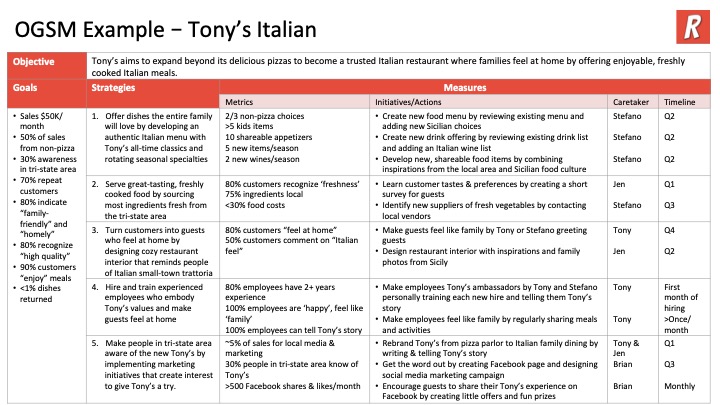
There’s a version of OGSM that works before product-market fit — and it fits on a whiteboard.
Most strategic frameworks were built for organisations that already know what they’re doing. OGSM is no exception — it was designed for Procter & Gamble, not for a two-person team pivoting every 90 days. But that doesn’t mean it’s useless before you hit product-market fit. It means you have to strip it back.
This post walks through what pre-PMF OGSM looks like in practice, what to cut, and when you should forget OGSM entirely.
Can OGSM Work Before You Have Product-Market Fit?
Yes — with significant caveats.
OGSM’s strength is alignment. It forces a team to agree on one Objective, a small number of Goals that define what success looks like, a handful of Strategies that describe how you’ll get there, and Measures that tell you whether your Strategies are working.
At the pre-PMF stage, the alignment problem is real. Co-founders argue about whether to prioritise the enterprise deal or the self-serve funnel. The first engineer builds for scale while the founders are still testing whether anyone wants the product. A one-page strategic document can cut through that noise faster than any amount of Slack discussion.
But here’s where it gets complicated. In a mature organisation, every element of an OGSM is grounded in data — historical performance, market research, validated positioning. Pre-PMF, you don’t have that. Your Objective, Goals, and Strategies are all hypotheses. Nothing is validated. The market may tell you in month three that your core assumption was wrong, and you’ll need to rewrite the whole thing.
That’s fine. The OGSM is not a contract — it’s a shared bet. The value is the alignment it creates now, not the accuracy it guarantees later. But to get that value without the overhead, your pre-PMF OGSM needs to feel less like a three-year plan and more like a focused hypothesis for the next six months. Horizon matters enormously here. Cut it to 90–180 days maximum and commit to reviewing it at the end of that window.
What Does a Pre-PMF OGSM Actually Look Like?
Here’s a worked example for a pre-revenue B2B SaaS startup building a compliance automation tool for SMEs.
Objective: Become the compliance automation tool that professional services SMEs trust to manage their audit trails.
Goals:
Achieve 10 paying customers (minimum £99/month) by end of month five
Reach NPS > 50 among pilot users after 60 days of use
Strategies:
Direct outreach to compliance managers in legal and accounting firms via founder-led LinkedIn outreach — 20 targeted messages per founder per week, no automation
Ship fortnightly based on pilot feedback — biweekly releases tied directly to the highest-friction moments identified in customer interviews
Run a 30-day free pilot with white-glove onboarding — reduce time-to-value so pilots convert before fatigue sets in
Measures:
Outreach response rate (target: ≥15%)
Pilot-to-paid conversion rate (target: ≥40%)
Weekly active users among pilot cohort (target: ≥70%)
Notice what this OGSM is doing — and what it isn’t.
The Objective is qualitative and directional. It describes the position you want to own in your market, not a number you want to hit by a date. That logic belongs in Goals. Goals are where the measurable commitments live — 10 customers, NPS above 50. They tell you whether you’re on track to reach the Objective.
Each Strategy is a real bet: a specific channel, a specific cadence, a specific go-to-market mechanism. There’s no hedging. If you chose LinkedIn outreach, you chose it over cold email, paid ads, and inbound SEO. That trade-off is the strategy. If every option still looks equally valid, you haven’t made a decision yet.
The Measures are leading indicators, not lagging ones. Outreach response rate tells you whether your messaging is resonating before you know whether it converts. Pilot-to-paid conversion tells you whether the product earns its price before you’ve closed enough deals to know if the model works. That’s the point — Measures should give you signal early enough to change course.
That’s it. One Objective. Two Goals. Three Strategies. A handful of Measures. It fits on one page. It could fit on a whiteboard. Nothing here requires a planning retreat or a strategy consultant — just a shared answer to the question: what are we actually trying to prove, and how?
What Should You Strip Out of a Pre-PMF OGSM?
Cascading Measures. In a full OGSM implementation, every Strategy has its own Measure set, and you may cascade further down into team or function-level Measures. Skip this entirely. You don’t have enough stable KPIs yet, and you’ll spend more time debating which metric belongs to which Strategy than you will running experiments. At this stage, pick three to five Measures that collectively tell you whether the Objective is on track — and leave it there. (For reference on what strong Measures look like at a later stage, see 7 OGSM Mistakes That Kill Your Strategy — the most common one is Measures that are outputs, not leading indicators.)
More than three Strategies. If you have five or six Strategies pre-PMF, you’re either hedging or you haven’t made a real bet yet. Three Strategies is a hard cap. Preferably two. Each Strategy should represent a real trade-off — something you’re choosing to do instead of something else. If every option looks equally valid, you haven’t done the hard prioritisation work. Pick the bets with the most signal-per-effort and cut the rest.
More than three Goals. Your Goals define what success looks like. Two to three Goals forces you to get specific about what actually matters in the next 90–180 days. More than that and you’re writing a wish list, not a strategy. If you have five Goals and they’re all “critical,” none of them are. Ruthlessly narrow it down to the two outcomes that would genuinely change what you do next.
Long time horizons. Don’t write a three-year OGSM at the pre-PMF stage. You don’t have the data to justify it, and it will be out of date before the ink is dry. Stick to 90–180 days. Review it at the end of that period. If your hypothesis has changed — and it probably will — update your Objective and reset.
How Do You Build Your First Pre-PMF OGSM?
You don’t need a facilitated off-site. You need a half-day session with your co-founders and a shared document. Here’s a simple sequence that works.
Start with the Objective. Before anything else, spend 30–45 minutes on the Objective alone. Write it individually, then compare. The Objective should describe the strategic position you’re trying to own — qualitative, directional, no dates. If you and your co-founder write different Objectives, that’s the most important conversation you’ll have all quarter. Don’t paper over it by merging both into a long sentence. Decide.
Draft the Goals together. Once the Objective is agreed, Goals follow relatively quickly. Goals answer: what does success look like in numbers, by when? Aim for two Goals maximum at this stage. If you find yourself wanting a third, ask whether it’s really a Measure in disguise.
Challenge every Strategy. For each proposed Strategy, ask: what is this instead of? If you can’t answer that, it’s not a Strategy — it’s a preference. A genuine Strategy has an opportunity cost. Write the alternative you rejected next to each Strategy you kept, and make sure the team understands why you chose this one.
Set your Measures last. Measures are often written first because they feel concrete and comfortable. Write them last. Start from your Strategies and ask: what would tell us, within 30 days, whether this Strategy is working? The answer to that question is your Measure. If you can’t answer it, your Strategy isn’t specific enough yet.
The whole session should take three to four hours maximum. If it’s taking longer, you’re probably arguing about the Objective — which means you skipped the most important step.
What If You Don’t Know Your Objective Yet?
This is the real test.
OGSM’s entire structure hangs on the Objective. Everything else — Goals, Strategies, Measures — is in service of that one sentence. If you can’t write a clear Objective that your co-founders agree on, you’re not ready for OGSM yet.
And that’s not a failure. It’s useful information.
If you and your co-founder spend 45 minutes trying to write the Objective and can’t agree, you’ve just uncovered a misalignment that would have derailed any planning process. The OGSM template has done its job without you completing it.
Common pre-PMF blockers to a clear Objective:
Disagreement about whether you’re targeting enterprises or SMEs
Uncertainty about whether you’re selling a product or a service
No shared view of the time horizon you’re planning against
An Objective that’s really a Goal (“grow to 100 customers”) rather than a directional statement (“become the default compliance tool for UK professional services firms”)
That last one trips up a lot of founding teams. An Objective describes a position — where you want to be in the market, and for whom. A Goal describes a result — what you will achieve by a specific date. If your Objective has a number in it, it’s probably a Goal. For worked examples of how to write a strong OGSM Objective at different stages, see OGSM Objectives Examples.
If you’re still stuck, don’t force the OGSM. Work on the Objective first — even if that means a half-day offsite with your co-founders before you open the template.
What’s the Alternative at the Very Earliest Stage?
If your team is fewer than five people, you’ve spoken to fewer than twenty potential customers, and you’re still testing your core value hypothesis — you might not need OGSM at all yet.
Two simpler tools worth trying first:
A one-pager. One sentence on the problem you’re solving, one sentence on the customer you’re solving it for, one sentence on your hypothesis about the solution, and three bullet points on what you’ll do in the next 30 days to test it. Fits in Notion. Can be updated in five minutes. Does not require a planning process.
A hypothesis map. A simple visual structure: your assumption (customers in segment X will pay for Y to solve Z), the experiments you’re running to test it, and what you’ll conclude from each outcome. This is close enough to strategic planning for the very early stage without the overhead of a full OGSM structure.
Neither of these replaces OGSM. They’re pre-OGSM — the planning work you do before you have enough signal to build a real strategy. Think of them as the foundation you lay so that, when you do write your first OGSM, it’s grounded in real customer understanding rather than founder assumptions.
When Should You Graduate to a Full OGSM?
Watch for three signals:
1. A validated Objective. You know who your customer is, what job they’re hiring your product to do, and you have paying customers (not just pilots) who confirm it. Your Objective is no longer a hypothesis — it’s a direction the business has already started moving in.
2. Stable KPIs. Your core metrics aren’t changing every sprint. You’ve settled on the two or three numbers that actually tell you whether the business is working — churn, CAC payback, NRR, whatever fits your model. Stable Measures are the prerequisite for a meaningful Measures cascade. If your definition of a “good week” changes month to month, you’re not there yet.
3. A team that needs alignment. If it’s two co-founders and a contractor, informal alignment is probably fine. Once you’re hiring fast enough that people are making decisions without full context, OGSM starts earning its overhead. The first sign is usually when you realise two team members have conflicting assumptions about the strategy — and neither of them is wrong, they just never compared notes.
Once you hit those three signals, you’re ready for the full version — Goals that cascade into team-level goals, Measures for each Strategy, and a quarterly planning process that involves the whole leadership team. For a detailed guide to what that looks like at the 20–100 person stage, see Is OGSM Right for Your Scale-Up?.
OGSM is a focused tool. Used at the pre-PMF stage, it works best when it’s small, honest about uncertainty, and reviewed often. The goal isn’t to have a perfect strategy. It’s to have a shared bet — one that everyone on the founding team can recite from memory and hold each other accountable to.
A strategy that only lives at the top of the organisation isn’t really a strategy — it’s a set of senior leadership intentions that nobody else acts on.
Cascading your OGSM means translating the company-level Objective, Goals, Strategies, and Measures into department-level OGSMs that support the parent plan. Each department keeps the same Objective, then builds its own Goals, Strategies, and Measures that contribute directly to the company’s. Done well, every team member can trace their work back to the organisation’s direction.
Here’s how to cascade without losing alignment — or your team’s sanity.
Why Cascading Matters
Most strategy failures aren’t failures of planning. They’re failures of translation. The executive team agrees on an excellent strategy, it gets presented, and then people go back to their desks and continue doing more or less what they were already doing.
The OGSM cascade solves this by creating a direct line of sight between the company’s Objective and every team’s day-to-day work. When someone in operations can look at their team’s OGSM and see exactly how it connects to the company-level Goals, strategy stops being something that happens in boardrooms and starts being something that shapes how people prioritise their week.
The Structure of a Cascade
Think of it as a tree:
Level 1 — Company OGSM: The overall Objective, Goals, Strategies, and Measures for the organisation.
Level 2 — Division or Function OGSMs: HR, Finance, Marketing, Sales, Operations each build their own OGSM. Same Objective. Different Goals and Strategies that reflect what their function contributes.
Level 3 — Team or Project OGSMs (optional): In larger organisations, individual teams or major projects may have their own sub-OGSMs cascaded from the division level.
The cascade doesn’t require all three levels. Many organisations work well with just two. What matters is that every level’s Goals visibly contribute to the level above it.
How to Build the Cascade
Step 1: Lock the Company OGSM First
Don’t start building department OGSMs until the company-level plan is finalised. This sounds obvious, but cascading before the top-level plan is locked leads to department Goals that point in slightly different directions.
The company OGSM is the fixed point. Everything below it aligns to it — not the other way around.
Step 2: Identify Each Department’s Contribution
For each department, ask: which company Goals does this function directly influence?
Marketing influences awareness, traffic, and pipeline Goals. Sales influences revenue and customer acquisition Goals. Operations may influence quality, retention, and cost Goals. HR influences capability and culture Goals that underpin almost everything else.
A department doesn’t need to contribute to every company Goal — just the ones where it genuinely has influence. A cascaded OGSM with three relevant Goals is better than one with six watered-down contributions.
Step 3: Write the Department Goals
Department Goals should be outcomes that directly feed the company-level Goals above them.
If the company Goal is “Grow annual recurring revenue from €5M to €8M by December 2026,” the Sales department Goal might be “Close €2.4M in new ARR from inbound leads by December 2026.” The Marketing department Goal might be “Generate 1,200 qualified leads for the sales team by year-end.”
Both contribute to the same company Goal. Neither duplicates the other.
Step 4: Define Department Strategies
Department Strategies are the specific choices that department will make to hit their Goals. These are usually more operational and specific than the company-level Strategies.
Company Strategy: “Invest in content marketing to drive inbound demand.”
Marketing’s Strategy (cascaded): “Publish two SEO-targeted articles per week; run monthly LinkedIn campaigns to drive article traffic; build a lead magnet to convert organic visitors.”
Step 5: Set Department Measures
Department Measures track progress on the department’s Strategies — and should be reviewed at the same cadence as company Measures (usually monthly).
The head of the department owns the department OGSM review. The company-level review draws from these department inputs.
Making the Cascade Visible
One of the most powerful things you can do with a cascade is make the connections visible — literally. In your OGSM template, cross-reference department Goals back to the company Goal they support.
For example, in the Marketing OGSM, next to each Goal, note the company Goal it feeds: “Feeds: Company Goal 2 — Revenue €8M.” This keeps the alignment explicit rather than assumed, and it gives every review a natural “so what” test: if we hit this department Goal, which company Goal moves?
Common Cascade Mistakes
Building department OGSMs in silos. If departments build their own OGSMs without referencing the company-level plan, you get local optimisation rather than aligned execution. Heads of department should build their plans in a facilitated session, ideally with the company OGSM on the wall.
Allowing too much divergence. Some flexibility in department-level Goals is fine. But if a department’s Goals don’t clearly contribute to any company Goal, they’re not cascading — they’re operating a separate strategy.
Treating the cascade as a one-time exercise. The cascade is a living system. When the company OGSM changes mid-year because of market conditions, the department OGSMs need to update too. Build in a review trigger: whenever the company-level plan changes significantly, review department plans within the following month.
Cascading too deep too soon. For most organisations, two levels is enough. A third level of team-level OGSMs makes sense only when teams are large and distinct enough to genuinely need their own planning. Don’t create complexity for its own sake.
Cascade in a Small Business
Cascading isn’t only for large organisations. Even a three-person business benefits from making the connection explicit between the business-level strategy and each person’s role.
If your business OGSM has a Goal of growing revenue 40% this year, a simple cascade might mean:
Person A’s individual plan focuses on sales and client relationships.
Person B’s plan focuses on delivery quality and retention.
Person C’s plan focuses on operations and cost efficiency.
Each person knows exactly how their work contributes to the shared Goal, and the monthly review becomes a two-level check: are we hitting our individual Measures, and is that moving the business Goal?
The Right Format for a Cascade
Cascading works best when all levels use the same template format. If the company OGSM is in PowerPoint, department OGSMs should be in the same template. If it’s in Excel, same. Consistency of format makes it easy to review across levels and keeps the visual alignment clear.
The OGSM Template for PowerPoint and OGSM Template for Excel are built for exactly this — you can use the same template at company and department level, adjust the Goals and Measures for each, and keep the whole cascade on the same page layout. That consistency makes cascade reviews much faster and alignment much more visible.
Most strategies fail not because leaders are not smart enough, but because they mistake aspiration for direction.
Strategies fail because they leave room for ambiguity, mistake action for progress, and lack integration into operational processes.
A strategy that cannot tell you what to say no to is not a strategy — it is a wish list dressed in a slide deck. I have spent years working with leadership teams across industries, from fast-scaling start-ups to established mid-market businesses, and the same three failure patterns show up every time. Not occasionally. Reliably. The good news: all three are fixable.
What Is the Real Reason Why Most Strategies Fail?
Ask most leadership teams what their strategy is and you will get a recitation of values, vision, and ambitions. “We want to be the most trusted provider in our market.” “We are committed to exceptional customer experience.” “We are focused on sustainable growth.”
None of that is strategy.
Strategy is a decision. Specifically, it is a decision about what you will do — and more importantly, what you will not do. When a strategy cannot tell you what to say no to, it cannot guide behaviour. Teams cannot prioritise. Middle managers make competing calls. Leaders wonder why execution keeps fragmenting.
I sat in a room last year with a leadership team of twelve people. I asked them each to write down the top three strategic priorities for the year. I got eleven different answers. Nobody was lying. Nobody was being difficult. They had all attended the same strategy presentation six months earlier. But the strategy was written in a way that let every person hear something different — because it had been designed to inspire, not to decide.
The real problem is not ambition. Ambition is useful. The problem is ambiguity disguised as direction. When everything feels strategic, nothing is.
The fix: Force the trade-off. Take your current strategy statement and ask: “What does this require us to stop doing, reduce, or decline?” If you cannot answer that, you do not have a strategy — you have a preference. The OGSM framework is one of the most effective tools I know for translating aspiration into specific, testable decisions. It requires you to name Goals that can be measured and Strategies that are genuinely choices — not just activities dressed up as direction.
Why Do Teams Confuse Busyness With Progress?
The second failure is subtler — and far more common than most leaders want to admit.
Teams are busy. Genuinely busy. Calendars are full. Projects are running. Slide decks are being built. And yet six months after the strategy was announced, nothing strategically significant has changed.
This happens because organisations confuse activity with progress. There is no feedback loop connecting what people do day-to-day to the outcomes the strategy is supposed to achieve. No-one knows whether all that busyness is actually moving the needle — or just keeping people occupied and comfortable.
I worked with a leadership team who were convinced their growth strategy was on track. Pipeline numbers were up. Sales activity was high. Everyone was running. When we mapped their KPIs back to strategic intent, we found they were measuring effort — calls made, proposals sent, meetings attended — rather than strategic outcome: revenue from new customer segments, retention in the target market, margin improvement. Their measurement system was accidentally tracking the wrong thing. It rewarded hustle and reported it as strategy.
This is extraordinarily common. And it is lethal because it feels fine right up until the board asks for results — at which point twelve months of momentum turns out to have been motion, not progress.
The fix: Build a feedback loop between action and outcome. For every strategic priority, define a leading indicator (something you can measure now that predicts the outcome you want) and a lagging indicator (the result you are ultimately trying to achieve). Review these regularly — not annually. If your strategy has measures that only tell you how you did last year, you are navigating with a rear-view mirror.
This is exactly where a structured approach like OGSM earns its keep. It forces you to define Measures for every Strategy — not just hope that action translates to outcome. You can download the OGSM template to see how that structure works in practice. Having the right measures changes what conversations happen at the leadership level — which is where strategy either lives or quietly dies.
Why Does Strategy Live in a Deck Instead of Driving Decisions?
This third failure pattern is the one I find most frustrating — because it is almost entirely avoidable.
Strategy gets announced, often with great fanfare. There is a leadership away-day, a well-designed presentation, a town-hall. People leave feeling energised. And then the deck lands in a SharePoint folder no-one opens, and the organisation goes back to doing what it has always done — because nothing about the operating system of the business has actually changed.
Strategy only drives behaviour when it is integrated into the rhythm of how the business runs. Not referenced once a quarter. Not reviewed at the annual planning cycle. Integrated into how decisions get made every single week.
When a team brings a resource request to a leadership meeting, does it get tested against strategic priorities? When a new partnership opportunity arrives, does the team have a clear framework for deciding whether it fits the strategy or distracts from it? When performance reviews happen, are people being measured against strategic contribution — or just output?
If the answers to those questions are no, the strategy is not running the business. It is decorating a wall somewhere.
The fix: Integrate strategy into your weekly and monthly operating cadences. The most effective leadership teams I have worked with have a standing item on their weekly meeting agenda: “What are we saying no to this week?” It takes five minutes. It keeps the strategy present. Over time, it reshapes culture — because the message lands clearly that strategy is not a document. It is a discipline.
This is also where having a clean, one-page strategy summary matters. If your strategy fits on a single page in plain language, people can refer to it and hold each other to it. If it lives in a 40-slide deck with small print and executive summaries, it will not survive contact with operational reality.
What Is the Common Thread Behind Every Strategy Failure?
All three failure patterns share the same root: strategy is treated as a communication exercise rather than an operational system.
Leaders create a strategy, communicate it, and expect behaviour to change. But behaviour changes when decisions change. Decisions change when there are clear criteria, feedback loops, and a rhythm of accountability woven into how the business actually operates.
The leaders who execute strategy well share three habits:
They can articulate their strategy in a single sentence — and specifically what it rules out.
They review leading indicators weekly, not just lagging ones quarterly.
They use the strategy to make — and refuse — real decisions, not just to guide presentations.
None of this is complicated. But all of it is harder than writing a slide deck. Which is why so few organisations actually do it.
What Should You Do Next?
If this resonates — the aspiration that never quite lands, the busyness that never quite becomes progress, the deck that quietly dies in a shared folder — I wrote more about it in The Strategy Lie, a business fable about exactly this pattern.
It goes deeper on why most strategy fails at the execution layer, and what the leaders who get it right do differently.
OGSM for Small Business: The Complete Strategic Planning Guide (With Real Examples)
Most strategic planning frameworks were built for companies with dedicated strategy teams, quarterly board reviews, and the kind of budget that covers three-day off-sites. If you run a business with 5 to 200 people, that’s not your world — and borrowing those tools wholesale is one of the fastest ways to waste a month and achieve nothing.
OGSM for small business is different. This guide is the most complete practical resource you’ll find on using OGSM as a small business owner, founder, or general manager. You’ll get the framework explained in plain language, a step-by-step build process, three real-world small business examples, a review cadence you can actually sustain, and a list of the mistakes that derail most first attempts.
By the time you finish reading, you’ll have everything you need to write your first OGSM — or fix the one that isn’t working.
Here’s the strategy planning mistake I see most often in small businesses: the owner spends a weekend writing a 20-page strategic plan, presents it to the team on a Monday, and by Friday nobody can remember what was in it.
The plan isn’t bad. The format is.
Long documents don’t drive execution. They sit in a folder on Google Drive, opened maybe twice before the next planning cycle. Meanwhile, the business runs on gut feel, whatever’s urgent that week, and the priorities of whoever shouts loudest. That’s not a strategy — it’s organised chaos.
Why Complex Frameworks Fail at Small Business Scale
OKRs, Balanced Scorecards, and similar frameworks are genuinely powerful at the right scale. The problem is they’re expensive to run. OKRs require a dedicated quarterly cycle with cascading objectives through layers of the organisation. The Balanced Scorecard needs someone who understands the four perspectives, a way to measure leading indicators, and regular calibration across departments. When you have 12 people and everyone has a day job, that overhead kills adoption.
I’ve watched founders burn out trying to implement OKRs as if they were running Google. The system becomes the work instead of supporting it.
What OGSM Solves
OGSM — Objectives, Goals, Strategies, Measures — was originally developed at Procter & Gamble as a way to fit an entire business strategy on a single page. That constraint is the feature, not the bug.
For small businesses, that single page does three things frameworks like OKR can’t easily do at this scale:
Alignment at a glance. Every person in your business can see the whole strategy, understand where they fit, and hold themselves accountable without a manager explaining the cascade every quarter.
Honest prioritisation. When everything has to fit on one page, you’re forced to choose. Most small businesses don’t have a strategy problem — they have a prioritisation problem. OGSM fixes that.
Low-friction review. You don’t need a strategy function to run a monthly OGSM check-in. A 30-minute team meeting against a shared document is enough.
If you want the deeper comparison between OGSM and other frameworks, read our OGSM vs OKR guide — but for most small businesses, OGSM is the right starting point.
What Is OGSM? The Four Elements Explained for Small Business Owners
OGSM stands for Objective, Goals, Strategies, and Measures. If you’ve never used it before, here’s what each element actually means — and how they fit together.
Objective
Your Objective is a single sentence describing what your business is trying to achieve in the next 12 to 36 months. It’s qualitative, directional, and inspiring. It’s not a revenue target — that comes later.
Think of it as your “why we’re pushing hard right now” statement. A good small business Objective sounds like:
“Become the most trusted supplier of commercial kitchen equipment in the Pacific Northwest.”
One sentence. No metrics. If your Objective needs a paragraph to explain, it’s too complicated.
Goals
Goals are the 3–5 measurable outcomes that define what success looks like for your Objective. This is where numbers enter the OGSM.
Goals are specific, time-bound, and measurable. They make your Objective concrete. For the kitchen equipment business above:
Grow annual revenue to $4.2M by end of year
Achieve net promoter score of 60+ among commercial clients
Expand product range to cover 90% of commercial kitchen categories
Retain 85% of accounts year-over-year
If you hit all four of those, you’re probably the most trusted supplier in the region. That’s the test: do your Goals prove your Objective was achieved?
Strategies
Strategies are how you’ll achieve your Goals. For each Goal, you identify 2–4 Strategies — the specific approaches, initiatives, or capabilities you’ll build.
Strategies answer the question: “What are we actually going to do?” They’re more directional than to-do lists but more concrete than vague intentions.
Goal: Grow revenue to $4.2M → Strategies: Launch outbound sales programme targeting hospitality groups; build preferred supplier agreements with three commercial kitchen designers; expand service contract offering to existing accounts.
Measures
Measures are how you’ll know your Strategies are working. Each Strategy should have at least one lead indicator (a measure of activity you control) and ideally a lag indicator (a measure of outcome).
This is where OGSM gets sharp. Most strategies fail not because they’re wrong but because nobody ever checks whether they’re working. Measures force that discipline.
Strategy
Lead Measure
Lag Measure
Outbound sales programme
Calls made per week
New accounts opened per quarter
Preferred supplier agreements
Agreements signed
Revenue from partner channel
For real-world examples of strong lead and lag Measures across different business types, our OGSM measures examples guide is worth bookmarking. For a deeper explanation of how Goals and Measures differ — and why confusing them is the most common OGSM mistake — read our OGSM Goals vs Measures guide.
The Worked Example: Coastal Home Cleaning Co.
Let me pull this together with a fictional small business so you can see how it looks in practice.
Business: Coastal Home Cleaning Co. — 18-person residential cleaning service, 3 years old, founder wants to expand to a second city within two years.
OGSM:
Objective: Become the premium home cleaning brand in our region, known for reliability and trust, ready to scale to a second market.
Goals:
Reach $1.8M annual revenue by end of Year 1
Maintain 4.8+ star average across all review platforms
Build a waitlist of 50+ qualified residential clients in Target City B
Reduce staff turnover to below 20% annually
Strategies (selected):
For Revenue Goal: Launch referral programme targeting existing 5-star accounts; introduce quarterly deep-clean packages at premium price point
For Expansion Goal: Hire city lead for Target City B by Q2; run localised digital ads in Target City B from Q3
For Retention Goal: Introduce team lead structure and performance bonus tied to client satisfaction scores
Measures:
Weekly: referral sign-ups; new bookings from ads
Monthly: revenue vs. target; review score; staff turnover YTD
That’s a complete OGSM. It fits on one page, every team member can understand it, and you can review it in 20 minutes.
How to Build Your OGSM: Step-by-Step
Building your first OGSM takes longer than maintaining one, but even a first attempt shouldn’t take more than a few focused hours — or a single 90-minute workshop. Here’s the process.
Step 1: Write Your Objective
Start here. Don’t try to write Goals first or you’ll anchor too quickly on today’s numbers and miss the bigger picture.
Ask yourself: what does winning look like for this business in the next 12–24 months? Write a sentence that captures that ambition. It should be inspiring enough to motivate people but honest enough to be credible.
Avoid objectives that are really Goals in disguise. “Reach £2M revenue” is a Goal. “Be the go-to accountancy firm for tech startups in London” is an Objective.
If you get stuck, try the formula: [Verb] + [Who/What] + [Qualifier].
“Become the most recommended [category] in [geography]”
“Build [business type] that [distinctive position]”
Step 2: Write 3–5 Goals
Now make it measurable. For each dimension of your Objective, identify one concrete Goal. Most small businesses need Goals in three to five areas:
Revenue / financial performance
Customer satisfaction / retention
Operational capability
Team / people
Market position / growth
Don’t write more than five. Five Goals means five things you’re truly committed to. More than that and you don’t have priorities — you have a wish list.
Each Goal needs a number and a timeframe. “Grow revenue” isn’t a Goal. “Grow revenue to $2.5M by December 31” is.
Step 3: Identify 2–4 Strategies Per Goal
For each Goal, ask: what do we need to do differently to achieve this? Strategies are not business-as-usual activities — they’re the moves that make the difference.
A useful stress-test: if you kept doing everything you’re currently doing but added nothing new, would you hit this Goal? If yes, you don’t need a Strategy there — just execution. Strategy is for the gaps.
Write each Strategy as a clear action phrase: “Launch X,” “Build Y,” “Partner with Z,” “Discontinue A.”
Limit yourself to 2–4 Strategies per Goal. Small businesses don’t have the bandwidth for more.
Step 4: Assign Measures With Owners
For each Strategy, set a lead and lag measure, and put someone’s name next to it. Unowned Measures don’t get tracked.
Lead measures matter more than most people think. Revenue is a lag measure — by the time it moves, the ship has already turned. Your lead measures tell you whether the ship is turning now. For a sales strategy, the lead might be “number of discovery calls per week.” For a retention strategy, it might be “NPS survey sent and response rate.”
Name the owner. In a small business, this is usually straightforward: the founder, a team lead, or a manager who will stand up in the review meeting and report the number.
The 90-Minute OGSM Workshop Agenda
If you want to build your OGSM with your team (recommended), here’s a workshop format that works:
Time
Activity
0–15 min
Framing: where we are now, what’s changed, what’s at stake
15–30 min
Draft Objective: each person writes one, group votes and refines
30–50 min
Goals: generate candidates, pressure-test with “does this prove the Objective?”
50–70 min
Strategies: breakout by Goal owner, rapid-fire, filter to 2–4 each
70–85 min
Measures: assign lead/lag for each Strategy, name owners
85–90 min
Review the full OGSM on one page: does it hang together?
You don’t need a facilitator. You need a shared document, a timer, and someone willing to kill ideas that don’t belong on the page.
What Do Real OGSM Examples for Small Businesses Look Like?
Three complete examples across different sectors. These are fictional businesses, but the numbers and strategies reflect what I’ve seen in real-world small business planning contexts.
Objective: Build a profitable direct-to-consumer brand with a loyal community of customers who buy more than once.
Goals:
Reach $900K annual revenue with 30% gross margin
Grow repeat purchase rate to 35%
Build email list to 25,000 active subscribers
Launch in two new product categories without compromising hero line margin
Strategies:
Revenue/margin: Reduce reliance on paid social by 20%; negotiate better COGS through bulk order commitments
Repeat purchase: Build post-purchase email sequence; launch loyalty programme with early access perk
Email list: Run quarterly lead magnet campaigns; partner with 10 micro-influencers on co-created content
New categories: Test two categories with limited drops before committing to stock; gate expansion on hero margin holding above 32%
Measures (selected): Weekly: email sign-ups, ad ROAS, inventory turns. Monthly: revenue, GM%, repeat rate, list size.
Example 3: The Salt Room (Hospitality — Boutique Hotel, 22 staff)
Objective: Position The Salt Room as the destination coastal stay in our region, with strong direct booking and a reputation that outlasts any single review platform.
Goals:
Achieve 80% average annual occupancy (up from 67%)
Grow direct bookings to 60% of total (currently 38%)
Occupancy: Target shoulder season with “slow travel” packages; build corporate retreat offering
Direct bookings: Launch loyalty programme; invest in SEO and email capture on website; reduce OTA commission by shifting incentives
Rating: Introduce guest experience check-in call at 24 hours; empower front desk to resolve issues on the spot up to £50
Events: Partner with local food/drink producers for quarterly events; test monthly supper club format
Measures: Weekly: bookings by channel, occupancy forecast. Monthly: occupancy, direct booking %, review scores, events revenue.
How Do You Run an OGSM Review?
The OGSM you write in January is only as good as the reviews you run in February, March, and beyond. The review rhythm is where most small businesses fall down — not the planning.
The Monthly OGSM Check-In (30 minutes)
Once a month, bring together whoever owns the Measures and run through the numbers. Keep it short. The agenda:
RAG status (5 min): For each Goal, is it green (on track), amber (risk), or red (off track)?
Lead measure review (10 min): Are activity levels where they should be? If a lag measure is red, check the leads first.
Blockers (10 min): What’s preventing progress? Who needs to make a decision?
Next 30 days (5 min): Confirm priority actions per Strategy.
No presentations. Pull up the OGSM document, go row by row. If something is amber or red, talk about it. If it’s green, move on.
The Quarterly Review (90–120 minutes)
Every quarter, do a proper review. This is where you decide whether your Strategies are still the right ones — not just whether you’re executing them.
The monthly tells you how fast you’re running. The quarterly tells you whether you’re running in the right direction.
Agenda additions vs. monthly:
Is each Strategy still valid, or has the market shifted?
Do Goals need adjusting based on what you’ve learned?
Any new Strategies to add? Any to retire?
This is also the moment to celebrate wins. Small businesses underdo recognition. If a Goal was hit, mark it.
The Annual Reset
Once a year, start fresh. Don’t just roll your existing OGSM forward. Ask the harder question: is the Objective still right?
Markets change. Businesses evolve. The Objective you wrote 12 months ago may no longer be the right ambition — or you may have achieved it and need a new one.
The annual reset is a full workshop. Bring your full leadership team (even if that’s just you and two others), block a half-day, and rebuild from the Objective down.
What Tools and Templates Do You Need for OGSM?
You don’t need software to run OGSM. A shared Google Doc or spreadsheet works perfectly for most small businesses with fewer than 50 people.
That said, the right template makes a real difference to first-time adoption. We have a free OGSM template designed specifically for small businesses — structured so your team can fill it in during the workshop, with built-in Measures tracking for monthly reviews. Download the free OGSM template here.
When You Don’t Need Software
If you have fewer than 30 people, a shared document and a monthly meeting is enough. Don’t buy strategy software to run a one-page framework. The overhead will kill the habit before it forms.
When Software Starts to Help
Once you have multiple teams or departments, each with their own strategies and measures, a dedicated tool makes alignment easier. You can cascade the top-level OGSM into team-level plans, link Measures to dashboards, and run reviews asynchronously.
At that point, you’re moving toward the enterprise OGSM model — and our main OGSM guide has what you need.
What Are the Most Common OGSM Mistakes Small Businesses Make?
These are the mistakes I see specifically in small business OGSM attempts — different from the errors enterprise teams make.
1. Writing the Objective Last
Most small business founders start with Goals (because they’ve been thinking about revenue targets for months) and then reverse-engineer an Objective. The result is an Objective that’s really just a restatement of the Goals in vague language.
Start with the Objective. It should be hard to write. If it comes easily, it’s probably not ambitious enough.
2. Confusing Strategies With Tasks
“Update the website” is not a Strategy. “Build direct booking capability to reduce OTA dependency” is. Strategies describe the approach — the how-we-win logic. Tasks sit inside Strategies. If your OGSM looks like a project plan, you’ve gone one level too deep.
3. Not Assigning Measure Owners
“We’ll track revenue monthly” is not a Measure with an owner. “Maria tracks revenue monthly, reports in team standup by the 5th” is. Without ownership, Measures don’t get reported, which means Strategies don’t get reviewed, which means the OGSM is just a document.
4. Too Many Goals
I’ve seen small business OGSMs with 9 Goals. That’s not a strategy — it’s a bucket list. With 9 Goals, you have no priorities. Everything is equally important, which means nothing is. Three to five Goals is the discipline that gives OGSM its power.
5. Treating the OGSM as a Once-a-Year Exercise
Writing the OGSM is not the work. Running the reviews is the work. A perfect OGSM that’s reviewed twice a year is less valuable than a decent OGSM that gets reviewed monthly by an engaged team. Build the review habit before you worry about OGSM perfection.
6. Hiding the OGSM From the Team
Some founders treat the OGSM as a leadership document and share a watered-down version with the team. That kills the alignment benefit entirely. If you’re worried about a Goal being sensitive (e.g. acquisition planning), leave it off the shared version — but share as much as you can. The team has to know what winning looks like to help you win.
FAQ
How long does it take to build an OGSM for the first time? Budget 90 minutes with your team for the first draft, plus 30 minutes of solo refinement after. Don’t try to make it perfect on day one. A 70% OGSM reviewed monthly beats a 100% OGSM that sits in a drawer.
How often should I update my OGSM? Review monthly. Adjust Strategies and Measures quarterly if needed. Reset the Objective and Goals annually, or when something significant changes in the business or market.
What’s the difference between OGSM Goals and KPIs? Goals are the finite outcomes that prove your Objective was achieved — you set them once per cycle and they don’t change month to month. KPIs (or Measures, in OGSM language) are the ongoing tracking metrics that tell you whether your Strategies are working. One Goal may have multiple Measures. For more on this distinction, see our OGSM Goals vs Measures guide.
Can I use OGSM for just one department or team? Yes. Team-level OGSMs work well when they cascade from a company-level OGSM. The team’s Objective should support one or more of the company’s Goals. If your team’s OGSM has nothing to do with the company’s Objectives, you’re not aligned — you’re just busy.
What if I’m a solo founder — is OGSM still useful? Yes, but simplify the format. You don’t need 5 Goals and 4 Strategies each. One page with a clear Objective, 3 Goals, and 2–3 Strategies per Goal is enough. The value is still the forced prioritisation and monthly review habit.
Is OGSM better than OKRs for small businesses? For most small businesses with fewer than 50 people, yes — OGSM is simpler to implement and easier to sustain. OKRs require quarterly cycles and often a dedicated champion to avoid drifting. If you want a detailed comparison, read our OGSM vs OKR guide.
Your strategy doesn’t need to be complex to be good. It needs to be clear, owned, and reviewed. OGSM gives small businesses exactly that — a one-page framework that fits how you actually work, forces real prioritisation, and builds the review habit that turns planning into execution.
Start with the Objective. Make it honest. Then build from there.
Setting goals is easy. Setting goals that actually tell you whether your strategy is working is a different skill entirely.
SMART goals for your OGSM are Specific, Measurable, Achievable, Relevant, and Time-bound targets that sit directly below your Objective and above your Strategies. A well-written OGSM Goal names exactly what you will achieve, by how much, and by when — leaving no room for ambiguity when it comes time to review.
This article walks you through how to write them well, with examples from both corporate and small business contexts.
What Makes a Goal “SMART” in an OGSM Context
The SMART framework predates OGSM, but the two were made for each other. In an OGSM, Goals are the layer that translates your Objective from aspiration into accountability. They answer the question: how will we know if we’ve succeeded?
Here’s what each element means in practice when you’re building an OGSM:
Specific — The goal defines a particular outcome, not a direction. “Grow revenue” is not specific. “Grow recurring revenue from existing customers” is specific.
Measurable — The goal includes a number you can track. Without a number, you cannot review it. “Improve customer satisfaction” is not measurable. “Achieve a Net Promoter Score of 45 or above” is measurable.
Achievable — The goal stretches the team without breaking it. An unachievable goal stops being motivating somewhere around week three. A good test: have you achieved something in this range before, and what would need to change to do it again?
Relevant — The goal connects directly to the Objective. If your Objective is to become the preferred provider in your region, a goal about global market share is probably off-track.
Time-bound — The goal has a deadline. For OGSM purposes, this is usually the end of the year, but quarterly milestones help.
The Structure of a Well-Written OGSM Goal
A useful template for writing OGSM Goals:
[Verb] [metric] from [current baseline] to [target] by [date].
For example:
Increase annual recurring revenue from €1.2M to €1.8M by 31 December 2026.
Reduce customer churn rate from 8% to 5% by Q4 2026.
Grow organic website traffic from 4,000 to 10,000 monthly sessions by year-end.
Each of these passes the SMART test: you can measure it, you know when you’re done, and there’s no ambiguity in the review meeting.
How Many Goals Should an OGSM Have?
Most OGSMs work best with three to five Goals. Fewer than three and you risk missing important dimensions of your strategy. More than five and attention gets diluted.
Think of your Goals as covering the key dimensions of your Objective. A business with a growth Objective might have Goals covering revenue, customer acquisition, customer retention, and market position. A non-profit with a community-impact Objective might have Goals around beneficiaries reached, programme delivery, and fundraising.
The rule: every Goal should be important enough that failing to hit it would make your Objective feel unachieved.
OGSM Goal Examples by Context
Corporate Strategy
Objective: Become the market leader in sustainable packaging in Northern Europe by 2027.
Goals:
Increase market share in sustainable packaging from 12% to 20% in Northern Europe by December 2026.
Grow revenue from sustainable product lines from €8M to €14M by December 2026.
Achieve a customer retention rate of 90% across key accounts by Q4 2026.
Launch two new certified sustainable products to market by June 2026.
Small Business
Objective: Build a profitable consulting practice focused on strategy for mid-sized businesses.
Goals:
Generate €180,000 in consulting revenue by December 2026 (baseline: €95,000).
Secure eight recurring retainer clients by Q3 2026 (baseline: three).
Achieve a client referral rate of 50% of new business by year-end.
Publish 24 articles or resources that drive inbound leads by December 2026.
Non-Profit
Objective: Expand access to financial literacy education in underserved communities.
Goals:
Reach 5,000 programme participants by December 2026 (baseline: 2,200).
Deliver programmes in at least six new partner schools by Q3 2026.
Raise €320,000 in restricted funding for programme delivery by year-end.
Common Mistakes When Writing OGSM Goals
Confusing Goals with Strategies. A Goal is an outcome. A Strategy is a choice about how to achieve it. “Launch a digital marketing campaign” is a Strategy, not a Goal. The Goal is the traffic or lead volume you expect that campaign to produce.
Writing aspirations instead of targets. “Be the best in our market” is an aspiration. It tells you nothing in a review meeting. The Goal version is: “Achieve an NPS of 60+ among enterprise customers by December 2026.”
Setting too many Goals. Seven or eight goals fragment focus. If everything is a priority, nothing is. Cut until you’re left with the goals that genuinely define success.
Ignoring the baseline. A goal without a baseline is hard to contextualise. “Grow revenue by 30%” sounds ambitious or conservative depending on whether you’re starting at €200K or €2M. Always state where you’re starting from.
Making Goals too safe. A Goal that you’re 100% certain you’ll hit isn’t motivating anyone. Aim for a target that requires some stretch — something you believe is achievable if your Strategies work.
Connecting Goals to Measures
In an OGSM, Goals sit alongside Measures — but they’re different things. Goals are your lagging indicators: the outcomes you’re measuring at the end of a period. Measures are your leading indicators: the early signals that tell you whether you’re on track to hit those Goals.
If your Goal is to grow organic website traffic to 10,000 monthly sessions, your related Measures might include: number of new articles published per month, average keyword ranking position for target terms, and backlinks acquired. These Measures tell you mid-year whether you’re heading toward the Goal — without waiting until December to find out.
Getting this distinction right is what makes your OGSM reviewable month to month, not just at year-end.
A Template That Does the Heavy Lifting
Writing SMART Goals gets easier when you’re working in a structure designed for it. The OGSM Template for PowerPoint and OGSM Template for Excel both include pre-built sections for Goals with space for baselines, targets, and RAG status — so your Goals are automatically set up for review. If you’re starting from scratch or want to tighten up an existing OGSM, they’re worth the hour it takes to populate them properly.
Most strategies don’t fail because they’re badly designed. They fail because the people who need to execute them never truly bought in.
Getting your team to follow the strategy comes down to three things: involving them in building it, communicating the why before the what, and making the plan visible and reviewable on a regular cadence. Teams don’t resist good strategies — they resist strategies they didn’t help shape and don’t fully understand.
Here’s a practical guide to closing the gap between the strategy you have and the strategy your team actually executes.
Why Teams Don’t Follow the Strategy
Research consistently shows that around two-thirds of business strategies fail during execution. The most common reasons have nothing to do with the quality of the strategy itself. They have everything to do with people.
The typical failure pattern looks like this: leadership spends weeks or months building a strategy. It gets presented at an all-hands meeting or in a town hall. People nod. The slides go into a shared folder. And then nothing changes — because the day-to-day work continues exactly as before.
The problem isn’t communication. It’s ownership. People don’t execute strategies they don’t feel responsible for. And you can’t create that sense of responsibility by presenting a strategy at someone. You have to build it with them.
Step 1: Involve the Team in Building the Strategy, Not Just Hearing It
This is the single biggest lever available to any leader. Strategies built in isolation — in the boardroom, by the senior leadership team, without input from the people who will execute them — almost always underperform strategies built collaboratively.
It’s not just about buy-in, though that matters enormously. It’s also about quality. The people closest to the work know things that leadership doesn’t. They know which initiatives are realistic and which are wishful thinking. They know where the bottlenecks are. They know what the customer actually says when nobody senior is in the room.
The practical implication: run a strategy workshop that involves your team in shaping the plan, not just hearing it. Use the OGSM process as your backbone — work through the objective, goals, and strategies together. People commit to what they helped create.
This doesn’t mean the final strategy is decided by committee. Leadership still sets the direction. But there’s a world of difference between “here is the strategy” and “we built this strategy together, and here is how your work connects to it.”
Step 2: Communicate the Why Before the What
Most strategy communication starts in the wrong place. It opens with the plan — the goals, the initiatives, the timelines — before ever explaining why the strategy exists and why it matters right now.
People don’t need to memorise the plan. They need to understand the reasoning behind it. When they do, they can make better decisions independently — without waiting to be told what to do in every situation.
Before sharing the OGSM itself, answer these three questions for your team:
Why now? What changed in the market, the business, or the environment that makes this strategy necessary?
Why this direction? What alternatives did you consider, and why did you choose this path over others?
What’s at stake? What happens if the strategy succeeds — and what happens if it doesn’t?
Teams that understand the reasoning behind a strategy are far more likely to adapt intelligently when circumstances change — rather than rigidly following a plan that no longer fits, or abandoning it altogether when they hit the first obstacle.
Step 3: Make the Strategy Visible
One of the great advantages of OGSM is that it fits on a single page. Use that. A strategy that lives in a presentation file and gets opened twice a year isn’t a strategy — it’s an archive.
Pin the OGSM somewhere your team sees it regularly. Print it. Post it in the shared workspace, physical or digital. Open every team meeting with a glance at the relevant strategies and measures. Keep it alive as a working document, not a historical record.
The goal is to make the strategy the natural context for every decision your team makes. When someone proposes a new initiative, the first question should be: which strategy does this support? If it doesn’t support any of them, that’s useful information.
Step 4: Connect Individual Roles to the Strategic Goals
Abstract strategy doesn’t motivate people. Personal relevance does. Every person on your team should be able to answer the question: “What specifically am I doing that contributes to this strategy?”
This is where OGSM’s cascade becomes powerful. Once you have a company-level OGSM, each team or department can build their own — with strategies and measures that connect directly to the level above. An individual’s day-to-day initiatives should be traceable, step by step, all the way up to the company objective.
When people can draw that line from their daily work to the bigger picture, the strategy stops feeling like something leadership does and starts feeling like something everyone is part of.
Step 5: Review It Together, Regularly
A strategy only stays alive if it’s regularly revisited. Build a review cadence into your team’s rhythm — monthly or quarterly — where you look at the OGSM together, assess progress against the measures, identify what’s working and what isn’t, and adjust accordingly.
These reviews serve two purposes. First, they keep the strategy current — adjusting initiatives and measures as the situation evolves. Second, and equally important, they send a consistent signal: this strategy matters, we take it seriously, and we’re accountable to it as a team.
The review meeting is where strategy execution actually happens. Without it, even the best-built OGSM will quietly fade into the background as the urgency of day-to-day work takes over.
Step 6: Celebrate Progress, Not Just Results
Strategy execution is a long game. Annual goals don’t get achieved in a week. If your team only hears about the strategy when something goes wrong or a target is missed, the strategy becomes associated with pressure and criticism — not progress and purpose.
Deliberately acknowledge progress along the way. A strategy that was 20% executed three months ago and is now 60% executed is a team that’s moving. Recognise it. Name the specific initiatives that drove the progress. Connect the dots between the team’s effort and the results on the OGSM.
Momentum is a strategy execution tool. Teams that feel they’re winning keep going. Teams that feel they’re failing — regardless of actual progress — disengage.
The Common Thread: Ownership
Every step in this guide points to the same underlying principle: strategy execution is an ownership problem, not a communication problem.
You can communicate a strategy perfectly — clearly, frequently, in multiple formats — and still see it fail if the people executing it don’t feel personally responsible for its success. Building that ownership requires involvement in the strategy’s creation, clarity about the reasoning behind it, visible connection between individual work and collective goals, and a consistent rhythm of review and recognition.
OGSM is built for exactly this. Its one-page format makes the strategy accessible. Its collaborative creation process builds ownership. Its review structure keeps it alive. When it’s used well, the OGSM isn’t a document your team files away — it’s the plan they work from every day.
Build the Foundation First
If your team doesn’t yet have an OGSM to rally around, that’s the right place to start. Our OGSM Template for PowerPoint and OGSM Template for Excel give you a structured, ready-to-use framework you can build with your team in a single session — and share immediately in a format everyone can work from.
A strategy your team helped build is a strategy your team will execute. Start there.
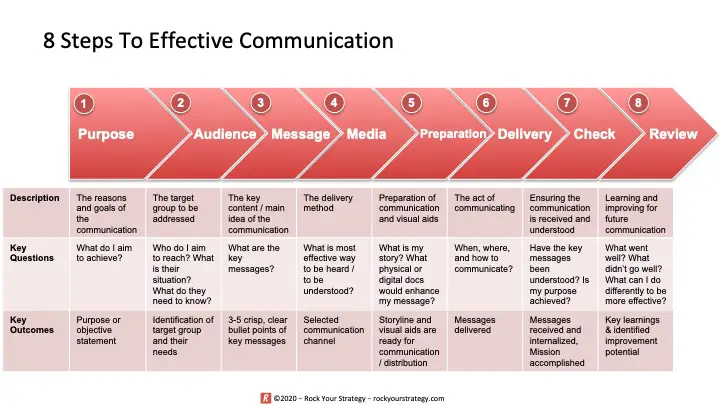
You have finished your strategic plan and you are ready to get started. But wait! Have you already thought about how to communicate the strategy to your employees? Here is the 8-step process to ensure that you effectively communicate the strategy to your employees.
8 Steps to Effective Communication
Be clear about the purpose of the communication
Know your audience
Plan your messages
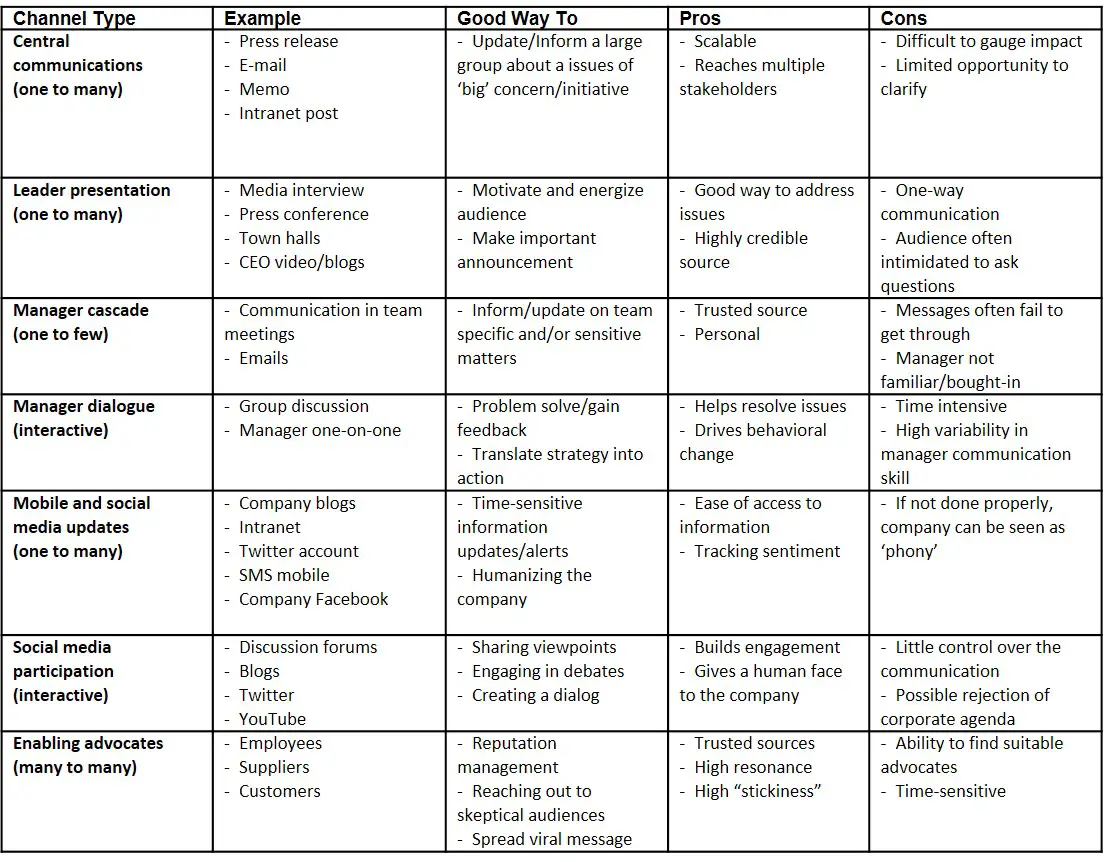
Choose how to communicate
Prepare your story and visual aids
Deliver the communication
Check for understanding
Review and learn
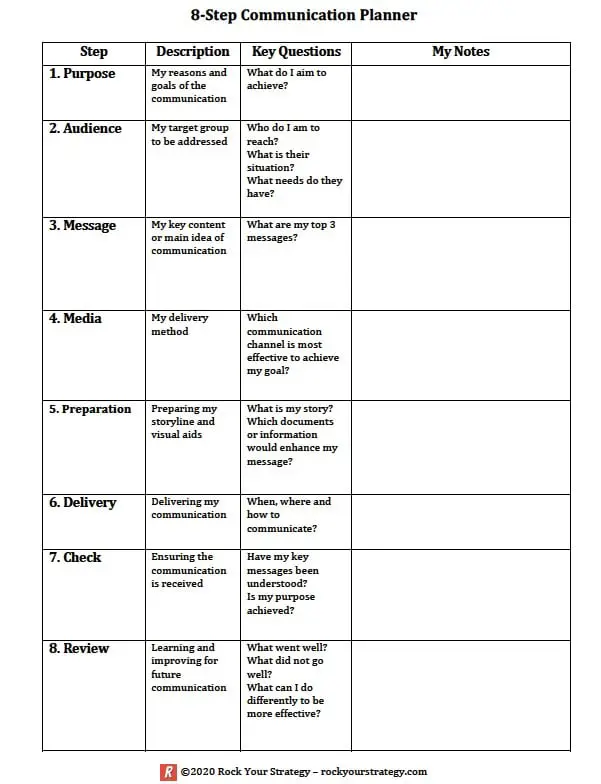
Creating understanding and buy-in about the strategic direction of the business is critical to success. Thinking through these 8 steps allows you to plan your messages and communicate with confidence and impact. When it comes to strategy, clarity is paramount. Read on to learn more about these 8 practical steps to effective communication and scroll down to download our preparation template.
Effective strategy communication
Before jumping into the 8 steps it is worth describing why effective strategy communication is so essential.
People are the engine behind your business. It’s the people that move your business forward, achieve your objectives and implement your strategy. It is therefore critical that your people understand the direction of the business and what is expected of them. Unfortunately, the reality is that in many organizations the strategy is not clear.
Numerous studies have shown that lack of clarity about the strategy and lack of communication are among the top reasons why strategies fail during implementation. Having a clear strategy is not good enough. It is important that the strategy is clear to employees and other stakeholders. Only then can you effectively move your business towards its destination.
So how exactly can you ensure that your team is clear about the business strategy? Communication, communication, communication.
In my experience, it is most beneficial to involve the employees throughout the strategy process. However, depending on the size of your organization, it may not be realistic to involve everyone. Besides, there is a business to run, customers to attend to, and products to deliver. So keeping an open line of communication throughout the process keeps the team engaged and updated on progress.
I like to say that when it comes to strategy, you cannot over-communicate. Since the topic of strategy can be daunting, it makes sense to plan your communication in order to have the desired impact.
An effective communication plan has 8 steps.
8 steps to effective communication
Following these 8 steps will put you on route to effective communication and successful strategy implementation. We will now go into the details of each of these 8 steps.
Communication is a tool to inform, influence, and socialize and communication happens between people. It can therefore be used in different ways and can be perceived differently by different people. In order to have the desired impact, it is important to first think about why you communicate. How you plan your communication and how you deliver it will differ based on your purpose.
The first step when you begin planning is to describe the purpose of your communication. What are the reasons and goals of the communication? What is the desired impact you wish to have on your target audience?
The key question is: what do you aim to achieve?
Be deliberate about this step and don’t gloss over it. Write down your reasons or purpose as specific as possible. This is really important! But why?
During the communication, people will decide in the first few seconds whether what they are about to hear or see is relevant to them. That’s right! Just a few seconds in, they will decide whether to pay attention to what you have to say or whether to tune out. That means you have one chance right in the beginning, possibly even before the communication begins, to generate interest and capture your audience’s minds and hearts.
If you are not clear about your purpose and its relevance in those first seconds, you will lose people or at least part of their mental and emotional capacity. For people to really listen and pay attention, you have to make an emotional connection with your audience.
Communication happens between people and people are emotional. The messages you send are not only the words you speak or the graphs on your Powerpoints. Your audience receives much more than that. Your audience uses all its human senses to receive your communication, especially when the communication itself or the topic you communicate about is deemed to have significant personal impact.
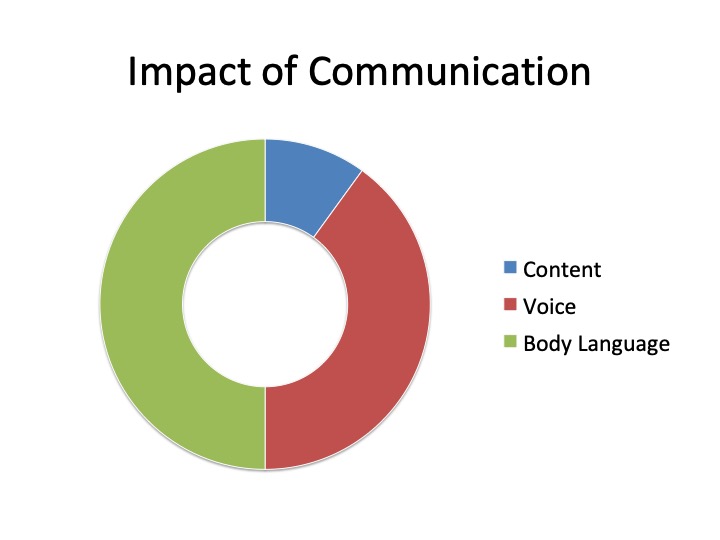
When you communicate, especially when holding in-person communication, the content of your communication has the smallest impact. The largest impact is made by how you communicate. In fact, content only accounts for about 10% of the impression you make. About 40% of the perception of your audience is influenced by your voice, i.e. how you articulate yourself, the pitch, the volume, the tempo. And 50% of your impression depends on your body language, which means your posture, your gestures, your facial expressions, and your eye contact.
This is important to consider. When you start with why you communicate and what you aim to achieve, you allow yourself to plan for all aspects of your communication in order to have the desired impact on your audience.
So be clear about your purpose and reasons and then plan your communication accordingly. The reasons why we communicate can be numerous. Here are common reasons for communication in the workplace:
Why we communicate
To share information
To ask questions
To make decisions
To receive or give feedback
To establish or deepen relationships
To motivate people
To express emotions
To entertain
In regards to strategy communication, here are a few examples of reasons and goals of communication related to strategy.
Examples of purposes
To inform the team about the new strategic direction, to explain why the change is necessary, and to make sure everyone understands how they can help.
To share information about the organizational change to build confidence in the team, to help people deal with uncertainty and to prevent the spreading of rumors.
To make the decision to invest in a new product line
To update senior management on progress with strategic initiative 3 and to receive additional funding for the next phase of the initiative.
To ask for support of the employees for adoption of a new company policy.
Notice that all of these reasons address very emotional topics. Strategy communication typically touches on topics that go very near and dear to people’s personal state of being. Strategy communication therefore needs to be carefully prepared and executed.
Briefly looking ahead to later steps and the actual delivery of the communication, it can actually be quite helpful to state in the beginning of your communication what you aim to accomplish. Stating your purpose makes clear to your audience why you are there and why they need to listen. But more about that later…
In summary, be specific about what you aim to achieve with your communication so that you can plan to capture your audience’ attention. Speaking of the audience, let’s look into that aspect of communication next.
2. Audience
The audience is the target group of your communication. These are the individuals or the group of people who you wish to address your communication to.
Communication is all about the audience. In communication it’s not about what you send and it’s everything about what is received. In order to communicate effectively then, it is important to understand who is going to receive your communication and how it will be understood and interpreted. That means the communication is most effective when it is customized to the target audience.
The second step of the process is to identify the target audience and to learn about their situation and needs. Let’s spend a bit more time here as this is so important.
The key questions are: (i) who do I aim to reach? (ii) What is their situation? (iii) What are their needs?
First, start by listing who your primary audience is. Is it the entire company? A specific organization or team? Are you communicating publicly towards certain stakeholders such as customers or investors? Write down the audience you primarily wish to address.
Then think about the secondary audience. What does that mean? Keep in mind that when you communicate to your primary audience that your message could also be picked up by people for whom the communication was not initially intended. What impact could the communication have on them? Consider the following example.
Example of primary and secondary audiences
Andy speaks at a trade fair about Florian’s Fastener Solutions’ new product line. He outlines the market need, introduces the new offering, describes its unique value proposition and compares it to competitive offerings. Andy closes with a call to action.
Andy’s primary audience is potential customers who attend the trade show. However, in this public forum also employees of Florian’s Fastener Solutions can hear the messages. It’s an opportunity for Andy to be a role model for his colleagues and to praise his team’s work on creating this new offering. His team may feel pride and motivation being praised by their leader so publicly.
At the same time, competitors could of course also be present at the trade fair and could also be in the secondary audience. Andy has to assume that his speech is also attended by competitors. He needs to account for that in the messages he sends and the information he shares. He must not divulge confidential information or trade secrets that could harm his company or his competitive situation.
In this example the primary audience is potential customers. The secondary audience includes colleagues/employees and competitors.
(Note: there could of course be additional members of the secondary audience such as business partners, government representatives, investors etc. but I have excluded them for sake of simplicity of the example.)
Secondly, for each identified target group, describe what the audiences’ situation is. Each communication has a context, an environment in which it is received. And it is worthwhile to think about the situation in a micro-environment, i.e. the immediate surroundings, and a macro-environment, i.e. the larger, external context. Think about the specific situation for each of the target audiences.
Situation Analysis
Micro-environment
Immediate, internal surroundings, incl. location, time of day, atmosphere, mood
For the trade show example above, the situation includes the immediate environment of the trade show. It is a public forum with many attendees. Imagine Andy’s communication takes place in the late morning just before lunch. His audience may be tired, jet-lagged or hungry or all of the above. Andy should consider all of these aspects in the micro-environment.
In addition, the trade show takes place in the macro-environment of the economic situation, the industry cycle, the time of year etc. If potential customers in Andy’s audience are currently experiencing economic hardship, they will receive his messages differently than when they are experiencing times of rapid growth and prosperity.
For each of your primary and secondary audiences, write down their specific micro- and macro-situations. Capture only what is relevant to your communication, i.e. what you need to plan for. Remember that you are not writing a PhD thesis on the political era or the economic epoch. A few bullet points may suffice.
Thirdly, capture the specific needs of your target audience. The needs describe the expectations your audience may have of you. Given their situation, what is it that your audience needs from you? Do they need information? Do they need the solution to a problem? Do they need assurance? Do they need entertainment? Do they need empathy and understanding?
Remember that the emotional state of your audience will influence the audience’s understanding and perception of your message. And this will ultimately determine your audience’s response. Depending on the impact you aim to have or the response you wish to trigger, you must appeal to the specific needs of the audience in their specific situation.
For example, if your audience needs information about the performance of a product to make a purchase decision, then actual performance data and reference cases or proof points might be very effective. If however your audience needs assurance that during the announced organizational change no one will lose their jobs, then a communication with data and timeline about the change will not be effective in addressing the audience’s concerns.
In regards to needs of the audience, consider that
Emotional needs must be addressed with an emotional message
Factual needs must be addressed with a factual and an emotional message.
On your list of target audiences and their situation, write down the specific needs each audience has given who they are and what situation they are in.
You can summarize your insights in a table that looks like this:
Audience (Primary & Secondary)
Situation (Micro- & Macro-situation)
Needs
Primary audience 1
…
…
Secondary audience 2
…
…
Secondary audience 3
…
…
When you are clear about the purpose of your communication and your primary and secondary target group, you can then proceed to craft your key messages.
3. Message
The message is the key content and core idea of your communication. The message describes the essence of the information you want your audience to hear, understand and walk away with.
The third step of the process is about working out clearly and concisely the key messages of your communication.
Why the message is critical becomes apparent with a simple example. Have you been in a conversation with another person and after the other person is finished speaking you are wondering what it was he or she tried to say? He or she may have spoken a lot but said very little? In such a situation, the message did not come across. The person failed to deliver a clear and concise message that you could understand and retain.
Being specific about your key messages is critical and not as easy as it seems. So dive in and take the time you need to get this right.
“Simplicity is the ultimate sophistication” – Leonardo Da Vinci
What are the hallmarks of key messages? Key messages are:
Concise: short and crisp summary of the most important information
Relevant: customized to audience’s situation and needs
Simple: easy to understand, in simple language
Memorable: easy to retain and repeat
Believable: real and imaginable, not far-fetched
Meaningful: carry significance for your target group
Thereby, key messages are no more than 2-3 clear and concise bullet points. And in that lies both the art and the difficulty.
Creating key messages is a 5-step process in itself. Go about it as follows:
Brainstorm: collect the key ideas and information you plan to convey
Draft: write out your messages taking into consideration your target audience, their situation and needs.
Trim: reduce the messages to their essence. Review each sentence so that each word carries meaning. Delete fluff or ambiguous terms.
Test: try the message on a confidant or trusted person. Check whether your key messages come across the way you intend and whether they have the desired impact.
Refine: review and refine your key messages based on the feedback you receive.
Note that you customize your key messages to your target audience. If you are addressing different stakeholders, I suggest you repeat this process for each target audience. That way you ensure that your communication is tailored to the needs of the respective group.
Once you have crafted your key messages, it’s time to choose your communication channel.
4. Media
Media refers to the communication channel. This is the means by which you conduct your communication and deliver your message. The choice of media must align with your purpose, your target audience and your message.
In step 4 of the process you choose your communication channel.
The key question in step 4 is: what is the most effective way to reach your target audience so that your key messages are heard and understood?
The choice of communication channel is an important decision. It either helps to effectively deliver your message or to undermine your impact. When choosing your channel, consider how many people you aim to reach and whether you aim to deliver your message one-way or seek feedback and interaction.
Additionally, especially if you have a larger team with multiple locations or if some employees work remotely, consider whether in-person communication is important. This can be of particular significance when sensitive and emotional information needs to be conveyed. Whenever possible, I prefer to communicate matters related to strategy face-to-face. So in your channel choices, take into consideration how best to reach colleagues who are not in the same location.
Choose your communication channel by asking 4 questions:
Do you plan to reach one, few, or many people?
Do you plan to communicate one-way, two-way or multiple-way (i.e. are you seeking feedback and/or interaction)?
What channel options do you have and what are pros and cons of each option?
Which channel option best suits your purpose, audience, and message?
Gartner, the research and advisory company, provides an excellent overview of channel options for internal communication in the following graphic.
Source: Gartner1
Note that channel choice is not a binary decision. I have beaten the drum enough by now that communicating your strategy or important aspects of your strategy is all about being heard and being understood. So when making channel choices, it’s more about your audience than about you and your message. Therefore, consider using multiple channels to convey your messages to ensure reaching each member of your organization.
Tip: Effective communication might not be achieved by choosing the right communication channel but by making the right combination of channel choices.
Consider our B2B strategy example Florian’s Fastener Solutions (read Florian’s story here). When communicating the company’s new strategy, Andy, the general manager of Florian’s, used multiple channels to communicate with Florian’s employees, customers, owners, and investors. After working out their strategy among the leadership team and several functional experts, Andy used the following channels for communication.
Andy conducted one-on-one meetings with each owner and major investor.
Andy announcedthe essence of the strategy by email to all employees.
On the same day, Andy called a town hall meeting to communicate the strategy to all employees. In the town hall, Andy provided more background about the need for change, his personal thoughts and motivations, and opened up for questions.
Andy and his leadership team used team meetings to communicate more detailed aspects of the strategy related to each function and team.
Finally, Andy and his leadership team used formal and informal one-on-one meetings to check in with important members of the team and those they felt weren’t clear or committed yet.
For external communication, Andy personally emailed key customers and suppliers to inform them of the new strategic direction. The sales team received talking points for individual communication with customers.
By using multiple communication channels, Andy was sure to reach every member of his organization. He invested additional efforts to be available for questions and feedback. And he followed up to ensure the new strategy was understood and people were clear how they could help.
Think about which communication channels are most effective for your communication and you are well on your way towards your delivery. And the preparation for the actual communication is next.
5. Preparation
You are almost ready to deliver your communication. Now it’s time to put it all together.
Step five of the process is about the concrete preparation to deliver your communication. This is when you write that email, prepare your full remarks, create the PowerPoint presentation, and rehearse your delivery.
The key questions are: what is my story? And what visual aids or supporting materials do I need to tell that story most effectively?
So before you open PowerPoint or Outlook and jump right in, review once more your purpose, your target audience, your messages and your communication channel. Then think about the story you are going to tell.
In order for your communication to be effective, you need to build an emotional connection with your audience right away. You need to make the audience interested and you want to keep your audience engaged throughout your communication. What does that mean for your story? Think about your communication as having 3 parts: a beginning, a middle, and an end. Set up a storyboard and work through those 3 parts.
Beginning
In the beginning, you need a hook to make your audience interested. When you begin, your audience will consciously or subconsciously go through the following questions: what is this about? Is this relevant to me? Should I pay attention? Is this worth my time? Don’t think just because you are the boss that your team will listen to you or read all your emails attentively. You first need to earn their trust and their attention. Consider starting with a personal anecdote or a meaningful fact and then continue with the purpose of the communication. As my speech mentor once said, “tell them what you’re going to tell them”.
Middle
The middle part carries the main information or key messages. This is the meat of the communication. Keep this part interesting and engaging. Just like in this article, keep paragraphs or remarks short and digestible. Use simple language that is easily understandable. Stick to your messages and make sure not to stray off topic. Consider to enrich the middle part with examples, illustrations and personal stories. This will make the content relatable and better yet personable.
End
At the end of the communication, two things are important: summarize your key messages or take-aways so that the audience will remember them. And include a call to action. What do you want your audience to do with the information you have shared? Do you want them to simply understand and retain the information? Or do you want to move your audience to action? Be clear about that at the end. Finish with what will happen next.
When you have your story mapped out, check what visual aids could support your message and enhance your delivery? Studies have shown that many of us are visual learners who benefit from seeing what they are hearing. Tap into that to increase your communication effectiveness.
Examples of visual aids could include
A graph with information in the text of your email
A set of PowerPoint slides to accompany your verbal remarks
A handout or sample of what you are discussing
Especially this last item, a sample or object, could be very powerful. Haptics are an incredibly important sense for humans. Seeing is believing? Try seeing, touching, smelling, etc. It’ll make your story come to life. Just don’t make it too fancy to distract from your story and messages!
Important not on PowerPoint slides: your slides are not your presentation. Your messages and your delivery are your presentation. The slides are just there to support the delivery of your message. If you have spent more than 10 minutes in a large corporation, you know what I’m talking about.
Ok, once your storyboard is ready, go ahead and open your email program, your word processing or your slideshow software and write your story and create your visual aids.
When you are finished, let it sit and take a break. Not only do you deserve a break after all that heavy lifting. It’s good to get some distance from your story so that when you come back to it, your eyes are fresh and you can critically review it one more time.
The last step of preparation is to rehearse your communication. Don’t take this step lightly. Practice your delivery. People say Steve Jobs planned and practiced his speeches meticulously to the last detail. Do it like the master himself. Ask a colleague or friend to help you with this. Having a live audience is helpful during practice. The feedback will help you refine and improve. Trust me on this one!
If your communication is in writing, have it reviewed and edited by a trusted friend or advisor. It’s amazing what a different pair eyes can see.
Tip: if you plan to speak in front of your organization and you are not used to doing so, practice your remarks in front of the mirror or better yet on video. Record yourself or ask someone to record for you. With a smartphone this is easily done these days. Review the video to see how you come across. Do several takes if you have to until you are satisfied. if this is an important communication, then your efforts will pay off!
One more thing: I have written this entire process from the point of view of the business leader. Many of us are fortunate enough, however, to have expert colleagues who help us with writing the concrete communication piece or who put the PowerPoint slides together. You may of course consider outsourcing this step if you have the resources to do so.
When you do outsource, make sure to walk your colleagues through the first 4 steps to make sure they fully understand the intent, the situation and the needed tone of the delivery. Make sure this remains your communication. It must fit your style and your choice of words. Authenticity is critical in communication – especially when communicating important or sensitive information like the business strategy.
Therefore, plan to invest time to edit the email, rewrite parts of the speech, and modify the PowerPoint slides. If necessary, ensure your colleague who created the text doesn’t feel hurt by your changes. But it is important that you are 100% comfortable with the communication. If not, the delivery may seem awkward or phony to the audience – or worse the audience might feel that this is not your communication and that you are not fully behind it. And when it comes to strategy, that would be the worst case scenario.
So get ready, make it yours, and move to action.
6. Delivery
Delivery refers to the act of communicating. After the previous six steps were about planning and preparation, step 6 is about implementation.
Before you go ahead to turn your plan into action, consider carefully when, where and how to deliver your message. You want to be fully in control of your delivery so as to have the planned impact on your audience.
Depending on your purpose, audience, message and media, you may have a number of options at your disposal. Think about these options in very practical terms. Then while considering your purpose, put your audience, its situation and its needs first.
Plan your communication at a time when you expect the highest amount of focus and concentration and the least amount of distractions and noise.
For example, for communication about your strategy, which month and day would be best? Would it be more effective for your business to kick things off on a Monday or close out the week on a Friday? Would the delivery be more effective first thing in the morning or in the afternoon? Do you have people in different time zones you need to include? Be deliberate about these choices.
Here’s what has worked well for me. When communicating important information, I try to communicate in person whenever I can. You have much greater control of your message and its delivery when you can use all your personal tools such as voice, body language, and eye contact. In-person communication allows me to connect better with my target audience on an emotional level and ensure that they are open to receive my message.
Should personal communication not be possible for any reason such as different locations and an inability to travel, then I’d prefer the next best alternative: video-conferencing. It’s not exactly in-person, but at least via video you can see each other and observe body language.
Having said that, whether in person, via video conference or in writing, when it comes to timing, I try to avoid times of distraction. My experience is that first thing in the morning, shortly before lunch, right after lunch and shortly before the end of the day are poor times for communicating important information.
This certainly depends on your work culture and norms in your business. My experience is that early in the morning people are not yet fully present. Some people might not be awake yet or might lack the needed level of caffeine. Others need the chat with colleagues to get up to speed or work their way through the email inbox before being ready to engage.
Lunch time is a similarly difficult time. Before lunch, people may be planning their lunch arrangements or their hungry stomachs may prevent them from focusing. After lunch, blood rushes to the stomach to help with digestion and the onset of “food-coma” makes the early afternoon an equally ineffective time.
In my experience, the best times for communicating important information are mid-morning (e.g. 10 am) and mid-afternoon (e.g. 2pm). People tend to be most present and most attentive at those times.
If you are working in a shift system, allow people to clock in and then communicate with them before their shift.
I want to re-emphasize one point I already mentioned above in passing, which is critical for effective communication: when delivering in-person communication, build an emotional connection with the audience first. It’s like the right pitch for a home-run or the perfect set for a spike. An emotional connection “opens up” the audience to receive your message. On the other hand, when the audience is not ready, the message will roll off like water from Teflon. So invest first in that personal, emotional connection, and then tell your story.
Lastly, remember for personal communication, your impact depends only 10% on the content, and 40% on voice and 50% on body language. Use all those tools in congruence with your messages.
Now, go get’em!
7. Check
Most communication literature ends here. Communication delivered – done. Well, I disagree. Having emphasized a lot how important it is to be heard and understood, I think it is important to check whether your communication was indeed received the way you intended. After all, success with your strategy starts with everyone being clear about your strategy.
Step 7 of the process is about checking with your target audience whether the communication has been received and understood.
The key questions in this step therefore are: have the key messages been understood? Has my purpose been achieved?
Let’s first understand why your communication may not be understood as intended. The reasons could be numerous:
Communication was missed: didn’t receive or open the email, didn’t attend the meeting, etc
Communication received but not understood: didn’t read/listen carefully, didn’t understand the meaning of the words, there was a language barrier, etc.
Communication received, but misunderstood: didn’t understand the jargon, associated different meaning to the words used, had a different point of view, etc.
Communication received and understood, but not convinced: didn’t think messages were realistic, had a different point of view, didn’t understand the why, etc.
Communication received, understood, and convinced, but didn’t know what’s expected next: didn’t know what to do with the information, didn’t understand the call to action, felt uncertain or unmoved.
Note that all these reasons, as different as they are, will lead to the same or very similar outcomes: the original purpose will be missed.
How to check whether your communication was effective? There is no right or wrong way to go about this. The easiest way is to be available for questions and ask for feedback.
For example, if you are speaking to your team in a town hall or team meeting, open up for questions immediately after finishing your remarks. If you communicate in writing, include directly in the text where, when and how people can ask you questions.
It is important to be patient with your audience. Let the information sink in and give people time to formulate their thoughts and questions.
Consider that not everyone may dare to speak up in public. Yes, it can be intimidating to many to raise their hand and ask what’s on their mind. So in addition to being available for questions in public, also follow up in private.
Make yourself available for smaller group discussions or one-on-one meetings. In those follow up sessions, seek to listen and understand. These are valuable opportunities to reinforce your messages and bring clarity to your purpose.
Here are example questions you can ask in order to trigger questions or feedback and gauge your communication effectiveness:
Do you have any questions?
Was anything unclear?
What were your main take-aways from the communication?
What can you do next?
If your audience has understood your messages and your purpose has been fulfilled – mission accomplished. There is only one last step.
8. Review
Having gone through the entire process, there is only one last step to take. What can you learn from this communication?
Step 8 of the process is about learning and improving for future communication.
Key questions of this final step are: what went well? What didn’t go well? What can I do differently to be more effective next time?
Ok, this is not rocket science. Simply sit down after you have completed the communication and reflect on how it went. Answer the key questions above and write down your insights. Learning from your experience is a great way to develop and improve yourself.
Think about how you approached the overall communication. You may want to reflect on the following types of questions:
Were you clear on your purpose?
Had you identified the target audience and their needs correctly?
Were your messages on point or did you have to reiterate during the communication?
Were the channels you chose effective in reaching your audience?
Would you change the channel mix if you were to start over?
What kind of questions did you receive during the communication?
Could you have prepared for the communication and the questions more effectively?
…
This list is just to start your brainstorm and certainly not exhaustive. Think about your own questions to reflect on based on your experience.
You can use the following table to write down your reflections.
Reflective Question
Your Notes
What went well?
What didn’t go well?
What can I do differently to be more effective next time?
If you have worked on this communication in a team, feel free to individually and jointly review your learnings and provide feedback to each other. Thereby you can all learn from this experience.
And next time you need to communicate, you will be even more effective in reaching your team and being understood.
Creative ways to communicate with employees
So what are effective ways to communicate with employees? We have put together a list of different communication channels to get the word out as follows.
There is no one, single best channel to communicate your strategy. Every organization and every individual is different. The key to effective communication is to use combinations of channels and to reiterate your key messages in different ways.
Remember that in the end it is not about what you want to say and it is everything about what your team hears and understands.
Preparation Template
Wow, this was a long article. I wanted to include everything I have learned and experienced to make this as helpful and practical as possible.
Looking for more tools and templates? Check out our template page below.
Templates
Find tools & templates for OGSM and your strategic planning process here.
OGSM Examples
Find OGSM examples and inspirations for your own journey here.
Conclusion
Effective communication is critical to successful business strategy implementation. And communication is not only about being heard, but more importantly it’s about being understood. Taking the time to plan your communication deliberately ensures that you have the desired impact. Our 8 step process to effective communication helps you rally your team and deliver results.
You have developed your strategy and are ready to implement. However to do so effectively, you want to make sure your team understands what your business strategy is all about and what is expected of them. Here are 12 effective ways to communicate your strategy to employees.
Team meeting
Townhall
Strategy conference
Virtual meeting / webinar
One-on-one meeting
Informal conversations
Video recording
Story / fairytale
Strategy handbook
Strategy board
Regular strategy newsletter
Use a one-page strategy framework
Great, that’s a handsome list. Now let’s dig deeper and learn more about how you can use these ways to get your message across. Before we do so, why is it so important to effectively communicate the strategy?
Importance of effective strategy communication
Your people are the engine behind your business. It’s the people that move your business forward. It’s the people that help you achieve your objectives and implement your strategy. It is therefore critical that your people understand the direction of the business and what is expected of them.
Unfortunately, the reality is that in many organizations the strategy is not clear.
According to a recent survey by Bridges Business Consultancy, a staggering 67% of strategies fail during implementation1. And the number 1 reason for failure is… (drum roll, please)… poor communication! A similar study conducted by the Economist Intelligence Unit found that communication surrounding strategic initiatives and communication of the overall strategy were among the top barriers for effective strategy implementation2.
Effective communication of a strategy is critical because there is a direct link between clarity of the strategy and its effective execution. This makes intuitive sense. When all rowers in a boat know in which direction to paddle, the boat is more likely to pick up speed and reach its destination.
Simply defined, the business strategy describes the set of choices the business makes to achieve its objective and goals. For the strategy to be effectively implemented, clarity about the vision, mission, and objectives of the business throughout the organization is essential.
So, here are 12 creative ways – in no particular order – to communicate your strategy to your employees to make sure that the people in your business know where the business is heading.
Team meeting
The team meeting is the classic approach to communicating important information such as the strategy of the business.
The team meeting is typically an in-person meeting of a group of people who know each other well and closely work with each other. Team meetings are typically held at regular intervals. Some teams meet daily, weekly or on a monthly basis.
Strategy discussion in team meeting
Team sizes can vary of course from a few people to a couple of dozen people. Regardless, team meetings are typically intimate settings with a level of trust established among team members. Team meetings are therefore good opportunities for strategy communication.
Depending on your team norms and culture, you may choose to present the strategy to the team or have a detailed discussion. The team setting is excellent however, because its setting allows for an intimate dialogue about the strategy, what it means for the business and what it means for your team.
Take as much time as you need for this discussion. Ensure that there is an opportunity to ask questions and clarify concerns. It must be the objective of the discussion to create clarity and understanding about the strategy. Conclude the team meeting when all questions are asked and everyone can state the strategy in their own words.
Consider using visual aids, props, stories or other means discussed in this article to make the strategy discussion in your team meeting as engaging and memorable as possible.
Town Hall Meetings
The town hall meeting is typically a communication session with a larger audience in which a group of people is consulted or informed on a topic of interest. According to Wikipedia, the town hall format originates from colonial era North America, when politicians communicated with their constituents on matters related to the community or new policies and regulations. The town hall format has meanwhile been popularized by politicians and business leaders around the globe.
Example of a small townhall meeting
The exact format, length, venue, and purpose of town hall meetings may vary. Town hall meetings are great for strategy communication because the business leader can directly address the entire company or a large group of employees. The format allows for interaction, debate, question & answer, and clarification.
The communication of the strategy during a town hall meeting could take the form of a presentation with subsequent Q&A session. The business leader or the senior leadership team can directly address the team and be available for questions and comments.
This way the organization can hear the strategy and its purpose directly from the most senior leaders instead of reading about it or hearing it cascaded through the hierarchy. This could greatly enhance the level of understanding of the strategy.
Strategy conference
The strategy conference is typically a high level meeting of the most senior members of an organization. The aim of a strategy conference is to communicate the strategy and also work out further details about its implementation. The purpose of a strategy conference is to involve its participants in the discussion and detailing of the strategy.
The strategy conference can be a powerful way of disseminating the strategy as it involves a large number of people in its creation and implementation. This creates buy-in and commitment. It also gives members of the organization the opportunity to help shape the strategy and with it the future of the business.
People participating in a strategy conference
Imagine the strategy conference to be a multi-day meeting at an offsite location. It may include formal presentations and speeches. It may also include workshops and break-out sessions.
The most effective strategy conferences have an overall theme or purpose and constitute a mix of sessions and formats.
The strategy conference should have a closing session in which the results of the conference are presented and discussed.
I have personally participated at several such strategy conferences on global, regional, and national levels. The conferences typically included 50-100 participants and covered longer-term strategic objectives and annual operating plans. The conferences I attended mixed formal speeches with informal discussions, casual encounters and team-building sessions.
Especially the latter part of informal and casual sessions were important in reaching the employees, setting the tone and making things fun and engaging. I can only recommend it!
Virtual meeting / webinar
A virtual meeting or webinar is similar to a town hall – except that it’s not held in person but online. The purpose is however the same. It’s a large group meeting to communicate the strategy directly from the leaders to the employees while providing a forum for questions and clarifications.
There are many online platforms nowadays that support such virtual meetings. There are for example, Microsoft Teams, Zoom, and Webex. All of these platforms allow for participants to dial in by computer or by phone and to share and view presentations.
Participating in a video conference
In addition, a technology I find particularly compelling to complement virtual meetings is Slido available on www.slido.com. Slido allows participants to ask their questions via a designated website or app. The questions can be collected, ranked and answered one-by-one in turn.
What’s particularly compelling on Slido is that participants have the choice to identify themselves or ask questions anonymously. In my experience the option of anonymity takes away some people’s barrier to raising questions. Slido also allows for polling and quizzing of participants and thereby creates a whole different meeting experience. Highly recommended!
One-on-one meetings
As the name suggests, one-on-one meetings are small, intimate sessions between two persons. Often less formal in nature, these are typical interactions between managers and employees or between peers.
Because of the intimate, private setting, one-on-ones can mark an effective occasion to provide in-depth information about the strategy, additional (potentially confidential) information or subject-matter specific information. It is also a good occasion to clarify specific questions or seek commitment from important individuals.
One-on-one meeting
I have often used one-on-one meetings to follow up on larger team communications and to address specific questions related to specific persons or topics. For example, I may follow up with a person who had a particular question in a town hall or I may clarify with the leader of a strategic initiative what exactly is expected of him or her.
In one-on-ones, I try to make sure that the other person is comfortable and feels free to raise any question or comment by establishing a trustful, relaxed atmosphere.
One word of caution: one-on-ones are not effective for strategy communication in the absence of an overall communication. Not only would it be inefficient to address a larger team or organization one by one. The team would also not have the benefit of hearing the same message, using the same words at the same time. So I’d use one-on-ones only in combination with one or multiple means of team communication.
Informal conversations
Informal conversations are casual encounters among two or more people outside of formal work settings. These can be joint meals, such as lunches or dinners, social events, or simply the proverbial watercooler or elevator chats.
The thing is that informal conversations typically take place among family members and friends or persons with a strong, trustful bond. The hallmark of an informal conversation is a high level of openness and vulnerability, frankness and candor. Because informal talks are less concerned with upkeeping of formality and professionalism, communication is often more emotional and direct. It is in these conversations that information is shared in its purest and often most honest form.
Informal gathering after work
The trust needed for informal conversations is of course not built in an instant. I do not walk up to a person and say “let’s have an informal conversation”. It is when the trust exists that an informal conversation can take place. In such cases, it can be a great additional means of transporting sensitive, emotional and impactful information.
More importantly however, informal conversations are important opportunities to listen, seek feedback and clarify concerns.
As a leader in the business, be open and available for formal and informal communications alike to fully reach the people in your team. Capture their thoughts and their feelings when speaking about strategy and the direction of the business.
Story / Fairytale
“Once upon a time…” Didn’t we just love story time as children?
Good stories make us feel good and take us on a journey to… dare I say… a land far, far away. Stories are emotional. They capture our imagination and are very memorable.
Harvard professor Marshall Ganz explains in his work on Public Narrative that stories can create meaning in ways that connect human emotions and thereby move people to action4. Stories communicate in live experiences and not in abstract terms and principles. This makes information personable, relatable, and memorable.
We remember things better when we hear them in story form, also because the chemical oxytocin is released in our bodies when we hear a good story. That is the same chemical which is released when we feel trust, love, and kindness. That’s why good stories make us feel good.
In business likewise, storytelling can be a very effective means of communication.
So, turn your strategy into a story about your business. Imagine what it will look and feel like when your business reaches its destination and achieves its objectives. Write the story down and tell it during meetings, town halls or chance encounters.
And with your story, capture your audience and move people to action.
Video recording
Turn the story about your business and about your strategy into a video or a mini movie!
In education, researchers have found that including visual content in the learning and teaching curriculum can help students better engage with the materials, increase retention by 29-42%, and develop higher order thinking skills3. Visual learning begins when graphs, images, and illustrations appear alongside words, numbers, and text.
Visual-spatial learning, as it is called, doesn’t stop after school. In worklife, visual learning is just as important to capture complex information and subject matter. And business strategy can be such a complex topic.
Videos are a great way to make complex information more approachable and understandable. Video gives the opportunity to explain and visually depict information and tell a story. Video is thereby a powerful way to communicate to create understanding.
Record your own strategy video
But use video to communicate your strategy? Absolutely! Video communication does not need to be expensive and does not need to be complex. From creating a simple doodle to filming a story about your strategy, there are fun ways to make video content engaging and understandable.
Be creative! You might even be able to recruit your colleagues to act out what it may look like to succeed with your strategy. Short video clips may be sufficient to communicate the key aspects of your strategy.
There’s one more benefit of video. Once the video exists, it can be used time and again to reinforce key messages as well.
So, I think you can tell that I am a fan of video content. There is a reason why YouTube is so successful after all.
Strategy handbook
In an age dominated by digital communication, such as emails, PowerPoints, podcasts, and tweets (and might I highlight that you are likely reading this on your desktop computer or mobile device), we hold less and less physical books in our hands.
However there is something to be said about the pleasures and the impact of print.
Granted, print is costly and bad for the environment. All too often printed brochures are handled once and then filed and forgotten – or worse, neglected and tossed.
There are benefits however to reading on paper. According to a recent article summarizing several studies5, the benefits of printed books are numerous.
Reading in print helps absorb more information
Print is easier on the eyes
Print helps remain focused and become less distracted
Print simply amplifies the joy of reading
Summarize your strategy in a printed booklet
So when communicating strategy, consider including a printed handbook as part of your communication package.
A strategy handbook could take the form of a colorful, printed booklet that summarizes in easy to understand terms the most important aspects of your vision, your mission, your objectives and strategic choices.
A strategy handbook could also include background information, market insights, external references or inspirations, and your story. Again, there are no boundaries to your creativity and what a strategy handbook could look like. Make it visually appealing and a strong representation of your business and what you are looking to achieve.
Strategy board
Remember those good old pin boards in your office? Yes, those boards with pins that gave Pinterest its name. They seem from a different day and age, don’t they? Colorful pin boards in places where people come together can however be an attractive means to capture attention and communicate information.
What might a strategy board then look like?
Imagine a white board, black board or pin board in the cafeteria, pantry or break room of your workplace. Imagine this board holding information about your strategy, the direction of the business, its objectives, progress, and achievements. Not so hard to imagine…
Pinboard as communicator of priorities
Such a board could however be a very engaging communicator when frequently updated. Studies have shown that we tend to overlook information that is static and blends into our day-to-day routines. We notice however when things change in areas that are common and known to us. This is where a strategy board can be appealing.
Besides holding constant information such as the vision or mission statements of the business that tend to placate the walls of offices these days, a strategy board would enable updating and keeping employees current on latest developments in the business.
Again, be creative. Use color. Make content attractive. You may consider depicting the strategy in a visual way and keep updating and adding information as you implement and make progress.
And as a bonus idea, allow people to update the board with their contributions, achievements and ideas. That keeps the information current and engaging and makes people come back to check for updates.
Regular strategy newsletter
Although I wouldn’t recommend email as the primary means to communicate your strategy, a regular strategy newsletter would be an exception.
A regular monthly or quarterly email from the business leader highlighting the progress made on your journey to implement your strategy and deliver results could actually be quite powerful.
Such a newsletter could be an opportunity to reiterate what is important to the business and why it’s important. It could highlight specific achievements and give credit to teams and celebrate successes.
As often stated, implementing a strategy is a marathon and not a sprint. It is not uncommon though that a new strategy is presented with great fanfare and shortly afterwards the business returns to its daily routines and urgencies.
In that context a regular update straight from the business leader keeps the strategy implementation in perspective.
If you are considering to launch a regular newsletter, consider to include the following:
An overview of the strategic priorities
A dashboard highlighting key figures and progress with strategy implementation
A reminder why you are in business: I.e. your purpose, vision and mission
A visualization of the destination of your business
Highlights and achievements from the time period since the previous newsletter
Lowlights or challenges from the previous period and how they are being addressed
Outlook and priorities for the months ahead
A call to action: e.g. information or an illustration how colleagues can engage with the strategy and contribute to its achievement
A few candid, personal words from the business leader such as words of gratitude or a personal experience related to the strategy.
A strategy newsletter does not need to be long or a lot of work to create. The key is to regularly check-in on progress, engage with the team, and keep the strategy and its implementation top of mind.
After all, everything you do, should be tied directly or indirectly to the strategy and helping the company achieve its objectives.
Use a one-page strategy framework
In any and all of your strategy communication, simplify key aspects of your strategy into a concise and easy-to-understand summary. In my experience, nothing is more confusing and demotivating than a 100-page Powerpoint deck that goes into all the details.
On the contrary, a clean, concise overview that introduces key aspects of your strategy such as where you are headed and how you are going to get there creates clarity and engagement.
One strategy framework that can help to depict the entire strategy on a single page is the OGSM.
OGSM stands for Objective, Goals, Strategies, and Measures. It is a one-page business plan that shows what the business aims to achieve and how it’s going to achieve it.
OGSM Example: Tony’s Italian
The OGSM framework is both a methodology to create a strategic plan and also an effective tool to communicate the strategy and drive implementation. In short, the OGSM is a great way to simplify your strategy and deliver results.
Find tools & templates for OGSM and your strategic planning process here.
OGSM Examples
Find OGSM examples and inspirations for your own journey here.
Consider including the one-page OGSM framework in your communication package or hanging it on your strategy board.
Conclusion
These are our 12 creative ways to enhance communication of your strategy to your employees. A strategy well communicated is a strategy well understood. And with greater clarity and understanding, the organization has a greater chance to succeed at implementing the strategy and delivering results.
As I have learned during my many years in business, when it comes to strategy, you cannot over-communicate.
Now over to you. What additional creative ideas do you have to communicate your strategy? Let us know or drop a comment below. We’d love to hear from you.
Two-thirds of all business strategies fail during implementation. And just like the seven cardinal sins, when strategies fail in business often one or more of the seven deadly sins of strategy are at work.
The seven deadly sins of business strategy:
Ignorance – not knowing
Incongruity – not fitting
Confusion – not understanding
Doubt – not believing
Discord – not uniting / not aligning
Incompetence – not able
Inertia – not acting
Become aware of these seven sins of business strategy and how to avoid them and you are on your way to business success. Here’s how.
Ignorance
The first sin is ignorance or not knowing.
Merriam-Webster defines ignorance as “the state or fact of being ignorant: lack of knowledge, […] or awareness”.1
When thinking of ignorance I cannot help but think of the three wise monkeys and the famous maxime “see no evil, hear no evil, speak no evil”. However when it comes to business strategy, it would obviously not be advisable to stick your head in the sand and pretend the world around you does not exist.
Running a successful business and developing effective strategies require staring the truth in the eye, relentlessly asking questions, and thoroughly analyzing and understanding the situation you are in.
In his classic book “Good To Great”, Jim Collins calls this “confronting the brutal facts”2. Collins argues that you cannot make good decisions without confronting the brutal facts of reality. You want to create an atmosphere where people are encouraged to raise issues and speak their minds. You want a climate where the truth is heard. How? According to Collins:
Lead with questions, not answers
Engage in dialogue and debate, not coercion.
Conduct autopsies, without blame.
Build “red flag” mechanisms that surface information that cannot be ignored.
Every good strategy process begins with an analysis of the current internal and external business environment in order to situate the strategy in the realities of the business.
Ignorance will set you up for failure. Knowledge, awareness and facing the facts will set you up for success.
Incongruity
The second sin of business strategy is incongruity or not fitting.
Merriam-Webster says incongruity refers to “something that is incongruous”, i.e. “something that is inconsistent within itself”.3
A business strategy can only be effective in delivering results when it fits the situation the business is in. Every business is different. Every strategy is different. Different strategies may be effective at different times. Along those lines, a strategy that may fit another business or at another time does not necessarily fit yours – and now.
I have seen businesses emulating other successful businesses’ strategies hoping that such a strategy would also work for them. Or I have seen new leaders coming to new businesses and attempting to implement the strategies that made their previous businesses successful. I’m not saying that this may never work. But I am saying that the specific strategy must fit the business and the situation that it’s in. If possible, check and adapt.
One important aspect of congruence is that your business must have the necessary knowledge, resources, skills and capabilities to implement the chosen strategy. If that is not the case, the strategy is incongruent with the business and bound to fail.
Starting your strategy process with an analysis of the current internal and external environment and truly understanding what strengths and weaknesses your business has, helps make sure that the strategy you develop fits your business and its situation.
One more important aspect that has served me well over the years: involve your team in the strategy process. Their insights and real day-to-day experiences will help test assumptions and guide the discussions towards the right priorities. Make sure however as noted above that the truth is heard.
With that you set yourself up to develop and execute a strategy that uniquely fits your business and your situation.
Confusion
The third sin is confusion or not understanding.
Merriam-Webster defines confusion as “the act of confusing” or the “state of being confused” and further describes these “to disturb in mind or purpose” or “to fail to differentiate from an often similar or related other”.4
In other words, related to business strategy, the strategy is unclear or not fully understood. And what could be worse than to develop a carefully designed strategy, nestled in the realities of the business, vetted over months, if in the end your team does not understand it.
Being unclear about the company’s strategy or not understanding how one’s own role contributes to the mission of the business are key reasons for employee disengagement. And when your team is not engaged, it is not effective in moving your company towards its objective and goals.
In order to create clarity about your strategy, consider the following three aspects:
Involve your team in the strategy process. Integrating your team’s insights and expertise when deciding where to play and how to win builds in their understanding of what you are trying to achieve.
Keep the strategy simple. Duh, this sounds obvious. But it is actually really hard to do. Calibrating your strategy so that it is not high in the clouds and disconnected from your business while anchoring it in the day-to-day realities without cluttering it with details is the ultimate challenge. Work with your team, follow a structured process, challenge yourself to reiterate until you can boil your strategy down to its simplest essence. Check for clarity, sufficiency, alignment before finalizing.
Communicate, communicate, communicate. Throughout the entire strategy process, communicate with your team. Share your thoughts, test assumptions, possibly involve customers.
A 2009 survey by Forbes Insights and FD revealed that a lack of understanding was the number 2 reason why strategies failed during execution5. What’s the number 1 reason? Unforeseen external circumstances (see Ignorance above).
So invest in clarity and involve your team and you should be well on your way.
Doubt
The fourth sin is doubt or not believing.
According to Merriam-Webster, doubt means “to call into question the truth of” something or “to lack confidence in” something.6
When thinking of business strategy, doubt is sewn when the strategy is not compelling, when the strategy does not have a clear destination or when the destination seems unattractive or out of reach.
A business strategy must spell out the purpose of the business and why moving the business towards its destination is an attractive, worthy cause. It’s strategies that appeal to a larger cause than the products of the company or a financial goal that inspire people and make people believe.
For example, a strategy that aims to “achieve profit X” or to “build product Y” are clear and realistic, but not inspiring. Instead, connect these goals to a larger cause such as serving a key customer need, solving a major problem or overcoming an industry challenge.
A strategy must clearly articulate a vision, a destination so compelling that it moves people to action.
Besides being connected to the realities of the business and being clear and understandable, therefore, a business strategy must inspire people to believe.
Discord
The fifth sin is discord or not uniting or aligning.
Merriam-Webster says discord refers to the “lack of agreement or harmony (as between persons, things, or ideas)”.7
Say you have defined a vision for your business. You have turned that inspiring vision into clear objectives and goals and you have rallied your team to join you on that journey. But what if it is not clear how you will reach your destination or worse what if there is disagreement about how to reach the destination? The energy you created deflates.
The same way there are “a thousand ways to Rome”, there are many ways for a business to reach its objectives. An effective strategy doesn’t only spell out what it aims to achieve, but also how it is going to achieve it. As Lafley and Martin say in “Playing to Win” it’s where to play AND how to win.
Strategy is all about making choices. It’s about allocating your finite resources to those initiatives that give you the highest chance of success. It’s about deciding which ventures to fund, which products to build, which services to offer, and which competencies & skills to develop.
It should not be your ambition to make everyone agree with the strategy. It’s ok to agree to disagree. It’s more important that everyone unites and gets behind the strategy to direct the company’s resources fully towards its vision and strategic objectives. How do you achieve that? Alignment.
During the strategy process, work with your team to translate the objective and goals into strategies that translate your ambitions into results. The strategies describe the ‘how’, the trade-offs, the resource allocation decisions. Then further work with your team on cascading the strategies into objectives and goals for each division, function, and team. In a small business with only a few people, the same process holds. Translate the strategies into clear objectives, goals, and initiatives for each person. The initiatives and actions of each team or person must align with the larger cause like one cogwheel in a system grabbing into another.
When the business is united behind the strategy and your team is aligned on how to reach your destination, you can fully direct your energy towards achieving your goals.
Incompetence
The sixth sin is incompetence or not being able to.
Merriam-Webster defines incompetence as “the state of being incompetent”, i.e. “lacking the qualities needed for effective action”.8
Incompetence or the lack of ability to do something is likely the easiest sin to understand and also the easiest to overcome. Yet, in my experience, incompetence is also the most underestimated.
When defining a strategy and setting the course for your business, it is important to confirm whether your business has the necessary knowledge, skills, and experiences to implement the strategy and achieve the goals. It’s worth reviewing these terms individually. For our intents and purposes, let’s define the terms as follows.
Knowledge – refers to knowing what to do. This means having acquired theoretical and practical knowledge through professional training, university, school or self study. Books are a wonderful source of knowledge.
Skills – refers to knowing how to do it. These are the competencies and techniques needed to complete a job, task or activity. These include hard skills and soft skills as well as generic skills and domain specific skills. Practice or training is a great way to acquire and hone skills.
Experience – refers to having done it before. This means having applied the acquired knowledge and skills in real life. Having faced and overcome the exact situation you aim to master.
Consider a sports example. Knowledge means you have read all about football, you have watched it on TV and have been told what football is and how to play it. Skill means you have practiced football. You have handled the ball, you have trained together with your team members. Experience means you have played the game and have been on the field in the competitive situation of winning or losing.
Having and honing all three, knowledge, skills, and experiences, vastly improve your chances of success and overcoming inertia.
This doesn’t mean that you cannot succeed if you lack any or all of them. Learning by doing or tackling a new challenge that no one has ever faced can be powerful ways to move people to action. Just know that lack of knowledge, skills and experiences can be a reason why your strategy is not progressing.
So audit yourself during the strategy process and check you have the necessary knowledge, skills, and experiences to do what you aim to do. If not, seek to understand whether this is critical for success. If yes, invest in building the necessary knowledge, skills and experiences before setting off on your journey.
Finally, make sure that your key initiatives critical to success are well resourced. Even if you have the necessary abilities, there is no guarantee for success. Ensure you have enough of them and that they are applied persistently.
Inertia
The seventh sin is inertia or not acting.
Merriam-Webster says inertia is the “indisposition to motion, exertion, or change” and defines inertness as “very slow to move or act”.9
In business strategy, inertia is an interesting phenomenon. Your strategy is ready, you have communicated with your team, but nothing happens. Progress is slow. Results are pending. What happened?
In physics, the reason for inertia is resistance. In business, the reasons could be manifold and not due to one single reason.
Inertia could be caused by a lack of focus. If you have too many topics on your plate, you may be working a little on all of them, but not sufficiently on any of them to make a difference or bring a topic to the end. Review the number of initiatives in your business. What matters most right now? What matters most long-term? Prioritize and work on what’s important first. Bring those topics to an end.
Inertia could be caused by a sheer insurmountable challenge. Have you had this before? A problem so big you didn’t know where to start? I have certainly been there and it keeps you from moving ahead. If you face such a situation, break it down. Divide the problem, project or initiative into smaller steps or sub-projects. Consult a colleague or mentor to help you with this when you get stuck. Sometimes another perspective can be powerful. Then tackle one topic at a time. Ensure that each sub-project has the resources and expertise to move forward.
Inertia could be caused by a lack of passion. When you find an activity you love doing, it seems no effort at all. You tackle it readily and you don’t seem to notice the time passing. However, when the opposite is true, when you face an activity you cannot get excited about, it seems to become a chore. You are more likely to put it off and choose to get other things done first. This is quite typical and can also happen with your strategic initiatives. When resourcing your initiatives and finding caretakers, make sure to check for interest to find someone who can get passionate about the project. If this is not the case, consider outsourcing. If it’s important to the strategy, but not core to your business or the passion of your business, find someone for whom it is.
Inertia could be caused by a lack of ability. As noted above under incompetence, lacking the necessary knowledge, skills, and experiences may prevent your team from moving forward. Ensure that you have the ability to succeed and that it is well resourced.
And of course, inertia could be caused by resistance. Sometimes outright resistance to the strategic direction, to the objective and goals, to the approach prevents progress. But resistance itself is not the reason. When resistance exists, there are more fundamental concerns in play that must be understood. Dig in! Approach your team, your customers, your stakeholders openly. Ask questions to truly understand their concerns. Fundamental reasons could be fear and anxiety about changes: plant closures, job losses, benefit changes. These concerns can be very personal and it’s critical they are heard and understood to help people cope. Any such reasons are legitimate. Approach them with empathy. Make it your personal mission to truly understand and then work with the people to overcome their underlying reasons for concern.
So how do you change inertia? Just like in physics, you apply force. No, not physical force. But you do need to give an input to create motion. And that input must come from the business leader.
Engage your team throughout the strategy process and ensure key people are involved. Openly and actively listen to questions and concerns. Communicate, communicate, communicate so everyone understands why you are doing what you are doing and how the team can help.
Engagement and understanding create buy-in. And buy-in helps you overcome inertia.
How to avoid the 7 sins of business strategy
Now that we have learned about the 7 sins of business strategy and heard some thoughts about how to avoid them, how do we set ourselves up for success?
In order to succeed in business, apply the following six principles of business strategy during your strategic planning and implementation.
1. Structured process
Whether you are in a large company or a small business, a disciplined strategic planning process is critical to success
Be deliberate about strategy development and implementation
If you have a team, involve your employees in the strategic planning and the implementation process
Involving your team not only sends a clear message of appreciation, but also helps with anticipating potential obstacles and preparing accordingly
Your team knows the day-to-day challenges and helps with a realistic assessment of opportunities and capabilities.
3. Buy-In & Alignment
When developing your strategy, make sure your objectives, goals, strategies, and measures are congruent with each other. Check whether strategies and measures are sufficient to achieve the objective and goals.
Seek systematic buy-in and alignment of objectives and strategies across your organization. Make sure each function is involved, understands what it takes to be successful, and has the resources and capabilities to succeed.
Systematically break down objective and goals and cascade them throughout the organization. Ensure that every level in the organization is aligned, empowered and pulls in the same direction.
4. Communication
Clarity about objective, goals and strategic priorities is of utmost importance. You cannot execute a strategy you do not understand.
Build communication as an integral part into strategy formulation and execution.
Listen to questions and concerns and consistently explain how initiatives and actions fit with the overall strategy and how each individual can help to achieve the objective and goals.
5. Accountability
While the business leader is ultimately accountable for success or failure of the strategy, the strategic plan must be the common objective for the entire business
Set clear expectations for each function and team and clarify how each contributes to moving the business in the right direction and delivering results.
Hold people responsible for implementing strategic initiatives and delivering expected results. Be a cheerleader for your team and allow no excuses.
6. Execution
Implementation must be considered a strategic initiative, not an operational task
Install a clear cadence when reviews take place and what actions have to be completed by whom and by when
Ensure that key initiatives are prioritized and resourced appropriately with the needed manpower and skills
Conclusion
In summary, to avoid the seven sins of business strategy, work with your team to follow the 6 proven principles of business strategy.
The OGSM methodology is one of the most effective antidotes to all seven deadly sins of business strategy — a clear, one-page plan that the whole team can see, understand, and act on. Download a pre-formatted, fully customizable OGSM Template for PowerPoint or OGSM Template for Excel from the Rock Your Strategy shop and build your strategy on solid foundations.
Many Fortune 500 companies and many small businesses have successfully implemented the OGSM methodology to support their strategic process. Why? Because there are many benefits to using OGSM to simplify strategy and deliver results. Here are 13 ways the OGSM methodology can improve your strategy too.
→ Want the complete OGSM reference before diving in? The Complete OGSM Framework Guide covers all four components in depth, real-world examples by industry, a comparison to OKRs and the Balanced Scorecard, and step-by-step build instructions.
1. Simplicity
The OGSM is simple. The methodology uses a simple framework, easy language and a one-page overview to break down a sophisticated process into an approachable, simple format. This makes it easy to understand and easy to adopt.
2. Clarity
The OGSM makes strategy clear and transparent. As the OGSM depicts the strategy on a single page, there is no need to read a long strategy paper or a thick powerpoint deck to understand what the business or the organization is looking to achieve and how it will get there. The objectives, goals, strategies and measures can all be found at first glance. Clarity about strategic objectives is critical if you want to achieve them.
3. Quick to learn
The OGSM methodology is easily understood and quick to learn. You do not need to hire expensive consultants first to explain to your executive team or your project team how to develop a strategy or deploy the tool. The format and terminology are simple and basic concepts of the methodology can be learned quickly in order to be deployed effectively. (Besides, you have Rock Your Strategy to help you through the process ;-))
4. Easy to communicate
The OGSM can be easily communicated. Key to effective communication is connecting with your target audience to help them understand the key content of your message. Because the OGSM is simple, easy to understand and makes your strategy clear and transparent, it is a wonderful way to communicate your strategy.
5. Versatility
The OGSM is versatile. It can be used for long-term strategic plans with time horizons of 3-5 years or longer. It can be applied to annual operating plans or budget plans. It can be deployed for large or small-scale projects etc. etc. In essence, anytime you have an intended outcome and need to plan how to achieve it, OGSM could be your tool.
I have personally applied OGSM both for long-term strategic plans and for annual operating plans and I have seen it used to manage a project. All worked very well.
6. Engagement
The OGSM creates engagement. By definition, engagement is when people pledge their support, when they feel a legal or moral obligation to do something. Involving the team, receiving their input and obtaining their buy-in is important. But showing in the OGSM how the team can support implementing the strategy and achieving results creates true commitment.
7. Focus
The OGSM creates focus. Strategy is all about making choices and the process and the OGSM format force making choices. Choices which initiatives to prioritize and how to allocate resources to achieve your objectives and goals. I have found that choosing 3-5 strategies is optimal in order not to put all your eggs in one basket while directing your attention and capabilities towards those activities where you can have the biggest impact.
8. Alignment
The OGSM aligns all functions and stakeholders towards a common objective and goals and shows how each can contribute towards achieving them. This is important to ensure that all parts of an organization pull in the same direction. Nothing could be worse for an organization than to create conflicting priorities or diverging interests which lead to inefficient allocation of resources or outright internal competition. While internal competition can be good in some situations. It is poison if there are conflicting views about what the strategic priorities of the business are.
9. Cascading
The OGSM makes cascading strategies throughout the organization easier and more straightforward. With OGSM you can cascade the strategy vertically from e.g. company level to division level to team level. You can also easily cascade horizontally from business unit or product line to various organizational functions, such as marketing, sales, operations, HR etc.
10. Teamwork
The OGSM methodology encourages teamwork and works best when discussed in the team. Bringing your team together to discuss your strategy, analyze the current situation, debate strategic choices, and decide resource allocation ensures that the strategy is connected to the realities of the business and creates understanding and buy-in.
11. Execution
The OGSM format connects WHAT you aim to achieve, the objective and goals, with HOW you are going to achieve it, the strategies and measures. This builds the execution plan into the strategic plan. That means the organization knows how to achieve its goals and can focus on implementing the initiatives.
12. Review
The OGSM methodology lends itself very well for regular monthly and quarterly reviews to make sure you stay on track to achieving your targets. While the OGSM is built top down, the review is conducted bottom up beginning with the measures and the strategies. Regular check-ins keep you on target and allow timely course corrections if needed.
13. Results
The OGSM approach has proven time and again that it helps people deliver results. A plan without implementation is simply that – a plan. The OGSM creates transparency about what is important and encourages taking action to turn plan into reality. Regular reviews keep the team engaged and focused. Timely course-corrections keep the team on track and ultimately lead to results.
Conclusion
OGSM stands for objective, goals, strategies, and measures. It is a simple approach to strategic planning for longer term and shorter term plans alike. It’s a one-page format that describes what the business aims to achieve and how it is going to achieve it.
If you would like to learn more about the OGSM methodology, please click here. You may also browse our examples and tools & templates. If you have any questions, please don’t hesitate to drop us a note. We’d love to hear from you.
Templates
Find tools & templates for OGSM and your strategic planning process here.
OGSM Examples
Find OGSM examples and inspirations for your own journey here.
See OGSM in Action: Real-World Examples by Industry
The 13 reasons above explain why OGSM works. The best way to see those benefits in practice is to look at how different types of organizations use the framework to build focused strategies and drive real results. We’ve developed detailed examples across four industries that represent the most common strategic planning challenges today — from high-growth SaaS companies and AI startups to DTC brands and non-profits.
OGSM Example: B2B SaaS — how a pipeline analytics company aligned its leadership team around a clear path from $2M to $8M ARR, including PLG onboarding, enterprise customer success, and upmarket expansion strategies
OGSM Example: AI Startup — how a Series A document intelligence company used OGSM to make the transition from research-led organisation to a business with a repeatable sales motion and growing retention
OGSM Example: E-commerce / DTC Brand — how a sustainable home goods company built a profitable growth strategy by reducing paid acquisition dependence and investing in owned audience channels
OGSM Example: Non-Profit — how an education foundation aligned programmes, funding diversification, and impact measurement into one coherent three-year strategy
OGSM Example: Tony’s Pizza — the classic OGSM case study that illustrates all four components in a simple, memorable context
Convinced by these 13 reasons? The fastest way to start applying OGSM in your business is with a ready-made template. Download a pre-formatted, fully customizable OGSM Template for PowerPoint or OGSM Template for Excel from the Rock Your Strategy shop — and see for yourself why so many successful companies rely on OGSM to simplify strategy and deliver results.