A strategy that only lives at the top of the organisation isn’t really a strategy — it’s a set of senior leadership intentions that nobody else acts on.
Cascading your OGSM means translating the company-level Objective, Goals, Strategies, and Measures into department-level OGSMs that support the parent plan. Each department keeps the same Objective, then builds its own Goals, Strategies, and Measures that contribute directly to the company’s. Done well, every team member can trace their work back to the organisation’s direction.
Here’s how to cascade without losing alignment — or your team’s sanity.
Why Cascading Matters
Most strategy failures aren’t failures of planning. They’re failures of translation. The executive team agrees on an excellent strategy, it gets presented, and then people go back to their desks and continue doing more or less what they were already doing.
The OGSM cascade solves this by creating a direct line of sight between the company’s Objective and every team’s day-to-day work. When someone in operations can look at their team’s OGSM and see exactly how it connects to the company-level Goals, strategy stops being something that happens in boardrooms and starts being something that shapes how people prioritise their week.
The Structure of a Cascade
Think of it as a tree:
Level 1 — Company OGSM: The overall Objective, Goals, Strategies, and Measures for the organisation.
Level 2 — Division or Function OGSMs: HR, Finance, Marketing, Sales, Operations each build their own OGSM. Same Objective. Different Goals and Strategies that reflect what their function contributes.
Level 3 — Team or Project OGSMs (optional): In larger organisations, individual teams or major projects may have their own sub-OGSMs cascaded from the division level.
The cascade doesn’t require all three levels. Many organisations work well with just two. What matters is that every level’s Goals visibly contribute to the level above it.
How to Build the Cascade
Step 1: Lock the Company OGSM First
Don’t start building department OGSMs until the company-level plan is finalised. This sounds obvious, but cascading before the top-level plan is locked leads to department Goals that point in slightly different directions.
The company OGSM is the fixed point. Everything below it aligns to it — not the other way around.
Step 2: Identify Each Department’s Contribution
For each department, ask: which company Goals does this function directly influence?
Marketing influences awareness, traffic, and pipeline Goals. Sales influences revenue and customer acquisition Goals. Operations may influence quality, retention, and cost Goals. HR influences capability and culture Goals that underpin almost everything else.
A department doesn’t need to contribute to every company Goal — just the ones where it genuinely has influence. A cascaded OGSM with three relevant Goals is better than one with six watered-down contributions.
Step 3: Write the Department Goals
Department Goals should be outcomes that directly feed the company-level Goals above them.
If the company Goal is “Grow annual recurring revenue from €5M to €8M by December 2026,” the Sales department Goal might be “Close €2.4M in new ARR from inbound leads by December 2026.” The Marketing department Goal might be “Generate 1,200 qualified leads for the sales team by year-end.”
Both contribute to the same company Goal. Neither duplicates the other.
Step 4: Define Department Strategies
Department Strategies are the specific choices that department will make to hit their Goals. These are usually more operational and specific than the company-level Strategies.
Company Strategy: “Invest in content marketing to drive inbound demand.”
Marketing’s Strategy (cascaded): “Publish two SEO-targeted articles per week; run monthly LinkedIn campaigns to drive article traffic; build a lead magnet to convert organic visitors.”
Step 5: Set Department Measures
Department Measures track progress on the department’s Strategies — and should be reviewed at the same cadence as company Measures (usually monthly).
The head of the department owns the department OGSM review. The company-level review draws from these department inputs.
Making the Cascade Visible
One of the most powerful things you can do with a cascade is make the connections visible — literally. In your OGSM template, cross-reference department Goals back to the company Goal they support.
For example, in the Marketing OGSM, next to each Goal, note the company Goal it feeds: “Feeds: Company Goal 2 — Revenue €8M.” This keeps the alignment explicit rather than assumed, and it gives every review a natural “so what” test: if we hit this department Goal, which company Goal moves?
Common Cascade Mistakes
Building department OGSMs in silos. If departments build their own OGSMs without referencing the company-level plan, you get local optimisation rather than aligned execution. Heads of department should build their plans in a facilitated session, ideally with the company OGSM on the wall.
Allowing too much divergence. Some flexibility in department-level Goals is fine. But if a department’s Goals don’t clearly contribute to any company Goal, they’re not cascading — they’re operating a separate strategy.
Treating the cascade as a one-time exercise. The cascade is a living system. When the company OGSM changes mid-year because of market conditions, the department OGSMs need to update too. Build in a review trigger: whenever the company-level plan changes significantly, review department plans within the following month.
Cascading too deep too soon. For most organisations, two levels is enough. A third level of team-level OGSMs makes sense only when teams are large and distinct enough to genuinely need their own planning. Don’t create complexity for its own sake.
Cascade in a Small Business
Cascading isn’t only for large organisations. Even a three-person business benefits from making the connection explicit between the business-level strategy and each person’s role.
If your business OGSM has a Goal of growing revenue 40% this year, a simple cascade might mean:
Person A’s individual plan focuses on sales and client relationships.
Person B’s plan focuses on delivery quality and retention.
Person C’s plan focuses on operations and cost efficiency.
Each person knows exactly how their work contributes to the shared Goal, and the monthly review becomes a two-level check: are we hitting our individual Measures, and is that moving the business Goal?
The Right Format for a Cascade
Cascading works best when all levels use the same template format. If the company OGSM is in PowerPoint, department OGSMs should be in the same template. If it’s in Excel, same. Consistency of format makes it easy to review across levels and keeps the visual alignment clear.
The OGSM Template for PowerPoint and OGSM Template for Excel are built for exactly this — you can use the same template at company and department level, adjust the Goals and Measures for each, and keep the whole cascade on the same page layout. That consistency makes cascade reviews much faster and alignment much more visible.
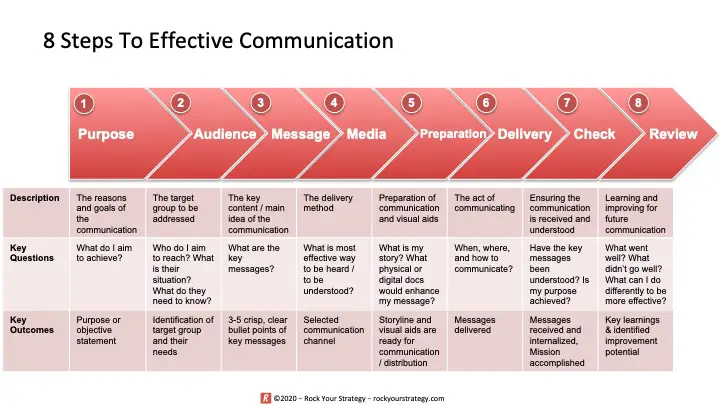
You have finished your strategic plan and you are ready to get started. But wait! Have you already thought about how to communicate the strategy to your employees? Here is the 8-step process to ensure that you effectively communicate the strategy to your employees.
8 Steps to Effective Communication
Be clear about the purpose of the communication
Know your audience
Plan your messages
Choose how to communicate
Prepare your story and visual aids
Deliver the communication
Check for understanding
Review and learn
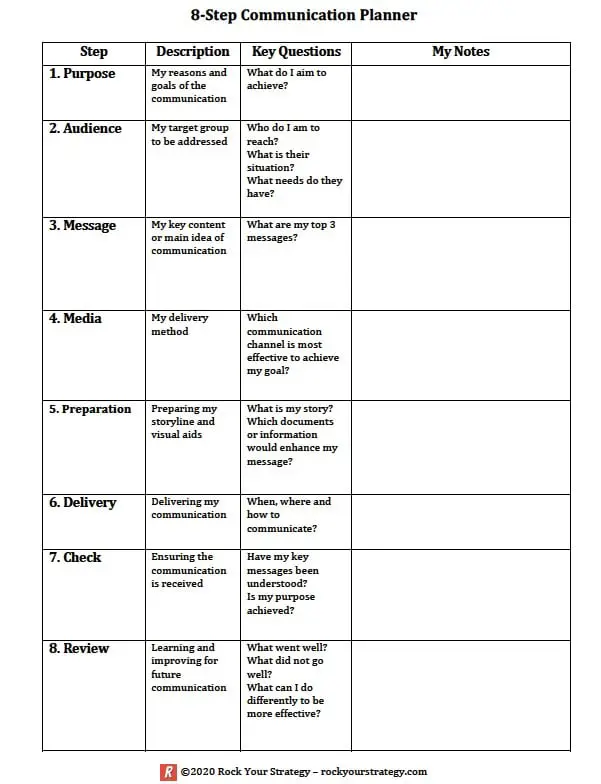
Creating understanding and buy-in about the strategic direction of the business is critical to success. Thinking through these 8 steps allows you to plan your messages and communicate with confidence and impact. When it comes to strategy, clarity is paramount. Read on to learn more about these 8 practical steps to effective communication and scroll down to download our preparation template.
Effective strategy communication
Before jumping into the 8 steps it is worth describing why effective strategy communication is so essential.
People are the engine behind your business. It’s the people that move your business forward, achieve your objectives and implement your strategy. It is therefore critical that your people understand the direction of the business and what is expected of them. Unfortunately, the reality is that in many organizations the strategy is not clear.
Numerous studies have shown that lack of clarity about the strategy and lack of communication are among the top reasons why strategies fail during implementation. Having a clear strategy is not good enough. It is important that the strategy is clear to employees and other stakeholders. Only then can you effectively move your business towards its destination.
So how exactly can you ensure that your team is clear about the business strategy? Communication, communication, communication.
In my experience, it is most beneficial to involve the employees throughout the strategy process. However, depending on the size of your organization, it may not be realistic to involve everyone. Besides, there is a business to run, customers to attend to, and products to deliver. So keeping an open line of communication throughout the process keeps the team engaged and updated on progress.
I like to say that when it comes to strategy, you cannot over-communicate. Since the topic of strategy can be daunting, it makes sense to plan your communication in order to have the desired impact.
An effective communication plan has 8 steps.
8 steps to effective communication
Following these 8 steps will put you on route to effective communication and successful strategy implementation. We will now go into the details of each of these 8 steps.
Communication is a tool to inform, influence, and socialize and communication happens between people. It can therefore be used in different ways and can be perceived differently by different people. In order to have the desired impact, it is important to first think about why you communicate. How you plan your communication and how you deliver it will differ based on your purpose.
The first step when you begin planning is to describe the purpose of your communication. What are the reasons and goals of the communication? What is the desired impact you wish to have on your target audience?
The key question is: what do you aim to achieve?
Be deliberate about this step and don’t gloss over it. Write down your reasons or purpose as specific as possible. This is really important! But why?
During the communication, people will decide in the first few seconds whether what they are about to hear or see is relevant to them. That’s right! Just a few seconds in, they will decide whether to pay attention to what you have to say or whether to tune out. That means you have one chance right in the beginning, possibly even before the communication begins, to generate interest and capture your audience’s minds and hearts.
If you are not clear about your purpose and its relevance in those first seconds, you will lose people or at least part of their mental and emotional capacity. For people to really listen and pay attention, you have to make an emotional connection with your audience.
Communication happens between people and people are emotional. The messages you send are not only the words you speak or the graphs on your Powerpoints. Your audience receives much more than that. Your audience uses all its human senses to receive your communication, especially when the communication itself or the topic you communicate about is deemed to have significant personal impact.
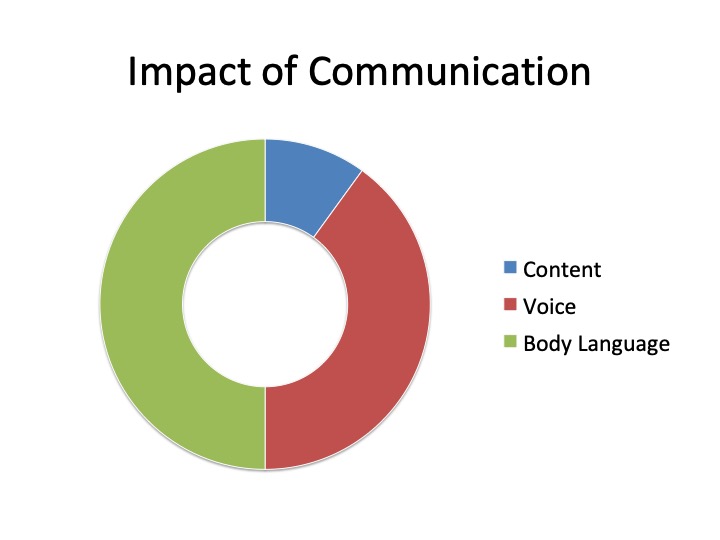
When you communicate, especially when holding in-person communication, the content of your communication has the smallest impact. The largest impact is made by how you communicate. In fact, content only accounts for about 10% of the impression you make. About 40% of the perception of your audience is influenced by your voice, i.e. how you articulate yourself, the pitch, the volume, the tempo. And 50% of your impression depends on your body language, which means your posture, your gestures, your facial expressions, and your eye contact.
This is important to consider. When you start with why you communicate and what you aim to achieve, you allow yourself to plan for all aspects of your communication in order to have the desired impact on your audience.
So be clear about your purpose and reasons and then plan your communication accordingly. The reasons why we communicate can be numerous. Here are common reasons for communication in the workplace:
Why we communicate
To share information
To ask questions
To make decisions
To receive or give feedback
To establish or deepen relationships
To motivate people
To express emotions
To entertain
In regards to strategy communication, here are a few examples of reasons and goals of communication related to strategy.
Examples of purposes
To inform the team about the new strategic direction, to explain why the change is necessary, and to make sure everyone understands how they can help.
To share information about the organizational change to build confidence in the team, to help people deal with uncertainty and to prevent the spreading of rumors.
To make the decision to invest in a new product line
To update senior management on progress with strategic initiative 3 and to receive additional funding for the next phase of the initiative.
To ask for support of the employees for adoption of a new company policy.
Notice that all of these reasons address very emotional topics. Strategy communication typically touches on topics that go very near and dear to people’s personal state of being. Strategy communication therefore needs to be carefully prepared and executed.
Briefly looking ahead to later steps and the actual delivery of the communication, it can actually be quite helpful to state in the beginning of your communication what you aim to accomplish. Stating your purpose makes clear to your audience why you are there and why they need to listen. But more about that later…
In summary, be specific about what you aim to achieve with your communication so that you can plan to capture your audience’ attention. Speaking of the audience, let’s look into that aspect of communication next.
2. Audience
The audience is the target group of your communication. These are the individuals or the group of people who you wish to address your communication to.
Communication is all about the audience. In communication it’s not about what you send and it’s everything about what is received. In order to communicate effectively then, it is important to understand who is going to receive your communication and how it will be understood and interpreted. That means the communication is most effective when it is customized to the target audience.
The second step of the process is to identify the target audience and to learn about their situation and needs. Let’s spend a bit more time here as this is so important.
The key questions are: (i) who do I aim to reach? (ii) What is their situation? (iii) What are their needs?
First, start by listing who your primary audience is. Is it the entire company? A specific organization or team? Are you communicating publicly towards certain stakeholders such as customers or investors? Write down the audience you primarily wish to address.
Then think about the secondary audience. What does that mean? Keep in mind that when you communicate to your primary audience that your message could also be picked up by people for whom the communication was not initially intended. What impact could the communication have on them? Consider the following example.
Example of primary and secondary audiences
Andy speaks at a trade fair about Florian’s Fastener Solutions’ new product line. He outlines the market need, introduces the new offering, describes its unique value proposition and compares it to competitive offerings. Andy closes with a call to action.
Andy’s primary audience is potential customers who attend the trade show. However, in this public forum also employees of Florian’s Fastener Solutions can hear the messages. It’s an opportunity for Andy to be a role model for his colleagues and to praise his team’s work on creating this new offering. His team may feel pride and motivation being praised by their leader so publicly.
At the same time, competitors could of course also be present at the trade fair and could also be in the secondary audience. Andy has to assume that his speech is also attended by competitors. He needs to account for that in the messages he sends and the information he shares. He must not divulge confidential information or trade secrets that could harm his company or his competitive situation.
In this example the primary audience is potential customers. The secondary audience includes colleagues/employees and competitors.
(Note: there could of course be additional members of the secondary audience such as business partners, government representatives, investors etc. but I have excluded them for sake of simplicity of the example.)
Secondly, for each identified target group, describe what the audiences’ situation is. Each communication has a context, an environment in which it is received. And it is worthwhile to think about the situation in a micro-environment, i.e. the immediate surroundings, and a macro-environment, i.e. the larger, external context. Think about the specific situation for each of the target audiences.
Situation Analysis
Micro-environment
Immediate, internal surroundings, incl. location, time of day, atmosphere, mood
For the trade show example above, the situation includes the immediate environment of the trade show. It is a public forum with many attendees. Imagine Andy’s communication takes place in the late morning just before lunch. His audience may be tired, jet-lagged or hungry or all of the above. Andy should consider all of these aspects in the micro-environment.
In addition, the trade show takes place in the macro-environment of the economic situation, the industry cycle, the time of year etc. If potential customers in Andy’s audience are currently experiencing economic hardship, they will receive his messages differently than when they are experiencing times of rapid growth and prosperity.
For each of your primary and secondary audiences, write down their specific micro- and macro-situations. Capture only what is relevant to your communication, i.e. what you need to plan for. Remember that you are not writing a PhD thesis on the political era or the economic epoch. A few bullet points may suffice.
Thirdly, capture the specific needs of your target audience. The needs describe the expectations your audience may have of you. Given their situation, what is it that your audience needs from you? Do they need information? Do they need the solution to a problem? Do they need assurance? Do they need entertainment? Do they need empathy and understanding?
Remember that the emotional state of your audience will influence the audience’s understanding and perception of your message. And this will ultimately determine your audience’s response. Depending on the impact you aim to have or the response you wish to trigger, you must appeal to the specific needs of the audience in their specific situation.
For example, if your audience needs information about the performance of a product to make a purchase decision, then actual performance data and reference cases or proof points might be very effective. If however your audience needs assurance that during the announced organizational change no one will lose their jobs, then a communication with data and timeline about the change will not be effective in addressing the audience’s concerns.
In regards to needs of the audience, consider that
Emotional needs must be addressed with an emotional message
Factual needs must be addressed with a factual and an emotional message.
On your list of target audiences and their situation, write down the specific needs each audience has given who they are and what situation they are in.
You can summarize your insights in a table that looks like this:
Audience (Primary & Secondary)
Situation (Micro- & Macro-situation)
Needs
Primary audience 1
…
…
Secondary audience 2
…
…
Secondary audience 3
…
…
When you are clear about the purpose of your communication and your primary and secondary target group, you can then proceed to craft your key messages.
3. Message
The message is the key content and core idea of your communication. The message describes the essence of the information you want your audience to hear, understand and walk away with.
The third step of the process is about working out clearly and concisely the key messages of your communication.
Why the message is critical becomes apparent with a simple example. Have you been in a conversation with another person and after the other person is finished speaking you are wondering what it was he or she tried to say? He or she may have spoken a lot but said very little? In such a situation, the message did not come across. The person failed to deliver a clear and concise message that you could understand and retain.
Being specific about your key messages is critical and not as easy as it seems. So dive in and take the time you need to get this right.
“Simplicity is the ultimate sophistication” – Leonardo Da Vinci
What are the hallmarks of key messages? Key messages are:
Concise: short and crisp summary of the most important information
Relevant: customized to audience’s situation and needs
Simple: easy to understand, in simple language
Memorable: easy to retain and repeat
Believable: real and imaginable, not far-fetched
Meaningful: carry significance for your target group
Thereby, key messages are no more than 2-3 clear and concise bullet points. And in that lies both the art and the difficulty.
Creating key messages is a 5-step process in itself. Go about it as follows:
Brainstorm: collect the key ideas and information you plan to convey
Draft: write out your messages taking into consideration your target audience, their situation and needs.
Trim: reduce the messages to their essence. Review each sentence so that each word carries meaning. Delete fluff or ambiguous terms.
Test: try the message on a confidant or trusted person. Check whether your key messages come across the way you intend and whether they have the desired impact.
Refine: review and refine your key messages based on the feedback you receive.
Note that you customize your key messages to your target audience. If you are addressing different stakeholders, I suggest you repeat this process for each target audience. That way you ensure that your communication is tailored to the needs of the respective group.
Once you have crafted your key messages, it’s time to choose your communication channel.
4. Media
Media refers to the communication channel. This is the means by which you conduct your communication and deliver your message. The choice of media must align with your purpose, your target audience and your message.
In step 4 of the process you choose your communication channel.
The key question in step 4 is: what is the most effective way to reach your target audience so that your key messages are heard and understood?
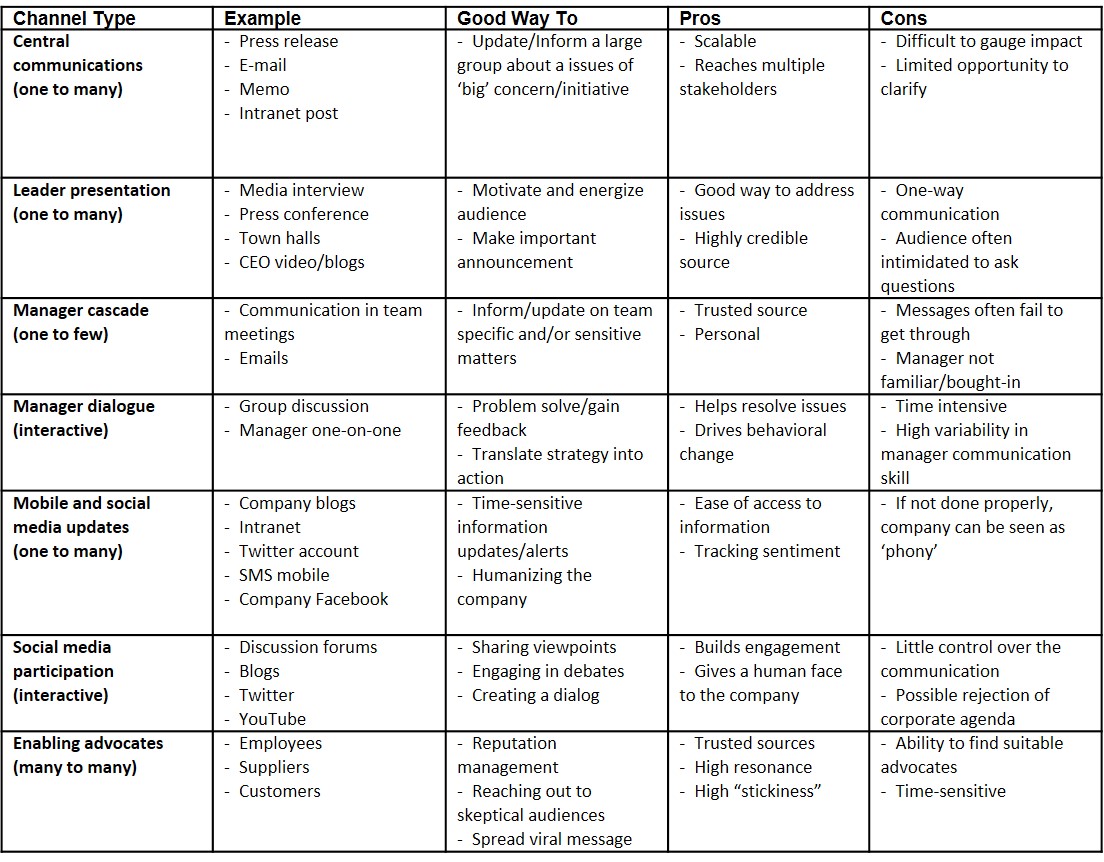
The choice of communication channel is an important decision. It either helps to effectively deliver your message or to undermine your impact. When choosing your channel, consider how many people you aim to reach and whether you aim to deliver your message one-way or seek feedback and interaction.
Additionally, especially if you have a larger team with multiple locations or if some employees work remotely, consider whether in-person communication is important. This can be of particular significance when sensitive and emotional information needs to be conveyed. Whenever possible, I prefer to communicate matters related to strategy face-to-face. So in your channel choices, take into consideration how best to reach colleagues who are not in the same location.
Choose your communication channel by asking 4 questions:
Do you plan to reach one, few, or many people?
Do you plan to communicate one-way, two-way or multiple-way (i.e. are you seeking feedback and/or interaction)?
What channel options do you have and what are pros and cons of each option?
Which channel option best suits your purpose, audience, and message?
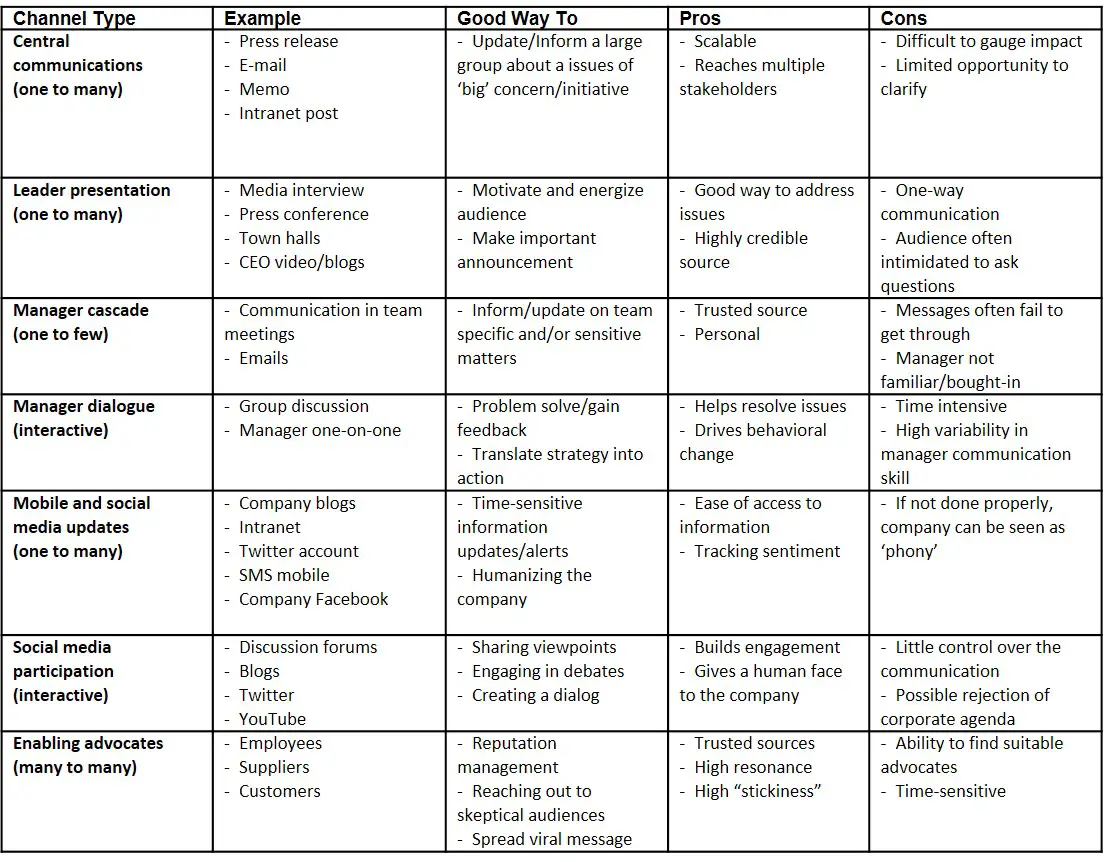
Gartner, the research and advisory company, provides an excellent overview of channel options for internal communication in the following graphic.
Source: Gartner1
Note that channel choice is not a binary decision. I have beaten the drum enough by now that communicating your strategy or important aspects of your strategy is all about being heard and being understood. So when making channel choices, it’s more about your audience than about you and your message. Therefore, consider using multiple channels to convey your messages to ensure reaching each member of your organization.
Tip: Effective communication might not be achieved by choosing the right communication channel but by making the right combination of channel choices.
Consider our B2B strategy example Florian’s Fastener Solutions (read Florian’s story here). When communicating the company’s new strategy, Andy, the general manager of Florian’s, used multiple channels to communicate with Florian’s employees, customers, owners, and investors. After working out their strategy among the leadership team and several functional experts, Andy used the following channels for communication.
Andy conducted one-on-one meetings with each owner and major investor.
Andy announcedthe essence of the strategy by email to all employees.
On the same day, Andy called a town hall meeting to communicate the strategy to all employees. In the town hall, Andy provided more background about the need for change, his personal thoughts and motivations, and opened up for questions.
Andy and his leadership team used team meetings to communicate more detailed aspects of the strategy related to each function and team.
Finally, Andy and his leadership team used formal and informal one-on-one meetings to check in with important members of the team and those they felt weren’t clear or committed yet.
For external communication, Andy personally emailed key customers and suppliers to inform them of the new strategic direction. The sales team received talking points for individual communication with customers.
By using multiple communication channels, Andy was sure to reach every member of his organization. He invested additional efforts to be available for questions and feedback. And he followed up to ensure the new strategy was understood and people were clear how they could help.
Think about which communication channels are most effective for your communication and you are well on your way towards your delivery. And the preparation for the actual communication is next.
5. Preparation
You are almost ready to deliver your communication. Now it’s time to put it all together.
Step five of the process is about the concrete preparation to deliver your communication. This is when you write that email, prepare your full remarks, create the PowerPoint presentation, and rehearse your delivery.
The key questions are: what is my story? And what visual aids or supporting materials do I need to tell that story most effectively?
So before you open PowerPoint or Outlook and jump right in, review once more your purpose, your target audience, your messages and your communication channel. Then think about the story you are going to tell.
In order for your communication to be effective, you need to build an emotional connection with your audience right away. You need to make the audience interested and you want to keep your audience engaged throughout your communication. What does that mean for your story? Think about your communication as having 3 parts: a beginning, a middle, and an end. Set up a storyboard and work through those 3 parts.
Beginning
In the beginning, you need a hook to make your audience interested. When you begin, your audience will consciously or subconsciously go through the following questions: what is this about? Is this relevant to me? Should I pay attention? Is this worth my time? Don’t think just because you are the boss that your team will listen to you or read all your emails attentively. You first need to earn their trust and their attention. Consider starting with a personal anecdote or a meaningful fact and then continue with the purpose of the communication. As my speech mentor once said, “tell them what you’re going to tell them”.
Middle
The middle part carries the main information or key messages. This is the meat of the communication. Keep this part interesting and engaging. Just like in this article, keep paragraphs or remarks short and digestible. Use simple language that is easily understandable. Stick to your messages and make sure not to stray off topic. Consider to enrich the middle part with examples, illustrations and personal stories. This will make the content relatable and better yet personable.
End
At the end of the communication, two things are important: summarize your key messages or take-aways so that the audience will remember them. And include a call to action. What do you want your audience to do with the information you have shared? Do you want them to simply understand and retain the information? Or do you want to move your audience to action? Be clear about that at the end. Finish with what will happen next.
When you have your story mapped out, check what visual aids could support your message and enhance your delivery? Studies have shown that many of us are visual learners who benefit from seeing what they are hearing. Tap into that to increase your communication effectiveness.
Examples of visual aids could include
A graph with information in the text of your email
A set of PowerPoint slides to accompany your verbal remarks
A handout or sample of what you are discussing
Especially this last item, a sample or object, could be very powerful. Haptics are an incredibly important sense for humans. Seeing is believing? Try seeing, touching, smelling, etc. It’ll make your story come to life. Just don’t make it too fancy to distract from your story and messages!
Important not on PowerPoint slides: your slides are not your presentation. Your messages and your delivery are your presentation. The slides are just there to support the delivery of your message. If you have spent more than 10 minutes in a large corporation, you know what I’m talking about.
Ok, once your storyboard is ready, go ahead and open your email program, your word processing or your slideshow software and write your story and create your visual aids.
When you are finished, let it sit and take a break. Not only do you deserve a break after all that heavy lifting. It’s good to get some distance from your story so that when you come back to it, your eyes are fresh and you can critically review it one more time.
The last step of preparation is to rehearse your communication. Don’t take this step lightly. Practice your delivery. People say Steve Jobs planned and practiced his speeches meticulously to the last detail. Do it like the master himself. Ask a colleague or friend to help you with this. Having a live audience is helpful during practice. The feedback will help you refine and improve. Trust me on this one!
If your communication is in writing, have it reviewed and edited by a trusted friend or advisor. It’s amazing what a different pair eyes can see.
Tip: if you plan to speak in front of your organization and you are not used to doing so, practice your remarks in front of the mirror or better yet on video. Record yourself or ask someone to record for you. With a smartphone this is easily done these days. Review the video to see how you come across. Do several takes if you have to until you are satisfied. if this is an important communication, then your efforts will pay off!
One more thing: I have written this entire process from the point of view of the business leader. Many of us are fortunate enough, however, to have expert colleagues who help us with writing the concrete communication piece or who put the PowerPoint slides together. You may of course consider outsourcing this step if you have the resources to do so.
When you do outsource, make sure to walk your colleagues through the first 4 steps to make sure they fully understand the intent, the situation and the needed tone of the delivery. Make sure this remains your communication. It must fit your style and your choice of words. Authenticity is critical in communication – especially when communicating important or sensitive information like the business strategy.
Therefore, plan to invest time to edit the email, rewrite parts of the speech, and modify the PowerPoint slides. If necessary, ensure your colleague who created the text doesn’t feel hurt by your changes. But it is important that you are 100% comfortable with the communication. If not, the delivery may seem awkward or phony to the audience – or worse the audience might feel that this is not your communication and that you are not fully behind it. And when it comes to strategy, that would be the worst case scenario.
So get ready, make it yours, and move to action.
6. Delivery
Delivery refers to the act of communicating. After the previous six steps were about planning and preparation, step 6 is about implementation.
Before you go ahead to turn your plan into action, consider carefully when, where and how to deliver your message. You want to be fully in control of your delivery so as to have the planned impact on your audience.
Depending on your purpose, audience, message and media, you may have a number of options at your disposal. Think about these options in very practical terms. Then while considering your purpose, put your audience, its situation and its needs first.
Plan your communication at a time when you expect the highest amount of focus and concentration and the least amount of distractions and noise.
For example, for communication about your strategy, which month and day would be best? Would it be more effective for your business to kick things off on a Monday or close out the week on a Friday? Would the delivery be more effective first thing in the morning or in the afternoon? Do you have people in different time zones you need to include? Be deliberate about these choices.
Here’s what has worked well for me. When communicating important information, I try to communicate in person whenever I can. You have much greater control of your message and its delivery when you can use all your personal tools such as voice, body language, and eye contact. In-person communication allows me to connect better with my target audience on an emotional level and ensure that they are open to receive my message.
Should personal communication not be possible for any reason such as different locations and an inability to travel, then I’d prefer the next best alternative: video-conferencing. It’s not exactly in-person, but at least via video you can see each other and observe body language.
Having said that, whether in person, via video conference or in writing, when it comes to timing, I try to avoid times of distraction. My experience is that first thing in the morning, shortly before lunch, right after lunch and shortly before the end of the day are poor times for communicating important information.
This certainly depends on your work culture and norms in your business. My experience is that early in the morning people are not yet fully present. Some people might not be awake yet or might lack the needed level of caffeine. Others need the chat with colleagues to get up to speed or work their way through the email inbox before being ready to engage.
Lunch time is a similarly difficult time. Before lunch, people may be planning their lunch arrangements or their hungry stomachs may prevent them from focusing. After lunch, blood rushes to the stomach to help with digestion and the onset of “food-coma” makes the early afternoon an equally ineffective time.
In my experience, the best times for communicating important information are mid-morning (e.g. 10 am) and mid-afternoon (e.g. 2pm). People tend to be most present and most attentive at those times.
If you are working in a shift system, allow people to clock in and then communicate with them before their shift.
I want to re-emphasize one point I already mentioned above in passing, which is critical for effective communication: when delivering in-person communication, build an emotional connection with the audience first. It’s like the right pitch for a home-run or the perfect set for a spike. An emotional connection “opens up” the audience to receive your message. On the other hand, when the audience is not ready, the message will roll off like water from Teflon. So invest first in that personal, emotional connection, and then tell your story.
Lastly, remember for personal communication, your impact depends only 10% on the content, and 40% on voice and 50% on body language. Use all those tools in congruence with your messages.
Now, go get’em!
7. Check
Most communication literature ends here. Communication delivered – done. Well, I disagree. Having emphasized a lot how important it is to be heard and understood, I think it is important to check whether your communication was indeed received the way you intended. After all, success with your strategy starts with everyone being clear about your strategy.
Step 7 of the process is about checking with your target audience whether the communication has been received and understood.
The key questions in this step therefore are: have the key messages been understood? Has my purpose been achieved?
Let’s first understand why your communication may not be understood as intended. The reasons could be numerous:
Communication was missed: didn’t receive or open the email, didn’t attend the meeting, etc
Communication received but not understood: didn’t read/listen carefully, didn’t understand the meaning of the words, there was a language barrier, etc.
Communication received, but misunderstood: didn’t understand the jargon, associated different meaning to the words used, had a different point of view, etc.
Communication received and understood, but not convinced: didn’t think messages were realistic, had a different point of view, didn’t understand the why, etc.
Communication received, understood, and convinced, but didn’t know what’s expected next: didn’t know what to do with the information, didn’t understand the call to action, felt uncertain or unmoved.
Note that all these reasons, as different as they are, will lead to the same or very similar outcomes: the original purpose will be missed.
How to check whether your communication was effective? There is no right or wrong way to go about this. The easiest way is to be available for questions and ask for feedback.
For example, if you are speaking to your team in a town hall or team meeting, open up for questions immediately after finishing your remarks. If you communicate in writing, include directly in the text where, when and how people can ask you questions.
It is important to be patient with your audience. Let the information sink in and give people time to formulate their thoughts and questions.
Consider that not everyone may dare to speak up in public. Yes, it can be intimidating to many to raise their hand and ask what’s on their mind. So in addition to being available for questions in public, also follow up in private.
Make yourself available for smaller group discussions or one-on-one meetings. In those follow up sessions, seek to listen and understand. These are valuable opportunities to reinforce your messages and bring clarity to your purpose.
Here are example questions you can ask in order to trigger questions or feedback and gauge your communication effectiveness:
Do you have any questions?
Was anything unclear?
What were your main take-aways from the communication?
What can you do next?
If your audience has understood your messages and your purpose has been fulfilled – mission accomplished. There is only one last step.
8. Review
Having gone through the entire process, there is only one last step to take. What can you learn from this communication?
Step 8 of the process is about learning and improving for future communication.
Key questions of this final step are: what went well? What didn’t go well? What can I do differently to be more effective next time?
Ok, this is not rocket science. Simply sit down after you have completed the communication and reflect on how it went. Answer the key questions above and write down your insights. Learning from your experience is a great way to develop and improve yourself.
Think about how you approached the overall communication. You may want to reflect on the following types of questions:
Were you clear on your purpose?
Had you identified the target audience and their needs correctly?
Were your messages on point or did you have to reiterate during the communication?
Were the channels you chose effective in reaching your audience?
Would you change the channel mix if you were to start over?
What kind of questions did you receive during the communication?
Could you have prepared for the communication and the questions more effectively?
…
This list is just to start your brainstorm and certainly not exhaustive. Think about your own questions to reflect on based on your experience.
You can use the following table to write down your reflections.
Reflective Question
Your Notes
What went well?
What didn’t go well?
What can I do differently to be more effective next time?
If you have worked on this communication in a team, feel free to individually and jointly review your learnings and provide feedback to each other. Thereby you can all learn from this experience.
And next time you need to communicate, you will be even more effective in reaching your team and being understood.
Creative ways to communicate with employees
So what are effective ways to communicate with employees? We have put together a list of different communication channels to get the word out as follows.
There is no one, single best channel to communicate your strategy. Every organization and every individual is different. The key to effective communication is to use combinations of channels and to reiterate your key messages in different ways.
Remember that in the end it is not about what you want to say and it is everything about what your team hears and understands.
Preparation Template
Wow, this was a long article. I wanted to include everything I have learned and experienced to make this as helpful and practical as possible.
Looking for more tools and templates? Check out our template page below.
Templates
Find tools & templates for OGSM and your strategic planning process here.
OGSM Examples
Find OGSM examples and inspirations for your own journey here.
Conclusion
Effective communication is critical to successful business strategy implementation. And communication is not only about being heard, but more importantly it’s about being understood. Taking the time to plan your communication deliberately ensures that you have the desired impact. Our 8 step process to effective communication helps you rally your team and deliver results.
You have developed your strategy and are ready to implement. However to do so effectively, you want to make sure your team understands what your business strategy is all about and what is expected of them. Here are 12 effective ways to communicate your strategy to employees.
Team meeting
Townhall
Strategy conference
Virtual meeting / webinar
One-on-one meeting
Informal conversations
Video recording
Story / fairytale
Strategy handbook
Strategy board
Regular strategy newsletter
Use a one-page strategy framework
Great, that’s a handsome list. Now let’s dig deeper and learn more about how you can use these ways to get your message across. Before we do so, why is it so important to effectively communicate the strategy?
Importance of effective strategy communication
Your people are the engine behind your business. It’s the people that move your business forward. It’s the people that help you achieve your objectives and implement your strategy. It is therefore critical that your people understand the direction of the business and what is expected of them.
Unfortunately, the reality is that in many organizations the strategy is not clear.
According to a recent survey by Bridges Business Consultancy, a staggering 67% of strategies fail during implementation1. And the number 1 reason for failure is… (drum roll, please)… poor communication! A similar study conducted by the Economist Intelligence Unit found that communication surrounding strategic initiatives and communication of the overall strategy were among the top barriers for effective strategy implementation2.
Effective communication of a strategy is critical because there is a direct link between clarity of the strategy and its effective execution. This makes intuitive sense. When all rowers in a boat know in which direction to paddle, the boat is more likely to pick up speed and reach its destination.
Simply defined, the business strategy describes the set of choices the business makes to achieve its objective and goals. For the strategy to be effectively implemented, clarity about the vision, mission, and objectives of the business throughout the organization is essential.
So, here are 12 creative ways – in no particular order – to communicate your strategy to your employees to make sure that the people in your business know where the business is heading.
Team meeting
The team meeting is the classic approach to communicating important information such as the strategy of the business.
The team meeting is typically an in-person meeting of a group of people who know each other well and closely work with each other. Team meetings are typically held at regular intervals. Some teams meet daily, weekly or on a monthly basis.
Strategy discussion in team meeting
Team sizes can vary of course from a few people to a couple of dozen people. Regardless, team meetings are typically intimate settings with a level of trust established among team members. Team meetings are therefore good opportunities for strategy communication.
Depending on your team norms and culture, you may choose to present the strategy to the team or have a detailed discussion. The team setting is excellent however, because its setting allows for an intimate dialogue about the strategy, what it means for the business and what it means for your team.
Take as much time as you need for this discussion. Ensure that there is an opportunity to ask questions and clarify concerns. It must be the objective of the discussion to create clarity and understanding about the strategy. Conclude the team meeting when all questions are asked and everyone can state the strategy in their own words.
Consider using visual aids, props, stories or other means discussed in this article to make the strategy discussion in your team meeting as engaging and memorable as possible.
Town Hall Meetings
The town hall meeting is typically a communication session with a larger audience in which a group of people is consulted or informed on a topic of interest. According to Wikipedia, the town hall format originates from colonial era North America, when politicians communicated with their constituents on matters related to the community or new policies and regulations. The town hall format has meanwhile been popularized by politicians and business leaders around the globe.
Example of a small townhall meeting
The exact format, length, venue, and purpose of town hall meetings may vary. Town hall meetings are great for strategy communication because the business leader can directly address the entire company or a large group of employees. The format allows for interaction, debate, question & answer, and clarification.
The communication of the strategy during a town hall meeting could take the form of a presentation with subsequent Q&A session. The business leader or the senior leadership team can directly address the team and be available for questions and comments.
This way the organization can hear the strategy and its purpose directly from the most senior leaders instead of reading about it or hearing it cascaded through the hierarchy. This could greatly enhance the level of understanding of the strategy.
Strategy conference
The strategy conference is typically a high level meeting of the most senior members of an organization. The aim of a strategy conference is to communicate the strategy and also work out further details about its implementation. The purpose of a strategy conference is to involve its participants in the discussion and detailing of the strategy.
The strategy conference can be a powerful way of disseminating the strategy as it involves a large number of people in its creation and implementation. This creates buy-in and commitment. It also gives members of the organization the opportunity to help shape the strategy and with it the future of the business.
People participating in a strategy conference
Imagine the strategy conference to be a multi-day meeting at an offsite location. It may include formal presentations and speeches. It may also include workshops and break-out sessions.
The most effective strategy conferences have an overall theme or purpose and constitute a mix of sessions and formats.
The strategy conference should have a closing session in which the results of the conference are presented and discussed.
I have personally participated at several such strategy conferences on global, regional, and national levels. The conferences typically included 50-100 participants and covered longer-term strategic objectives and annual operating plans. The conferences I attended mixed formal speeches with informal discussions, casual encounters and team-building sessions.
Especially the latter part of informal and casual sessions were important in reaching the employees, setting the tone and making things fun and engaging. I can only recommend it!
Virtual meeting / webinar
A virtual meeting or webinar is similar to a town hall – except that it’s not held in person but online. The purpose is however the same. It’s a large group meeting to communicate the strategy directly from the leaders to the employees while providing a forum for questions and clarifications.
There are many online platforms nowadays that support such virtual meetings. There are for example, Microsoft Teams, Zoom, and Webex. All of these platforms allow for participants to dial in by computer or by phone and to share and view presentations.
Participating in a video conference
In addition, a technology I find particularly compelling to complement virtual meetings is Slido available on www.slido.com. Slido allows participants to ask their questions via a designated website or app. The questions can be collected, ranked and answered one-by-one in turn.
What’s particularly compelling on Slido is that participants have the choice to identify themselves or ask questions anonymously. In my experience the option of anonymity takes away some people’s barrier to raising questions. Slido also allows for polling and quizzing of participants and thereby creates a whole different meeting experience. Highly recommended!
One-on-one meetings
As the name suggests, one-on-one meetings are small, intimate sessions between two persons. Often less formal in nature, these are typical interactions between managers and employees or between peers.
Because of the intimate, private setting, one-on-ones can mark an effective occasion to provide in-depth information about the strategy, additional (potentially confidential) information or subject-matter specific information. It is also a good occasion to clarify specific questions or seek commitment from important individuals.
One-on-one meeting
I have often used one-on-one meetings to follow up on larger team communications and to address specific questions related to specific persons or topics. For example, I may follow up with a person who had a particular question in a town hall or I may clarify with the leader of a strategic initiative what exactly is expected of him or her.
In one-on-ones, I try to make sure that the other person is comfortable and feels free to raise any question or comment by establishing a trustful, relaxed atmosphere.
One word of caution: one-on-ones are not effective for strategy communication in the absence of an overall communication. Not only would it be inefficient to address a larger team or organization one by one. The team would also not have the benefit of hearing the same message, using the same words at the same time. So I’d use one-on-ones only in combination with one or multiple means of team communication.
Informal conversations
Informal conversations are casual encounters among two or more people outside of formal work settings. These can be joint meals, such as lunches or dinners, social events, or simply the proverbial watercooler or elevator chats.
The thing is that informal conversations typically take place among family members and friends or persons with a strong, trustful bond. The hallmark of an informal conversation is a high level of openness and vulnerability, frankness and candor. Because informal talks are less concerned with upkeeping of formality and professionalism, communication is often more emotional and direct. It is in these conversations that information is shared in its purest and often most honest form.
Informal gathering after work
The trust needed for informal conversations is of course not built in an instant. I do not walk up to a person and say “let’s have an informal conversation”. It is when the trust exists that an informal conversation can take place. In such cases, it can be a great additional means of transporting sensitive, emotional and impactful information.
More importantly however, informal conversations are important opportunities to listen, seek feedback and clarify concerns.
As a leader in the business, be open and available for formal and informal communications alike to fully reach the people in your team. Capture their thoughts and their feelings when speaking about strategy and the direction of the business.
Story / Fairytale
“Once upon a time…” Didn’t we just love story time as children?
Good stories make us feel good and take us on a journey to… dare I say… a land far, far away. Stories are emotional. They capture our imagination and are very memorable.
Harvard professor Marshall Ganz explains in his work on Public Narrative that stories can create meaning in ways that connect human emotions and thereby move people to action4. Stories communicate in live experiences and not in abstract terms and principles. This makes information personable, relatable, and memorable.
We remember things better when we hear them in story form, also because the chemical oxytocin is released in our bodies when we hear a good story. That is the same chemical which is released when we feel trust, love, and kindness. That’s why good stories make us feel good.
In business likewise, storytelling can be a very effective means of communication.
So, turn your strategy into a story about your business. Imagine what it will look and feel like when your business reaches its destination and achieves its objectives. Write the story down and tell it during meetings, town halls or chance encounters.
And with your story, capture your audience and move people to action.
Video recording
Turn the story about your business and about your strategy into a video or a mini movie!
In education, researchers have found that including visual content in the learning and teaching curriculum can help students better engage with the materials, increase retention by 29-42%, and develop higher order thinking skills3. Visual learning begins when graphs, images, and illustrations appear alongside words, numbers, and text.
Visual-spatial learning, as it is called, doesn’t stop after school. In worklife, visual learning is just as important to capture complex information and subject matter. And business strategy can be such a complex topic.
Videos are a great way to make complex information more approachable and understandable. Video gives the opportunity to explain and visually depict information and tell a story. Video is thereby a powerful way to communicate to create understanding.
Record your own strategy video
But use video to communicate your strategy? Absolutely! Video communication does not need to be expensive and does not need to be complex. From creating a simple doodle to filming a story about your strategy, there are fun ways to make video content engaging and understandable.
Be creative! You might even be able to recruit your colleagues to act out what it may look like to succeed with your strategy. Short video clips may be sufficient to communicate the key aspects of your strategy.
There’s one more benefit of video. Once the video exists, it can be used time and again to reinforce key messages as well.
So, I think you can tell that I am a fan of video content. There is a reason why YouTube is so successful after all.
Strategy handbook
In an age dominated by digital communication, such as emails, PowerPoints, podcasts, and tweets (and might I highlight that you are likely reading this on your desktop computer or mobile device), we hold less and less physical books in our hands.
However there is something to be said about the pleasures and the impact of print.
Granted, print is costly and bad for the environment. All too often printed brochures are handled once and then filed and forgotten – or worse, neglected and tossed.
There are benefits however to reading on paper. According to a recent article summarizing several studies5, the benefits of printed books are numerous.
Reading in print helps absorb more information
Print is easier on the eyes
Print helps remain focused and become less distracted
Print simply amplifies the joy of reading
Summarize your strategy in a printed booklet
So when communicating strategy, consider including a printed handbook as part of your communication package.
A strategy handbook could take the form of a colorful, printed booklet that summarizes in easy to understand terms the most important aspects of your vision, your mission, your objectives and strategic choices.
A strategy handbook could also include background information, market insights, external references or inspirations, and your story. Again, there are no boundaries to your creativity and what a strategy handbook could look like. Make it visually appealing and a strong representation of your business and what you are looking to achieve.
Strategy board
Remember those good old pin boards in your office? Yes, those boards with pins that gave Pinterest its name. They seem from a different day and age, don’t they? Colorful pin boards in places where people come together can however be an attractive means to capture attention and communicate information.
What might a strategy board then look like?
Imagine a white board, black board or pin board in the cafeteria, pantry or break room of your workplace. Imagine this board holding information about your strategy, the direction of the business, its objectives, progress, and achievements. Not so hard to imagine…
Pinboard as communicator of priorities
Such a board could however be a very engaging communicator when frequently updated. Studies have shown that we tend to overlook information that is static and blends into our day-to-day routines. We notice however when things change in areas that are common and known to us. This is where a strategy board can be appealing.
Besides holding constant information such as the vision or mission statements of the business that tend to placate the walls of offices these days, a strategy board would enable updating and keeping employees current on latest developments in the business.
Again, be creative. Use color. Make content attractive. You may consider depicting the strategy in a visual way and keep updating and adding information as you implement and make progress.
And as a bonus idea, allow people to update the board with their contributions, achievements and ideas. That keeps the information current and engaging and makes people come back to check for updates.
Regular strategy newsletter
Although I wouldn’t recommend email as the primary means to communicate your strategy, a regular strategy newsletter would be an exception.
A regular monthly or quarterly email from the business leader highlighting the progress made on your journey to implement your strategy and deliver results could actually be quite powerful.
Such a newsletter could be an opportunity to reiterate what is important to the business and why it’s important. It could highlight specific achievements and give credit to teams and celebrate successes.
As often stated, implementing a strategy is a marathon and not a sprint. It is not uncommon though that a new strategy is presented with great fanfare and shortly afterwards the business returns to its daily routines and urgencies.
In that context a regular update straight from the business leader keeps the strategy implementation in perspective.
If you are considering to launch a regular newsletter, consider to include the following:
An overview of the strategic priorities
A dashboard highlighting key figures and progress with strategy implementation
A reminder why you are in business: I.e. your purpose, vision and mission
A visualization of the destination of your business
Highlights and achievements from the time period since the previous newsletter
Lowlights or challenges from the previous period and how they are being addressed
Outlook and priorities for the months ahead
A call to action: e.g. information or an illustration how colleagues can engage with the strategy and contribute to its achievement
A few candid, personal words from the business leader such as words of gratitude or a personal experience related to the strategy.
A strategy newsletter does not need to be long or a lot of work to create. The key is to regularly check-in on progress, engage with the team, and keep the strategy and its implementation top of mind.
After all, everything you do, should be tied directly or indirectly to the strategy and helping the company achieve its objectives.
Use a one-page strategy framework
In any and all of your strategy communication, simplify key aspects of your strategy into a concise and easy-to-understand summary. In my experience, nothing is more confusing and demotivating than a 100-page Powerpoint deck that goes into all the details.
On the contrary, a clean, concise overview that introduces key aspects of your strategy such as where you are headed and how you are going to get there creates clarity and engagement.
One strategy framework that can help to depict the entire strategy on a single page is the OGSM.
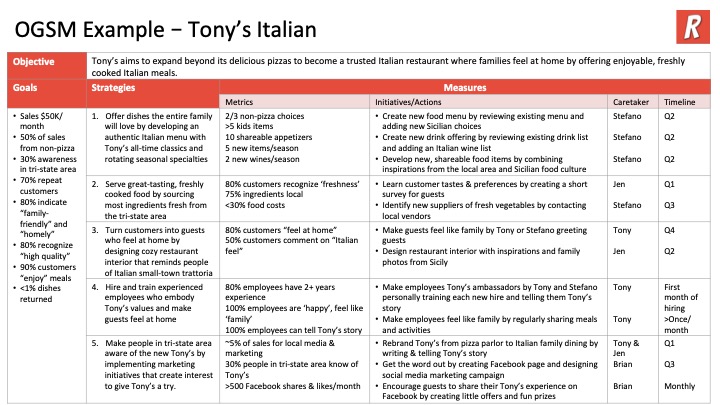
OGSM stands for Objective, Goals, Strategies, and Measures. It is a one-page business plan that shows what the business aims to achieve and how it’s going to achieve it.
OGSM Example: Tony’s Italian
The OGSM framework is both a methodology to create a strategic plan and also an effective tool to communicate the strategy and drive implementation. In short, the OGSM is a great way to simplify your strategy and deliver results.
Find tools & templates for OGSM and your strategic planning process here.
OGSM Examples
Find OGSM examples and inspirations for your own journey here.
Consider including the one-page OGSM framework in your communication package or hanging it on your strategy board.
Conclusion
These are our 12 creative ways to enhance communication of your strategy to your employees. A strategy well communicated is a strategy well understood. And with greater clarity and understanding, the organization has a greater chance to succeed at implementing the strategy and delivering results.
As I have learned during my many years in business, when it comes to strategy, you cannot over-communicate.
Now over to you. What additional creative ideas do you have to communicate your strategy? Let us know or drop a comment below. We’d love to hear from you.