Tag: strategy process

  • How to Build Your OGSM With AI: A Step-by-Step Guide (With the Questions to Expect)

    How to Build Your OGSM With AI: A Step-by-Step Guide (With the Questions to Expect)

    Most people who sit down to build a strategy with AI make the same mistake in the first thirty seconds: they ask it to write the strategy.

    You’ll get something back. Well-structured, confidently worded, and completely generic — a plan that would fit any firm in your industry, which means it fits none.

    The alternative is to use AI the way you’d use a good facilitator: let it run the process, ask the questions and hold the standard, while you do the deciding. An afternoon’s work, and you get something you’ll still defend in June.

    Here’s what that session looks like, phase by phase, with the real questions and the quality bar each phase holds. It’s what the OGSM Strategy Builder does — but the process is the process, and you can get value from this post without buying anything.

    What do you need before you start?

    Not much, but the numbers matter. Have these to hand:

    • Revenue — last full year and the one before, so growth is visible.
    • Margin — gross, and operating if you have it.
    • Growth rate — actual, not aspirational.
    • Customer concentration — what share of revenue your largest customer represents, and your top five.
    • The one operational number your business runs on. Utilisation for a services firm, lead time for a manufacturer, covers per night for a restaurant, renewal rate for anything on contract. You know yours.

    Then two more things: two to four hours of real work, which almost nobody does in one sitting, and a working answer to why now? Nobody writes a strategic plan because it’s January. Something changed, or is about to, and that’s the real subject of the session.

    If a number isn’t to hand, estimate it, say so, and move on. It gets flagged later as something to verify.

    My worked example throughout: Marlow Instrumentation Services, a fourteen-person Midlands firm calibrating lab instruments for pharmaceutical and food-testing customers. Revenue £2.4m, growing 3% a year, gross margin sliding from 41% to 36%, largest customer 22% of revenue.

    Phase 0: What does the diagnosis actually ask you?

    Ten to twenty minutes, and the phase everyone wants to skip.

    It opens with real questions — what you do, who buys from you, how you’ve changed. Then the one that matters: what made you want to do this now?

    Then scope (whole business or one function?) and horizon — a 3–5 year strategic plan or a 1-year operating plan. Pick one. It governs how ambitious the objective can be, whether timelines read 2028 or Q3, and whether reviews are quarterly or monthly.

    Then the Five-Answer Test:

    Ask five of your leaders, separately, so they can’t hear each other: what is our strategy?

    You’ll get five answers. Each reasonable, each confident, and not one quite the same. Solo? The equivalent is: could your best customer say what you’re trying to be?

    Then the Seven Cardinal Sins self-diagnosis, asked one at a time. Are you deciding from a picture of your market that’s a few years old (Ignorance)? Do five leaders give five answers (Discord)? Could someone on the floor say what the company is trying to do (Confusion)? Does the daily work quietly contradict the stated strategy (Incongruity)? Is there someone who has to carry this who doesn’t believe in it (Doubt)? Does the plan need capabilities you don’t have yet (Incompetence)? Is it agreed, pinned up, and not moving (Inertia)?

    Most businesses recognise three or four. That’s normal, and worth saying out loud, because people get defensive here. The ones you name become the watchlist for every phase that follows.

    Finally: list everything the business is currently working on. Everything taking real time or money. It’ll be longer than you expect — twenty items is common. Nothing gets resolved now. That list comes back in Phase 5, and it’s the argument.

    Phase 1: How does the reality check work?

    Key figures first — the numbers you prepared. Then a SWOT, built by conversation rather than form-filling.

    The questions have teeth. Name a strength and you’ll be asked who else in your market would claim the same thing? Give a number and you’ll be asked where it came from. Each quadrant caps at three to five items: if a strength doesn’t make your top five, it isn’t a key strength.

    Marlow’s SWOT surfaced the pairing that mattered — their biggest weakness (a price list that hadn’t kept up with wage inflation) sitting against their biggest threat (two national providers undercutting them per instrument). That pairing became a strategy three phases later.

    Where your situation warrants it you’ll be offered PESTEL, market trends, Porter’s Generic Strategies, Five Forces or the 5P marketing mix. Where it doesn’t, you won’t. A fourteen-person firm doesn’t need Five Forces to work out that price competition has arrived.

    Phase 2: How do you land on an objective you’d defend?

    Twenty to forty minutes. It’ll feel long. It should — everything downstream is derived from this one sentence.

    You’ll be pointed back to your why now? answer, then asked a present-tense question that people find easier than the future-tense one:

    When a customer chooses you over the alternative today, why do they?

    The honest answer is usually the raw material for the second half of your objective.

    Then three options — three genuinely different bets, not three rewordings — each with what it commits you to and what it rules out. You choose, or say the real one is none of them.

    Marlow’s first attempt was typical:

    “Grow the business by delivering excellent service to our clients.”

    Three problems. “Grow” is an outcome, not a direction. “Excellent service” is a claim every competitor makes. And swap in a competitor’s name — it still reads fine, which means nothing was chosen.

    After three drafts:

    “Become the default calibration partner for regulated pharmaceutical and food-testing labs in the Midlands by making audit-ready documentation, not price per instrument, the reason customers stay.”

    That names a segment, names a mechanism, and rules something out — price-led work, about a third of their current enquiry flow.

    Then five quick tests: substitute a competitor’s name (does it still work?); could five people repeat it the same way after hearing it twice?; what does it rule out?; what would someone do differently on Monday?; and is it ambitious enough to be worth it, grounded enough that nobody laughs? More on the craft in how to write a great objective.

    Phase 3: How do you turn that into goals?

    Twenty to thirty minutes. Three to five SMART goals, each written so it can be checked without a conversation: [metric] from [baseline] to [target] by [date].

    It starts with the twelve-month question — we meet again in a year, it’s gone well, what’s different? — then two relentless follow-ups: how much? and is that ambitious enough? The second is where the real number appears. People’s first answer is almost always their safe answer.

    “Improve customer retention.”
    “Contract renewal rate from 81% to 92% by 31 December.”

    Two rules shape the set. At least one financial goal — every strategy eventually shows up in the money. And goals covering both halves of your objective, the “what” and the “how”. Marlow’s renewal and revenue goals cover the what; regulated-lab revenue share and documentation turnaround cover the how. A plan with only “what” goals can be hit by accident, doing all the things you said you’d stop.

    Then the gate, which is the most useful question in the method:

    If we achieve exactly these goals — and nothing else — have we succeeded?

    If something is missing, write a goal for it. If a goal could be missed entirely and you’d still say the objective was met, it’s a metric you like, not a goal — it belongs in the Dashboard. See Goals vs Measures.

    Phase 4: What makes the strategies phase uncomfortable?

    Thirty to fifty minutes, and the phase that matters most. Everything before this could be done by a thoughtful person with a spreadsheet. This is where something gets given up.

    You’ll be pushed back to the SWOT pairings — your biggest weakness is X and your biggest threat is Y; what specifically are you going to do about that? You’ll generate six or eight candidates and then be forced to cut to three to five. The cut is the work.

    Each one has to pass the tactic test. A strategy sets a direction; it does not spell out the work. If it still leaves a real “but how, exactly?” for the next phase to answer, it is pitched at the right level. If it already specifies the work in full, it is an initiative and belongs in Phase 5.

    “Improve our marketing.” — Too vague. Costs nothing to agree to.
    “Redesign the website.” — Too specific. That’s an initiative.
    “Win regulated-lab accounts from the national providers by selling audit-readiness and documentation turnaround instead of price per instrument.” — Owner: Priya.

    Every strategy gets a named owner. Not “the team”. A person who has to answer for it at the review.

    Then the We WILL / We will NOT list, which takes ten minutes and turns intentions into a decision:

    We WILLWe will NOT
    Focus on regulated pharma and food-testing labsQuote on single-instrument, price-only tenders
    Compete on documentation and turnaroundCompete on price per instrument
    Build accreditation depth in two instrument classesCover every instrument a customer owns

    The right-hand column is the one that matters and the one that gets skipped. When you resist, you’ll get prompts like what would your competitor be pleased to hear you’d decided to keep doing?

    For Marlow, that column meant walking away from roughly £180k of low-margin work. Someone had built that revenue. That’s what a real trade-off feels like.

    Phase 5: How do the measures get built?

    Thirty to forty-five minutes. Per strategy, two structurally different things, kept explicitly apart.

    The Dashboard — 2–4 KPIs, each with a definition, baseline, target, frequency and data owner. At least one leading, one lagging. Six to twenty across the plan.

    The Action Plan — 2–3 initiatives that cause the strategy to work, each with a caretaker and dates.

    The speedometer doesn’t make the car go faster. Without the Dashboard you’re flying blind; without the Action Plan you have targets and no engine. Full method in the complete guide to OGSM Measures.

    Three questions build a dashboard. If this strategy is working, what would change? Then the “so what?” filter — if this number moves, what decision follows? If none, drop it. Then: what would you need to see in ninety days, before the annual numbers land? That last one finds your leading indicator.

    “Number of sales calls made.” — Activity. Tells you what your team did, not whether it worked.
    Lagging: revenue from regulated labs — £912k to £1.44m — monthly — Priya.
    Leading: quotes issued to regulated labs — 4/month to 12/month — monthly — Priya.
    Initiative: rebuild the certificate pack so it’s audit-ready without customer follow-up — Dan — January to end of Q2.

    Anything without a baseline gets refused. If the baseline genuinely doesn’t exist, establishing it becomes the first initiative under that strategy.

    Then the capacity conversation, the antidote to Inertia. Your Phase 0 workload list comes back and every item goes into one of three buckets: continues, paused, stopped.

    You’ve got nine new initiatives on top of eighteen existing ones. Which existing ones stop? Not “deprioritised” — stopped. If everything stays, we execute nothing.

    Focus is not about adding. It’s about removing.

    Phase 6: What does the stress test look for?

    Fifteen to twenty-five minutes, delivered in three parts: what holds, what I’d challenge, and what I can’t verify.

    Mechanical checks first — counts, missing baselines, strategies without owners, activity metrics wearing outcome metrics’ clothing, an empty “will not” list. Then judgement: the competitor test, the arithmetic test (do these strategies plausibly deliver these goals, or is it 28% growth against three efficiency initiatives?), the resourcing test, the capability check and the belief check.

    That third section is usually missing from AI strategy work, and it’s the honest bit. It has read everything and lived none of it. Your market size, a competitor’s intent, whether your team can absorb nine initiatives — those come back to you to check before the plan goes live.

    Where you disagree with a finding, it’s recorded as an accepted risk with your rationale and a watch-for. Not a defeat — a decision made with eyes open.

    Phase 7: How does it get delivered and cascaded?

    Fifteen to thirty minutes. The one-pager is built in the formats you want — HTML to share, Excel to track, PowerPoint to present, PDF to pin up.

    Then cascade guidance, if you have layers: a higher-level Measure becomes a lower-level Goal, cascaded to business and function level only, never to individuals. The named failure is cascading by copying rather than translating — a divisional plan that restates the corporate strategies in different words hasn’t cascaded, it’s photocopied.

    Then the communication plan — to whom, what, how, when, by whom — with three to five key messages you could repeat from memory. And the review calendar: monthly for a one-year plan, quarterly for a three-to-five-year one, with every meeting in the diary before the session ends. Agendas in how to run an OGSM review meeting.

    It closes by asking for three concrete things: the first review date, the first thing that stops, and the first visible win.

    Phase 8: What happens at the review?

    This phase repeats, and it is the one that decides whether the other eight were worth the afternoon.

    Before each review you bring the workbook back. It goes through the plan strategy by strategy — not metric by metric, because you think in strategies and a list of thirty numbers produces thirty guesses. Where are the numbers, and where are the initiatives?

    Then it does three things you would probably skip on your own.

    It compares against the plan rather than against last month. Not “did it go up?” but “is it on the path we said?” If the goal is a 30% improvement over twelve months and four months in you have moved 3%, it will tell you that you are a third of the way through the time and a tenth of the way through the distance. That sentence is more useful than any adjective.

    It checks the “we will not” list. Strategies are rarely reversed in a meeting. They get reversed one exception at a time. “You said you’d stop taking price-led work. Two of your last four wins were price-led. Either the strategy has changed or the behaviour needs to.”

    And it flags the item that has been amber for four months and never discussed — because amber feels survivable, and an initiative holding the same non-green status for three cycles is not a status, it’s a decision nobody is making.

    You get a prepared agenda with at-risk items first, and the short list of things that need a decision rather than a status update. Afterwards, you come back and say what was decided, and it goes into the workbook.

    One rule it will hold you to: don’t change a strategy because it’s uncomfortable. Give it two or three review cycles. Most strategies look wrong at month three, because the cost has arrived and the benefit hasn’t. Folding then is the commonest way a sound plan dies. Change when the ground has genuinely moved — a competitor arrives, a customer concentration risk becomes an event — not when you have simply gone off it.

    How does saving and resuming work?

    At the end of every phase your progress is written to a workbook file and handed to you. Save it. To come back — next evening, next month — start a session, hand the file back, and you’ll be told in two sentences where you left off. Nothing you’ve decided gets redone.

    Use it. A plan built across four evenings beats one rushed in an afternoon, and Phase 4 benefits from sleeping on it.

    Frequently asked questions

    How long does it actually take?

    Two to four hours of real work — nearer two if your numbers are to hand and you decide quickly, nearer four if you take the analysis seriously. Most people split it across two or three sittings, which is what the save-and-resume is for. Phases 2 and 4 take the longest and should. If you finish in twenty minutes, you filled in a template.

    Can I use this if I already have a strategy?

    Yes — often the better use. Run Phase 0 and Phase 6 against what you have, then re-enter wherever your plan first breaks down. Usually Phase 4, because most existing plans have goals and initiatives but no actual choices.

    Do I need my leadership team in the room?

    Not to build the draft. But be clear what you’re producing. If you own the business, this is a decision. If you’re a manager in a company of four hundred, it’s a strong draft to take into a real conversation.

    What if I don’t have baselines for everything?

    Write [baseline: to be established by DATE] rather than leaving it blank, and make establishing it the first initiative. A target without a baseline is unfalsifiable — in nine months nobody will agree whether it was hit.

    Will the AI just agree with everything I say?

    It shouldn’t, and a good process is designed against it. Expect to be told an answer could apply to any company in your industry, and to be asked what you’d stop. If the session felt comfortable throughout, something was avoided.

    Can it decide my strategy for me?

    No, and you shouldn’t want it to. It doesn’t know your market, your customers, or what happened last time you tried this. It drafts options; choosing is yours. A strategy you didn’t choose is one you won’t defend when it costs you something.

    What happens after the plan is built?

    Phase 8, every month or quarter, for as long as the plan is live. Twenty to thirty minutes with the workbook before the meeting you run with your team. See how to run an OGSM strategy review meeting for the agenda itself.

    Is this different from prompting Claude directly?

    Yes, in the way that matters: consistency of standard. A prompt gets one good answer. A process holds the same bar across eight phases, remembers Phase 0 when you contradict it in Phase 5, and refuses the shortcuts. If you’d rather work from prompts, how to use AI to build your OGSM has them.

    Where to go from here

    Nothing here requires a purchase. Open Claude, work the phases in this order, hold yourself to the quality bars, and you’ll produce something far better than a filled-in template — because the hard part is the questions, not the format.

    Read the common OGSM mistakes alongside it, and 30 OGSM examples across six industries if you want to see finished ones first.

    And if you’d rather not have to remember the questions or hold the standard yourself, the OGSM Strategy Builder does all eight phases with you and is available in the shop.

    Either way, do it before January. The plan you write in a quiet week is worth three you write under pressure.

    Rock on.

  • OGSM Example For B2B Companies: How Florian’s Fastener Solutions Returned to Growth

    OGSM Example For B2B Companies: How Florian’s Fastener Solutions Returned to Growth

    Looking for inspiration on how to structure your strategic plan? Or just looking for an OGSM example? Get to know Andy and learn how he applies the OGSM methodology to his small B2B company.

    OGSM stands for Objective, Goals, Strategies and Measures and is a one-page business plan that defines ‘what’ you aim to achieve and ‘how’ you are going to achieve it. It is a simple but powerful method that enables strategic clarity, alignment and execution. The OGSM can be applied to large companies and small businesses alike.

    This fictional story tells the tale about how small business owner Andy used the OGSM methodology to breathe new life into his father’s old business. Scroll to the bottom of this article if you want to skip the story and head straight to the OGSM. 

    Introduction

    Andy hadn’t been able to sleep. Cold sweat on his forehead, he had been tossing back and forth all night. He stared at the marred face in the mirror: tired eyes with deep black rings underneath stared back at him. Andy counted the worry lines engraved on his forehead. His mind was racing. How would he be able to save his company? How would they be able to defend their share – never mind achieve their growth objective? What was he going to tell his investors? 

    Ever since Competitech had entered the market for fasteners the previous spring, their market share had dwindled. Florian’s Fastener Solutions had been the market leader for nuts, bolds, washers, and screws throughout the entire Northeast ever since his late father had built the company five decades ago. The iconic F-logo was well known in hardware stores and construction sites across the region. Now everything seemed to change. If they didn’t do something fast, they might be running out of cash in 12-18 months.

    Florian’s Logo

    The annual Board of Directors meeting was coming up in less than 3 weeks. Andy wasn’t sure if he could wait that long. He had to refine his plan and discuss it again with his team. 

    Andy showered, got dressed, and paused just before descending the stairs. He peeked through the children’s bedroom door. All quiet. He could only hear the steady breathing of his two daughters still fast asleep. “If only you knew how stressful and fearsome this world can be”, he thought to himself. Andy blew kisses to both and rushed downstairs. 

    Just as he grabbed his bag and ran out to the car his phone rang. “Andy, you up?” asked the familiar voice of his head of finance on the other end of the line. “Good morning, Frank. Yeah, I’m on my way to the office. What’s up?”

    “Good! Get down here. The report is back. It’s worse than we thought.”

    Founding of an industry icon

    Florian’s Fastener Solutions was founded by Florian Walterman in 1965. The son of German immigrants who had fled to the US in the 1930s, Florian worked his way through college by taking any construction job he could find. By the time he graduated, he had made a name for himself as being hard-working, gritty, and determined. No job was too tough. No task was too dirty. If you wanted something done, you asked for Flo. And it was these traits that he infused into his company right from the start. 

    It was not an easy start however. For the first few years, Florian had a hard time making ends meet. He had to take out a massive loan to afford the heavy equipment. The small shop he rented produced nuts and bolts for some of the construction outfits he had worked for during college. However at the back end of the American construction boom of the 1950s and 60s, there were fewer projects and Florian had to be creative.  

    Florian began experimenting with different materials and production processes. He tried new metals and blends and added new products. His goal was to make the best fasteners money could buy. If you needed bonding, Florian was determined that it had to be his products to do the job. That also explained his early slogan: Florian’s will fix it!

    Ad in local newspaper in the late 1960s

    Through sheer will and hard work, Florian persevered. His breakthrough came when a new chain store for hardware and gardening equipment approached him for an exclusive contract. The chain’s plan was to expand all across the Northeast and wanted to carry Florian’s fastener products. When they even offered to fund Florian’s needed expansion through an upfront payment, Florian readily agreed. 

    In the following years, the chain rapidly grew into American suburbia and with it Florian’s fasteners. Working hard to keep up with demand, Florian built a second site, purchased more equipment and hired more staff. As sales grew, so did the company. But Florian remained as hard nosed, down to earth, and gritty as he had always been.

    Florian’s became a household name and its italic F on the bold head a well-known sign of quality and craftsmanship. An industry icon was born. 

    Family business

    Andy had never wanted to get into the family business. Florian’s was his dad’s. It even carried his name. No, ever since being a little boy he wanted to go out to see the world. He wanted to help people who were less privileged than himself. 

    During high school he worked on a project in Puerto Rico. He was blessed with his dad’s workmanship and strong hands and was glad to put them to good use. In the summer after graduating he led a group of friends to Tanzania to build a school and teach English. He knew he wanted to devote his life to helping others and his choice of college degree was easy. 

    One day in Fall, Andy had just settled into his 3rd year at the Stanford University social sciences program, his mother called. “Andy, it’s your dad. He had a stroke. Can you come home?”

    Shocked how anything could harm his steadfast father, Andy took the first Eastbound flight the following day. When his rental car pulled up the driveway, the last sun rays of the day peaked through the tall pine trees behind his parents’ house as dusk began to settle. Andy had this eerie feeling that more than a day was coming to an end. 

    “Thank you for coming home, Andy.” said his mother after a long, warm embrace. “Your father is at St. Mary’s hospital. The doctors say he may not make it.” Andy had always had a difficult relationship with his father. Not wanting to continue the business had driven a wedge between them. At this moment however, Andy felt overwhelmed with sadness and regret. All these years he was away while his father was consumed by work. They had not really had a chance to open up about their feelings for each other. 

    “He always wanted you to be here, you know”, his mother continued. “He loved you very much. He had made plans for you to carry on the company after he retired…” His mother’s voice trembled and tears began streaming down her cheeks. “But retirement never came… and now he’s…” 

    Andy held his mother tightly. “Let’s go see him”, he said gently. 

    At the hospital, Andy and his mother sat around his father’s bed. His eyes were closed. It was quiet in the room except for the beeping of the ECG and the hissing of the respirator. The doctors had prepared Andy for what to expect before they entered the room. “Your father has been waiting for you, Andy. He’s not conscious but he can hear you. He doesn’t have much time left. He’ll be happy that you’re here.”

    Sitting by his father’s bedside, tears filled Andy’s eyes. He carefully took his father’s hand and whispered close to his ear, “I’m here, Dad. And I’m here to stay. Thank you for everything. I love you very much.” Andy thought he felt a twitch in his father’s hand. It was as if he wanted to say “I hear you, son. I love you.” 

    Andy looked up at his mother, “I’m ready, Mom. I’ll stay. We’ll get through this together.”

    Departure and a new beginning

    The funeral of Florian Walterman took place 3 weeks later. It was a beautiful ceremony. Many friends and life companions of the Walterman’s paid their respects. 

    Afterwards, Andy, his mother and Frank, Florian’s head of finance and Florian Walterman’s right hand man, sat together laughing and telling tales from Florian’s life and achievements. 

    Suddenly, Frank became serious. “Andy, your father left an envelope with me and asked me to pass to you should he ever leave. The time has come that I pass this letter to you. It includes a copy of his will and his wishes for the handover of the company. It was his wish that the two of you take over the reigns of the company. Please read the letter carefully and let me know if you have any questions. Know that I’m there for you whenever you need me.”

    Frank handed Andy the letter, padded him on the shoulder, thanked Andy and his mother for the wonderful ceremony and left. 

    Andy took a deep breath and opened the letter. His mother knew the contents and looked at Andy while he studied each line and each word. 

    When Andy looked up, his mother said, “Andy, it’s your company now. I will head the Board of Directors but you run the day-to-day operations. Frank has looked after everything for the last weeks. The company is in good shape but a number of challenges are ahead. We need your foresight, your energy, and your care to take the company into the new millennium.” 

    Competitech

    While Andy was driving to the office, he had to think back to the day 15 years ago, when he took over Florian’s from his father. 

    The first day in the company after the funeral had been strange for him. His father’s office still had had the musky smell of his old man’s cologne. There had been piles of paper everywhere and it had taken him some time to get sorted. Frank was there for him every step of the way. Frank had introduced him to the team, the operations, and the state of the business. He had taken him by the hand and made sure that Andy learned as quickly as he could. Andy was grateful for Frank’s mentorship. No, Frank was more than a mentor. Frank was like family. 

    And now Frank was waiting for him at the office with the fateful news he had been dreading all night.

    Andy parked his car in front of the building and wished that he had stopped for coffee. Lost in thoughts he drove right by his usual morning coffee stop. “What’s wrong with me?”, he murmured as he stumbled up the steps to the office.

    “Andy, finally.” Frank wasn’t much of a small talker, especially not in the morning. “We have an hour until the team gets in. Read this.” 

    Andy gave Frank a blank stare, took the report from his hand and walked into his office. “Give me the highlights, Frank.” 

    “Competitech is making much faster progress than we thought. They have taken 2 more retailers on the West coast and are working hard to get into our home base. Stan at Home Improv called me last night. He has Competitech calling him twice a day with new offers. He says he won’t be able to convince his head of purchasing to dodge their prices much longer.”

    Andy spun around in his chair, suddenly wide awake. “Frank, I think we have to approach this differently. Let’s stop playing defense. I think we have to take this head on. It’s time to go into offense.”

    Andy shared with Frank what he had been thinking about all night. When he was finished Frank let out a long sigh. “And you are convinced this will fly?” 

    “I’m not, Frank. But I think it’s our only chance. Let’s discuss the idea with the team. And then let’s hash out a plan that can beat Competitech, restore our path to growth and convince the Board of Directors and our organization to come on board for the ride.” 

    Staging a turnaround

    It was 8 a.m. by the time the last person sat down in the conference room. Murmurs of “G’morning” made the round. The entire leadership team had followed Andy’s call for the all-hands meeting. The small conference room seemed to be bursting at the seams with all seven leaders in attendance.

    There was Frank, of course, the head of finance, who was seated right next to Andy. Next to him was Dan, head of operations, followed by Sharon, head of sales & marketing. Unlike in many other companies, Dan and Sharon usually stuck together. Next to Sharon was Alisha, the head of R&D. On the opposite side of the table, Tom, head of procurement, and Sarah, head of HR, sat in their usual seats.

    Florian’s Fastener Solutions leadership team in late 2010s
    Managing DirectorAndy Walterman
    FinanceFrank
    Operations
    (incl. manufacturing & supply chain)
    Dan
    Sales & MarketingSharon
    Research & Development (R&D)Alisha
    ProcurementTom
    Human Resources (HR)Sarah
    lawyers posing for a photo
    Photo by August de Richelieu on Pexels.com

    Andy opened, “Good morning, everyone. Thank you for joining this early on a Monday. We have some important news to share and then some critical topics to discuss.” 

    Chatter erupted in the room. There was a crinkling of suspense and worry in the air.

    “Please guys, let me explain.” Andy cleared his throat. “The market report we commissioned came back this morning… We lost further market share and are now at 15%. Competitech continues its march across the country and is rolling up customers state by state. Their share has swelled to 26%. This needs to stop. If we lose Home Improv or any of our main retail customers here in the Northeast, we will run out of cash as early as next year. I don’t need to explain what that would mean to our company and to the legacy my father has built together with all of you.”

    Andy paused and looked around the room. He had everyone’s undivided attention. “Look, I am not going to sugarcoat this. This situation is dire. Competitech is significantly larger than us, offers cut throat prices with their cheap imports, and has a much wider portfolio of fasteners, screws, nails, and other metal products. Competitech is targeting large retailers and wholesalers and is already knocking on Home Improv’s door. If we simply wait and do nothing, they will wash over us like a tsunami. But we will not let that happen!”

    Sharon spoke up first, “How do you plan to do that, Andy? Competitech is everywhere. They have a much larger sales force and their prices are 20% lower than hours. My guys are running out of arguments.” Dan nodded. “We cannot compete with their costs. We have optimized our processes over the last years as much as we could. There are no quick wins here.”

    Chatter erupted once again as the team began talking over each other. Frank raised his hand and the room fell silent. The sign Florian had established still worked like a charm. “Andy had an idea. It’s risky financially but it’s worth considering. Give him a chance to explain.”

    “Thanks, Frank.” Andy continued. “Sharon, Dan, I hear you. You guys have done your utmost to put us – and keep us – in a competitive position. That has contained the impact so far. Thank you for that. However what got us here, will not help us going forward. We have to rethink our strategy and refocus our resources.” 

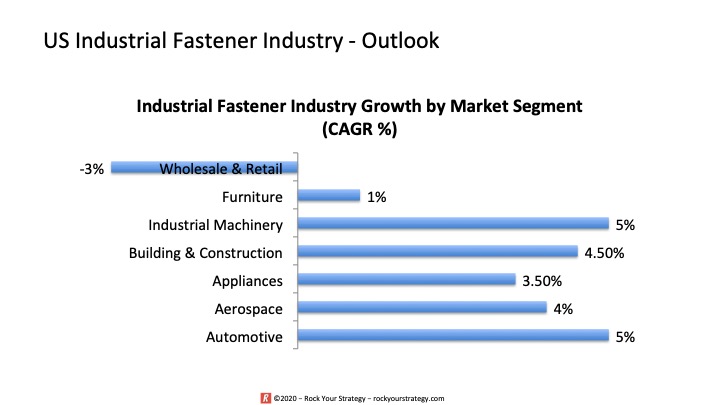
    Frank picked up the market report which had been printed and laid out for each team member. “Besides the current market shares and competitive positions, the report also offers an outlook for different sectors of the market in future.” Frank tapped on a graph on page 7 of the report. 

    US Industrial Fastener Market Report (Source: fictional)

    “While the overall fastener industry in the US is growing 2%, the wholesale & retail sector which has been our home market for all these years is going to decline faster in the years ahead”.

    Sharon sighed, “I’ve been telling you this, Frank. Retail is dead in the water. No one is fixing up their houses anymore. Young people want to live in the cities. They play on their smartphones all day and have two left hands when it comes to swinging a hammer…”

    “You have,” acknowledged Andy. “And we need to direct our attention to what is growing. Look at the chart. Construction, our other main market, remains robust. Automotive, Aerospace, Industrial Machinery are all showing positive growth for the coming years.”

    “This is interesting!” Alisha exclaimed. She had skipped ahead in the report and read about the market trends within each of the sectors. “Some of the drivers of growth in Building & Construction are the building of data centers and elevators & escalators. Have we looked at this in more detail yet?”

    “You hit the nail on the head, Alisha.” Andy smiled for the first time that day. “We are a small company. We will not be able to take on Competitech with their size. Nor will we be able to satisfy the Automotive industry’s requirement for scale and JIT. Why not use our size to our advantage and focus our attention on growing industries that require custom made products and value-adding services? Such as the IT and Elevator industries.”

    The team began discussing the various market segments and debating which ones best fit their capabilities and size. After an hour of reviewing the facts they indeed honed in on IT and Elevators. 

    “Sounds to me like these are the industries with the highest growth rates in the next few years and for which we are uniquely positioned with our expertise here in the Northeast,” concluded Tom.

    “But the industries are still small”, said Dan. “They alone will not be able to sustain us.”

    Andy agreed, “It will take time for us to prepare entering those markets. We will need to add new products and new skills. And meanwhile, we must not give up our fortress. We will need to work on our cost position and secure our largest customers. The cash flow from our sales today will need to fund our sales of the future.”

    “We will need additional resources for what you have in mind, Andy. We have good standing with our banks, but we will need a clear plan to convince them”, remarked Frank. 

    “We will need to convince our teams first, Frank. People are nervous. They see our sales declining and are worried that their jobs are at risk.” Sarah reminded everyone what was at stake.

    “No one will lose their jobs. We will need everyone if we want to pull this off: you, your teams, the Board, everyone. We need to go back to the values my father instilled in this business to stage a turnaround. Let’s take a break and then resume to make a plan.” 

    Making a strategic plan

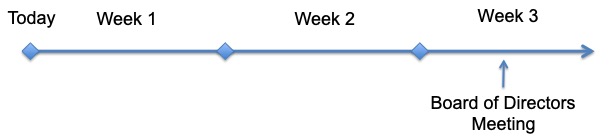
    When the team returned to the conference room, Andy had already set up 2 flip charts. On the one in front of the room he had written a timeline. 

    Andy rolled up his sleeves. “Alright, folks. We have less than three weeks to put together the plan. I suggest we start right away today by setting the framework and then work over the next 2 weeks with our teams to flesh out the details. If we want broad buy-in from the team, we need to involve them as we always have.” 

    Andy flipped over the flip chart, revealing a process chart. “My dad had sworn by this process. Let’s use it again to guide our discussions. We had a good starting point this morning, but we need to dig deeper into those market segments to better understand their dynamics, customer needs, and competition.”

    Business Strategy Process
    rockyourstrategy.com Strategy Process

    “I suggest we approach it as follows.” Andy pointed to the strategy process. “Let’s focus today on the Mission and Business Analysis steps. Sharon, can you then work with your team on the Industry Analysis until the end of the week? Let’s then resume next Monday with the Vision and Strategic Choices parts before we then develop the Execution Plans with our teams for the remainder of that week. Goal must be to have a plan ready by the end of next week. That’s 10 days, 12 with the weekend. Are you guys ok with that?”

    “Wow, that’s a tight timeline, Andy!” Dan was not usually the one to point out the obvious. 

    “Yes, it is, Dan. This is not going to be easy. I am open to alternative ideas if you have any.” Andy scanned the room, but no one had a suggestion. 

    “Then let’s get started,” said both Alisha and Sarah in unison. They looked at each other and giggled. “Yes, let’s get started”, confirmed Andy, glad that the mood had lightened. “Frank, can you take over and facilitate?”

    Intimately familiar with the strategy process, Frank was happy to. He got up and walked to the front of the room.

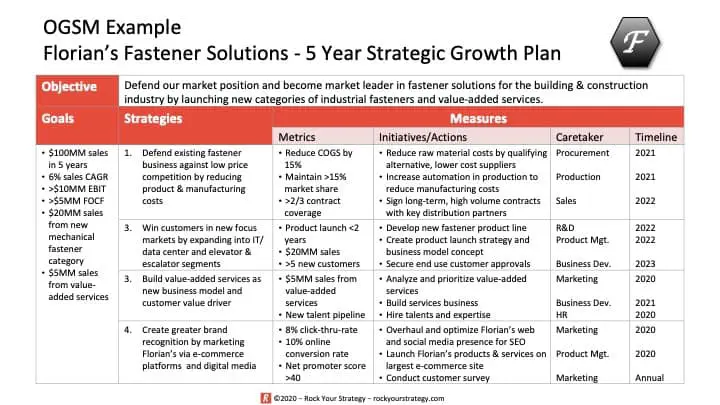
    OGSM example – the 5 year growth plan

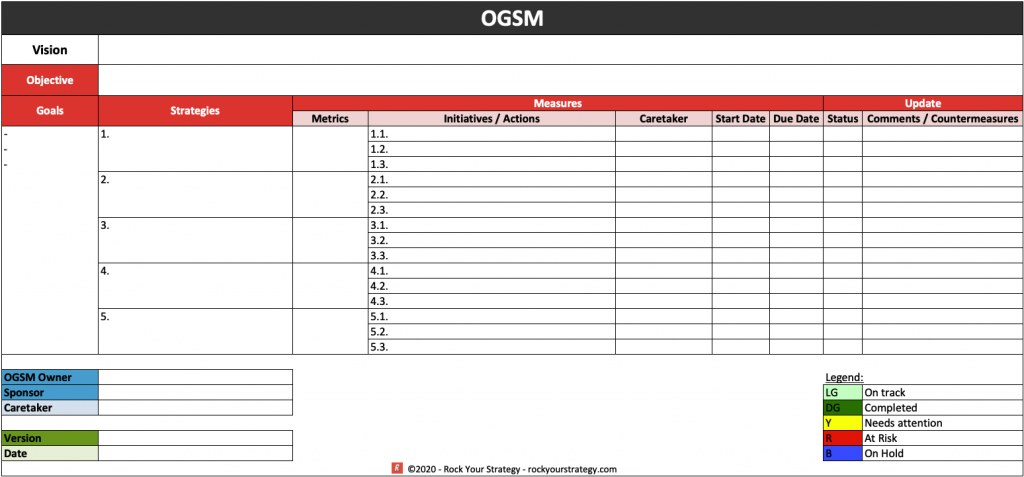
    The Leadership team of Florian’s Fastener Solutions went to work. And over the next two weeks worked out a detailed plan with their teams. They summarized their strategy in a simple one-page business plan they called their OGSM. 

    OGSM Example - Florian's Fastener Solutions
    OGSM Example of Florian’s Fastener Solutions

    Click here for a downloadable PDF copy of Florian’s OGSM.

    What is OGSM? 

    OGSM stands for Objective, Goals, Strategies and Measures and is a one-page business plan which details what you aim to achieve and how you are going to achieve it

    Read more about the OGSM methodology and how it can help you simplify your strategy and deliver results here

    Andy knew his dad had used the OGSM methodology for years. He had liked its simplicity and the clarity it created. Combining the what and the how moved the team from planning to execution and aligned everyone behind the overall direction of the company.

    “If you want your team to follow you, Andy, your team needs clarity where you’re headed!” he had always implored on him. Andy heard his father’s voice ring through his head. He could remember a treasure trove of bumper sticker-like one-liners from his childhood. He barely ever listened to his dad when he talked about work at the dinner table. When Andy took over Florian’s however he had been glad for the lessons his dad had taught him. 

    • “Making the numbers is not a strategy. Strategy is about making choices!”
    • “Appeal to your people’s hearts and their minds and they will take you anywhere.”
    • “Take care of your people and they will take care of your customers.”
    • “A plan is only as good as its execution!”

    Andy sat in his office, eyes locked on a copy of the freshly minted OGSM in front of him. He felt good about their plan. Not only did the leadership team work on it with enthusiasm. But the entire organization had pitched in. He was surprised at the commitment everyone had shown. It was as if they had just been waiting to be asked to contribute. And maybe they had been… 

    Andy felt exhausted as he dialled his mother’s phone number. He wanted to set up a meeting to jointly review the final plan. He had kept her apprised of progress over the past two weeks. Being the chairlady of the Board of Directors, Andy made sure she was in lockstep with the team every step of the way. 

    With the Board of Directors meeting now days away and the change they proposed significant, Andy did not want to leave anything up to chance. The transformation itself would be enough of a gamble.

    Epilogue

    Sarah raised a glass. “Andy, on behalf of the leadership team, I would like to thank you! If it wasn’t for your dedication, your optimism and your continued reinforcement of the plan and its execution, I’m not sure whether we’d be here today.” The rest of the team joined in cajoling and shouts of encouragement and appreciation. Sarah threw an icy look before bursting out into laughter. “Quiet, I am not finished yet!”  

    Florian’s Fastener Solutions leadership team was sitting together on the farmhouse patio of the little vineyard which Florian Walterman had bought years ago. Overlooking Cayuga Lake, the vineyard at Finger Lakes had become a favorite get-away for company events and team celebrations. 

    It was a beautiful late Summer evening. A slight breeze made the warm air comfortable. Bottles of the vineyard’s signature Riesling were nestled in the ice bucket next to the large table. Andy had invited the team to the vineyard to celebrate the latest contract Sharon had signed the previous week and the progress the company had made in executing their plan.

    “When we embarked on this journey three years ago, I was frankly not convinced that we would be able to turn things around.” Sarah said honestly. “Of course I was hopeful. I had faith in our abilities and our team members. But I was not convinced.”

    “Boooooh”, Sharon and Dan interrupted Sarah with wide smiles. “Shush, you two”, she responded with an equally wide grin. 

    “Andy, you kept us going. You convinced your mother and the Board of Directors, you got the funding from the bank, and you led the meticulous execution of our plan every quarter and every month. Here we are 3 years in. We are not done yet. But we are on track and have returned to growth again! Cheers to you! Cheers to Florian’s!”

    The team raised their glasses in celebration and the rings of clinking glass could be heard reverberating across the valley. As the sun was setting over Cayuga Lake, the seven leaders kept chatting while enjoying the wins they had achieved. They knew they were not yet at their destination and that more challenges lay ahead. But tonight they enjoyed the wine and each other’s company. 

    Final Notes

    While this story is totally fictional, the learnings can be real. If you would like to learn more about the OGSM methodology, read our introduction to the OGSM methodology here. You can explore other examples and templates via the respective links. 

    Florian’s Fastener Solutions, all characters and all data points are completely fictional and the brain child of the author. Any resemblance to real life events or circumstances is not intended and may be coincidental. Please excuse us if some data seems contradictory or far-fetched. The story intends to introduce the OGSM methodology and its application. It is not the purpose to provide actual industry information or a real world case study. 

    If you have any questions or comments, why not leave us a note in the comment box below or sign up to our free newsletter here. We’d love to hear from you.

  • How to Create a Business Strategy That Delivers Results in 6 Simple Strategy Process Steps

    How to Create a Business Strategy That Delivers Results in 6 Simple Strategy Process Steps

    In order to understand how to create a business strategy in 6 simple strategy process steps, it’s worth starting with strategic planning.

    Strategic planning is the process of creating a strategic direction for your business or organization. It describes designing the choices you make towards achieving an objective or desired future state.

    Strategy development includes a thorough assessment of your business or organization and the environment in which you operate. It determines where you are headed and how you are going to get there.

    The Strategy Process

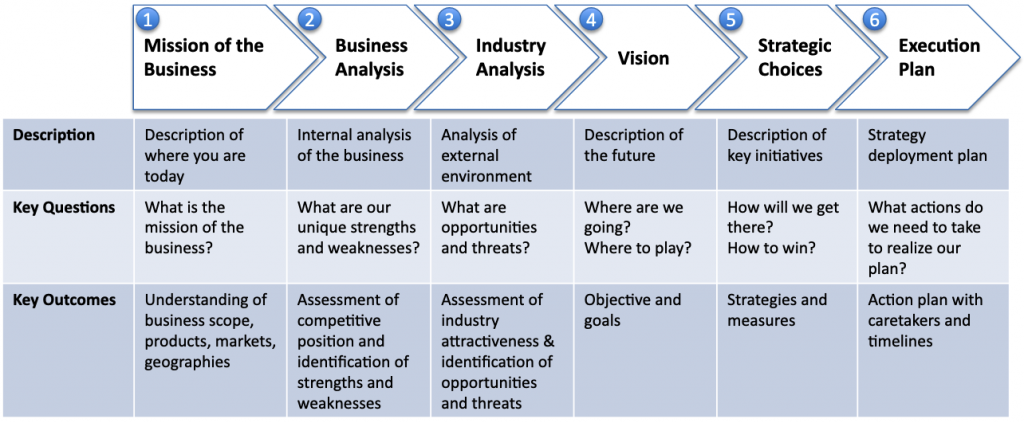
    The strategy development process includes 6 steps and answers 6 critical questions:

    Infographic: The 6 steps of the strategy process
    The 6 steps of the strategy process

    Businesses or organizations develop strategies for different purposes and over different time horizons. Most commonly strategies span 3-5 years and aim to develop the business towards a specific objective. This may for example include growth or productivity or often both. 

    Strategies are also often designed for shorter term purposes such as annual operating plans. In this case the objectives are to be achieved within one year and the strategies chosen are more tactical in nature. 

    In larger corporations, the strategic development process actually takes multiple of these horizons into considerations and incorporates them into one strategy process. In their book “Playing to Win: How Strategy Really Works”, A.G. Lafley and Roger L. Martin, describe this process as cascading the strategy.

    Cascading is an important process to ensure different divisions and functions of a large corporation align their objectives and strategies with the larger purpose and resources of the company. We’ll talk about that later.

    For smaller, for example owner-led businesses, this is overkill and too time-consuming. Strategy development is critical for small businesses nonetheless as we will describe in the 6 steps of strategy development.

    In this article you will learn how to take your business through the strategy process to create strategies that deliver results. And you will get to know a charming restaurant owner who exemplifies what this process could look like in action. 

    Want to learn more about strategy?

    Side bar: if you’d like to read more about strategy before jumping into the strategy development process, check out this article on “What is strategy?”.

    Let’s go through the 6 steps one by one starting with the mission of the business. Before we jump in, consider engaging an experienced facilitator to help guide you and your team through the process in a strategy workshop.


    Step 1: Mission of the Business
    Step 1: Mission of the Business

    Step 1: Mission of the Business

    We begin with a description of your business. The reason we start here is because clarity about the identity and purpose of your business is a critical first element of your strategy. 

    Don’t overlook this important step. This is like building the foundation before you construct a house on it. A strong foundation allows you to build a tall and beautiful home. 

    The description of your business should include a statement about the business scope, the products you are selling, the markets you are targeting, and the geographies you are operating in. It is useful to write this out and to discuss it in your team to ensure that everyone is on the same page. 

    Being clear about your business is very important because it will influence the choices you make and ultimately whether you will be successful in implementing your strategy.

    It strikes me time and again how different people have different ways to describe the same business. The differences may be subtle, only a few words may be different. But when you are developing a strategy, it is important that everyone is clear about who you are and what your starting point is. Otherwise it will be difficult to describe your destination and what you need to do to get there. 

    Consider the following simple example.

    Example: Tony’s Pizza

    Example: Tony’s Pizza

    Tony is the owner of a small chain of pizza restaurants called Tony’s Pizza. There are 2 locations in the tri-state area. Tony has gathered his team to review their strategy and identify new areas of growth. Having subscribed to “Rock Your Strategy”, Tony is beginning with a discussion of the mission of the business. 

    “Easy!”, exclaims Stefano, head chef of the chain and designer of its menu. “All we have to do is expand the menu beyond pizza. We are an Italian family restaurant after all! Diners want antipasti and secondi!”. 

    “Italian family restaurant?” asks Jen confused. Jen is Tony’s wife and takes care of the company’s finances. “Honestly, we are a pizza parlor. We make pizza and sell pizza. People come here because we have the best pizza at the best prices. People don’t come here for the ‘dining experience’”.

    Brian, the part-time delivery driver, looks up from his smartphone. “Actually, I do get asked occasionally when I deliver pizzas whether we are only a pizza delivery service or whether we have a sit-in restaurant as well. It seems customers are not aware of our 2 restaurant locations.”

    Tony realizes that this is going to be more difficult than he had expected. Ten minutes into the meeting and there is no consensus on what kind of business they are actually running today: a family restaurant, a pizza parlor, or a pizza delivery service? Tony senses that clarity about today’s business is needed before they can discuss how to identify future opportunities for growth. 

    Okay, I admit that the Tony’s Pizza example is maybe an oversimplification. But the point is that Tony’s choices about how to grow his business are going to be vastly different depending on how he defines his starting point. 

    If he determines his business to be a family restaurant, then to grow sales, he may indeed consider expanding his menu. Investing in new, higher-priced main dishes may appeal to a different kind of customer segment with more disposable income. 

    If Tony concludes that his business is a pizza parlor, growing sales may require opening additional locations. This might take time and be quite capital intensive.  

    If in the mind of the customer Tony’s Pizza is only a delivery service, then maybe all he needs to do is advertise to make people aware of his 2 dine-in locations to grow sales. 

    His strategy therefore strongly depends on the definition of his company’s current business scope, products, and markets.

    Key Take-away from Step 1

    Be clear about your business’ main mission and purpose and make sure everyone on your team has the same understanding. This will ensure that you are thinking along the same lines later as you discuss steps 2-6. 


    Step 2: Business Analysis
    Step 2: Business Analysis

    Step 2: Business Analysis

    If step 1 was about your company’s mission, then step 2 dives deeper to identify your business’ core competencies and competitive position

    Step 2 answers the question “What are my unique strengths and weaknesses?”

    Let me first say that a detailed business analysis can be a daunting task. You pull away the curtain and unveil your company’s deepest secrets. This can be very uncomfortable and some owners might not be agreeable to reveal such details to their teams. This is up to you.

    In my experience, it is helpful to be honest with yourself and teams appreciate the trust and understanding of the business. If you are not comfortable to do this in your team, conduct the analysis by yourself and share your outcomes. The insights about strengths and weaknesses are important, less so how you arrived at them. 

    Company Financials 

    During business analysis, review the historical financial performance of your business. Analyze your sales, costs and profitability by product line, market, and geography. Seek insights from the data to identify where you perform particularly well or particularly poorly. 

    Customer Feedback

    Do you have a record of customer feedback? This is the time to bring out that dusty bin with the feedback forms. Customer feedback is an invaluable resource in strategy development. Review the feedback and seek patterns of things you do well and things that customers are not satisfied with. If you do not have a record of customer feedback, consider conducting a survey or spend time speaking with your customers to gain insights for this process. 

    Employee Satisfaction

    Also speak with your employees about their perception of company strengths and weaknesses. Ask them about their satisfaction working for your company. What are they particularly fond of? Where do they see room for improvement? 

    Strengths and Weaknesses

    Bring all the insights together and record your business’s strengths and weaknesses. Identify your core competencies. In the next steps of strategy development, you will want to use your core strengths to your competitive advantage. And you will want to work on improving or managing your weaknesses depending on their importance to achieving your objectives.

    A powerful tool to help you with this is the SWOT analysis. SWOT stands for strengths, weaknesses, opportunities, and threats. Read here in more detail how to do the SWOT analysis right. The link also includes examples and templates.

    Key Take-away from Step 2

    Business analysis is all about identifying your company’s key strengths and weaknesses as suggested by your financial performance, your customers’ feedback and your employees’ satisfaction. You will want to leverage your strengths in your strategy and manage or improve your weaknesses. 


    Step 3: Industry Analysis
    Step 3: Industry Analysis

    Step 3: Industry Analysis

    While step 2 looked at your business in detail, step 3 now analyzes the external environment in which your business operates. This is an assessment of your industry to identify growth drivers and business risks. 

    Step 3 answers the question: “what are my opportunities and threats?”

    Independent of the size of your business, it is a good idea to have a solid understanding of your external environment. In this step, I am not talking about GDP figures or unemployment rates, even though these can be interesting indicators about the overall economic environment. Industry analysis seeks to identify risks and opportunities directly relevant to your industry and to your business. Insights gained here may have a direct effect on your choices where to play and how to win

    To do this well, consider the following analyses: industry attractiveness and customer needs. 

    Industry Attractiveness Analysis

    The objective of industry analysis is to learn how attractive your industry is long term and which parts to focus on. This should include a brief look at macroeconomic factors influencing your business, understanding your key competitors, as well as the size and growth prospects of your market.

    Tools that may help with this step include a PESTEL analysis, Porter’s Five Forces, and market size and growth estimates as well as market growth drivers. In B2B markets, it would additionally be useful to analyze the value chain and create an industry map.

    When applying the tools, focus on identifying opportunities and threats and capture these. Find templates and explanations for these tools here.

    Customer Needs Analysis 

    The objective of customer needs analysis is to understand what your customers are looking for and what is important to them. This will help you determine how to develop your product and service offerings when making strategic choices. 

    The approach to customer needs analysis can differ in B2C and B2B markets, but the essence is the same: understand your customers!

    Just to briefly scrape the surface, in B2C markets seek to explore your customers’ preferences, likes and dislikes. There are expensive market and retail reports and other key figures available by third party market research firms if you want to fork out a hefty amount of money. Or you can simply ask your customers about their preferences if this is practical for you. The customer feedback forms above may already give you a head start. 

    In B2B markets, focus your analysis not on what customers want but what they truly need and what they are willing to pay for. This can often be understood in economic terms since your customers are profit-making businesses too and your products or services have an economic value to them. 

    Identify needs that are not yet served by you or your competitors. Look for changes in your customer preferences which may allow you to cut costs. Capture the opportunities and risks identified.

    Pro-Tip: Look for patterns in your findings and group customers into segments. Cluster those customers together that have similar needs. If you go into marketing planning after your strategy process, this information will become very useful. 

    A Word of Caution

    Have you heard of the term ‘analysis paralysis’? Don’t overdo it with analyzing every detail of the environment around you. This step is also not about using and filling every tool you can find in management books. This is about using tools to guide you in asking the right questions and generating meaningful insights to determine where to take your business.

    Once you have the insights you need, stop the analysis and move forward. If you don’t yet feel comfortable with your findings or identify a risk or opportunity you don’t yet fully understand, dive deeper.  

    Key Take-away from Step 3

    Analyze your industry attractiveness and your customer needs to identify opportunities and threats in your external environment.


    Step 4: Vision
    Step 4: Vision

    Step 4: Vision

    During steps 1-3 we described the present situation of your business and your industry. In step 4 we begin thinking more concretely about the future – your future. 

    Step 4 describes the vision for your business and answers the questions “where am I going?” or “where to play?”.

    The vision is not a fantasy or dream about your company. It is a real destination you aspire to reach in the next 3-5 years. You make concrete choices about the where you intend to play.

    In step 4 you derive key insights from the mission of the business, your key strengths and weaknesses and your main opportunities and threats. You use these to set concrete objectives and goals for your business.

    Objectives

    The objective is a qualitative statement about your business’s ambitions over the next 3-5 years. This is the future state of your organization. The objective should be concise and specific. It should spell out in no unmistakable terms what you are aiming to achieve, i.e. where you will play.

    Read here in more detail how to write a great objective statement for your business.

    Depending on the type of your business and the current situation it is in, this might be a single sentence statement. If you envision a major transformation of your business, you may want to elaborate a bit more.

    Your objective should be aspirational. It should allow you to leverage your identified strengths to take advantage of identified opportunities or mitigate identified threats. It may describe how you want to position yourself to add value to your customers. 

    Goals

    The goals are the quantitative description of your objective. Goals should translate your qualitative objective statement into measurable, financial figures. These are the numbers that represent the future state and help you to measure whether you are successful. 

    Make sure that your goals align with the purpose and the timeframe of your objective. A great way to describe your goals is to apply the SMART approach to goal-setting. Goals must be

    • Specific: the goal must be clear and unambiguous 
    • Measurable: the goal must be quantifiable and progress trackable
    • Achievable: the goal should be ambitious, but it must be attainable
    • Relevant: the goal must be realistic and relevant to your objective
    • Time-bound: the goal must have a clear timeline and target end point.

    The objective and goals together describe WHAT you are aiming to achieve. Click here to learn more about how to set clear goals for your strategic plan.

    Let’s meet Tony again to see how he set the vision for Tony’s Pizza. 

    Example: Tony’s Objective

    Example: Tony’s Pizza

    Reviewing the business has been an exciting journey for Tony and his team so far. They studied their business financials and customer feedback. They reviewed local economic data and sifted through competitive insights. Tony and Jen even dined a couple of times in different restaurants in the city to see what other restaurants were doing. 

    Tony was pleased to read how much customers loved their pizza. Particularly their pizza dough and his family’s secret pizza sauce received rave reviews.

    However he was surprised to see population growth figures in the tri-state area and rising GDP per capita. It’s true, more and more young families had moved to their town from the city over the past 5 years ever since the new interstate was built. But he hadn’t realized how much bigger the town had become. 

    Speaking with the mayor, the chamber of commerce and other small business owners, Tony learned that their town had become a popular dwelling for families who sought more space outside the city but were not willing to give up their modern city lifestyles. The only thing missing really was more dining choices. There were a couple of pizza restaurants, fast-food chains, and a steakhouse. After all, they had been doing well in this setting with their pizza parlor for many years. But Tony was curious whether a proper sit-down family restaurant with Italian cuisine would be a popular niche not yet served. 

    After further studying the possibility, Tony and his team made a decision. They were to transform one of their pizza parlors into a family restaurant. Tony captured their objective: 

    Tony’s aims to expand beyond its delicious pizzas to become a trusted Italian restaurant where families feel at home and share an enjoyable, freshly cooked meal. 

    Tony looked up and felt proud. This sounded like a great objective. He could already see the smiles on happy customer faces and smell the intoxicating scent of fresh Italian dishes being served.

    Key Take-away from Step 4

    Creating a vision for your business means describing what you want to achieve in 3-5 years, i.e. deciding where you choose to play. This future state is captured in ambitious but achievable objectives and goals. 


    Step 5: Strategic Choices
    Step 5: Strategic Choices

    Step 5: Strategic Choices

    In step 4, you set an aspirational objective for your business that you aim to achieve in 3-5 years. Step 5 is about defining the strategy and designing the path to your destination. This is probably the hardest part of strategy development. It is about making tough choices. 

    Step 5 answers the questions “how am I going to get there?” or “how to win?”. 

    Are you familiar with the proverb “all roads lead to Rome”? There are probably many ways how you could achieve your objectives. However, resources are finite. So in step 5, you will choose how to allocate your time and your resources to achieve your objective. 

    Strategies

    Choose 3-5 strategies that align with the purpose of your business, your objective and the identified strengths, weaknesses, opportunities, and threats. As so often in life, less is more! You will benefit from being able to focus.

    When choosing your strategies, think about your customer needs, industry trends and your company strengths. Consider what products and services to develop or what markets to focus on. Consider whether you will win against competition via better prices (lower cost) or better products (differentiation).  And consider what company culture or people skills will be needed to succeed. 

    Double-check whether any of your weaknesses or identified threats may prevent you from achieving your objectives. Incorporate mitigation measures into your strategic initiatives.

    Example: Tony’s Strategies

    Example: Tony’s Pizza

    Tony had decided to sleep over his freshly drafted objective statement. This is something he learned from his late mother: important decisions should not be made lightly. Tony could still remember the ring of her voice in his ears, “a good night’s sleep will bring clarity and determination.” And that was the case. 

    Coffee in hand, Tony and his team resumed discussion on their new strategy. They sought to create 3-5 strong strategic initiatives that would help them turn their pizza parlor into an Italian restaurant local residents would love. 

    The team debated several aspects of successful Italian restaurants they knew. But the longer they discussed, the more they came back to two important principles. They wanted to create a restaurant that remained true to Tony’s values and reminded people of the cozy pizza parlor heritage. And they wanted to make sure that the restaurant was unique to the tri-state area and incorporated features of the community. 

    At the end of the day, they stared at 5 scribbled statements on scattered flipcharts. At that moment they knew they had nailed it. 

    • Offer dishes the entire family will love by developing an approachable Italian menu with Tony’s all-time classics and rotating seasonal specialties
    • Serve great-tasting, freshly cooked food by sourcing most ingredients fresh from the local tri-state area 
    • Turn customers into guests who feel at home by designing a cozy restaurant interior that reminds people of a small-town Italian trattoria.
    • Hire and train experienced employees who embody Tony’s values and make guests feel at home. 
    • Make people in the tri-state area aware of Tony’s new dining experience by implementing marketing initiatives that create interest to give the new Tony’s a try. 

    Key Take-away from Step 5

    Strategic choices is about deciding how to allocate your resources to achieve your objectives. Strategies define the roadmap to success, i.e. how to win.


    Step 6: Execution Plan
    Step 6: Execution Plan

    Step 6: Execution Plan

    We are almost there! But not quite yet. Because a good strategy is only as good as its execution. And how often have you seen people make plans that they did not turn into reality? Exactly! Step 6 is about creating an execution plan that ensures you implement your strategies and reach your objective and goals

    Step 6 answers the question: “What actions do I need to take to realize my plan?”

    Developing an execution plan means defining concrete, quantifiable measures that combine actions with caretakers and timelines. Step 6 is all about commitment. 

    Make sure that for each of the 3-5 strategies chosen in step 5, there are concrete actions defined. Think through what it takes to deliver the strategy. What actions are needed? What resources do you need? Who do you need to speak with? Whose support, expertise or permission is needed? 

    Consider breaking down each strategy into no more than 3-5 concrete actions and define owners, timelines, and a quantifiable target for each. Especially the quantifiable target makes sure that there is clarity about expectations and what success looks like. 

    In addition to designing an action plan, create a review dashboard and agree how the plan is followed up on. How do you check progress? When do you review the plan? When and how are employees expected to report back? 

    Depending on the nature and time horizon of your strategy, it is good practice to review the action plan of a 3-5 year strategy every 6 month and to review the progress of an annual operating plan at least once per quarter

    Key Take-away from Step 6

    Designing an execution plan means agreeing on key actions, caretakers, timelines and targets and implementing a reporting and review procedure.


    The 6 Steps of Strategy Development

    Strategy Process Conclusion

    In this article you learned how to take your business through the strategy development process to create effective strategies that deliver results. 

    Strategy development includes a thorough assessment of your business or organization and the environment in which you operate. It determines where you are headed and how you are going to get there.

    The strategic planning process consists of 6 steps: 

    1. Mission of the Business
    2. Business Analysis
    3. Industry Analysis
    4. Vision
    5. Strategic Choices
    6. Execution Plan

    Bonus Tip: Strategy Development and OGSM

    The beauty of the OGSM methodology is that it can help you capture all 6 steps of the strategy development process. In the OGSM, you can set your business’ 3-5 year objective and goals. You describe your strategies or strategic choices how you will get there. And you determine your measures, i.e. your action plan. All on one page. This makes your strategy easy to read and understand, easy to communicate, and easy to execute. 

    To learn more about OGSM and how it can help you simplify your strategy and deliver results, click here

    Read more about OGSM in our top 10 OGSM tips or the long list of OGSM Do’s and Don’ts and the 13 reasons why successful companies choose OGSM.

    If you enjoyed this article, have any questions or would like to leave feedback, please use the comment box below. Would love to hear from you!

    References

    Lafely, A.G. & Martin, Roger L. (2013). Playing To Win: How Strategy Really Works. Boston: Harvard Business Review Press.