
AI startups face a version of the classic strategy problem in concentrated form: the technology is powerful and the opportunity is large, but the surface area of possible applications is so wide that focus becomes genuinely hard. Without a forcing mechanism, teams default to building everything and selling to everyone — which usually means making real progress on nothing.
This example shows how a fictional AI startup — Synapse AI, a Series A company building document intelligence software for professional services firms — used the OGSM framework to make the transition from research-led organisation to revenue-driven business. The company, numbers, and details are illustrative. The strategic challenges are real.
If you’re new to the OGSM framework, start with the Complete OGSM Framework Guide. If you’re ready to build, download our OGSM templates for PowerPoint and Excel.
About Synapse AI
Synapse AI has built a proprietary large language model fine-tuned for legal and financial document analysis. Their technology can extract key clauses from contracts, flag risk provisions, summarise regulatory filings, and surface precedent across thousands of documents in seconds — work that currently takes teams of paralegals and junior analysts hours to complete.
At the time of this OGSM, Synapse has closed a $6M Series A, has ARR of $500K from 8 paying customers (law firms and one investment bank), and a team of 22 people. The core technology is strong, but the go-to-market is ad hoc. Deals have come through founder relationships, not a repeatable process. The board is expecting a path to $3M ARR before the next funding round.
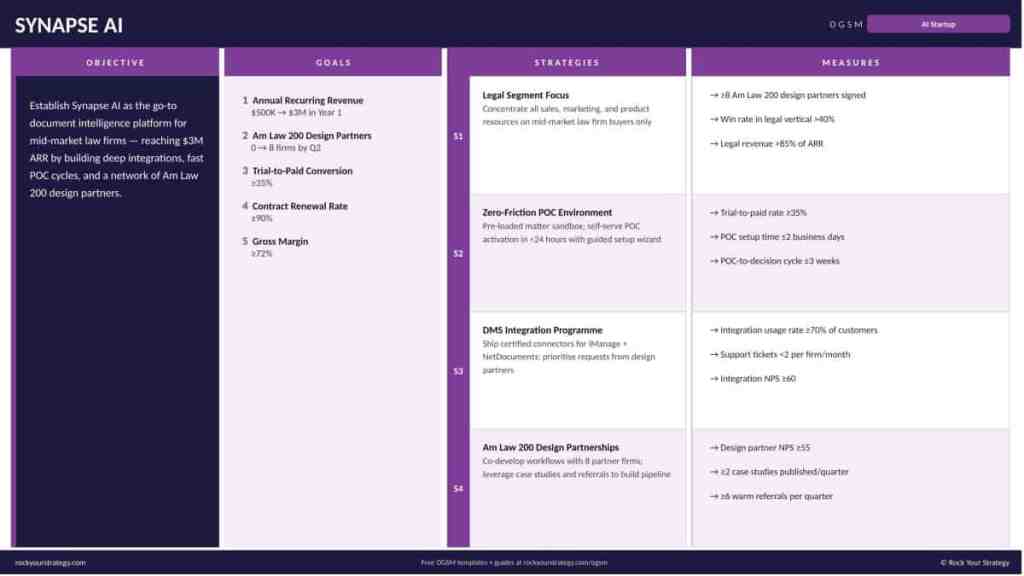
The Synapse AI OGSM
Objective
Establish Synapse AI as the trusted document intelligence platform for mid-size professional services firms by building a repeatable sales motion and deepening product value within our initial customer segment.
Goals
Goals define what success looks like in measurable terms at the end of the 18-month period. Synapse’s goals reflect both the growth expectations of their Series A investors and the operational milestones needed to build a fundable Series B story.
| Goal | Current | Target |
|---|---|---|
| Annual Recurring Revenue (ARR) | $500K | $3M |
| Number of paying customers | 8 | 40 |
| Average Contract Value (ACV) | $62K | ≥$75K |
| Gross Revenue Retention | 88% | ≥95% |
| Sales cycle length | 6–8 months | ≤4 months |
Strategies
Strategies are the high-impact choices about where Synapse will concentrate resources — and, by implication, what they will not do. Each is written as a “what-by-how” statement.
Strategy 1: Build a repeatable sales process by focusing exclusively on mid-size law firms (50–200 attorneys) and codifying what converts
Eight of Synapse’s customers are law firms. That’s not a coincidence — the document density, compliance requirements, and billable-hour economics create a strong value proposition. Rather than broadening to financial services or consulting firms in parallel, Synapse will go deep in legal first: building case studies, developing a sales playbook from their best-performing deals, and hiring a sales hire with legal tech experience.
Strategy 2: Shorten the sales cycle by building a self-serve proof-of-concept environment that demonstrates value on the prospect’s own documents
The 6–8 month sales cycle is the biggest obstacle to hitting the ARR target. Most of that time is spent on internal buy-in and IT security reviews. Synapse will build a sandboxed POC environment where prospects can upload 20–50 of their own documents and see Synapse work on their real content — compressing time-to-wow and reducing stakeholder objections before formal procurement.
Strategy 3: Increase retention and expand ACV by embedding Synapse deeper into each customer’s existing workflow through integrations with iManage and NetDocuments
Three of the eight customers have churned or downgraded because Synapse lived outside their existing document management system. The fix is technical but strategic: native integrations with the two dominant legal DMS platforms (iManage and NetDocuments) will make Synapse a workflow layer, not a separate tool — dramatically increasing switching costs and expansion potential.
Strategy 4: Build market credibility by partnering with two Am Law 200 firms as design partners to develop and publicly validate the next product generation
Enterprise legal buyers are highly reference-dependent. A proof point from a recognised firm carries more weight than any marketing claim. Synapse will recruit two Am Law 200 firms as paid design partners — giving them early access to roadmap features in exchange for co-development input, case study rights, and permission to use their logos in sales materials.
Measures
Measures link each strategy to the specific metrics and actions that will drive execution. This is where the OGSM becomes an operating document rather than a strategy slide.
| Strategy | Key Metrics | Actions |
|---|---|---|
| Legal segment focus | New logo win rate in legal ≥30%; Deals from playbook ≥80%; Legal ACV ≥$75K | Document top 3 closed-won deals into sales playbook (Q1); Hire legal tech AE (Q1); Develop 5 law firm case studies (Q1–Q2) |
| POC environment | POC-to-paid conversion ≥60%; Sales cycle ≤4 months; POC sessions per month ≥8 | Build sandboxed POC environment (Q1–Q2); Integrate into outbound sequence as step 3 (Q2); Train sales team on POC-led demo (Q2) |
| DMS integrations | Gross retention ≥95%; iManage/NetDocuments installs ≥70% of base; Expansion from integrated accounts ≥20% | Ship iManage integration (Q2); Ship NetDocuments integration (Q3); Launch customer success onboarding for integration activation (Q3) |
| Am Law design partners | 2 design partners signed by Q2; Case study published by Q3; Logo usage in ≥50% of sales decks | Identify and approach 6 Am Law 200 targets (Q1); Negotiate design partner agreements (Q1–Q2); Build joint product roadmap sessions (Q2–Q4) |
What Makes This OGSM Work
The objective is honest about the stage. Synapse didn’t write an objective about “disrupting the legal industry” or “transforming how professional services firms work.” They wrote an objective about building a repeatable sales motion and deepening product value within a specific segment. That honesty about what actually needs to happen in the next 18 months is what makes the OGSM useful rather than aspirational.
The segment choice is load-bearing. Strategy 1’s decision to focus exclusively on mid-size law firms is the most important strategic choice in this OGSM. It constrains everything else: who you hire, what integrations you build, which design partners you pursue. AI startups that try to serve all verticals simultaneously typically end up with a generic product and no compelling case studies for any of them.
The POC strategy addresses the real bottleneck. Many AI startups focus their strategy on product improvements when the real constraint is procurement friction. Synapse identified that 60% of their sales cycle was internal buy-in and security review — and built a strategy around compressing that, not just making the product better.
Common OGSM Mistakes AI Startups Make
The OGSM framework works for AI startups precisely because it forces trade-offs that are easy to avoid. Here are the patterns we see most often go wrong.
Technology as strategy. “We will use our proprietary LLM to outperform competitors” is not a strategy — it’s a capability. A strategy describes where and how you will deploy that capability to create value for a specific customer in a specific context. Synapse’s Strategy 1 is a strategy. “We have better AI” is not.
Too many segments in the goals. AI startups often set ARR goals without specifying which customer segments will drive that revenue. If the goal is $3M ARR from 40 customers, but 15 of those are from legal and 25 are from “various industries,” the OGSM has no real alignment. The segment clarity has to show up in the goals, not just the strategies.
Measures without owners. The measures table in Synapse’s OGSM has owners implicit in each action. In practice, when you build this with your team, every action should have a named owner and a due date. Without those two things, measures become aspirational rather than operational.
Build Your Own OGSM
Use our pre-formatted OGSM templates to build your own one-page strategy. Available for Microsoft PowerPoint (for board and leadership presentations) and Microsoft Excel (for building, tracking, and updating your plan). Both are fully editable and immediately downloadable.
Browse OGSM templates in the shop →
More OGSM Examples
See how the OGSM framework applies across different business contexts:
- OGSM Example: B2B SaaS — pipeline analytics company scaling from $2M to $8M ARR
- OGSM Example: E-commerce / DTC Brand — sustainable home goods company scaling past $5M revenue
- OGSM Example: Non-Profit — education foundation aligning programmes with funding strategy
- OGSM Example: Tony’s Pizza — the classic OGSM case study
Questions or comments? Drop them below, or sign up to our free newsletter for practical strategy tips. Rock on!
Leave a Comment