
E-commerce and direct-to-consumer brands face a particular version of the strategy problem: growth levers are highly visible (paid social, influencer, new product launches) but the discipline to choose between them is rare. Without that discipline, brands hit $3–5M in revenue and stall — spending more on acquisition, watching margins compress, and losing the brand clarity that made them interesting in the first place.
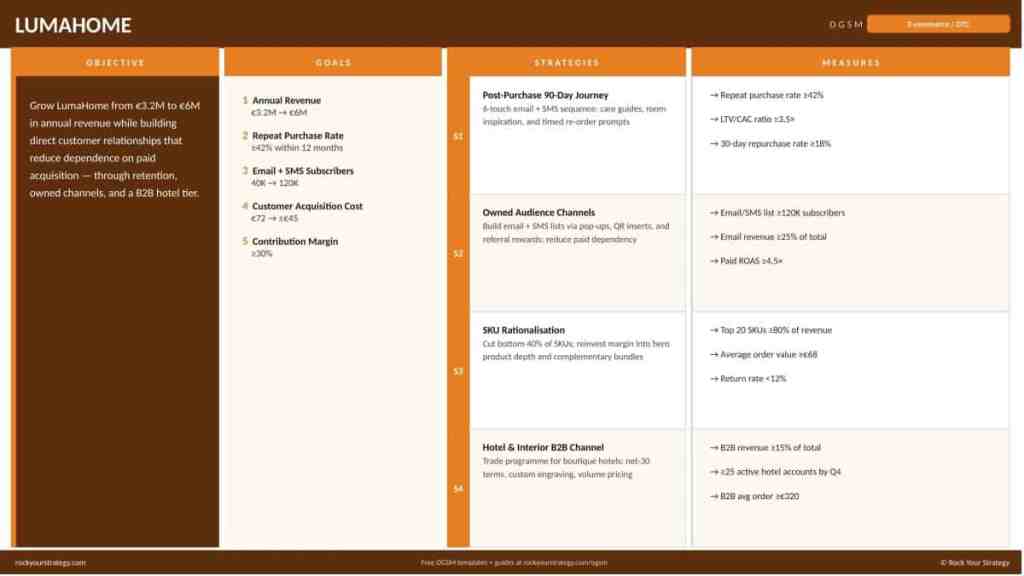
This example shows how a fictional DTC brand — LumaHome, a sustainable home goods company selling premium linen bedding and textiles — used the OGSM framework to build a focused growth strategy around profitability and customer lifetime value rather than top-line growth at any cost. The company, numbers, and details are illustrative. The strategic tensions are real.
If you’re new to the OGSM framework, start with the Complete OGSM Framework Guide. If you’re ready to build, download our OGSM templates for PowerPoint and Excel.
About LumaHome
LumaHome makes premium linen bedding, cushion covers, and table textiles from certified organic flax sourced in Europe. They sell DTC through their own website and have a small but growing wholesale presence with two boutique hotel groups. Their brand positioning sits at the intersection of sustainability, craftsmanship, and understated design — think Parachute meets Muji.
At the time of this OGSM, LumaHome has reached $3.2M in annual revenue with a 58% gross margin. Customer acquisition cost (CAC) has risen 40% over 18 months due to increased Meta advertising costs. Repeat purchase rate is 28% — below the 40%+ benchmarks for premium DTC brands in this category. The founding team wants to reach $6M revenue while improving contribution margin, not just hitting the revenue number.
The LumaHome OGSM
Objective
Establish LumaHome as the leading premium sustainable home textile brand for design-conscious consumers by building a loyal repeat customer base and reducing dependence on paid acquisition.
Goals
LumaHome’s goals reflect the dual ambition of the objective: grow revenue meaningfully while improving the unit economics that make growth sustainable.
| Goal | Current | Target |
|---|---|---|
| Annual revenue | $3.2M | $6M |
| Repeat purchase rate | 28% | ≥42% |
| Customer acquisition cost (CAC) | €62 | ≤€45 |
| Contribution margin | 22% | ≥30% |
| Email subscriber list | 18,000 | ≥50,000 |
Strategies
Each strategy reflects a deliberate choice about where LumaHome will invest and what they will prioritise over alternatives. They are written as “what-by-how” statements.
Strategy 1: Increase repeat purchase rate by building a post-purchase customer journey that turns first-time buyers into multi-category customers within 90 days
LumaHome’s best customers buy bedding, then cushion covers, then table linens — a natural progression that most customers never discover on their own. The strategy is to build an intentional 90-day post-purchase sequence: personalised email flows based on first purchase category, a loyalty programme that rewards category expansion, and a discovery kit offer at day 30 that introduces adjacent products at a trial price.
Strategy 2: Reduce paid acquisition dependence by building owned audience channels — email and organic content — to drive ≥40% of new customer revenue
Currently, 71% of new customer revenue flows through paid social. Every year, platform CPMs rise and margin compresses. LumaHome will invest in organic content (a home styling editorial series, YouTube room transformation videos, and a weekly newsletter) and SEO to build channels where acquisition cost approaches zero over time.
Strategy 3: Improve contribution margin by rationalising the SKU range and concentrating production volume on the top 20% of products that generate 80% of revenue
LumaHome currently offers 67 SKUs. Their bottom 40 SKUs account for less than 8% of revenue but require the same photography, copywriting, inventory management, and customer service overhead as the top performers. Cutting these and concentrating purchasing volume on hero products will improve COGS through volume discounts and simplify operations.
Strategy 4: Expand the wholesale channel by signing 3–5 boutique hotel partners to create a premium B2B revenue stream with high order values and strong brand validation
Hotels buy in high volume, pay premium prices for design quality, and serve as living showrooms for the LumaHome brand. Guests experience the product in an aspirational context and frequently search for it after their stay. LumaHome will develop a dedicated hotel programme with custom sizing options, volume pricing, and a concierge procurement service.
Measures
Measures translate each strategy into specific metrics and actions. Without this level of specificity, strategies stay on the page rather than driving daily decisions.
| Strategy | Key Metrics | Actions |
|---|---|---|
| Post-purchase journey | Repeat purchase rate ≥42%; Second purchase within 90 days ≥35%; Loyalty programme enrolment ≥50% of buyers | Build 90-day post-purchase email flows by category (Q1); Launch loyalty programme (Q2); Test discovery kit offer to cohort of 1,000 first-time buyers (Q1) |
| Owned audience | Paid acquisition share ≤60% by Q4; Email list ≥50K; Organic search traffic +80% | Launch weekly newsletter (Q1); Publish 2 editorial home styling features per month (Q1 onward); Commission 4 YouTube room videos per quarter (Q2) |
| SKU rationalisation | SKU count reduced to ≤40; COGS on hero SKUs reduced ≥8%; Inventory turnover improved to ≥4x/year | Audit SKU performance by revenue and margin (Q1); Discontinue bottom 27 SKUs (Q1); Renegotiate supply contracts on top 15 SKUs with increased volume (Q2) |
| Hotel channel | 3 hotel partners signed by Q3; Hotel B2B revenue ≥$400K; Average hotel order value ≥$8K | Develop hotel product catalogue and pricing (Q1); Identify and approach 20 boutique hotel targets (Q1–Q2); Sign first 3 contracts (Q2–Q3) |
What Makes This OGSM Work
The objective reframes the success metric. LumaHome could have written an objective about “becoming Europe’s leading sustainable home brand.” Instead they named the mechanism that will make the business sustainably successful: a loyal repeat customer base and reduced paid acquisition dependence. That reframe shapes every strategic choice that follows.
The goals create productive tension. Hitting $6M revenue while reducing CAC from €62 to €45 is not easy — those goals push against each other. That tension is intentional. It forces LumaHome to find growth from existing customers and organic channels rather than just spending more on acquisition. If you only set revenue goals, you’ll hit them by paying whatever it costs to acquire customers.
Strategy 3 is the most uncomfortable one — and the most important. SKU rationalisation requires saying no to products that have fans, require design write-offs, and feel like a step backward. But in DTC, operational simplicity directly drives margin. The OGSM makes the case for that decision in the context of the full strategy, which is harder to argue against than the decision in isolation.
DTC-Specific OGSM Considerations
A few things worth noting if you’re building an OGSM for a DTC or e-commerce business.
Include both acquisition and retention in your goals. Most DTC strategies focus exclusively on revenue and new customer acquisition. The repeat purchase rate and CAC goals in LumaHome’s OGSM are what force the retention and owned channel strategies into the plan. Without them, those strategies don’t have a goal to drive toward.
Contribution margin is a more honest goal than gross margin. Gross margin at 58% sounds healthy. Contribution margin at 22% — after paid acquisition, fulfilment, and returns — tells a different story. Set your goals at the level that reflects the actual cost structure of your growth model.
Be specific about the channel mix in your strategies. “Invest in content” is not a strategy. “Build owned audience channels to drive ≥40% of new customer revenue” is a strategy — because it has a measurable target, a directional choice (owned over paid), and implies what you’re willing to trade off (short-term paid growth) to achieve it.
Build Your Own OGSM
Use our pre-formatted OGSM templates to build your own one-page strategy. Available for Microsoft PowerPoint (for investor and leadership presentations) and Microsoft Excel (for building, tracking, and updating your plan). Both are fully editable and immediately downloadable.
Browse OGSM templates in the shop →
More OGSM Examples
See how the OGSM framework applies across different business contexts:
- OGSM Example: B2B SaaS — pipeline analytics company scaling from $2M to $8M ARR
- OGSM Example: AI Startup — Series A company navigating from research to revenue
- OGSM Example: Non-Profit — education foundation aligning programmes with funding strategy
- OGSM Example: Tony’s Pizza — the classic OGSM case study
Questions or comments? Drop them below, or sign up to our free newsletter for practical strategy tips. Rock on!
Leave a Comment