Great strategy workshop facilitators are resourceful, think well on their feet, and have the right workshop tools at their disposal to get everyone involved and turn lively discussions into meaningful insights and results.
Here are my top 6 most favorite strategy workshop tools and how to use them most effectively.
Tool
Description
Best used to…
More information
OGSM
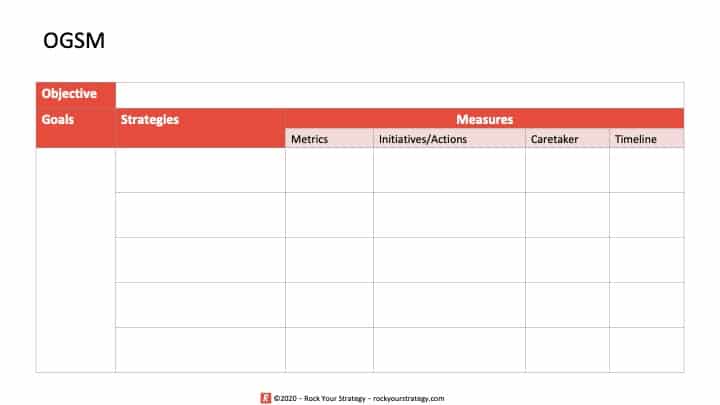
OGSM stands for Objectives, Goals, Strategies, Measures and is a one-page business plan. The OGSM methodology can lead through the strategy process, can document the strategic plan and lends itself to communicating and executing the strategy effectively.
…document, communicate, and execute the strategy throughout the entire strategy process.
PESTEL stands for Political, Economic, Social, Technological, Environmental, and Legal Analysis
…examine the external environment during the Industry Analysis phase to identify opportunities and threats
Porter’s Five Forces
Method to analyze competition, competititive intensity and thereby attractiveness of an industry.
…gauge industry or segment profitability (“ability to make money”) during Industry Analysis phase
SWOT Analysis
SWOT stands for Strengths, Weaknesses, Opportunities, and Threats. The analysis examines internal strengths and weaknesses of the business and external opportunities and threats.
…bring together and document insights from the Business Analysis and Industry Analysis phases. Seek to use strengths to take advantage of opportunities and mitigate threats. Improve or manage your weaknesses relevant to your objectives, opportunities and threats.
Directional Policy Matrix (also known as McKinsey Nine-Box-Matrix)
Framework to determine investment priorities by assessing investment options by industry attractiveness (y-axis) and by your competitive strength (x-axis)
…decide where to prioritize resources and ‘where to play’ when many markets or business opportunities are available. Prepared during Business Analysis and Industry Analysis phases and used during Vision phases.
Porter’s Generic Strategies
Framework to describe how your business creates a competitive advantage by either pursuing a cost leadership, differentiation, or niche focus strategy.
…describe competitive positioning of your business during Industry Analysis phase and shape resource allocation during Vision phase
Only 6. That’s it! There are many, many more tools out there. However, I like to keep things simple and some of these are complicated enough.
The right tool for the right strategic question
The key to successful facilitation and ultimately a successful strategy workshop is not to run through model after model and fill template after template. The reason you use a tool is because you need a job done. You have a strategic question for which you need a concise answer. You apply the appropriate tool that will lead you to the answer.
Let’s take another look at that list of 6 tools and determine which tool is best used for which strategic question.
Tool
Strategic Questions
How to answer
How to use
OGSM
What are my strategic priorities? Where to play? How to win?
OGSM relates Opportunities & Goals (the WHAT) with Strategies & Measures (the HOW)
Fill template on computer
PESTEL Analysis
What are external opportunities or threats for my business?
Framework identifies external trends by category to design mitigation measures
Flip charts / Brainstorm
Porter’s Five Forces
Can we sustainably make money in this industry?
Framework analyzes competitive intensity from 5 perspectives. When each is high, ability to make money over the long term is low.
Flip charts / Brainstorm
SWOT Analysis
What are my core competencies? What are key strengths for my business?
Identify top 3-4 strengths and weaknesses of the business vis-a-vis most promising opportunities and most urgent threats
Flip charts / Brainstorm
Directional Policy Matrix (also known as McKinsey Nine-Box-Matrix)
Where to play? How to win? Where to allocate my resources?
Invest in businesses with high attractiveness and high competitive strength. Maintain, harvest or divest businesses with medium or low assessment.
Fill template on computer
Porter’s Generic Strategies
How to develop and sustain competitive advantage? How to allocate resources?
Drive profitability through cost leadership where the market determines prices. Drive profits via higher prices where product/service differentiation is possible
Flip charts
You have noticed that I added a column on “how to use”. When working with these tools I have found it most effective to facilitate a discussion using flip charts, post it notes and markers. This keeps the group engaged and allows you to pace the discussion.
However you can of course also prepare hard copy templates of the frameworks or jointly fill a projected soft copy on a computer. Filling a computer template works particularly well for the OGSM framework and the DPM matrix. These tools benefit from quick calculations and tabulations of spreadsheet software (not to name any particular ones… :))
A word of caution
Have you heard this proverb?
“A fool with a tool is still a fool.”
Not that I am accusing you of being a fool… The point is that the tool by itself does not guarantee a fruitful discussion and meaningful insights. How you use the tool to generate answers is what matters.
So beware of template filling exercises. Let the strategy process guide your progress and only enter meaningful content after it has been discussed. Don’t let the template limit your thinking. Stimulate the group to do your thinking first and then capture your thoughts in the template – possibly after the workshop.
That’s why I like flip charts, post its, and markers.
Conclusion
While there are countless strategy tools, I like 6 to answer the most critical strategic questions during the strategy process. Use them to guide you to the answers and capture the insights in the respective strategic framework.
OGSM
PESTEL Analysis
Porter’s Five Forces
SWOT Analysis
Directional Policy Matrix
Porter’s Generic Strategies
If you enjoyed this article or have questions or comments, please leave us a reply below. Would love to hear about your experiences with these tools.
Have you ever come across the acronym OGSM and wondered what it meant? Here’s what it stands for.
OGSM stands for Objectives, Goals, Strategies, and Measures. It is a one-page strategic business plan that outlines WHAT you want to achieve and HOW you are going to achieve it.
The OGSM methodology has been popularized by its deployment at corporate staples such as P&G or Coca-Cola. And you can adopt it for your business too!
→ Want the complete OGSM reference? The Complete OGSM Framework Guide covers all four components in depth, real-world examples by industry, a comparison to OKRs and the Balanced Scorecard, and step-by-step build instructions.
OGSM: the one-page business strategy
The OGSM approach is great, because it simplifies a potentially complex concept into a simple framework that cuts through the clutter and shows clearly the choices that form your strategic direction.
The OGSM framework may look something like this:
The OGSM may be the deliverable of a strategic process that discusses through the objectives, goals, strategies, and measures. Or it may very well facilitate that process. I have done both and I really like the OGSM’s ability to facilitate the process, force choices and capture the output.
Theobjective is a qualitative statement about your ambition. It describes the future state of your organization. It is the destination of your journey.
The objective should be quite specific and spell out in no unmistakable terms what you are aiming to achieve over a chosen time horizon. For annual business plans this may be 1 year or for longer term strategies typically 3-5 years.
Examples might include “Become the recognized category leader in up-market shoe cream” or “Double our market share in coal-powered mobile phones” (even though I am not sure that’s a sustainable segment to target… But more about targeting later).
Note that this is not a vision or mission statement or an open-ended dream. It may be however a priority or major milestone in the pursuit of your vision. In fact, for annual business plans, I personally like to think of the objective as being a focus area for the year as I aim to realize my vision.
Regardless of the time horizon, clarity about the objective is absolutely critical as it guides the rest of the OGSM. It is important that all stakeholders understand and agree with the objective.
As the saying goes…
“If you don’t know where you are going, any road will take you there.”
The goals are the quantitative description of your objective. Goals should translate your qualitative objective statement into measurable figures. These are the numbers that represent the future state and help you to measure whether you are successful.
The objective and goals together describe WHAT you are aiming to achieve.
Examples of goals are concrete revenue, growth or profitability targets. Other examples may include cost savings, market share or service level targets. In more operational plans this could simply be the number of new customers acquired or a process cycle time.
The key point is that your goals need to align with the purpose and the timeframe of your objective. If your objective is to achieve break-neck revenue growth, choose goals such as sales turnover, market share, leads or opportunity pipeline. If your objective is to improve productivity, choose return on capital, operating expense ratio or inventory turns for example.
In order to be meaningful, I like to choose no more than 3-5 goals. These should be the key indicators whether you meet your objective. They do not need to represent every KPI you have on your operating dashboard. Measure what matters. No more, no less.
The strategies are the key initiatives you undertake to realize your objective and achieve your goals. Strategies are the qualitative description of your roadmap to success. These are the choices you make to win.
Or said differently, if there are “1000 ways to Rome”, then the strategies describe the way you choose to take.
When it comes to strategies, the word choice is critical. Your time is limited, your resources are finite. You cannot do everything. Besides, the OGSM is a one-page plan. So choosing the most effective, most probable strategies that allow you to succeed is important.
From my experience, focusing on 3-5 strategies is best. This allows sufficient focus without putting all your eggs in one basket.
The measures describe the concrete action plan and metrics for each strategy. Measures quantify the strategies and clarify who does what by when.
In fact, I have sometimes heard people spell out OGSM as Objectives, Goals, Strategies and Metrics.
In their excellent and practical book “The 1 Page Business Strategy”, van Eck & Leenhouts actually split measures into a dashboard and an action plan. This is a very helpful way to ensure that each strategy is executed by implementing the concrete action plan and monitoring the dashboard for progress with chosen key performance indicators.
I highly recommend the book and following this practice.
When using the OGSM to draft a strategic plan or annual operating plan for your business, follow the O-G-S-M sequence to build up your plan.
Begin with a strong objective statement that clearly describes the future direction of the business. Then translate the qualitative objective into 3-5 relevant quantitative goals. The objective and goals together describe WHAT you are aiming to achieve.
Subsequently, make choices about 3-5 strategies that determine how resources are deployed to achieve the objectives and goals. Check that the strategies sufficiently address all goals and are congruent with the objective.
Finally, for each strategy, create relevant measures that allow you to quantify each strategy and drive implementation. Translate each strategy into 2-3 metrics that define success and draft 2-3 initiatives that help you turn strategy into action. For each initiative, define caretaker and timeline.
Capture the complete OGSM on a one-page business plan to clearly visualise the business’ priorities and how objectives will be achieved. Read more about creating an OGSM for your business here.
We discussed that OGSM stands for Objectives, Goals, Strategies and Measures. While the objectives and goals describe WHAT you aim to achieve. The strategies and measures describe HOW you will get there. But what does an OGSM actually look like? Here are a few examples.
Tony’s Italian OGSM Example
Florian’s OGSM Example
The OGSM translates the strategic objective of a business, organization or project into practical day-to-day steps. By focusing on your daily action plan you ensure progress towards your longer term goals.
Want to see how OGSM applies across different industries and business types? We’ve built detailed, worked examples for four business contexts that reflect today’s most common strategic planning challenges:
OGSM Example: B2B SaaS — a pipeline analytics company building a strategy from $2M to $8M ARR, covering PLG onboarding, enterprise CS, upmarket expansion, and benchmark content
OGSM Example: AI Startup — a Series A document intelligence company transitioning from research-led to revenue-driven with a repeatable sales motion in the legal sector
OGSM Example: E-commerce / DTC Brand — a sustainable home goods company building profitable growth by reducing paid acquisition dependence and growing owned audience channels
OGSM Example: Non-Profit — an education foundation aligning programme reach, funding diversification, and impact measurement into one three-year strategy
OGSM Example: Tony’s Pizza — the classic case study that walks through all four OGSM components in a simple, accessible context
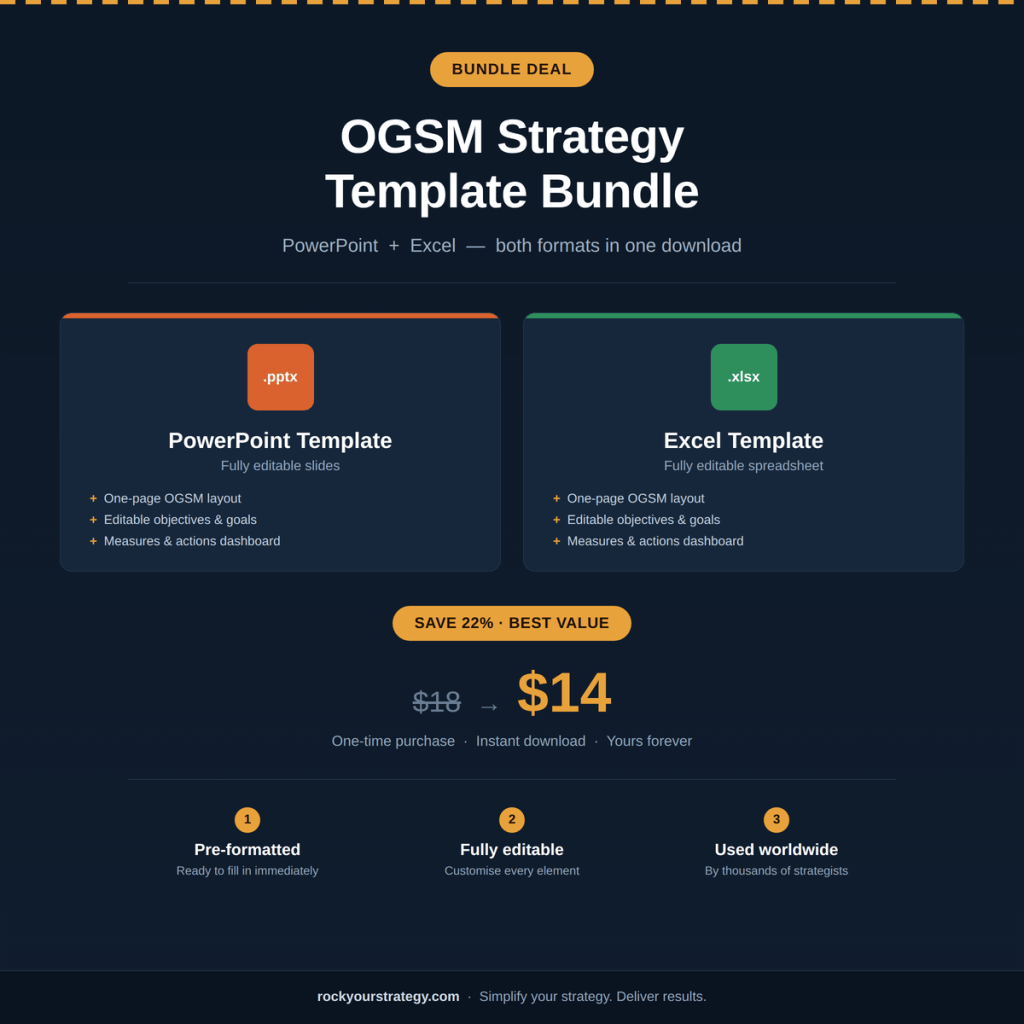
Get both the PowerPoint and Excel OGSM templates in one download — pre-formatted, fully customizable, and instantly available. Save 20% versus buying them separately.
$ 14.00
OGSM Template Bundle — PowerPoint + Excel
Get both the PowerPoint and Excel OGSM templates in one download. Save 20% versus buying separately.
By the way, the OGSM is not only for large corporations. Its simplicity makes it well suited also for small businesses, entrepreneurs and even non-work projects. Should small businesses even do strategic planning? Click on the link to find out.
The set-up of qualitative objectives with quantitative goals and qualitative strategies with quantitative measures helps to translate a corporate strategy into a division’s objective or a product line strategy into a functional department objective.
The higher level organization’s strategy becomes the lower level organization’s objective. The higher level organization’s measures become the lower level organization’s goals and so on.
A well-cascaded OGSM thereby ensures that each team’s (or even each individual’s) activities are well aligned with the overall organization’s objectives and goals.
In order to understand how to create a business strategy in 6 simple strategy process steps, it’s worth starting with strategic planning.
Strategic planning is the process of creating a strategic direction for your business or organization. It describes designing the choices you make towards achieving an objective or desired future state.
Strategy development includes a thorough assessment of your business or organization and the environment in which you operate. It determines where you are headed and how you are going to get there.
The Strategy Process
The strategy development process includes 6 steps and answers 6 critical questions:
The 6 steps of the strategy process
Businesses or organizations develop strategies for different purposes and over different time horizons. Most commonly strategies span 3-5 years and aim to develop the business towards a specific objective. This may for example include growth or productivity or often both.
Strategies are also often designed for shorter term purposes such as annual operating plans. In this case the objectives are to be achieved within one year and the strategies chosen are more tactical in nature.
In larger corporations, the strategic development process actually takes multiple of these horizons into considerations and incorporates them into one strategy process. In their book “Playing to Win: How Strategy Really Works”, A.G. Lafley and Roger L. Martin, describe this process as cascading the strategy.
Cascading is an important process to ensure different divisions and functions of a large corporation align their objectives and strategies with the larger purpose and resources of the company. We’ll talk about that later.
For smaller, for example owner-led businesses, this is overkill and too time-consuming. Strategy development is critical for small businesses nonetheless as we will describe in the 6 steps of strategy development.
Side bar: if you’d like to read more about strategy before jumping into the strategy development process, check out this article on “What is strategy?”.
Let’s go through the 6 steps one by one starting with the mission of the business. Before we jump in, consider engaging an experienced facilitator to help guide you and your team through the process in a strategy workshop.
Step 1: Mission of the Business
Step 1: Mission of the Business
We begin with a description of your business. The reason we start here is because clarity about the identity and purpose of your business is a critical first element of your strategy.
Don’t overlook this important step. This is like building the foundation before you construct a house on it. A strong foundation allows you to build a tall and beautiful home.
The description of your business should include a statement about the business scope, the products you are selling, the markets you are targeting, and the geographies you are operating in. It is useful to write this out and to discuss it in your team to ensure that everyone is on the same page.
It strikes me time and again how different people have different ways to describe the same business. The differences may be subtle, only a few words may be different. But when you are developing a strategy, it is important that everyone is clear about who you are and what your starting point is. Otherwise it will be difficult to describe your destination and what you need to do to get there.
Consider the following simple example.
Example: Tony’s Pizza
Example: Tony’s Pizza
Tony is the owner of a small chain of pizza restaurants called Tony’s Pizza. There are 2 locations in the tri-state area. Tony has gathered his team to review their strategy and identify new areas of growth. Having subscribed to “Rock Your Strategy”, Tony is beginning with a discussion of the mission of the business.
“Easy!”, exclaims Stefano, head chef of the chain and designer of its menu. “All we have to do is expand the menu beyond pizza. We are an Italian family restaurant after all! Diners want antipasti and secondi!”.
“Italian family restaurant?” asks Jen confused. Jen is Tony’s wife and takes care of the company’s finances. “Honestly, we are a pizza parlor. We make pizza and sell pizza. People come here because we have the best pizza at the best prices. People don’t come here for the ‘dining experience’”.
Brian, the part-time delivery driver, looks up from his smartphone. “Actually, I do get asked occasionally when I deliver pizzas whether we are only a pizza delivery service or whether we have a sit-in restaurant as well. It seems customers are not aware of our 2 restaurant locations.”
Tony realizes that this is going to be more difficult than he had expected. Ten minutes into the meeting and there is no consensus on what kind of business they are actually running today: a family restaurant, a pizza parlor, or a pizza delivery service? Tony senses that clarity about today’s business is needed before they can discuss how to identify future opportunities for growth.
Okay, I admit that the Tony’s Pizza example is maybe an oversimplification. But the point is that Tony’s choices about how to grow his business are going to be vastly different depending on how he defines his starting point.
If he determines his business to be a family restaurant, then to grow sales, he may indeed consider expanding his menu. Investing in new, higher-priced main dishes may appeal to a different kind of customer segment with more disposable income.
If Tony concludes that his business is a pizza parlor, growing sales may require opening additional locations. This might take time and be quite capital intensive.
If in the mind of the customer Tony’s Pizza is only a delivery service, then maybe all he needs to do is advertise to make people aware of his 2 dine-in locations to grow sales.
His strategy therefore strongly depends on the definition of his company’s current business scope, products, and markets.
Key Take-away from Step 1
Be clear about your business’ main mission and purpose and make sure everyone on your team has the same understanding. This will ensure that you are thinking along the same lines later as you discuss steps 2-6.
Step 2: Business Analysis
Step 2: Business Analysis
If step 1 was about your company’s mission, then step 2 dives deeper to identify your business’ core competencies and competitive position.
Step 2 answers the question “What are my unique strengths and weaknesses?”
Let me first say that a detailed business analysis can be a daunting task. You pull away the curtain and unveil your company’s deepest secrets. This can be very uncomfortable and some owners might not be agreeable to reveal such details to their teams. This is up to you.
In my experience, it is helpful to be honest with yourself and teams appreciate the trust and understanding of the business. If you are not comfortable to do this in your team, conduct the analysis by yourself and share your outcomes. The insights about strengths and weaknesses are important, less so how you arrived at them.
Company Financials
During business analysis, review the historical financial performance of your business. Analyze your sales, costs and profitability by product line, market, and geography. Seek insights from the data to identify where you perform particularly well or particularly poorly.
Customer Feedback
Do you have a record of customer feedback? This is the time to bring out that dusty bin with the feedback forms. Customer feedback is an invaluable resource in strategy development. Review the feedback and seek patterns of things you do well and things that customers are not satisfied with. If you do not have a record of customer feedback, consider conducting a survey or spend time speaking with your customers to gain insights for this process.
Employee Satisfaction
Also speak with your employees about their perception of company strengths and weaknesses. Ask them about their satisfaction working for your company. What are they particularly fond of? Where do they see room for improvement?
Strengths and Weaknesses
Bring all the insights together and record your business’s strengths and weaknesses. Identify your core competencies. In the next steps of strategy development, you will want to use your core strengths to your competitive advantage. And you will want to work on improving or managing your weaknesses depending on their importance to achieving your objectives.
A powerful tool to help you with this is the SWOT analysis. SWOT stands for strengths, weaknesses, opportunities, and threats. Read here in more detail how to do the SWOT analysis right. The link also includes examples and templates.
Key Take-away from Step 2
Business analysis is all about identifying your company’s key strengths and weaknesses as suggested by your financial performance, your customers’ feedback and your employees’ satisfaction. You will want to leverage your strengths in your strategy and manage or improve your weaknesses.
Step 3: Industry Analysis
Step 3: Industry Analysis
While step 2 looked at your business in detail, step 3 now analyzes the external environment in which your business operates. This is an assessment of your industry to identify growth drivers and business risks.
Step 3 answers the question: “what are my opportunities and threats?”
Independent of the size of your business, it is a good idea to have a solid understanding of your external environment. In this step, I am not talking about GDP figures or unemployment rates, even though these can be interesting indicators about the overall economic environment. Industry analysis seeks to identify risks and opportunities directly relevant to your industry and to your business. Insights gained here may have a direct effect on your choices where to play and how to win.
To do this well, consider the following analyses: industry attractiveness and customer needs.
Industry Attractiveness Analysis
The objective of industry analysis is to learn how attractive your industry is long term and which parts to focus on. This should include a brief look at macroeconomic factors influencing your business, understanding your key competitors, as well as the size and growth prospects of your market.
Tools that may help with this step include a PESTEL analysis, Porter’s Five Forces, and market size and growth estimates as well as market growth drivers. In B2B markets, it would additionally be useful to analyze the value chain and create an industry map.
The objective of customer needs analysis is to understand what your customers are looking for and what is important to them. This will help you determine how to develop your product and service offerings when making strategic choices.
The approach to customer needs analysis can differ in B2C and B2B markets, but the essence is the same: understand your customers!
Just to briefly scrape the surface, in B2C markets seek to explore your customers’ preferences, likes and dislikes. There are expensive market and retail reports and other key figures available by third party market research firms if you want to fork out a hefty amount of money. Or you can simply ask your customers about their preferences if this is practical for you. The customer feedback forms above may already give you a head start.
In B2B markets, focus your analysis not on what customers want but what they truly need and what they are willing to pay for. This can often be understood in economic terms since your customers are profit-making businesses too and your products or services have an economic value to them.
Identify needs that are not yet served by you or your competitors. Look for changes in your customer preferences which may allow you to cut costs. Capture the opportunities and risks identified.
Pro-Tip: Look for patterns in your findings and group customers into segments. Cluster those customers together that have similar needs. If you go into marketing planning after your strategy process, this information will become very useful.
A Word of Caution
Have you heard of the term ‘analysis paralysis’? Don’t overdo it with analyzing every detail of the environment around you. This step is also not about using and filling every tool you can find in management books. This is about using tools to guide you in asking the right questions and generating meaningful insights to determine where to take your business.
Once you have the insights you need, stop the analysis and move forward. If you don’t yet feel comfortable with your findings or identify a risk or opportunity you don’t yet fully understand, dive deeper.
Key Take-away from Step 3
Analyze your industry attractiveness and your customer needs to identify opportunities and threats in your external environment.
Step 4: Vision
Step 4: Vision
During steps 1-3 we described the present situation of your business and your industry. In step 4 we begin thinking more concretely about the future – your future.
Step 4 describes the vision for your business and answers the questions “where am I going?” or “where to play?”.
The vision is not a fantasy or dream about your company. It is a real destination you aspire to reach in the next 3-5 years. You make concrete choices about the where you intend to play.
In step 4 you derive key insights from the mission of the business, your key strengths and weaknesses and your main opportunities and threats. You use these to set concrete objectives and goals for your business.
Objectives
The objective is a qualitative statement about your business’s ambitions over the next 3-5 years. This is the future state of your organization. The objective should be concise and specific. It should spell out in no unmistakable terms what you are aiming to achieve, i.e. where you will play.
Depending on the type of your business and the current situation it is in, this might be a single sentence statement. If you envision a major transformation of your business, you may want to elaborate a bit more.
Your objective should be aspirational. It should allow you to leverage your identified strengths to take advantage of identified opportunities or mitigate identified threats. It may describe how you want to position yourself to add value to your customers.
Goals
The goals are the quantitative description of your objective. Goals should translate your qualitative objective statement into measurable, financial figures. These are the numbers that represent the future state and help you to measure whether you are successful.
Make sure that your goals align with the purpose and the timeframe of your objective. A great way to describe your goals is to apply the SMART approach to goal-setting. Goals must be
Specific: the goal must be clear and unambiguous
Measurable: the goal must be quantifiable and progress trackable
Achievable: the goal should be ambitious, but it must be attainable
Relevant: the goal must be realistic and relevant to your objective
Time-bound: the goal must have a clear timeline and target end point.
Let’s meet Tony again to see how he set the vision for Tony’s Pizza.
Example: Tony’s Objective
Example: Tony’s Pizza
Reviewing the business has been an exciting journey for Tony and his team so far. They studied their business financials and customer feedback. They reviewed local economic data and sifted through competitive insights. Tony and Jen even dined a couple of times in different restaurants in the city to see what other restaurants were doing.
Tony was pleased to read how much customers loved their pizza. Particularly their pizza dough and his family’s secret pizza sauce received rave reviews.
However he was surprised to see population growth figures in the tri-state area and rising GDP per capita. It’s true, more and more young families had moved to their town from the city over the past 5 years ever since the new interstate was built. But he hadn’t realized how much bigger the town had become.
Speaking with the mayor, the chamber of commerce and other small business owners, Tony learned that their town had become a popular dwelling for families who sought more space outside the city but were not willing to give up their modern city lifestyles. The only thing missing really was more dining choices. There were a couple of pizza restaurants, fast-food chains, and a steakhouse. After all, they had been doing well in this setting with their pizza parlor for many years. But Tony was curious whether a proper sit-down family restaurant with Italian cuisine would be a popular niche not yet served.
After further studying the possibility, Tony and his team made a decision. They were to transform one of their pizza parlors into a family restaurant. Tony captured their objective:
Tony’s aims to expand beyond its delicious pizzas to become a trusted Italian restaurant where families feel at home and share an enjoyable, freshly cooked meal.
Tony looked up and felt proud. This sounded like a great objective. He could already see the smiles on happy customer faces and smell the intoxicating scent of fresh Italian dishes being served.
Key Take-away from Step 4
Creating a vision for your business means describing what you want to achieve in 3-5 years, i.e. deciding where you choose to play. This future state is captured in ambitious but achievable objectives and goals.
Step 5: Strategic Choices
Step 5: Strategic Choices
In step 4, you set an aspirational objective for your business that you aim to achieve in 3-5 years. Step 5 is about defining the strategy and designing the path to your destination. This is probably the hardest part of strategy development. It is about making tough choices.
Step 5 answers the questions “how am I going to get there?” or “how to win?”.
Are you familiar with the proverb “all roads lead to Rome”? There are probably many ways how you could achieve your objectives. However, resources are finite. So in step 5, you will choose how to allocate your time and your resources to achieve your objective.
When choosing your strategies, think about your customer needs, industry trends and your company strengths. Consider what products and services to develop or what markets to focus on. Consider whether you will win against competition via better prices (lower cost) or better products (differentiation). And consider what company culture or people skills will be needed to succeed.
Double-check whether any of your weaknesses or identified threats may prevent you from achieving your objectives. Incorporate mitigation measures into your strategic initiatives.
Example: Tony’s Strategies
Example: Tony’s Pizza
Tony had decided to sleep over his freshly drafted objective statement. This is something he learned from his late mother: important decisions should not be made lightly. Tony could still remember the ring of her voice in his ears, “a good night’s sleep will bring clarity and determination.” And that was the case.
Coffee in hand, Tony and his team resumed discussion on their new strategy. They sought to create 3-5 strong strategic initiatives that would help them turn their pizza parlor into an Italian restaurant local residents would love.
The team debated several aspects of successful Italian restaurants they knew. But the longer they discussed, the more they came back to two important principles. They wanted to create a restaurant that remained true to Tony’s values and reminded people of the cozy pizza parlor heritage. And they wanted to make sure that the restaurant was unique to the tri-state area and incorporated features of the community.
At the end of the day, they stared at 5 scribbled statements on scattered flipcharts. At that moment they knew they had nailed it.
Offer dishes the entire family will love by developing an approachable Italian menu with Tony’s all-time classics and rotating seasonal specialties
Serve great-tasting, freshly cooked food by sourcing most ingredients fresh from the local tri-state area
Turn customers into guests who feel at home by designing a cozy restaurant interior that reminds people of a small-town Italian trattoria.
Hire and train experienced employees who embody Tony’s values and make guests feel at home.
Make people in the tri-state area aware of Tony’s new dining experience by implementing marketing initiatives that create interest to give the new Tony’s a try.
Key Take-away from Step 5
Strategic choices is about deciding how to allocate your resources to achieve your objectives. Strategies define the roadmap to success, i.e. how to win.
Step 6: Execution Plan
Step 6: Execution Plan
We are almost there! But not quite yet. Because a good strategy is only as good as its execution. And how often have you seen people make plans that they did not turn into reality? Exactly! Step 6 is about creating an execution plan that ensures you implement your strategies and reach your objective and goals.
Step 6 answers the question: “What actions do I need to take to realize my plan?”
Developing an execution plan means defining concrete, quantifiable measures that combine actions with caretakers and timelines. Step 6 is all about commitment.
Make sure that for each of the 3-5 strategies chosen in step 5, there are concrete actions defined. Think through what it takes to deliver the strategy. What actions are needed? What resources do you need? Who do you need to speak with? Whose support, expertise or permission is needed?
Consider breaking down each strategy into no more than 3-5 concrete actions and define owners, timelines, and a quantifiable target for each. Especially the quantifiable target makes sure that there is clarity about expectations and what success looks like.
In addition to designing an action plan, create a review dashboard and agree how the plan is followed up on. How do you check progress? When do you review the plan? When and how are employees expected to report back?
Designing an execution plan means agreeing on key actions, caretakers, timelines and targets and implementing a reporting and review procedure.
The 6 Steps of Strategy Development
Strategy Process Conclusion
In this article you learned how to take your business through the strategy development process to create effective strategies that deliver results.
Strategy development includes a thorough assessment of your business or organization and the environment in which you operate. It determines where you are headed and how you are going to get there.
The strategic planning process consists of 6 steps:
Mission of the Business
Business Analysis
Industry Analysis
Vision
Strategic Choices
Execution Plan
Bonus Tip: Strategy Development and OGSM
The beauty of the OGSM methodology is that it can help you capture all 6 steps of the strategy development process. In the OGSM, you can set your business’ 3-5 year objective and goals. You describe your strategies or strategic choices how you will get there. And you determine your measures, i.e. your action plan. All on one page. This makes your strategy easy to read and understand, easy to communicate, and easy to execute.
To learn more about OGSM and how it can help you simplify your strategy and deliver results, click here.
Before jumping into the OGSM methodology, allow me first a note on strategy and delivering results since that is what OGSM helps you accomplish.
Strategy describes the choices you make to achieve an objective. It is the approach you take to reach your destination. Strategy is about where to play and how to win.It is a roadmap to success.
Strategy is often perceived as a difficult topic – a high-flying, powerpoint-tossing exercise, rich in important sounding words and often disconnected from substance and reality. It’s perceived to be a game for senior executives and smart consultants and often causes more frustration than clarity and purpose. I know because I’ve been there. In the following I’ll share my experience and best practices.
Strategy is a roadmap to success
Everyone knows strategy is important. A good strategy is critical for success. It connects an enterprise’s purpose with its activities. It is a roadmap for action and guides decision making. It creates alignment in the organization and engagement in the team.
“Begin with the end in mind.”
Stephen Covey
Creating a strategy seems like a difficult, resource-intensive process that takes time. And indeed in large corporations that often is the case. But it doesn’t have to be. In fact, it shouldn’t be. A good strategy could be developed on the back of a napkin (Okay, bringing a napkin into the meeting with your board of directors or any stakeholder may not look convincing. But we’ll speak about communicating a strategy later). Or at an offsite retreat. Or with the team in a conference room. And it should fit on a single page. Because strategy is actually quite simple.
Strategy is nothing else than the choices you make to achieve an objective. It’s the approach you take to win. It’s a roadmap to success.
Most importantly though, strategy is about making choices. More specifically it is about the choices where to play and how to win.
For example, a strategy may describe what products to sell and which markets to target to grow your business 20% this year. Or a strategy could outline which customers to approach and what promotional offer to use to close that next sale. Or, quite simply, strategy may be the way you get to work today, choosing the mode of transport and which route you take.
Strategies are roadmaps that can be created at a corporate level, at a business unit or product/category level or at a tactical point-of-sale level. The point is that strategy is a means to an end, but never the end itself. The strategy is not the goal.
Too often in my business life I have heard: “our strategy is to make the numbers!” Yes, making the numbers is key. Business is ultimately about delivering results. But that is the goal, not the strategy. “Making the numbers” does not say WHERE to play or HOW to win. Strategy will say HOW to make the numbers.
Driving strategy implementation
So a strategy is a plan to achieve something. But it is more than a plan. Strategy is a set of choices that determines if and how you are going to be successful. And success is measured by results. And if you want to deliver excellent results, a plan is still not enough. You need a system for implementation. You need an approach that ensures that action is taken and followed up on. And that’s often the crux.
“A strategy is only as good as its execution”.
My former mentor and friend
Let me take you on a quick journey. How often have you seen a strong strategic plan crafted with great diligence? Many hours of careful market analysis and data crunching go into its preparation. Well-formatted powerpoint slides are created. A raving presentation is given to an excited leadership team. Words of commitment are spoken and a spirited decision is made in pursuit of the identified opportunity and its promising results.
Only… after its presentation, the powerpoint is filed and everyone goes back to their daily work. You know, that day-to-day grind that keeps us all busy: emails, customer complaints, delayed shipments, and other small catastrophes. And nothing happens. Sounds familiar? Yes, I know. I’ve been there too. That’s why strategies fail.
A good strategy rallies the team: gain commitment, assign accountabilities, trigger action, drive change, ensure follow through. And that only happens when people know what is expected of them. That only happens when there is absolute clarity WHAT needs to get done and HOW it is accomplished. That only happens when there is a clear action plan, clear caretakers, clear deliverables, clear timelines. Enter the OGSM.
My aim is to make the topic of strategy approachable and winnable. I want you to be widely successful at creating strategies and executing them to perfection. Whether you are a leader at a Fortune 500, an aspiring entrepreneur, a hopeful young professional or a stay-home-mom with a side hustle, I want to help you win.
Because a good strategy is ultimately measured by its results: achieving 20% business growth, closing that next sale, or safely getting to work on time. Because only a good strategy that is well executed will lead to the desired results.
Having said all that, in the following, I will focus on the OGSM methodology to simplify strategy and deliver results. There are of course many other tools and approaches. After all, many books and articles have been written on the subject. However, in my personal experience I have found that the OGSM approach is the most compelling in leading through a strategy process, making choices and coming up with a one-page deliverable that is easy to understand, easy to communicate and easy to execute.
Focusing on only one approach may of course have disadvantages. Not everyone may find the OGSM methodology equally appealing. Not everyone may deem it the best fit for them. And that’s ok! If you gave it a try though, I am sure you may find that it is quite applicable to almost any circumstance, any business, any endeavor. It is true that it is not all encompassing. It is not a silver bullet. And it’s usage by itself will not guarantee success. After all, it’s merely a tool. In the end what you do with it still matters the most.
Covey, Stephen R. (2012). 7 Habits Of Highly Effective People. New York: Simon & Schuster
Ready to put your strategy into action? The OGSM methodology gives you a simple, proven one-page framework to make it happen. Download a pre-formatted, fully customizable OGSM Template for PowerPoint or OGSM Template for Excel from the Rock Your Strategy shop — and turn your strategy into results.