Creating a marketing plan can seem overwhelming, but it doesn’t have to be. With the right framework and approach, you can create an effective marketing plan that aligns with your business goals and objectives.
Creating a strong marketing plan is crucial to the success of any business. Using the OGSM methodology aligns the marketing plan with the overall business objective and goals and details clear strategies and measures for successful implementation.
In this article, we’ll walk you through the OGSM methodology, which stands for Objectives, Goals, Strategies, and Measures, how to apply it to effective marketing plans and provide relevant examples for each element of the plan.
What is a marketing plan?
Before we dig in, what is a marketing plan anyway and why do I need one? A marketing plan is a comprehensive document that outlines a company’s marketing efforts including how to achieve business goals such as increasing sales, expanding the customer base, and launching new products.
The benefits of a marketing plan therefore include aligning marketing goals with business objectives, identifying potential opportunities and threats, allocating resources effectively, and measuring the success of marketing efforts. In other words, by creating a killer marketing plan, you can stay ahead of your competition and achieve your desired business goals.
OK, so how do we go about creating a killer marketing plan using the OGSM methodology?
The first step in creating a killer marketing plan is to define your objective. Objectives are the big picture goals you want to achieve with your marketing plan. These could include increasing sales, expanding your customer base, or launching a new product. To define your objectives, ask yourself:
What is my business’s mission and vision, and how can my marketing plan support these?
What are the top three to five goals I want to achieve with my marketing plan?
When you are clear on your mission and goals, write an objective statement using the “what-by-how” method. The “what-by-how” method includes in one statement both what you aim to achieve and clarity how you are going to achieve it.
Example:
Let’s say you’re the marketing manager for a fashion brand whose vision includes becoming the most desired online fashion brand. Your objectives might include increasing brand awareness, driving more traffic to your online store, and boosting sales. Your marketing plan should support these objectives and align with your brand’s mission and vision.
Your Objective could read:
Become the most desired online fashion brand by increasing brand awareness, driving more traffic to our online store, and boosting sales.
Once you’ve defined your objective, the next step is to set specific, measurable goals that support your objectives. Goals should be specific, measurable, achievable, relevant, and time-bound (SMART).
For example, if your objective is to increase sales, a SMART goal could be to increase sales by 10% in the next quarter. To set your goals, ask yourself:
What specific metrics do I want to achieve with my marketing plan?
How will I measure my progress toward these metrics?
Example:
Continuing with the fashion brand example, let’s say your objective is to boost sales. Your SMART goals could include
increasing online sales by 15% in the next six months,
With your objective and goals in place, it’s time to develop your marketing strategies. Strategies are the actions you will take to achieve your goals. Your strategies should be specific, actionable, and aligned with your goals. To develop your strategies, ask yourself:
What specific tactics will I use to achieve my goals?
How will I allocate my resources (budget, time, etc.) to support my strategies?
Aim to select no more than 3-5 specific initiatives in order to allocate your resources to the most effective activities. Similar to your objective statement, consider writing your strategies using the “what-by-how” method to make them as specific and actionable as possible.
Example:
For the fashion brand, your strategies could include
Raise brand awareness by launching a new influencer marketing campaign,
Increase website traffic by optimizing your website for search engines, and
Boost web traffic conversion rates by creating targeted email campaigns.
You could allocate your resources as follows: 50% of your budget to influencer marketing, 30% to website optimization, and 20% to email campaigns.
Finally, it’s essential to measure the effectiveness of your marketing plan to determine whether you’re on track to achieving your objective and goals. Measures are the specific metrics you will use to evaluate the success of the strategies in your marketing plan. To define your measures, ask yourself:
What metrics will I use to track the effectiveness of my marketing plan?
How will I use this data to make informed decisions and adjust my marketing plan as needed?
Select specific metrics for each of your strategies or initiatives. While the strategies are qualitative statements, the metrics should be quantifiable data and figures.
Example:
For the fashion brand, your measures could include
tracking website traffic,
conversion rates,
email open rates and click-through rates, and
social media engagement.
You could use this data to make informed decisions about which strategies are working and adjust your marketing plan as needed.
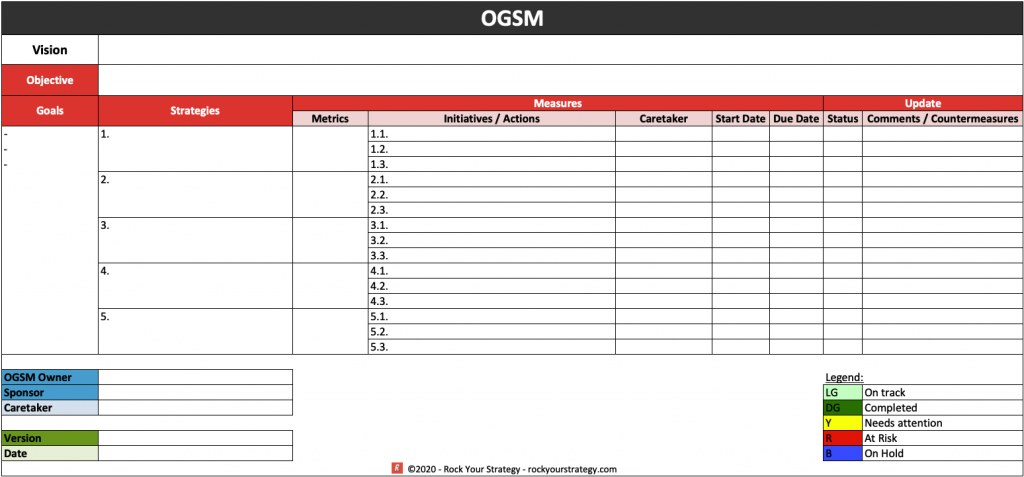
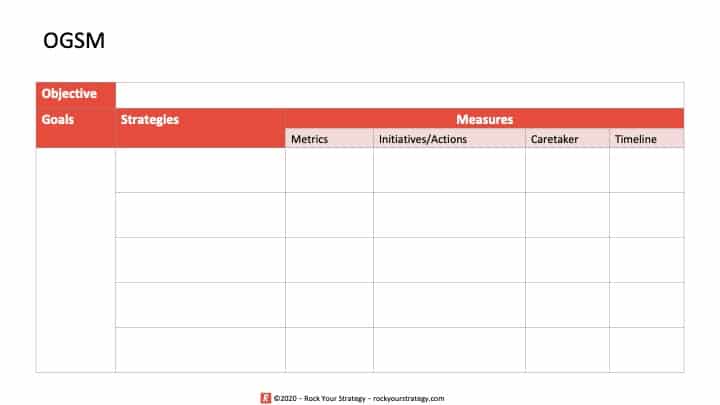
Creating a killer marketing plan using the OGSM methodology takes time and effort, but it’s well worth it in the end. Using a template can help you get started and accelerate your progress. Here are templates for Excel and Powerpoint to give you a leg up:
OGSM Template for Excel
Pre-formatted, easy-to-use OGSM template for Microsoft Excel.
By aligning your marketing plan with your business objectives, setting SMART goals, developing actionable strategies, and tracking your progress with specific measures, you can create a successful marketing plan for your business.
As you spring into action, plan ahead to regularly review the effectiveness of your marketing plan and to make needed adjustments to keep you on track. Read more about regular reviews here. Rock on!
There are various different types of strategies and many different strategy tools. But which type of strategy is best suited for the OGSM model?
OGSM can be used for various types of strategies, including but not limited to business strategy, marketing strategy, operations strategy, and human resources strategy.
In general, OGSM can be applied to any situation where an organization wants to define and achieve specific outcomes and goals. Let’s explore this further but first clarify what is OGSM?
The OGSM Model
OGSM stands for Objectives, Goals, Strategies, and Measures. It is a management framework that helps organizations define and align their objectives, goals, strategies, and measures in a structured and organized manner. It enables organizations to clearly articulate their desired outcomes and the actions required to achieve them.
The benefits of using OGSM include:
Clarity of purpose: OGSM provides a clear understanding of what the organization wants to achieve and the steps it needs to take to get there.
Alignment of efforts: OGSM ensures that everyone in the organization is working towards the same goals and objectives, fostering better teamwork and collaboration.
Improved decision making: OGSM provides a framework for setting and tracking key performance indicators, enabling organizations to make informed decisions and adjust their strategies as needed.
Increased accountability: OGSM makes it easier to hold individuals and teams accountable for achieving specific goals and objectives.
Better prioritization: OGSM helps organizations prioritize their efforts and allocate resources more effectively, leading to improved efficiency and better outcomes.
Business strategy: OGSM can help businesses define their objectives, set goals, and determine the strategies and measures necessary to achieve their desired outcomes.
Marketing strategy: OGSM can be used to create a structured approach to marketing campaigns, including defining objectives, setting goals, and determining the strategies and measures needed to achieve desired outcomes.
Operations strategy: OGSM can be used to optimize operational processes and procedures, including defining objectives, setting goals, and determining the strategies and measures necessary to achieve desired outcomes.
Human resources strategy: OGSM can be used to develop and implement human resources policies and practices, including defining objectives, setting goals, and determining the strategies and measures necessary to achieve desired outcomes.
Supply chain strategy: OGSM can be used to optimize supply chain and logistics processes, including defining objectives, setting goals, and determining the strategies and measures necessary to achieve desired outcomes.
OGSM for Marketing Strategy
Let’s look at marketing strategies in more detail. OGSM can be a useful tool for developing and implementing a marketing strategy. Here is an example:
Objectives: In the OGSM framework, objectives represent the long-term outcomes that a marketing campaign aims to achieve. For example, an objective for a marketing campaign could be to increase brand awareness among target audiences.
Goals: Goals are specific, measurable, and time-bound targets that support the objectives of a marketing campaign. For example, a goal for the objective mentioned above could be to increase brand awareness by 10% in the next six months.
Strategies: Strategies are the high-level plans for how to achieve the goals set for a marketing campaign. For example, a strategy for the goal mentioned above could be to implement an influencer marketing campaign that reaches the target audience through social media.
Measures: Measures are the metrics used to track the progress and effectiveness of a marketing campaign. For example, a measure for the strategy mentioned above could be the number of followers gained on social media channels as a result of the influencer marketing campaign.
By using OGSM, organizations can create a comprehensive and structured approach to marketing campaigns, ensuring that all efforts are aligned and focused on achieving specific, measurable outcomes. Additionally, by tracking measures, organizations can regularly assess the effectiveness of their marketing strategies and make adjustments as needed to ensure they stay on track to meet their goals.
How to get started with OGSM?
Adopting OGSM can be a straightforward process. Here’s how you can get started:
Define the objective: Start by defining the overall objective for your organization or for a specific initiative. The objective should be a qualitative statement about the desired future state of your business or initiative. Learn more about setting objectives here.
Set goals: Next, set goals that support your objectives. These goals should be SMART (specific, measurable, achievable, relevant, and time-bound) targets that help you achieve your objective. Learn more about setting effective goals here.
Determine strategies: Based on your goals, determine the strategies you will use to achieve them. These strategies should be high-level plans that outline the steps you will take to achieve your goals. Learn more about choosing the right strategies here.
Identify measures: Identify the measures that you will use to track the progress and effectiveness of your strategies. These measures should be quantifiable metrics that help you assess the success of your efforts. Learn more about effective measures here.
Implement and monitor: Implement your strategies and regularly monitor and assess your progress using the measures you have identified. Adjust your strategies as needed to ensure that you are on track to achieve your goals. Learn more about strategy execution here.
Review and refine: Regularly review and refine your OGSM plan to ensure that it remains relevant and effective. Learn more about conducting regular reviews here.
It’s important to keep in mind that OGSM is a flexible framework, and you can adjust it to fit the specific needs of your organization. The key is to ensure that your objectives, goals, strategies, and measures are aligned and support each other.
If you are like me then you may also be wondering if there is a better way to drive strategy execution and achieve business results. When I first came across OKRs and OGSM, I was wondering what’s the difference between OKR and OGSM and which one should I apply? Here’s what I found out.
OKR and OGSM are both goal-setting methodologies that help companies execute their strategies but they differ in scope, timeframe and format.
Let’s explore these differences and their similarities to help you choose which one to apply. I’ll add examples and templates below.
Difference between OKR and OGSM
Before we jump into the details, let’s first find out what OKR and OGSM are.
OKR stands for Objectives and Key Results.
OGSM is short for Objectives, Goals, Strategies, and Measures.
In the OKR methodology, the Objective describes what you want to achieve usually over a monthly or quarterly timeframe and the Key Results describe what achievement would look like.
In the OGSM approach, the Objective and the Goals jointly describe what you aim to achieve and the Strategies and Measures give clarity how you aim to achieve it.
Hence, both OKR and OGSM are goal-setting methodologies that help companies execute their strategies following Peter Drucker’s idea of management by objectives. While OGSM is said to go back to Japanese automotive manufacturers who brought the approach to the United States, OKRs were first implemented at Hewlett-Packard and popularized by their application at Intel and later Google.
Nowadays, OGSM is famously adopted at major consumer staples such as P&G and Coca-Cola, while OKRs are widely practiced in many technology companies and start-ups across the world.
Despite their similarities, there are 3 major differences between OKR and OGSM: scope, timeframe and format.
1. Scope
The first major difference is in scope.
OGSM is well suited for describing strategic plans for large and small businesses alike. The approach is typically applied and aligned top-down from the corporate or business level to individual divisions, product lines, or teams.
OKRs seem better suited for individual and team-level goal-setting. They are often created and aligned bottom-up.
2. Timeframe
The second key difference is in the timeframe or time horizon.
OGSM applies well to longer term strategic plans (over 3-5 years) or annual operating plans (1 year). The objective, goals, strategies, and measures are chosen in line with this longer timeframe.
Once the OGSM is developed, the focus is on implementation and execution. Course adjustments or modifications to the OGSM are made as needed in annual or quarterly reviews.
OKRs typically describe shorter term goals and key results. Objectives and key results are often set quarterly or monthly and aligned accordingly. Once all key results are achieved, new objectives and key results are set.
The application of OKRs is therefore more dynamic and OKRs change more frequently.
3. Format & Terminology
The third and most obvious difference lies in the format of the goal setting approach.
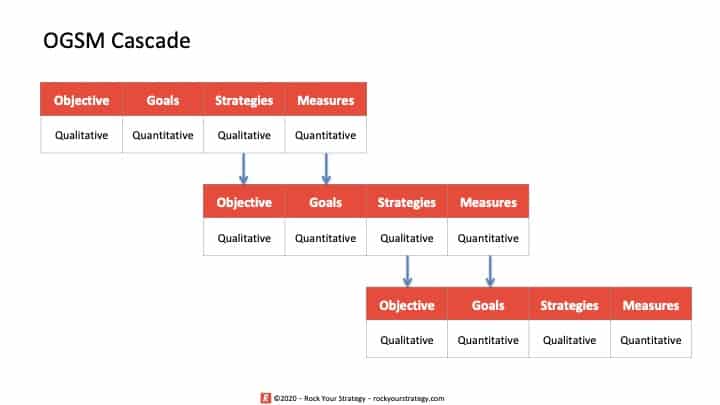
OGSM describes in detail the objective, goals, strategies, and measures. Objectives are words, goals are numbers. Strategies are words, measures are numbers. The OGSM is thereby more elaborate in describing, aligning and quantifying where the business is heading and how it aims to get there. The plan is summarized on a handy, single page overview.
OKRs on the other hand typically describe the objective in qualitative terms and then jump straight to detailed key results which may be qualitative or quantitative. Often no more than 3-5 key results are chosen to define the objective. OKR is therefore simpler in its approach.
The following table illustrates the difference in format and compares the terminology.
OKR
OGSM
Objective
Objective
Goals
Strategies
Key Results
Measures
When analyzing and applying OGSM and OKR, many more detailed differences will become apparent. For the purpose of identifying the key differences and helping to choose which approach to apply, I find that those three distinctions were most critical.
What are advantages and disadvantages of OKR and OGSM?
While both OKR and OGSM are goal setting methodologies, due to their differences in scope, timeframe and format, they each have unique advantages and disadvantages.
Advantages & disadvantages of OKR
The advantages and disadvantages of OKR are summarized in the following table.
Advantages
Disadvantages
– Quick to create and apply bottom-up – Easily adjusted and changed – Can facilitate performance management and feedback
– Lacks the longer term context – Doesn’t describe how to achieve key results – Bottom-up OKR definition can make alignment across company tricky
Advantages & disadvantages of OGSM
The advantages and disadvantages of OGSM are summarized in the following table.
Advantages
Disadvantages
– Simple one-page overview creates clarity about overall business plan – Clearly aligns goals (“what”) with actions (“how”) – Guides execution and follow-through – Highly versatile: can be applied for large & small businesses, organizations and non-work projects
– Not easily changed or adjusted short-term – Requires strong leadership buy-in – Company wide cascading can be perceived as cumbersome and overly bureaucratic if not well managed
One additional advantage of OGSM is that the simple one-page business plan format lends itself well for communication of the business strategy with your team. This is however also an advantage of the OKR methodology as well.
When should I apply OKR or OGSM?
OKRs work well for individuals and teams and when your timeframe to achieve your objectives is rather short such as 1-3 months.
OKRs are thereby particularly well suited for highly dynamic environments where change occurs quickly and where the organization has to remain agile to adapt. This is why many start-ups and technology companies apply OKRs.
OGSM provides a more robust structure which makes it more suitable for overall strategic plans or annual operating plans. While OGSM are well suited for larger companies, they also provide strong guidance for smaller businesses and entrepreneurs.
Tip: OKRs and OGSM can of course be applied in combination. The OGSM can be used to set the overall vision and direction of the company with clear financial goals, strategies and measures. These can be broken down into quarterly OKRs. The OKRs then help to drive quarterly execution in alignment with the strategies and measures.
What are examples of OKR and OGSM?
Applying the OGSM methodology is not difficult. Here are examples to show how to use the OGSM methodology in practice.
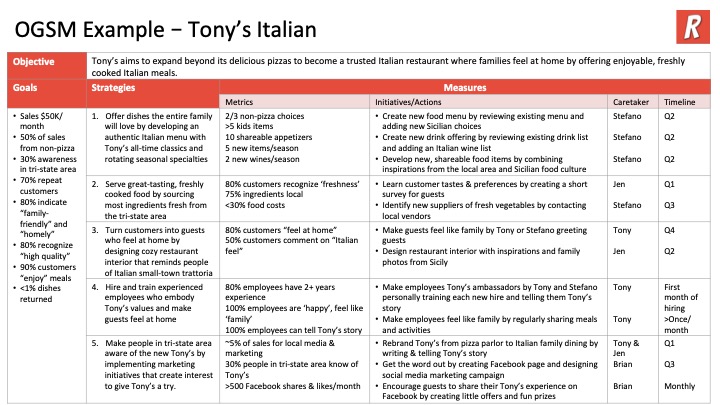
Tony’s Italian OGSM
Tony’s Italian is a fictional story about how Tony turned his pizza parlour into a family restaurant. The example shows how to apply OGSM to a small consumer business. Click here to read the full story of how Tony goes through the strategy process and captures his insights and strategic decisions in the OGSM. Or find the OGSM below.
Tony’s Italian OGSM Example
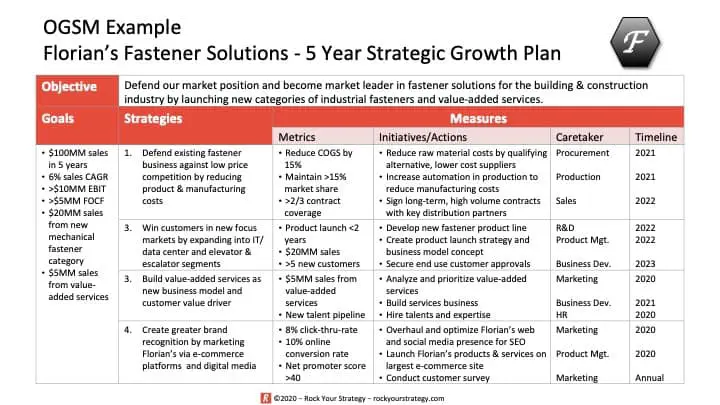
Florian’s Fasteners OGSM
Florian’s Fasteners tells the fictional story of a small B2B business that turned around its fortunes after a strategic review. Click here to read Florian’s story or find the OGSM below.
Florian’s OGSM Example
Examples of OKR
For examples of the OKR methodology, I can really recommend the resources at www.whatmatters.com.
John Doerr, author of the excellent book “Measure What Matters”, and his team go into lots of details and practical examples.
Where can I find OGSM templates?
Here are templates of the OGSM to get you started. Click on the following links to download PDF copies of the simpler Microsoft PowerPoint template or the more sophisticated Microsoft Excel template.
OGSM Template in PowerPoint
OGSM Template for Microsoft Excel
If you’d like to learn more about how to use these templates to create your OGSM, check out this article.
And before you go, check out our jam-packed Resource page with more tools and templates to help you simplify your strategy and achieve excellent results. Rock on!
How do you get a quick but profound assessment of the situation of your business? Conduct a SWOT analysis!
SWOT stands for strengths, weaknesses, opportunities, and threats and evaluates the situation of a business, project or organization. Conducting a SWOT analysis is a 5-step process:
Decide the objective of your analysis
Identify strengths, weaknesses, opportunities, and threats
Challenge and prioritize your results
Make a plan
Take action
The SWOT analysis is a simple but very powerful tool. You can use it stand alone or as part of a strategy process. Read on for a step-by-step guide how to create an impactful SWOT analysis and download our free templates and examples to help you get started.
How to do SWOT Analysis?
The SWOT analysis is an intimate view of your business, project, or venture.
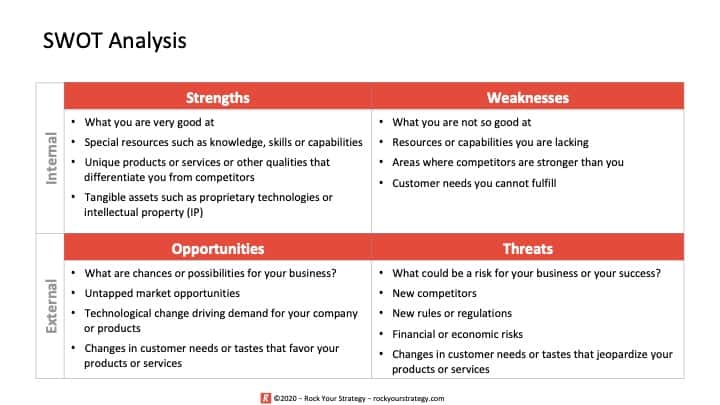
Strengths and weaknesses are internal to your business. This means they describe the business itself or the internal situation. These are factors, such as products, services, capabilities, skills, knowledge, etc. that you are good at or not so good at. You can directly influence these internal factors.
Opportunities and threats are external to your business, which means these are factors outside of your business that you are exposed to. These can be market trends, the political, economic, socio-cultural, technological, environmental, legal/regulatory environments (PESTEL), or of course competitors, suppliers, and customers. Usually, you cannot directly influence external factors.
SWOT Analysis
The SWOT analysis is often conducted as part of a strategic review process. But it can also help to obtain a quick overview of the health of a project or the prospects of a new venture. It can be conducted for the entire business or on a product or team level.
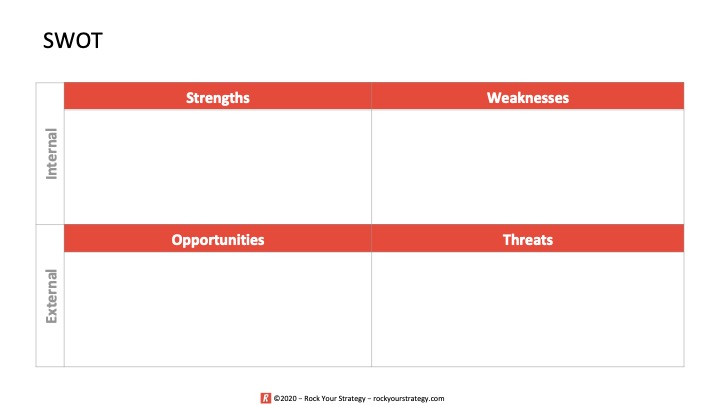
The SWOT is typically depicted in a 2×2 matrix that looks as follows.
Strengths
Weaknesses
– … – … – …
– … – … – …
Opportunities
Threats
– … – … – …
– … – … – …
Simple 2×2 SWOT Analysis Matrix
In order to conduct a SWOT analysis, take the following 5 steps.
1. Decide the objective of your analysis
What is the purpose of your SWOT analysis? Is this SWOT for your entire business or for a subset such as a product, division or team? Are you analyzing your SWOT as part of a strategic review or for another reason?
Be clear and deliberate about why you conduct the analysis before you begin. This is often overlooked and may cause confusion during the analysis or ambiguous results. Your purpose gives context to the analysis and allows you to be more specific in your assessment.
2. Identify strengths, weaknesses, opportunities, and threats
Conduct a brainstorm about each of the four elements of the SWOT. List down all the aspects you can come up with. The following questions may help. Your answers can be qualitative or quantitative but try to be as specific as you can.
Strengths
What are you particularly good at?
What makes you and your business unique in the marketplace?
What are you distinctively better at than your competition?
What special resources such as knowledge, skills or competencies do you have?
What tangible assets give you an advantage such as proprietary technologies, intellectual property?
What do customers love about you? Why do customers buy from you?
Weaknesses
What are you less good at?
What resources, knowledge or skills are you lacking?
What are your competitors better at than you?
What complaints or feedback do customers have about your products or services?
What processes or procedures need improvement?
Opportunities
What chances or possibilities exist for your business?
What market trends could positively influence your business?
Are there technological trends that could drive demand for your products or services?
Are there customers or sales channels you are not yet fully exploring?
Threats
What could be risks for your business or for your success?
Are there emerging competitors or alternative products or services?
What changes in customer needs or tastes could jeopardize demand for your products or services
Are there supply side risks to availability of raw materials or services you source?
Are there changes to rules or regulations which could affect your business?
What are financial or economic risks you face?
As you go through each of the four elements in turn, be brutally honest with yourself. Don’t sugarcoat the weaknesses or undermine your strengths. Consider using a PESTEL analysis to complement your external assessment. Be realistic and focus on getting to the truth.
3. Challenge and prioritize your results
After you have gone through each element in turn, take a step back and review your list of strengths, weaknesses, opportunities and threats.
For each element, highlight the top 3 to maximum 5 identified aspects. If you can, work on this in a team. It really helps to review your list from different angles and debate your outcome. Challenge yourself to identify really only the top 3-5 aspects relevant to the purpose of your SWOT analysis. Then transfer these prioritized items into the 2 x 2 SWOT matrix.
Why only the top 3-5 aspects? In my experience, it really helps to focus your attention on the top results. Think about it. If a strength doesn’t make it into your top 5, is it really a key strength? If a threat doesn’t make it into your top 5, should you really devote significant resources to it?
4. Make a plan
When the SWOT analysis is complete, turn your insights into a plan of action. In order to do this, conduct a crossover analysis, plotting your strengths and weaknesses against your opportunities and threats. Formulate strategies by asking yourself the following questions:
What strengths can you deploy to take advantage of your opportunities?
What strengths can you use to mitigate or eliminate your threats?
What weaknesses do you need to improve to benefit from an opportunity?
What weaknesses do you need to act on to overcome a threat?
Write down your strategies in a clear action plan including caretakers and timeline. Discuss and align the plan with your team. Ensure that everyone is clear about the plan’s objectives and actions and everyone’s roles and responsibilities.
Go back to your original purpose of the SWOT analysis and confirm that all objectives are met.
5. Take action
Now take action and execute your plan! Set up regular reviews at which you check on progress of your plan to make sure you are on track to achieving your objective and goals.
What to do with SWOT analysis results?
Once the SWOT analysis is completed, formulate strategies to act on the insights gained. In order to do this, conduct a crossover analysis, plotting your strengths and weaknesses against your opportunities and threats.
This may look as follows.
Opportunities
Threats
Strengths
Strength-Opportunity StrategiesWhat strengths help you take advantage of the identified opportunities?
Strength-Threat StrategiesWhat strengths help you overcome the identified threats?
Weaknesses
Weakness-Opportunity StrategiesWhat weaknesses to improve to benefit from opportunities? What opportunities might help you overcome a weakness?
Weakness-Threat StrategiesWhat weaknesses to improve to minimize a threat?
Crossover Analysis of SWOT Results
Write out 2-3 strategies for each crossover pair for a total of 8-12 strategies. Then prioritize your strategies based on your objective and goals. Aim to identify the 3-5 strategies that optimize your chance of success or with the best return on investment.
Then turn your strategies into an action plan with clear initiatives, caretakers, and timeline. Conduct regular reviews to make sure you are on track to achieving your objective and goals.
Why conduct a SWOT analysis?
The SWOT analysis is a simple but powerful tool to assess the internal and external situation of your business, project or organization.
It can be conducted quickly and easily without creating major costs or devoting significant resources. The SWOT analysis can be performed alone or in a team. It can be applied at various levels of an organization: to the business as a whole or to individual teams or products.
The results of a SWOT analysis can immediately be acted on. Or they can be integrated into a larger business strategy process.
Should small businesses use SWOT analysis?
The SWOT analysis is a simple but powerful tool to assess the situation of your business. As it can be conducted quickly and easily without creating major costs to the business, it is a great tool for small businesses to evaluate their strengths, weaknesses, opportunities, and threats.
All you really need is a pen and paper to follow the simple 5-step process. Or download one of our free templates to help you get started!
SWOT template
Begin your SWOT analysis by downloading our free SWOT analysis template.
Make sure to check out our resource page where you can find many other useful tools and templates to help you win at strategy and at business.
SWOT examples
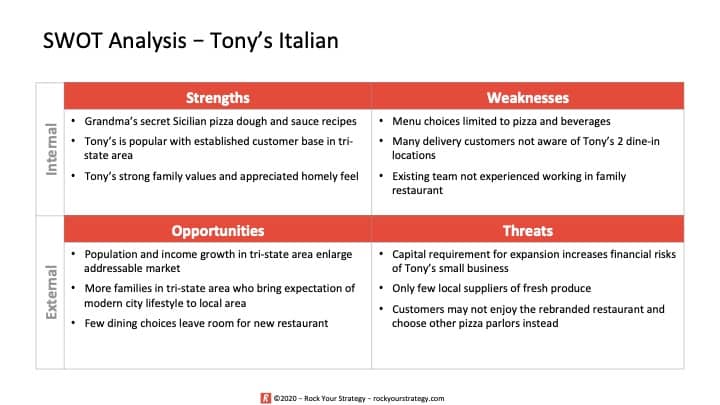
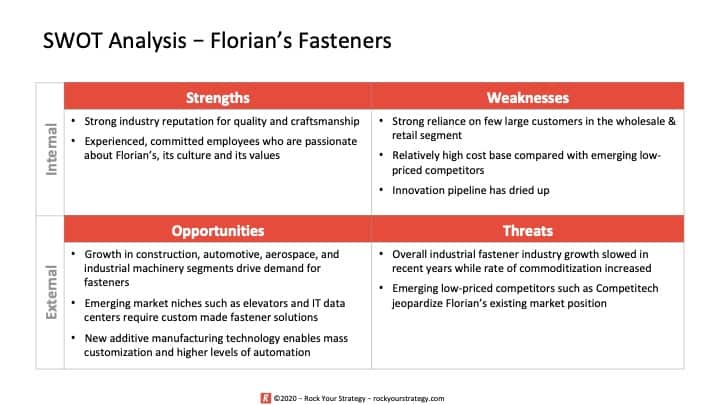
In the following are two examples of SWOT analyses applied in practice. The first is a B2C example of Tony’s Italian restaurant. The second is a B2B example of Florian’s Fastener Solutions. Both of these examples are fictional to protect confidential information but the insights and learning can be real.
If you’re researching SWOT analysis to help create a strategy for your business, project or venture, make sure to check out our other articles on strategic planning.
Our resource page with examples, tools & templates, workshop materials, book recommendations and glossary may also be of value to you.
If you have any questions or comments, why not leave us a comment below or sign up to our free newsletter here. We’d love to hear from you. Rock on!
Two-thirds of all business strategies fail during implementation. And just like the seven cardinal sins, when strategies fail in business often one or more of the seven deadly sins of strategy are at work.
The seven deadly sins of business strategy:
Ignorance – not knowing
Incongruity – not fitting
Confusion – not understanding
Doubt – not believing
Discord – not uniting / not aligning
Incompetence – not able
Inertia – not acting
Become aware of these seven sins of business strategy and how to avoid them and you are on your way to business success. Here’s how.
Ignorance
The first sin is ignorance or not knowing.
Merriam-Webster defines ignorance as “the state or fact of being ignorant: lack of knowledge, […] or awareness”.1
When thinking of ignorance I cannot help but think of the three wise monkeys and the famous maxime “see no evil, hear no evil, speak no evil”. However when it comes to business strategy, it would obviously not be advisable to stick your head in the sand and pretend the world around you does not exist.
Running a successful business and developing effective strategies require staring the truth in the eye, relentlessly asking questions, and thoroughly analyzing and understanding the situation you are in.
In his classic book “Good To Great”, Jim Collins calls this “confronting the brutal facts”2. Collins argues that you cannot make good decisions without confronting the brutal facts of reality. You want to create an atmosphere where people are encouraged to raise issues and speak their minds. You want a climate where the truth is heard. How? According to Collins:
Lead with questions, not answers
Engage in dialogue and debate, not coercion.
Conduct autopsies, without blame.
Build “red flag” mechanisms that surface information that cannot be ignored.
Every good strategy process begins with an analysis of the current internal and external business environment in order to situate the strategy in the realities of the business.
Ignorance will set you up for failure. Knowledge, awareness and facing the facts will set you up for success.
Incongruity
The second sin of business strategy is incongruity or not fitting.
Merriam-Webster says incongruity refers to “something that is incongruous”, i.e. “something that is inconsistent within itself”.3
A business strategy can only be effective in delivering results when it fits the situation the business is in. Every business is different. Every strategy is different. Different strategies may be effective at different times. Along those lines, a strategy that may fit another business or at another time does not necessarily fit yours – and now.
I have seen businesses emulating other successful businesses’ strategies hoping that such a strategy would also work for them. Or I have seen new leaders coming to new businesses and attempting to implement the strategies that made their previous businesses successful. I’m not saying that this may never work. But I am saying that the specific strategy must fit the business and the situation that it’s in. If possible, check and adapt.
One important aspect of congruence is that your business must have the necessary knowledge, resources, skills and capabilities to implement the chosen strategy. If that is not the case, the strategy is incongruent with the business and bound to fail.
Starting your strategy process with an analysis of the current internal and external environment and truly understanding what strengths and weaknesses your business has, helps make sure that the strategy you develop fits your business and its situation.
One more important aspect that has served me well over the years: involve your team in the strategy process. Their insights and real day-to-day experiences will help test assumptions and guide the discussions towards the right priorities. Make sure however as noted above that the truth is heard.
With that you set yourself up to develop and execute a strategy that uniquely fits your business and your situation.
Confusion
The third sin is confusion or not understanding.
Merriam-Webster defines confusion as “the act of confusing” or the “state of being confused” and further describes these “to disturb in mind or purpose” or “to fail to differentiate from an often similar or related other”.4
In other words, related to business strategy, the strategy is unclear or not fully understood. And what could be worse than to develop a carefully designed strategy, nestled in the realities of the business, vetted over months, if in the end your team does not understand it.
Being unclear about the company’s strategy or not understanding how one’s own role contributes to the mission of the business are key reasons for employee disengagement. And when your team is not engaged, it is not effective in moving your company towards its objective and goals.
In order to create clarity about your strategy, consider the following three aspects:
Involve your team in the strategy process. Integrating your team’s insights and expertise when deciding where to play and how to win builds in their understanding of what you are trying to achieve.
Keep the strategy simple. Duh, this sounds obvious. But it is actually really hard to do. Calibrating your strategy so that it is not high in the clouds and disconnected from your business while anchoring it in the day-to-day realities without cluttering it with details is the ultimate challenge. Work with your team, follow a structured process, challenge yourself to reiterate until you can boil your strategy down to its simplest essence. Check for clarity, sufficiency, alignment before finalizing.
Communicate, communicate, communicate. Throughout the entire strategy process, communicate with your team. Share your thoughts, test assumptions, possibly involve customers.
A 2009 survey by Forbes Insights and FD revealed that a lack of understanding was the number 2 reason why strategies failed during execution5. What’s the number 1 reason? Unforeseen external circumstances (see Ignorance above).
So invest in clarity and involve your team and you should be well on your way.
Doubt
The fourth sin is doubt or not believing.
According to Merriam-Webster, doubt means “to call into question the truth of” something or “to lack confidence in” something.6
When thinking of business strategy, doubt is sewn when the strategy is not compelling, when the strategy does not have a clear destination or when the destination seems unattractive or out of reach.
A business strategy must spell out the purpose of the business and why moving the business towards its destination is an attractive, worthy cause. It’s strategies that appeal to a larger cause than the products of the company or a financial goal that inspire people and make people believe.
For example, a strategy that aims to “achieve profit X” or to “build product Y” are clear and realistic, but not inspiring. Instead, connect these goals to a larger cause such as serving a key customer need, solving a major problem or overcoming an industry challenge.
A strategy must clearly articulate a vision, a destination so compelling that it moves people to action.
Besides being connected to the realities of the business and being clear and understandable, therefore, a business strategy must inspire people to believe.
Discord
The fifth sin is discord or not uniting or aligning.
Merriam-Webster says discord refers to the “lack of agreement or harmony (as between persons, things, or ideas)”.7
Say you have defined a vision for your business. You have turned that inspiring vision into clear objectives and goals and you have rallied your team to join you on that journey. But what if it is not clear how you will reach your destination or worse what if there is disagreement about how to reach the destination? The energy you created deflates.
The same way there are “a thousand ways to Rome”, there are many ways for a business to reach its objectives. An effective strategy doesn’t only spell out what it aims to achieve, but also how it is going to achieve it. As Lafley and Martin say in “Playing to Win” it’s where to play AND how to win.
Strategy is all about making choices. It’s about allocating your finite resources to those initiatives that give you the highest chance of success. It’s about deciding which ventures to fund, which products to build, which services to offer, and which competencies & skills to develop.
It should not be your ambition to make everyone agree with the strategy. It’s ok to agree to disagree. It’s more important that everyone unites and gets behind the strategy to direct the company’s resources fully towards its vision and strategic objectives. How do you achieve that? Alignment.
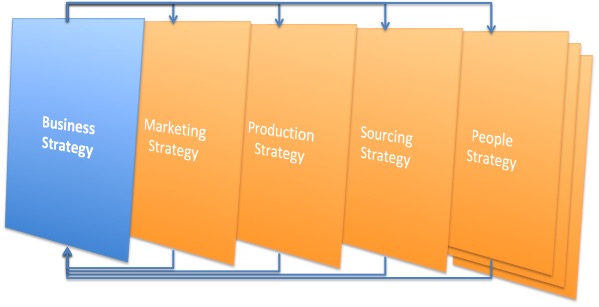
During the strategy process, work with your team to translate the objective and goals into strategies that translate your ambitions into results. The strategies describe the ‘how’, the trade-offs, the resource allocation decisions. Then further work with your team on cascading the strategies into objectives and goals for each division, function, and team. In a small business with only a few people, the same process holds. Translate the strategies into clear objectives, goals, and initiatives for each person. The initiatives and actions of each team or person must align with the larger cause like one cogwheel in a system grabbing into another.
When the business is united behind the strategy and your team is aligned on how to reach your destination, you can fully direct your energy towards achieving your goals.
Incompetence
The sixth sin is incompetence or not being able to.
Merriam-Webster defines incompetence as “the state of being incompetent”, i.e. “lacking the qualities needed for effective action”.8
Incompetence or the lack of ability to do something is likely the easiest sin to understand and also the easiest to overcome. Yet, in my experience, incompetence is also the most underestimated.
When defining a strategy and setting the course for your business, it is important to confirm whether your business has the necessary knowledge, skills, and experiences to implement the strategy and achieve the goals. It’s worth reviewing these terms individually. For our intents and purposes, let’s define the terms as follows.
Knowledge – refers to knowing what to do. This means having acquired theoretical and practical knowledge through professional training, university, school or self study. Books are a wonderful source of knowledge.
Skills – refers to knowing how to do it. These are the competencies and techniques needed to complete a job, task or activity. These include hard skills and soft skills as well as generic skills and domain specific skills. Practice or training is a great way to acquire and hone skills.
Experience – refers to having done it before. This means having applied the acquired knowledge and skills in real life. Having faced and overcome the exact situation you aim to master.
Consider a sports example. Knowledge means you have read all about football, you have watched it on TV and have been told what football is and how to play it. Skill means you have practiced football. You have handled the ball, you have trained together with your team members. Experience means you have played the game and have been on the field in the competitive situation of winning or losing.
Having and honing all three, knowledge, skills, and experiences, vastly improve your chances of success and overcoming inertia.
This doesn’t mean that you cannot succeed if you lack any or all of them. Learning by doing or tackling a new challenge that no one has ever faced can be powerful ways to move people to action. Just know that lack of knowledge, skills and experiences can be a reason why your strategy is not progressing.
So audit yourself during the strategy process and check you have the necessary knowledge, skills, and experiences to do what you aim to do. If not, seek to understand whether this is critical for success. If yes, invest in building the necessary knowledge, skills and experiences before setting off on your journey.
Finally, make sure that your key initiatives critical to success are well resourced. Even if you have the necessary abilities, there is no guarantee for success. Ensure you have enough of them and that they are applied persistently.
Inertia
The seventh sin is inertia or not acting.
Merriam-Webster says inertia is the “indisposition to motion, exertion, or change” and defines inertness as “very slow to move or act”.9
In business strategy, inertia is an interesting phenomenon. Your strategy is ready, you have communicated with your team, but nothing happens. Progress is slow. Results are pending. What happened?
In physics, the reason for inertia is resistance. In business, the reasons could be manifold and not due to one single reason.
Inertia could be caused by a lack of focus. If you have too many topics on your plate, you may be working a little on all of them, but not sufficiently on any of them to make a difference or bring a topic to the end. Review the number of initiatives in your business. What matters most right now? What matters most long-term? Prioritize and work on what’s important first. Bring those topics to an end.
Inertia could be caused by a sheer insurmountable challenge. Have you had this before? A problem so big you didn’t know where to start? I have certainly been there and it keeps you from moving ahead. If you face such a situation, break it down. Divide the problem, project or initiative into smaller steps or sub-projects. Consult a colleague or mentor to help you with this when you get stuck. Sometimes another perspective can be powerful. Then tackle one topic at a time. Ensure that each sub-project has the resources and expertise to move forward.
Inertia could be caused by a lack of passion. When you find an activity you love doing, it seems no effort at all. You tackle it readily and you don’t seem to notice the time passing. However, when the opposite is true, when you face an activity you cannot get excited about, it seems to become a chore. You are more likely to put it off and choose to get other things done first. This is quite typical and can also happen with your strategic initiatives. When resourcing your initiatives and finding caretakers, make sure to check for interest to find someone who can get passionate about the project. If this is not the case, consider outsourcing. If it’s important to the strategy, but not core to your business or the passion of your business, find someone for whom it is.
Inertia could be caused by a lack of ability. As noted above under incompetence, lacking the necessary knowledge, skills, and experiences may prevent your team from moving forward. Ensure that you have the ability to succeed and that it is well resourced.
And of course, inertia could be caused by resistance. Sometimes outright resistance to the strategic direction, to the objective and goals, to the approach prevents progress. But resistance itself is not the reason. When resistance exists, there are more fundamental concerns in play that must be understood. Dig in! Approach your team, your customers, your stakeholders openly. Ask questions to truly understand their concerns. Fundamental reasons could be fear and anxiety about changes: plant closures, job losses, benefit changes. These concerns can be very personal and it’s critical they are heard and understood to help people cope. Any such reasons are legitimate. Approach them with empathy. Make it your personal mission to truly understand and then work with the people to overcome their underlying reasons for concern.
So how do you change inertia? Just like in physics, you apply force. No, not physical force. But you do need to give an input to create motion. And that input must come from the business leader.
Engage your team throughout the strategy process and ensure key people are involved. Openly and actively listen to questions and concerns. Communicate, communicate, communicate so everyone understands why you are doing what you are doing and how the team can help.
Engagement and understanding create buy-in. And buy-in helps you overcome inertia.
How to avoid the 7 sins of business strategy
Now that we have learned about the 7 sins of business strategy and heard some thoughts about how to avoid them, how do we set ourselves up for success?
In order to succeed in business, apply the following six principles of business strategy during your strategic planning and implementation.
1. Structured process
Whether you are in a large company or a small business, a disciplined strategic planning process is critical to success
Be deliberate about strategy development and implementation
If you have a team, involve your employees in the strategic planning and the implementation process
Involving your team not only sends a clear message of appreciation, but also helps with anticipating potential obstacles and preparing accordingly
Your team knows the day-to-day challenges and helps with a realistic assessment of opportunities and capabilities.
3. Buy-In & Alignment
When developing your strategy, make sure your objectives, goals, strategies, and measures are congruent with each other. Check whether strategies and measures are sufficient to achieve the objective and goals.
Seek systematic buy-in and alignment of objectives and strategies across your organization. Make sure each function is involved, understands what it takes to be successful, and has the resources and capabilities to succeed.
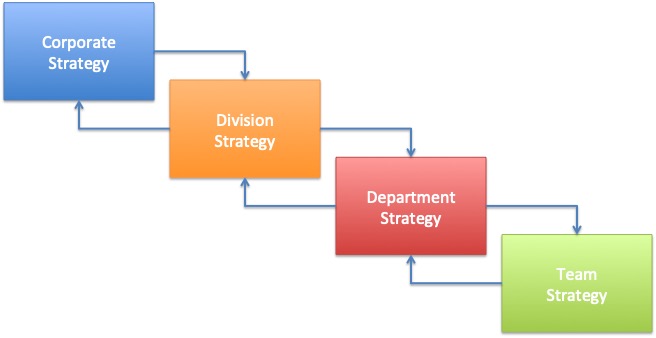
Systematically break down objective and goals and cascade them throughout the organization. Ensure that every level in the organization is aligned, empowered and pulls in the same direction.
4. Communication
Clarity about objective, goals and strategic priorities is of utmost importance. You cannot execute a strategy you do not understand.
Build communication as an integral part into strategy formulation and execution.
Listen to questions and concerns and consistently explain how initiatives and actions fit with the overall strategy and how each individual can help to achieve the objective and goals.
5. Accountability
While the business leader is ultimately accountable for success or failure of the strategy, the strategic plan must be the common objective for the entire business
Set clear expectations for each function and team and clarify how each contributes to moving the business in the right direction and delivering results.
Hold people responsible for implementing strategic initiatives and delivering expected results. Be a cheerleader for your team and allow no excuses.
6. Execution
Implementation must be considered a strategic initiative, not an operational task
Install a clear cadence when reviews take place and what actions have to be completed by whom and by when
Ensure that key initiatives are prioritized and resourced appropriately with the needed manpower and skills
Conclusion
In summary, to avoid the seven sins of business strategy, work with your team to follow the 6 proven principles of business strategy.
The OGSM methodology is one of the most effective antidotes to all seven deadly sins of business strategy — a clear, one-page plan that the whole team can see, understand, and act on. Download a pre-formatted, fully customizable OGSM Template for PowerPoint or OGSM Template for Excel from the Rock Your Strategy shop and build your strategy on solid foundations.
Many Fortune 500 companies and many small businesses have successfully implemented the OGSM methodology to support their strategic process. Why? Because there are many benefits to using OGSM to simplify strategy and deliver results. Here are 13 ways the OGSM methodology can improve your strategy too.
→ Want the complete OGSM reference before diving in? The Complete OGSM Framework Guide covers all four components in depth, real-world examples by industry, a comparison to OKRs and the Balanced Scorecard, and step-by-step build instructions.
1. Simplicity
The OGSM is simple. The methodology uses a simple framework, easy language and a one-page overview to break down a sophisticated process into an approachable, simple format. This makes it easy to understand and easy to adopt.
2. Clarity
The OGSM makes strategy clear and transparent. As the OGSM depicts the strategy on a single page, there is no need to read a long strategy paper or a thick powerpoint deck to understand what the business or the organization is looking to achieve and how it will get there. The objectives, goals, strategies and measures can all be found at first glance. Clarity about strategic objectives is critical if you want to achieve them.
3. Quick to learn
The OGSM methodology is easily understood and quick to learn. You do not need to hire expensive consultants first to explain to your executive team or your project team how to develop a strategy or deploy the tool. The format and terminology are simple and basic concepts of the methodology can be learned quickly in order to be deployed effectively. (Besides, you have Rock Your Strategy to help you through the process ;-))
4. Easy to communicate
The OGSM can be easily communicated. Key to effective communication is connecting with your target audience to help them understand the key content of your message. Because the OGSM is simple, easy to understand and makes your strategy clear and transparent, it is a wonderful way to communicate your strategy.
5. Versatility
The OGSM is versatile. It can be used for long-term strategic plans with time horizons of 3-5 years or longer. It can be applied to annual operating plans or budget plans. It can be deployed for large or small-scale projects etc. etc. In essence, anytime you have an intended outcome and need to plan how to achieve it, OGSM could be your tool.
I have personally applied OGSM both for long-term strategic plans and for annual operating plans and I have seen it used to manage a project. All worked very well.
6. Engagement
The OGSM creates engagement. By definition, engagement is when people pledge their support, when they feel a legal or moral obligation to do something. Involving the team, receiving their input and obtaining their buy-in is important. But showing in the OGSM how the team can support implementing the strategy and achieving results creates true commitment.
7. Focus
The OGSM creates focus. Strategy is all about making choices and the process and the OGSM format force making choices. Choices which initiatives to prioritize and how to allocate resources to achieve your objectives and goals. I have found that choosing 3-5 strategies is optimal in order not to put all your eggs in one basket while directing your attention and capabilities towards those activities where you can have the biggest impact.
8. Alignment
The OGSM aligns all functions and stakeholders towards a common objective and goals and shows how each can contribute towards achieving them. This is important to ensure that all parts of an organization pull in the same direction. Nothing could be worse for an organization than to create conflicting priorities or diverging interests which lead to inefficient allocation of resources or outright internal competition. While internal competition can be good in some situations. It is poison if there are conflicting views about what the strategic priorities of the business are.
9. Cascading
The OGSM makes cascading strategies throughout the organization easier and more straightforward. With OGSM you can cascade the strategy vertically from e.g. company level to division level to team level. You can also easily cascade horizontally from business unit or product line to various organizational functions, such as marketing, sales, operations, HR etc.
10. Teamwork
The OGSM methodology encourages teamwork and works best when discussed in the team. Bringing your team together to discuss your strategy, analyze the current situation, debate strategic choices, and decide resource allocation ensures that the strategy is connected to the realities of the business and creates understanding and buy-in.
11. Execution
The OGSM format connects WHAT you aim to achieve, the objective and goals, with HOW you are going to achieve it, the strategies and measures. This builds the execution plan into the strategic plan. That means the organization knows how to achieve its goals and can focus on implementing the initiatives.
12. Review
The OGSM methodology lends itself very well for regular monthly and quarterly reviews to make sure you stay on track to achieving your targets. While the OGSM is built top down, the review is conducted bottom up beginning with the measures and the strategies. Regular check-ins keep you on target and allow timely course corrections if needed.
13. Results
The OGSM approach has proven time and again that it helps people deliver results. A plan without implementation is simply that – a plan. The OGSM creates transparency about what is important and encourages taking action to turn plan into reality. Regular reviews keep the team engaged and focused. Timely course-corrections keep the team on track and ultimately lead to results.
Conclusion
OGSM stands for objective, goals, strategies, and measures. It is a simple approach to strategic planning for longer term and shorter term plans alike. It’s a one-page format that describes what the business aims to achieve and how it is going to achieve it.
If you would like to learn more about the OGSM methodology, please click here. You may also browse our examples and tools & templates. If you have any questions, please don’t hesitate to drop us a note. We’d love to hear from you.
Templates
Find tools & templates for OGSM and your strategic planning process here.
OGSM Examples
Find OGSM examples and inspirations for your own journey here.
See OGSM in Action: Real-World Examples by Industry
The 13 reasons above explain why OGSM works. The best way to see those benefits in practice is to look at how different types of organizations use the framework to build focused strategies and drive real results. We’ve developed detailed examples across four industries that represent the most common strategic planning challenges today — from high-growth SaaS companies and AI startups to DTC brands and non-profits.
OGSM Example: B2B SaaS — how a pipeline analytics company aligned its leadership team around a clear path from $2M to $8M ARR, including PLG onboarding, enterprise customer success, and upmarket expansion strategies
OGSM Example: AI Startup — how a Series A document intelligence company used OGSM to make the transition from research-led organisation to a business with a repeatable sales motion and growing retention
OGSM Example: E-commerce / DTC Brand — how a sustainable home goods company built a profitable growth strategy by reducing paid acquisition dependence and investing in owned audience channels
OGSM Example: Non-Profit — how an education foundation aligned programmes, funding diversification, and impact measurement into one coherent three-year strategy
OGSM Example: Tony’s Pizza — the classic OGSM case study that illustrates all four components in a simple, memorable context
Convinced by these 13 reasons? The fastest way to start applying OGSM in your business is with a ready-made template. Download a pre-formatted, fully customizable OGSM Template for PowerPoint or OGSM Template for Excel from the Rock Your Strategy shop — and see for yourself why so many successful companies rely on OGSM to simplify strategy and deliver results.
Looking for inspiration on how to structure your strategic plan? Or just looking for an OGSM example? Get to know Andy and learn how he applies the OGSM methodology to his small B2B company.
OGSM stands for Objective, Goals, Strategies and Measures and is a one-page business plan that defines ‘what’ you aim to achieve and ‘how’ you are going to achieve it. It is a simple but powerful method that enables strategic clarity, alignment and execution. The OGSM can be applied to large companies and small businesses alike.
This fictional story tells the tale about how small business owner Andy used the OGSM methodology to breathe new life into his father’s old business. Scroll to the bottom of this article if you want to skip the story and head straight to the OGSM.
Introduction
Andy hadn’t been able to sleep. Cold sweat on his forehead, he had been tossing back and forth all night. He stared at the marred face in the mirror: tired eyes with deep black rings underneath stared back at him. Andy counted the worry lines engraved on his forehead. His mind was racing. How would he be able to save his company? How would they be able to defend their share – never mind achieve their growth objective? What was he going to tell his investors?
Ever since Competitech had entered the market for fasteners the previous spring, their market share had dwindled. Florian’s Fastener Solutions had been the market leader for nuts, bolds, washers, and screws throughout the entire Northeast ever since his late father had built the company five decades ago. The iconic F-logo was well known in hardware stores and construction sites across the region. Now everything seemed to change. If they didn’t do something fast, they might be running out of cash in 12-18 months.
Florian’s Logo
The annual Board of Directors meeting was coming up in less than 3 weeks. Andy wasn’t sure if he could wait that long. He had to refine his plan and discuss it again with his team.
Andy showered, got dressed, and paused just before descending the stairs. He peeked through the children’s bedroom door. All quiet. He could only hear the steady breathing of his two daughters still fast asleep. “If only you knew how stressful and fearsome this world can be”, he thought to himself. Andy blew kisses to both and rushed downstairs.
Just as he grabbed his bag and ran out to the car his phone rang. “Andy, you up?” asked the familiar voice of his head of finance on the other end of the line. “Good morning, Frank. Yeah, I’m on my way to the office. What’s up?”
“Good! Get down here. The report is back. It’s worse than we thought.”
Founding of an industry icon
Florian’s Fastener Solutions was founded by Florian Walterman in 1965. The son of German immigrants who had fled to the US in the 1930s, Florian worked his way through college by taking any construction job he could find. By the time he graduated, he had made a name for himself as being hard-working, gritty, and determined. No job was too tough. No task was too dirty. If you wanted something done, you asked for Flo. And it was these traits that he infused into his company right from the start.
It was not an easy start however. For the first few years, Florian had a hard time making ends meet. He had to take out a massive loan to afford the heavy equipment. The small shop he rented produced nuts and bolts for some of the construction outfits he had worked for during college. However at the back end of the American construction boom of the 1950s and 60s, there were fewer projects and Florian had to be creative.
Florian began experimenting with different materials and production processes. He tried new metals and blends and added new products. His goal was to make the best fasteners money could buy. If you needed bonding, Florian was determined that it had to be his products to do the job. That also explained his early slogan: Florian’s will fix it!
Ad in local newspaper in the late 1960s
Through sheer will and hard work, Florian persevered. His breakthrough came when a new chain store for hardware and gardening equipment approached him for an exclusive contract. The chain’s plan was to expand all across the Northeast and wanted to carry Florian’s fastener products. When they even offered to fund Florian’s needed expansion through an upfront payment, Florian readily agreed.
In the following years, the chain rapidly grew into American suburbia and with it Florian’s fasteners. Working hard to keep up with demand, Florian built a second site, purchased more equipment and hired more staff. As sales grew, so did the company. But Florian remained as hard nosed, down to earth, and gritty as he had always been.
Florian’s became a household name and its italic F on the bold head a well-known sign of quality and craftsmanship. An industry icon was born.
Family business
Andy had never wanted to get into the family business. Florian’s was his dad’s. It even carried his name. No, ever since being a little boy he wanted to go out to see the world. He wanted to help people who were less privileged than himself.
During high school he worked on a project in Puerto Rico. He was blessed with his dad’s workmanship and strong hands and was glad to put them to good use. In the summer after graduating he led a group of friends to Tanzania to build a school and teach English. He knew he wanted to devote his life to helping others and his choice of college degree was easy.
One day in Fall, Andy had just settled into his 3rd year at the Stanford University social sciences program, his mother called. “Andy, it’s your dad. He had a stroke. Can you come home?”
Shocked how anything could harm his steadfast father, Andy took the first Eastbound flight the following day. When his rental car pulled up the driveway, the last sun rays of the day peaked through the tall pine trees behind his parents’ house as dusk began to settle. Andy had this eerie feeling that more than a day was coming to an end.
“Thank you for coming home, Andy.” said his mother after a long, warm embrace. “Your father is at St. Mary’s hospital. The doctors say he may not make it.” Andy had always had a difficult relationship with his father. Not wanting to continue the business had driven a wedge between them. At this moment however, Andy felt overwhelmed with sadness and regret. All these years he was away while his father was consumed by work. They had not really had a chance to open up about their feelings for each other.
“He always wanted you to be here, you know”, his mother continued. “He loved you very much. He had made plans for you to carry on the company after he retired…” His mother’s voice trembled and tears began streaming down her cheeks. “But retirement never came… and now he’s…”
Andy held his mother tightly. “Let’s go see him”, he said gently.
At the hospital, Andy and his mother sat around his father’s bed. His eyes were closed. It was quiet in the room except for the beeping of the ECG and the hissing of the respirator. The doctors had prepared Andy for what to expect before they entered the room. “Your father has been waiting for you, Andy. He’s not conscious but he can hear you. He doesn’t have much time left. He’ll be happy that you’re here.”
Sitting by his father’s bedside, tears filled Andy’s eyes. He carefully took his father’s hand and whispered close to his ear, “I’m here, Dad. And I’m here to stay. Thank you for everything. I love you very much.” Andy thought he felt a twitch in his father’s hand. It was as if he wanted to say “I hear you, son. I love you.”
Andy looked up at his mother, “I’m ready, Mom. I’ll stay. We’ll get through this together.”
Departure and a new beginning
The funeral of Florian Walterman took place 3 weeks later. It was a beautiful ceremony. Many friends and life companions of the Walterman’s paid their respects.
Afterwards, Andy, his mother and Frank, Florian’s head of finance and Florian Walterman’s right hand man, sat together laughing and telling tales from Florian’s life and achievements.
Suddenly, Frank became serious. “Andy, your father left an envelope with me and asked me to pass to you should he ever leave. The time has come that I pass this letter to you. It includes a copy of his will and his wishes for the handover of the company. It was his wish that the two of you take over the reigns of the company. Please read the letter carefully and let me know if you have any questions. Know that I’m there for you whenever you need me.”
Frank handed Andy the letter, padded him on the shoulder, thanked Andy and his mother for the wonderful ceremony and left.
Andy took a deep breath and opened the letter. His mother knew the contents and looked at Andy while he studied each line and each word.
When Andy looked up, his mother said, “Andy, it’s your company now. I will head the Board of Directors but you run the day-to-day operations. Frank has looked after everything for the last weeks. The company is in good shape but a number of challenges are ahead. We need your foresight, your energy, and your care to take the company into the new millennium.”
Competitech
While Andy was driving to the office, he had to think back to the day 15 years ago, when he took over Florian’s from his father.
The first day in the company after the funeral had been strange for him. His father’s office still had had the musky smell of his old man’s cologne. There had been piles of paper everywhere and it had taken him some time to get sorted. Frank was there for him every step of the way. Frank had introduced him to the team, the operations, and the state of the business. He had taken him by the hand and made sure that Andy learned as quickly as he could. Andy was grateful for Frank’s mentorship. No, Frank was more than a mentor. Frank was like family.
And now Frank was waiting for him at the office with the fateful news he had been dreading all night.
Andy parked his car in front of the building and wished that he had stopped for coffee. Lost in thoughts he drove right by his usual morning coffee stop. “What’s wrong with me?”, he murmured as he stumbled up the steps to the office.
“Andy, finally.” Frank wasn’t much of a small talker, especially not in the morning. “We have an hour until the team gets in. Read this.”
Andy gave Frank a blank stare, took the report from his hand and walked into his office. “Give me the highlights, Frank.”
“Competitech is making much faster progress than we thought. They have taken 2 more retailers on the West coast and are working hard to get into our home base. Stan at Home Improv called me last night. He has Competitech calling him twice a day with new offers. He says he won’t be able to convince his head of purchasing to dodge their prices much longer.”
Andy spun around in his chair, suddenly wide awake. “Frank, I think we have to approach this differently. Let’s stop playing defense. I think we have to take this head on. It’s time to go into offense.”
OGSM Template for Excel
Pre-formatted, easy-to-use OGSM template for Microsoft Excel.
Andy shared with Frank what he had been thinking about all night. When he was finished Frank let out a long sigh. “And you are convinced this will fly?”
“I’m not, Frank. But I think it’s our only chance. Let’s discuss the idea with the team. And then let’s hash out a plan that can beat Competitech, restore our path to growth and convince the Board of Directors and our organization to come on board for the ride.”
Staging a turnaround
It was 8 a.m. by the time the last person sat down in the conference room. Murmurs of “G’morning” made the round. The entire leadership team had followed Andy’s call for the all-hands meeting. The small conference room seemed to be bursting at the seams with all seven leaders in attendance.
There was Frank, of course, the head of finance, who was seated right next to Andy. Next to him was Dan, head of operations, followed by Sharon, head of sales & marketing. Unlike in many other companies, Dan and Sharon usually stuck together. Next to Sharon was Alisha, the head of R&D. On the opposite side of the table, Tom, head of procurement, and Sarah, head of HR, sat in their usual seats.
Florian’s Fastener Solutions leadership team in late 2010s
Andy opened, “Good morning, everyone. Thank you for joining this early on a Monday. We have some important news to share and then some critical topics to discuss.”
Chatter erupted in the room. There was a crinkling of suspense and worry in the air.
“Please guys, let me explain.” Andy cleared his throat. “The market report we commissioned came back this morning… We lost further market share and are now at 15%. Competitech continues its march across the country and is rolling up customers state by state. Their share has swelled to 26%. This needs to stop. If we lose Home Improv or any of our main retail customers here in the Northeast, we will run out of cash as early as next year. I don’t need to explain what that would mean to our company and to the legacy my father has built together with all of you.”
Andy paused and looked around the room. He had everyone’s undivided attention. “Look, I am not going to sugarcoat this. This situation is dire. Competitech is significantly larger than us, offers cut throat prices with their cheap imports, and has a much wider portfolio of fasteners, screws, nails, and other metal products. Competitech is targeting large retailers and wholesalers and is already knocking on Home Improv’s door. If we simply wait and do nothing, they will wash over us like a tsunami. But we will not let that happen!”
Sharon spoke up first, “How do you plan to do that, Andy? Competitech is everywhere. They have a much larger sales force and their prices are 20% lower than hours. My guys are running out of arguments.” Dan nodded. “We cannot compete with their costs. We have optimized our processes over the last years as much as we could. There are no quick wins here.”
Chatter erupted once again as the team began talking over each other. Frank raised his hand and the room fell silent. The sign Florian had established still worked like a charm. “Andy had an idea. It’s risky financially but it’s worth considering. Give him a chance to explain.”
“Thanks, Frank.” Andy continued. “Sharon, Dan, I hear you. You guys have done your utmost to put us – and keep us – in a competitive position. That has contained the impact so far. Thank you for that. However what got us here, will not help us going forward. We have to rethink our strategy and refocus our resources.”
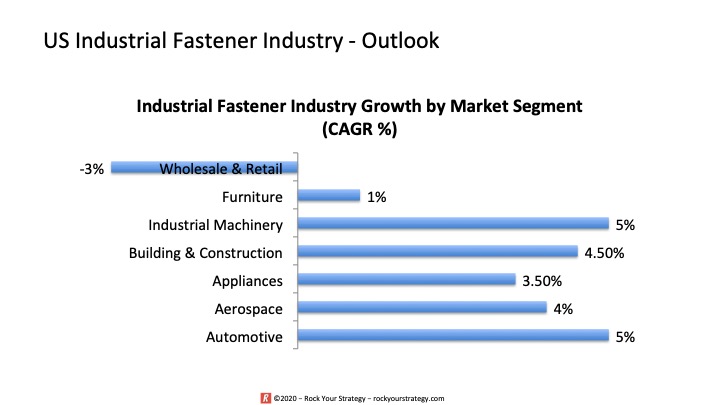
Frank picked up the market report which had been printed and laid out for each team member. “Besides the current market shares and competitive positions, the report also offers an outlook for different sectors of the market in future.” Frank tapped on a graph on page 7 of the report.
US Industrial Fastener Market Report (Source: fictional)
“While the overall fastener industry in the US is growing 2%, the wholesale & retail sector which has been our home market for all these years is going to decline faster in the years ahead”.
Sharon sighed, “I’ve been telling you this, Frank. Retail is dead in the water. No one is fixing up their houses anymore. Young people want to live in the cities. They play on their smartphones all day and have two left hands when it comes to swinging a hammer…”
“You have,” acknowledged Andy. “And we need to direct our attention to what is growing. Look at the chart. Construction, our other main market, remains robust. Automotive, Aerospace, Industrial Machinery are all showing positive growth for the coming years.”
“This is interesting!” Alisha exclaimed. She had skipped ahead in the report and read about the market trends within each of the sectors. “Some of the drivers of growth in Building & Construction are the building of data centers and elevators & escalators. Have we looked at this in more detail yet?”
“You hit the nail on the head, Alisha.” Andy smiled for the first time that day. “We are a small company. We will not be able to take on Competitech with their size. Nor will we be able to satisfy the Automotive industry’s requirement for scale and JIT. Why not use our size to our advantage and focus our attention on growing industries that require custom made products and value-adding services? Such as the IT and Elevator industries.”
The team began discussing the various market segments and debating which ones best fit their capabilities and size. After an hour of reviewing the facts they indeed honed in on IT and Elevators.
“Sounds to me like these are the industries with the highest growth rates in the next few years and for which we are uniquely positioned with our expertise here in the Northeast,” concluded Tom.
“But the industries are still small”, said Dan. “They alone will not be able to sustain us.”
Andy agreed, “It will take time for us to prepare entering those markets. We will need to add new products and new skills. And meanwhile, we must not give up our fortress. We will need to work on our cost position and secure our largest customers. The cash flow from our sales today will need to fund our sales of the future.”
“We will need additional resources for what you have in mind, Andy. We have good standing with our banks, but we will need a clear plan to convince them”, remarked Frank.
“We will need to convince our teams first, Frank. People are nervous. They see our sales declining and are worried that their jobs are at risk.” Sarah reminded everyone what was at stake.
“No one will lose their jobs. We will need everyone if we want to pull this off: you, your teams, the Board, everyone. We need to go back to the values my father instilled in this business to stage a turnaround. Let’s take a break and then resume to make a plan.”
Making a strategic plan
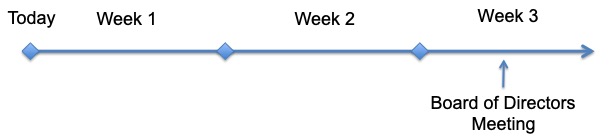
When the team returned to the conference room, Andy had already set up 2 flip charts. On the one in front of the room he had written a timeline.
Andy rolled up his sleeves. “Alright, folks. We have less than three weeks to put together the plan. I suggest we start right away today by setting the framework and then work over the next 2 weeks with our teams to flesh out the details. If we want broad buy-in from the team, we need to involve them as we always have.”
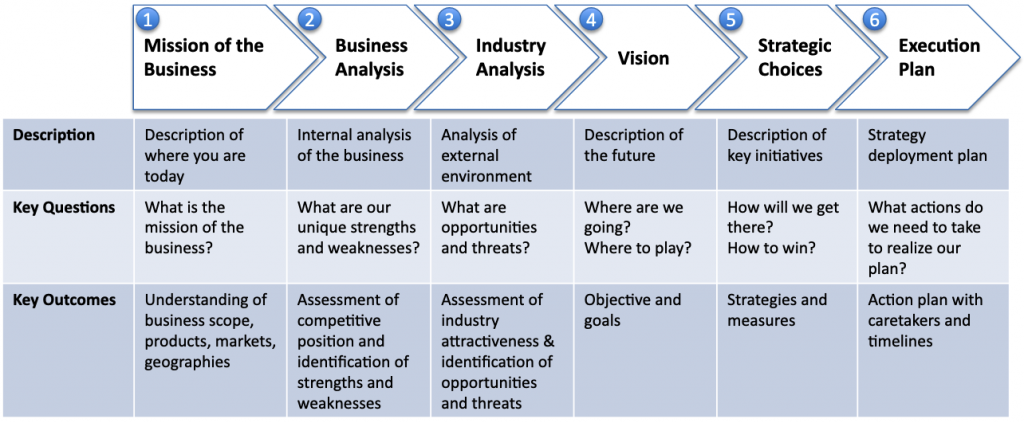
Andy flipped over the flip chart, revealing a process chart. “My dad had sworn by this process. Let’s use it again to guide our discussions. We had a good starting point this morning, but we need to dig deeper into those market segments to better understand their dynamics, customer needs, and competition.”
rockyourstrategy.com Strategy Process
“I suggest we approach it as follows.” Andy pointed to the strategy process. “Let’s focus today on the Mission and Business Analysis steps. Sharon, can you then work with your team on the Industry Analysis until the end of the week? Let’s then resume next Monday with the Vision and Strategic Choices parts before we then develop the Execution Plans with our teams for the remainder of that week. Goal must be to have a plan ready by the end of next week. That’s 10 days, 12 with the weekend. Are you guys ok with that?”
“Wow, that’s a tight timeline, Andy!” Dan was not usually the one to point out the obvious.
“Yes, it is, Dan. This is not going to be easy. I am open to alternative ideas if you have any.” Andy scanned the room, but no one had a suggestion.
“Then let’s get started,” said both Alisha and Sarah in unison. They looked at each other and giggled. “Yes, let’s get started”, confirmed Andy, glad that the mood had lightened. “Frank, can you take over and facilitate?”
Intimately familiar with the strategy process, Frank was happy to. He got up and walked to the front of the room.
OGSM example – the 5 year growth plan
The Leadership team of Florian’s Fastener Solutions went to work. And over the next two weeks worked out a detailed plan with their teams. They summarized their strategy in a simple one-page business plan they called their OGSM.
OGSM stands for Objective, Goals, Strategies and Measures and is a one-page business plan which details what you aim to achieve and how you are going to achieve it.
Andy knew his dad had used the OGSM methodology for years. He had liked its simplicity and the clarity it created. Combining the what and the how moved the team from planning to execution and aligned everyone behind the overall direction of the company.
“If you want your team to follow you, Andy, your team needs clarity where you’re headed!” he had always implored on him. Andy heard his father’s voice ring through his head. He could remember a treasure trove of bumper sticker-like one-liners from his childhood. He barely ever listened to his dad when he talked about work at the dinner table. When Andy took over Florian’s however he had been glad for the lessons his dad had taught him.
“Making the numbers is not a strategy. Strategy is about making choices!”
“Appeal to your people’s hearts and their minds and they will take you anywhere.”
“Take care of your people and they will take care of your customers.”
“A plan is only as good as its execution!”
Andy sat in his office, eyes locked on a copy of the freshly minted OGSM in front of him. He felt good about their plan. Not only did the leadership team work on it with enthusiasm. But the entire organization had pitched in. He was surprised at the commitment everyone had shown. It was as if they had just been waiting to be asked to contribute. And maybe they had been…
Andy felt exhausted as he dialled his mother’s phone number. He wanted to set up a meeting to jointly review the final plan. He had kept her apprised of progress over the past two weeks. Being the chairlady of the Board of Directors, Andy made sure she was in lockstep with the team every step of the way.
With the Board of Directors meeting now days away and the change they proposed significant, Andy did not want to leave anything up to chance. The transformation itself would be enough of a gamble.
Epilogue
Sarah raised a glass. “Andy, on behalf of the leadership team, I would like to thank you! If it wasn’t for your dedication, your optimism and your continued reinforcement of the plan and its execution, I’m not sure whether we’d be here today.” The rest of the team joined in cajoling and shouts of encouragement and appreciation. Sarah threw an icy look before bursting out into laughter. “Quiet, I am not finished yet!”
Florian’s Fastener Solutions leadership team was sitting together on the farmhouse patio of the little vineyard which Florian Walterman had bought years ago. Overlooking Cayuga Lake, the vineyard at Finger Lakes had become a favorite get-away for company events and team celebrations.
It was a beautiful late Summer evening. A slight breeze made the warm air comfortable. Bottles of the vineyard’s signature Riesling were nestled in the ice bucket next to the large table. Andy had invited the team to the vineyard to celebrate the latest contract Sharon had signed the previous week and the progress the company had made in executing their plan.
“When we embarked on this journey three years ago, I was frankly not convinced that we would be able to turn things around.” Sarah said honestly. “Of course I was hopeful. I had faith in our abilities and our team members. But I was not convinced.”
“Boooooh”, Sharon and Dan interrupted Sarah with wide smiles. “Shush, you two”, she responded with an equally wide grin.
“Andy, you kept us going. You convinced your mother and the Board of Directors, you got the funding from the bank, and you led the meticulous execution of our plan every quarter and every month. Here we are 3 years in. We are not done yet. But we are on track and have returned to growth again! Cheers to you! Cheers to Florian’s!”
The team raised their glasses in celebration and the rings of clinking glass could be heard reverberating across the valley. As the sun was setting over Cayuga Lake, the seven leaders kept chatting while enjoying the wins they had achieved. They knew they were not yet at their destination and that more challenges lay ahead. But tonight they enjoyed the wine and each other’s company.
Final Notes
While this story is totally fictional, the learnings can be real. If you would like to learn more about the OGSM methodology, read our introduction to the OGSM methodology here. You can explore other examples and templates via the respective links.
Florian’s Fastener Solutions, all characters and all data points are completely fictional and the brain child of the author. Any resemblance to real life events or circumstances is not intended and may be coincidental. Please excuse us if some data seems contradictory or far-fetched. The story intends to introduce the OGSM methodology and its application. It is not the purpose to provide actual industry information or a real world case study.
If you have any questions or comments, why not leave us a note in the comment box below or sign up to our free newsletter here. We’d love to hear from you.
10-Page Strategy Presentation Template
Fully customizable strategy presentation template for Microsoft Powerpoint
When formulating and executing your business strategy, it is important to ensure that everyone in the company understands the overall direction and that their work is linked with the business’ objective and goals. But how to achieve that exactly? This is where cascading strategy helps to create results.
Cascading the business strategy means arranging and translating the strategy along the organization’s structure or processes so that everyone in the organization is fully aligned behind the business’ objective and goals and works together to achieve them.
Effectively cascading your strategy can be the difference between a strategy existing only on paper and moving an organization to action – and to results. However this is much easier said than done. Read on to learn how 3 considerations help you cascade your strategy and deliver excellent results.
Cascading strategy
The Merriam-Webster dictionary defines a ‘cascade’ as “something arranged or occurring in a series or in a succession of stages so that each stage derives from or acts upon the product of the preceding” (source).
In business, cascading means translating strategic priorities from a higher hierarchical level to a lower level or from one function to another. It is a way of aligning the strategy throughout the organization and engaging people in the strategy process.
Engaging everyone in the business is not only important to communicate the strategy and create transparency, but also to connect each function and job role with strategy execution. Nowadays, people really want to be involved. And a higher level of involvement and engagement has tremendous benefits.
A 2016 meta analysis by Gallup found that organizations with high levels of engagement achieved 20% increase in sales, were 21% more profitable and 17% more productive than organizations with low levels of engagement1.
A study by LSA Global went one step further and found that highly aligned organizations grew their sales 58% faster and were 72% more profitable2.
These are astounding findings. However when reflecting about what happens when people are involved and when they feel fully engaged, the findings are not so surprising at all. Consider the following questions:
Do you remember the last time you felt that you were really clear about how you contributed to the overall business goals?
Can you recall an instance when you felt that the work you did contributed to a larger cause?
Or can you remember how you felt knowing that what you did had meaning to your customers, to your business or to the people you work with?
I remember such times vividly. And in most of these occasions I felt significantly more effective. When I am working on tasks that are directly linked to the success of the business or when I know the meaning of the work I am doing, I am significantly more productive and more happy at work.
Cascading ensures that each person’s role is connected to the overall business strategy and that everyone has a stake in its implementation and the success of the business.
Now that’s profound. How do you create such levels of clarity and engagement via cascading strategy?
3 considerations for cascading strategy
There are three important considerations for cascading your strategy throughout your business:
Cascading can take place vertically and/or horizontally
Alignment can be direct and/or indirect
The process of cascading is reiterative
Vertical and Horizontal Cascading
Vertical cascading means breaking down the strategy from a higher level of the organizational hierarchy to a lower level.
For example, the corporate strategy is broken down into the divisional strategies or the divisional strategy into departmental strategies. Cascading means that the individual lower level strategies together roll back up into the higher level strategy. Hence, successfully achieving the divisional strategies would result in the successful delivery of the corporate strategy.
Horizontal cascading means breaking down a business strategy into the various functions that work together to deliver the business strategy.
For example, a divisional strategy is broken down into the sales & marketing strategy, production strategy, sourcing strategy and people strategy. Again, delivery of each of the functional strategies would ensure that the overall business strategy is achieved.
In practice, cascading a strategy is typically a mix of vertical and horizontal cascading. The important part is that the strategies perfectly align to ensure that the organization works together to achieve the overall business objective and goals.
When cascading the strategy, each division, department, team or individual should ask the following questions:
How can I contribute to the achievement of the higher level strategy?
What initiatives and actions can we/I take that result in the achievement of the objective and goals?
Direct and Indirect Alignment
Direct alignment means that everyone is working towards the same goal: a team or individual directly contributes to the achievement of a goal.
Consider for example a sales goal. The business aims to achieve $1 million growth in revenue or +10%. The goal is broken down into a sales goals for each business unit or product line as follows:
Product Line 1
+ 500,000
Product Line 2
+ 300,000
Product Line 3
+ 200,000
Total Sales Growth
+ 1,000,000
Each of the product lines are now directly aligned with the overall $1 million growth goal.
Indirect alignment means that different teams or different individuals are working towards an overall goal in their own specific ways.
For example, consider the goal to improve customer satisfaction by 10 points. This is a goal several functions need to contribute towards in their own ways, including Sales, Operations, Product Quality etc.
Sales may target to increase customer interactions.
Operations may set a supply chain fulfillment target.
Manufacturing or Product Quality may set a yield or defect rate target.
…and so on.
No single function may be able to achieve the overall goal by itself, it takes a concerted effort of indirectly aligned goals and initiatives.
Reiterative Process
The process to cascade goals and strategies is reiterative and truly a team effort.
In my experience, cascading is most effective when it is not a one-way street. All too often goals are set top-down by a superior passing down her goals to her team. And the team leaders then pass down their goals further to their team members. This way may be quick but may not lead to engagement or buy-in.
A more effective way to cascade goals is to build in a feedback loop. The higher organizational level engages in a discussion about its goals with the lower level. Priorities are discussed and clarified. The lower level asks questions and proposes initiatives to achieve the goals and in turn sets goals for its own actions.
This reiterative process can be performed vertically, cascading the strategy down the hierarchy, and horizontally, aligning the strategy across functions or divisions.
As noted above, people are much more productive when they are engaged. And including everyone in the strategy process is a great way to increase engagement through involvement.
Ok – enough theory. So how do you actually cascade? A simple strategic tool such as OGSM can help to document the business strategy and cascade it throughout the organization. Let’s start with what OGSM is and how it can help.
Cascading strategy using OGSM
OGSM stands for Objective, Goals, Strategies and Measures. It is a one-page business plan which depicts what you are aiming to achieve and how you are going to achieve it.
Whether you are defining a 3-5 strategic plan or an annual operating plan, the OGSM aligns the objective and goals with the strategies, initiatives and actions needed to execute the business strategy. This creates clarity in the organization about the business’ priorities.
In addition, the structure of the OGSM excellently lends itself to cascading the strategy. The objective and goals jointly describe what the organization targets are. The strategies and measures jointly define how they are going to be achieved. At the same time, objectives are qualitative, goals are quantitative. Strategies are qualitative, measures are quantitative.
Objective
Goals
Strategies
Measures
Qualitative
Quantitative
Qualitative
Quantitative
When cascading the OGSM, the higher level’s strategies and measures become the lower level’s objectives and goals. The following graph depicts this relationship.
This allows cascading the business strategy both vertically and horizontally and links every division’s and team’s objectives, goals, strategies and measures with the overall direction of the business.
When cascading the OGSM this way, build in the 3 elements above including vertical and horizontal cascading, direct and indirect alignment, and designing the process in a reiterative way in your team.
Teams that are clear about the business strategy and understand how they can directly contribute to its implementation are more productive and achieve better results.
Cascading your strategy throughout the business ensures clarity and alignment.
When cascading your strategy consider vertical and horizontal cascading, direct and indirect alignment, and building in a reiterative feedback loop.
The OGSM methodology is a great way to engage your team in the strategy process and effectively cascading the strategy throughout your organization.
It seems like a question of preference or belief such as Pepsi vs. Coke, Pampers vs. Huggies or Nutella vs. Nusspli. But far from it. Whether in large corporations or small businesses, choosing to put people first or put strategy first can mean the difference between success or failure.
Whether you are leading a small business, a team or a large corporation, always put the people first. Hire the smartest and most agile people you can find who best align with the values of your business. And jointly you will figure out the best possible strategy and execution for your business.
If you are like me, you may find this counterintuitive at first. After all, isn’t it the inspiring vision and well-defined strategy that motivate people to achieve results? And am I not a little dramatic to say that whether to put people first or strategy first can mean the difference between success and failure? Well, yes and no. Let’s explore this further.
People come first
If I had a dollar for every time that a colleague, professor or past superior told me that “structure follows strategy”, I’d have a nice purse collected by now. And there is a point to that statement.
Before you start drawing organizational charts and boxes with names, you do want to figure out where the business is going and how it is going to get there. And then organize according to that strategy. But that is not the question.
When the question is whether to put people first or strategy first, then it’s absolutely people first! People… not organization or structure.
No matter what your endeavor, what your business is, what team or organization you lead, surround yourself with the best people you can find. If you have a team of A-players, a team of movers and shakers, doers and believers, a team that trusts each other, debates each other, and helps each other solve problems, a team which challenges itself to greater heights, you can virtually achieve anything.
When choosing team members, hire for attitude first and aptitude second. I forgot where I first heard this phrase, but when you google it, you find tons of relevant hits. It’s often extended by “hire for attitude, train the skills”. What it means is that you first want to probe for values and character traits which fit your business, your team, and yourself. Don’t get blinded by amazing test scores, knowledge and skills. Those are great, but the hard skills can be trained. Hire for integrity, work ethic, team work, and grit, and then the hard skills are the cherry on top.
When recruiting, never settle for “good enough”. In my experience, you are much better off holding out for the “right” person than hiring the first good person you can find. Don’t settle. Be rigorous in your search, clear in your expectations, and live up to the standard you aim to set.
Who Before What
Now that makes sense but let’s come back to people and strategy. And this is where I like best the analogy from Jim Collins and his classic book “Good to Great”. In “Good to Great”, Jim Collins explains that his extensive research of great companies found a key common denominator: who comes before what.
Collins describes leading a business like driving a bus. The business leader is the bus driver. Typically new business leaders set a direction first and then drive the bus in that direction. Collins’ research however suggests that the greatest companies first figure out who should be on the bus (and who shouldn’t) and in which seats they should be before determining the direction the bus should go.
When I first read “Good to Great” I found this surprising. I myself had always thought that you start by describing a vision for the business so compelling that people wanted to strive to get there. What I had neglected is that I was blessed with teams who inherently were motivated to pursue that vision. But even that wasn’t really the point.
It started making sense to me when further exploring Jim Collins’ analogy. He wrote that people come first because imagine you have people on the bus because of its direction. This works out fine as long as the bus is going towards that direction. What if shortly into the journey you figure out that the business is heading in the wrong direction? What if the environment around you has changed? If people on the bus are only there for its direction, you have a problem. If you have great people on the bus who are there to be with other great people, then you will quickly be able to adapt and change direction.
So get the people off the bus who are there for the direction. Get those people on the bus who are there for the joint journey. Put the right people in the right seats. And then jointly figure out in which direction the bus – or the business – should be going.
In Good to Great Jim Collins argues that the continuous, disciplined approach of putting people first and strategy second was one of the key differences between companies that were merely good and those that were truly great.
According to Collins, great leaders understand that there are three basic truths:
If you first choose the right people, you can more easily adapt to a changing world.
If you have the right people, you don’t need to worry about motivating them.
If you have the wrong people, even the greatest strategy only achieves mediocre results.
So following these principles, spend a major portion of your time and attention on assembling and developing your team. Once you have assembled a great team, then jointly define the strategy and jointly drive execution to deliver great results.
Using OGSM to develop strategy in a great team
When you are ready to develop strategy, consider using the OGSM methodology as a process and catalyst for your strategy.
Economic crises can be challenging times for all of us but a grave pandemic such as COVID-19 and the ensuing economic fallout are particularly damaging to small businesses. In steering through this crisis myself, I thought I would write down lessons learnt about how small businesses can survive and thrive through economic crises.
During times of crisis, small businesses must focus on what matters most: your people, your customers, and your cash flow. It is about survival first and then about being prepared to take advantage of the recovery thereafter.
While you are in the eye of the storm, the situation can be damning and it may seem like there is no end in sight. But hold tight and keep in mind that in every crisis there are challenges and opportunities. Here is what I learned during these difficult times and how you can succeed too.
In crisis, focus on what matters most
Whether your small business is hard hit or coasting through, at times of wide-spread economic crisis it is important to focus on what matters most: your people, your customers, and your cash flow – in that order. Everything else is secondary at this time. Nevertheless, look out for opportunities to benefit from the crisis.
Take care of your people
As the old adage goes, your employees are your most important asset. And it does sound like a cliche, but far from it. Your employees run the business. They are in touch with your customers. They make your products. They provide your services. For many small businesses, it’s the employees that make the business special. Take good care of your employees at all times – and especially during a crisis.
The crisis may be a major cause of concern for your employees. More than ever, it is important that you listen to your employees’ concerns and anxieties during a crisis. Will there be enough business to keep the lights on? How will the crisis affect their jobs? Will they be able to keep their jobs? Will I be able to earn a living and put food on the table? These may be just a few of their questions and concerns. Be receptive and empathetic to your employees’ worries and needs.
Your employees look to you for leadership, guidance and a steady hand that navigates the ship through the storm. Communicate as openly, transparently and as often as you can about the situation of business. Tell your employees about the health of the business, what you are doing to keep the business going, and what they can do to help. Be honest, truthful, and candid. Don’t sugarcoat things. Your employees can handle the truth. In fact, anything but the truth may cause further concern and further distraction.
At times of crisis, try everything you can to keep your employees. Whether your employees may have been with you for a long or a short period of time, they hold very valuable knowledge and skills about your business, about your customers and about your business partners. This is knowledge you don’t want to lose. And as you navigate through the crisis and prepare for recovery, you want to have your knowledgeable, skilled people around you to support a recovery out of the crisis as quickly as possible.
If your business struggles through the crisis and gets under cost pressure, cut all other costs first before considering layoffs. Explore all options and find ways to retain your employees. There may be measures available to cut costs that you haven’t thought of. Consider the following measures:
Stop discretionary spending: cut out all the extras, such as free snacks and other office perks. Stop any non-essential travel or entertainment expenses. Delay any non-essential business expenses such as software or hardware upgrades. Freeze bonuses and new hiring.
Offer unpaid leave: consider additional vacation time for employees. Even if it is unpaid, holiday time may be a good compromise instead of layoffs.
Reduced business hours: check feasibility to shorten the workweek or closing your shop early when foot traffic is slow. Reduce salaries in accordance with reduced work hours.
Temporary pay cuts: this may be a tough pill to swallow but is still better than layoffs. Make this measure temporary and allow employees to plan for it. This will go down much better if you as the business owner and the most senior leaders take a bigger pay cut than workers and front line employees. As the business owner, lead the way. Demonstrate that everyone’s in it and allow the broader shoulders to carry the larger load.
Work-from-home arrangements: see whether working from home would be a feasible way to keep the business running and cut expenses. Consider to sublease space that you don’t need or to negotiate a reduced office or shop rent.
Government support programs: I know this may not be popular or may require careful consideration. But check whether there are federal or local government programs available to you. Seek advice and check the fine print. There may be strings attached to accepting government money to retain employees.
Reduce contractors or part-timers: if all other ways are insufficient, consider reducing part-time hours or contractors first before considering employee layoffs.
Whatever you do, speak openly to your employees about the situation and that you need to take action. You are all in this together. Maybe you and your employees can jointly find ideas to cut costs or increase productivity that will take pressure off the business. It’s amazing what a joint brainstorm can do. Find solutions that work for everyone and that allow you to retain your employees. Besides helping the business through the crisis, involving your employees will foster greater trust and may actually boost morale. You will be surprised what is possible when everyone sticks their heads together to jointly find a solution.
When in crisis, making it through the crisis immediately becomes the top priority. When you are on the other side, you will need your employees to build the business back up and you will be glad to have them.
Take care of your customers
Whether you are in the B2B or B2C space, take care of your customers at times of crisis. It is in difficult times that true partners and reliable suppliers separate themselves from the rest.
Remember that it is your customers who you are in business for. They pay for your products and services. Their satisfaction ultimately determines your success – and how you steer through the crisis.
In an unprecedented crisis such as COVID-19 with stay-at-home orders and social distancing measures in place, customer behaviors can certainly change and customer needs may too. Demand for certain products or services may suddenly decline or shift to different offerings or channels.
Consider these consumer examples:
People no longer shop at the mall but purchase daily necessities online
People no longer go to movie theatres but watch movies at home
People buy fewer leisure products and luxury goods and instead buy more hygiene products and cleaning supplies
People do not dine out as much and instead cook at home or order home delivery.
While some of these changes may be temporary, others may have a longer lasting effect. For example, consider someone who has signed up for a home delivery service or an online streaming service during the crisis. Once this person has become accustomed to the conveniences, he or she might be reluctant to change back. If this applies to your business and you have seen your customers’ behavior change, don’t despair. What you still have in any case is the relationship with your customers. So lean in.
Similar to being there for your employees, be there for your customers – through thick and thin. Speak with your customers to understand their situation, their needs and their concerns. Identify ways how your business can help your customers through the crisis. This will strengthen your relationship and put you in the pole position to support your customer also during a recovery after the crisis.
Besides your ongoing business which led you to the supplier-customer relationship in the first place, look for new ways to support your customers or look for alternative business models to serve your customers. For example, are there other products or services you can help your customer with at this time of crisis? Can you shift your offering to another channel or media, e.g. online via webcasts, podcasts, or video conferencing?
Consider the real life example of training and development consultancy Glo Training in Hong Kong. Started in 2018 by Principal Instructor and business owner Gary Lo, Glo Training aims “to inspire and transform lives through creating unique learning experiences in 3 areas: personal growth, professional skills and coaching” (www.glo-consulting.institute). When the pandemic hit, corporate clients cancelled training and sent their employees into home offices. Gary adjusted and shifted his programs online. Since the start of the pandemic, Gary has provided more than 70 webinars and has recorded numerous online video courses. You can find Glo Training’s YouTube channel via this link.
In addition to serving your existing customers differently the way Gary has done, changes to your offering may allow you to pick up new customers who you weren’t serving before.
Imagine the fictional example of Tony’s Pizza I have written about in a separate article (see the Tony’s Pizza example here). Tony decided to transform his pizza parlor into an Italian family restaurant. During this COVID-19 crisis, Tony’s pizza delivery service with the added menu of the family restaurant may appeal to new customers who would previously not have ordered only from the pizza menu.
Take a look at your business and your existing customers. Audit yourself and check whether you can transform your existing business in a way that serves your existing customers differently and picks up new customers.
Ask yourself these questions. The list is non-exhaustive but might get your own creative juices flowing:
Can you provide your products and services to your customers online?
Can you turn your knowledge & expertise into a service for your customers?
Can you give your customers access to your equipment and machinery?
Can you mobilize your business from a physical shop to a business “on wheels”?
Find ways to keep in touch with your customers and remain a valuable partner and source of information, hope and courage also during the crisis. Remember that strong customer relationships come out stronger after the crisis when weathering the storm together.
Take care of your cash flow
Last but certainly not least, take care of your cash flow. When the crisis hits and the business stops in its tracks what matters most is liquidity, i.e. cash.
According to businessdictionary.com, liquidity is “a measure of the extent to which a person or organization has cash to meet immediate and short-term obligations” (source). And that is what it is about in a crisis: having sufficient funds to pay salaries, pay bills, and survive.
At any time really, but particularly during times of crisis, as a small business owner be the master of your cash flow. Closely manage your cash inflows and your cash outflows and aim to achieve anet positive cash flow. A positive cash flow means that your cash inflows are larger than your cash outflows. Hence, your cash balance increases.
Cash inflows
Your cash inflows are primarily the payments you receive from customers for the products and services you provide. In accounting terms, these are cash flows from operating activities. Cash inflows can however also come from bank loans or credit lines. These are called cash flows from financing activities. Finally, cash inflows can also come from investing activities such as selling assets including e.g. shareholdings, property and equipment.
During a crisis review all your cash inflows and identify assets that can be turned into cash most easily. These are usually accounts receivables and inventories which together make up your working capital.
Accounts receivables are your customers’ outstanding bills to you. Follow up with your customers and make sure you are getting paid. When a crisis hits, your customers may be similarly affected and might likewise require to manage their cash flows. Place an emphasis on bill collection to reduce the risk of bad debts.
If a customer has payment problems, work with your customer and agree on measures to get paid. Consider for example creating a payment plan in installments over time instead of a lump sum payment all at once. This might create just enough flexibility to help both you and your customer with cash flow.
In addition, try as much as possible to reduce your working capital by turning your inventories into cash. Inventories are your raw materials and in-process materials held for production and your finished goods held for sale to your customers. Review all your inventories and find ways to reduce them and turn them into cash.
For example, review aging or slow moving stocks and consider a promotion or sales event to clear them at reduced prices or discounts. Check whether you can bundle products and move slow-moving goods in combination with products that sell well.
Cash outflows
Your cash outflows can equally be categorized into operating, financing, and investing cash flows. Review all your cash outflows and identify ways to minimize your cash outflows at times of crisis.
Minimizing your cash outflows effectively means reducing your expenses and outstanding payments as far as possible. Review again the list from above for ways to reduce your expenses. Stop or significantly reduce:
Discretionary spending
Entertainment expenses
Business travel
External hiring
Avoid any non-essential spending at this time.
This may include your investing activities – review these next. If your business is capital intensive, there might be large opportunities to preserve cash from reducing capital expenditures. Investments may include the purchase of new equipment, machinery or other property. Check whether you can postpone these activities or avoid them altogether.
Next, review your accounts payable. Accounts payable are your open bills and invoices towards your suppliers (for sake of accuracy, accounts payable also count towards your working capital). These may of course also include interest expenses towards banks or other creditors.
Speak with your suppliers about payment extensions to postpone making payments. Make sure to discuss and agree on measures with your suppliers or partners instead of deciding unilaterally to delay or withhold payment. This may cause late fees or penalties – especially when dealing with creditors, utilities or government entities – which will increase the burden later. Instead try to make deals such as agreeing on payment plans (see above). You may be surprised how accommodating some of your partners might be. Just ask!
In any event, try to reduce any other expenses before you turn to your personnel expenses. As noted above, take care of your employees and work with them to make it through the crisis. There are several measures discussed above that might help you manage your cash flow without letting go of your people. Your people are your most important assets. Involve them in the process. Exhaust all your options before letting go of people.
One additional thought which might be a bit late if you are already fighting the crisis. Here it is anyway: If your business depends very strongly on your cash flow to run the business, then you want to make sure to have enough of a cash cushion to make it through a crisis. Jim Harmer and Ricky Kessler of Income School advocate for private persons to keep cash reserves that cover 3-6 months of expenses. They call this an emergency fund. The same holds true for businesses!
If you don’t yet have an emergency fund, consider creating one as soon as you can. This is cash you leave in the bank and that you don’t touch unless you have an emergency that requires you to tab into your cash reserves. If you have to use it, fill it back up as soon as you can. Again, as I said, it might be a bit late right now to build this fund if you are already in the crisis. But make sure to begin building such a cash cushion as soon as you can.
If you are hit hard by the crisis, try to avoid any cash out that is not essential to keeping the business running. Maintain a net positive cash flow to build a cushion that allows you to survive the crisis and come out stronger on the other end. When the situation improves you want to be able to use your cash to take advantage of the recovery.
Take care of yourself also!
One more thought: besides your people, your customers, and your cash flow, don’t forget to take care of yourself! Focus on your health and well-being and find time to reflect, recharge, and re-energize. Your business and your people need you at your best in times of crisis so invest the time that you need.
It’s easy to forget about yourself while being there for your team and keeping the business afloat. But just like on the airplane, when we are told to put on our own oxygen masks first before helping others, make sure you’re OK yourself so that you can help others.
When investing in yourself, consider both your mental health and your physical health. Make sure that you get plenty of sleep, eat well, and get sufficient movement. These times are stressful so make sure that your body and your mind are ready to cope. Your business needs you are your peak performance ability.
Conclusion
When in crisis, focus on what matters: your people, your customers, and your cash flows.
Focus first on survival and helping your business weather the storm. Then look out for opportunities to come out of the crisis stronger than you were before.
How are you managing through the crisis? Where do you place your focus? We’d love to hear from you. Feel free to drop a comment below. We hope you are healthy and well and are finding a way to cope. Take care!