Category: Strategic Planning

Posts and articles about strategy development.

  • How Many Initiatives Should My Strategy Have?

    How Many Initiatives Should My Strategy Have?

    When using the OGSM approach to strategy, I often come across the question of how many initiatives a strategy should have. In the following, I summarize what works best in my experience.

    When developing the implementation plan for your strategy, define about 2-3 initiatives per strategy.  This gives sufficient focus without relying too heavily on a single action without alternative.

    There are a few things to look out for however when selecting the initiatives to implement your strategy. I’ll provide an approach to selecting and testing your initiatives below to ensure that the 2-3 initiatives you pick are the right ones.   

    Defining the initiatives to implement your strategy

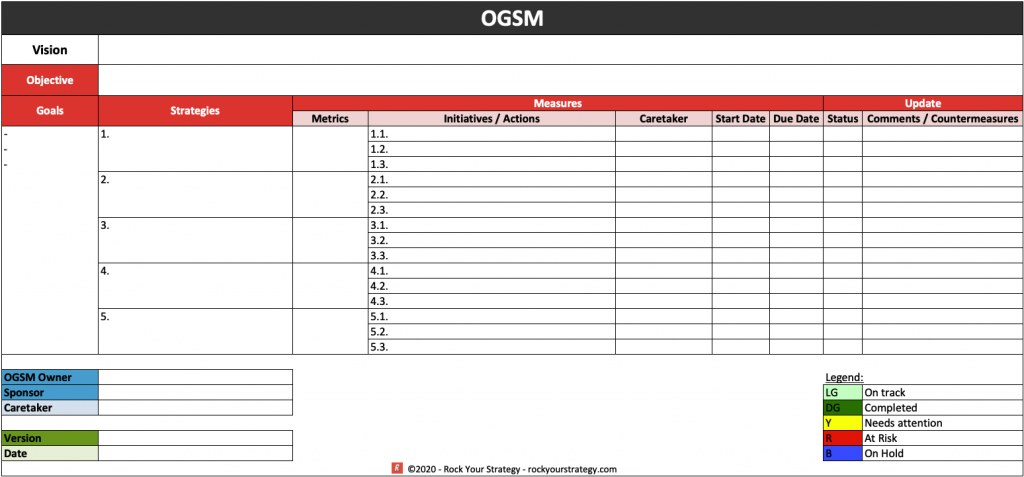
    A good strategic plan not only describes clearly what you are aiming to achieve. It also describes how you are going to achieve it. The OGSM methodology allows you to describe your strategic plan on one page detailing out your objective, your goals, your strategies and your measures. The objective and the goals together define what you intend to achieve. The strategies and measures together define how you are going to achieve it. 

    For the purpose of this article, I will not dive deeper into OGSM. But you can read our introduction to OGSM here.

    Once you have defined your objective, your goals, and your strategies, you begin thinking about your implementation plan – your measures. I like to break down my measures into two parts: metrics and initiatives. 

    The metrics are the quantifiable targets and performance indicators that define success for each strategy. The initiatives are the actions and projects that will drive implementation of the strategy and lead you to success. 

    The reason I like to separate the two is clarity. When I first started using the OGSM approach about a decade ago, I noticed how my team and I often used “measures” and “metrics” interchangeably to describe the “M” in OGSM. We were wondering what the difference was and whether it made a difference at all. It did! 

    We understood measures quite literally to be things that we’d “measure”. Hence the metrics. So we defined a number of metrics for each strategy and left it at that. 

    However, during implementation during the year, we noticed that we were not quite sure whether we were on track to achieving the metrics by year end. We took a run rate (i.e. a lucky guess really as it didn’t account for seasonality) and figured that we must be about on track. Anyway, in the end things always work out, right? 

    Wrong. We had no clue. We were missing a clear articulation of what we needed to do to turn the strategy into reality and check whether we were on track or not. We needed a clear translation of the strategies into measures which included both metrics and an action plan. The metrics would allow us to track progress and keep us on track and the action plan would clearly articulate what had to be done by whom and by when to achieve the metrics. 

    From then on out, we always defined measures as both metrics and initiatives. 

    So then how many initiatives are right? 

    In the first couple of years that we split metrics and initiatives in our annual operating plan, our OGSM was basically a large action plan. We probably had about 5-8 actions per strategy – sometimes more than 10. All actions started in January, ran in parallel and ended in December. So across the entire OGSM with 1 objective, 6 goals, 4 strategies and about 5-8 measures per strategy, we ended up with close to 30 actions! This was not only a massive effort to implement, it was a massive effort to keep track of! We didn’t know better and proceeded. 

    It quickly became clear however that this was not going to be effective. Our OGSM reviews took 8 hours every month. We were committed to action and accountability and wanted to go through each initiative and confirm we were on track. When we weren’t, we wanted to know why and what we had to do to get back on track. With close to 40 initiatives one year, this took forever. 

    We had noticed that many of the initiatives we tracked were actions we had to do anyway during daily operations. We defined actions such as “visit 10 customers per quarter”. The action was specific, measurable, ambitious, realistic and time-bound. It was however also exactly what was expected of our customer service team anyway during a typical sales process.

    We had also noticed that we described different actions under different strategies that actually contributed to the same projects. For example, one strategy had to do with driving growth, another strategy had to do with innovating. We noticed that we duplicated several initiatives that were counted under growth and under innovation. We were looking at the same topics over and over again just from different perspectives. That was redundant and a waste of time. So the following year we changed our approach. 

    In order to streamline our annual operating plan, we decided to define no more than 2-3 initiatives per strategy. Two or three initiatives per strategy meant we had max 12 initiatives overall, which was plenty for my team to handle. And we immediately noticed a change in how we implemented. 

    • We were much more focused. Fewer initiatives allowed us to allocate more resources for each initiative. It became easier to keep track of our OGSM. And it was easier to communicate and remind each other what was important.  
    • We were much more effective. We noticed that greater focus led to greater achievement of milestones and progress towards our goals and objectives. We had to put things on hold less often or pivot to change our approach.
    • We were much more efficient. We noticed that we spent much less time reporting and discussing progress updates of the action items. Monthly reviews were much more efficient and took less time. 
    • We were much more successful. When we conducted our year-end review and looked at our achievements, a couple of colleagues were quick to point out that they felt our success was directly linked to our much more focused execution. This felt really good!

    Since then, I always guide my teams to define no more than 2-3 initiatives when designing the measures for the OGSM. This avoids building a laundry list of actions. Instead, fewer initiatives keep the team on track, allow greater concentration of resources for each initiative, and vastly increase the chances of success. 

    How do I select my initiatives? 

    OK, got it. So I am only supposed to choose 2-3 initiatives for each strategy. But how do I choose those initiatives? How do I know which ones are the right ones? Excellent, those are the right questions. Unfortunately there is no hard and fast rule. But this is what has worked well for me. 

    During the strategic planning process, I conduct a SWOT exercise for my business. In the team, we reflect on our core strengths and our biggest weaknesses, we look at the most promising opportunities and the largest threats. We do this by conducting an internal assessment but we also use our customer satisfaction feedback to get an external perspective. This gives us valuable insights into what we need to do differently. The SWOT informs our strategies and then the detailed initiatives with which we implement our strategies. 

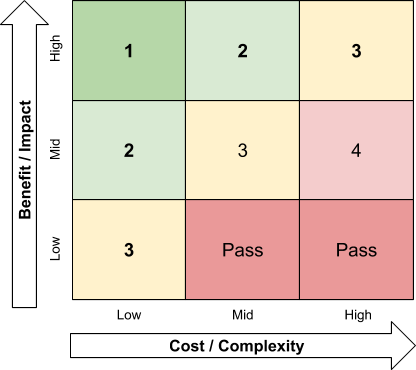
    The SWOT analysis is probably my primary source for initiatives. In addition, we may conduct a brainstorming exercise with a cross-functional team to come up with additional ideas. All ideas are then ranked based on cost vs. benefit or impact vs. complexity. We choose those initiatives with the largest impact towards our metrics and goals with the smallest strain on resources. 

    After you have chosen your initiatives, write the initiatives in the ‘what-by-how’ format. This means structuring the sentence that describes the action in two parts: the ‘what’-part and the ‘how’-part. The ‘what’-part describes what needs to get done. The ‘how’-part describes how it will get done. Here are a couple of simple examples: 

    • Win new customers by launching a targeted social media marketing campaign
    • Save costs by combining trips wherever possible 

    These are just examples to illustrate the ‘what-by-how’ method. I first learned about the ‘what-by-how’-format from the practical OGSM guide “The 1 Page Business Strategy” by Van Eck & Leenhouts. It’s a great way to write your initiatives as clearly and measurable as possible. Make them unambiguous. Leave nothing to chance.

    Finally, make sure that each initiative has a caretaker and a clearly defined timeline and milestones. Ask the caretakers whether they understand what is expected of them. Ask them to describe their initiative in their own words. Clarify when and how you expect them to report on progress and what successful delivery looks like. Check whether they have the resources, knowledge and skills to be successful. Remember, nothing gets done unless accountability is clear and caretakers buy in. 

    How do I test my initiatives? 

    After you have selected the initiatives for your strategic plan, conduct a test to check whether the initiatives are indeed the right ones. Do four checks: 

    • Check for alignment 
    • Check for sufficiency 
    • Check for clarity
    • Check for resource sufficiency

    Check for alignment to ensure that each chosen initiative directly supports implementing the strategy and achieving the desired goals and objectives for your strategy. This tests whether the initiative is actually effective in achieving the targeted goals in part or in full.

    Check for sufficiency means reviewing all initiatives together and checking whether they fully implement all aspects of the strategy. This tests whether the chosen 2-3 initiatives fully address the purpose of the strategy and whether all measures and metrics can be accomplished. If aspects of the strategy are not yet sufficiently addressed, choose another initiative or swap for one with greater impact. 

    Check for clarity means confirming that the initiative is fully understood by the organization. Especially the people responsible for implementation must know exactly what is expected of them. Make sure that for each initiative there is a caretaker, clear actions, timelines and milestones defined. Ask team members to repeat in their own words what the initiative aims to achieve to check understanding and clarity. Rephrase the initiative in the strategic plan if needed to be absolutely clear. 

    Check for resource sufficiency means confirming that you or the team have the resources needed to successfully complete the action or initiative. Resources may mean money (e.g. cash, capital etc), time (e.g. number of employees / FTEs), knowledge (e.g. access to data or information), or skills (e.g. expertise, experience). Confirm that you already have access to the needed resources or can build them in time. Be realistic about this! This is not the time to be overly optimistic or try to be a hero.

    Pro-tip: conduct the 4 checks with your team or if you are a sole business owner with a mentor or board member. It has always paid off for me to get a second pair of eyes on my implementation plan. Discussing the implementation plan in the team allows you to collect feedback, questions and concerns and further create clarity and commitment. 

    What if I have more than 2-3 initiatives? 

    When you choose your initiatives and you conduct your test and you realize that you need four or even five initiatives to implement the strategy, then go with four or five. 

    Each business is different and each strategy is unique. If you need five initiatives to successfully implement your strategy and achieve your goals and objectives – and you have the resources to do it – then decide on five. The purpose is to be successful and deliver results. No one will celebrate you for having followed the OGSM rules and having limited yourself to 2-3 initiatives if you fail to implement your strategy (spoiler alert: there are no rules). 

    The reason why I go with 2-3 is to force choices and to make trade-offs. More often than not, we tend to throw more resources at a problem than necessary. I call this ‘tossing spaghetti against the wall’ to see which ones stick. As so often in business, try to do more with less. If you can accomplish your strategy with only 3 initiatives, then you do not need number 4. If you need more than 3 to be successful, that’s perfectly ok too.

    Conclusion

    When developing the implementation plan for your strategy, choose 2-3 initiatives per strategy. This allows sufficient focus without putting all your eggs in one basket. 

    Conducting a SWOT analysis or brainstorming are effective ways to come up with initiatives. Prioritize initiatives by analyzing cost vs. benefit or impact vs. complexity. 

    For each initiative ensure you define a caretaker, timeline, and expected deliverables. 

    Conduct four tests on your initiatives to confirm they are the right ones: check for alignment, sufficiency, clarity, and resource sufficiency. 

    I hope you find this article useful and wish you success with implementing your strategy. If you have any questions or comments, why not leave a reply below. Would love to hear from you! 

    References

    Van Eck, Marc & Leenhouts, Ellen (2014). The 1 Page Business Strategy – Streamline Your Business Plan In 4 Simple Steps. Pearson Benelux.


  • What Comes First: Objective, Goals Or Strategy?

    What Comes First: Objective, Goals Or Strategy?

    In business, objectives, goals and strategies are often used interchangeably when describing a company’s direction. Yet they are very different. Which one comes first – and does it really matter? 

    When developing a business strategy, first decide your objective, i.e. where you are going. Translate your objective into measurable goals that define success. Then develop your strategies which determine how you are going to achieve your objective and reach your goals. 

    Or said differently, if business strategy was a road trip, then your objective would be your destination and your strategies your means to reach it. Unless you are a happy-go-lucky vacationeer for whom the journey is the destination, you decide on your destination first and then determine how to get there. Let’s explore further why this order is important. 

    Begin with the end in mind

    One of the books that has been most influential in my career is The 7 Habits Of Highly Effective People by Stephen Covey. One specific quote left a particular impression on me which I have since applied to almost every endeavor in my business life including strategy: begin with the end in mind. 

    “To begin with the end in mind means to start with a clear understanding of your destination. It means to know where you’re going so that you better understand where you are now and so that the steps you take are always in the right direction.”

    Stephen Covey

    It is this quote that convinced me that strategy must begin with the destination. What do I aim to achieve? What dream or vision do I have for my business? Where do I want to be in e.g. five years? Painting this vision in as concrete terms as possible makes it tangible – not only for myself but also for my team. And a concrete, tangible vision inspires action. Turning the description of my destination into an objective statement and clearly defined goals make them tangible. 

    What is a strategic objective?

    The objective is a qualitative statement about what a business aims to achieve over a specified timeframe. The chosen timeframe of a strategic plan is typically 3-5 years and for an annual operating plan 1 year.

    The goals are the quantifiable targets or intended results to be accomplished. These typically are financial figures or other measurable metrics. In strategy, goals are the quantification of the objective to judge its achievement over the chosen timeframe.

    It is best to describe the goals as SMART goals. SMART stands for specific, measurable, achievable, relevant, and time-bound. Thereby each goal is clear and unambiguous.

    Once I have defined my destination, then I can decide how I will get there. As Stephen said, only then do I know that “the steps [I] take are always in the right direction.” And these steps are my strategies.

    Should small businesses do strategic planning?

    What is the difference between goals and strategies?

    Strategies are the plan of action to achieve a long-term vision or objective. Strategies describe the choices a business makes about resource allocation to accomplish its objective and goals.

    When designing my strategic plans, I aim to choose 3-5 strategies to give the business sufficient focus without putting all my eggs in one basket. Once I have made those choices, I develop an implementation plan that turns the strategies into action. This ensures that I move my business towards the destination.

    So what is the difference between goals and strategies? The goals are part of the description of the destination while the strategies describe the way to reach it. 

    What are objective and goal examples? 

    When writing my objective statement, I use the ‘what-by-how’ method described by van Eck and Leenhouts in their excellent book “The 1 Page Business Strategy”. The ‘what-by-how’ method divides the objective statement into a ‘what’-part which describes what I aim to achieve and a ‘how’-part which already gives a sneak-preview on how I am going to achieve it. In the objective statement, I already build-in a lead to my strategy! This makes the objective statement clear and actionable. Consider the following simple examples:

    • “Go to Berlin by bus”
    • “Learn to master the guitar by practicing every day” 
    • “Drive rapid business growth by launching a new product line”

    Goals then are the quantification of these objective statements. Goals are facts and figures that turn objectives into measurable results. I define 1-2 goals each for the ‘what’-part and the ‘how’-part of the objective. Referring to previous examples: 

    • Reach Berlin-Mitte by 4pm. Pay less than $20 for the ticket. Less than 2 hours journey time.
    • Master “Sultans of Swing” by Dire Straits within 2 years. Practice 1 hour daily.
    • Grow 15% CAGR over 3 years. $5MM annual sales from new product line by year 2. 

    By setting concrete goals for both the ‘what’-part and the ‘how’-part of the objective statement, the objective becomes clear and measurable and you can track that you stay on course.

    Read more about how to create clear goals for your business strategy here.

    So does it matter whether objective or strategies come first? 

    In my experience it does matter whether objective or strategies come first. Strategies describe how I aim to achieve an objective. I would therefore define my objective first and then only after I am clear about my objective and my goals would I define my strategies. 

    Having said that, the objective is not the very first item I discuss in my strategic planning process. Before looking into the future and developing my objective, I analyze where I am today. I want to be clear about my business’ current situation. What is the purpose of my business? What kind of business am I running? What mission am I on? What success have I had so far? Only when I know where I am today, can I look to the future.  

    Let’s come back to Stephen Covey. He said, beginning with the end in mind “means to know where you’re going so that you better understand where you are now […] so that the steps you take are always in the right direction.” So knowing where you are starting from is just as important as knowing where you are headed. 

    So know where you are today, define where you are headed and then choose how you will get there. 

    A great way to define your strategic plan starting with a clear objective statement is the OGSM methodology. Read on about the OGSM approach to strategy here.  

    Conclusion

    When developing a strategy, always start with the end in mind. Once you define your destination, you know that the steps you take are always in the right direction. 

    Therefore, first define your objective statement and your goals. Then develop your strategies that help you reach your destination and avoid the 7 deadly sins of business strategy.  

    If this article was helpful or if you have any questions or comments, feel free to leave us a reply below. We would love to hear from you.

  • Should Small Businesses Do Strategic Planning?

    Should Small Businesses Do Strategic Planning?

    In small businesses strategic planning is often brushed aside as being too costly and time-consuming and taking too much attention away from operations. However, without a strategic plan, a business would lack the clear sense of direction it needs to be successful. So as an aspiring small business owner myself, I explored the question whether a small business really should do strategic planning or not and I found some interesting answers.

    In short, strategic planning is not only for large corporations but for small businesses too. Clarity about the vision of the business, its objectives, where to play and how to win are critical for any business. A well-crafted, well-communicated, one-page strategic plan is however sufficient for a small business to succeed.

    Such a one-page strategic plan does not need a lot of time or money to create. It only takes some strategic thinking about a few key questions. I’ll explore these questions in the following but first let’s understand why small businesses should do strategic planning. 

    Why small businesses should do strategic planning

    The easy answer to the question whether small businesses should do strategic planning is of course: yes! But why really? Strategy is about making choices. But when you are just getting started, you don’t have much of a choice and pretty much jump at every opportunity you get to gain a customer and make a sale. 

    But even as a small business your resources are finite, your time is limited and there are millions of ways you can spend your time. You want to make sure your time and talents are directed towards those activities that will help you reach your objectives – fast. And for that you need a plan. 

    A plan helps you define what success means for you and how you are going to achieve it. Anyone who has ever aimed to reach any objective will tell you that any endeavor with a plan is more likely to succeed than one without. I’m sure you have the same experience. This is why football coaches create game plans and why my dad always looked at the route planner before setting off to drive the family to our vacation destination. 

    And that really is what a strategy is: a clear direction or plan of actions that will help you get to a goal or destination. So why wouldn’t you want to have a strategy for your business?  

    Truth is many small business owners feel they don’t have the time or the resources to create a complex strategic plan. Any time away from customers and operations feels like you are not making progress. And I feel the same way. Every time I don’t publish, I feel like I am wasting my time. 

    However, how do you know that you’re spending your precious time on the right activities? How do you know whether the customers you are pursuing are the right ones? And does everyone in your business from shareholders to employees understand why those activities and customers are the right ones? Are they spending their time on activities that are aligned with your objectives as well? 

    This is where a well-crafted, simple strategic plan comes in. First it helps to clarify why you are in business and what your main objective is. This is something I no longer take for granted. Even to remind myself why I got started in the first place is quite helpful to stay focused and keep motivated. When I hit a roadblock or have had a frustrating day, reminding myself why I am in business gets me back up to try again and keep going. 

    Next, having a strategic plan that clearly articulates the initiatives and metrics that need to be accomplished to succeed will actually get you there. A plan without execution is only that: a plan. So having a plan with clear initiatives and measures that articulates what actions need to be taken, how resources are allocated, and keeps track of execution will lead to success. 

    Finally, a simple but effective strategic plan aligns the team with the overall vision and objective. A plan that not only paints an inspiring vision or desirable destination but also shows a path how to get there really gets the team fired up and moves the team into motion. And you want the team to be as clear as you are about the business’ direction to be fully engaged and committed to do whatever it takes to achieve success.  

    A great way to summarize such a strategic plan is the OGSM methodology. OGSM stands for Objective, Goals, Strategies, and Measures and is a one-page business plan that defines where you are heading and how you are going to get there. It’s simple, it works well to get the team involved and it builds-in the execution plan. In my experience the OGSM is a great way for small businesses to create their strategic plan, drive execution and achieve the  desired results. 

    What are elements of a strategic plan? 

    So what then are the strategic questions you need to answer for your small business strategic plan? Explore the following: 

    • Why are you in business? Don’t take this for granted or laugh it off. Being clear about why you are in business gives you and your company a purpose, a “raison d’etre”. What is it that made you start your business in the first place? How does running your company achieve that purpose? For me it helps to remind myself that I am in business to provide for my family and to inspire growth. That’s what gets me out of bed in the morning and what keeps me going when I hit a rough patch.
    • Where are you heading? What is the vision and the objective for your business? The vision is your longer term aspiration while the objective is a concrete statement about what you want to achieve in a given period of time, e.g. 3 years or the next 12 months. Define unambiguous SMART goals that allow you to quantify your objective and measure success. 
    • How are you going to get there? Audit your external environment for opportunities and threats and assess your personal and your business’ strengths and weaknesses. Check how they match up and identify the ‘sweet spot’ where your purpose, vision, objective, strengths and opportunities overlap. Identify a small number of concrete customers or customer segments and product or service offerings in this focus area and figure out how to use your strengths to create a competitive advantage. Create 3-5 strategies that move you towards your objective and achieve your goals. The key point here is focus. You won’t be able to do everything for everyone. Double down on the ‘sweet spot’ and give it all your focus and energy.  
    • What obstacles could prevent you from achieving your objective? Go back to the threats and weaknesses you identified in your external and internal analyses and review your competition. Identify concrete risks that could prevent you from reaching your goals. Create mitigation measures to proactively address and overcome the most likely and most devastating risks. 
    • What key actions are you going to take every day to move towards your objective and achieve your goals? Now pull your key strategies and risk mitigating measures together and create a concrete action plan. Each action must have a timeline and caretaker. Make sure that the actions are sufficient to cover all strategies and achieve all goals. Review for clarity and get buy-in and commitment from your team.
    • How are you keeping track of your progress to stay on course? Create a governance procedure, such as reviewing your action plan once per month and reviewing your strategies and risks every six months. Make a commitment to yourself and to your team to get at it and do not let off. 

    Capture the answers to these questions in your OGSM. If your OGSM is well-aligned following the above strategic questions, then you can fully focus on your customers and execute your action plan in daily operations knowing that it will lead you to achieving your strategic objectives. 

    And then go at it and execute, execute, execute. 

    To learn more about the OGSM approach to strategy, click here to read my introduction to OGSM and review each step in detail. 

    Why do small businesses ignore strategic planning?

    Whether evident or not but every business has a strategy. Some businesses are more explicit about their strategy while others more implicit. Every business does somehow allocate resources and does decide which customers or projects to pursue to achieve results. Not every business however goes through a deliberate planning process and documents their strategy. And this can have several different reasons. 

    • Too busy – small businesses and their owners might be so consumed with keeping the business afloat that taking a step back and planning ahead seems like an impossible task. I always have to think of this cartoon in which two people are busting their guts pulling a cart with square wheels. When another person arrives and suggests round wheels they decline saying they are too busy to entertain his idea. Sometimes it can be very useful to take a step back to look at the bigger picture and confirm that you are still going in the right direction. 
    • Not sure how – some small businesses may simply lack the knowledge and expertise about how to do strategic planning or how to do it effectively. Strategy does not need to be rocket science though but can be a simple plan that sets priorities for the business. 
    • Fast changes – many businesses nowadays operate in rapidly changing environments in which a strategic plan may appear outdated as soon as it is decided. Even in those environments however it pays to be clear about what the objectives of the business are and how results are measured and achieved. Especially when there is a large team at work, when things change quickly, you want to reiterate your plans quickly and have everyone involved so that everyone knows at all times what’s important and how you plan to succeed. 
    • Owner led – a small business may be led by an owner with strong strategic skills who is able to mastermind the strategy and direct the team. Great industry knowledge or foresight may allow the owner to anticipate changes and adjust the course proactively. Nevertheless, making the strategy transparent and creating clarity about how everyone contributes to its successful implementation creates engagement and engagement creates results. In my experience an effective team is always stronger than an effective individual. 

    Whatever the reason may be, if you have not considered taking a step back for your small business to review the bigger picture and create a strategic plan, I would encourage you to do so. One of the worst things that can happen to a small business and its owner is to be surprised and unprepared in the face of an unforeseen event.

    If you are still not sure where to start, don’t worry, you have come to the right place! Learn here how to create a business strategy that delivers results in 6 simple steps.  

    Common mistakes small companies make in strategic planning

    While some small businesses ignore strategic planning, others have tried and failed. In fact, a Forbes Insights study of 163 CEOs revealed that more than a third of all strategies fail. Here are some common mistakes I have seen in practice and how you can make sure they don’t happen to you. 

    • Pursuing someone else’s strategy – reading strategy books and autobiographies of successful business owners and entrepreneurs can be inspiring. And copying someone else’s strategy can be a good idea. However it must fit your business. It must be an approach that you can apply and customize to your business and your situation. It’s fine to seek inspiration and motivation from successful reference cases. Reality is not every business will be the next Apple or the next Tesla. Blaze your own trail. Build a strategy that fits for you and your business.
    • Spreading too thinly – No, I am not speaking about spreading Nutella too thinly on a slice of bread even though that would be a mistake as well (the ratio must be 2:1!). Lack of direction and lack of focus lead to spreading your resources across too many activities. You are much more effective if you can devote your entire attention and energy to delivering one thing instead of trying to deliver four, five or six things simultaneously. When developing your strategy, focus your attention on those initiatives with the biggest impact and highest likelihood of success towards your objective and goals. Do those first activities first that take you 90% there and then optimize later to take you the rest of the way. 
    • Working on the wrong things – If you are like me, it’s easy to get distracted by customers who yell the loudest or innovations or technical gadgets that seem most interesting. Resist the urge. Do not fall prey to “shiny objects”. Check your biases towards recent events, availability of information, or most memorable experiences. Focus on those things that matter most to your purpose, vision, and objectives.
    • Lack of communication – what good does a strategic plan do when it lands in a drawer after it’s designed and doesn’t see the light of day? Make your strategic plan transparent to your business, your employees and key stakeholders. Over-communicate. Make sure everyone is absolutely clear what the priorities of the business are and how everyone contributes to the achievement of your objective – from management team to part-time aid. 
    • Starting with PowerPoint – when thinking about “strategy”, have you ever caught yourself thinking about presentation slides and strategy tools rather than an actual action plan? If you are planning a strategic review, do not first open your slideshow software. Start instead by talking to your customers and your employees about their challenges and what they would love to be able to do or achieve. Use the insights to design your strategy process.
    • The most common mistake I have experienced though is not executing! Whether in large corporations or small businesses, the biggest issue with strategic plans is not doing what you said you were going to do. If this sounds familiar to you, don’t worry, you are in good company. And there are a million reasons for this: things change, quality issues get in the way, tragedy strikes, or you run out of cash. A strategy should never be carved in stone to remain flexible to adjust to changes in the internal or external environment. But be deliberate about building in the execution plan and review cadence and follow through ruthlessly. Pivot when you need to. But execute, execute, execute. 

    Now you know! And because knowledge is power you can now make sure that the same mistakes don’t happen to you.

    Conclusion

    Yes, strategic planning is not only for large corporations but for small businesses too. Strategy gives a business the direction it needs to be successful by defining where to play and how to win. 

    Developing a strategy does not need to be costly and time-consuming. It could be as simple as a conversation in your team about where you are heading and how you are going to get there. Whatever you do, document your objective, goals, strategies and measures on a one-page strategic plan, involve your team, over-communicate with your employees, and execute, execute, execute 

    Now over to you. How does your small business do strategic planning? If you have any questions or comments, why not drop us a reply below. We would love to hear from you.

  • What Should The Agenda Of A Strategic Planning Meeting Look Like?

    What Should The Agenda Of A Strategic Planning Meeting Look Like?

    If you have been asked to prepare the agenda of a strategic planning meeting but are not sure what to include, look no further. I have scoured over the many strategy workshops I have held to consolidate my insights into one agenda guide. 

    The agenda of a strategic planning meeting should follow the strategy process and should generally have six parts: 

    • Current Situation
    • Internal Analysis 
    • External Analysis
    • Future Destination
    • Strategy Development
    • Execution Plan

    Depending on the length of the meeting, the agenda may span one, two, or three days and include opening statements, ice breakers, and summaries as needed. 

    Let’s explore further what the agenda of an excellent meeting should concretely look like, followed by examples which you can use for your meeting.

    Strategic Planning Meeting Agenda

    First things first, the planning of a strategy meeting usually does not start with writing the agenda. There are few things I would recommend to do before that. I have written all about it in this 14-step preparation guide for strategy meetings. For the purpose of this article though, allow me to focus straight away on the agenda itself. 

    Whether you are organizing a one, two, or three-day strategic planning meeting, the agenda for such meetings generally looks quite similar. The agenda typically follows the strategy process or strategy framework you have chosen for your strategic review. The difference between the one, two or three-day agenda is the amount of time you have to dive deeper into analyses, invite outside input or include discussion and get-to-know sessions. 

    I have led and facilitated one, two, and three-day meetings and I would recommend making the length of the meeting dependent on the type of strategic challenge, the familiarity of the group, and the amount of change your business is facing. The higher the stakes and the less the group knows each other, the more you will benefit from a longer session. 

    As such, one-day meetings are great for brief, annual reviews of the strategic direction of the business. Two and three-day sessions are preferred for more in-depth reviews and larger strategic overhauls. Now let’s finally look at the actual agenda. 

    I like to structure the agenda of the strategy meeting according to the strategy process and add kick-off and summary sessions. In addition, depending on how much time is available, I’ll add introduction sessions and ice-breakers. These are valuable if the group does not know each other well but will need to work effectively in a trusting environment for the duration of the meeting. 

    In the beginning is a Welcome & Introduction session. The purpose of this session is to set the expectations for the meeting including meeting objectives, desired outcomes, meeting rules and the agenda itself. If time allows, I’d follow this with an introduction round giving each person the opportunity to introduce themselves and share their expectations for the meeting. 

    Pro Tip: consider kicking off the meeting with a personal story that allows you to grab the attention of the participants and connect them with the objective of the meeting. This sets the tone and breaks the ice. 

    Bonus Tip: If needed, include an introduction to the strategic process. This session familiarizes the team with the strategy process and the strategy framework & tools that will be applied. This will help demystify what strategy is and what participants are expected to do for the rest of the meeting. 

    The first content point is the Current Situation of the business. Use this session to clarify the mission and purpose of the business and its historic development to the present day. Some of this information should be prepared up front and the depth of the discussion should be in line with the significance of the strategic review. In a one-day annual review, this session can be short and focus more on recent financials. In a turn-everything-upside-down company overhaul, this could be an extensive soul-searching session. 

    Next, the agenda features the Internal Analysis. This session aims to review the business’ core strengths and weaknesses and a significant amount of time should be devoted to this discussion. Similarly, the External Analysis should receive sufficient attention to identify changes in the external environment including opportunities and threats. You may consider holding these discussions in break-out groups for each group to dive deeper into their task and report back with their findings.  

    Pro-Tip: Include sufficient break time in your agenda between these sessions to allow participants to refresh, get some air or digest the discussions. Providing time to look into emails and allow side discussions keeps participants focused and present during the meeting time. 

    The purpose of the next session is to define the Future Direction. This is arguably the most interesting session requiring the most creative thinking. Ensure that there is sufficient time and space to have this discussion. Avoid heading straight into this session after a lunch break or in the evening when people enter their “food coma” or feel tired from a long day. The best time of day for this session is early morning or mid-afternoon after an energy booster.

    Strategy Development is the next session that requires a clear mind and strong decision making. Setting the strategy is all about making strategic choices about how you will get from A to B. If well prepared and well structured, this discussion may not take as long as the situational analysis. But the risk of getting lost in the nitty-gritty details poses a challenge for time management. 

    After the future destination and the key strategies are confirmed, the purpose of the next part is to confirm the detailed Execution Plan. This session often does not receive enough attention and is rushed at the end of a meeting. Take sufficient time for this session! …or risk not implementing what you have spent so much time discussing during this meeting. It does help to schedule this session towards the end of the meeting to create a sense of urgency and gain commitment from participants. But do not skip this. 

    Finally, make a point to Wrap Up in order to summarize key take-aways, review the action items, and lay out the next steps. Use this session also to confirm that meeting objectives were met and that each participant had a chance to address his or her expectations. 

    Pro-Tip: If time allows, include a feedback round at the end of the meeting to learn how the meeting was perceived and what can be improved next time around. 

    One more thought about timing. If possible, I personally prefer to keep detailed session times flexible instead of scheduling hard start and end times. Especially for two or three-day meetings, I’ll set only start time in the mornings and finish time in the evenings. Other times are indications based on meeting progress. If the discussions are effective and producing results, I try not to interrupt just because the agenda says “break at 10:30am”. This of course depends on the setting, meeting venue, and food & beverage arrangements. If possible, plan ahead to allow such flexibility.  

    There you have it: this is the rundown for a strategy meeting. Read on for examples and additional insights for your strategy meeting agenda design.

    What does the agenda of a 3-day strategic planning meeting look like? 

    A 3-day setting allows for in-depth discussions and creative use of timeslots. In a 3-day setting, I only set daily start time, finish time and lunch time and allow the rest of the timing to be dictated by the flow of the meeting. 

    This is what a sample agenda for a 3-day meeting looks like. 

    Day 1Day 2Day 3
    Morning~8:30:
    Welcome & Introductions
    ~9:30:
    Introduction to Strategy Process
    ~10:30:
    Current Situation
    ~8:30:
    Recap Day 1 and rundown Day 2
    ~9:00:
    Future Destination
    ~8:30:
    Recap Day 2 and rundown Day 3
    ~9:00:
    Execution Plan
    Lunch~12:30: 
    Lunch
    ~12:30:
    Lunch
    ~12:30:
    Lunch
    Afternoon~13:30: 
    Internal Analysis
    External Analysis
    ~17:00: 
    Wrap Up Day 1
    ~13:30:
    Strategy Development
    ~17:00:
    Wrap Up Day 2
    ~13:30:
    Open questions / parking lot
    ~14:30: 
    Actions and Next Steps
    ~16:00:
    Feedback
    ~17:00:
    Wrap Up
    Evening~18:00:
    Group Dinner

    What does the agenda of a 2-day strategic planning meeting look like? 

    The rundown of a 2-day strategy meeting is similar to a 3-day meeting in terms of seeking in-depth discussions and keeping individual time slots more flexible. However, in a 2-day setting, the agenda is overall more dense. 

    This is what a sample agenda for a 2-day meeting looks like. 

    Day 1Day 2
    Morning~8:30:
    Welcome & Introductions
    ~9:30:
    Current Situation
    ~11:00:
    Internal Analysis 
    ~8:30:
    Recap Day 1 and rundown Day 2
    ~9:00:
    Strategy Development
    ~11:00:
    Execution Plan
    Lunch~12:30: 
    Lunch
    ~13:00:
    Lunch
    Afternoon~13:30:
    External Analysis
    ~15:30: 
    Future Destination
    ~17:30: 
    Wrap Up Day 1
    ~14:00:
    Open questions / parking lot
    ~15:00: 
    Actions and Next Steps
    ~16:00:
    Feedback
    ~17:00:
    Wrap Up
    Evening~19:00:
    Group Dinner

    Can I do a strategic planning meeting in only 1 day? 

    Yes, it is possible to conduct a strategic planning meeting in only one day. However, in a one-day setting, detailed analysis and in-depth discussions are less feasible. 

    A one-day session is most effective for annual strategic review meetings in which to confirm the long-term future of the business and ongoing strategy execution. A one-day agenda also works really well for annual operating planning meetings. 

    When choosing a one-day setting, I prefer to be more structured and adhere to more fixed time slots. This helps to ensure that discussions do not overrun and that meeting objectives can be met. 

    A one-day strategy meeting agenda looks like this:

    Day 1
    Morning8:00: Welcome & Introductions
    8:30: Current Situation: Highlights & Lowlights
    9:30: Internal & External Analysis Break-out sessions (incl. break)
    11:00: Situational Analysis Report Out Presentations
    11:30: Review of Future Destination
    Lunch13:00: Lunch
    Afternoon14:00: Review of Strategic Choices & Progress 
    15:30: Adjustments to Execution Plan
    16:30: Actions & Next Steps
    17:30: Wrap Up 
    Evening19:00: Group Dinner

    How do I plan for a strategic planning meeting? 

    Creating the agenda of a strategy meeting is just one part of the preparation. Based on my experience running strategy workshops, I have written a 14-step guide about how to prepare for a strategic planning meeting. This has helped me save vast amounts of time and ensure that I do not forget anything. 

    You can find my introduction to this 14-step approach here including a printable one-page checklist. 

    In addition, take a look at our resource page with tools, templates and examples as well as a handy workshop material shopping lists. 

    Conclusion

    The agenda of a strategic planning meeting largely depends on the type of strategic challenge, amount of change the business is facing and the familiarity of the participants. 

    Generally, the agenda of a strategy meeting follows the strategy process and additionally includes opening statements, ice breakers, and summaries as needed. Strategy meetings typically last between one and three days. 

    If you found this article helpful or have any questions or comments, why not leave us a reply below? We’d be happy to hear from you. 

  • How to Set Effective Measures to Implement Your Strategy

    How to Set Effective Measures to Implement Your Strategy

    When using the OGSM methodology or developing any strategic plan, it is important to define strong measures that drive strategy implementation. This is how you turn your strategy into results.

    Measures are the M in OGSM and include key metrics and an action plan that track strategy execution and define who does what by when.

    This is where the rubber hits the road. After deciding your objective and goals and choosing your strategies, the measures move the business towards its objective and tell you whether the strategy is working in practice.

    Divide measures into key metrics and action plan

    When defining the measures for strategy execution, I have found it very helpful to think of them in terms of key metrics on the one hand and key initiatives on the other hand. Key metrics measure progress and quantify achievement. Key initiatives are the actions that drive you forward. Both are critical to success. 

    First, define your key metrics. For each of your strategies, choose 2-3 key metrics that define success for the strategy. Similar to how goals are the translation of the objective into facts & figures, the metrics translate the strategies into numbers. 

    When you wrote your strategies you applied the “what-by-how” format to indicate what needs to be done and how it will be achieved. Now define 1-2 key metrics each for the “what”-part and for the “how”-part. This ensures not only that you know when you have achieved your strategy but also if you are making progress in the right direction while taking action. 

    Similar to the goals defined earlier, use the SMART approach also for choosing your key metrics. The metrics should be specific, measurable, ambitious, realistic, and time-bound. 

    The key metrics should be linked with your goals. When you have defined your key metrics, check back whether that is the case. Delivering all the key metrics should achieve all the goals. Not more, not less.  

    Next, craft your action plan by defining key initiatives. The action plan should be a concise list of key initiatives that turns the strategies into reality.

    Write your initiatives in the “what-by-how” format which you also used when writing the strategies. This again ensures that for each action it is clear what you aim to do and how you are going to do it. For example, “identify new customers by asking existing customers for references.” 

    For each strategy, choose a maximum of 2-3 key initiatives. The point here is focus. These should be the top 2-3 initiatives that really drive the change and deliver the key metrics for the strategy. Beware of including activities that are anyway part of your day-to-day routine. 

    After you have defined your initiatives, check for clarity, feasibility, sufficiency, and alignment. The initiatives must be understandable and unambiguous. The initiatives must be realistic and the resources available or accessible. All initiatives should be sufficient to achieve the intended results of the strategy. And all chosen initiatives must be congruent with each other and not be in conflict. 

    To complete the action plan, define one concrete caretaker for each initiative and set an ambitious but realistic timeline. This is important and unfortunately often forgotten in strategic planning. By setting caretaker and timeline, you assign clear accountability to make sure the job gets done. 

    The caretaker may not be the only person working on this initiative, but this person is the one accountable that the initiative is completed. That’s why it’s important to only define one caretaker so there is no confusion about who is in the lead. It is the caretaker’s responsibility then to assemble the team and the resources needed to execute the action. 

    Finally, capture the measures in the OGSM to complete the one-page business plan. Now you are ready to drive implementation and turn your strategy into results. 

    Why separate key metrics and action plan?

    In their excellent and practical book “The 1 Page Business Strategy”, van Eck & Leenhouts split measures into a dashboard and an action plan. This is a great way to ensure that each strategy is executed by following the concrete action plan and monitoring the dashboard for progress with implementing the strategy.

    I have tried this in practice now multiple times and find the separation extremely helpful. Prior to practicing this approach, I had seen measures interpreted in different ways. Some define the M in OGSM simply as “metrics”. Others have a long list of actions. Neither one individually convinced me to purposefully execute strategies and keep up with the pace of change. You need both. 

    The key metrics on the one hand define in quantitative facts and figures what each of the chosen strategies needs to deliver. As we define key metrics for both the “what”-part and the “how”-part of a strategy, we have ongoing feedback whether we are on the right track. 

    The action plan defines who does what by when to drive implementation. This breaks each strategy down into bite-size action items that can be executed in day-to-day operations. As each action has one caretaker and a due date, clear accountability is assigned. After defining a strategy you don’t want to come back months later wondering how to implement and who should be in charge. 

    By having clearly defined metrics and a solid action plan, you can directly move the business towards executing the strategy. 

    What metrics should I choose? 

    The short answer is “measure what matters” and use as much as possible key metrics that you are already familiar with. 

    The metrics you choose should be directly linked with the purpose and the scope of the strategies and link with the achievement of the goals defined earlier. 

    These can of course be financial metrics such as sales value, units sold, profit margin etc. They are very commonly also operational metrics such as number of products launched, cycle time, yield rate, percentage of satisfied customers, or an employee engagement score. The metrics you choose highly depend on the nature of the strategy.

    So it is less important which exact metric you choose and there is no one-size-fits-all approach. It is more important that you choose a metric that measures what you are looking to achieve. It must give you clear quantifiable feedback whether you are on the right track to achieving your overall goals. 

    When defining a key metric for a strategy, I have found it useful to first look at the many metrics the business already measures to see if one does the job, before creating a new metric that the team is unfamiliar with. You probably already have many key performance indicators. I would try to avoid burdening the business with new metrics unless of course the change of course requires you to do so. 

    If you are struggling to find a suitable metric, consider simply defining “Yes/No” to indicate whether an action has been done at a given time. I’m not recommending this as a best practice. But I have been in situations where there seemed to be no single metric to really define what we wanted to measure. Instead of getting stuck, we decided to define “Yes/No” as a clear binary measure whether the activity is done and move on. 

    Avoid creating a laundry list of actions

    Have you experienced this before? You create an action plan or a to-do-list to achieve an objective and before you know it you have written down 8 or 10 detailed actions. All of a sudden your action plan looks like a laundry list. 

    When implementing strategy, the problem with a laundry list of actions is that you lose focus. You end up spending more time tracking, updating and discussing action plans than actually taking action and driving execution towards your objectives and goals. You don’t want reporting. You want progress. 

    So when defining your action plan, be selective and limit yourself to 2-3 key initiatives per strategy. These should be the must-do actions directly linked to driving execution and delivering the key metrics for the strategy. 

    Beware of the common reflex to include in the action plan day-to-day routines you do anyway. Even if they contribute in small ways to executing the strategy and moving your business towards your objective. “Processing customer orders” is essential for your business, but does not move the needle for executing your strategy. Only include those initiatives that drive change.

    Read more about my thoughts on how many initiatives to choose here.

    I’ve completed my OGSM. What’s next?

    After you have completed your strategic plan, the real work is starting: the execution. 

    All too often in my business experience I have seen wonderful strategic plans being crafted. Many of them created real euphoria in the business about a great future. And that is what a good strategic plan should do! But then after the strategy was created, it was documented, filed and everyone went back to day-to-day operations. Customers called, shipments were delayed, reality struck. Have you experienced this as well? It happens, but it drives me nuts. 

    The most important part of any strategy is its execution. It’s why the strategy was created in the first place. To set a clear direction and destination for the business and decide how to allocate its resources to get there! So now is the time to use the resources, take action, and get there. Here’s what I have found useful to implement my strategic plan. 

    When finalizing your strategic plan, decide on an approach how to implement the plan and when to check in for progress. For a 3-5 year strategy, it makes sense to check on progress once a quarter and to conduct a strategic review once per year. 

    The purpose of the quarterly reviews is to make sure the strategy is working and that you are progressing on the key initiatives towards your key metrics. 

    The purpose of the annual strategic review is to check progress towards your objective and your goals and to identify any changes in your strategic context. Review the external environment and internal environment and review the SWOT analysis. Confirm whether previous assumptions still hold or if changes in your environment require you to make changes to your strategic plan.

    For an annual operating plan with objective and goals for one year, check on progress once a month and conduct a more thorough review once per quarter. Again, you are looking for what’s working and what’s not and if adjustments are needed. 

    What if I miss my targets and don’t make progress? 

    First of all, don’t panic. This is why you conduct periodic reviews. This gives you a chance to be proactive and adjust if needed. 

    Start by finding out why you are not making progress. Diagnose whether the problem lies in the strategy or in its implementation. As you have defined key metrics for both the “what”-part of the strategy and the “how”-part, they should give you an indication where the issue is. 

    If the problem lies with the implementation, check through the action plan. Do you have the right people on the job? Are the needed resources available? Is the timeline realistic? Are there challenges the team has met that you can help overcome? This means getting into the weeds a little bit. 

    If the problem lies with the strategy itself, check whether something in the external or internal environment has changed. Were any of your assumptions inaccurate. Have customer preferences changed? Has a new competitor emerged with a better offering? Depending on the answers you find it is either time to double down or to pivot. 

    No strategic plan should ever be written in stone and pivoting means adjusting your strategic plan. Go back to some of the steps described earlier and adjust your strategies, key metrics and key initiatives in accordance with your findings. If you have a team of employees, conduct strategic pivots together with your team so that they understand what is changing and why. When it comes to strategy, few things are worse than making changes that people don’t understand. 

    When people lose clarity about the strategy, they lose engagement. And a loss of engagement means a loss in productivity. This means your objective and your goals could be at risk. 

    Proactively adjusting your strategic plan and taking your team with you allow you to stay on track to achieving your obejctive and goals.

    Conclusion

    When defining the measures for strategy execution, set up key metrics and key initiatives. Key metrics measure progress and quantify achievement. Key initiatives are the action plan that drive you forward. Define a caretaker and a timeline for each initiative to ensure accountability. 

    Capture your implementation plan in a document such as the OGSM to drive execution. 

    Determine a cadence for reviewing your progress with implementation. This allows you to double down on what’s working or to pivot when it’s not. 

    Congratulations! You have completed all four steps towards creating an OGSM for your business. Now good luck with your execution and turning your strategy into results.

    If you would like to go back to earlier articles about objectives, goals, or strategies, please refer to the respective links. Click here for a general introduction of the OGSM.

    If you enjoyed this article or have questions or comments, why don’t you leave us a reply below? Would love to hear from you!

    References

    Van Eck, Marc & Leenhouts, Ellen (2014). The 1 Page Business Strategy – Streamline Your Business Plan in 4 Simple Steps. Pearson Benelux.
  • How To Develop Strategies That Work?

    How To Develop Strategies That Work?

    Making smart strategic choices is critical for any business, particularly small businesses. But when searching online for guidance on how to develop strategies, I have been frustrated to find mostly theoretical or conceptual answers which are primarily geared towards larger corporations. Here is how I learned to develop strategies in practice.

    Developing effective strategies is a 5-step process to make choices about how to achieve desired results:

    1. Set objectives and goals as your destination
    2. Develop strategic alternatives using SWOT analysis
    3. Prioritize 3-5 strategies 
    4. Check that chosen strategies are aligned, sufficient, and clear
    5. Set measures and create action plan to drive implementation

    Especially in small businesses, there is little time and resources for a structured strategic planning process. The focus of the business and its owner is on customers, delivering products or services, and getting paid. Cash flow is king. Yet, also small businesses benefit from a clear strategy.  So in order to avoid sounding too theoretical myself, let’s drill into the details of the five steps and add practical tips and examples. 

    Strategy means making choices about where to focus resources to achieve results

    First of all, strategies are not developed in isolation. There is always a context within which a business operates and there are people involved who handle the day-to-day aspects of the business. Both context and people should be considered and included in the process. 

    What do I mean by context? My business operates in an industry, in a market, in a regulatory environment. There are forces external to my business which I have little influence over. They can be a source of opportunity or threat. I need to understand these influences and gauge the impact they might have on my business. 

    In addition, there is an internal context. My business should have a purpose. It has certain capabilities and limited financial means. It is important to understand the internal strengths and weaknesses of the business. Together these form the context within which I operate and which sets the stage for developing strategies. 

    People run the business, make decisions and allocate resources. As far as you can, involve your people in the strategic process. This will create greater clarity about the context, why choices are made, and how everyone can contribute to the success of the business. Clarity creates engagement and engagement creates results. So involve the team in formulating the strategy. If it’s just you, this will be easy. However, I’d still recommend going through the 5-step process. 

    Step 1: Begin with the end in mind

    In order to formulate strategies, begin with the end in mind. Set the objective and define measurable goals that you aim to achieve over a given time frame – typically 3-5 years. 

    The objective should be a clear and concise, qualitative statement about the direction of the business. The goals are the quantitative translation of the objective into measurable facts and figures. Learn more about how to write a great objective and set clear goals via the respective links. 

    Step 2: Develop strategic alternatives using SWOT

    SWOT stands for Strengths, Weaknesses, Opportunities and Threats. It is a simple but very effective tool to get a handle on your internal strengths and weaknesses and external opportunities and threats. This is what a simple SWOT framework looks like: 

    Strengths: 
    – …
    – …
    – …
    Weaknesses:
    – …
    – …
    – …
    Opportunities: 
    – …
    – …
    – …
    Threats: 
    – …
    – …
    – …
    Simple SWOT Analysis

    Conduct a brief but thoughtful assessment of your strengths and weaknesses first. Identify the top 3 of each and write them down. 

    Tip: Be brutally honest with yourself. You do not gain anything from this exercise if you beautify weaknesses or underestimate your own strengths. If you are not sure where to start, think about what you do well and why customers buy from you. Check into customer feedback if you have any or conduct a survey among your customers or your employees. If you have a team, conduct this exercise as a brainstorming workshop. 

    Then turn to the outside environment of your business and identify the top 3 opportunities and threats and write them down. Be concise and specific. Refrain from capturing only “competition” as a threat. Yes, competition can be a threat, but which aspect of competition, which product, which competitor particularly etc.? Again, be brief but be precise. Work in a team if you can.

    Bring the 4 SWOT categories together onto one page and do a ‘crossover’ analysis to identify strategic alternatives. Look at the following pairs to derive strategy statements. 

    Crossover Analysis
    Crossover Analysis of SWOT Results
    • Strength-Opportunity Strategies: Can you use any of your strengths to capture an opportunity?
    • Strength-Threat Strategies: Can you use any of your strengths to eliminate or mitigate a threat?
    • Weakness-Opportunity Strategies: Can you use any of your opportunities to improve or mitigate any of your weaknesses? Or could any of your weaknesses prevent you from taking advantage of an opportunity? 
    • Weakness-Threat Strategies: Can you use any of your opportunities to minimize your threats? Or do you need to improve or manage around any of your weaknesses to prevent a threat? 

    Write all strategic alternatives down in the “what-by-how” format. Statements using the “what-by-how” format have two parts that specify what you do and how you are going to do it. For example, “go to work by taking the bus”, or “grow my business by launching a new product.” The benefit of doing this is that you directly specify how you will achieve what you intend to do and have a starting point when formulating your action plan in step 5. 

    Excellent, now you have an option space from which you will choose your strategies next. 

    Step 3: Choose 3-5 strategies 

    This is the hardest and the most fun part! This is where you make choices about how to spend your time and resources to achieve your objective. But exactly how do I do that? 

    FIrst, review all strategic alternatives from step 2 and cluster them by category. (Bear with me for this step. This will become very useful later on.) In my experience it is very helpful to think about strategies in clusters of value-add or how they help drive competitiveness. You will see how in a moment and when checking for sufficiency in step 4. Typical categories of value-add are  

    • Growth: these are strategies regarding focus markets, particular market trends, customers or growth drivers. 
    • Productivity: these are strategies regarding process efficiency, cost improvements, supply chain, lead times, yield, quality and so on. 
    • Product / Service offering: these are strategies regarding product development, innovation, adding new services or content for your customers
    • Positioning / Value Proposition: these are strategies regarding value-add for customers, differentiation from competitors and clarifying how you want to be perceived by your customers
    • People / Organizational Capabilities: these are strategies regarding knowledge, skills or capabilities you need to add or culture and employees.

    If a strategy could fit into multiple categories, just pick one that seems most logical. It is not so critical which category you allocate. It’s more important that the purpose and the value-add of the strategy becomes clear. 

    Next, go back to your objective and your goals and prioritize your list of categorized strategic alternatives. Prioritize the strategic alternatives according to which alternatives fit best with the purpose of your objective and will give you the biggest chance to succeed at the smallest cost. 

    For example, if your objective is to grow the business, review the alternatives in your growth category and check for strategies that help you build the internal processes and skills you need to succeed. If your objective is to drive greater productivity, review the alternatives in your productivity category. If your objective is to build greater customer satisfaction, review the strategies in positioning and so on. 

    If you have developed many alternatives, consider using the following simple tool to prioritize strategies according to cost/benefit. Evaluate each strategy on its cost/complexity/time to implement and its benefit/impact/return on investment. Prioritize strategies in boxes numbered 1, then 2, then 3 etc. Check strategies with low cost and low benefit for potential quick wins, which may help you build momentum. 

    Prioritization Matrix
    Prioritization Matrix

    Your goal in this step is to choose the 3-5 strategies that will create the greatest impact/benefit with the lowest cost/complexity towards achieving your objective and all your goals. 

    Pro Tip: Be conscious of potential cognitive biases in step 3. Make as much as possible rational, logical and data-driven choices. Avoid getting caught up in biases towards most recent projects (recency bias), personal beliefs (confirmation bias), or the first information you find (availability bias). Look outside your comfort zone. Conduct your research and seek multiple sources of data if necessary. The best strategy may just be the one that you had not thought of before.

    Step 4: Check alignment, sufficiency & clarity

    You are almost there. Now review your top 3-5 strategies once more to make sure they are the right ones. Do three checks:

    • Check for alignment
    • Check for sufficiency
    • Check for clarity

    Checking for alignment means ensuring that the chosen strategies are congruent with each other. All chosen strategies need to move the business in the same direction, namely towards your objective. If you have chosen two strategies that are in conflict with each other or pull in opposing directions, review if there is not a better alternative. 

    For example, it could be problematic if two strategies required the full attention of the same resource. Imagine you only had access to one web designer and the capacity of the web designer was fully occupied by one of the strategies. That would put the second strategy at risk. 

    Checking for sufficiency means ensuring that the chosen strategies satisfy the objective and all the goals. If an aspect of your objective or any of the goals are not sufficiently addressed by the strategies, go back to your strategic alternatives and either select an additional one or swap for one with greater impact. 

    Checking for clarity means ensuring that the chosen strategies are 100% understandable and unambiguous. Review the strategies with your team. Ask the team to rephrase the strategies in their own words to check for understanding. I cannot stress this point enough. Different people read the same word but have two completely different understandings of what it means. Adjust the wording until everything is clear. Invest in clarity, over-communicate. Everyone must be clear what is expected of them to be successful.

    Important: only move on from this step once the chosen 3-5 strategies are rock solid. Anything less than that will get you in trouble when driving execution. 

    Side pocket from my personal experience

    I once facilitated a strategy workshop with a team of senior managers at a large corporation. We formulated ambitious objectives and goals and chose 5 well aligned strategies. Until one manager spoke up and said he didn’t agree with one of the strategies. 

    A 3-hour discussion ensued. The manager tried hard to convince his colleagues of his concerns but everyone else was not on board. After some time I felt something did not seem right. There might be a misunderstanding. How could there be such a vast difference in opinion on this strategy? 

    It turns out, the manager misunderstood what the purpose of the strategy was. Once that misunderstanding was resolved, we were able to decide on the five strategies and come to a quick conclusion.

    Imagine this had happened during the execution and this manager would have worked on a project that was completely irrelevant to the objective? It could have placed the strategic plan in jeopardy or at least would have been a complete waste of resources. 

    In a small business with few people and limited resources, this could have spelled disaster. 

    Please note that due to confidentiality I cannot be more specific about this example. Sorry!

    Step 5: Set measures and create action plan

    Finally, create the implementation plan. A former mentor and friend once said, “a strategy is only as good as its execution.” So this is when you plan that execution. 

    First, define 2-3 measures for each strategy that guide your implementation. Measures translate the strategy into quantifiable facts and figures that allow you to track the progress and success of your strategy. These can of course be financial figures, such as sales, cost budgets, or units sold etc. Or these could be operational metrics such as yield rate, customer satisfaction, or cycle time. 

    Next, clarify who does what by when. For each strategy, create an action plan that specifies 2-3 initiatives with caretakers and timeline. Make sure that the chosen initiatives are aligned, sufficient, and clear to execute the strategy and achieve each of the metrics.

    Once this is completed, check once more that resources are sufficient to achieve everything you have developed and that there is absolute clarity about what you aim to achieve and how you are going to do it. 

    Finally, write down and summarize your strategic plan in a clean and clear document. A great way to do so is to use the OGSM format.  

    Done! Give yourself and/or your team members a big hand. Now that you have developed your strategic plan, the real work can begin. 

    What is the importance of making strategic choices? 

    Earlier I said it was important to choose only 3-5 strategies. But why? Why not choose all relevant strategies and increase my chances of success? And if you had endless time and resources that may be a good idea. However, resources are finite and if you are like me, you want to earn the highest possible return on investment. So you need to prioritize and choose.

    The reason we pick three to five strategies is to focus. Focus enables you to concentrate your resources on those strategies most likely to succeed. Focus allows you to follow through and not get distracted. Focus allows your team to keep track of those strategies most important to your business. In an age of constant news and information flow, it is easy to get sidetracked or to get excited about new opportunities and activities. If you are serious about executing your strategies, however, you need focus. 

    In my experience, three to five strategies are just right. If you choose more than five, you spread your resources too thinly and have to keep track of too many activities. If you choose less than three, you are heavily dependent on success in all of them. If one of them fails, your entire objective is immediately in jeopardy. 3-5 strategies achieve the right balance between diversification and focus.  

    How is strategy different in small business? 

    If you are anything like me, then at the beginning of my business, I did not concern myself much with strategy. I had picked a target market, I had an idea for a product, and then it was GO GO GO. My total focus was on creating that product – as quick and as many as I could.

    When I realized however that I was not quite meeting customer needs and that my product had to adapt, I had to make a strategic decision which path to pursue next to drive cash flow. As a small business owner that’s what it’s all about: cash. Of course it is also about customer satisfaction and growth and managing costs etc. But the primary goal for a small business is to be cash flow positive. So I pivoted and modified the product to drive sales and with that cash flow. 

    In essence, in a small business, when it’s just you, you go through the strategic process above lightning fast in your mind. As soon as you have a partner or employee, it makes sense to discuss through the process with the other person. The more people you have or the more products you sell or the more markets and customers you serve, the more formal or more explicit you want to be in working through the strategic process. 

    Do not lose sight of why you do it though. The purpose of reviewing your strategy is to get back to making products, creating content, and delivering services for your customers. So do not spend too much time on the strategic review. Be pragmatic. Review the strategy to make sure you focus on the right products, the right content, and the right customers. Write those priorities down so they are explicit to yourself and to your employees and stakeholders. 

    Things that are written down create clarity and commitment. If it’s not just you, discuss through the process, write down your strategies, and make sure that everyone in your business is clear about where you are heading and how you are going to get there. 

    How do I execute the strategy effectively to achieve results? 

    The most effective way to turn strategy into results is

    • Having clear objectives and tangible goals,
    • Having a clearly written down strategies and measures,
    • Having a clear action plan with timeline and caretakers (even if that is yourself)
    • And then execution, execution, execution.

    This is not rocket science. But it does take focus and discipline. The best strategic plan is not worth the paper it’s written on if you do not believe in it and do not execute it ruthlessly.  

    A great way to turn strategy into results is to use the OGSM methodology. OGSM stands for Objectives, Goals, Strategies, and Measures. It is a one-page business plan which connects WHAT you want to achieve with HOW you are going to do it. The OGSM builds the execution plan directly into the strategy. 

    What I really like about the OGSM is that it creates clarity about what needs to be done to achieve the goals. It also doesn’t take a lot of time to set up. And it neatly aligns strategies and measures with objectives and goals. This alignment means that in day-to-day operations I can focus entirely on executing my action plan knowing that it will lead me to delivering the desired results.

    Commit yourself to regularly reviewing your OGSM and making sure that you do what you said you would do. A good cadence to review your action plan for your 3-5 year strategy is on a quarterly basis. An annual operating plan should be reviewed monthly. Take an hour every month to check whether you are keeping up with your commitments. Double down on what’s working. Pivot where it’s not – and you will stay well on track to executing your strategy and achieving results. 

    Conclusion

    Strategies are the key initiatives you undertake to realize your objective and achieve your goals. 

    Whether for large businesses or small ones, developing effective strategies is a 5-step process to make choices about how to achieve desired results:

    1. Set objectives and goals as your destination
    2. Develop strategic alternatives using SWOT analysis
    3. Prioritize 3-5 strategies 
    4. Check that chosen strategies are aligned, sufficient, and clear
    5. Set measures and create action plan to drive implementation

    Especially in small businesses, there is little time and resources for a structured strategic planning process. The focus of the business is on customers, products or services, and getting paid. Cash flow is king. Yet, small businesses also benefit from a clear strategy and the OGSM methodology is a pragmatic way to achieve that.

    If you’d like to learn more about the OGSM methodology, click here. 

    If you enjoyed this article or have any questions or comments, please leave us a comment below. Would love to hear from you! 

  • How To Set Clear Goals For Your Strategic Plan?

    How To Set Clear Goals For Your Strategic Plan?

    During our annual planning meeting earlier this year, my team asked some really good questions about setting strategic goals and I decided to write down the answers because they vastly improved our strategic plan for this year. Here they are. But first, let’s define what strategic goals are. 

    In the context of strategic planning, goals are quantifiable metrics that translate your objective into expected, measurable results. Goals should be specific, measurable, achievable, relevant, and time-bound and should cover both financial and operational targets. Goals help you track whether you are making progress towards achieving your strategic objectives. 

    It is critical to set meaningful goals because “what gets measured gets done”. That by itself however is not good enough. So how exactly do we set clear goals that drive achievement of our strategic objective?  

    How To Set SMART Strategic Goals?

    In my business we are using the OGSM methodology to define our annual strategic plan. The OGSM is a one-page business plan that describes what we are aiming to achieve and how we are going to get there. The objectives and goals (O and G) together describe the ‘WHAT’ while the strategies and measures (S and M) together describe the ‘HOW’. 

    While the objective is a qualitative statement about the future direction of your business. The goals are the quantitative description of your objective. Goals should translate your qualitative objective statement into measurable figures. These are the big picture numbers that represent the future state of your business and help you measure whether you are successful. 

    It is important that your goals align with the purpose and the timeframe of your objective. A great way to describe your goals is to apply the SMART approach to goal-setting. Goals must be

    • Specific: the goal must be clear and unambiguous 
    • Measurable: the goal must be quantifiable and progress trackable
    • Achievable: the goal should be ambitious, but it must be attainable
    • Relevant: the goal must be realistic and relevant to your objective
    • Time-bound: the goal must have a clear timeline and target end point.

    When we set strategic goals, we look at our objective statement and translate each element of the objective into a goal. We make sure that we cover both financial aspects but also high level operational aspects. By applying the SMART logic, each goal is clear and unambiguous. 

    We do this until each element of the objective is captured by at least one or two goals. Then we review the goals and double check that they truly reflect what we aim to achieve. We test whether each of the goals is needed to fully satisfy the objective. If we spot a goal that seems superfluous or not relevant, we drop it. 

    Once the goals are selected, we assign numerical values for the targets we aim to achieve. The numbers should reflect the ambition and the timeframe of the objective. The goals should stretch the team, but should also be rooted in the realities of today so that they are ambitious but achievable.

    How Many Goals Should Your Strategic Plan Have? 

    We typically set 5-8 strategic goals. Why? The goals are the high-level metrics that make the objective of our strategic plan measurable. We prioritize those goals that are truly relevant to the objective and our specified time frame.  

    When writing our strategic objective, we use the “what-by-how” method. This means the objective statement has two parts which together define what we are aiming to achieve and how we will do so. For each of these two parts we set 1-2 dedicated goals. Because this gives us data to determine 

    • when we have achieved our objective, and 
    • how we are tracking along the way. 

    Depending on the length and nature of the strategic statement this usually means we end up with 5-8 goals. 

    Could you be successful with only 2-3 goals? Yes, you probably could as long as they are sufficient to measure success of your strategic objective. Could you be successful with 8-12 goals or more? Yes, you probably could. But now I’d be concerned whether these dozen goals are still the most important high-level goals about the future state of your business, or whether these are already the key performance indicators of your day-to-day operations. Keep only those goals that are relevant to the strategic objective.

    What Are Examples of Strategic Goals? 

    We are running a for-profit business so we must cover the financials. Typical hard and soft financial goals include

    • Revenue (e.g. sales, volume, quantity)
    • Profit (e.g. gross profit, EBIT, EBITDA)
    • Cost (e.g. operating expenses, personnel costs, marketing costs)
    • Market Share
    • Growth (e.g. sales growth, CAGR, growth over market)

    In addition, we may cover important operational aspects such as

    • Innovation
    • Quality
    • Customer satisfaction
    • Employee engagement

    These are typical categories of strategic goals. We pick the goals relevant to our strategic objective. Consider the following two concrete, albeit fictional examples. 

    Example 1: Tony’s Pizza

    Objective: Tony’s aims to expand beyond its delicious pizzas to become a trusted Italian restaurant where families feel at home and share an enjoyable, freshly cooked meal. 

    Goals

    • $$$ Total sales revenue per month 
    • $$$ Gross profit per month
    • >60% sales from non-pizza food & beverage menu
    • 80% of customers indicate they feel at home at Tony’s
    • 95% of customers indicate they feel the food is fresh and enjoyable

    Example 2: Florian’s Fastener Solutions

    Objective: Drive double-digit sales growth to become market leader in fastener solutions by expanding into international markets and launching new category of mechanical fasteners

    Goals

    • $$$ sales/year, 12% compounded annual growth rate (CAGR)
    • >26% market share
    • >40% of customers would indicate Florian’s as a leader in fastener solutions 
    • $$$ sales/year in international markets
    • 20% of sales from new mechanical fastener category
    • 5 product launches/year

    In the examples, Tony and Florian defined 5 and 6 examples, respectively. And both of them ensured that each element of their objective statement were covered.

    Why Are Clear Strategic Goals Important? 

    As mentioned earlier, “what gets measured gets done”. So it is important that you measure what matters. This means that your goals must be clearly aligned with your business purpose and your strategic objective. It is also important that everyone in your business understands these goals and knows how to contribute to their achievement. 

    Consider the following bad example from my business experience. Our objective included to drive sales growth from innovation. So we set the target to launch 5 new products that year, similar to Florian’s fasteners above. That goal was specific, measurable, achievable, realistic, and time-bound. Yet when it came down to the wire, the team ended up launching 5 new products that were barely ready, had not yet completed customer testing, and ended up flopping hard. What had happened? The team was so focused on launching and the number 5 that there was no regard for making sure that the products performed and were actually getting sales. 

    I learned the hard way that if growth or innovation sales is what I am after, then I have to define goals for the product development and the launch (the how) and the sales (the what).

    Clearly defined goals communicate to the organization what the priorities are and where to focus. So reflect on the real purpose or intention of your strategic objective and make sure that your goals clearly reflect what you are aiming to achieve.  

    How Do You Make Sure That The Goals Are Achieved? 

    In the OGSM methodology, the Objectives and Goals describe ‘WHAT’ you aim to achieve, the Strategies and Measures define ‘HOW’ you are going to get there.

    After the goals are set, we move forward to define strategies and measures which will drive implementation of the strategic plan. We usually define 3-5 strategies and check that they align with the objective and goals and do not leave any goal uncovered. 

    Next, we define measures. For each strategy, we define concrete, measurable targets and an action plan with clear caretakers and concrete deadlines. 

    Finally, we agree on a review cadence and when and how progress is reported. We typically set up a monthly dashboard that covers the measures as key performance indicators. In addition, we set up two different kinds of governance meetings to track implementation. 

    • 60-minute monthly review of issues and underperforming performance indicators
    • 2-3 hour quarterly progress review for all strategies and measures. 

    Note that we do not actually review the objective and goals unless something in the review of the strategies and measures indicates a drastic shift in the market or our business priorities. We usually only review the strategies and measures and thereby ensure that the goals are achieved.  

    Conclusion

    Goals are high-level, quantifiable metrics that translate your strategic objective into expected, measurable results. 

    Set goals using the SMART approach and cover both financial and operational targets. As “what gets measured gets done”, make sure the goals are relevant and sufficient to achieve every element of your objective. Define 3-5 strategies and corresponding measures to ensure implementation and goal achievement. 

    If you would like to learn more about the OGSM approach to strategy and goal-setting, continue here. 

    Do you have any questions or feedback? We’d love to hear from you. Please leave us a comment below.

  • How To Write A Great Objective For A Strategic Plan?

    How To Write A Great Objective For A Strategic Plan?

    A great strategic plan must give clear direction to the business about where it is going and how it will get there. And this starts with a great objective statement.

    The objective is a written, qualitative statement describing the direction of the business by answering the question “where are we going?”. The best objective statements are clear and concise, inspiring and ambitious, yet achievable over the chosen timeframe.

    Packing so much information into just one sentence is difficult. However, writing a great objective statement is critical because everything else in the strategic plan will follow its lead. Particularly when working with the OGSM methodology, it’s important to have a strong objective statement. Here is how you can craft an excellent objective for your strategic plan.

    Follow These 5 Steps To Write An Objective Statement For Your Strategic Plan

    While the objective is a key element of the strategic plan, it is not the first thing you do in strategic planning. Prior to writing the objective statement, first conduct an analysis of the purpose of the business and the situation it is in. The situational analysis should look into the internal and external environment of the business to identify strengths, weaknesses, opportunities and threats. This provides the strategic context for the strategic plan.

    Next, determine the timeframe for the strategic plan. This is important as the objective should describe the future state at the end of this time period. A common time frame for a strategic plan is 3-5 years, but this may vary with company purpose, the realities of the business and its industry. When writing an annual plan, the timeframe is 1 year.

    Armed with the business’ current situation, set out to brainstorm the results you aim to achieve over the specified timeframe. Consider the following questions to guide your thought process: 

    • What are you aiming to achieve over the time period? What does success look like? 
    • What are customers, employees, or other stakeholders going to say about your business?
    • What challenges do you have to overcome? 
    • What processes or competences are critical to your success?  

    Consolidate your thoughts to draft a one-sentence objective statement using the what-by-how method. The what-by-how method described by Marc van Eck & Ellen Leenhouts in their excellent book “The One-Page Business Strategy” structures the sentence into two parts: a ‘what’-part and a ‘how’-part. This ensures that your statement is specific and actionable. Proceed as follows. 

    1. Write the ‘what’-part of the statement optimally in a Verb-Adjective-Noun sentence structure, including at least Verb-Noun. 
      • For example, “drive aggressive growth…” or “improve profitability…” or “become our customers’ first choice…”. 
    2. Write the ‘how’-part as a description of what you will do to achieve the ‘what’-part of the statement. Start the ‘how’-part with “by”.
      • For example, “…by launching new products in the consumer category” or “…by consolidating our tool brands into a leading home improvement business” or “…by putting our customer at the center of everything we do”.   

    See the “what-by-how” method explained in this short YouTube video.

    Finally, review the objective statement and make sure it does not leave anything unwanted or unsatisfied. Ask yourself the following questions. 

    • Is the statement clear and concise? 
      • Is it specific and understandable?
      • Does every word in the statement have a purpose? Delete any ambiguity or redundancy. 
    • Is the statement ambitious and inspiring? 
      • Does the objective stretch the organization? 
      • Does it rally the team and inspire action?
    • Is the statement achievable in the time frame? 
      • Does the objective sound realistic?
    • Is the statement rooted in the realities of the business? 
      • Is the objective congruent with vision and mission of the business? 
      • Does it fit with the business’ internal and external situation? 

    If you have followed these steps, then your objective should be quite specific and spell out in no unmistakable terms what you are aiming to achieve over the chosen time horizon and how you are going to get there. 

    Examples of Objective Statements

    Now that we have discussed how to write the objective, let’s look at some really good examples. 

    Consider a company producing shoe cream that wishes to diversify its offering. The objective of its strategic plan might read:

    “Become the recognized category leader in up-market shoe cream by expanding our existing portfolio of shoe treatment products and developing new, exclusive channels to market.” 

    Or alternatively consider a very innovative mobile phone brand with high growth ambitions. 

    “Double our market share in solar-powered mobile phones by developing more efficient miniature-sized solar panels and expanding our retail footprint in Utopia.”

    Note that each of these examples has a clear articulation of the “what”-part of the objective statement and two clear aspects of the “how”-part. The statements are clear and concise. You can argue that they are ambitious and inspiring (becoming the recognized category leader, doubling the market share). And if you are a company in these respective spaces already, it seems realistic to achieve those objectives. 

    On the flip side, here are some examples of objective statements which might not be effective for strategic planning. 

    • “Deliver growth” 
    • “Make the numbers”
    • “Implement the project”

    Note that all of these statements follow the Verb-Noun sequence and are actionable. However, the statements are not specific, I don’t find them particularly inspiring, and they also do not articulate how we will achieve the objective. How about the following instead? 

    • “Be great by delivering awesome service”
    • “Run the company by empowering the employees”

    Both of these statements follow the “what-by-how” approach. In the first statement, however, it is not clear what “being great” means and “awesome service” is very ambiguous. The second statement does not read like a strategic direction for the future but more of an operational guidance for today. 

    Some of these statements are quite simplistic. I purposefully chose them though to clearly illustrate what a good objective statement looks like. And don’t laugh, but I have actually seen a couple of those latter ones in practice! 

    Important Considerations

    When creating the objective statement for your strategic plan, it is paramount that all stakeholders understand and agree with the objective and the strategic context within which it is nestled. 

    The strategic plan is built to support achieving the objective of the business. If there is doubt in the organization whether the right objective is chosen or if parts of the objective are unclear, then the entire strategic plan might be in doubt. It’s worth investing in making sure that all key stakeholders are in agreement. 

    In addition, note that the objective is not the company vision or mission statement or an open-ended dream. The objective spells out a concrete, attainable result within a specified time frame, e.g. 3-5 years, while the vision may be a longer term aspiration. The objective may however very well be a priority or major milestone in the pursuit of your longer term vision. In fact, for annual business plans, I personally like to think of the objective as being a focus area for the year as I aim to realize my vision.

    Common Mistakes With Strategic Objectives 

    When writing your objective statement, look out for the following common pitfalls. 

    • Objective is unclear 
      • It sometimes runs in human nature that when we think of strategy that we use big words and formulate very ambitious plans. Check for clarity though. Being ambitious and pushing the boundaries of what is possible is great when everyone in the business understands what is expected of them. Large, ambiguous terms may need to be defined or specified if necessary. 
    • Objective includes the ‘what’ but not the ‘how’-part or vice versa
      • The objective statement is most clear and actionable when both aspects of the ‘what-by-how’ approach are considered. Check whether you spot the word “by” in your statement as an indicator whether anything is missing.
    • Objective does not fit with the scope or priorities of the business
      • This might sound obvious but I have experienced this in practice. Choose an objective that does not run counter to the purpose of your business or conflicts with its values, vision or mission. In fact, ensure that the objective is well aligned and contributes to their realization.
    • Objective is not ambitious enough and therefore does not inspire action
      • If the objective of a 3-5 year strategic plan is achievable within 6-12 months, it is not ambitious enough and will not inspire the organization to take action. Challenge yourself to large objectives that require step change instead of incremental modifications. 
    • Objective is a laundry list of projects or initiatives
      • The objective statement should not be a to-do list of current projects. Double check to make sure the objective is not too operational but aims into the 3-5 year future.
    • Objective is too long
      • If you realize that the objective statement is wrapping too many lines and begins to enumerate too many ‘hows’, consider reviewing whether you are setting the right priorities. The longer the statement, the larger the risk that clarity, congruence and realism are lost.

    When following the 5 steps of writing an excellent objective statement above, you should have no trouble at all with avoiding falling into any of these common traps.  

    Where to go from here?

    A strong objective statement is key to the success of your strategy as it defines the direction for your business.

    The objective is the O in OGSM and sets the tone for everything else that follows in the OGSM methodology. Once you have defined your objective, continue here to learn about how to set effective goals for your OGSM.

    If you would like to learn more about the OGSM, continue here. 

    Do you have any questions or feedback? We’d be happy to hear from you via the comment box below.

    References

    Van Eck, Marc & Leenhouts, Ellen (2014.) The 1 Page Business Strategy – Streamline Your Business Plan In 4 Steps. Pearson Benelux.


    Once you’ve nailed your objective statement, the next step is building out your full OGSM. Give yourself the right structure to work from: download a pre-formatted, fully customizable OGSM Template for PowerPoint or OGSM Template for Excel from the Rock Your Strategy shop.

  • How To Prepare For Facilitating A Strategy Workshop

    How To Prepare For Facilitating A Strategy Workshop

    You have been tasked with facilitating a strategy workshop but are not sure where to begin? Don’t worry. Having been in your situation many times, I have developed the following detailed checklist to set you up for success.

    Follow this 14-point checklist step-by-step to prepare for any strategic planning meeting.

    Strategy Workshop Preparation Checklist

    1. Familiarize yourself with the business
      • What is the mission of the business? What industry is it in? What are its main products and services? Who are its customers? What has been its historic performance?
      • Get to know the people
    2. Discuss objectives and expectations with the leader of the business
      • Become clear about the meeting purpose and the desired results
      • Ask about the strategic context
        • Is there a higher order strategy that places expectations or objectives on this business?
        • Are there shareholder or senior leadership expectations that set constraints for the business strategy?
      • Ask who should be participating in the meeting.
        • Keep in mind that this is supposed to be a strategy workshop.
        • The right level and mix of seniority, subject matter expertise, business insight and outside perspective is important
      • Clarify and seek permission to access business resources that you need for preparation
        • Ask about who can lead or support content preparation for the meeting, such as data analysis
        • Get access to data needed
        • If applicable, ask who you can contact to organize meeting logistics, such as venue preparation, food & beverage arrangements etc.
      • Ask about any special circumstances you need to be aware of, such as team dynamics, office politics, conflicts of interest
        • These are obviously sensitive questions. But if appropriate to ask, they reveal important information about the expected meeting dynamics
      • Pro Tip: ask about any special expectations placed in you as the facilitator
    3. Review meeting objectives, expectations, participants, and strategic context
      • Check for congruence and feasibility to cover the expectations in a workshop
      • Deside which strategic model or strategic process to apply to achieve purpose and objectives
      • Note: this is a good to chance to ask follow up questions or to adjust the scope as needed.
      • Bonus Tip: Click here for a strategic framework I have found very useful in facilitating strategic planning meetings
    4. Lock yourself in and draft the workshop concept
      • Set length of workshop needed to achieve meeting objectives
      • Draft workshop agenda along strategy process
      • Select strategy workshop tools and discussion starters
      • Design meeting location, venue, and meeting room arrangement
      • Plan meeting logistics such as venue, food & beverage options, and materials needed
        • Consider if you need break-out rooms or space for individual and team work
      • Estimate meeting costs
    5. Discuss workshop proposal incl. concept, agenda, cost, and support needed with business leader and seek endorsement
      • Remember this is not your workshop. You are facilitating on the business leader’s behalf. It may be OK to bring in your thoughts and ideas. But make sure you are on the same page and agreeable with her/his purpose and ideas for the workshop (It’ll potentially save you a lot of trouble and embarrassment later)
    6. Collect and analyze data for insights
      • For a strategy workshop you will want to analyze 3 sets of data:
        • Historical financial data about the business
        • Historical financial data about the industry
        • Historical financial data about key target markets
        • Important: seek future estimates / projections for each of these from reputable, trustworthy sources
      • Work with the nominated team(s) to analyze relevant data at least 4 weeks prior to the workshop, longer if possible.
      • Seek for patterns in the data or specific insights to identify threats to the health of the business and opportunities for future growth
      • Remember that you may not be the expert at what the numbers mean. Lean on the team the business leader advised you can work with. Guide the team towards the insights you are seeking.
    7. Set up meeting logistics
      • Book venue (and travel if needed),
      • Order food & beverage arrangements and
      • Purchase/arrange workshop materials
    8. Send out meeting invitations
      • Include meeting purpose, objectives, agenda and preparation instructions in the invitation
      • Send invites well ahead of time to allow for participants to prepare and clarify questions and expectations
      • Be available to clarify such questions
    9. Prepare workshop materials, visual aids, flip charts, facilitation tools, and discussion questions
      • A great tool to facilitate the strategic planning workshop is the OGSM. Learn more about my introduction of OGSM here.
      • Prepare workshop materials. Click here for my preparation checklist for all materials and equipment you will need for your workshop.
      • Prepare ice-breakers, brainteasers and small games for breaks
      • Pro Tip: if you facilitate workshops more often, put together a small workshop kit with all materials you need so that you have them handy every time. Find everything you need here on my aforementioned preparation checklist.
    10. Get to know key meeting participants up front
      • Learn from them about the business, its situation, and their thoughts on its strategic direction
      • Build rapport or personal relationship with key opinion leaders or decision makers / influencers
      • Pro tip: Seek to participate at a management meeting as the proverbial ‘fly on the wall’ to observe meeting etiquette, roles of participants, and business culture.
    11. Discuss insights from data analysis and open questions with the business leader (latest one week prior to the workshop)
    12. Visit workshop venue and familiarize yourself with the facilities
      • Check meeting room and seating arrangement
      • Test projector and visual aids
      • Familiarize with location of washrooms and emergency exists
    13. Review workshop concept once more
      • Review talking points and visual aids
      • Rehearse critical aspects of the workshop up front
      • Review responses to your invitation to make sure key workshop participants are indeed attending. Follow up with participant or business leader as needed.
    14. Relax.
    Workshop Materials
    Double check once more if you have all workshop materials.

    You are all set! Now look forward to the meeting knowing that you are well prepared.

    Download the printable version of the 14-step checklist here to help you prepare.

    Preparation Time

    This checklist will take you probably 4-6 weeks to complete depending on the specific circumstances of your workshop. So make sure to plan ahead. The earlier you can start, the better.

    “Before anything else, preparation is the key to success.”

    Alexander Graham Bell

    Conclusion

    Preparing to facilitate a strategy workshop can be a daunting task. The detailed 14-step checklist is a proven step-by-step guide to prepare for a successful strategic planning meeting.

    If you have any questions or comments, why don’t you leave me a reply below. Would love to hear about your thoughts or experiences on how to prepare for a strategy workshop.

  • Top 6 Strategy Workshop Tools and How to Use Them Most Effectively

    Top 6 Strategy Workshop Tools and How to Use Them Most Effectively

    Great strategy workshop facilitators are resourceful, think well on their feet, and have the right workshop tools at their disposal to get everyone involved and turn lively discussions into meaningful insights and results.

    Here are my top 6 most favorite strategy workshop tools and how to use them most effectively.

    ToolDescriptionBest used to…More information
    OGSMOGSM stands for Objectives, Goals, Strategies, Measures and is a one-page business plan. The OGSM methodology can lead through the strategy process, can document the strategic plan and lends itself to communicating and executing the strategy effectively.…document, communicate, and execute the strategy throughout the entire strategy process.Click here for more information
    PESTEL AnalysisPESTEL stands for Political, Economic, Social, Technological, Environmental, and Legal Analysis…examine the external environment during the Industry Analysis phase to identify opportunities and threats
    Porter’s Five ForcesMethod to analyze competition, competititive intensity and thereby attractiveness of an industry.…gauge industry or segment profitability (“ability to make money”) during Industry Analysis phase
    SWOT AnalysisSWOT stands for Strengths, Weaknesses, Opportunities, and Threats. The analysis examines internal strengths and weaknesses of the business and external opportunities and threats. …bring together and document insights from the Business Analysis and Industry Analysis phases. Seek to use strengths to take advantage of opportunities and mitigate threats. Improve or manage your weaknesses relevant to your objectives, opportunities and threats.
    Directional Policy Matrix
    (also known as McKinsey Nine-Box-Matrix)
    Framework to determine investment priorities by assessing investment options by industry attractiveness (y-axis) and by your competitive strength (x-axis)…decide where to prioritize resources and ‘where to play’ when many markets or business opportunities are available. Prepared during Business Analysis and Industry Analysis phases and used during Vision phases.
    Porter’s Generic StrategiesFramework to describe how your business creates a competitive advantage by either pursuing a cost leadership, differentiation, or niche focus strategy.…describe competitive positioning of your business during Industry Analysis phase and shape resource allocation during Vision phase

    Only 6. That’s it! There are many, many more tools out there. However, I like to keep things simple and some of these are complicated enough.

    The right tool for the right strategic question

    The key to successful facilitation and ultimately a successful strategy workshop is not to run through model after model and fill template after template. The reason you use a tool is because you need a job done. You have a strategic question for which you need a concise answer. You apply the appropriate tool that will lead you to the answer.

    Let’s take another look at that list of 6 tools and determine which tool is best used for which strategic question.

    ToolStrategic QuestionsHow to answerHow to use
    OGSMWhat are my strategic priorities?
    Where to play?
    How to win?
    OGSM relates Opportunities & Goals (the WHAT) with Strategies & Measures (the HOW)Fill template on computer
    PESTEL AnalysisWhat are external opportunities or threats for my business? Framework identifies external trends by category to design mitigation measuresFlip charts / Brainstorm
    Porter’s Five ForcesCan we sustainably make money in this industry?Framework analyzes competitive intensity from 5 perspectives. When each is high, ability to make money over the long term is low. Flip charts / Brainstorm
    SWOT AnalysisWhat are my core competencies? What are key strengths for my business? Identify top 3-4 strengths and weaknesses of the business vis-a-vis most promising opportunities and most urgent threatsFlip charts / Brainstorm
    Directional Policy Matrix
    (also known as McKinsey Nine-Box-Matrix)
    Where to play? How to win?
    Where to allocate my resources?
    Invest in businesses with high attractiveness and high competitive strength. Maintain, harvest or divest businesses with medium or low assessment.Fill template on computer
    Porter’s Generic StrategiesHow to develop and sustain competitive advantage?
    How to allocate resources?
    Drive profitability through cost leadership where the market determines prices. Drive profits via higher prices where product/service differentiation is possible Flip charts

    You have noticed that I added a column on “how to use”. When working with these tools I have found it most effective to facilitate a discussion using flip charts, post it notes and markers. This keeps the group engaged and allows you to pace the discussion.

    However you can of course also prepare hard copy templates of the frameworks or jointly fill a projected soft copy on a computer. Filling a computer template works particularly well for the OGSM framework and the DPM matrix. These tools benefit from quick calculations and tabulations of spreadsheet software (not to name any particular ones… :))

    A word of caution

    Have you heard this proverb?

    “A fool with a tool is still a fool.”

    Not that I am accusing you of being a fool… The point is that the tool by itself does not guarantee a fruitful discussion and meaningful insights. How you use the tool to generate answers is what matters.

    So beware of template filling exercises. Let the strategy process guide your progress and only enter meaningful content after it has been discussed. Don’t let the template limit your thinking. Stimulate the group to do your thinking first and then capture your thoughts in the template – possibly after the workshop.

    That’s why I like flip charts, post its, and markers.

    Conclusion

    While there are countless strategy tools, I like 6 to answer the most critical strategic questions during the strategy process. Use them to guide you to the answers and capture the insights in the respective strategic framework.

    • OGSM
    • PESTEL Analysis
    • Porter’s Five Forces
    • SWOT Analysis
    • Directional Policy Matrix
    • Porter’s Generic Strategies

    If you enjoyed this article or have questions or comments, please leave us a reply below. Would love to hear about your experiences with these tools.