Most startups have no shortage of ambition. What they’re short on is focus.
OGSM works exceptionally well for startups because it forces strategic focus on a single page — one objective, three to five goals, a handful of clear strategies, and the measures to track them. For a resource-constrained team, that’s not a limitation. It’s the whole point. A well-built startup OGSM replaces lengthy business plans with a living document your whole team can execute from day one.
Here’s how to build one — adapted specifically for the realities of an early-stage or fast-growing business.
Why Startups Avoid Strategy (And Why That’s a Mistake)
The most common objection to strategic planning in startups is speed. Things change too fast. The market shifts. The product pivots. Writing a strategy feels like a waste of time when everything is in flux.
There’s some truth in this — but it misses something important. The problem isn’t strategy. The problem is the wrong kind of strategy.
A 40-page business plan is the wrong kind. It takes weeks to write, goes out of date immediately, and nobody reads it twice. But that’s not what OGSM is.
OGSM is a one-page strategic plan. It takes a few hours to build with your founding team, fits on a single slide, and can be updated in minutes when circumstances change. It doesn’t slow you down. It gives you the clarity to move faster — because everyone on the team knows exactly what they’re optimising for.
The startups that struggle aren’t the ones that plan too much. They’re the ones that move fast in too many directions at once.
Why OGSM Is Particularly Well-Suited to Startups
OGSM has several features that make it especially effective for early-stage businesses.
It’s short. One page forces ruthless prioritisation. You can’t fit everything on one page, which means you have to decide what matters most. That decision is the strategy.
It’s visual. The OGSM is structured as a table — objective at the top, goals and strategies and measures aligned across a single row structure. The entire team can see the plan at a glance. No scrolling through slides. No hunting for the relevant paragraph.
It links ambition to action. The OGSM connects your objective (where you’re going) directly to the initiatives your team works on every week. That connection is what most startup planning lacks. The mission is inspiring but the Monday morning to-do list feels disconnected from it. OGSM closes that gap.
It’s easy to update. When your assumptions change — and in a startup, they will — you update the relevant line of the OGSM and re-share it. A one-page plan adapts in minutes. A 40-page business plan doesn’t.
How to Adapt OGSM for a Startup Context
The standard OGSM structure works well for startups with one adjustment: be more comfortable with uncertainty in your goals and measures early on, and expect to revisit them more frequently than an established business would.
Here’s how to approach each element.
The Objective should describe the future state you’re building toward — not what you do today, but where you’re heading. Keep it to one sentence. Make it specific enough to be meaningful, but broad enough to survive a product pivot. Good startup objectives often describe the problem you’re solving and the customer you’re serving, not just the revenue you want to hit.
The Goals should be 3 to 5 quantitative targets for the next 12 months. In a startup, at least one of these will almost certainly be a revenue or growth target. Others might cover customer acquisition, product milestones, team building, or runway. Be honest with yourself: a goal you can’t measure isn’t a goal, it’s a wish.
The Strategies are where most startups underinvest. A strategy isn’t “grow our customer base.” That’s a goal. A strategy is the specific approach you’ll take: “Grow our customer base by partnering with three complementary SaaS platforms to reach their existing user communities.” The more specific you can be, the more useful the strategy becomes as a decision-making tool — helping your team say no to the things that don’t fit.
The Measures — covering both the metrics you track and the initiatives you’ll execute — should be lean. A startup OGSM typically has two to three initiatives per strategy, not ten. Pick the ones that move the needle. Everything else is noise.
What a Startup OGSM Looks Like in Practice
Here’s a simplified example for an early-stage B2B SaaS startup:
Objective: Become the go-to project management tool for freelance creative agencies by delivering a beautifully simple platform that saves them five hours of admin per week.
Goals:
€500K ARR by December
200 paying customers by Q3
NPS score of 50+ by Q2
Churn rate below 5% monthly
Strategy 1: Win the freelance agency segment by focusing all marketing and product development on their specific workflow needs. Measures: 3 agency partnerships signed, 50 case studies published, product roadmap reviewed quarterly with 5 agency customers
Strategy 2: Drive acquisition through content and community, not paid ads. Measures: 10,000 monthly blog visitors by Q4, 1 active community forum launched, 2 guest posts per month on agency-focused publications
This is a real plan. It fits on one page. The whole founding team can point to it and say: this is what we’re doing and why.
Three Mistakes Startups Make With OGSM
Mistake 1: Setting too many goals. More than five goals dilutes focus. Pick the three to five numbers that genuinely indicate your startup is on the right trajectory, and track those obsessively.
Mistake 2: Writing vague strategies. “Build brand awareness” is not a strategy. “Build brand awareness by publishing two founder-led LinkedIn articles per week targeting our ICP” is. The test: can someone on your team look at a strategy and know exactly what to do on Monday morning?
Mistake 3: Building it in isolation. The OGSM only works if the team that needs to execute it had a hand in creating it. Even in a founding team of two, build it together. The conversation is as valuable as the document.
Start With the Template, Not a Blank Page
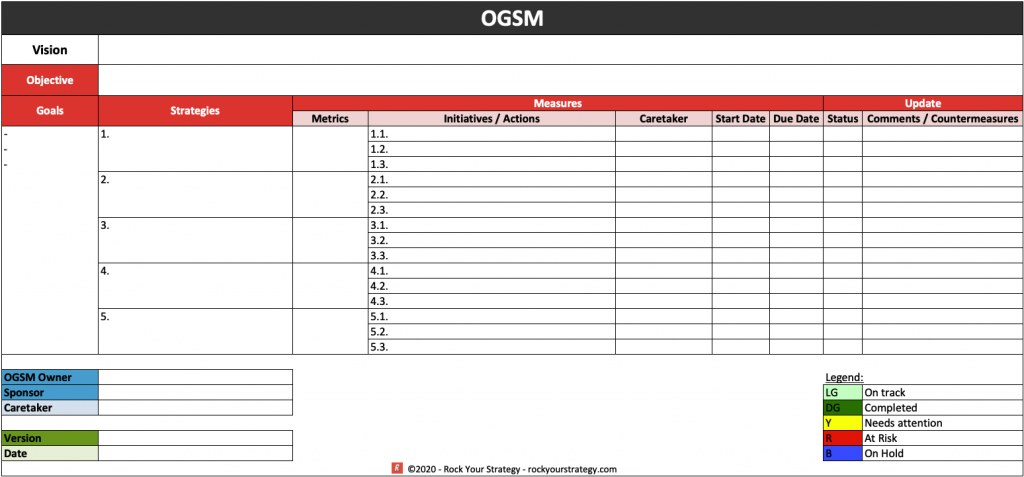
If you want to build your startup OGSM quickly, the fastest way to start is with a structured template that gives you the right layout from the beginning. Our OGSM Template for PowerPoint and OGSM Template for Excel are designed to get you from blank page to complete strategic plan in a single working session.
And if you want to see the framework in action before you build your own, our OGSM examples show how real businesses — from a small Italian restaurant to a B2B company — have used it to build plans that actually get executed.
Two of the most popular strategic frameworks in business today. One right answer for your situation.
OGSM is the stronger choice when you need a complete strategic plan that covers both what you want to achieve and how you’ll get there — typically over a 1 to 3 year horizon. OKRs are better suited to teams running fast, short goal-setting cycles — usually quarterly — without needing the full strategic context layer. The key practical difference: OGSM includes an explicit strategy; OKRs do not.
Here’s a full breakdown of both frameworks — how they work, where they shine, where they fall short, and how to decide which one is right for your business.
What Is OGSM?
OGSM stands for Objectives, Goals, Strategies, and Measures. It’s a one-page strategic planning framework that captures your entire business strategy in a single, structured document — from the qualitative ambition at the top to the specific actions and metrics at the bottom.
The four components work together in a deliberate hierarchy:
Objective — a qualitative statement describing where you want to go
Goals — 3 to 5 quantitative targets that define what success looks like
Strategies — the specific approaches you’ll take to achieve those goals
Measures — the metrics and initiatives that tell you whether your strategies are working
OGSM was developed in the 1950s and has been used by large multinationals — Procter & Gamble, Unilever, Mars, and many others — to align strategy across complex organisations. Today it’s just as effective for small businesses and individual teams as it is for global corporations.
What Are OKRs?
OKRs stands for Objectives and Key Results. The framework was developed by Andy Grove at Intel in the 1970s, then popularised at Google by investor John Doerr in the late 1990s. Since then it has become the framework of choice in Silicon Valley and the broader startup world.
An OKR consists of two parts:
Objective — an inspiring, qualitative statement of what you want to achieve
Key Results — typically 3 to 5 measurable outcomes that define what achieving the objective looks like
OKRs are usually set quarterly, reviewed regularly, and graded at the end of each cycle. The framework is designed to move fast: set ambitious targets, execute quickly, learn, and reset.
OGSM vs OKR: The Key Differences
Both frameworks start with an objective. After that, they diverge significantly.
1. Strategy vs Results
This is the most important difference. OGSM includes an explicit layer for strategies — the specific approaches, choices, and methods you’ll use to achieve your goals. OKRs skip this layer entirely. An OKR tells you what you want to achieve and how you’ll measure success, but not how you’ll actually get there.
For businesses that need to make real strategic choices — which markets to enter, which customer segments to prioritise, which capabilities to build — the absence of a strategy layer in OKRs is a genuine limitation.
2. Time Horizon
OGSM is designed for medium to long-term strategic planning — typically one to three years. It gives your organisation a stable north star to execute against over time.
OKRs are built for speed. Most organisations run OKRs on a quarterly cycle, which makes them excellent for execution but less suited to long-term strategic direction.
3. Comprehensiveness
An OGSM is a complete strategic plan. It answers the fundamental questions of business strategy in one document: Where are we going? What does success look like? How will we get there? How will we know we’re on track?
OKRs answer the first two and the last, but leave the third — the “how” — undefined. This works well for organisations where strategy is set separately and OKRs are used purely as an execution and alignment tool.
4. Origin and Culture
OGSM has roots in classic corporate planning and is most commonly used in large, established organisations — particularly in consumer goods, pharma, and professional services.
OKRs emerged from the tech world and are deeply embedded in startup culture. They reflect a philosophy of ambition, experimentation, and rapid iteration that suits fast-growing companies better than a methodical annual planning process.
5. Cascade
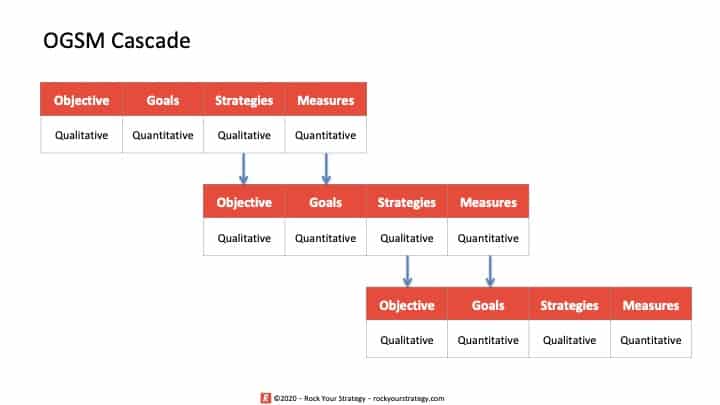
Both frameworks can cascade through an organisation — from company level to department to team to individual. OGSM cascades through the strategy layer: each department or team writes its own OGSM that aligns with the strategies above it. OKRs cascade through the key results: a company-level key result becomes the objective for the team below.
In practice, OGSM cascades are more structured and strategic; OKR cascades are faster and more flexible.
When to Choose OGSM
OGSM is the right choice if:
You need a complete strategic plan, not just a goal-setting tool
Your planning horizon is one year or longer
You need to align a team or organisation around both direction and execution
You’re in a more established business where strategic choices and trade-offs matter
You want a single document your entire leadership team can read, debate, and commit to
You need to cascade strategy clearly from the top down
When to Choose OKRs
OKRs are the right choice if:
Your organisation moves fast and needs to reset goals frequently
Strategy is already set and you need a rigorous execution and accountability tool
You’re in a startup or tech company where quarterly cycles fit naturally
You want individual contributors to set their own OKRs aligned to company objectives
You prefer a lighter, more agile framework over a comprehensive strategic plan
Can You Use Both Together?
Yes — and some organisations do. A common approach is to use OGSM for the annual strategic plan (the “what” and “how” over 12 months) and OKRs for the quarterly execution layer within each strategy.
In this model, the OGSM gives you strategic direction and stability. The OKRs give each team a focused, time-bound set of outcomes to drive in the next 90 days. The two frameworks reinforce each other rather than compete.
The risk to watch out for: complexity. Running both frameworks at once requires discipline and clear governance. If the OGSM and OKRs aren’t explicitly connected, teams end up with two sets of priorities that quietly pull in different directions.
Which Should You Choose?
If you’re building or refreshing a strategic plan for your business, OGSM will serve you better. It forces you to make real strategic choices, not just set targets — and that discipline is what separates strategies that get executed from plans that gather dust.
If you already have a clear strategy in place and your primary challenge is execution and team alignment at a fast pace, OKRs are a powerful complement.
When in doubt, start with OGSM. It gives you everything OKRs give you — a clear objective, measurable goals, and a way to track progress — plus the strategic layer that OKRs leave out.
Ready to Build Your OGSM?
If OGSM sounds like the right fit, the best place to start is a clean, ready-to-use template. Our OGSM Template for PowerPoint and OGSM Template for Excel are built for exactly this — a structured, professional framework you can populate in a single session and share with your team immediately.
Still not sure which framework is right for you? Read What Is OGSM? for a deeper look at the methodology, or explore our OGSM examples to see it in action.
If you are like me then you may also be wondering if there is a better way to drive strategy execution and achieve business results. When I first came across OKRs and OGSM, I was wondering what’s the difference between OKR and OGSM and which one should I apply? Here’s what I found out.
OKR and OGSM are both goal-setting methodologies that help companies execute their strategies but they differ in scope, timeframe and format.
Let’s explore these differences and their similarities to help you choose which one to apply. I’ll add examples and templates below.
Difference between OKR and OGSM
Before we jump into the details, let’s first find out what OKR and OGSM are.
OKR stands for Objectives and Key Results.
OGSM is short for Objectives, Goals, Strategies, and Measures.
In the OKR methodology, the Objective describes what you want to achieve usually over a monthly or quarterly timeframe and the Key Results describe what achievement would look like.
In the OGSM approach, the Objective and the Goals jointly describe what you aim to achieve and the Strategies and Measures give clarity how you aim to achieve it.
Hence, both OKR and OGSM are goal-setting methodologies that help companies execute their strategies following Peter Drucker’s idea of management by objectives. While OGSM is said to go back to Japanese automotive manufacturers who brought the approach to the United States, OKRs were first implemented at Hewlett-Packard and popularized by their application at Intel and later Google.
Nowadays, OGSM is famously adopted at major consumer staples such as P&G and Coca-Cola, while OKRs are widely practiced in many technology companies and start-ups across the world.
Despite their similarities, there are 3 major differences between OKR and OGSM: scope, timeframe and format.
1. Scope
The first major difference is in scope.
OGSM is well suited for describing strategic plans for large and small businesses alike. The approach is typically applied and aligned top-down from the corporate or business level to individual divisions, product lines, or teams.
OKRs seem better suited for individual and team-level goal-setting. They are often created and aligned bottom-up.
2. Timeframe
The second key difference is in the timeframe or time horizon.
OGSM applies well to longer term strategic plans (over 3-5 years) or annual operating plans (1 year). The objective, goals, strategies, and measures are chosen in line with this longer timeframe.
Once the OGSM is developed, the focus is on implementation and execution. Course adjustments or modifications to the OGSM are made as needed in annual or quarterly reviews.
OKRs typically describe shorter term goals and key results. Objectives and key results are often set quarterly or monthly and aligned accordingly. Once all key results are achieved, new objectives and key results are set.
The application of OKRs is therefore more dynamic and OKRs change more frequently.
3. Format & Terminology
The third and most obvious difference lies in the format of the goal setting approach.
OGSM describes in detail the objective, goals, strategies, and measures. Objectives are words, goals are numbers. Strategies are words, measures are numbers. The OGSM is thereby more elaborate in describing, aligning and quantifying where the business is heading and how it aims to get there. The plan is summarized on a handy, single page overview.
OKRs on the other hand typically describe the objective in qualitative terms and then jump straight to detailed key results which may be qualitative or quantitative. Often no more than 3-5 key results are chosen to define the objective. OKR is therefore simpler in its approach.
The following table illustrates the difference in format and compares the terminology.
OKR
OGSM
Objective
Objective
Goals
Strategies
Key Results
Measures
When analyzing and applying OGSM and OKR, many more detailed differences will become apparent. For the purpose of identifying the key differences and helping to choose which approach to apply, I find that those three distinctions were most critical.
What are advantages and disadvantages of OKR and OGSM?
While both OKR and OGSM are goal setting methodologies, due to their differences in scope, timeframe and format, they each have unique advantages and disadvantages.
Advantages & disadvantages of OKR
The advantages and disadvantages of OKR are summarized in the following table.
Advantages
Disadvantages
– Quick to create and apply bottom-up – Easily adjusted and changed – Can facilitate performance management and feedback
– Lacks the longer term context – Doesn’t describe how to achieve key results – Bottom-up OKR definition can make alignment across company tricky
Advantages & disadvantages of OGSM
The advantages and disadvantages of OGSM are summarized in the following table.
Advantages
Disadvantages
– Simple one-page overview creates clarity about overall business plan – Clearly aligns goals (“what”) with actions (“how”) – Guides execution and follow-through – Highly versatile: can be applied for large & small businesses, organizations and non-work projects
– Not easily changed or adjusted short-term – Requires strong leadership buy-in – Company wide cascading can be perceived as cumbersome and overly bureaucratic if not well managed
One additional advantage of OGSM is that the simple one-page business plan format lends itself well for communication of the business strategy with your team. This is however also an advantage of the OKR methodology as well.
When should I apply OKR or OGSM?
OKRs work well for individuals and teams and when your timeframe to achieve your objectives is rather short such as 1-3 months.
OKRs are thereby particularly well suited for highly dynamic environments where change occurs quickly and where the organization has to remain agile to adapt. This is why many start-ups and technology companies apply OKRs.
OGSM provides a more robust structure which makes it more suitable for overall strategic plans or annual operating plans. While OGSM are well suited for larger companies, they also provide strong guidance for smaller businesses and entrepreneurs.
Tip: OKRs and OGSM can of course be applied in combination. The OGSM can be used to set the overall vision and direction of the company with clear financial goals, strategies and measures. These can be broken down into quarterly OKRs. The OKRs then help to drive quarterly execution in alignment with the strategies and measures.
What are examples of OKR and OGSM?
Applying the OGSM methodology is not difficult. Here are examples to show how to use the OGSM methodology in practice.
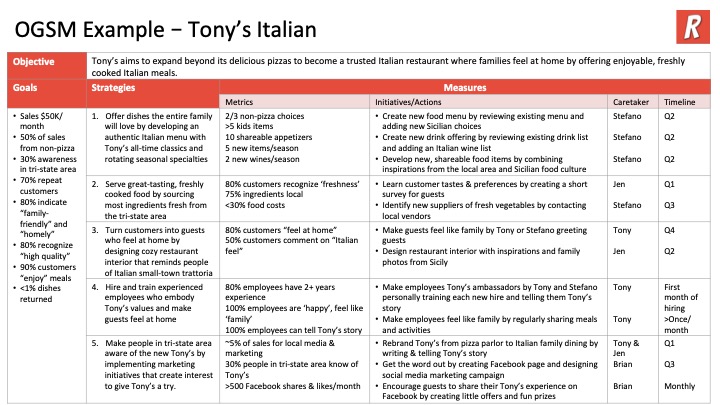
Tony’s Italian OGSM
Tony’s Italian is a fictional story about how Tony turned his pizza parlour into a family restaurant. The example shows how to apply OGSM to a small consumer business. Click here to read the full story of how Tony goes through the strategy process and captures his insights and strategic decisions in the OGSM. Or find the OGSM below.
Tony’s Italian OGSM Example
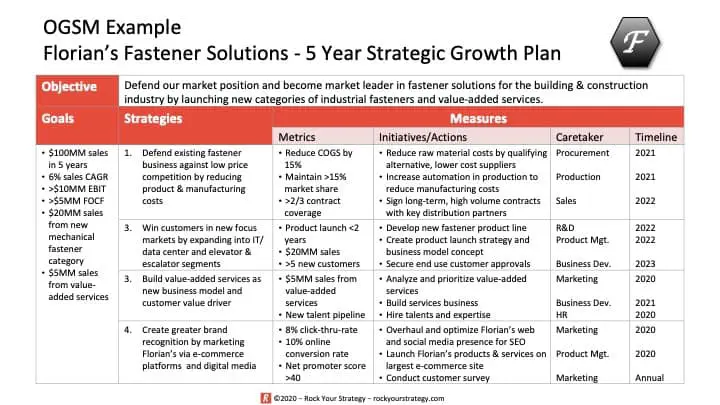
Florian’s Fasteners OGSM
Florian’s Fasteners tells the fictional story of a small B2B business that turned around its fortunes after a strategic review. Click here to read Florian’s story or find the OGSM below.
Florian’s OGSM Example
Examples of OKR
For examples of the OKR methodology, I can really recommend the resources at www.whatmatters.com.
John Doerr, author of the excellent book “Measure What Matters”, and his team go into lots of details and practical examples.
Where can I find OGSM templates?
Here are templates of the OGSM to get you started. Click on the following links to download PDF copies of the simpler Microsoft PowerPoint template or the more sophisticated Microsoft Excel template.
OGSM Template in PowerPoint
OGSM Template for Microsoft Excel
If you’d like to learn more about how to use these templates to create your OGSM, check out this article.
And before you go, check out our jam-packed Resource page with more tools and templates to help you simplify your strategy and achieve excellent results. Rock on!
Two-thirds of all business strategies fail during implementation. And just like the seven cardinal sins, when strategies fail in business often one or more of the seven deadly sins of strategy are at work.
The seven deadly sins of business strategy:
Ignorance – not knowing
Incongruity – not fitting
Confusion – not understanding
Doubt – not believing
Discord – not uniting / not aligning
Incompetence – not able
Inertia – not acting
Become aware of these seven sins of business strategy and how to avoid them and you are on your way to business success. Here’s how.
Ignorance
The first sin is ignorance or not knowing.
Merriam-Webster defines ignorance as “the state or fact of being ignorant: lack of knowledge, […] or awareness”.1
When thinking of ignorance I cannot help but think of the three wise monkeys and the famous maxime “see no evil, hear no evil, speak no evil”. However when it comes to business strategy, it would obviously not be advisable to stick your head in the sand and pretend the world around you does not exist.
Running a successful business and developing effective strategies require staring the truth in the eye, relentlessly asking questions, and thoroughly analyzing and understanding the situation you are in.
In his classic book “Good To Great”, Jim Collins calls this “confronting the brutal facts”2. Collins argues that you cannot make good decisions without confronting the brutal facts of reality. You want to create an atmosphere where people are encouraged to raise issues and speak their minds. You want a climate where the truth is heard. How? According to Collins:
Lead with questions, not answers
Engage in dialogue and debate, not coercion.
Conduct autopsies, without blame.
Build “red flag” mechanisms that surface information that cannot be ignored.
Every good strategy process begins with an analysis of the current internal and external business environment in order to situate the strategy in the realities of the business.
Ignorance will set you up for failure. Knowledge, awareness and facing the facts will set you up for success.
Incongruity
The second sin of business strategy is incongruity or not fitting.
Merriam-Webster says incongruity refers to “something that is incongruous”, i.e. “something that is inconsistent within itself”.3
A business strategy can only be effective in delivering results when it fits the situation the business is in. Every business is different. Every strategy is different. Different strategies may be effective at different times. Along those lines, a strategy that may fit another business or at another time does not necessarily fit yours – and now.
I have seen businesses emulating other successful businesses’ strategies hoping that such a strategy would also work for them. Or I have seen new leaders coming to new businesses and attempting to implement the strategies that made their previous businesses successful. I’m not saying that this may never work. But I am saying that the specific strategy must fit the business and the situation that it’s in. If possible, check and adapt.
One important aspect of congruence is that your business must have the necessary knowledge, resources, skills and capabilities to implement the chosen strategy. If that is not the case, the strategy is incongruent with the business and bound to fail.
Starting your strategy process with an analysis of the current internal and external environment and truly understanding what strengths and weaknesses your business has, helps make sure that the strategy you develop fits your business and its situation.
One more important aspect that has served me well over the years: involve your team in the strategy process. Their insights and real day-to-day experiences will help test assumptions and guide the discussions towards the right priorities. Make sure however as noted above that the truth is heard.
With that you set yourself up to develop and execute a strategy that uniquely fits your business and your situation.
Confusion
The third sin is confusion or not understanding.
Merriam-Webster defines confusion as “the act of confusing” or the “state of being confused” and further describes these “to disturb in mind or purpose” or “to fail to differentiate from an often similar or related other”.4
In other words, related to business strategy, the strategy is unclear or not fully understood. And what could be worse than to develop a carefully designed strategy, nestled in the realities of the business, vetted over months, if in the end your team does not understand it.
Being unclear about the company’s strategy or not understanding how one’s own role contributes to the mission of the business are key reasons for employee disengagement. And when your team is not engaged, it is not effective in moving your company towards its objective and goals.
In order to create clarity about your strategy, consider the following three aspects:
Involve your team in the strategy process. Integrating your team’s insights and expertise when deciding where to play and how to win builds in their understanding of what you are trying to achieve.
Keep the strategy simple. Duh, this sounds obvious. But it is actually really hard to do. Calibrating your strategy so that it is not high in the clouds and disconnected from your business while anchoring it in the day-to-day realities without cluttering it with details is the ultimate challenge. Work with your team, follow a structured process, challenge yourself to reiterate until you can boil your strategy down to its simplest essence. Check for clarity, sufficiency, alignment before finalizing.
Communicate, communicate, communicate. Throughout the entire strategy process, communicate with your team. Share your thoughts, test assumptions, possibly involve customers.
A 2009 survey by Forbes Insights and FD revealed that a lack of understanding was the number 2 reason why strategies failed during execution5. What’s the number 1 reason? Unforeseen external circumstances (see Ignorance above).
So invest in clarity and involve your team and you should be well on your way.
Doubt
The fourth sin is doubt or not believing.
According to Merriam-Webster, doubt means “to call into question the truth of” something or “to lack confidence in” something.6
When thinking of business strategy, doubt is sewn when the strategy is not compelling, when the strategy does not have a clear destination or when the destination seems unattractive or out of reach.
A business strategy must spell out the purpose of the business and why moving the business towards its destination is an attractive, worthy cause. It’s strategies that appeal to a larger cause than the products of the company or a financial goal that inspire people and make people believe.
For example, a strategy that aims to “achieve profit X” or to “build product Y” are clear and realistic, but not inspiring. Instead, connect these goals to a larger cause such as serving a key customer need, solving a major problem or overcoming an industry challenge.
A strategy must clearly articulate a vision, a destination so compelling that it moves people to action.
Besides being connected to the realities of the business and being clear and understandable, therefore, a business strategy must inspire people to believe.
Discord
The fifth sin is discord or not uniting or aligning.
Merriam-Webster says discord refers to the “lack of agreement or harmony (as between persons, things, or ideas)”.7
Say you have defined a vision for your business. You have turned that inspiring vision into clear objectives and goals and you have rallied your team to join you on that journey. But what if it is not clear how you will reach your destination or worse what if there is disagreement about how to reach the destination? The energy you created deflates.
The same way there are “a thousand ways to Rome”, there are many ways for a business to reach its objectives. An effective strategy doesn’t only spell out what it aims to achieve, but also how it is going to achieve it. As Lafley and Martin say in “Playing to Win” it’s where to play AND how to win.
Strategy is all about making choices. It’s about allocating your finite resources to those initiatives that give you the highest chance of success. It’s about deciding which ventures to fund, which products to build, which services to offer, and which competencies & skills to develop.
It should not be your ambition to make everyone agree with the strategy. It’s ok to agree to disagree. It’s more important that everyone unites and gets behind the strategy to direct the company’s resources fully towards its vision and strategic objectives. How do you achieve that? Alignment.
During the strategy process, work with your team to translate the objective and goals into strategies that translate your ambitions into results. The strategies describe the ‘how’, the trade-offs, the resource allocation decisions. Then further work with your team on cascading the strategies into objectives and goals for each division, function, and team. In a small business with only a few people, the same process holds. Translate the strategies into clear objectives, goals, and initiatives for each person. The initiatives and actions of each team or person must align with the larger cause like one cogwheel in a system grabbing into another.
When the business is united behind the strategy and your team is aligned on how to reach your destination, you can fully direct your energy towards achieving your goals.
Incompetence
The sixth sin is incompetence or not being able to.
Merriam-Webster defines incompetence as “the state of being incompetent”, i.e. “lacking the qualities needed for effective action”.8
Incompetence or the lack of ability to do something is likely the easiest sin to understand and also the easiest to overcome. Yet, in my experience, incompetence is also the most underestimated.
When defining a strategy and setting the course for your business, it is important to confirm whether your business has the necessary knowledge, skills, and experiences to implement the strategy and achieve the goals. It’s worth reviewing these terms individually. For our intents and purposes, let’s define the terms as follows.
Knowledge – refers to knowing what to do. This means having acquired theoretical and practical knowledge through professional training, university, school or self study. Books are a wonderful source of knowledge.
Skills – refers to knowing how to do it. These are the competencies and techniques needed to complete a job, task or activity. These include hard skills and soft skills as well as generic skills and domain specific skills. Practice or training is a great way to acquire and hone skills.
Experience – refers to having done it before. This means having applied the acquired knowledge and skills in real life. Having faced and overcome the exact situation you aim to master.
Consider a sports example. Knowledge means you have read all about football, you have watched it on TV and have been told what football is and how to play it. Skill means you have practiced football. You have handled the ball, you have trained together with your team members. Experience means you have played the game and have been on the field in the competitive situation of winning or losing.
Having and honing all three, knowledge, skills, and experiences, vastly improve your chances of success and overcoming inertia.
This doesn’t mean that you cannot succeed if you lack any or all of them. Learning by doing or tackling a new challenge that no one has ever faced can be powerful ways to move people to action. Just know that lack of knowledge, skills and experiences can be a reason why your strategy is not progressing.
So audit yourself during the strategy process and check you have the necessary knowledge, skills, and experiences to do what you aim to do. If not, seek to understand whether this is critical for success. If yes, invest in building the necessary knowledge, skills and experiences before setting off on your journey.
Finally, make sure that your key initiatives critical to success are well resourced. Even if you have the necessary abilities, there is no guarantee for success. Ensure you have enough of them and that they are applied persistently.
Inertia
The seventh sin is inertia or not acting.
Merriam-Webster says inertia is the “indisposition to motion, exertion, or change” and defines inertness as “very slow to move or act”.9
In business strategy, inertia is an interesting phenomenon. Your strategy is ready, you have communicated with your team, but nothing happens. Progress is slow. Results are pending. What happened?
In physics, the reason for inertia is resistance. In business, the reasons could be manifold and not due to one single reason.
Inertia could be caused by a lack of focus. If you have too many topics on your plate, you may be working a little on all of them, but not sufficiently on any of them to make a difference or bring a topic to the end. Review the number of initiatives in your business. What matters most right now? What matters most long-term? Prioritize and work on what’s important first. Bring those topics to an end.
Inertia could be caused by a sheer insurmountable challenge. Have you had this before? A problem so big you didn’t know where to start? I have certainly been there and it keeps you from moving ahead. If you face such a situation, break it down. Divide the problem, project or initiative into smaller steps or sub-projects. Consult a colleague or mentor to help you with this when you get stuck. Sometimes another perspective can be powerful. Then tackle one topic at a time. Ensure that each sub-project has the resources and expertise to move forward.
Inertia could be caused by a lack of passion. When you find an activity you love doing, it seems no effort at all. You tackle it readily and you don’t seem to notice the time passing. However, when the opposite is true, when you face an activity you cannot get excited about, it seems to become a chore. You are more likely to put it off and choose to get other things done first. This is quite typical and can also happen with your strategic initiatives. When resourcing your initiatives and finding caretakers, make sure to check for interest to find someone who can get passionate about the project. If this is not the case, consider outsourcing. If it’s important to the strategy, but not core to your business or the passion of your business, find someone for whom it is.
Inertia could be caused by a lack of ability. As noted above under incompetence, lacking the necessary knowledge, skills, and experiences may prevent your team from moving forward. Ensure that you have the ability to succeed and that it is well resourced.
And of course, inertia could be caused by resistance. Sometimes outright resistance to the strategic direction, to the objective and goals, to the approach prevents progress. But resistance itself is not the reason. When resistance exists, there are more fundamental concerns in play that must be understood. Dig in! Approach your team, your customers, your stakeholders openly. Ask questions to truly understand their concerns. Fundamental reasons could be fear and anxiety about changes: plant closures, job losses, benefit changes. These concerns can be very personal and it’s critical they are heard and understood to help people cope. Any such reasons are legitimate. Approach them with empathy. Make it your personal mission to truly understand and then work with the people to overcome their underlying reasons for concern.
So how do you change inertia? Just like in physics, you apply force. No, not physical force. But you do need to give an input to create motion. And that input must come from the business leader.
Engage your team throughout the strategy process and ensure key people are involved. Openly and actively listen to questions and concerns. Communicate, communicate, communicate so everyone understands why you are doing what you are doing and how the team can help.
Engagement and understanding create buy-in. And buy-in helps you overcome inertia.
How to avoid the 7 sins of business strategy
Now that we have learned about the 7 sins of business strategy and heard some thoughts about how to avoid them, how do we set ourselves up for success?
In order to succeed in business, apply the following six principles of business strategy during your strategic planning and implementation.
1. Structured process
Whether you are in a large company or a small business, a disciplined strategic planning process is critical to success
Be deliberate about strategy development and implementation
If you have a team, involve your employees in the strategic planning and the implementation process
Involving your team not only sends a clear message of appreciation, but also helps with anticipating potential obstacles and preparing accordingly
Your team knows the day-to-day challenges and helps with a realistic assessment of opportunities and capabilities.
3. Buy-In & Alignment
When developing your strategy, make sure your objectives, goals, strategies, and measures are congruent with each other. Check whether strategies and measures are sufficient to achieve the objective and goals.
Seek systematic buy-in and alignment of objectives and strategies across your organization. Make sure each function is involved, understands what it takes to be successful, and has the resources and capabilities to succeed.
Systematically break down objective and goals and cascade them throughout the organization. Ensure that every level in the organization is aligned, empowered and pulls in the same direction.
4. Communication
Clarity about objective, goals and strategic priorities is of utmost importance. You cannot execute a strategy you do not understand.
Build communication as an integral part into strategy formulation and execution.
Listen to questions and concerns and consistently explain how initiatives and actions fit with the overall strategy and how each individual can help to achieve the objective and goals.
5. Accountability
While the business leader is ultimately accountable for success or failure of the strategy, the strategic plan must be the common objective for the entire business
Set clear expectations for each function and team and clarify how each contributes to moving the business in the right direction and delivering results.
Hold people responsible for implementing strategic initiatives and delivering expected results. Be a cheerleader for your team and allow no excuses.
6. Execution
Implementation must be considered a strategic initiative, not an operational task
Install a clear cadence when reviews take place and what actions have to be completed by whom and by when
Ensure that key initiatives are prioritized and resourced appropriately with the needed manpower and skills
Conclusion
In summary, to avoid the seven sins of business strategy, work with your team to follow the 6 proven principles of business strategy.
The OGSM methodology is one of the most effective antidotes to all seven deadly sins of business strategy — a clear, one-page plan that the whole team can see, understand, and act on. Download a pre-formatted, fully customizable OGSM Template for PowerPoint or OGSM Template for Excel from the Rock Your Strategy shop and build your strategy on solid foundations.
Many Fortune 500 companies and many small businesses have successfully implemented the OGSM methodology to support their strategic process. Why? Because there are many benefits to using OGSM to simplify strategy and deliver results. Here are 13 ways the OGSM methodology can improve your strategy too.
→ Want the complete OGSM reference before diving in? The Complete OGSM Framework Guide covers all four components in depth, real-world examples by industry, a comparison to OKRs and the Balanced Scorecard, and step-by-step build instructions.
1. Simplicity
The OGSM is simple. The methodology uses a simple framework, easy language and a one-page overview to break down a sophisticated process into an approachable, simple format. This makes it easy to understand and easy to adopt.
2. Clarity
The OGSM makes strategy clear and transparent. As the OGSM depicts the strategy on a single page, there is no need to read a long strategy paper or a thick powerpoint deck to understand what the business or the organization is looking to achieve and how it will get there. The objectives, goals, strategies and measures can all be found at first glance. Clarity about strategic objectives is critical if you want to achieve them.
3. Quick to learn
The OGSM methodology is easily understood and quick to learn. You do not need to hire expensive consultants first to explain to your executive team or your project team how to develop a strategy or deploy the tool. The format and terminology are simple and basic concepts of the methodology can be learned quickly in order to be deployed effectively. (Besides, you have Rock Your Strategy to help you through the process ;-))
4. Easy to communicate
The OGSM can be easily communicated. Key to effective communication is connecting with your target audience to help them understand the key content of your message. Because the OGSM is simple, easy to understand and makes your strategy clear and transparent, it is a wonderful way to communicate your strategy.
5. Versatility
The OGSM is versatile. It can be used for long-term strategic plans with time horizons of 3-5 years or longer. It can be applied to annual operating plans or budget plans. It can be deployed for large or small-scale projects etc. etc. In essence, anytime you have an intended outcome and need to plan how to achieve it, OGSM could be your tool.
I have personally applied OGSM both for long-term strategic plans and for annual operating plans and I have seen it used to manage a project. All worked very well.
6. Engagement
The OGSM creates engagement. By definition, engagement is when people pledge their support, when they feel a legal or moral obligation to do something. Involving the team, receiving their input and obtaining their buy-in is important. But showing in the OGSM how the team can support implementing the strategy and achieving results creates true commitment.
7. Focus
The OGSM creates focus. Strategy is all about making choices and the process and the OGSM format force making choices. Choices which initiatives to prioritize and how to allocate resources to achieve your objectives and goals. I have found that choosing 3-5 strategies is optimal in order not to put all your eggs in one basket while directing your attention and capabilities towards those activities where you can have the biggest impact.
8. Alignment
The OGSM aligns all functions and stakeholders towards a common objective and goals and shows how each can contribute towards achieving them. This is important to ensure that all parts of an organization pull in the same direction. Nothing could be worse for an organization than to create conflicting priorities or diverging interests which lead to inefficient allocation of resources or outright internal competition. While internal competition can be good in some situations. It is poison if there are conflicting views about what the strategic priorities of the business are.
9. Cascading
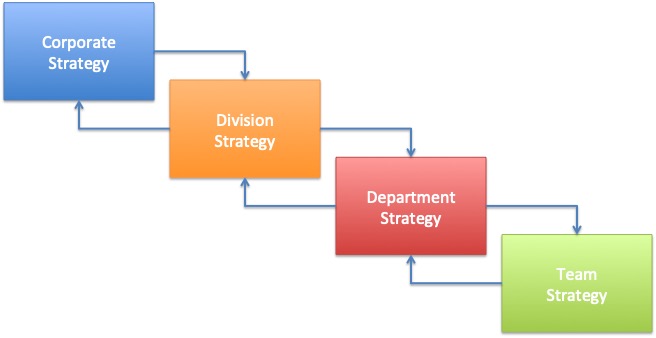
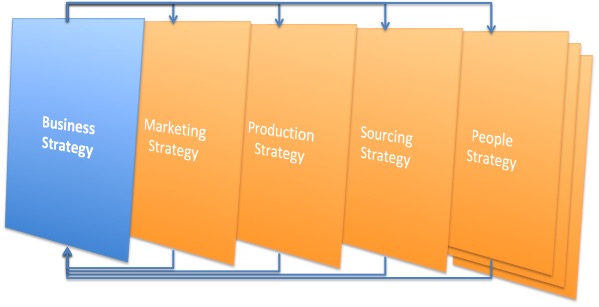
The OGSM makes cascading strategies throughout the organization easier and more straightforward. With OGSM you can cascade the strategy vertically from e.g. company level to division level to team level. You can also easily cascade horizontally from business unit or product line to various organizational functions, such as marketing, sales, operations, HR etc.
10. Teamwork
The OGSM methodology encourages teamwork and works best when discussed in the team. Bringing your team together to discuss your strategy, analyze the current situation, debate strategic choices, and decide resource allocation ensures that the strategy is connected to the realities of the business and creates understanding and buy-in.
11. Execution
The OGSM format connects WHAT you aim to achieve, the objective and goals, with HOW you are going to achieve it, the strategies and measures. This builds the execution plan into the strategic plan. That means the organization knows how to achieve its goals and can focus on implementing the initiatives.
12. Review
The OGSM methodology lends itself very well for regular monthly and quarterly reviews to make sure you stay on track to achieving your targets. While the OGSM is built top down, the review is conducted bottom up beginning with the measures and the strategies. Regular check-ins keep you on target and allow timely course corrections if needed.
13. Results
The OGSM approach has proven time and again that it helps people deliver results. A plan without implementation is simply that – a plan. The OGSM creates transparency about what is important and encourages taking action to turn plan into reality. Regular reviews keep the team engaged and focused. Timely course-corrections keep the team on track and ultimately lead to results.
Conclusion
OGSM stands for objective, goals, strategies, and measures. It is a simple approach to strategic planning for longer term and shorter term plans alike. It’s a one-page format that describes what the business aims to achieve and how it is going to achieve it.
If you would like to learn more about the OGSM methodology, please click here. You may also browse our examples and tools & templates. If you have any questions, please don’t hesitate to drop us a note. We’d love to hear from you.
Templates
Find tools & templates for OGSM and your strategic planning process here.
OGSM Examples
Find OGSM examples and inspirations for your own journey here.
See OGSM in Action: Real-World Examples by Industry
The 13 reasons above explain why OGSM works. The best way to see those benefits in practice is to look at how different types of organizations use the framework to build focused strategies and drive real results. We’ve developed detailed examples across four industries that represent the most common strategic planning challenges today — from high-growth SaaS companies and AI startups to DTC brands and non-profits.
OGSM Example: B2B SaaS — how a pipeline analytics company aligned its leadership team around a clear path from $2M to $8M ARR, including PLG onboarding, enterprise customer success, and upmarket expansion strategies
OGSM Example: AI Startup — how a Series A document intelligence company used OGSM to make the transition from research-led organisation to a business with a repeatable sales motion and growing retention
OGSM Example: E-commerce / DTC Brand — how a sustainable home goods company built a profitable growth strategy by reducing paid acquisition dependence and investing in owned audience channels
OGSM Example: Non-Profit — how an education foundation aligned programmes, funding diversification, and impact measurement into one coherent three-year strategy
OGSM Example: Tony’s Pizza — the classic OGSM case study that illustrates all four components in a simple, memorable context
Convinced by these 13 reasons? The fastest way to start applying OGSM in your business is with a ready-made template. Download a pre-formatted, fully customizable OGSM Template for PowerPoint or OGSM Template for Excel from the Rock Your Strategy shop — and see for yourself why so many successful companies rely on OGSM to simplify strategy and deliver results.
I recently wrote about monthly OGSM reviews which are important, regular check-ins to make sure you are on track with executing your business plan. In addition, quarterly in-depth reviews are an effective complement to monthly reviews. But what’s the difference and why have them?
While monthly OGSM reviews are brief updates about execution progress, quarterly OGSM reviews are more thorough examinations of strategies and measures to confirm whether the business is on track to achieving its overall objective and goals.
Executing your strategy should be right among your top priorities as the business leader. And regular reviews are critical to following through. Here’s how you can go about it most effectively.
Quarterly OGSM Reviews
When using the OGSM methodology for your annual operating plan (AOP) or your 3-5 year strategy, it is important to conduct in-depth quarterly reviews to keep on track with execution.
The purpose of the quarterly review is to get an update on the progress of each strategic initiative on your business plan. This means that each Measure and Strategy are examined against their targets and that progress is made towards Objective and Goals as expected.
For the quarterly OGSM review, I therefore usually schedule a 2-3 hour session in the first month of the following quarter. A timeslot of 2-3 hours allows enough time to dive into detail for each initiative while not wasting valuable time. If you are overall on track, 2 hours might suffice. If you need more time for detailed reviews, go with 3 hours, maximum 4 hours.
During the meeting, each initiative owner provides an update on progress, milestones, challenges, and next steps. The initiative owners should review both the metrics and the actions taken. This is best prepared up front and shared as pre-read ahead of time. I am providing a template below that might be useful for this.
Begin with an overview of the entire OGSM and overall progress of the business against its objectives. Then go bottom up strategy by strategy to review first those initiatives that are behind expectations or require attention. Then go to those initiatives that are on track.
Pay particular attention to those initiatives that are facing challenges, have key milestones coming up, or require decisions or support from the leadership team.
For each initiative, discuss countermeasures and actions as appropriate. Agree on the follow up required. As during the monthly review, all actions are recorded with caretakers and timelines.
After reviewing each initiative, confirm that the overall path chosen is still the right one. The OGSM should never be carved in stone and the quarterly review is the time to revisit whether the chosen initiatives are still the right ones to move the business towards its overall objective and goals.
Consider to stop those initiatives that are not contributing to target achievement. Consider adding initiatives needed to get the business back on track. As during the OGSM creation, consider carefully the resources needed for new and old initiatives. Make sure there are clear caretakers, timelines and actions defined.
Finish the quarterly review meeting with a round of feedback and a review of the recorded action items.
Planning Ahead
In the monthly review article I suggested to plan out the 12 monthly reviews ahead of time. Go ahead and send out 12 recurring calendar invites directly in the beginning of the year. Thereby it’s in the calendar and everyone can plan ahead. It becomes a monthly staple.
Once a quarter, designate one of the monthly reviews as the larger quarterly review. I like to go for the first month of the following quarter, i.e. January, April, July, October. The reason is that quarterly figures are available and evenly spaced out, you have a chance for a deeper review every 3 months.
Extend the recurring invitations of those quarterly review dates from 60min to 2-3 hours as suggested above.
Preparation for the quarterly review
The best review meetings are those that are well prepared. Go into the quarterly update meeting with an updated OGSM document and a one-page update for each initiative. This requires that the OGSM document is updated by the caretaker prior to the meeting and that each initiative owner prepares a one-page update as well.
OGSM Document
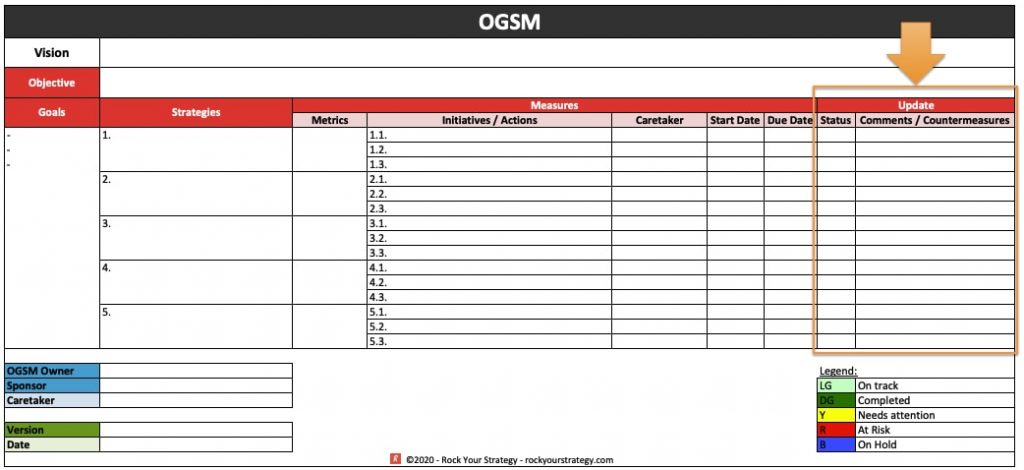
On the OGSM document there are 2 columns that need to be updated. This includes the status field and a brief comment about target achievement incl. proposed actions or countermeasures (as necessary). See the following image.
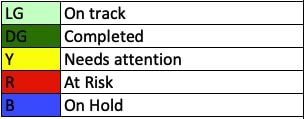
For the status field, I typically use the following color-coded setting which has served me well:
Further explanation about each of these status colors as follows:
Color
Status
Description
Light Green (LG)
On Track
Item is in progress and on track to achieving it’s targets.
Dark Green (DG)
Completed
Item is done and targets are met.
Yellow (Y)
Needs Attention
Item needs attention by the organization or its senior team in order to stay on track and not fall behind.
Red (R)
At Risk
Item is at risk of missing its targets and needs urgent attention and action.
Blue (B)
On Hold
Item has been placed on hold, postponed or deprioritized.
Regarding the color-coding, I always emphasize that the status assessments are meant to be forward-looking and action-oriented and not punitive. A red color is not bad by itself. It does not mean that someone is getting fired. Encourage your team to use ‘yellow’ and ‘red’ statuses to signal that urgent action is needed.
Initiative One-Pagers
For each of the strategic initiatives, ask the initiative owners to prepare a one-page update about progress. This should include progress, milestones, challenges, and next steps. The following template might be useful.
You can find this project report template and other useful tools on our Tools & Templates page.
Ask the initiative owners to share these up front as pre-read. In my experience, review meetings are significantly more efficient and productive when there are no surprises in the meeting. Providing a pre-read up front allows everyone to be prepared and to direct the attention during the meeting to where it is most needed.
One comment about these one-pagers: preparing a one-page update sounds like a lot of administrative work. And yes, it is. It is up to you how you want to manage this. If you feel it’s over the top, then skip the one-pagers and concentrate on the OGSM document. I can however say from my own experience that the regular updating of a one-page initiative update gives additional legitimization and scrutiny to the initiative. Having led both OGSM reviews as business leader and OGSM initiatives as a project leader, I much appreciated the one-pagers as a situational snapshot similar to the balance sheet in an annual report.
What does the agenda of a quarterly review meeting look like?
The agenda of a quarterly review meeting looks similar in structure to the monthly review, however offers more time to go into detail for each of the strategies and measures. As noted above, a 2-3 hour meeting has served me well, which includes the senior business leaders and the owners of the strategies and measures.
This is what the agenda of a quarterly OGSM review meeting might look like.
Time
Topic
Caretaker
5 min
Welcome & opening statements
Business Leader
15 min
Review Financials & key Performance Indicators
Business Leader or OGSM Caretaker/facilitator
15 min
Review actions from previous OGSM review
OGSM caretaker/facilitator
90 min
Review strategies and measures Each initiative owner provides an update on progress, milestones, challenges, and next steps. Review initiatives ‘at risk’ and ‘need attention’ and discuss countermeasuresReview ‘on track’ initiatives and next stepsCheck for decisions, resource needs
Initiative owners (~10 min each)
15 min
Review progress towards overall objective and goals based on initiative updates
OGSM Caretaker/facilitator
15 min
Confirm actions from this OGSM review
Business Leader or OGSM Caretaker/facilitator
10 min
Feedback
Business Leader or OGSM Caretaker/facilitator
Meeting adjourned
Note that I added a 10min section on feedback to the end of the agenda. The purpose of this feedback session is to jointly assess the effectiveness of the review meeting and the progress of the initiatives. It’s meant to be brief and candid. Go around the room in round-robin style and give everyone a chance to speak. This has proven very useful in my experience to vastly improve the review meetings and keep the team engaged. Sometimes the real concerns only came out at the very end….
Feel free to copy this out and into the invitations of your quarterly OGSM review meetings. Or you can find a PDF copy of this meeting agenda and other useful on our Tools & Templates page here.
What happens after the Quarterly OGSM Review?
Once you have finished the quarterly review, send out the detailed meeting minutes to all participants and important stakeholders. Include the updated OGSM, any additional documents such as the initiative one-pagers, and most importantly the decisions and action items.
The initiative owners are then asked to implement their actions as agreed during the meeting. Follow up on the actions and the status of the initiatives in the next monthly review.
Tip: it has really benefited the businesses I have been a part of when the business leader follows up with initiative owners also “offline”. These may be informal check-ins or watercooler chats. These casual encounters are helpful to keep engaged, get a feel for progress and sometimes get more valuable information than during a formal meeting.
What’s the difference between Monthly & Quarterly OGSM Reviews?
I like to make a clear distinction between more thorough quarterly OGSM reviews and more frequent monthly OGSM reviews.
As described above, the purpose of the quarterly OGSM review is a more in-depth review of the OGSM to confirm whether the business is on track to achieving its overall objective and goals.
The purpose of the monthly OGSM review on the other hand is a more regular check-in to track execution and take corrective actions for those initiatives which are ‘at risk’ or ‘need attention’. The discussion is brief, candid and solution-oriented. The monthly OGSM review only takes about 60 minutes.
As during the quarterly review, all actions are recorded with caretakers and timelines.
Why conduct reviews at all?
Fair question! Why do we conduct reviews? And why so many? The whole point of making a plan is to know where you are going and to align your company’s resources behind the overall objective and goals of the business. So the review aims to establish that you are going in the right direction and that you are on track to achieving your targets!
In another article about the 11 secrets of strategy execution I have recently quoted a study that found that ⅔ of all strategies fail during implementation. That’s a staggering finding and a massive waste of resources.
Key reasons why strategies fail according to the quoted study are that the strategies aren’t clear, that they are ill communicated, that senior management is not behind them, and that execution is not part of the company culture.
Senior management led reviews of strategy execution are therefore critical for the following reasons:
OGSM reviews are an opportunity to regularly reinforce priorities and achieve clarity about the direction of the business
Senior leaders demonstrate that strategy execution is a priority and that they personally attend to execution
Regular reviews encourage taking action and following through on plans
Regular reviews offer the opportunity to celebrate wins, give exposure to successful projects, and provide support and encouragement to initiatives falling behind.
In my experience these are critical reasons for conducting regular monthly check-ins and in-depth quarterly reviews and vastly improve your odds at achieving your targets and delivering results.
How to create an OGSM for your business?
We have now been speaking about implementing your OGSM and keeping on track with your execution via quarterly review meetings. But how do you actually create an OGSM in the first place?
The purpose of the quarterly OGSM review is to ensure that the implementation of your plan is on track.
Schedule a 2-3 hour session (based on progress) and review each initiative and strategy. Each initiative owner provides an update on progress, milestones, challenges, and next steps. This should be prepared ahead of time.
The review includes an assessment of each strategy to confirm that the path chosen is still the right one to move the business towards its overall objectives.
If required, countermeasures are discussed and agreed on. All actions are recorded with caretakers and timelines.
What experiences have you made with your OGSM review? We’d be happy to learn about your best practices. Feel free to leave us a comment below. We’d love to hear from you.
Looking for inspiration on how to structure your strategic plan? Or just looking for an OGSM example? Get to know Andy and learn how he applies the OGSM methodology to his small B2B company.
OGSM stands for Objective, Goals, Strategies and Measures and is a one-page business plan that defines ‘what’ you aim to achieve and ‘how’ you are going to achieve it. It is a simple but powerful method that enables strategic clarity, alignment and execution. The OGSM can be applied to large companies and small businesses alike.
This fictional story tells the tale about how small business owner Andy used the OGSM methodology to breathe new life into his father’s old business. Scroll to the bottom of this article if you want to skip the story and head straight to the OGSM.
Introduction
Andy hadn’t been able to sleep. Cold sweat on his forehead, he had been tossing back and forth all night. He stared at the marred face in the mirror: tired eyes with deep black rings underneath stared back at him. Andy counted the worry lines engraved on his forehead. His mind was racing. How would he be able to save his company? How would they be able to defend their share – never mind achieve their growth objective? What was he going to tell his investors?
Ever since Competitech had entered the market for fasteners the previous spring, their market share had dwindled. Florian’s Fastener Solutions had been the market leader for nuts, bolds, washers, and screws throughout the entire Northeast ever since his late father had built the company five decades ago. The iconic F-logo was well known in hardware stores and construction sites across the region. Now everything seemed to change. If they didn’t do something fast, they might be running out of cash in 12-18 months.
Florian’s Logo
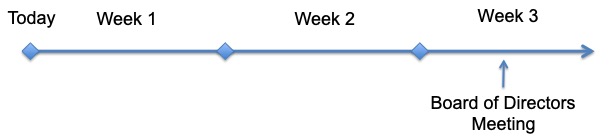
The annual Board of Directors meeting was coming up in less than 3 weeks. Andy wasn’t sure if he could wait that long. He had to refine his plan and discuss it again with his team.
Andy showered, got dressed, and paused just before descending the stairs. He peeked through the children’s bedroom door. All quiet. He could only hear the steady breathing of his two daughters still fast asleep. “If only you knew how stressful and fearsome this world can be”, he thought to himself. Andy blew kisses to both and rushed downstairs.
Just as he grabbed his bag and ran out to the car his phone rang. “Andy, you up?” asked the familiar voice of his head of finance on the other end of the line. “Good morning, Frank. Yeah, I’m on my way to the office. What’s up?”
“Good! Get down here. The report is back. It’s worse than we thought.”
Founding of an industry icon
Florian’s Fastener Solutions was founded by Florian Walterman in 1965. The son of German immigrants who had fled to the US in the 1930s, Florian worked his way through college by taking any construction job he could find. By the time he graduated, he had made a name for himself as being hard-working, gritty, and determined. No job was too tough. No task was too dirty. If you wanted something done, you asked for Flo. And it was these traits that he infused into his company right from the start.
It was not an easy start however. For the first few years, Florian had a hard time making ends meet. He had to take out a massive loan to afford the heavy equipment. The small shop he rented produced nuts and bolts for some of the construction outfits he had worked for during college. However at the back end of the American construction boom of the 1950s and 60s, there were fewer projects and Florian had to be creative.
Florian began experimenting with different materials and production processes. He tried new metals and blends and added new products. His goal was to make the best fasteners money could buy. If you needed bonding, Florian was determined that it had to be his products to do the job. That also explained his early slogan: Florian’s will fix it!
Ad in local newspaper in the late 1960s
Through sheer will and hard work, Florian persevered. His breakthrough came when a new chain store for hardware and gardening equipment approached him for an exclusive contract. The chain’s plan was to expand all across the Northeast and wanted to carry Florian’s fastener products. When they even offered to fund Florian’s needed expansion through an upfront payment, Florian readily agreed.
In the following years, the chain rapidly grew into American suburbia and with it Florian’s fasteners. Working hard to keep up with demand, Florian built a second site, purchased more equipment and hired more staff. As sales grew, so did the company. But Florian remained as hard nosed, down to earth, and gritty as he had always been.
Florian’s became a household name and its italic F on the bold head a well-known sign of quality and craftsmanship. An industry icon was born.
Family business
Andy had never wanted to get into the family business. Florian’s was his dad’s. It even carried his name. No, ever since being a little boy he wanted to go out to see the world. He wanted to help people who were less privileged than himself.
During high school he worked on a project in Puerto Rico. He was blessed with his dad’s workmanship and strong hands and was glad to put them to good use. In the summer after graduating he led a group of friends to Tanzania to build a school and teach English. He knew he wanted to devote his life to helping others and his choice of college degree was easy.
One day in Fall, Andy had just settled into his 3rd year at the Stanford University social sciences program, his mother called. “Andy, it’s your dad. He had a stroke. Can you come home?”
Shocked how anything could harm his steadfast father, Andy took the first Eastbound flight the following day. When his rental car pulled up the driveway, the last sun rays of the day peaked through the tall pine trees behind his parents’ house as dusk began to settle. Andy had this eerie feeling that more than a day was coming to an end.
“Thank you for coming home, Andy.” said his mother after a long, warm embrace. “Your father is at St. Mary’s hospital. The doctors say he may not make it.” Andy had always had a difficult relationship with his father. Not wanting to continue the business had driven a wedge between them. At this moment however, Andy felt overwhelmed with sadness and regret. All these years he was away while his father was consumed by work. They had not really had a chance to open up about their feelings for each other.
“He always wanted you to be here, you know”, his mother continued. “He loved you very much. He had made plans for you to carry on the company after he retired…” His mother’s voice trembled and tears began streaming down her cheeks. “But retirement never came… and now he’s…”
Andy held his mother tightly. “Let’s go see him”, he said gently.
At the hospital, Andy and his mother sat around his father’s bed. His eyes were closed. It was quiet in the room except for the beeping of the ECG and the hissing of the respirator. The doctors had prepared Andy for what to expect before they entered the room. “Your father has been waiting for you, Andy. He’s not conscious but he can hear you. He doesn’t have much time left. He’ll be happy that you’re here.”
Sitting by his father’s bedside, tears filled Andy’s eyes. He carefully took his father’s hand and whispered close to his ear, “I’m here, Dad. And I’m here to stay. Thank you for everything. I love you very much.” Andy thought he felt a twitch in his father’s hand. It was as if he wanted to say “I hear you, son. I love you.”
Andy looked up at his mother, “I’m ready, Mom. I’ll stay. We’ll get through this together.”
Departure and a new beginning
The funeral of Florian Walterman took place 3 weeks later. It was a beautiful ceremony. Many friends and life companions of the Walterman’s paid their respects.
Afterwards, Andy, his mother and Frank, Florian’s head of finance and Florian Walterman’s right hand man, sat together laughing and telling tales from Florian’s life and achievements.
Suddenly, Frank became serious. “Andy, your father left an envelope with me and asked me to pass to you should he ever leave. The time has come that I pass this letter to you. It includes a copy of his will and his wishes for the handover of the company. It was his wish that the two of you take over the reigns of the company. Please read the letter carefully and let me know if you have any questions. Know that I’m there for you whenever you need me.”
Frank handed Andy the letter, padded him on the shoulder, thanked Andy and his mother for the wonderful ceremony and left.
Andy took a deep breath and opened the letter. His mother knew the contents and looked at Andy while he studied each line and each word.
When Andy looked up, his mother said, “Andy, it’s your company now. I will head the Board of Directors but you run the day-to-day operations. Frank has looked after everything for the last weeks. The company is in good shape but a number of challenges are ahead. We need your foresight, your energy, and your care to take the company into the new millennium.”
Competitech
While Andy was driving to the office, he had to think back to the day 15 years ago, when he took over Florian’s from his father.
The first day in the company after the funeral had been strange for him. His father’s office still had had the musky smell of his old man’s cologne. There had been piles of paper everywhere and it had taken him some time to get sorted. Frank was there for him every step of the way. Frank had introduced him to the team, the operations, and the state of the business. He had taken him by the hand and made sure that Andy learned as quickly as he could. Andy was grateful for Frank’s mentorship. No, Frank was more than a mentor. Frank was like family.
And now Frank was waiting for him at the office with the fateful news he had been dreading all night.
Andy parked his car in front of the building and wished that he had stopped for coffee. Lost in thoughts he drove right by his usual morning coffee stop. “What’s wrong with me?”, he murmured as he stumbled up the steps to the office.
“Andy, finally.” Frank wasn’t much of a small talker, especially not in the morning. “We have an hour until the team gets in. Read this.”
Andy gave Frank a blank stare, took the report from his hand and walked into his office. “Give me the highlights, Frank.”
“Competitech is making much faster progress than we thought. They have taken 2 more retailers on the West coast and are working hard to get into our home base. Stan at Home Improv called me last night. He has Competitech calling him twice a day with new offers. He says he won’t be able to convince his head of purchasing to dodge their prices much longer.”
Andy spun around in his chair, suddenly wide awake. “Frank, I think we have to approach this differently. Let’s stop playing defense. I think we have to take this head on. It’s time to go into offense.”
OGSM Template for Excel
Pre-formatted, easy-to-use OGSM template for Microsoft Excel.
Andy shared with Frank what he had been thinking about all night. When he was finished Frank let out a long sigh. “And you are convinced this will fly?”
“I’m not, Frank. But I think it’s our only chance. Let’s discuss the idea with the team. And then let’s hash out a plan that can beat Competitech, restore our path to growth and convince the Board of Directors and our organization to come on board for the ride.”
Staging a turnaround
It was 8 a.m. by the time the last person sat down in the conference room. Murmurs of “G’morning” made the round. The entire leadership team had followed Andy’s call for the all-hands meeting. The small conference room seemed to be bursting at the seams with all seven leaders in attendance.
There was Frank, of course, the head of finance, who was seated right next to Andy. Next to him was Dan, head of operations, followed by Sharon, head of sales & marketing. Unlike in many other companies, Dan and Sharon usually stuck together. Next to Sharon was Alisha, the head of R&D. On the opposite side of the table, Tom, head of procurement, and Sarah, head of HR, sat in their usual seats.
Florian’s Fastener Solutions leadership team in late 2010s
Andy opened, “Good morning, everyone. Thank you for joining this early on a Monday. We have some important news to share and then some critical topics to discuss.”
Chatter erupted in the room. There was a crinkling of suspense and worry in the air.
“Please guys, let me explain.” Andy cleared his throat. “The market report we commissioned came back this morning… We lost further market share and are now at 15%. Competitech continues its march across the country and is rolling up customers state by state. Their share has swelled to 26%. This needs to stop. If we lose Home Improv or any of our main retail customers here in the Northeast, we will run out of cash as early as next year. I don’t need to explain what that would mean to our company and to the legacy my father has built together with all of you.”
Andy paused and looked around the room. He had everyone’s undivided attention. “Look, I am not going to sugarcoat this. This situation is dire. Competitech is significantly larger than us, offers cut throat prices with their cheap imports, and has a much wider portfolio of fasteners, screws, nails, and other metal products. Competitech is targeting large retailers and wholesalers and is already knocking on Home Improv’s door. If we simply wait and do nothing, they will wash over us like a tsunami. But we will not let that happen!”
Sharon spoke up first, “How do you plan to do that, Andy? Competitech is everywhere. They have a much larger sales force and their prices are 20% lower than hours. My guys are running out of arguments.” Dan nodded. “We cannot compete with their costs. We have optimized our processes over the last years as much as we could. There are no quick wins here.”
Chatter erupted once again as the team began talking over each other. Frank raised his hand and the room fell silent. The sign Florian had established still worked like a charm. “Andy had an idea. It’s risky financially but it’s worth considering. Give him a chance to explain.”
“Thanks, Frank.” Andy continued. “Sharon, Dan, I hear you. You guys have done your utmost to put us – and keep us – in a competitive position. That has contained the impact so far. Thank you for that. However what got us here, will not help us going forward. We have to rethink our strategy and refocus our resources.”
Frank picked up the market report which had been printed and laid out for each team member. “Besides the current market shares and competitive positions, the report also offers an outlook for different sectors of the market in future.” Frank tapped on a graph on page 7 of the report.
US Industrial Fastener Market Report (Source: fictional)
“While the overall fastener industry in the US is growing 2%, the wholesale & retail sector which has been our home market for all these years is going to decline faster in the years ahead”.
Sharon sighed, “I’ve been telling you this, Frank. Retail is dead in the water. No one is fixing up their houses anymore. Young people want to live in the cities. They play on their smartphones all day and have two left hands when it comes to swinging a hammer…”
“You have,” acknowledged Andy. “And we need to direct our attention to what is growing. Look at the chart. Construction, our other main market, remains robust. Automotive, Aerospace, Industrial Machinery are all showing positive growth for the coming years.”
“This is interesting!” Alisha exclaimed. She had skipped ahead in the report and read about the market trends within each of the sectors. “Some of the drivers of growth in Building & Construction are the building of data centers and elevators & escalators. Have we looked at this in more detail yet?”
“You hit the nail on the head, Alisha.” Andy smiled for the first time that day. “We are a small company. We will not be able to take on Competitech with their size. Nor will we be able to satisfy the Automotive industry’s requirement for scale and JIT. Why not use our size to our advantage and focus our attention on growing industries that require custom made products and value-adding services? Such as the IT and Elevator industries.”
The team began discussing the various market segments and debating which ones best fit their capabilities and size. After an hour of reviewing the facts they indeed honed in on IT and Elevators.
“Sounds to me like these are the industries with the highest growth rates in the next few years and for which we are uniquely positioned with our expertise here in the Northeast,” concluded Tom.
“But the industries are still small”, said Dan. “They alone will not be able to sustain us.”
Andy agreed, “It will take time for us to prepare entering those markets. We will need to add new products and new skills. And meanwhile, we must not give up our fortress. We will need to work on our cost position and secure our largest customers. The cash flow from our sales today will need to fund our sales of the future.”
“We will need additional resources for what you have in mind, Andy. We have good standing with our banks, but we will need a clear plan to convince them”, remarked Frank.
“We will need to convince our teams first, Frank. People are nervous. They see our sales declining and are worried that their jobs are at risk.” Sarah reminded everyone what was at stake.
“No one will lose their jobs. We will need everyone if we want to pull this off: you, your teams, the Board, everyone. We need to go back to the values my father instilled in this business to stage a turnaround. Let’s take a break and then resume to make a plan.”
Making a strategic plan
When the team returned to the conference room, Andy had already set up 2 flip charts. On the one in front of the room he had written a timeline.
Andy rolled up his sleeves. “Alright, folks. We have less than three weeks to put together the plan. I suggest we start right away today by setting the framework and then work over the next 2 weeks with our teams to flesh out the details. If we want broad buy-in from the team, we need to involve them as we always have.”
Andy flipped over the flip chart, revealing a process chart. “My dad had sworn by this process. Let’s use it again to guide our discussions. We had a good starting point this morning, but we need to dig deeper into those market segments to better understand their dynamics, customer needs, and competition.”
rockyourstrategy.com Strategy Process
“I suggest we approach it as follows.” Andy pointed to the strategy process. “Let’s focus today on the Mission and Business Analysis steps. Sharon, can you then work with your team on the Industry Analysis until the end of the week? Let’s then resume next Monday with the Vision and Strategic Choices parts before we then develop the Execution Plans with our teams for the remainder of that week. Goal must be to have a plan ready by the end of next week. That’s 10 days, 12 with the weekend. Are you guys ok with that?”
“Wow, that’s a tight timeline, Andy!” Dan was not usually the one to point out the obvious.
“Yes, it is, Dan. This is not going to be easy. I am open to alternative ideas if you have any.” Andy scanned the room, but no one had a suggestion.
“Then let’s get started,” said both Alisha and Sarah in unison. They looked at each other and giggled. “Yes, let’s get started”, confirmed Andy, glad that the mood had lightened. “Frank, can you take over and facilitate?”
Intimately familiar with the strategy process, Frank was happy to. He got up and walked to the front of the room.
OGSM example – the 5 year growth plan
The Leadership team of Florian’s Fastener Solutions went to work. And over the next two weeks worked out a detailed plan with their teams. They summarized their strategy in a simple one-page business plan they called their OGSM.
OGSM stands for Objective, Goals, Strategies and Measures and is a one-page business plan which details what you aim to achieve and how you are going to achieve it.
Andy knew his dad had used the OGSM methodology for years. He had liked its simplicity and the clarity it created. Combining the what and the how moved the team from planning to execution and aligned everyone behind the overall direction of the company.
“If you want your team to follow you, Andy, your team needs clarity where you’re headed!” he had always implored on him. Andy heard his father’s voice ring through his head. He could remember a treasure trove of bumper sticker-like one-liners from his childhood. He barely ever listened to his dad when he talked about work at the dinner table. When Andy took over Florian’s however he had been glad for the lessons his dad had taught him.
“Making the numbers is not a strategy. Strategy is about making choices!”
“Appeal to your people’s hearts and their minds and they will take you anywhere.”
“Take care of your people and they will take care of your customers.”
“A plan is only as good as its execution!”
Andy sat in his office, eyes locked on a copy of the freshly minted OGSM in front of him. He felt good about their plan. Not only did the leadership team work on it with enthusiasm. But the entire organization had pitched in. He was surprised at the commitment everyone had shown. It was as if they had just been waiting to be asked to contribute. And maybe they had been…
Andy felt exhausted as he dialled his mother’s phone number. He wanted to set up a meeting to jointly review the final plan. He had kept her apprised of progress over the past two weeks. Being the chairlady of the Board of Directors, Andy made sure she was in lockstep with the team every step of the way.
With the Board of Directors meeting now days away and the change they proposed significant, Andy did not want to leave anything up to chance. The transformation itself would be enough of a gamble.
Epilogue
Sarah raised a glass. “Andy, on behalf of the leadership team, I would like to thank you! If it wasn’t for your dedication, your optimism and your continued reinforcement of the plan and its execution, I’m not sure whether we’d be here today.” The rest of the team joined in cajoling and shouts of encouragement and appreciation. Sarah threw an icy look before bursting out into laughter. “Quiet, I am not finished yet!”
Florian’s Fastener Solutions leadership team was sitting together on the farmhouse patio of the little vineyard which Florian Walterman had bought years ago. Overlooking Cayuga Lake, the vineyard at Finger Lakes had become a favorite get-away for company events and team celebrations.
It was a beautiful late Summer evening. A slight breeze made the warm air comfortable. Bottles of the vineyard’s signature Riesling were nestled in the ice bucket next to the large table. Andy had invited the team to the vineyard to celebrate the latest contract Sharon had signed the previous week and the progress the company had made in executing their plan.
“When we embarked on this journey three years ago, I was frankly not convinced that we would be able to turn things around.” Sarah said honestly. “Of course I was hopeful. I had faith in our abilities and our team members. But I was not convinced.”
“Boooooh”, Sharon and Dan interrupted Sarah with wide smiles. “Shush, you two”, she responded with an equally wide grin.
“Andy, you kept us going. You convinced your mother and the Board of Directors, you got the funding from the bank, and you led the meticulous execution of our plan every quarter and every month. Here we are 3 years in. We are not done yet. But we are on track and have returned to growth again! Cheers to you! Cheers to Florian’s!”
The team raised their glasses in celebration and the rings of clinking glass could be heard reverberating across the valley. As the sun was setting over Cayuga Lake, the seven leaders kept chatting while enjoying the wins they had achieved. They knew they were not yet at their destination and that more challenges lay ahead. But tonight they enjoyed the wine and each other’s company.
Final Notes
While this story is totally fictional, the learnings can be real. If you would like to learn more about the OGSM methodology, read our introduction to the OGSM methodology here. You can explore other examples and templates via the respective links.
Florian’s Fastener Solutions, all characters and all data points are completely fictional and the brain child of the author. Any resemblance to real life events or circumstances is not intended and may be coincidental. Please excuse us if some data seems contradictory or far-fetched. The story intends to introduce the OGSM methodology and its application. It is not the purpose to provide actual industry information or a real world case study.
If you have any questions or comments, why not leave us a note in the comment box below or sign up to our free newsletter here. We’d love to hear from you.
10-Page Strategy Presentation Template
Fully customizable strategy presentation template for Microsoft Powerpoint
When formulating and executing your business strategy, it is important to ensure that everyone in the company understands the overall direction and that their work is linked with the business’ objective and goals. But how to achieve that exactly? This is where cascading strategy helps to create results.
Cascading the business strategy means arranging and translating the strategy along the organization’s structure or processes so that everyone in the organization is fully aligned behind the business’ objective and goals and works together to achieve them.
Effectively cascading your strategy can be the difference between a strategy existing only on paper and moving an organization to action – and to results. However this is much easier said than done. Read on to learn how 3 considerations help you cascade your strategy and deliver excellent results.
Cascading strategy
The Merriam-Webster dictionary defines a ‘cascade’ as “something arranged or occurring in a series or in a succession of stages so that each stage derives from or acts upon the product of the preceding” (source).
In business, cascading means translating strategic priorities from a higher hierarchical level to a lower level or from one function to another. It is a way of aligning the strategy throughout the organization and engaging people in the strategy process.
Engaging everyone in the business is not only important to communicate the strategy and create transparency, but also to connect each function and job role with strategy execution. Nowadays, people really want to be involved. And a higher level of involvement and engagement has tremendous benefits.
A 2016 meta analysis by Gallup found that organizations with high levels of engagement achieved 20% increase in sales, were 21% more profitable and 17% more productive than organizations with low levels of engagement1.
A study by LSA Global went one step further and found that highly aligned organizations grew their sales 58% faster and were 72% more profitable2.
These are astounding findings. However when reflecting about what happens when people are involved and when they feel fully engaged, the findings are not so surprising at all. Consider the following questions:
Do you remember the last time you felt that you were really clear about how you contributed to the overall business goals?
Can you recall an instance when you felt that the work you did contributed to a larger cause?
Or can you remember how you felt knowing that what you did had meaning to your customers, to your business or to the people you work with?
I remember such times vividly. And in most of these occasions I felt significantly more effective. When I am working on tasks that are directly linked to the success of the business or when I know the meaning of the work I am doing, I am significantly more productive and more happy at work.
Cascading ensures that each person’s role is connected to the overall business strategy and that everyone has a stake in its implementation and the success of the business.
Now that’s profound. How do you create such levels of clarity and engagement via cascading strategy?
3 considerations for cascading strategy
There are three important considerations for cascading your strategy throughout your business:
Cascading can take place vertically and/or horizontally
Alignment can be direct and/or indirect
The process of cascading is reiterative
Vertical and Horizontal Cascading
Vertical cascading means breaking down the strategy from a higher level of the organizational hierarchy to a lower level.
For example, the corporate strategy is broken down into the divisional strategies or the divisional strategy into departmental strategies. Cascading means that the individual lower level strategies together roll back up into the higher level strategy. Hence, successfully achieving the divisional strategies would result in the successful delivery of the corporate strategy.
Horizontal cascading means breaking down a business strategy into the various functions that work together to deliver the business strategy.
For example, a divisional strategy is broken down into the sales & marketing strategy, production strategy, sourcing strategy and people strategy. Again, delivery of each of the functional strategies would ensure that the overall business strategy is achieved.
In practice, cascading a strategy is typically a mix of vertical and horizontal cascading. The important part is that the strategies perfectly align to ensure that the organization works together to achieve the overall business objective and goals.
When cascading the strategy, each division, department, team or individual should ask the following questions:
How can I contribute to the achievement of the higher level strategy?
What initiatives and actions can we/I take that result in the achievement of the objective and goals?
Direct and Indirect Alignment
Direct alignment means that everyone is working towards the same goal: a team or individual directly contributes to the achievement of a goal.
Consider for example a sales goal. The business aims to achieve $1 million growth in revenue or +10%. The goal is broken down into a sales goals for each business unit or product line as follows:
Product Line 1
+ 500,000
Product Line 2
+ 300,000
Product Line 3
+ 200,000
Total Sales Growth
+ 1,000,000
Each of the product lines are now directly aligned with the overall $1 million growth goal.
Indirect alignment means that different teams or different individuals are working towards an overall goal in their own specific ways.
For example, consider the goal to improve customer satisfaction by 10 points. This is a goal several functions need to contribute towards in their own ways, including Sales, Operations, Product Quality etc.
Sales may target to increase customer interactions.
Operations may set a supply chain fulfillment target.
Manufacturing or Product Quality may set a yield or defect rate target.
…and so on.
No single function may be able to achieve the overall goal by itself, it takes a concerted effort of indirectly aligned goals and initiatives.
Reiterative Process
The process to cascade goals and strategies is reiterative and truly a team effort.
In my experience, cascading is most effective when it is not a one-way street. All too often goals are set top-down by a superior passing down her goals to her team. And the team leaders then pass down their goals further to their team members. This way may be quick but may not lead to engagement or buy-in.
A more effective way to cascade goals is to build in a feedback loop. The higher organizational level engages in a discussion about its goals with the lower level. Priorities are discussed and clarified. The lower level asks questions and proposes initiatives to achieve the goals and in turn sets goals for its own actions.
This reiterative process can be performed vertically, cascading the strategy down the hierarchy, and horizontally, aligning the strategy across functions or divisions.
As noted above, people are much more productive when they are engaged. And including everyone in the strategy process is a great way to increase engagement through involvement.
Ok – enough theory. So how do you actually cascade? A simple strategic tool such as OGSM can help to document the business strategy and cascade it throughout the organization. Let’s start with what OGSM is and how it can help.
Cascading strategy using OGSM
OGSM stands for Objective, Goals, Strategies and Measures. It is a one-page business plan which depicts what you are aiming to achieve and how you are going to achieve it.
Whether you are defining a 3-5 strategic plan or an annual operating plan, the OGSM aligns the objective and goals with the strategies, initiatives and actions needed to execute the business strategy. This creates clarity in the organization about the business’ priorities.
In addition, the structure of the OGSM excellently lends itself to cascading the strategy. The objective and goals jointly describe what the organization targets are. The strategies and measures jointly define how they are going to be achieved. At the same time, objectives are qualitative, goals are quantitative. Strategies are qualitative, measures are quantitative.
Objective
Goals
Strategies
Measures
Qualitative
Quantitative
Qualitative
Quantitative
When cascading the OGSM, the higher level’s strategies and measures become the lower level’s objectives and goals. The following graph depicts this relationship.
This allows cascading the business strategy both vertically and horizontally and links every division’s and team’s objectives, goals, strategies and measures with the overall direction of the business.
When cascading the OGSM this way, build in the 3 elements above including vertical and horizontal cascading, direct and indirect alignment, and designing the process in a reiterative way in your team.
Teams that are clear about the business strategy and understand how they can directly contribute to its implementation are more productive and achieve better results.
Cascading your strategy throughout the business ensures clarity and alignment.
When cascading your strategy consider vertical and horizontal cascading, direct and indirect alignment, and building in a reiterative feedback loop.
The OGSM methodology is a great way to engage your team in the strategy process and effectively cascading the strategy throughout your organization.
It seems like a question of preference or belief such as Pepsi vs. Coke, Pampers vs. Huggies or Nutella vs. Nusspli. But far from it. Whether in large corporations or small businesses, choosing to put people first or put strategy first can mean the difference between success or failure.
Whether you are leading a small business, a team or a large corporation, always put the people first. Hire the smartest and most agile people you can find who best align with the values of your business. And jointly you will figure out the best possible strategy and execution for your business.
If you are like me, you may find this counterintuitive at first. After all, isn’t it the inspiring vision and well-defined strategy that motivate people to achieve results? And am I not a little dramatic to say that whether to put people first or strategy first can mean the difference between success and failure? Well, yes and no. Let’s explore this further.
People come first
If I had a dollar for every time that a colleague, professor or past superior told me that “structure follows strategy”, I’d have a nice purse collected by now. And there is a point to that statement.
Before you start drawing organizational charts and boxes with names, you do want to figure out where the business is going and how it is going to get there. And then organize according to that strategy. But that is not the question.
When the question is whether to put people first or strategy first, then it’s absolutely people first! People… not organization or structure.
No matter what your endeavor, what your business is, what team or organization you lead, surround yourself with the best people you can find. If you have a team of A-players, a team of movers and shakers, doers and believers, a team that trusts each other, debates each other, and helps each other solve problems, a team which challenges itself to greater heights, you can virtually achieve anything.
When choosing team members, hire for attitude first and aptitude second. I forgot where I first heard this phrase, but when you google it, you find tons of relevant hits. It’s often extended by “hire for attitude, train the skills”. What it means is that you first want to probe for values and character traits which fit your business, your team, and yourself. Don’t get blinded by amazing test scores, knowledge and skills. Those are great, but the hard skills can be trained. Hire for integrity, work ethic, team work, and grit, and then the hard skills are the cherry on top.
When recruiting, never settle for “good enough”. In my experience, you are much better off holding out for the “right” person than hiring the first good person you can find. Don’t settle. Be rigorous in your search, clear in your expectations, and live up to the standard you aim to set.
Who Before What
Now that makes sense but let’s come back to people and strategy. And this is where I like best the analogy from Jim Collins and his classic book “Good to Great”. In “Good to Great”, Jim Collins explains that his extensive research of great companies found a key common denominator: who comes before what.
Collins describes leading a business like driving a bus. The business leader is the bus driver. Typically new business leaders set a direction first and then drive the bus in that direction. Collins’ research however suggests that the greatest companies first figure out who should be on the bus (and who shouldn’t) and in which seats they should be before determining the direction the bus should go.
When I first read “Good to Great” I found this surprising. I myself had always thought that you start by describing a vision for the business so compelling that people wanted to strive to get there. What I had neglected is that I was blessed with teams who inherently were motivated to pursue that vision. But even that wasn’t really the point.
It started making sense to me when further exploring Jim Collins’ analogy. He wrote that people come first because imagine you have people on the bus because of its direction. This works out fine as long as the bus is going towards that direction. What if shortly into the journey you figure out that the business is heading in the wrong direction? What if the environment around you has changed? If people on the bus are only there for its direction, you have a problem. If you have great people on the bus who are there to be with other great people, then you will quickly be able to adapt and change direction.
So get the people off the bus who are there for the direction. Get those people on the bus who are there for the joint journey. Put the right people in the right seats. And then jointly figure out in which direction the bus – or the business – should be going.
In Good to Great Jim Collins argues that the continuous, disciplined approach of putting people first and strategy second was one of the key differences between companies that were merely good and those that were truly great.
According to Collins, great leaders understand that there are three basic truths:
If you first choose the right people, you can more easily adapt to a changing world.
If you have the right people, you don’t need to worry about motivating them.
If you have the wrong people, even the greatest strategy only achieves mediocre results.
So following these principles, spend a major portion of your time and attention on assembling and developing your team. Once you have assembled a great team, then jointly define the strategy and jointly drive execution to deliver great results.
Using OGSM to develop strategy in a great team
When you are ready to develop strategy, consider using the OGSM methodology as a process and catalyst for your strategy.
According to a recent survey(1) a staggering 67% of well-formulated strategies fail during execution. Let that sink in for a moment: two thirds of all strategies fail. With the following 11 secrets of successful strategy execution, your strategy won’t be among them.
Have a clear strategy
Cascade your strategy throughout the business
Communicate your strategy and appeal to your team’s heart and mind
Make execution the leaders’ top priority
Integrate strategy execution into your company culture
Create a dashboard to track your progress
Hold monthly check-ins
Review execution in-depth once per quarter
Communicate progress on execution and celebrate successes
Keep in touch with initiative leaders informally
Review your strategy once per year
Knowing these 11 secrets does not automatically guarantee strategy execution success. You do have to put in the work and actively drive execution. However, by living these 11 secrets, you are a giant step ahead. Read on for a detailed description of each of these secrets to execute your strategy successfully and deliver excellent results.
1. Have a clear strategy
Sure, having a strategy is key to executing it. The emphasis here however is on the word clear. Clarity about the business strategy is in my experience the number one success criteria for successful execution. And this is easier said than done.
It is mission critical that everyone in the business is clear about where the business is going and how it is going to get there – and how everyone in the business contributes to making sure it gets done.
Imagine your team is not clear about where you are going. Imagine your team is not clear how you are going to get there. Everyone might be working very hard but it may seem like a hamster in a wheel: a lot of effort, but little progress. Worse still, different teams may be working on projects that pull in opposing directions. Clarity about the destination and how to get there helps to align everyone’s efforts in the same direction.
When the strategy is not clear and the business is not aligned, execution will feel like sitting in a dragonboat in which the rowers are not synchronized. If you have ever sat in a dragonboat, you will immediately know what I mean.
Dragon boat rowing in sync
Although varying with the size of the dragonboat, there are typically 18-20 rowers in a boat sitting in 9-10 rows of 2. The rowers in a dragonboat aim to synchronize their rowing movements to the beat of a drum. The rowers move the paddle at the same time into the water, leaning back with a deep, long pull, and then taking the paddle out of the water, leaning forward to do the motion again. When all 18 rowers do this motion in exact synchrony, the boat effortlessly glides forward as if floating on top of the water. If the rowers are not in synchrony, the boat sits and drags deep in the water as if pulling a weight.
A clear and well aligned strategy is like the drum in a dragonboat. It synchronizes the organization and ensures it can glide forward towards its destination. When the strategy is not clear, each member of the business may “row” at their own speed and hamper progress towards the organization’s objective and goals.
Here are a few symptoms of unclear strategies
Too high level: the strategy may be defined in terms that are too broad and generic, which leaves too much room for interpretation. Make sure your strategy is defined in unambiguous, self-explanatory terms that apply directly to the situation of your business.
Strategies not broken down into connected activities: The strategy may outline a clear general direction, but the detailed initiatives and actions needed to move the business towards its goals are not clear.
No clear measures what success looks like or when it is reached: The strategy may outline an inspiring future with clear actions but the goals and metrics are not defined. The business may not know what milestones need to be reached by when.
Not clearly communicated: The strategy may be well defined and clearly discussed among the leadership team and the board of directors, but it may not be clearly communicated to the rest of the business.
Not clearly connected to people’s jobs: The strategy may be clearly defined, but people’s roles and responsibilities do not clearly align with what needs to be done to reach the future destination. Make sure that your team understands how each individual’s role aligns with the strategy and can contribute towards its achievement.
Check your strategy for clarity before finalizing and make sure it is understood by the entire organization.
2. Cascade your strategy throughout the business
Cascading your strategy throughout the business is the next important secret to execution success. A cascade is “something arranged or occurring in a series or in a succession of stages so that each stage derives from or acts upon the product of the preceding”(2).
“Cascading” strategy means arranging the strategy along the organization’s hierarchy so that the organization is fully aligned behind the organization’s objective and works together to achieve it.
In essence, this means ensuring that the strategy is translated into meaningful activities that allow each group or function to work towards the overall company objective and goals.
Vertical cascading means breaking down the strategy from a higher level of the organizational hierarchy to a lower level. In large corporations this may look like the graphic below. In small businesses, this might be much simpler but works the same way.
Cascading Vertically
Horizontal cascading means breaking down a business strategy into the various functions that work together to deliver the business strategy. Again, in large corporations this might mean formally cascading across large units or departments of the company. In small business, this might just be across a smaller team or individuals. Irrespective of the size of the business, the key aspect is translating the business strategy into meaningful objectives and initiatives for each function that align with the overall business strategy.
Cascading Horizontally
In practice, cascading a strategy is typically a mix of the vertical and horizontal process. The important part is that the strategies align seamlessly to ensure that the organization works together to achieve the overall business objective and goals.
Strategies align best when cascading the strategy is a reiterative process. The higher level strategy gives input to the lower level strategy. And it also receives feedback and modifications from the lower level based on realities in the business, feasibility, and availability of resources.
This reiterative process makes the strategy more realistic and creates understanding and buy-in.
One more thought: when cascading your strategy, make sure each team or function has the skills, knowledge and resources needed to execute their part of the strategy.
3. Communicate your strategy and appeal to your team’s heart and mind
Communicate, communicate, communicate. When it comes to your strategy, you cannot over-communicate.
In fact, according to the earlier quoted survey(1) on strategy implementation, the top 3 reasons why strategies fail are
Poor communication
Lack of leadership
Using the wrong measures
Poor communication is the top reason why strategies fail! In fact, research described in an article(3) in the Harvard Business Review in 2008 revealed that information mattered most to strategy execution. So when you communicate, include relevant, up-to-date information that covers the following:
Explain what external and internal realities led to this strategy
Explain why this destination is meaningful for the business
Explain what it will look and feel like when the destination is reached
Explain how the business aims to reach its destination
Explain how everyone’s roles and their work contribute to taking the company to its destination
Convey full confidence that the business can and will get there – leave not an iota of doubt
Information by itself however is not sufficient to have the impact that you aim for. Before you communicate anything, you have to make sure that your audience is receptive to what you have to say. Don’t assume that your team will automatically listen because you are the leader or because it’s about the strategy. You need to “open” your audience first by appealing to their hearts and their minds. Make an emotional connection first, then share what you have to say.
When you communicate, consider the following pointers:
Customize your message to your audience – focus on being understood
Make an emotional connection with your audience right away in the beginning before sharing any information
Use practical examples that are meaningful to your particular audience
Summarize the key takeaways at the end of the communication
Include a call-to-action so people know what to do or where to start
In addition, take into consideration that different people learn differently or might be receptive to different types of communication, such as personal interaction, written information, video etc. When planning your communication, explore different media types to get the message across. And if you can afford it, do not only choose one, try to use all media types available to you. You may consider using the following means to communicate your strategy:
Town hall meeting
Personal letter or email
Video recording or animation
Detailed strategy document, such as a white paper
Posters
Infographics etc.
Strategy communication should never be a one-off, but should be a continuous stream of information. Create a clear communication strategy about how you aim to launch your new strategy (as if it was a product launch) and design the communication by audience, message, timing, and media. Communicate thoroughly and consistently over time about your strategy and its progress during implementation.
If your strategy requires a transformational change in your company, it is particularly important to communicate clearly and consistently so that your team understands why the change is necessary and how it will impact them.
In that case focus on “selling” the problem first, before offering the solution, i.e. the new strategic direction.
4. Make execution the leaders’ top priority
It’s the job of the business leader and his or her most senior team to drive strategy execution. Period. If execution is not on the leadership’s agenda, it will fall off the team’s agenda as well.
I have seen this time and again in my personal experience – both when driving execution as a mid-level manager in a large company myself and when consulting with other business leaders. When the strategy and its execution is top of mind of the business leaders, the implementation progresses. When the leadership’s attention turns elsewhere and does not come back to strategy execution, the organization will turn accordingly.
Battle Ropes
This is like whipping ropes in your local gym. The movement of the end of the rope travels throughout the rope like a wave. This is like the motion created by the leader of an organization. If the leader moves in one direction, the business will eventually follow. If the leader moves away from execution, the rest of the business will as well.
But what does that actually look like being “top of mind of the business leader”?
Put strategy execution on the agenda of every leadership meeting
The business leader personally runs formal strategy execution reviews (more on that later)
Key initiatives are led by the business leader personally
The business leader informally checks on execution progress when “walking the shop floor”
The business leader uses every opportunity to touch on the strategy and execution during communications such as round tables, town halls, one-on-ones, business trips, site visits, even customer/supplier/partner meetings (as appropriate)
It is important that the business leader holds him-/herself and the team accountable for doing what they said they would do in the strategy. The business leader has to walk that talk, or no one else will.
5. Integrate strategy execution into your company culture
For strategy execution to be a sustaining priority, it must become deeply ingrained into your company culture. But what is culture exactly and how can strategy execution become part of it?
According to businessdictionary.com, organizational culture refers to “the values and behaviors that contribute to the unique social and psychological environment of an organization”(4). Investopia.com says “corporate culture refers to the beliefs and behaviors that determine how a company’s employees and management interact and handle outside business transactions”(5).
I always simply like to say that culture is “how things are done around here”. Hence, culture encompasses the norms and behaviors deemed expected and acceptable for people and by people working in an organization. In companies and especially in small businesses, the culture is strongly influenced by the values and behaviors of the business leader. So integrating strategy execution into company culture is actually closely tied to the previous point of making execution the business leaders’ priority.
For execution to become part of the culture, execution has to become a norm and expectation that plans are implemented, activities are finished, and work is getting done. A high sense of responsibility and accountability must exist in the organization and it starts from the business leader and does not only apply to strategy. This holds true for all actions:
Do what you say you will do
Honor promises and commitments
Follow through on activities
Bring things to an end
Hold others’ accountable for their actions and commitments
For strategy execution to become part of the culture, similarly make it an expected norm and behavior that strategy execution is prioritized and followed through on. How? Consider the following pointers:
For each strategic initiative assign a clear caretaker, targets, timeline and milestones.
Make sure each strategic initiative is well resourced and the team has the necessary knowledge, skills and tools to get the job done.
Follow up at regular intervals and make sure the work gets done.
Rigorously prioritize what the business is working on. Move up the activities that lead the business towards its strategic objective and goals. Move down or eliminate the activities that don’t.
Check how each new idea, project or initiative helps bring the business closer to its destination.
Celebrate successes and reward achievements towards the strategic objectives.
Read more about how to drive execution in your business in the book “Execution – The Discipline of Getting Things Done”. Find this and other book recommendations on our resource page here.
Most important of all, however, culture is about people. Be there for your people and help them execute. Listen to their needs, their questions, their concerns, their difficulties, and their aspirations. Be present, be available, be genuine and act on what you learn. Take them with you on this journey of strategy execution and together execution will become part of the culture.
6. Create a dashboard to track your progress
“If you can’t measure it, you can’t improve it.”
Peter Drucker
Reality is that what you measure gets done. But measuring alone will not be sufficient. It takes three things:
Measure those metrics critical to your strategy execution
Make those metrics transparent in a dashboard
Create practices around reviewing the dashboard regularly and taking appropriate actions
In his insightful book “Measure What Matters”, John Doerr emphasizes the importance of setting goals – the right goals – and tracking those metrics that are directly linked with your strategy and achieving your objectives.
Carefully select those metrics that directly measure your business’ performance towards implementing your strategic initiatives. In other words: measure what really matters. Let go of the notion that you must measure and report everything. Deprioritize those metrics that are nice to have, but do not provide the necessary information to move the business towards its strategic goals.
Create a dashboard that tracks all selected metrics and reports your performance on a monthly basis.
For each metric on the dashboard, define a clear target. This is important so that the organization is clear about the expected performance. This also sets a clear standard for acceptable performance and guides the team in what is expected from them.
Add to the dashboard a traffic light system that highlights in green, yellow, and red how each measure performs versus its target. This allows you to quickly identify those metrics that require your attention.
I have done well with the following classification, but feel free to create your own based on your business’ needs.
Performance
Color
Meaning
Metric meets or exceeds target
Green
On Track
Metric <10% below target
Yellow
Needs Attention
Metric >10% below target
Red
At Risk – Urgent Action Needed
Traffic Light System for Dashboards
It is important that clear accountability is established for each metric on the dashboard. This is the person who is responsible for the metric’s performance. So assign clear accountabilities for each measure and make sure that the respective person has the ability to influence the metric and is clear about what is expected of him or her.
Make the dashboard available to your team so that its performance is transparent and can jointly be monitored. Consider to hang a print out in the pantry or coffee corner. Put it where people get together and where they can see it. Do weigh off confidentiality vs. transparency. If you are concerned about showing certain metrics, consider whether they were the right metrics to begin with.
Be clear what is expected to happen when the dashboard indicates that a measure is not on track. Discuss with the team and identify appropriate actions to get back on track.
Finally and just as importantly: Celebrate successes! Compliment the the team behind metrics that are on track and clearly exceeding its targets. Likewise identify the drivers for performance and thank the team for its efforts and its success.
7. Hold monthly check-ins
A monthly check-in is a monthly review of the progress you are making in executing your strategy. The purpose of the check-in is to monitor progress, identify roadblocks or concerns and decide on appropriate actions and countermeasures.
The monthly check-in should be attended by the team responsible for strategy execution. That certainly must include the business owner and the most senior leadership team as well as the strategic initiative caretakers.
Monthly check-ins are typically 60-120 minutes long depending on the nature of the business and the magnitude of the change your strategy is driving. Larger changes or strategy implementation processes that are facing significant challenges might require a bit more time. Strategy execution processes that are running smoothly might require less time.
Center the discussion of the monthly check-in on your strategy execution dashboard. Let the traffic lights guide your discussion, starting with the red lights first, then discussing the yellow lights and finally looking at the green lights. Your primary focus here should be on those metrics and initiatives that are ‘at risk’ or require urgent attention.
During your discussion of the metrics, focus on understanding what drives performance. Identify the root causes why certain metrics are falling behind or why others are ahead. Once you have identified the root causes, identify effective actions to improve the metrics. Ensure for each action that you have clarity about what is expected, that there is a caretaker and a timeline for action.
Hold your monthly check-ins on a fixed schedule. For example devote one hour every second Tuesday of the month to reviewing progress with strategy execution. The advantage of a fixed schedule is to create a habit in your business to review strategy execution. It allows you to plan ahead. There are no surprise meetings or sudden requests. There are also no excuses for not being prepared to discuss the performance of your metric. Set a date and stick with it.
Once you have fixed a regular date, plan ahead for the entire calendar year or fiscal year. Set reminders or send out recurring calendar invites to all participants. That way the date is blocked in everyone’s calendars ahead of time and you can avoid short notice schedule conflicts.
For the monthly check-ins to be effective, make sure to follow through on agreed actions. Start each check-in by reviewing the actions from the previous month and ensure all actions have been closed. Strong follow up is critical to establishing an execution culture as noted before.
In addition to monthly check-ins, conduct in-depth reviews of your strategy execution once per quarter. While monthly check-ins are brief reviews which focus on initiatives and measures that require attention and corrective actions. The purpose of the quarterly review is to monitor progress of the entire strategic plan in more depth, addressing progress of each initiative.
In order to conduct the quarterly review, plan for 2-3 hours to half-day to have sufficient time to cover the entire plan. Similar to the monthly check-in, participants must include the business owner, the most senior leadership team and the caretakers of the strategic plan and its initiatives.
While a strategic plan is typicallybuilt top-down, starting with long-term objective and goals of the business and then designing strategic initiatives and actions to get there. The review of the strategic plan is conducted bottom-up beginning with a review of key metrics and actions and then moving up to strategic initiatives and finally reviewing and confirming the long-term direction.
As such, the owners of each initiative report on the progress of their initiatives highlighting the following key points:
Objective and status of the initiative
Progress and achievements of the initiative to date
Challenges or roadblocks that need to be overcome
Next steps or next actions
Support needed from the leadership
The update of each initiative should not take longer than 10 minutes and should be crisp and to the point. Encourage the initiative owners to report openly and transparently on the status of the initiative. No sugar-coating or exaggerations. A simple one-page template for each initiative can help support initiative owners with their update and keeping things on track.
Depending on progress, the team agrees for each initiative on appropriate actions and countermeasures. Should any of your strategic initiatives hit major roadblocks, consider whether a pivot is needed. A pivot is simply a change of direction and the very reason why you conduct the quarterly review. Document any changes in your strategic plan.
As part of the initiative review, conduct a review of the needed resources to ensure that each initiative is well funded and able to achieve its objectives – especially when changes are needed. Again, make sure that the initiative owners are aware what is expected from them for the quarter ahead. Define clear caretakers and timelines for all agreed actions.
During the quarterly review, include a brief assessment whether your assumptions about the external environment and the internal situation of the business are still valid or whether anything has changed. Confirm that the long-term objective and goals are still in tact and achievable.
9. Communicate progress on execution and celebrate successes
An important part of strategy execution is keeping everyone in your business apprised of progress. Communicate frequently and openly to maintain clarity about the direction of the business and uphold momentum.
Include in your regular communication the following highlights:
Achievements/accomplishments to date
Challenges and countermeasures
Dashboard and traffic lights
Priorities for the upcoming quarter
Potential market news or changes in the external environment
In your communication, place a particular emphasis on celebrating successes! Make accomplishments as public as appropriate and reward the team for their achievements.
Make celebrations an integral part of your execution plan. Successes – large and small – build positive momentum for your strategy execution. Even small victories can be important to create confidence and solicit buy-in. Strategy execution is a movement and every successful step in the right direction helps.
A great way to provide a platform for successes and to reward the behaviors needed for the strategy to succeed is to create awards that are directly linked to the strategic initiatives.
For example, if sales growth is an important measure for your business, consider creating an award that celebrates the most successful customer projects or largest closed deals. If cost savings are critical for your business, reward cost saving ideas. You get the point: again measure what matters and reward the right behaviors that lead to success. And when you’re having success: celebrate!
Celebrate successes – large & small!
The importance of celebration cannot be underestimated. You don’t need to throw a major party every month – even though that can certainly help shape your company culture… A small nod to recognize a person or a team for reaching a milestone or delivering a project or achieving a goal can go a long way!
Regularly stop what everyone’s doing to celebrate successes: a closed deal, a new sale, a dollar saved, a target achieved. Buy a cake, invite the team for lunch, have flowers delivered, or simply write a “thank you”-note (hand-written notes will never go out of style!). The point is to catch someone doing the right thing and to create a joyful moment or postitive experience to recognize the success. Besides, celebrations are fun and a great team-building activity!
Celebrate your successes and speak about them. As my grandma would have said: do good and talk about it.
In order to communicate effectively, consider to publish a regular internal newsletter shortly after the quarterly reviews. Or consider sending a brief email update to the business after the monthly check-ins. Don’t leave your team wondering what’s going on and how the business is doing.
Here are a few examples that have served me well:
Internal newsletter devoted to strategy execution
Email updates from the business leader
Quarterly town halls or “all hands on deck” team meetings
Webcasts or video conferences for remote team meetings
Installation of a physical strategy execution board in the pantry or cafeteria
When it comes to strategy execution you almost cannot over-communicate. Be creative, involve your team. But whatever you do, communicate often, regularly and frequently, celebrate successes and take your team on the journey with you.
10. Keep in touch with initiative leaders informally
In addition to more formal monthly and quarterly reviews, keep in touch with initiative leaders informally. Be present, support execution, ask how things are going.
The key point here is to be available to initiative leaders, to lend support and to know what’s going on in the business outside of what’s formally reported in the monthly or quarterly reviews.
When you are well-connected and you know what’s going on in the business, you have the ability to sense when challenges are brewing or support is needed. Even in a very open culture, not everyone in your business may be comfortable to speak up or may know when to ask for help. By keeping in touch with your colleagues, you get to know when help is needed.
Keeping in touch with colleagues from all across the business also allows you to put into perspective what is being reported in the formal monthly or quarterly business reviews. You have a better understanding about the situation of the business and can take more meaningful and appropriate action.
Catch up informally
A great opportunity to keep in touch with initiative leaders informally is to “walk the shop floor” or engage in social activities. Invite your colleague for lunch or sit down over a cup of coffee. Create chance encounters in the pantry or cafeteria. Create opportunities for the initiative leaders to share information about their project, the progress they are making, or obstacles they are facing.
When you are having an informal chat, create an open and comfortable atmosphere. Ask open questions and let the other person lead the conversation.
Caution: do not micromanage! When you frequently check in with your initiative leaders, you may come across as controlling and micro-managing. Your colleagues need space to execute. Don’t be overbearing with control and oversight. Even though different people require different degrees of freedom to operate, nobody likes a micro-manager. When you micro-manage you effectively communicate that you do not trust the other person with completing the task. That’s the opposite of what you want.
So when you have informal encounters with your initiative leaders, focus on being available, focus on listening and go with the flow of the conversation.
11. Review your strategy once per year
Last but not least, the 11th secret to successful strategy execution is to review your strategy once per year. The purpose is to review the overall direction of the business and your strategy.
So once per year, gather your senior team to conduct an in-depth review of the external and internal environment, your objective and goals, your strategic choices, and the progress you have made thus far.
The purpose is not to re-invent the strategy every year. The purpose is to confirm that you are on the right track. Having said that, if your analysis shows significant changes in the external or internal environment or the progress of your execution, this is very much the time to revisit whether a change in direction is needed.
In my experience, devoting 1-2 days per year to this exercise is helpful. It’s an intensive workshop that requires good preparation and optimally the help of professional facilitation.
I like to schedule the annual strategic review in mid-year – typically July or early August. It’s a good time to take stock and to review your course before planning for the following year begins.
The strategic review follows the strategy process and revists in turn the situation of the business, the external environment, the internal environment, the long-term objective, the strategic choices and the strategic plan. In short, review where to play and how to win.
I can recommend from experience to follow this process for any business – large and small.
Strategic Process
When your analysis suggests that you are on the right track and that your fundamental assumptions about the market, your competitors, and your products & services hold up, the annual review should result in few changes.
When you see significant changes however, plan to take more time and to re-do the strategic process in more depth.
In any case, go through the full process every 3-5 years to re-cast your strategic direction and set sail to new horizons.
Winning at strategy and winning at business are not rocket science. However, companies fail time and again to execute their strategy and deliver the intended results.