Category: Strategy Execution

Posts and articles about strategy deployment and implementation

  • What Should Small Business Owners Focus On During A Crisis?

    What Should Small Business Owners Focus On During A Crisis?

    Economic crises can be challenging times for all of us but a grave pandemic such as COVID-19 and the ensuing economic fallout are particularly damaging to small businesses. In steering through this crisis myself, I thought I would write down lessons learnt about how small businesses can survive and thrive through economic crises.

    During times of crisis, small businesses must focus on what matters most: your people, your customers, and your cash flow. It is about survival first and then about being prepared to take advantage of the recovery thereafter. 

    While you are in the eye of the storm, the situation can be damning and it may seem like there is no end in sight. But hold tight and keep in mind that in every crisis there are challenges and opportunities. Here is what I learned during these difficult times and how you can succeed too. 

    In crisis, focus on what matters most 

    Whether your small business is hard hit or coasting through, at times of wide-spread economic crisis it is important to focus on what matters most: your people, your customers, and your cash flow – in that order. Everything else is secondary at this time. Nevertheless, look out for opportunities to benefit from the crisis.

    Take care of your people

    As the old adage goes, your employees are your most important asset. And it does sound like a cliche, but far from it. Your employees run the business. They are in touch with your customers. They make your products. They provide your  services. For many small businesses, it’s the employees that make the business special. Take good care of your employees at all times – and especially during a crisis. 

    The crisis may be a major cause of concern for your employees. More than ever, it is important that you listen to your employees’ concerns and anxieties during a crisis. Will there be enough business to keep the lights on? How will the crisis affect their jobs? Will they be able to keep their jobs? Will I be able to earn a living and put food on the table? These may be just a few of their questions and concerns. Be receptive and empathetic to your employees’ worries and needs.  

    Your employees look to you for leadership, guidance and a steady hand that navigates the ship through the storm. Communicate as openly, transparently and as often as you can about the situation of business. Tell your employees about the health of the business, what you are doing to keep the business going, and what they can do to help. Be honest, truthful, and candid. Don’t sugarcoat things. Your employees can handle the truth. In fact, anything but the truth may cause further concern and further distraction. 

    At times of crisis, try everything you can to keep your employees. Whether your employees may have been with you for a long or a short period of time, they hold very valuable knowledge and skills about your business, about your customers and about your business partners. This is knowledge you don’t want to lose. And as you navigate through the crisis and prepare for recovery, you want to have your knowledgeable, skilled people around you to support a recovery out of the crisis as quickly as possible. 

    If your business struggles through the crisis and gets under cost pressure, cut all other costs first before considering layoffs. Explore all options and find ways to retain your employees. There may be measures available to cut costs that you haven’t thought of. Consider the following measures:

    • Stop discretionary spending: cut out all the extras, such as free snacks and other office perks. Stop any non-essential travel or entertainment expenses. Delay any non-essential business expenses such as software or hardware upgrades. Freeze bonuses and new hiring. 
    • Offer unpaid leave: consider additional vacation time for employees. Even if it is unpaid, holiday time may be a good compromise instead of layoffs. 
    • Reduced business hours: check feasibility to shorten the workweek or closing your shop early when foot traffic is slow. Reduce salaries in accordance with reduced work hours. 
    • Temporary pay cuts: this may be a tough pill to swallow but is still better than layoffs. Make this measure temporary and allow employees to plan for it. This will go down much better if you as the business owner and the most senior leaders take a bigger pay cut than workers and front line employees. As the business owner, lead the way. Demonstrate that everyone’s in it and allow the broader shoulders to carry the larger load. 
    • Work-from-home arrangements: see whether working from home would be a feasible way to keep the business running and cut expenses. Consider to sublease space that you don’t need or to negotiate a reduced office or shop rent. 
    • Government support programs: I know this may not be popular or may require careful consideration. But check whether there are federal or local government programs available to you. Seek advice and check the fine print. There may be strings attached to accepting government money to retain employees.  
    • Reduce contractors or part-timers: if all other ways are insufficient, consider reducing part-time hours or contractors first before considering employee layoffs. 

    Whatever you do, speak openly to your employees about the situation and that you need to take action. You are all in this together. Maybe you and your employees can jointly find ideas to cut costs or increase productivity that will take pressure off the business. It’s amazing what a joint brainstorm can do. Find solutions that work for everyone and that allow you to retain your employees. Besides helping the business through the crisis, involving your employees will foster greater trust and may actually boost morale. You will be surprised what is possible when everyone sticks their heads together to jointly find a solution. 

    When in crisis, making it through the crisis immediately becomes the top priority. When you are on the other side, you will need your employees to build the business back up and you will be glad to have them.

    Take care of your customers

    Whether you are in the B2B or B2C space, take care of your customers at times of crisis. It is in difficult times that true partners and reliable suppliers separate themselves from the rest. 

    Remember that it is your customers who you are in business for. They pay for your products and services. Their satisfaction ultimately determines your success – and how you steer through the crisis. 

    In an unprecedented crisis such as COVID-19 with stay-at-home orders and social distancing measures in place, customer behaviors can certainly change and customer needs may too. Demand for certain products or services may suddenly decline or shift to different offerings or channels. 

    Consider these consumer examples: 

    • People no longer shop at the mall but purchase daily necessities online
    • People no longer go to movie theatres but watch movies at home
    • People buy fewer leisure products and luxury goods and instead buy more hygiene products and cleaning supplies
    • People do not dine out as much and instead cook at home or order home delivery.

    While some of these changes may be temporary, others may have a longer lasting effect. For example, consider someone who has signed up for a home delivery service or an online streaming service during the crisis. Once this person has become accustomed to the conveniences, he or she might be reluctant to change back. If this applies to your business and you have seen your customers’ behavior change, don’t despair. What you still have in any case is the relationship with your customers. So lean in.

    Similar to being there for your employees, be there for your customers – through thick and thin. Speak with your customers to understand their situation, their needs and their concerns. Identify ways how your business can help your customers through the crisis. This will strengthen your relationship and put you in the pole position to support your customer also during a recovery after the crisis.

    Besides your ongoing business which led you to the supplier-customer relationship in the first place, look for new ways to support your customers or look for alternative business models to serve your customers. For example, are there other products or services you can help your customer with at this time of crisis? Can you shift your offering to another channel or media, e.g. online via webcasts, podcasts, or video conferencing?

    Consider the real life example of training and development consultancy Glo Training in Hong Kong. Started in 2018 by Principal Instructor and business owner Gary Lo, Glo Training aims “to inspire and transform lives through creating unique learning experiences in 3 areas: personal growth, professional skills and coaching” (www.glo-consulting.institute). When the pandemic hit, corporate clients cancelled training and sent their employees into home offices. Gary adjusted and shifted his programs online. Since the start of the pandemic, Gary has provided more than 70 webinars and has recorded numerous online video courses. You can find Glo Training’s YouTube channel via this link.

    In addition to serving your existing customers differently the way Gary has done, changes to your offering may allow you to pick up new customers who you weren’t serving before. 

    Imagine the fictional example of Tony’s Pizza I have written about in a separate article (see the Tony’s Pizza example here). Tony decided to transform his pizza parlor into an Italian family restaurant. During this COVID-19 crisis, Tony’s pizza delivery service with the added menu of the family restaurant may appeal to new customers who would previously not have ordered only from the pizza menu. 

    Take a look at your business and your existing customers. Audit yourself and check whether you can transform your existing business in a way that serves your existing customers differently and picks up new customers. 

    Ask yourself these questions. The list is non-exhaustive but might get your own creative juices flowing:

    • Can you provide your products and services to your customers online? 
    • Can you turn your knowledge & expertise into a service for your customers? 
    • Can you give your customers access to your equipment and machinery? 
    • Can you mobilize your business from a physical shop to a business “on wheels”?

    Find ways to keep in touch with your customers and remain a valuable partner and source of information, hope and courage also during the crisis. Remember that strong customer relationships come out stronger after the crisis when weathering the storm together. 

    Take care of your cash flow

    Last but certainly not least, take care of your cash flow. When the crisis hits and the business stops in its tracks what matters most is liquidity, i.e. cash. 

    According to businessdictionary.com, liquidity is “a measure of the extent to which a person or organization has cash to meet immediate and short-term obligations” (source). And that is what it is about in a crisis: having sufficient funds to pay salaries, pay bills, and survive.

    At any time really, but particularly during times of crisis, as a small business owner be the master of your cash flow. Closely manage your cash inflows and your cash outflows and aim to achieve a net positive cash flow. A positive cash flow means that your cash inflows are larger than your cash outflows. Hence, your cash balance increases.  

    Cash inflows

    Your cash inflows are primarily the payments you receive from customers for the products and services you provide. In accounting terms, these are cash flows from operating activities. Cash inflows can however also come from bank loans or credit lines. These are called cash flows from financing activities. Finally, cash inflows can also come from investing activities such as selling assets including e.g. shareholdings, property and equipment.

    During a crisis review all your cash inflows and identify assets that can be turned into cash most easily. These are usually accounts receivables and inventories which together make up your working capital. 

    Accounts receivables are your customers’ outstanding bills to you. Follow up with your customers and make sure you are getting paid. When a crisis hits, your customers may be similarly affected and might likewise require to manage their cash flows. Place an emphasis on bill collection to reduce the risk of bad debts. 

    If a customer has payment problems, work with your customer and agree on measures to get paid. Consider for example creating a payment plan in installments over time instead of a lump sum payment all at once. This might create just enough flexibility to help both you and your customer with cash flow. 

    In addition, try as much as possible to reduce your working capital by turning your inventories into cash. Inventories are your raw materials and in-process materials held for production and your finished goods held for sale to your customers. Review all your inventories and find ways to reduce them and turn them into cash. 

    For example, review aging or slow moving stocks and consider a promotion or sales event to clear them at reduced prices or discounts. Check whether you can bundle products and move slow-moving goods in combination with products that sell well. 

    Cash outflows

    Your cash outflows can equally be categorized into operating, financing, and investing cash flows. Review all your cash outflows and identify ways to minimize your cash outflows at times of crisis. 

    Minimizing your cash outflows effectively means reducing your expenses and outstanding payments as far as possible. Review again the list from above for ways to reduce your expenses. Stop or significantly reduce:

    • Discretionary spending
    • Entertainment expenses
    • Business travel
    • External hiring 
    • Avoid any non-essential spending at this time.

    This may include your investing activities – review these next. If your business is capital intensive, there might be large opportunities to preserve cash from reducing capital expenditures. Investments may include the purchase of new equipment, machinery or other property. Check whether you can postpone these activities or avoid them altogether. 

    Next, review your accounts payable. Accounts payable are your open bills and invoices towards your suppliers (for sake of accuracy, accounts payable also count towards your working capital). These may of course also include interest expenses towards banks or other creditors. 

    Speak with your suppliers about payment extensions to postpone making payments. Make sure to discuss and agree on measures with your suppliers or partners instead of deciding unilaterally to delay or withhold payment. This may cause late fees or penalties – especially when dealing with creditors, utilities or government entities – which will increase the burden later. Instead try to make deals such as agreeing on payment plans (see above). You may be surprised how accommodating some of your partners might be. Just ask! 

    In any event, try to reduce any other expenses before you turn to your personnel expenses. As noted above, take care of your employees and work with them to make it through the crisis. There are several measures discussed above that might help you manage your cash flow without letting go of your people. Your people are your most important assets. Involve them in the process. Exhaust all your options before letting go of people. 

    One additional thought which might be a bit late if you are already fighting the crisis. Here it is anyway: If your business depends very strongly on your cash flow to run the business, then you want to make sure to have enough of a cash cushion to make it through a crisis. Jim Harmer and Ricky Kessler of Income School advocate for private persons to keep cash reserves that cover 3-6 months of expenses. They call this an emergency fund. The same holds true for businesses! 

    If you don’t yet have an emergency fund, consider creating one as soon as you can. This is cash you leave in the bank and that you don’t touch unless you have an emergency that requires you to tab into your cash reserves. If you have to use it, fill it back up as soon as you can. Again, as I said, it might be a bit late right now to build this fund if you are already in the crisis. But make sure to begin building such a cash cushion as soon as you can. 

    If you are hit hard by the crisis, try to avoid any cash out that is not essential to keeping the business running. Maintain a net positive cash flow to build a cushion that allows you to survive the crisis and come out stronger on the other end. When the situation improves you want to be able to use your cash to take advantage of the recovery. 

    Take care of yourself also!

    One more thought: besides your people, your customers, and your cash flow, don’t forget to take care of yourself! Focus on your health and well-being and find time to reflect, recharge, and re-energize. Your business and your people need you at your best in times of crisis so invest the time that you need. 

    It’s easy to forget about yourself while being there for your team and keeping the business afloat. But just like on the airplane, when we are told to put on our own oxygen masks first before helping others, make sure you’re OK yourself so that you can help others. 

    When investing in yourself, consider both your mental health and your physical health. Make sure that you get plenty of sleep, eat well, and get sufficient movement. These times are stressful so make sure that your body and your mind are ready to cope. Your business needs you are your peak performance ability.

    Conclusion

    When in crisis, focus on what matters: your people, your customers, and your cash flows.

    Focus first on survival and helping your business weather the storm. Then look out for opportunities to come out of the crisis stronger than you were before.

    How are you managing through the crisis? Where do you place your focus? We’d love to hear from you. Feel free to drop a comment below. We hope you are healthy and well and are finding a way to cope. Take care!

  • How To Conduct A Monthly OGSM Review?

    How To Conduct A Monthly OGSM Review?

    A plan is only as good as its execution. And to keep up with execution of your OGSM, it’s important to conduct timely and engaging review sessions to stay on track. But with a full schedule of meetings already in the calendar, how do you make the most of your OGSM review?

    When conducting a monthly OGSM review, invite your senior team to a 60-min meeting in which to review the OGSM from bottom to top. Review your Measures’ key initiatives and metrics first and then move up to the Strategies. Discuss countermeasures for those initiatives ‘at risk’ or which ‘need attention’. Take down all agreed actions for follow up.

    This monthly review is however not only a meeting. It requires some preparation up front and diligent follow up thereafter. Here’s how you get the most out of your monthly OGSM review.

    Monthly OGSM Reviews

    When using the OGSM methodology for your annual operating plans, it is important to conduct monthly reviews to keep on track with execution. 

    The reason I propose a monthly review cadence (instead of quarterly for example) is to have the ability to act and respond timely to implementation progress (or lack thereof) in your senior team. This allows you to make timely decisions to double-down on what is working and pivot on what is not. Doing this only once a quarter may put the plan at risk as countermeasures may not result in desired outcomes in time. 

    Plan Ahead

    In order not to miss a session, I like scheduling out all monthly reviews ahead of time. Go ahead at the beginning of the year and send out recurring invitations for 12 sessions. That way they are in the calendar ahead of time and do not get in the way of day-to-day scheduling difficulties. 

    Having all 12 sessions scheduled out also allows you and your team to plan ahead and prepare. A well-prepared OGSM review is significantly more effective than if people need to rush an update on short notice. If the OGSM review is every second Tuesday of the month for example, there are no surprises when the next one comes around. 

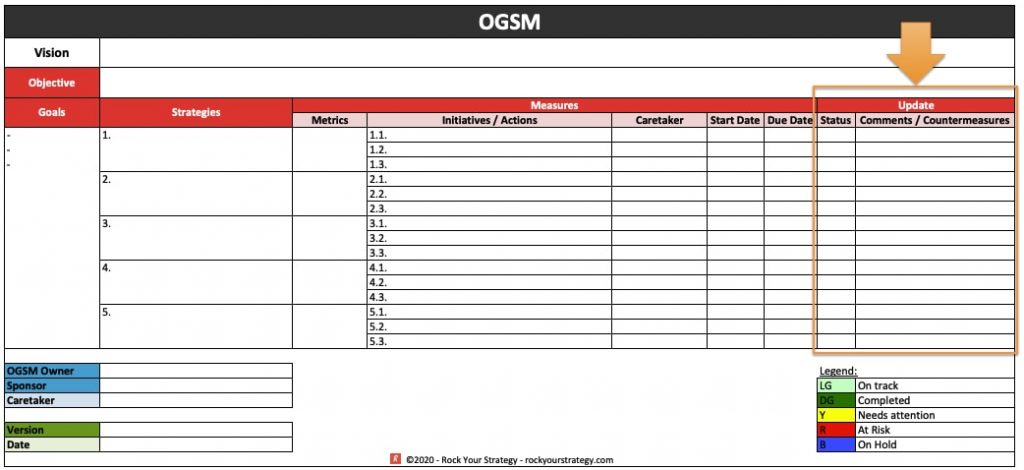
    Speaking of preparation, in my experience it really helps to have an OGSM caretaker who keeps the document current and helps prepare for the reviews. This caretaker updates the financials and key figures ahead of the review meeting and reminds strategy and initiative owners to provide their updates directly on the OGSM document (see image below). 

    OGSM Update
    OGSM Template with Update Section

    Go into the meeting with an updated and current OGSM document.

    An important word about status colors

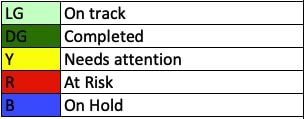
    On the OGSM document, record the status of each initiative and a brief update comment incl. proposed countermeasures (as necessary). For status, I typically use the following color-coded setting which has served me well: 

    Status Colors
    Status Update Colors
    ColorStatusDescription
    Light Green (LG)On TrackItem is in progress and on track to achieving it’s targets.
    Dark Green (DG)CompletedItem is done and targets are met.
    Yellow (Y)Needs AttentionItem needs attention by the organization or its senior team in order to stay on track and not fall behind.
    Red (R)At RiskItem is at risk of missing its targets and needs urgent attention and action. 
    Blue (B)On HoldItem has been placed on hold, postponed or deprioritized. 

    Regarding the color-coding, I always emphasize that these status settings are meant to be forward-looking and action-oriented and not punitive. A red color is not bad by itself. It does not mean that someone is getting fired. Encourage your team to use ‘yellow’ and ‘red’ statuses to signal that urgent action is needed. 

    We have become so accustomed that ‘yellow’ and ‘red’ on business reports are bad. What a bunch of baloney. Take active steps to take your team’s fear from using ‘yellow’ and ‘red’. Emphasize that these are signal colors to direct attention to where it is most needed. Nobody gains from beautifying or hiding the true status of an initiative just because we are trained to prefer to see ‘green’. 

    Good! Now that we got that straight, let’s dive into the OGSM review itself.

    Rundown of the OGSM review meeting

    A monthly review is not an in-depth strategy review but a monthly check-in to make sure your plan is on track. I have found a duration of 60 minutes most effective. One hour is long enough to review the performance indicators, identify key issues and decide on countermeasures. It is also short enough to make it a monthly staple without taking too much time out of operations. A concise 60-minute session keeps the group engaged and the OGSM on track. 

    During the monthly OGSM review, follow a structured agenda that guides the team through the review process. 

    Start with a review of the financials and key performance indicators. Identify where you are on track and where you are lagging behind expectations. Discuss in the team what the drivers of performance are and identify the reasons for missing the mark. 

    Then review the individual Measures starting with those which are behind expectations. Follow the colors. Begin with the ‘red’ initiatives, followed by ‘yellow’. 

    Initiatives marked ‘red’ are at risk and need urgent attention and action. Identify why you are behind. Discuss in the team effective countermeasures that you can take to adjust the course and get back on track. Agree on the actions to be taken by whom and by when and record the actions on an action item list. Then move on to the next item. 

    Let me pause here for a moment. That was brief but important! The whole purpose of doing the OGSM review is to identify where you are behind, why you are behind and to correct the course. So be candid and thorough here. The purpose is not to assign blame or search for fault. You are looking to identify where improvement is needed and then go do it. 

    Reasons why a measure is behind might be numerous: the external environment has changed, customer needs have changed, competitors are more effective, the action is not well-resourced, the team does not have the knowledge or skills needed to succeed, other unforeseen hurdles or challenges are preventing the team from making progress. 

    As with the color-coding above, when you are in session, create an atmosphere that invites the team to be candid and direct. You want everyone to be as straight as an arrow. 

    After all ‘red’ and ‘yellow’ items are discussed, review the ‘green’ initiatives which are on track. Check whether any major milestones are coming up or decisions are needed. Only discuss those ‘green’ initiatives worth discussing. 

    With 10 minutes left in the meeting, wrap up the initiative review and confirm all the countermeasures and actions agreed on in the meeting. Double-check that each action has a caretaker, a timeline, and that everyone is clear about the expected deliverables. Take note of all actions on the action item list. 

    At the 60-minute mark, thank everyone for their contributions and their constructive review before closing the meeting. 

    Follow up

    After the OGSM review session has ended, send a short note to all participants and OGSM stakeholders. Confirm the OGSM as it was discussed and share the action item list for everyone’s information and action. Now the focus shifts back to operations, executing your OGSM and implementing the agreed corrective actions. 

    Until the next monthly review. 

    What does the agenda of a monthly review meeting look like?

    For easy reference, this is what the agenda of a monthly OGSM review meeting might look like. Feel free to copy this out and into the invitation of your monthly OGSM review meeting. 

    TimeTopicCaretaker
    10 minReview Financials & key Performance IndicatorsBusiness Leader or OGSM Caretaker/facilitator
    10 min Review actions from previous OGSM reviewOGSM caretaker/facilitator
    20 minReview initiatives ‘at risk’ and ‘need attention’ and discuss countermeasuresInitiative owner
    10 minReview ‘on track’ initiativesInitiative owner
    10 minConfirm actions from this OGSM reviewBusiness Leader or OGSM Caretaker/facilitator
    Meeting adjourned
    Sample Agenda of a Monthly OGSM Review Meeting

    When to schedule a monthly review? 

    There is no hard or fast rule when to schedule a monthly review. I have found it most useful to schedule the meeting in the second week of the month. By the second week, you may have had a chance to review the financials from the previous month and update the OGSM document. 

    Getting the OGSM review done in the second week of the month then leaves the rest of the month to focus on operations and drive execution. 

    Consider picking a fixed day for your regular reviews, for example every second Tuesday of the month. Then your team can build a regular rhythm about the review and there is no surprise when it comes around. 

    Schedule out all 12 monthly sessions at the beginning of the year. Most calendar software such as Microsoft Outlook or Google Calendar allow you to set recurring invitations identifying the chosen day of the month. That makes scheduling the meetings easy and straightforward. Include the agenda in the invitation so everyone knows what to expect ahead of time. 

    What is the difference between a monthly and a quarterly OGSM review? 

    I like to make a clear distinction between frequent monthly OGSM reviews and more thorough quarterly OGSM reviews. 

    As described above, the purpose of the monthly OGSM review is to track the execution of the measures and to agree on corrective actions for those initiatives which are ‘at risk’ or ‘need attention’. The discussion is brief, candid and solution-oriented. The monthly OGSM review only takes about 60 minutes. 

    The purpose of the quarterly OGSM review is a more in-depth review of the OGSM to confirm whether the business is on track to achieving its overall objective and goals. 

    For the quarterly OGSM review, I schedule a 2-3 hour session (based on progress) which reviews each initiative and strategy. Each initiative owner provides an update on progress, milestones, challenges, and next steps. 

    The review includes an assessment of each strategy to confirm that the path chosen is still the right one to move the business towards its overall objectives. 

    If required, countermeasures are discussed and agreed on. As during the monthly review, all actions are recorded with caretakers and timelines. 

    How to create an OGSM for your business? 

    We have now been speaking about implementing your OGSM and keeping on track with your execution via monthly review meetings. But how do you actually create an OGSM in the first place? 

    Check out Rock Your Strategy’s resources about OGSM and how to create effective strategic plans that deliver results. You can read a general introduction about OGSM here. The article includes links to deep dives into each element of the OGSM: objectives, goals, strategies, and measures. 

    Conclusion

    The purpose of the monthly OGSM review is to ensure that the implementation of your plan is on track. The review starts with preparation already before the actual meeting. 

    Prepare all key figures and status updates prior to the OGSM review meeting to facilitate an effective session. 

    During the meeting, address those initiatives first that are “at risk” or “need attention”. Identify root causes and agree on countermeasures. 

    Record all action items, caretakers, and due dates and ensure diligent follow up after the meeting. 

    What experiences have you made with your OGSM review? If you liked this article or have any questions or comments, why not leave us a reply below? We’d love to hear from you. 

  • Why Good Strategies Fail And How To Avoid That Yours Does Too

    Why Good Strategies Fail And How To Avoid That Yours Does Too

    Shockingly, 1 out of 3 business strategies fails and only about 50% of strategic initiatives are considered successful. This is a massive waste of resources and could sink a business. So why do so many strategies fail and what can you do to avoid the same fate?

    According to studies by Forbes Insights and EIU, business strategies fail because of lack of leadership attention, changes in the external environment, lack of the right capabilities and resources, lack of understanding, and a lack of tracking and accountability. In other words, the main reasons why strategies fail are lack of leadership and execution.

    Many of the reasons why strategies fail are preventable. In this article, I will describe six key principles and four success factors that lead to strategy success. But first let’s understand better why good strategies fail. 

    How good strategies fail

    Allow me to take you on a journey. Imagine you were in a strategy meeting. You discussed the future direction of the business. You analyzed the external market environment and identified opportunities for growth. You debated internal strengths and weaknesses and defined core capabilities. With a match between core strengths and market opportunities, you decided on ambitious objectives and goals and laid out an exciting strategic plan. 

    There was great euphoria in the room about what it would feel like to reach your vision and deliver such ambitious results. You felt good about yourself and about your chances of success. And then the meeting ended and everyone went back to work. One month, two months, three months passed and nothing had changed. Instead reality happened and the exciting plan was still that – just a plan. But no worries, you thought, the meeting organizer was surely still working on the follow up actions and soon something would happen. But nothing did happen. 

    Nine months later, the great unveiling. The strategy was communicated with a massive Powerpoint deck. Senior leadership was excited and explained with great fanfare how this strategy would change everything. Now things would be clear and better times were ahead. However, what was described seemed old, outdated and in some parts different from was discussed previously. You feel like you were teleported back to a time 9 months ago, when market realities were different. 

    Meanwhile, the world had turned about 270 times. The strategy meeting was long ago. The euphoria was a distant memory. Competitors had already made their move and put pressure on prices. You had meanwhile slugged out the day-to-day and moved on. You wondered what had happened and if the objectives and goals which once seemed so exciting were now still attainable…

    If this sounds familiar, you are not alone. This story is not hypothetical. It has actually happened to me and it felt deflating and demotivating. All the work we had done a year prior in analyzing the market and understanding our own competitive position was basically outdated – and in retrospect a waste of time. And the worst part – I later learned – the delay of 9 months was due to our own internal processes and entirely avoidable. Had we moved faster to implement our strategy, we would have been 1 year ahead and 1 year closer to reaching our objective. Instead we were spinning the hamster wheel, running in place. But what had happened? 

    Instead of moving straight into execution after the strategy workshop, when information was up-to-date and motivation was highest, a long process of documentation and alignment ensued. This is what happened:

    After the strategy workshop had ended, the facilitators began typing down the flip charts. Some action items on the flip charts were not clearly legible and had to be clarified. Unfortunately, the person who wrote the notes was on vacation and couldn’t be reached for two weeks. The business leader was meanwhile traveling and insisted on reviewing the strategy documentation. By now a month had passed.

    Before anything was shared the business leader wanted to present the workshop findings in an upcoming leadership meeting to get the leadership’s blessing before giving the green light.

    At the leadership meeting however, doubt was uttered whether the strategic goals were realistic. It was also revealed that the business division was slated for a larger strategic review with corporate. Since the larger review would take place over the next six months, it was decided to hold the strategic implementation until the divisional strategy was reviewed. Eight months later, during the great unveiling, the original strategy seemed no longer relevant. The implementation that ensued was haphazard and largely ineffective.

    Reasons for failure

    Unfortunately, the story above is not a seldom occurrence in large corporations. Also small businesses are not immune from strategy failure. In the story, there were a number of things that went wrong: 

    • Slow follow-up: it took way too long to move from plan to action. So long in fact that momentum fizzled and the original strategy was no longer implemented.
    • Lack of leadership support: the business leader sought buy-in from the next level leadership team only after the strategy meeting. Support was not immediately received and leadership alignment took another 8 months.
    • Changes in the market: While the company was conducting another strategic review, competitors had already moved-in and occupied the position the company had sought to obtain.
    • Strategy itself was flawed: when the strategy was finally rolled out as part of the division’s strategic plan, the strategy was altered and no longer timely. The original strategic intent had changed.
    • The team no longer believed in the strategy: the strategy which was finally presented barely resembled the strategy which the team had originally prepared. Even though it was a great idea to initially involve the team in strategy development, the team later felt it was no longer their strategy. The team was disengaged and not motivated to drive implementation.

    Studies confirm why good strategies fail

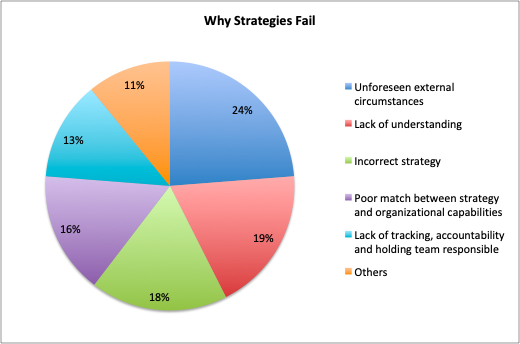
    A survey1 of 163 CEOs, senior strategists and communications professionals conducted by Forbes Insights and FD in conjunction with the Association for Strategic Planning and the Council of Public Relations Firms in 2009 revealed that about one-third of strategies fail. And the reasons for failure are mainly five-fold:  

    Source: Forbes Insights
    • Unforeseen external circumstances (24%) refer to changes in the external environment or economic downturns
    • Lack of understanding (19%) among the team involved in developing the strategy and about what they need to do to make it successful
    • Incorrect strategy (18%) means the strategy itself is flawed
    • Poor match between the strategy and the core competencies of the organization (16%), i.e. the business does not have the capabilities needed to succeed
    • Lack of tracking, accountability and holding the team responsible (13%)
    • Others (11%)

    A report2 by The Economist Intelligence Unit published in 2013 largely confirmed these findings and added an important further insight: the role of leadership. On behalf of the Project Management Institute, EIU surveyed 587 senior executives globally and further conducted in-depth interviews with the following findings: 

    • Importance of strategy implementation recognized, but efforts often fall short
      • 88% of respondents said executing strategic initiatives successfully will be essential or very important for their organization’s competitiveness
      • 61% acknowledge that their firms struggle to turn strategy formulation into day-to-day implementation
      • Only 56% of strategic initiatives considered successful in previous 3 years
      • Companies whose business model is poorly aligned with strategy report weaker financial results than their peers.
    • Leadership often missing in action
      • Leadership buy-in and support considered number one reason for success of strategic initiatives
      • Only 50% of respondents said strategy implementation received appropriate senior leadership attention
      • 28% admit that individual strategy implementation projects do not obtain necessary senior leadership support
    • Majority of companies lack the skills or failed to deploy necessary personnel 
      • Only 41% of respondents said their companies provide sufficiently skilled personnel
      • Only 18% said hiring of people with necessary skills or leadership talent to implement strategy was a very high priority at their firms
      • Only 11% said developing those skills among existing team was a priority
      • Companies that hired and developed the needed skills succeeded in 62% of strategic initiatives.

    So when summarizing the two studies and reflecting on my own 15-year business experience, the primary reasons why good strategies fail are a lack of leadership and a lack of execution. 

    Business leaders have to lead from the front and spearhead both the strategy formulation and the strategy implementation. It is not sufficient to sponsor strategies when they are developed and communicated and then not drive the organizational change required for implementation.

    When strategies fail, senior management is responsible. In small businesses that’s the owner or the managing direction and the most senior team. In larger corporations that the C-suite all the way to divisional heads and to team supervisors. 

    Business leaders are responsible for making realistic assessments of organizational capabilities and to either build or hire the skills and knowledge needed to succeed. Business leaders are also responsible for making available the resources needed to succeed. This may be human resources or funds for capital investments.

    Senior leadership support is the single most important factor in successful strategy execution. But that alone is not sufficient. In the following, I’ll detail six principles needed to avoid strategies from failing. 

    How to avoid strategies from failing

    Apply the following six principles during your strategic planning and implementation to avoid your strategy from failing. This is how you become part of the two-thirds who succeed. 

    • 1. Structured process
      • Whether you are in a large company or a small business, a disciplined strategic planning process is critical to success
      • Be deliberate about strategy development and implementation
      • As the leader, make sure the business has the time and the space to conduct a proper strategic review
      • Follow a strategic process such as our 6-step process to create business strategies that deliver results. 
    • 2. Engagement
      • If you have a team, involve your employees in the strategic planning and the implementation process
      • Involving your team not only sends a clear message of appreciation, but also helps with anticipating potential obstacles and preparing accordingly
      • Your team knows the day-to-day challenges and help with a realistic assessment of opportunities and capabilities.
      • Involvement creates buy-in and buy-in creates engagement. Engaged teams create better results.
    • 3. Buy-In & Alignment
      • Seek three kinds of alignment: vertically, horizontally, and the strategy itself.
      • First, when developing your strategy, make sure your objectives, goals, strategies, and measures are congruent with each other. Check whether strategies and measures are sufficient to achieve the objective and goals. 
      • Second, seek systematic buy-in and alignment of objectives and strategies across functions of your organization. Make sure each function is involved and understands what it takes to be successful. Make sure each function has the resources and capabilities to support the strategy. Only if the entire organization is aligned, can you successfully execute and achieve the desired results.
      • Third, systematically break down objective and goals and cascade them throughout the organization. Ensure that every level in the organization is aligned, empowered and pulls in the same direction. 
    • 4. Communication
      • Clarity about objective, goals and strategic priorities is of utmost importance. You cannot execute a strategy you do not understand. 
      • Build communication as an integral part into strategy formulation and execution. 
      • When it comes to strategy, you cannot over-communicate. Consistently explain how initiatives and actions fit with the overall strategy and how they help to achieve the objective and goals. 
      • Communication is an important responsibility of the business leader. But also team leaders and communication professionals need to consistently beat the drum.
    • 5. Accountability
      • While the business leader is ultimately accountable for success or failure of the strategy, the strategic plan must be the common objective for the entire business
      • Set clear expectations for each function and team and clarify how each contributes to moving the business in the right direction and delivering results. 
      • Hold people responsible for implementing strategic initiatives and delivering expected results
      • Be a cheerleader for your team and allow no excuses 
    • 6. Execution
      • Implementation must be considered a strategic initiative, not an operational task
      • Install a clear cadence when reviews take place and what actions have to be completed by whom and by when
      • Ensure that key initiatives are prioritized and resourced appropriately with the needed manpower and skills

    What are success factors for business strategies? 

    In their excellent book “Execution: The Discipline Of Getting Things Done”, Larry Bossidy and Ram Charan describe what it takes to be successful in leading a business and implementing strategy. And – spoiler alert – it is execution!

    In order to understand execution, Bossidy and Charan recommend to keep three things in mind: 

    • Execution is a discipline and integral to strategy
      • When planning the strategy, the organization’s ability to execute it must already be taken into account
      • During execution, constantly and systematically expose internal and external realities and act on them. 
    • Execution is the major job of the business leader
      • The leader must be immersed in the company and in charge of execution
      • Leaders run 3 core processes: picking other leaders, setting the strategic direction, and conducting operations
      • Leaders must be intimately and intensely involved with their people and operations. They know the realities and talk about them. They know the details and are excited about what they’re doing. They are passionate about getting results. 
    • Execution must be a core element of the organization’s culture. 
      • Dialogue is the core of culture and the basic unit of work. How people talk to each other determines how well the organization functions
      • Leaders who execute set the tone for the rest of the organization – they lead by example
      • Leaders who execute assemble an architecture of execution including processes for execution and promoting people who get things done
      • Leaders who execute look for gaps between desired and actual outcomes and work to close the gap and raise the bar higher still. 

    All this is a tall order but by executing and getting things done, strategies get implemented and results are achieved. 

    As such, I see these three elements as key success factors for implementing strategy and delivering results and would add a fourth.

    Here are my four key success factors: 

    1. 1. Make execution integral to your strategy 
    2. 2. Make execution part of your business culture 
    3. 3. As the business leader drive execution on a daily basis 
    4. 4. Make realistic assessments about capabilities and devote the right type and amount of resources to strategy implementation.

    How do I drive strategy execution without micromanaging?

    When leaders are deeply involved in strategy execution what do they actually do? And how do they keep from micromanaging and getting caught up in daily firefighting? 

    Focus your leadership attention on the right initiatives. Areas in which senior leaders have the most impact are general oversight and management of execution, communication and support for strategic initiatives, and providing concerted focus for key activities.

    Speak with your team, ask tough questions and expect candid answers. Do this not only while chairing business reviews and regular implementation review meetings but also in between. Go see your team, be available to them, know what’s going on. Help the team reflect where most of the attention is needed. Support action and swift decision-making, remove obstacles and help the team succeed.

    Focus on your team members. Make sure that the right type and amount of resources are available to successfully implement the key initiatives. Reward the doers and achievers. Coach the ones who fall behind.

    Driving strategy execution is the full-time job of the business leader. Do not delegate this responsibility. As the business leader, it’s your job to show up and lead from the front. 

    Conclusion

    Many reasons why strategies fail are preventable. Most commonly strategies fail due to a lack of leadership and lack of execution. 

    Businesses can avoid this fate by following six key principles and paying attention to four success factors. 

    What is your experience with good strategies that fail? If you have any questions or comments, why not leave us a reply below? We’d love to hear from you.

    References

    1) “The Powerful Convergence Of Strategy, Leadership, and Communications: Getting It Right” by Forbes Insights and FD, 2009. https://www.forbes.com/forbesinsights/FDStrategy/index.html

    2) “Why Good Strategies Fail – Lessons for the C-Suite” by The Economist Intelligence Unit, 2013. https://www.pmi.org/-/media/pmi/documents/public/pdf/learning/thought-leadership/why-good-strategies-fail-report.pdf

    3) Bossidy, L., Charan, R. (2002). Execution: The Discipline Of Getting Things Done. New York: Crown Business.

  • What Is OGSM?

    What Is OGSM?

    Have you ever come across the acronym OGSM and wondered what it meant? Here’s what it stands for.

    OGSM stands for Objectives, Goals, Strategies, and Measures. It is a one-page strategic business plan that outlines WHAT you want to achieve and HOW you are going to achieve it.

    The OGSM methodology has been popularized by its deployment at corporate staples such as P&G or Coca-Cola. And you can adopt it for your business too!

    → Want the complete OGSM reference? The Complete OGSM Framework Guide covers all four components in depth, real-world examples by industry, a comparison to OKRs and the Balanced Scorecard, and step-by-step build instructions.

    OGSM: the one-page business strategy

    The OGSM approach is great, because it simplifies a potentially complex concept into a simple framework that cuts through the clutter and shows clearly the choices that form your strategic direction.

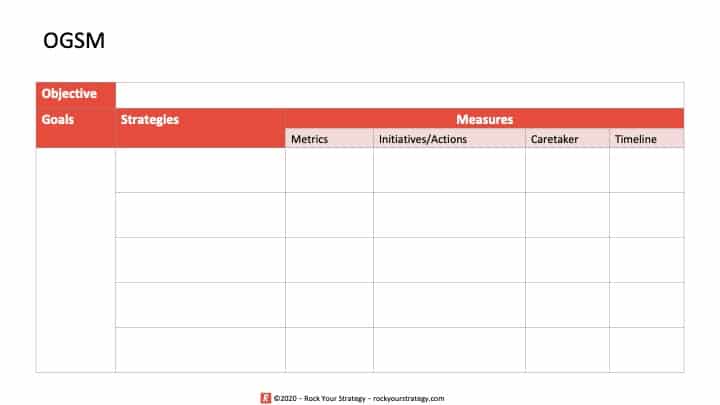
    The OGSM framework may look something like this:

    OGSM Template

    The OGSM may be the deliverable of a strategic process that discusses through the objectives, goals, strategies, and measures. Or it may very well facilitate that process. I have done both and I really like the OGSM’s ability to facilitate the process, force choices and capture the output.

    Because of its simplicity and its complete overview, the OGSM is also a great tool to communicate the strategy to employees, the wider organization and other stakeholders.

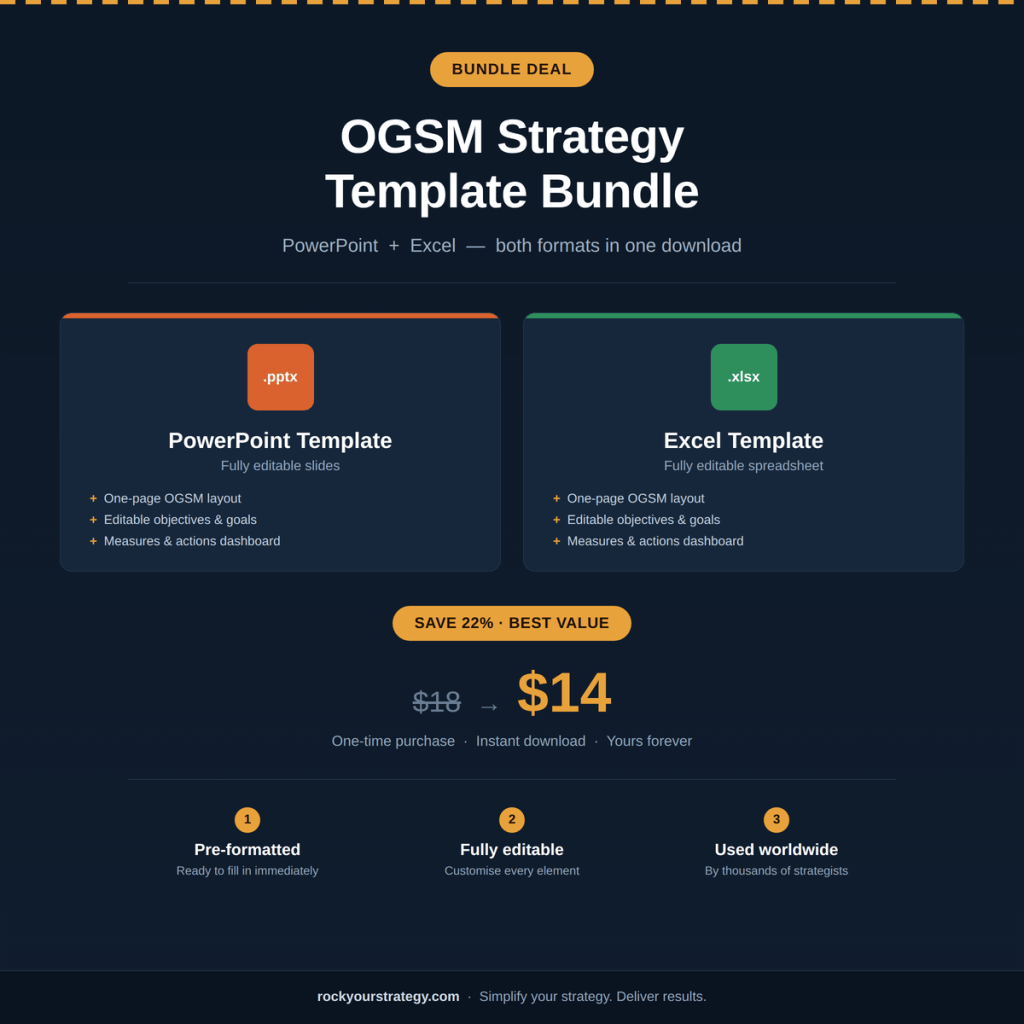
    Download a pre-formatted, fully customizable OGSM template for Microsoft PowerPoint or Microsoft Excel here.

    Let’s go through each component in turn.

    O stands for Objectives

    The objective is a qualitative statement about your ambition. It describes the future state of your organization. It is the destination of your journey.

    The objective should be quite specific and spell out in no unmistakable terms what you are aiming to achieve over a chosen time horizon. For annual business plans this may be 1 year or for longer term strategies typically 3-5 years.

    Examples might include “Become the recognized category leader in up-market shoe cream” or “Double our market share in coal-powered mobile phones” (even though I am not sure that’s a sustainable segment to target… But more about targeting later).

    Note that this is not a vision or mission statement or an open-ended dream. It may be however a priority or major milestone in the pursuit of your vision. In fact, for annual business plans, I personally like to think of the objective as being a focus area for the year as I aim to realize my vision.

    Regardless of the time horizon, clarity about the objective is absolutely critical as it guides the rest of the OGSM. It is important that all stakeholders understand and agree with the objective.

    As the saying goes…

    “If you don’t know where you are going, any road will take you there.”

    INSPIRED BY LEWIS CARROLL’S ‘ALICE IN WONDERLAND’

    Click here to learn more about how to write a great objective statement for your strategic plan.

    G stands for Goals

    The goals are the quantitative description of your objective. Goals should translate your qualitative objective statement into measurable figures. These are the numbers that represent the future state and help you to measure whether you are successful.

    The objective and goals together describe WHAT you are aiming to achieve.

    Examples of goals are concrete revenue, growth or profitability targets. Other examples may include cost savings, market share or service level targets. In more operational plans this could simply be the number of new customers acquired or a process cycle time.

    The key point is that your goals need to align with the purpose and the timeframe of your objective. If your objective is to achieve break-neck revenue growth, choose goals such as sales turnover, market share, leads or opportunity pipeline. If your objective is to improve productivity, choose return on capital, operating expense ratio or inventory turns for example.

    In order to be meaningful, I like to choose no more than 3-5 goals. These should be the key indicators whether you meet your objective. They do not need to represent every KPI you have on your operating dashboard. Measure what matters. No more, no less.

    Click here to learn more about how to set clear goals for your strategic plan.

    S stands for Strategies

    The strategies are the key initiatives you undertake to realize your objective and achieve your goals. Strategies are the qualitative description of your roadmap to success. These are the choices you make to win.

    Or said differently, if there are “1000 ways to Rome”, then the strategies describe the way you choose to take.

    When it comes to strategies, the word choice is critical. Your time is limited, your resources are finite. You cannot do everything. Besides, the OGSM is a one-page plan. So choosing the most effective, most probable strategies that allow you to succeed is important.

    From my experience, focusing on 3-5 strategies is best. This allows sufficient focus without putting all your eggs in one basket.

    Click here to learn more about how to develop strategies that work.

    M stands for Measures

    The measures describe the concrete action plan and metrics for each strategy. Measures quantify the strategies and clarify who does what by when.

    In fact, I have sometimes heard people spell out OGSM as Objectives, Goals, Strategies and Metrics.

    In their excellent and practical book “The 1 Page Business Strategy”, van Eck & Leenhouts actually split measures into a dashboard and an action plan. This is a very helpful way to ensure that each strategy is executed by implementing the concrete action plan and monitoring the dashboard for progress with chosen key performance indicators.

    I highly recommend the book and following this practice.

    Click here to learn more about how to set effective measures to implement your strategy.

    How to create an OGSM for your business

    When using the OGSM to draft a strategic plan or annual operating plan for your business, follow the O-G-S-M sequence to build up your plan.

    Begin with a strong objective statement that clearly describes the future direction of the business. Then translate the qualitative objective into 3-5 relevant quantitative goals. The objective and goals together describe WHAT you are aiming to achieve.

    Subsequently, make choices about 3-5 strategies that determine how resources are deployed to achieve the objectives and goals. Check that the strategies sufficiently address all goals and are congruent with the objective.

    Finally, for each strategy, create relevant measures that allow you to quantify each strategy and drive implementation. Translate each strategy into 2-3 metrics that define success and draft 2-3 initiatives that help you turn strategy into action. For each initiative, define caretaker and timeline.

    Capture the complete OGSM on a one-page business plan to clearly visualise the business’ priorities and how objectives will be achieved. Read more about creating an OGSM for your business here.

    Ultimately a plan is only as good as its execution. In order to achieve your objective and goals, regularly review progress of executing your OGSM on a quarterly basis. In order to do this well, read about the 11 secrets of successful strategy execution here.

    OGSM Examples

    We discussed that OGSM stands for Objectives, Goals, Strategies and Measures. While the objectives and goals describe WHAT you aim to achieve. The strategies and measures describe HOW you will get there. But what does an OGSM actually look like? Here are a few examples.

    Tonys Italian OGSM
    Tony’s Italian OGSM Example
    Florian's OGSM
    Florian’s OGSM Example

    The OGSM translates the strategic objective of a business, organization or project into practical day-to-day steps. By focusing on your daily action plan you ensure progress towards your longer term goals.

    Want to see how OGSM applies across different industries and business types? We’ve built detailed, worked examples for four business contexts that reflect today’s most common strategic planning challenges:

    • OGSM Example: B2B SaaS — a pipeline analytics company building a strategy from $2M to $8M ARR, covering PLG onboarding, enterprise CS, upmarket expansion, and benchmark content
    • OGSM Example: AI Startup — a Series A document intelligence company transitioning from research-led to revenue-driven with a repeatable sales motion in the legal sector
    • OGSM Example: E-commerce / DTC Brand — a sustainable home goods company building profitable growth by reducing paid acquisition dependence and growing owned audience channels
    • OGSM Example: Non-Profit — an education foundation aligning programme reach, funding diversification, and impact measurement into one three-year strategy
    • OGSM Example: Tony’s Pizza — the classic case study that walks through all four OGSM components in a simple, accessible context

    OGSM Templates

    If you have seen enough and want to get started on your own OGSM, see below for free, downloadable OGSM templates or visit our shop to download pre-formatted, fully customizable templates.

    OGSM Template
    OGSM Template
    OGSM Template
    OGSM Template

    By the way, the OGSM is not only for large corporations. Its simplicity makes it well suited also for small businesses, entrepreneurs and even non-work projects. Should small businesses even do strategic planning? Click on the link to find out.


    Bonus Tip: Cascading The OGSM

    If you are part of a larger organization with different business units, product lines or functional organizations, you will appreciate that the OGSM can easily be cascaded into departments or teams.

    The set-up of qualitative objectives with quantitative goals and qualitative strategies with quantitative measures helps to translate a corporate strategy into a division’s objective or a product line strategy into a functional department objective.

    The higher level organization’s strategy becomes the lower level organization’s objective. The higher level organization’s measures become the lower level organization’s goals and so on.

    A well-cascaded OGSM thereby ensures that each team’s (or even each individual’s) activities are well aligned with the overall organization’s objectives and goals.


    If you’d like to learn more about OGSM, check out our Dos and Don’ts of OGSM or the 7 Deadly Sins of Business Strategy. More practical tools and templates, workshop guides and book recommendations can be found in our jam-packed resource section. Rock on!

    Get started and download your pre-formatted, fully customizable OGSM template here.

    References

    Van Eck, Marc & Leenhouts, Ellen (2014). The 1 Page Business Strategy – Streamline Your Business Plan In 4 Simple Steps. Pearson Benelux.

  • What is Strategy?

    What is Strategy?

    Before jumping into the OGSM methodology, allow me first a note on strategy and delivering results since that is what OGSM helps you accomplish.

    Strategy describes the choices you make to achieve an objective. It is the approach you take to reach your destination. Strategy is about where to play and how to win. It is a roadmap to success.

    Strategy is often perceived as a difficult topic – a high-flying, powerpoint-tossing exercise, rich in important sounding words and often disconnected from substance and reality. It’s perceived to be a game for senior executives and smart consultants and often causes more frustration than clarity and purpose. I know because I’ve been there. In the following I’ll share my experience and best practices.

    Strategy is a roadmap to success

    Everyone knows strategy is important. A good strategy is critical for success. It connects an enterprise’s purpose with its activities. It is a roadmap for action and guides decision making. It creates alignment in the organization and engagement in the team.

    “Begin with the end in mind.”

    Stephen Covey

    Creating a strategy seems like a difficult, resource-intensive process that takes time. And indeed in large corporations that often is the case. But it doesn’t have to be. In fact, it shouldn’t be. A good strategy could be developed on the back of a napkin (Okay, bringing a napkin into the meeting with your board of directors or any stakeholder may not look convincing. But we’ll speak about communicating a strategy later). Or at an offsite retreat. Or with the team in a conference room. And it should fit on a single page. Because strategy is actually quite simple.

    Strategy is nothing else than the choices you make to achieve an objective. It’s the approach you take to win. It’s a roadmap to success.

    Most importantly though, strategy is about making choices. More specifically it is about the choices where to play and how to win.

    For example, a strategy may describe what products to sell and which markets to target to grow your business 20% this year. Or a strategy could outline which customers to approach and what promotional offer to use to close that next sale. Or, quite simply, strategy may be the way you get to work today, choosing the mode of transport and which route you take.

    Strategies are roadmaps that can be created at a corporate level, at a business unit or product/category level or at a tactical point-of-sale level. The point is that strategy is a means to an end, but never the end itself. The strategy is not the goal.

    Too often in my business life I have heard: “our strategy is to make the numbers!” Yes, making the numbers is key. Business is ultimately about delivering results. But that is the goal, not the strategy. “Making the numbers” does not say WHERE to play or HOW to win. Strategy will say HOW to make the numbers.

    Driving strategy implementation

    So a strategy is a plan to achieve something. But it is more than a plan. Strategy is a set of choices that determines if and how you are going to be successful. And success is measured by results. And if you want to deliver excellent results, a plan is still not enough. You need a system for implementation. You need an approach that ensures that action is taken and followed up on. And that’s often the crux.

    “A strategy is only as good as its execution”.

    My former mentor and friend

    Let me take you on a quick journey. How often have you seen a strong strategic plan crafted with great diligence? Many hours of careful market analysis and data crunching go into its preparation. Well-formatted powerpoint slides are created. A raving presentation is given to an excited leadership team. Words of commitment are spoken and a spirited decision is made in pursuit of the identified opportunity and its promising results.

    Only… after its presentation, the powerpoint is filed and everyone goes back to their daily work. You know, that day-to-day grind that keeps us all busy: emails, customer complaints, delayed shipments, and other small catastrophes. And nothing happens. Sounds familiar? Yes, I know. I’ve been there too. That’s why strategies fail.

    A good strategy rallies the team: gain commitment, assign accountabilities, trigger action, drive change, ensure follow through. And that only happens when people know what is expected of them. That only happens when there is absolute clarity WHAT needs to get done and HOW it is accomplished. That only happens when there is a clear action plan, clear caretakers, clear deliverables, clear timelines. Enter the OGSM.

    My aim is to make the topic of strategy approachable and winnable. I want you to be widely successful at creating strategies and executing them to perfection. Whether you are a leader at a Fortune 500, an aspiring entrepreneur, a hopeful young professional or a stay-home-mom with a side hustle, I want to help you win. 

    Because a good strategy is ultimately measured by its results: achieving 20% business growth, closing that next sale, or safely getting to work on time. Because only a good strategy that is well executed will lead to the desired results.

    Having said all that, in the following, I will focus on the OGSM methodology to simplify strategy and deliver results. There are of course many other tools and approaches. After all, many books and articles have been written on the subject. However, in my personal experience I have found that the OGSM approach is the most compelling in leading through a strategy process, making choices and coming up with a one-page deliverable that is easy to understand, easy to communicate and easy to execute.

    Focusing on only one approach may of course have disadvantages. Not everyone may find the OGSM methodology equally appealing. Not everyone may deem it the best fit for them. And that’s ok! If you gave it a try though, I am sure you may find that it is quite applicable to almost any circumstance, any business, any endeavor. It is true that it is not all encompassing. It is not a silver bullet. And it’s usage by itself will not guarantee success. After all, it’s merely a tool. In the end what you do with it still matters the most.

    So let’s get to work! 

    Where can you go from here? Consider checking out our post on 6 steps to develop strategies that delivers results or learn more about OGSM here. Finally, leave a comment below. Would love to hear from you!

    Not sure how to get started? Read this article about using an OGSM template to guide through the strategic planning process.

    References

    Covey, Stephen R. (2012). 7 Habits Of Highly Effective People. New York: Simon & Schuster


    Ready to put your strategy into action? The OGSM methodology gives you a simple, proven one-page framework to make it happen. Download a pre-formatted, fully customizable OGSM Template for PowerPoint or OGSM Template for Excel from the Rock Your Strategy shop — and turn your strategy into results.