Category: OGSM

  • 7 OGSM Mistakes That Kill Your Strategy (And Exactly How to Fix Them)

    7 OGSM Mistakes That Kill Your Strategy (And Exactly How to Fix Them)

    The most common OGSM mistakes are writing strategies that are actually tactics, using vague measures that can’t be tracked, and treating the framework as a one-time exercise rather than a living document. These three errors alone account for the majority of OGSM failures I’ve seen across organisations of every size. Fix them — along with the four others in this list — and your OGSM will do what it’s supposed to: get everyone moving in the same direction with clarity and accountability.


    Mistake #1: Confusing Strategies with Tactics

    What it looks like: Your Strategies row reads like a project plan. “Launch new CRM system.” “Run Q3 sales training.” “Redesign the website.” These are activities, not strategies.

    Why it happens: Strategies are genuinely hard to write. Tactics feel concrete and action-oriented, so they sneak in. The team wants to feel like they’re already executing.

    The fix: A Strategy should answer how you intend to compete or win, not what you’re going to do next Tuesday. It describes a deliberate choice about where to focus resources. Ask: “Could a competitor do the opposite of this and still be a viable business?” If yes, you’ve got a real strategic choice.

    Before: “Launch new CRM system”
    After: “Build a retention-first sales model by deepening existing account relationships over new acquisition”


    Mistake #2: Measures That Can’t Be Measured

    What it looks like: Your Measures row includes entries like “Improved customer satisfaction,” “Better team engagement,” or “Stronger brand awareness.” These aren’t measures. They’re wishes.

    Why it happens: Teams often know what outcome they want but haven’t done the work to define how they’ll know when they’ve got it. Vague measures feel safer — they’re harder to fail against.

    The fix: Every Measure needs a number, a unit, and a deadline. If you can’t articulate the current baseline and the target you’re aiming for, you don’t have a measure yet. Replace vague outcomes with specific indicators: NPS score, revenue per account, churn rate, hiring lead time.

    Before: “Improved customer satisfaction”
    After: “NPS ≥ 45 by end of Q4 (baseline: 31)”


    Mistake #3: No Owner on Each Strategy

    What it looks like: The OGSM looks great on paper. Everyone nods in the all-hands presentation. Six months later, three strategies haven’t moved and nobody’s quite sure whose job it was to drive them.

    Why it happens: OGSM is typically built as a leadership team exercise, and accountability assignments feel awkward in that setting. Nobody wants to call out colleagues in front of the group.

    The fix: Every Strategy needs a named owner — one person, not a team or a department. That person isn’t necessarily doing all the work, but they are accountable for progress and for raising blockers. Build ownership into the OGSM document itself, not into a separate RACI somewhere that nobody reads. For a deeper walkthrough of how ownership fits into a well-built OGSM, see our complete OGSM guide.


    Mistake #4: OGSM Done Once, Never Reviewed

    What it looks like: The strategy gets built in January. It lives in a slide deck or a shared drive. By March, nobody’s looking at it. By June, teams are making decisions that directly contradict it — not maliciously, just because it’s become wallpaper.

    Why it happens: Building the OGSM is the visible, exciting part. Review cycles feel like admin. Without a structured cadence, they get deprioritised.

    The fix: Build your review rhythm into the OGSM itself. Quarterly reviews for the full document, monthly check-ins on Measures. The review meeting should answer three questions: Are our measures on track? Are our strategies still valid? Do we need to adjust anything? If the OGSM is right, reviews are short. If something’s off, you want to know now — not in December.


    Mistake #5: Too Many Strategies

    What it looks like: The Strategies section has nine, eleven, sometimes fourteen rows. Every function of the business managed to get its pet initiative onto the document.

    Why it happens: OGSM builds are often participatory exercises. Inclusion feels important. Leaders don’t want to be seen dismissing colleagues’ priorities, so everything makes the cut.

    The fix: A real strategy requires trade-offs. If everything is a priority, nothing is. Three to five Strategies is the right range for most organisations. If you have more than five, you don’t have a strategy — you have a wish list. Run a forced-ranking exercise and cut ruthlessly. The strategies that survive are the ones the business is genuinely willing to resource and protect.

    Before: Eleven strategy rows covering marketing, HR, operations, finance, and digital transformation
    After: Three strategies directly linked to the Objective, with clear owners and measurable outcomes


    Mistake #6: Objectives Written as Activities

    What it looks like: The Objective reads: “Develop a high-performing culture” or “Implement a digital transformation programme.” These describe things you’re going to do, not what you’re trying to become.

    Why it happens: Activities are easy to agree on. Outcomes require the leadership team to commit to something they might not achieve — which is uncomfortable.

    The fix: An Objective should describe a future state of the organisation — inspiring, directional, qualitative. It answers: “What kind of business are we trying to become?” Think of it as the headline on your strategy story. “Become the most trusted logistics partner in Southeast Asia” is an Objective. “Implement a digital transformation programme” is a project plan.


    Mistake #7: Cascade Failure — L2 OGSM Not Aligned to L1

    What it looks like: The corporate OGSM is built. Functional teams then build their own OGSMs — but they’re working from their own priorities, not from the strategic choices made at Level 1. By the time you get to Level 2 or Level 3, the OGSMs are pointing in different directions.

    Why it happens: Cascade is often treated as a communications exercise rather than a design exercise. The L1 OGSM gets shared, and then teams are told to “build theirs.” Without a structured handoff, each team builds what makes sense to them.

    The fix: Before any team builds an L2 OGSM, they need to understand which L1 Strategies they are responsible for supporting — and how. The L2 Objective should directly enable a specific L1 Strategy. The Measures at L2 should roll up into the Measures at L1. If a team’s OGSM could exist without the L1 OGSM mattering at all, it hasn’t been cascaded — it’s been parallel-planned. For a full breakdown of how to cascade correctly, read our article on OGSM cascade and alignment.


    The Pattern Behind Every OGSM Mistake

    Most OGSM problems share a common root: the framework was treated as a documentation exercise rather than a thinking exercise. The grid gets filled in, but the hard strategic conversations — what are we not doing, who is accountable, how will we actually know if it’s working — never happen.

    If your OGSM feels like it’s not pulling its weight, go back through this list and check which of these seven mistakes you’re carrying. Pick the one that’s doing the most damage and fix it this week. Don’t try to overhaul the whole document at once — that’s how OGSMs get abandoned.

    One broken row, fixed cleanly, does more for strategy execution than a perfect document that no one uses.

    Rock on.

  • How to Write SMART Goals for Your OGSM (With Examples)

    How to Write SMART Goals for Your OGSM (With Examples)

    Setting goals is easy. Setting goals that actually tell you whether your strategy is working is a different skill entirely.

    SMART goals for your OGSM are Specific, Measurable, Achievable, Relevant, and Time-bound targets that sit directly below your Objective and above your Strategies. A well-written OGSM Goal names exactly what you will achieve, by how much, and by when — leaving no room for ambiguity when it comes time to review.

    This article walks you through how to write them well, with examples from both corporate and small business contexts.

    What Makes a Goal “SMART” in an OGSM Context

    The SMART framework predates OGSM, but the two were made for each other. In an OGSM, Goals are the layer that translates your Objective from aspiration into accountability. They answer the question: how will we know if we’ve succeeded?

    Here’s what each element means in practice when you’re building an OGSM:

    Specific — The goal defines a particular outcome, not a direction. “Grow revenue” is not specific. “Grow recurring revenue from existing customers” is specific.

    Measurable — The goal includes a number you can track. Without a number, you cannot review it. “Improve customer satisfaction” is not measurable. “Achieve a Net Promoter Score of 45 or above” is measurable.

    Achievable — The goal stretches the team without breaking it. An unachievable goal stops being motivating somewhere around week three. A good test: have you achieved something in this range before, and what would need to change to do it again?

    Relevant — The goal connects directly to the Objective. If your Objective is to become the preferred provider in your region, a goal about global market share is probably off-track.

    Time-bound — The goal has a deadline. For OGSM purposes, this is usually the end of the year, but quarterly milestones help.

    The Structure of a Well-Written OGSM Goal

    A useful template for writing OGSM Goals:

    [Verb] [metric] from [current baseline] to [target] by [date].

    For example:

    • Increase annual recurring revenue from €1.2M to €1.8M by 31 December 2026.
    • Reduce customer churn rate from 8% to 5% by Q4 2026.
    • Grow organic website traffic from 4,000 to 10,000 monthly sessions by year-end.

    Each of these passes the SMART test: you can measure it, you know when you’re done, and there’s no ambiguity in the review meeting.

    How Many Goals Should an OGSM Have?

    Most OGSMs work best with three to five Goals. Fewer than three and you risk missing important dimensions of your strategy. More than five and attention gets diluted.

    Think of your Goals as covering the key dimensions of your Objective. A business with a growth Objective might have Goals covering revenue, customer acquisition, customer retention, and market position. A non-profit with a community-impact Objective might have Goals around beneficiaries reached, programme delivery, and fundraising.

    The rule: every Goal should be important enough that failing to hit it would make your Objective feel unachieved.

    OGSM Goal Examples by Context

    Corporate Strategy

    Objective: Become the market leader in sustainable packaging in Northern Europe by 2027.

    Goals:

    • Increase market share in sustainable packaging from 12% to 20% in Northern Europe by December 2026.
    • Grow revenue from sustainable product lines from €8M to €14M by December 2026.
    • Achieve a customer retention rate of 90% across key accounts by Q4 2026.
    • Launch two new certified sustainable products to market by June 2026.

    Small Business

    Objective: Build a profitable consulting practice focused on strategy for mid-sized businesses.

    Goals:

    • Generate €180,000 in consulting revenue by December 2026 (baseline: €95,000).
    • Secure eight recurring retainer clients by Q3 2026 (baseline: three).
    • Achieve a client referral rate of 50% of new business by year-end.
    • Publish 24 articles or resources that drive inbound leads by December 2026.

    Non-Profit

    Objective: Expand access to financial literacy education in underserved communities.

    Goals:

    • Reach 5,000 programme participants by December 2026 (baseline: 2,200).
    • Deliver programmes in at least six new partner schools by Q3 2026.
    • Raise €320,000 in restricted funding for programme delivery by year-end.

    Common Mistakes When Writing OGSM Goals

    Confusing Goals with Strategies. A Goal is an outcome. A Strategy is a choice about how to achieve it. “Launch a digital marketing campaign” is a Strategy, not a Goal. The Goal is the traffic or lead volume you expect that campaign to produce.

    Writing aspirations instead of targets. “Be the best in our market” is an aspiration. It tells you nothing in a review meeting. The Goal version is: “Achieve an NPS of 60+ among enterprise customers by December 2026.”

    Setting too many Goals. Seven or eight goals fragment focus. If everything is a priority, nothing is. Cut until you’re left with the goals that genuinely define success.

    Ignoring the baseline. A goal without a baseline is hard to contextualise. “Grow revenue by 30%” sounds ambitious or conservative depending on whether you’re starting at €200K or €2M. Always state where you’re starting from.

    Making Goals too safe. A Goal that you’re 100% certain you’ll hit isn’t motivating anyone. Aim for a target that requires some stretch — something you believe is achievable if your Strategies work.

    Connecting Goals to Measures

    In an OGSM, Goals sit alongside Measures — but they’re different things. Goals are your lagging indicators: the outcomes you’re measuring at the end of a period. Measures are your leading indicators: the early signals that tell you whether you’re on track to hit those Goals.

    If your Goal is to grow organic website traffic to 10,000 monthly sessions, your related Measures might include: number of new articles published per month, average keyword ranking position for target terms, and backlinks acquired. These Measures tell you mid-year whether you’re heading toward the Goal — without waiting until December to find out.

    Getting this distinction right is what makes your OGSM reviewable month to month, not just at year-end.

    A Template That Does the Heavy Lifting

    Writing SMART Goals gets easier when you’re working in a structure designed for it. The OGSM Template for PowerPoint and OGSM Template for Excel both include pre-built sections for Goals with space for baselines, targets, and RAG status — so your Goals are automatically set up for review. If you’re starting from scratch or want to tighten up an existing OGSM, they’re worth the hour it takes to populate them properly.

  • How to Run an OGSM Strategy Review Meeting That Actually Moves the Needle

    How to Run an OGSM Strategy Review Meeting That Actually Moves the Needle

    Most strategy review meetings end with a slide deck nobody looks at again and a vague promise to “do better next quarter.”

    An effective OGSM strategy review meeting follows a fixed agenda: review your measures first, diagnose why goals are on or off track, agree on one to three concrete actions, and assign ownership before anyone leaves the room. Done monthly or quarterly, a 60–90 minute meeting is enough to keep a team aligned and a strategy alive.

    The difference between a review that drives change and one that just takes up calendar space is structure. Here’s exactly how to run it.

    Why Most Strategy Reviews Fail

    Strategy reviews fail for predictable reasons. The meeting is too long, too unfocused, or too comfortable. Teams report on what happened without asking why it happened — and leave without agreeing on what to do differently.

    The OGSM framework actually makes this easier to fix. Because OGSM separates your Objective (direction), Goals (measurable targets), Strategies (choices), and Measures (leading indicators), you always have a clear agenda. You’re not reviewing a vague “progress update.” You’re reviewing specific numbers against specific targets and asking specific questions.

    Who Should Be in the Room

    Keep it small. A strategy review is not an all-hands or a status report. It’s a decision-making session.

    The right people are those who own a Goal or a Strategy on the OGSM — typically your leadership team or department heads. If you’re a small business owner, this might just be you and one or two key team members.

    A useful rule: if someone can’t directly act on what’s discussed, they probably don’t need to be there.

    The Agenda That Works

    Step 1: Open With the Objective (5 minutes)

    Start every meeting by reading the Objective out loud. Not as a ritual — as a reset. It refocuses the room on direction before anyone dives into numbers.

    Ask one question: “Are we still headed in the right direction?” If the answer is genuinely no, the agenda changes. Otherwise, move on.

    Step 2: Review the Measures (15–20 minutes)

    Your Measures are the leading indicators that tell you whether your Strategies are working before it’s too late to adjust. Go through them one by one.

    For each Measure, ask:

    • What is the current status versus the target?
    • Is it green, amber, or red?
    • If it’s amber or red, why?

    Keep this factual. No blame, no defensiveness. You’re diagnosing, not judging.

    Step 3: Review the Goals (15–20 minutes)

    Goals are your lagging indicators — the outcomes you’re working toward. They tell you whether your Strategies are delivering results.

    Walk through each Goal:

    • Where do we stand against the target?
    • Are we on track for the period-end figure?
    • Which Strategies are contributing, and which aren’t?

    This is where the connection between strategy and outcome becomes visible. If a Measure is green but the related Goal is red, something in your diagnosis or strategy logic is off.

    Step 4: Agree on Actions (15–20 minutes)

    This is the most important part of the meeting — and the one most often rushed.

    Based on what you’ve just reviewed, agree on one to three specific actions to take before the next meeting. Not themes. Not intentions. Actions, with a named owner and a due date.

    A useful format:

    “By [date], [name] will [specific action] in order to [expected impact on Goal or Measure].”

    Three concrete actions with owners will do more for your strategy than ten discussion points with no follow-through.

    Step 5: Update the OGSM (10 minutes)

    Before the meeting closes, update your OGSM document with:

    • Current status on each Measure and Goal (RAG rating)
    • Actions agreed, with owners and dates
    • Any changes to a Strategy if one has clearly stopped working

    This keeps your OGSM a living document rather than a snapshot from last quarter. If you’re working from a shared template — a PowerPoint or Excel version — update it during the meeting so everyone leaves with the same picture.

    Step 6: Close With One Sentence (5 minutes)

    End every review with a one-sentence summary: “Our strategy is [on track / needs attention in one area / requires a course correction] — our priority action is [X].”

    It sounds simple, but a clear verbal close does two things: it reinforces alignment, and it gives anyone who needs to communicate the outcome to their teams a ready-made message.

    How Often Should You Meet?

    For most teams, a monthly rhythm works well during the first year of an OGSM cycle. Monthly is frequent enough to catch issues early, and infrequent enough to allow time for actions to take effect.

    If your strategy is in a critical period — a turnaround, a major launch, a tight quarter — move to bi-weekly. If things are running smoothly and your Measures are consistently green, quarterly is fine.

    The worst cadence is no cadence. A strategy that’s only reviewed when something goes wrong is a strategy that exists on paper only.

    Common Pitfalls to Avoid

    Reporting instead of reviewing. There’s a difference between presenting a slide of numbers and genuinely asking why those numbers are what they are. Push for the “why” every time.

    Skipping the action step. If the meeting ends without agreed actions, it wasn’t a review — it was a briefing. Always leave with ownership.

    Changing the strategy too often. If a Strategy changes every month, you never find out whether it was working. Give strategies at least two or three review cycles before you adjust them.

    Making it too long. Ninety minutes is enough for most teams. If you regularly run over, the problem is usually unclear preparation, not insufficient time.

    Prepare Before You Meet

    A strategy review is only as good as the data going into it. Before the meeting:

    • Update Measure and Goal data against targets
    • Flag any items that need discussion (not just reporting)
    • Share the updated OGSM with participants at least 24 hours in advance

    If participants walk into the room seeing the numbers for the first time, the first half of the meeting is wasted on comprehension rather than diagnosis.

    The Right Tool Makes It Easier

    Running an effective strategy review is much easier when your OGSM is in a format that’s built for it — one where Measures, Goals, and RAG status are all visible on one page, and where the whole team is looking at the same document.

    If you’re still managing your OGSM in a general-purpose template or a text document, consider moving to a structured format designed for this purpose. The OGSM Template for PowerPoint and OGSM Template for Excel are both built to support exactly this kind of review — with clear layout, RAG indicators, and a structure your team can update in real time. When your tool matches your meeting rhythm, the review practically runs itself.

  • How to Get Your Team to Actually Follow the Strategy

    How to Get Your Team to Actually Follow the Strategy

    Most strategies don’t fail because they’re badly designed. They fail because the people who need to execute them never truly bought in.

    Getting your team to follow the strategy comes down to three things: involving them in building it, communicating the why before the what, and making the plan visible and reviewable on a regular cadence. Teams don’t resist good strategies — they resist strategies they didn’t help shape and don’t fully understand.

    Here’s a practical guide to closing the gap between the strategy you have and the strategy your team actually executes.

    Why Teams Don’t Follow the Strategy

    Research consistently shows that around two-thirds of business strategies fail during execution. The most common reasons have nothing to do with the quality of the strategy itself. They have everything to do with people.

    The typical failure pattern looks like this: leadership spends weeks or months building a strategy. It gets presented at an all-hands meeting or in a town hall. People nod. The slides go into a shared folder. And then nothing changes — because the day-to-day work continues exactly as before.

    The problem isn’t communication. It’s ownership. People don’t execute strategies they don’t feel responsible for. And you can’t create that sense of responsibility by presenting a strategy at someone. You have to build it with them.

    Step 1: Involve the Team in Building the Strategy, Not Just Hearing It

    This is the single biggest lever available to any leader. Strategies built in isolation — in the boardroom, by the senior leadership team, without input from the people who will execute them — almost always underperform strategies built collaboratively.

    It’s not just about buy-in, though that matters enormously. It’s also about quality. The people closest to the work know things that leadership doesn’t. They know which initiatives are realistic and which are wishful thinking. They know where the bottlenecks are. They know what the customer actually says when nobody senior is in the room.

    The practical implication: run a strategy workshop that involves your team in shaping the plan, not just hearing it. Use the OGSM process as your backbone — work through the objective, goals, and strategies together. People commit to what they helped create.

    This doesn’t mean the final strategy is decided by committee. Leadership still sets the direction. But there’s a world of difference between “here is the strategy” and “we built this strategy together, and here is how your work connects to it.”

    Step 2: Communicate the Why Before the What

    Most strategy communication starts in the wrong place. It opens with the plan — the goals, the initiatives, the timelines — before ever explaining why the strategy exists and why it matters right now.

    People don’t need to memorise the plan. They need to understand the reasoning behind it. When they do, they can make better decisions independently — without waiting to be told what to do in every situation.

    Before sharing the OGSM itself, answer these three questions for your team:

    • Why now? What changed in the market, the business, or the environment that makes this strategy necessary?
    • Why this direction? What alternatives did you consider, and why did you choose this path over others?
    • What’s at stake? What happens if the strategy succeeds — and what happens if it doesn’t?

    Teams that understand the reasoning behind a strategy are far more likely to adapt intelligently when circumstances change — rather than rigidly following a plan that no longer fits, or abandoning it altogether when they hit the first obstacle.

    Step 3: Make the Strategy Visible

    One of the great advantages of OGSM is that it fits on a single page. Use that. A strategy that lives in a presentation file and gets opened twice a year isn’t a strategy — it’s an archive.

    Pin the OGSM somewhere your team sees it regularly. Print it. Post it in the shared workspace, physical or digital. Open every team meeting with a glance at the relevant strategies and measures. Keep it alive as a working document, not a historical record.

    The goal is to make the strategy the natural context for every decision your team makes. When someone proposes a new initiative, the first question should be: which strategy does this support? If it doesn’t support any of them, that’s useful information.

    Step 4: Connect Individual Roles to the Strategic Goals

    Abstract strategy doesn’t motivate people. Personal relevance does. Every person on your team should be able to answer the question: “What specifically am I doing that contributes to this strategy?”

    This is where OGSM’s cascade becomes powerful. Once you have a company-level OGSM, each team or department can build their own — with strategies and measures that connect directly to the level above. An individual’s day-to-day initiatives should be traceable, step by step, all the way up to the company objective.

    When people can draw that line from their daily work to the bigger picture, the strategy stops feeling like something leadership does and starts feeling like something everyone is part of.

    Step 5: Review It Together, Regularly

    A strategy only stays alive if it’s regularly revisited. Build a review cadence into your team’s rhythm — monthly or quarterly — where you look at the OGSM together, assess progress against the measures, identify what’s working and what isn’t, and adjust accordingly.

    These reviews serve two purposes. First, they keep the strategy current — adjusting initiatives and measures as the situation evolves. Second, and equally important, they send a consistent signal: this strategy matters, we take it seriously, and we’re accountable to it as a team.

    The review meeting is where strategy execution actually happens. Without it, even the best-built OGSM will quietly fade into the background as the urgency of day-to-day work takes over.

    Step 6: Celebrate Progress, Not Just Results

    Strategy execution is a long game. Annual goals don’t get achieved in a week. If your team only hears about the strategy when something goes wrong or a target is missed, the strategy becomes associated with pressure and criticism — not progress and purpose.

    Deliberately acknowledge progress along the way. A strategy that was 20% executed three months ago and is now 60% executed is a team that’s moving. Recognise it. Name the specific initiatives that drove the progress. Connect the dots between the team’s effort and the results on the OGSM.

    Momentum is a strategy execution tool. Teams that feel they’re winning keep going. Teams that feel they’re failing — regardless of actual progress — disengage.

    The Common Thread: Ownership

    Every step in this guide points to the same underlying principle: strategy execution is an ownership problem, not a communication problem.

    You can communicate a strategy perfectly — clearly, frequently, in multiple formats — and still see it fail if the people executing it don’t feel personally responsible for its success. Building that ownership requires involvement in the strategy’s creation, clarity about the reasoning behind it, visible connection between individual work and collective goals, and a consistent rhythm of review and recognition.

    OGSM is built for exactly this. Its one-page format makes the strategy accessible. Its collaborative creation process builds ownership. Its review structure keeps it alive. When it’s used well, the OGSM isn’t a document your team files away — it’s the plan they work from every day.

    Build the Foundation First

    If your team doesn’t yet have an OGSM to rally around, that’s the right place to start. Our OGSM Template for PowerPoint and OGSM Template for Excel give you a structured, ready-to-use framework you can build with your team in a single session — and share immediately in a format everyone can work from.

    A strategy your team helped build is a strategy your team will execute. Start there.


    Related: What Is OGSM? | Top 10 OGSM Tips | OGSM for Startups

  • OGSM for Startups: How to Build a One-Page Strategy When Resources Are Tight

    OGSM for Startups: How to Build a One-Page Strategy When Resources Are Tight

    Most startups have no shortage of ambition. What they’re short on is focus.

    OGSM works exceptionally well for startups because it forces strategic focus on a single page — one objective, three to five goals, a handful of clear strategies, and the measures to track them. For a resource-constrained team, that’s not a limitation. It’s the whole point. A well-built startup OGSM replaces lengthy business plans with a living document your whole team can execute from day one.

    Here’s how to build one — adapted specifically for the realities of an early-stage or fast-growing business.

    Why Startups Avoid Strategy (And Why That’s a Mistake)

    The most common objection to strategic planning in startups is speed. Things change too fast. The market shifts. The product pivots. Writing a strategy feels like a waste of time when everything is in flux.

    There’s some truth in this — but it misses something important. The problem isn’t strategy. The problem is the wrong kind of strategy.

    A 40-page business plan is the wrong kind. It takes weeks to write, goes out of date immediately, and nobody reads it twice. But that’s not what OGSM is.

    OGSM is a one-page strategic plan. It takes a few hours to build with your founding team, fits on a single slide, and can be updated in minutes when circumstances change. It doesn’t slow you down. It gives you the clarity to move faster — because everyone on the team knows exactly what they’re optimising for.

    The startups that struggle aren’t the ones that plan too much. They’re the ones that move fast in too many directions at once.

    Why OGSM Is Particularly Well-Suited to Startups

    OGSM has several features that make it especially effective for early-stage businesses.

    It’s short. One page forces ruthless prioritisation. You can’t fit everything on one page, which means you have to decide what matters most. That decision is the strategy.

    It’s visual. The OGSM is structured as a table — objective at the top, goals and strategies and measures aligned across a single row structure. The entire team can see the plan at a glance. No scrolling through slides. No hunting for the relevant paragraph.

    It links ambition to action. The OGSM connects your objective (where you’re going) directly to the initiatives your team works on every week. That connection is what most startup planning lacks. The mission is inspiring but the Monday morning to-do list feels disconnected from it. OGSM closes that gap.

    It’s easy to update. When your assumptions change — and in a startup, they will — you update the relevant line of the OGSM and re-share it. A one-page plan adapts in minutes. A 40-page business plan doesn’t.

    How to Adapt OGSM for a Startup Context

    The standard OGSM structure works well for startups with one adjustment: be more comfortable with uncertainty in your goals and measures early on, and expect to revisit them more frequently than an established business would.

    Here’s how to approach each element.

    The Objective should describe the future state you’re building toward — not what you do today, but where you’re heading. Keep it to one sentence. Make it specific enough to be meaningful, but broad enough to survive a product pivot. Good startup objectives often describe the problem you’re solving and the customer you’re serving, not just the revenue you want to hit.

    The Goals should be 3 to 5 quantitative targets for the next 12 months. In a startup, at least one of these will almost certainly be a revenue or growth target. Others might cover customer acquisition, product milestones, team building, or runway. Be honest with yourself: a goal you can’t measure isn’t a goal, it’s a wish.

    The Strategies are where most startups underinvest. A strategy isn’t “grow our customer base.” That’s a goal. A strategy is the specific approach you’ll take: “Grow our customer base by partnering with three complementary SaaS platforms to reach their existing user communities.” The more specific you can be, the more useful the strategy becomes as a decision-making tool — helping your team say no to the things that don’t fit.

    The Measures — covering both the metrics you track and the initiatives you’ll execute — should be lean. A startup OGSM typically has two to three initiatives per strategy, not ten. Pick the ones that move the needle. Everything else is noise.

    What a Startup OGSM Looks Like in Practice

    Here’s a simplified example for an early-stage B2B SaaS startup:

    Objective: Become the go-to project management tool for freelance creative agencies by delivering a beautifully simple platform that saves them five hours of admin per week.

    Goals:

    • €500K ARR by December
    • 200 paying customers by Q3
    • NPS score of 50+ by Q2
    • Churn rate below 5% monthly

    Strategy 1: Win the freelance agency segment by focusing all marketing and product development on their specific workflow needs.
    Measures: 3 agency partnerships signed, 50 case studies published, product roadmap reviewed quarterly with 5 agency customers

    Strategy 2: Drive acquisition through content and community, not paid ads.
    Measures: 10,000 monthly blog visitors by Q4, 1 active community forum launched, 2 guest posts per month on agency-focused publications

    This is a real plan. It fits on one page. The whole founding team can point to it and say: this is what we’re doing and why.

    Three Mistakes Startups Make With OGSM

    Mistake 1: Setting too many goals. More than five goals dilutes focus. Pick the three to five numbers that genuinely indicate your startup is on the right trajectory, and track those obsessively.

    Mistake 2: Writing vague strategies. “Build brand awareness” is not a strategy. “Build brand awareness by publishing two founder-led LinkedIn articles per week targeting our ICP” is. The test: can someone on your team look at a strategy and know exactly what to do on Monday morning?

    Mistake 3: Building it in isolation. The OGSM only works if the team that needs to execute it had a hand in creating it. Even in a founding team of two, build it together. The conversation is as valuable as the document.

    Start With the Template, Not a Blank Page

    If you want to build your startup OGSM quickly, the fastest way to start is with a structured template that gives you the right layout from the beginning. Our OGSM Template for PowerPoint and OGSM Template for Excel are designed to get you from blank page to complete strategic plan in a single working session.

    And if you want to see the framework in action before you build your own, our OGSM examples show how real businesses — from a small Italian restaurant to a B2B company — have used it to build plans that actually get executed.


    Related: What Is OGSM? | How To Write A Great Objective For A Strategic Plan | OGSM vs OKR

  • OGSM vs OKR: Which Strategic Framework Is Right for Your Business?

    OGSM vs OKR: Which Strategic Framework Is Right for Your Business?

    Two of the most popular strategic frameworks in business today. One right answer for your situation.

    OGSM is the stronger choice when you need a complete strategic plan that covers both what you want to achieve and how you’ll get there — typically over a 1 to 3 year horizon. OKRs are better suited to teams running fast, short goal-setting cycles — usually quarterly — without needing the full strategic context layer. The key practical difference: OGSM includes an explicit strategy; OKRs do not.

    Here’s a full breakdown of both frameworks — how they work, where they shine, where they fall short, and how to decide which one is right for your business.

    What Is OGSM?

    OGSM stands for Objectives, Goals, Strategies, and Measures. It’s a one-page strategic planning framework that captures your entire business strategy in a single, structured document — from the qualitative ambition at the top to the specific actions and metrics at the bottom.

    The four components work together in a deliberate hierarchy:

    • Objective — a qualitative statement describing where you want to go
    • Goals — 3 to 5 quantitative targets that define what success looks like
    • Strategies — the specific approaches you’ll take to achieve those goals
    • Measures — the metrics and initiatives that tell you whether your strategies are working

    OGSM was developed in the 1950s and has been used by large multinationals — Procter & Gamble, Unilever, Mars, and many others — to align strategy across complex organisations. Today it’s just as effective for small businesses and individual teams as it is for global corporations.

    What Are OKRs?

    OKRs stands for Objectives and Key Results. The framework was developed by Andy Grove at Intel in the 1970s, then popularised at Google by investor John Doerr in the late 1990s. Since then it has become the framework of choice in Silicon Valley and the broader startup world.

    An OKR consists of two parts:

    • Objective — an inspiring, qualitative statement of what you want to achieve
    • Key Results — typically 3 to 5 measurable outcomes that define what achieving the objective looks like

    OKRs are usually set quarterly, reviewed regularly, and graded at the end of each cycle. The framework is designed to move fast: set ambitious targets, execute quickly, learn, and reset.

    OGSM vs OKR: The Key Differences

    Both frameworks start with an objective. After that, they diverge significantly.

    1. Strategy vs Results

    This is the most important difference. OGSM includes an explicit layer for strategies — the specific approaches, choices, and methods you’ll use to achieve your goals. OKRs skip this layer entirely. An OKR tells you what you want to achieve and how you’ll measure success, but not how you’ll actually get there.

    For businesses that need to make real strategic choices — which markets to enter, which customer segments to prioritise, which capabilities to build — the absence of a strategy layer in OKRs is a genuine limitation.

    2. Time Horizon

    OGSM is designed for medium to long-term strategic planning — typically one to three years. It gives your organisation a stable north star to execute against over time.

    OKRs are built for speed. Most organisations run OKRs on a quarterly cycle, which makes them excellent for execution but less suited to long-term strategic direction.

    3. Comprehensiveness

    An OGSM is a complete strategic plan. It answers the fundamental questions of business strategy in one document: Where are we going? What does success look like? How will we get there? How will we know we’re on track?

    OKRs answer the first two and the last, but leave the third — the “how” — undefined. This works well for organisations where strategy is set separately and OKRs are used purely as an execution and alignment tool.

    4. Origin and Culture

    OGSM has roots in classic corporate planning and is most commonly used in large, established organisations — particularly in consumer goods, pharma, and professional services.

    OKRs emerged from the tech world and are deeply embedded in startup culture. They reflect a philosophy of ambition, experimentation, and rapid iteration that suits fast-growing companies better than a methodical annual planning process.

    5. Cascade

    Both frameworks can cascade through an organisation — from company level to department to team to individual. OGSM cascades through the strategy layer: each department or team writes its own OGSM that aligns with the strategies above it. OKRs cascade through the key results: a company-level key result becomes the objective for the team below.

    In practice, OGSM cascades are more structured and strategic; OKR cascades are faster and more flexible.

    When to Choose OGSM

    OGSM is the right choice if:

    • You need a complete strategic plan, not just a goal-setting tool
    • Your planning horizon is one year or longer
    • You need to align a team or organisation around both direction and execution
    • You’re in a more established business where strategic choices and trade-offs matter
    • You want a single document your entire leadership team can read, debate, and commit to
    • You need to cascade strategy clearly from the top down

    When to Choose OKRs

    OKRs are the right choice if:

    • Your organisation moves fast and needs to reset goals frequently
    • Strategy is already set and you need a rigorous execution and accountability tool
    • You’re in a startup or tech company where quarterly cycles fit naturally
    • You want individual contributors to set their own OKRs aligned to company objectives
    • You prefer a lighter, more agile framework over a comprehensive strategic plan

    Can You Use Both Together?

    Yes — and some organisations do. A common approach is to use OGSM for the annual strategic plan (the “what” and “how” over 12 months) and OKRs for the quarterly execution layer within each strategy.

    In this model, the OGSM gives you strategic direction and stability. The OKRs give each team a focused, time-bound set of outcomes to drive in the next 90 days. The two frameworks reinforce each other rather than compete.

    The risk to watch out for: complexity. Running both frameworks at once requires discipline and clear governance. If the OGSM and OKRs aren’t explicitly connected, teams end up with two sets of priorities that quietly pull in different directions.

    Which Should You Choose?

    If you’re building or refreshing a strategic plan for your business, OGSM will serve you better. It forces you to make real strategic choices, not just set targets — and that discipline is what separates strategies that get executed from plans that gather dust.

    If you already have a clear strategy in place and your primary challenge is execution and team alignment at a fast pace, OKRs are a powerful complement.

    When in doubt, start with OGSM. It gives you everything OKRs give you — a clear objective, measurable goals, and a way to track progress — plus the strategic layer that OKRs leave out.

    Ready to Build Your OGSM?

    If OGSM sounds like the right fit, the best place to start is a clean, ready-to-use template. Our OGSM Template for PowerPoint and OGSM Template for Excel are built for exactly this — a structured, professional framework you can populate in a single session and share with your team immediately.

    Still not sure which framework is right for you? Read What Is OGSM? for a deeper look at the methodology, or explore our OGSM examples to see it in action.


    Related: Top 10 OGSM Tips To Rock Your Strategy | What Type of Strategies Are Best for OGSM?

  • OGSM Example: Non-Profit — Aligning Programmes and Funding with a One-Page Strategy

    OGSM Example: Non-Profit — Aligning Programmes and Funding with a One-Page Strategy

    Non-profit strategy is harder than it looks. The mission is often clear. The activities are often many. The funding is often restricted to specific programmes. And the pressure to demonstrate impact to donors, foundations, and government partners creates a reporting burden that can crowd out strategic thinking entirely.

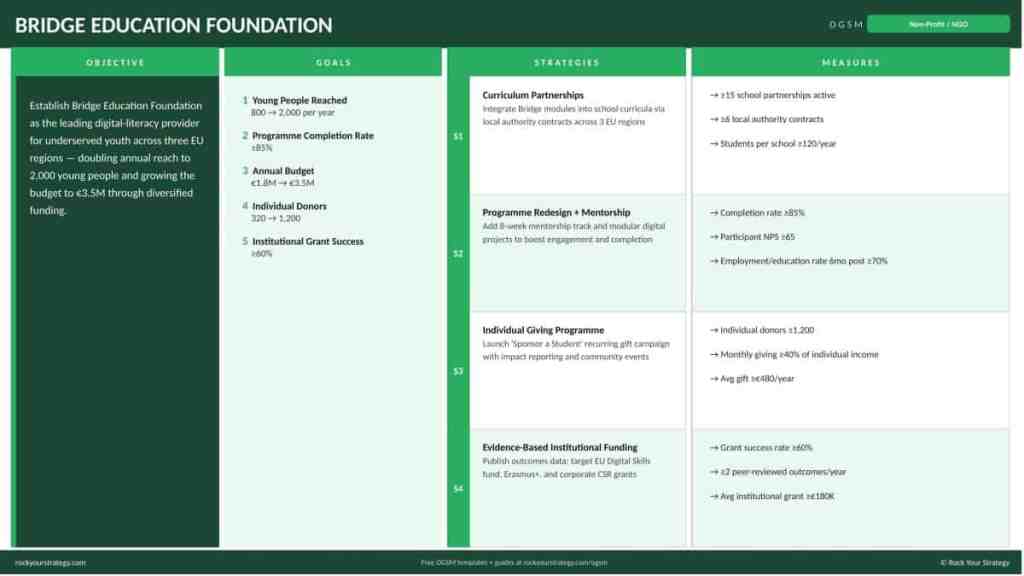
    The OGSM framework is well-suited to non-profit contexts precisely because it creates alignment across programmes, funding sources, and staff — on a single page that everyone can read and understand. This example shows how a fictional education non-profit — the Bridge Education Foundation, an NGO focused on digital literacy for underserved youth — used the OGSM to align their leadership team and build a coherent three-year strategy. The organisation, numbers, and details are illustrative. The strategic challenges are real.

    If you’re new to the OGSM framework, start with the Complete OGSM Framework Guide. If you’re ready to build, download our OGSM templates for PowerPoint and Excel.

    About Bridge Education Foundation

    The Bridge Education Foundation delivers digital literacy programmes to young people aged 12–18 in under-resourced secondary schools and community centres across three cities. Their flagship programme — Code Bridge — is a 12-week after-school coding and digital skills curriculum that has reached 2,400 young people since its founding. They also run a summer camp and a mentorship programme connecting graduates with working professionals in tech.

    At the time of this OGSM, Bridge has an annual budget of €1.8M, a team of 14 (6 programme staff, 4 operations, 2 fundraising, 2 leadership), and funding from three corporate partners, two government grants, and a base of 340 individual donors. The core programme is strong — participant outcomes are well above sector benchmarks — but the organisation is over-reliant on two funding relationships and has not grown its reach in three years. The board wants a strategy that addresses both sustainability and scale.

    The Bridge Education Foundation OGSM

    Objective

    Establish Bridge Education Foundation as a leading provider of digital literacy education for underserved youth by deepening programme impact, diversifying our funding base, and scaling our reach to 6,000 young people by 2028.

    Goals

    Bridge’s goals translate the three-year objective into measurable outcomes. They cover both mission impact (reach and programme quality) and organisational sustainability (funding diversification and financial resilience).

    GoalCurrentTarget (3-year)
    Young people reached per year8002,000
    Programme completion rate74%≥85%
    Annual budget€1.8M€3.5M
    Largest funder as % of total income38%≤20%
    Individual donor base340≥1,200

    Strategies

    Strategies define where Bridge will concentrate its energy and resources over the three-year period. Each reflects a conscious choice, written as a “what-by-how” statement.

    Strategy 1: Scale programme reach by partnering with 8 additional schools to deliver Code Bridge as part of the formal curriculum rather than only as after-school provision

    After-school programming reaches motivated young people but misses many who can’t stay after school due to family commitments, transport, or part-time work. Embedding Code Bridge into curriculum time with partner schools — as an elective, a PSHE module, or a dedicated digital skills period — dramatically increases reach without proportionally increasing staff cost. Bridge will target schools where leadership already prioritises digital inclusion.

    Strategy 2: Improve programme completion and outcomes by redesigning Code Bridge to include structured mentorship from week 4, based on what the data shows drives completion

    Bridge’s data shows that participants who connect with a mentor in the first four weeks complete the programme at 91% vs. 61% for those who don’t. Currently, mentorship is introduced at week 8 and is inconsistently assigned. Moving structured mentor matching to week 4 and making it systematic — rather than dependent on coordinator capacity — will significantly improve the completion goal.

    Strategy 3: Diversify the funding base by growing individual and community giving to represent ≥25% of income through a structured major donor programme and a public annual campaign

    Bridge’s current over-reliance on two funders creates existential risk. One funder is an EU-funded programme that may not renew post-2026. Individual giving — currently at 12% of income — is more resilient, unrestricted, and often unlocks matched funding from corporate partners. Bridge will build a major donor programme targeting 20 donors at the €5K–€25K level and run an annual public campaign (“Bridge the Gap”) to grow the broad donor base.

    Strategy 4: Build an evidence base that unlocks institutional funding by publishing annual impact data to a recognised social impact standard and submitting for two major foundation grants per year

    Major foundations and government funders increasingly require evidence to a recognised standard (SROI, Theory of Change, third-party evaluation) before making significant investments. Bridge has strong outcome data but has never packaged it systematically for external reporting. Publishing an annual impact report to a recognised standard — and using it as the centrepiece of foundation grant applications — will unlock a class of funding that is currently inaccessible.

    Measures

    Measures connect each strategy to the metrics and actions that will make it real. For a non-profit, measures need to cover both programme delivery and organisational development activities.

    StrategyKey MetricsActions
    Curriculum partnerships8 school partnerships signed; 2,000 young people reached p/a by year 3; Cost per participant reduced ≤€250Map 20 target schools by digital inclusion priority (Q1); Develop school partnership proposal and MOU (Q1); Sign first 3 school partnerships (Q1–Q2)
    Programme redesignCompletion rate ≥85%; Mentor assigned by week 4 for ≥90% of participants; Mentor satisfaction score ≥4.2/5Audit mentor matching process and identify bottlenecks (Q1); Redesign mentor onboarding and matching workflow (Q2); Pilot new model with next cohort (Q2–Q3)
    Individual givingIndividual giving ≥25% of income; Major donor base of 20 at €5K+; Annual campaign raises ≥€120KHire part-time fundraising coordinator (Q1); Identify and cultivate 30 major donor prospects (Q1–Q2); Launch Bridge the Gap annual campaign (Q3)
    Evidence & fundingAnnual impact report published; 2 major foundation applications submitted p/a; Foundation income ≥€600K by year 3Commission Theory of Change refresh (Q1); Publish Year 1 impact report to SROI standard (Q2); Submit first two foundation applications (Q3)

    What Makes This OGSM Work

    The goals are honest about the dual challenge. It would be easy for Bridge to set only mission goals (reach 6,000 young people) or only financial goals (reach €3.5M budget). The OGSM forces both onto the same page — including the uncomfortable funding concentration goal. You can’t build a three-year strategy without acknowledging the existential risk in the current funding model.

    Strategy 2 is evidence-led. Rather than assuming that “better mentorship” is the answer, Bridge’s data specifically shows that early mentor assignment (week 4 vs. week 8) is the variable that drives completion. The strategy is specific because the evidence is specific. This is what good strategy looks like: not a general direction, but a precise intervention based on what the data tells you.

    The measures distinguish between metrics and actions. Many non-profit strategies set impact targets but don’t name the operational actions that will get there. Bridge’s OGSM links each strategy to both numbers (key metrics) and specific actions with timelines. That distinction is what turns a strategy into a workplan.

    OGSM one-pager strategy example — Bridge Education

    Adapting OGSM for Non-Profit Contexts

    The OGSM works for non-profits with a few adaptations worth noting.

    The Objective should lead with mission, not operations. For a non-profit, the objective should answer the question: “What change are we trying to create in the world, and how?” Bridge’s objective names both the mission (digital literacy for underserved youth) and the strategic mechanisms (deepening impact, diversifying funding, scaling reach). That combination keeps the organisation focused on mission while being honest about the organisational development needed to achieve it.

    Goals should include both impact and sustainability metrics. A non-profit that tracks only programme reach will tend to under-invest in funding diversification. One that tracks only financial metrics will drift toward mission in name only. Both dimensions need to be in the goals for the strategy to be coherent.

    Be explicit about funding in the strategies. Many non-profit strategic plans treat fundraising as a support function rather than a strategic priority. Bridge’s OGSM includes two explicit fundraising strategies — individual giving diversification and evidence-based institutional funding — because without those, the programme strategies have no financial foundation.

    Build Your Own OGSM

    Use our pre-formatted OGSM templates to build your own one-page strategy. Available for Microsoft PowerPoint (for board presentations and funder reporting) and Microsoft Excel (for building, tracking, and updating your plan). Both are fully editable and immediately downloadable.

    Browse OGSM templates in the shop →

    More OGSM Examples

    See how the OGSM framework applies across different business contexts:

    Questions or comments? Drop them below, or sign up to our free newsletter for practical strategy tips. Rock on!

  • OGSM Example: E-commerce / DTC Brand — Scaling a Sustainable Home Goods Company

    OGSM Example: E-commerce / DTC Brand — Scaling a Sustainable Home Goods Company

    E-commerce and direct-to-consumer brands face a particular version of the strategy problem: growth levers are highly visible (paid social, influencer, new product launches) but the discipline to choose between them is rare. Without that discipline, brands hit $3–5M in revenue and stall — spending more on acquisition, watching margins compress, and losing the brand clarity that made them interesting in the first place.

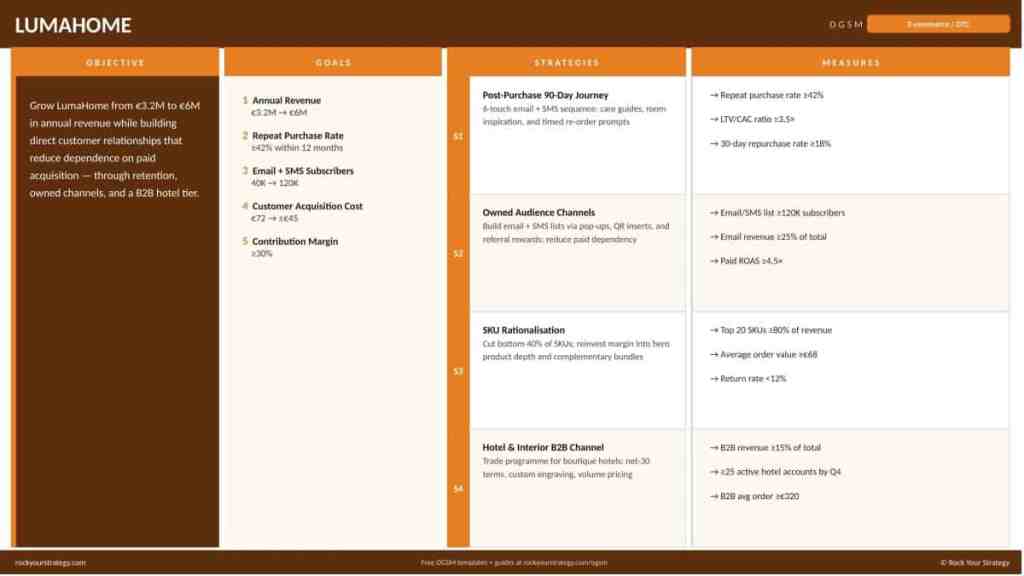
    This example shows how a fictional DTC brand — LumaHome, a sustainable home goods company selling premium linen bedding and textiles — used the OGSM framework to build a focused growth strategy around profitability and customer lifetime value rather than top-line growth at any cost. The company, numbers, and details are illustrative. The strategic tensions are real.

    If you’re new to the OGSM framework, start with the Complete OGSM Framework Guide. If you’re ready to build, download our OGSM templates for PowerPoint and Excel.

    About LumaHome

    LumaHome makes premium linen bedding, cushion covers, and table textiles from certified organic flax sourced in Europe. They sell DTC through their own website and have a small but growing wholesale presence with two boutique hotel groups. Their brand positioning sits at the intersection of sustainability, craftsmanship, and understated design — think Parachute meets Muji.

    At the time of this OGSM, LumaHome has reached $3.2M in annual revenue with a 58% gross margin. Customer acquisition cost (CAC) has risen 40% over 18 months due to increased Meta advertising costs. Repeat purchase rate is 28% — below the 40%+ benchmarks for premium DTC brands in this category. The founding team wants to reach $6M revenue while improving contribution margin, not just hitting the revenue number.

    The LumaHome OGSM

    Objective

    Establish LumaHome as the leading premium sustainable home textile brand for design-conscious consumers by building a loyal repeat customer base and reducing dependence on paid acquisition.

    Goals

    LumaHome’s goals reflect the dual ambition of the objective: grow revenue meaningfully while improving the unit economics that make growth sustainable.

    GoalCurrentTarget
    Annual revenue$3.2M$6M
    Repeat purchase rate28%≥42%
    Customer acquisition cost (CAC)€62≤€45
    Contribution margin22%≥30%
    Email subscriber list18,000≥50,000

    Strategies

    Each strategy reflects a deliberate choice about where LumaHome will invest and what they will prioritise over alternatives. They are written as “what-by-how” statements.

    Strategy 1: Increase repeat purchase rate by building a post-purchase customer journey that turns first-time buyers into multi-category customers within 90 days

    LumaHome’s best customers buy bedding, then cushion covers, then table linens — a natural progression that most customers never discover on their own. The strategy is to build an intentional 90-day post-purchase sequence: personalised email flows based on first purchase category, a loyalty programme that rewards category expansion, and a discovery kit offer at day 30 that introduces adjacent products at a trial price.

    Strategy 2: Reduce paid acquisition dependence by building owned audience channels — email and organic content — to drive ≥40% of new customer revenue

    Currently, 71% of new customer revenue flows through paid social. Every year, platform CPMs rise and margin compresses. LumaHome will invest in organic content (a home styling editorial series, YouTube room transformation videos, and a weekly newsletter) and SEO to build channels where acquisition cost approaches zero over time.

    Strategy 3: Improve contribution margin by rationalising the SKU range and concentrating production volume on the top 20% of products that generate 80% of revenue

    LumaHome currently offers 67 SKUs. Their bottom 40 SKUs account for less than 8% of revenue but require the same photography, copywriting, inventory management, and customer service overhead as the top performers. Cutting these and concentrating purchasing volume on hero products will improve COGS through volume discounts and simplify operations.

    Strategy 4: Expand the wholesale channel by signing 3–5 boutique hotel partners to create a premium B2B revenue stream with high order values and strong brand validation

    Hotels buy in high volume, pay premium prices for design quality, and serve as living showrooms for the LumaHome brand. Guests experience the product in an aspirational context and frequently search for it after their stay. LumaHome will develop a dedicated hotel programme with custom sizing options, volume pricing, and a concierge procurement service.

    Measures

    Measures translate each strategy into specific metrics and actions. Without this level of specificity, strategies stay on the page rather than driving daily decisions.

    StrategyKey MetricsActions
    Post-purchase journeyRepeat purchase rate ≥42%; Second purchase within 90 days ≥35%; Loyalty programme enrolment ≥50% of buyersBuild 90-day post-purchase email flows by category (Q1); Launch loyalty programme (Q2); Test discovery kit offer to cohort of 1,000 first-time buyers (Q1)
    Owned audiencePaid acquisition share ≤60% by Q4; Email list ≥50K; Organic search traffic +80%Launch weekly newsletter (Q1); Publish 2 editorial home styling features per month (Q1 onward); Commission 4 YouTube room videos per quarter (Q2)
    SKU rationalisationSKU count reduced to ≤40; COGS on hero SKUs reduced ≥8%; Inventory turnover improved to ≥4x/yearAudit SKU performance by revenue and margin (Q1); Discontinue bottom 27 SKUs (Q1); Renegotiate supply contracts on top 15 SKUs with increased volume (Q2)
    Hotel channel3 hotel partners signed by Q3; Hotel B2B revenue ≥$400K; Average hotel order value ≥$8KDevelop hotel product catalogue and pricing (Q1); Identify and approach 20 boutique hotel targets (Q1–Q2); Sign first 3 contracts (Q2–Q3)

    What Makes This OGSM Work

    The objective reframes the success metric. LumaHome could have written an objective about “becoming Europe’s leading sustainable home brand.” Instead they named the mechanism that will make the business sustainably successful: a loyal repeat customer base and reduced paid acquisition dependence. That reframe shapes every strategic choice that follows.

    The goals create productive tension. Hitting $6M revenue while reducing CAC from €62 to €45 is not easy — those goals push against each other. That tension is intentional. It forces LumaHome to find growth from existing customers and organic channels rather than just spending more on acquisition. If you only set revenue goals, you’ll hit them by paying whatever it costs to acquire customers.

    Strategy 3 is the most uncomfortable one — and the most important. SKU rationalisation requires saying no to products that have fans, require design write-offs, and feel like a step backward. But in DTC, operational simplicity directly drives margin. The OGSM makes the case for that decision in the context of the full strategy, which is harder to argue against than the decision in isolation.

    OGSM one-pager strategy example — Luma Home

    DTC-Specific OGSM Considerations

    A few things worth noting if you’re building an OGSM for a DTC or e-commerce business.

    Include both acquisition and retention in your goals. Most DTC strategies focus exclusively on revenue and new customer acquisition. The repeat purchase rate and CAC goals in LumaHome’s OGSM are what force the retention and owned channel strategies into the plan. Without them, those strategies don’t have a goal to drive toward.

    Contribution margin is a more honest goal than gross margin. Gross margin at 58% sounds healthy. Contribution margin at 22% — after paid acquisition, fulfilment, and returns — tells a different story. Set your goals at the level that reflects the actual cost structure of your growth model.

    Be specific about the channel mix in your strategies. “Invest in content” is not a strategy. “Build owned audience channels to drive ≥40% of new customer revenue” is a strategy — because it has a measurable target, a directional choice (owned over paid), and implies what you’re willing to trade off (short-term paid growth) to achieve it.

    Build Your Own OGSM

    Use our pre-formatted OGSM templates to build your own one-page strategy. Available for Microsoft PowerPoint (for investor and leadership presentations) and Microsoft Excel (for building, tracking, and updating your plan). Both are fully editable and immediately downloadable.

    Browse OGSM templates in the shop →

    More OGSM Examples

    See how the OGSM framework applies across different business contexts:

    Questions or comments? Drop them below, or sign up to our free newsletter for practical strategy tips. Rock on!

  • OGSM Example: AI Startup — From Research to Revenue at Series A

    OGSM Example: AI Startup — From Research to Revenue at Series A

    AI startups face a version of the classic strategy problem in concentrated form: the technology is powerful and the opportunity is large, but the surface area of possible applications is so wide that focus becomes genuinely hard. Without a forcing mechanism, teams default to building everything and selling to everyone — which usually means making real progress on nothing.

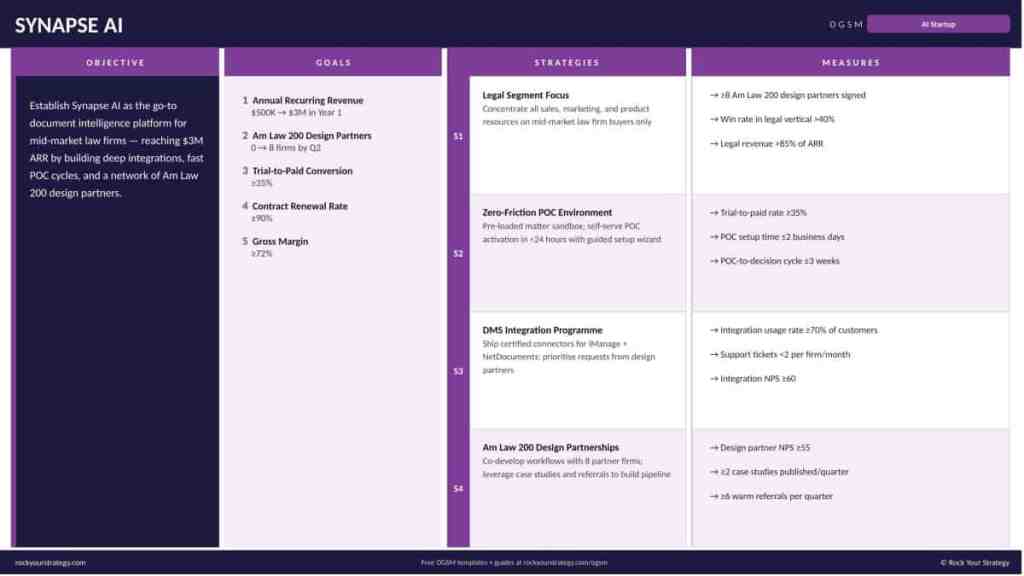
    This example shows how a fictional AI startup — Synapse AI, a Series A company building document intelligence software for professional services firms — used the OGSM framework to make the transition from research-led organisation to revenue-driven business. The company, numbers, and details are illustrative. The strategic challenges are real.

    If you’re new to the OGSM framework, start with the Complete OGSM Framework Guide. If you’re ready to build, download our OGSM templates for PowerPoint and Excel.

    About Synapse AI

    Synapse AI has built a proprietary large language model fine-tuned for legal and financial document analysis. Their technology can extract key clauses from contracts, flag risk provisions, summarise regulatory filings, and surface precedent across thousands of documents in seconds — work that currently takes teams of paralegals and junior analysts hours to complete.

    At the time of this OGSM, Synapse has closed a $6M Series A, has ARR of $500K from 8 paying customers (law firms and one investment bank), and a team of 22 people. The core technology is strong, but the go-to-market is ad hoc. Deals have come through founder relationships, not a repeatable process. The board is expecting a path to $3M ARR before the next funding round.

    The Synapse AI OGSM

    Objective

    Establish Synapse AI as the trusted document intelligence platform for mid-size professional services firms by building a repeatable sales motion and deepening product value within our initial customer segment.

    Goals

    Goals define what success looks like in measurable terms at the end of the 18-month period. Synapse’s goals reflect both the growth expectations of their Series A investors and the operational milestones needed to build a fundable Series B story.

    GoalCurrentTarget
    Annual Recurring Revenue (ARR)$500K$3M
    Number of paying customers840
    Average Contract Value (ACV)$62K≥$75K
    Gross Revenue Retention88%≥95%
    Sales cycle length6–8 months≤4 months

    Strategies

    Strategies are the high-impact choices about where Synapse will concentrate resources — and, by implication, what they will not do. Each is written as a “what-by-how” statement.

    Strategy 1: Build a repeatable sales process by focusing exclusively on mid-size law firms (50–200 attorneys) and codifying what converts

    Eight of Synapse’s customers are law firms. That’s not a coincidence — the document density, compliance requirements, and billable-hour economics create a strong value proposition. Rather than broadening to financial services or consulting firms in parallel, Synapse will go deep in legal first: building case studies, developing a sales playbook from their best-performing deals, and hiring a sales hire with legal tech experience.

    Strategy 2: Shorten the sales cycle by building a self-serve proof-of-concept environment that demonstrates value on the prospect’s own documents

    The 6–8 month sales cycle is the biggest obstacle to hitting the ARR target. Most of that time is spent on internal buy-in and IT security reviews. Synapse will build a sandboxed POC environment where prospects can upload 20–50 of their own documents and see Synapse work on their real content — compressing time-to-wow and reducing stakeholder objections before formal procurement.

    Strategy 3: Increase retention and expand ACV by embedding Synapse deeper into each customer’s existing workflow through integrations with iManage and NetDocuments

    Three of the eight customers have churned or downgraded because Synapse lived outside their existing document management system. The fix is technical but strategic: native integrations with the two dominant legal DMS platforms (iManage and NetDocuments) will make Synapse a workflow layer, not a separate tool — dramatically increasing switching costs and expansion potential.

    Strategy 4: Build market credibility by partnering with two Am Law 200 firms as design partners to develop and publicly validate the next product generation

    Enterprise legal buyers are highly reference-dependent. A proof point from a recognised firm carries more weight than any marketing claim. Synapse will recruit two Am Law 200 firms as paid design partners — giving them early access to roadmap features in exchange for co-development input, case study rights, and permission to use their logos in sales materials.

    Measures

    Measures link each strategy to the specific metrics and actions that will drive execution. This is where the OGSM becomes an operating document rather than a strategy slide.

    StrategyKey MetricsActions
    Legal segment focusNew logo win rate in legal ≥30%; Deals from playbook ≥80%; Legal ACV ≥$75KDocument top 3 closed-won deals into sales playbook (Q1); Hire legal tech AE (Q1); Develop 5 law firm case studies (Q1–Q2)
    POC environmentPOC-to-paid conversion ≥60%; Sales cycle ≤4 months; POC sessions per month ≥8Build sandboxed POC environment (Q1–Q2); Integrate into outbound sequence as step 3 (Q2); Train sales team on POC-led demo (Q2)
    DMS integrationsGross retention ≥95%; iManage/NetDocuments installs ≥70% of base; Expansion from integrated accounts ≥20%Ship iManage integration (Q2); Ship NetDocuments integration (Q3); Launch customer success onboarding for integration activation (Q3)
    Am Law design partners2 design partners signed by Q2; Case study published by Q3; Logo usage in ≥50% of sales decksIdentify and approach 6 Am Law 200 targets (Q1); Negotiate design partner agreements (Q1–Q2); Build joint product roadmap sessions (Q2–Q4)

    What Makes This OGSM Work

    The objective is honest about the stage. Synapse didn’t write an objective about “disrupting the legal industry” or “transforming how professional services firms work.” They wrote an objective about building a repeatable sales motion and deepening product value within a specific segment. That honesty about what actually needs to happen in the next 18 months is what makes the OGSM useful rather than aspirational.

    The segment choice is load-bearing. Strategy 1’s decision to focus exclusively on mid-size law firms is the most important strategic choice in this OGSM. It constrains everything else: who you hire, what integrations you build, which design partners you pursue. AI startups that try to serve all verticals simultaneously typically end up with a generic product and no compelling case studies for any of them.

    The POC strategy addresses the real bottleneck. Many AI startups focus their strategy on product improvements when the real constraint is procurement friction. Synapse identified that 60% of their sales cycle was internal buy-in and security review — and built a strategy around compressing that, not just making the product better.

    OGSM one-pager strategy example — Synapse AI

    Common OGSM Mistakes AI Startups Make

    The OGSM framework works for AI startups precisely because it forces trade-offs that are easy to avoid. Here are the patterns we see most often go wrong.

    Technology as strategy. “We will use our proprietary LLM to outperform competitors” is not a strategy — it’s a capability. A strategy describes where and how you will deploy that capability to create value for a specific customer in a specific context. Synapse’s Strategy 1 is a strategy. “We have better AI” is not.

    Too many segments in the goals. AI startups often set ARR goals without specifying which customer segments will drive that revenue. If the goal is $3M ARR from 40 customers, but 15 of those are from legal and 25 are from “various industries,” the OGSM has no real alignment. The segment clarity has to show up in the goals, not just the strategies.

    Measures without owners. The measures table in Synapse’s OGSM has owners implicit in each action. In practice, when you build this with your team, every action should have a named owner and a due date. Without those two things, measures become aspirational rather than operational.

    Build Your Own OGSM

    Use our pre-formatted OGSM templates to build your own one-page strategy. Available for Microsoft PowerPoint (for board and leadership presentations) and Microsoft Excel (for building, tracking, and updating your plan). Both are fully editable and immediately downloadable.

    Browse OGSM templates in the shop →

    More OGSM Examples

    See how the OGSM framework applies across different business contexts:

    Questions or comments? Drop them below, or sign up to our free newsletter for practical strategy tips. Rock on!

  • OGSM Example: B2B SaaS — How a Pipeline Analytics Company Hit $8M ARR

    OGSM Example: B2B SaaS — How a Pipeline Analytics Company Hit $8M ARR

    Most B2B SaaS strategies collapse under the weight of too many priorities. Product wants to ship features. Sales wants more leads. Finance wants CAC under control. The OGSM framework forces you to resolve that tension on a single page — before it resolves itself in the wrong direction.

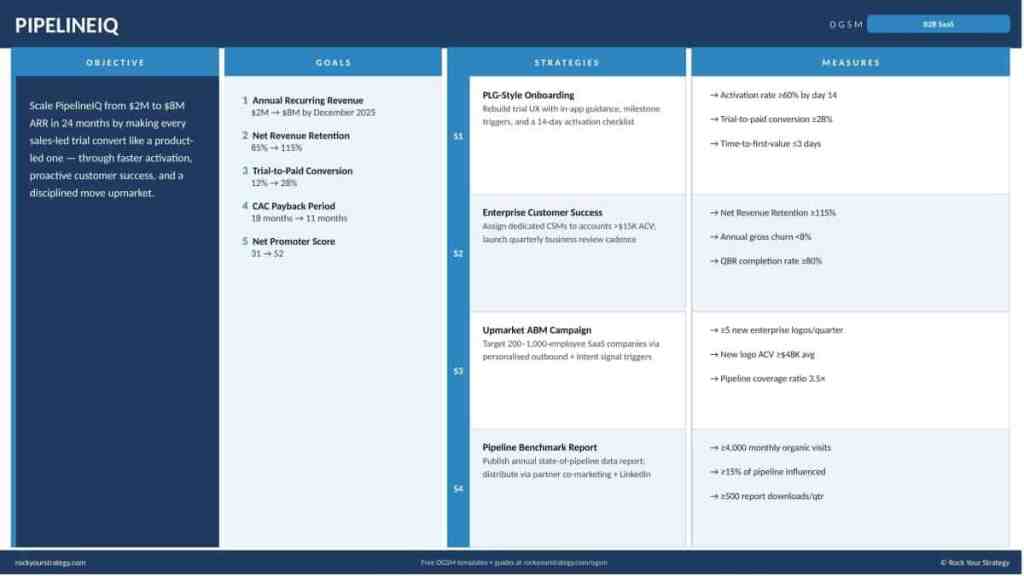
    This example shows how a fictional B2B SaaS company — PipelineIQ, a pipeline analytics platform for mid-market sales teams — used the OGSM methodology to align their leadership team around a clear path from $2M to $8M ARR. The numbers, company, and details are illustrative. The strategic logic is real.

    If you’re new to the framework, read the Complete OGSM Framework Guide first. If you’re ready to apply it, download our OGSM templates for PowerPoint and Excel and use this example as your reference.

    About PipelineIQ

    PipelineIQ is a B2B SaaS company that helps mid-market sales teams visualize pipeline health, forecast revenue more accurately, and identify deals at risk before they slip. They integrate with Salesforce and HubSpot and sell primarily to VP Sales and RevOps leaders at companies with 50–500 employees.

    At the time of this OGSM, PipelineIQ has reached $2M ARR with strong product-market fit signals — high NPS, good retention among customers who fully onboard — but inconsistent trial-to-paid conversion and a growing gap between SMB and enterprise performance. The leadership team needs to decide where to concentrate resources for the next 12 months.

    The PipelineIQ OGSM

    Objective

    Become the leading pipeline analytics platform for mid-market B2B sales teams by accelerating product-led growth and deepening enterprise retention.

    Goals

    Goals translate the objective into measurable outcomes. PipelineIQ chose five metrics that collectively define what success looks like at the end of the 12-month period.

    GoalCurrentTarget
    Annual Recurring Revenue (ARR)$2M$8M
    Net Revenue Retention (NRR)102%≥115%
    Trial-to-paid conversion rate9%≥18%
    CAC payback period18 months≤12 months
    Net Promoter Score (NPS)38≥50

    Strategies

    Strategies are the 3–5 high-impact choices that determine where PipelineIQ concentrates its resources. Each is written as a “what-by-how” statement — specific enough to exclude things they won’t do.

    Strategy 1: Accelerate trial-to-paid conversion by redesigning the onboarding flow around a fast time-to-value milestone

    PipelineIQ’s data shows that users who reach their first “pipeline health score” within 72 hours of signup convert at 3x the rate of those who don’t. The strategy is to rebuild the onboarding sequence around this milestone — removing friction, adding guided prompts, and making the health score the first thing every trial user sees.

    Strategy 2: Increase NRR by building a structured customer success motion for accounts above $15K ARR

    Churn is concentrated in the $10K–$20K ARR band, typically from accounts that never fully adopted the forecasting module. A dedicated CS motion — quarterly business reviews, adoption scoring, and expansion playbooks — will address this before it compounds.

    Strategy 3: Move upmarket into the $20K–$60K ACV segment by targeting RevOps leaders at Series B–D companies through account-based outreach

    Mid-market accounts have lower churn, higher NPS, and more expansion potential than SMBs. PipelineIQ will build an ABM programme targeting 200 high-fit accounts per quarter, led by outbound sequences from a newly hired senior AE.

    Strategy 4: Build category authority by publishing the annual B2B Pipeline Benchmark Report as the definitive industry reference

    Owned research creates durable inbound demand and shortens sales cycles. PipelineIQ will survey 500+ sales leaders, publish findings in Q2, and use the report as the cornerstone of their content and PR strategy for the year.

    Measures

    Measures define how each strategy will be tracked and executed. For each strategy, PipelineIQ identified 2–3 Key Metrics (the numbers that define success) and 2–3 Actions (the concrete initiatives that will move those numbers).

    StrategyKey MetricsActions
    PLG onboardingTrial-to-paid ≥18%; Time-to-health-score <72hrs; Onboarding completion >60%Rebuild onboarding flow (Q1); Launch in-app guidance (Q1); A/B test activation emails (Q2)
    Enterprise CS motionNRR ≥115%; Churn in $15K+ band <5%; QBR completion >80%Hire CS Manager (Q1); Build adoption scoring (Q1); Launch expansion playbook for top 50 accounts (Q2)
    Upmarket ABMPipeline from ABM ≥$3M; ACV of new logos ≥$25K; ABM win rate ≥25%Hire senior AE (Q1); Build 200-account target list (Q1); Launch outbound sequences (Q2)
    Benchmark reportDownloads ≥2,000; MQLs attributed ≥150; Press mentions ≥10Survey 500 sales leaders (Q1); Publish with PR push (Q2); Content distribution plan (Q2)

    What Makes This OGSM Work

    Three things stand out about PipelineIQ’s OGSM that are worth noting for your own strategy work.

    The objective resolves a real tension. PipelineIQ could have written a generic objective about “becoming a market leader.” Instead, they named the two specific mechanisms driving growth — product-led growth and enterprise retention — which immediately signals to the team where resources will flow and where they won’t.

    The goals are genuinely constraining. An NRR target of ≥115% is not a stretch goal bolted onto an existing plan. It forces a structural change: you can’t hit 115% NRR without a real CS motion. The goal drives the strategy, not the other way around.

    The strategies make explicit trade-offs. Strategy 3 targets Series B–D companies specifically — not “all upmarket segments.” Strategy 4 commits to one owned research asset rather than a broad content calendar. These exclusions are as important as the inclusions.

    OGSM vs. OKR: Which Framework Works Better for SaaS?

    This is a question that comes up often in SaaS leadership teams, especially those that have previously used OKRs.

    OGSMOKR
    Output formatOne page, full strategy visible at onceNested list of objectives and key results by team
    Strategic choicesExplicit — strategies define what you will and won’t doImplicit — key results may point in different directions
    Execution linkMeasures connect each strategy to specific actions and ownersKey results tracked separately; initiatives often disconnected
    CadenceAnnual with quarterly measure reviewsQuarterly cycles with annual reset
    Best suited forFull business strategy alignment (board to team)Team-level goal-setting and performance tracking

    Many SaaS companies find that OGSM works better at the business unit or company level precisely because it forces the strategic trade-off conversation. OKRs can sit alongside it at the team or individual level for execution tracking.

    OGSM one-pager strategy example — PipelineIQ

    Build Your Own OGSM

    Use our pre-formatted OGSM templates to build your own one-page strategy. Available for Microsoft PowerPoint (for leadership presentations) and Microsoft Excel (for building, tracking, and updating your plan). Both are fully editable and immediately downloadable.

    Browse OGSM templates in the shop →

    More OGSM Examples

    See how the OGSM framework applies across different business contexts:

    Questions or comments? Drop them below, or sign up to our free newsletter for practical strategy tips. Rock on!