Category: OGSM

  • What Time Frame To Choose For OGSM?

    What Time Frame To Choose For OGSM?

    I’m often asked if there is an optimal time period or timeline for which to use the OGSM methodology. Does OGSM only work for long-term strategies or also for shorter term business plans? Let’s explore this question.

    The OGSM methodology is in my experience best suited for 3-5 year strategic plans and annual operating plans with a 1-year time frame. Because of its versatility however, the OGSM methodology can also be applied for strategic plans or project plans of any other time frame.

    In this article, we’ll explore different aspects of time in regards to OGSM. Read on to find out whether the OGSM methodology applies well for your business plan or project plan.

    Strategic time horizons for OGSM

    OGSM stands for Objectives, Goals, Strategies, and Measures and is a one-page strategic planning methodology. OGSM connects ‘what’ you want to achieve with ‘how’ you are going to achieve it. And although the OGSM methodology is relatively simple, it’s worth investing the time to think through each component thoroughly. That’s why this structured approach is best suited for strategic plans or annual operating plans that don’t change on a monthly or weekly basis.

    In my almost 10 years of experience in working with the OGSM methodology I have found that the OGSM approach works best for strategic plans with time horizons of 3-5 years or for annual operating plans with a time horizon of 1 year.

    Personally, I have most often applied the OGSM methodology for annual operating plans in my businesses.

    The structure of the OGSM methodology excellently lends itself to formulating the objective for a fiscal year and breaking it down into measurable goals (the ‘what’). The strategies then define the key business priorities or key initiatives during the year to deliver the objective and goals (the ‘how’). Finally the measures describe in quantifiable terms the key performance indicators and actions for each strategy.

    The approach works the same way for strategic plans of longer time horizons such as for 3-5 years. The difference is that the objective and the goals then define the destination to be reached after 3-5 years. And the strategies and measures describe the key initiatives and actions over the 3-5 year time horizon.

    Here’s an example what the objective and goals for an annual operating plan may look like (1-year time horizon).

    1-Year Business Plan Example

    ObjectiveRapidly expand the business this year by reaching new customers with our new products
    Goals– Increase sales by 15%
    – Develop 20 new customers
    – Launch 5 new products

    And here’s an example what the objective and goals for a longer term strategic plan may look like (3-5 year time horizon).

    3-5 Year Strategic Plan Example

    ObjectiveBecome the recognized industry leader by developing innovative products and value-added services
    Goals– Achieve 30% market share
    – >60% of customers name us as “industry leader”
    – 20% of sales from new products
    – >30% sales from services

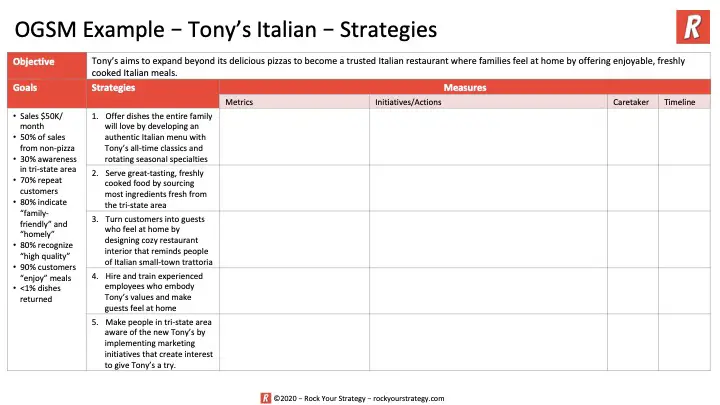
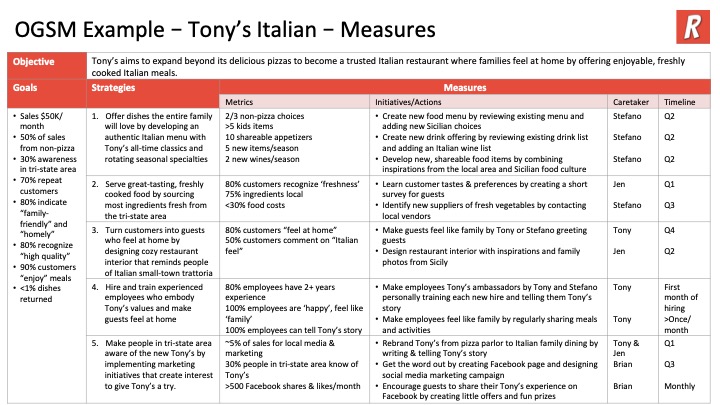
    If you’d like to see a complete OGSM example and read the fictional story of how Tony’s Pizza created an OGSM for their business transformation, please click here.

    As stated before, the OGSM approach can be applied to any project or business plan of shorter or longer time horizons as well. The key point is to align the objective and goals and the strategies and measures with the chosen time horizon.

    What’s the review timeline for OGSM?

    The OGSM should be reviewed regularly to make sure you are on track to achieving your goals and the ultimate objective. How often such reviews should take place depends on your time horizon.

    When applying the OGSM methodology to 3-5 year strategic plans, the OGSM should be reviewed quarterly or at least twice per year. Conduct the review bottom-up, beginning with the measures and then the strategies. Finally confirm that you are on track to achieving your goals and objective.

    A thorough review meeting with your team may last 2-3 hours depending on how deep you go into discussion and how well you prepare up front. I’ve done quite well with a 3-hour morning session once per quarter. Those review meetings were scheduled way in advance and everyone knew when they were coming and what had to be prepared. This made the reviews very efficient and the discussions targeted towards keeping the OGSM on track.

    Annual Operating Plans on the other hand should be reviewed on a monthly basis. As the time horizon is significantly shorter, more frequent reviews are needed to ensure the plan remains on track. In addition to brief monthly reviews of the OGSM measures that “need attention” or are “at risk”, consider conducting quarterly more in-depth reviews of the 1-year OGSM.

    Read more about how to conduct monthly reviews of your OGSM in this article.

    Reviewing the OGSM regularly allows you to identify early on when initiatives need attention or when you are getting off track. Use the regular reviews to make necessary adjustments in a timely fashion by defining countermeasures and when needed redeploying resources.

    When should I begin creating the OGSM?

    Well, the short answer is anytime. The longer answer depends on your strategic time horizon.

    3-5 Year Strategic Plans

    If you are using the OGSM methodology to guide your 3-5 year strategic planning process, then you can of course begin this process anytime you determine that your business needs to review its strategy.

    In larger or longer-running businesses you should review your strategic plan at least once every 3-5 years or whenever substantial changes in your industry or market place can be observed.

    When you decide to overhaul your business strategy, consider doing your strategic review in the middle of your fiscal year. Find a time when you are undisturbed by shorter term actions such as budget setting or annual operating planning. This will allow you the time and the mental space to take a step back and think big.

    1-Year Annual Operating Plans

    If you are applying the OGSM methodology for your Annual Operating Plan or a 1-year business plan, then I’d recommend beginning the process right around your budget setting period.

    By aligning the budgeting process and the OGSM creation, you are defining your business goals and your key initiatives in one go. I.e. you are defining ‘what’ you want to achieve and ‘how’ you are going to achieve it. This is exactly where OGSM is most powerful.

    Unfortunately, in many large corporations the budgeting process runs independently from the discussion of business priorities. Budgets are typically set first (often top down), and then months later the business tries to figure out how to achieve the targets.

    I usually begin the annual planning process in late September and invite my team to join the process. We set objective and financial goals first and then break them down into the key strategies and initiatives and set meaningful quantifiable measures. These become the topline and cost budgets. The OGSM and the financial targets are then cascaded throughout the business into the various functions and teams.

    We aim to have this re-iterative process completed by November to allow sufficient time for alignment and communication before the year begins and we begin execution of the plan.

    Templates

    Find tools & templates for OGSM and your strategic planning process here.

    OGSM Examples

    Find OGSM examples and inspirations for your own journey here.

    How much time does it take to create an OGSM?

    In my experience creating an OGSM for an annual operating plan or a longer term strategic plan can take anywhere between one day to several weeks or months. This depends on the strategic time horizon, the complexity of the business situation and the number of people involved in creating the OGSM.

    Creating a first draft of the OGSM can easily be accomplished in a single day. It is the discussions, alignments and the cascading of the OGSM that can stretch over multiple weeks.

    The most complex and time-consuming parts of the OGSM are in my experience the objective discussion and making choices about strategies and resource allocation. The discussion of goals and measures is relatively straight forward and follows the objective and the strategies, respectively.

    When you plan to conduct an OGSM workshop or strategic planning meeting, worry less about the time it takes to create the OGSM. I’d recommend to focus on robust discussions about the internal and external situation of the business and what the objective and goals should be for the next year(s). Then make trade-offs about where to focus your resources to achieve your goals.

    Learn more about how to conduct a strategic planning meeting here.

    In summary, take the time that you need. Don’t rush the discussions or simply go through the motions. And especially avoid simply filling templates for the sake of filling the templates. The OGSM is a great way to guide or facilitate your discussions. But it is the quality of your discussion which determines the quality of your OGSM or business plan and the time it takes to create it.

    Conclusion

    The OGSM methodology is very versatile and can be applied to virtually any strategic plan, project plan, and corresponding time frame.

    The most effective time horizon in my experience is to use the OGSM methodology for 3-5 year strategic plans or 1-year annual operating plans.

    What is your experience with the OGSM methodology. What time horizon have you found to be most effective for OGSM? Drop us a line below. We would love to hear from you.

  • Top 10 OGSM Tips To Rock Your Strategy

    Top 10 OGSM Tips To Rock Your Strategy

    Using the OGSM methodology for strategic planning is not rocket science. But with these top 10 OGSM tips you can vastly increase your chance of success. 

    1. Create the OGSM with your team
    2. Focus on what you can influence
    3. Conduct a SWOT analysis
    4. Use the ‘what-by-how’ method
    5. Choose no more than 5 strategies
    6. Build your plan top-down
    7. Review your plan bottom-up
    8. Cascade the OGSM
    9. Conduct monthly reviews
    10. Renew OGSM annually

    → Want the full OGSM picture alongside these tips? The Complete OGSM Framework Guide covers all four components in depth, real-world examples, and a comparison to OKRs and the Balanced Scorecard.

    Read on for a detailed description of each of these tips to simplify your strategy and deliver excellent results.

    1. Create the OGSM with your team

    “Two heads are better than one.”   

    I’m sure you have heard this old saying. When two people work together they are more likely to solve a problem than one person doing it alone. And I’m sure you have also experienced that teams are often more effective than individuals when they work together openly and collaboratively towards a shared goal. 

    The same holds true for strategic planning and using the OGSM methodology. When creating your strategic plan, assemble your team and jointly embark on the journey to design the future of your business.

    Creating an inspiring, ambitious and effective strategic plan starts with asking critical questions about your internal and external environment. Such situational assessment is best performed when you bring in different points’ of view, different knowledge and skills and can challenge each other and your status quo.

    Involving your team in the strategic planning process has an additional benefit. Involvement creates ownership and buy-in. By being involved in the strategic plan, your team will have greater understanding about the business’ situation, its future direction and how each and every team member can contribute to moving the business in the right direction.

    Don’t create your OGSM in isolation. Engage your team. You will create a better plan and will have already taken a giant step towards achieving it. 

    2. Focus on what you can influence

    Be proactive. Create the future that you envision for your business or for yourself. Take responsibility for your company and focus your strategic plan on what you CAN influence

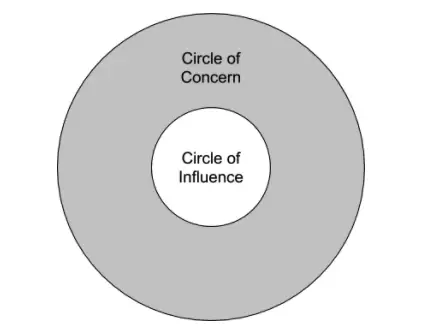
    According to Stephen Covey’s bestselling book The 7 Habits of Highly Effective People, there are two circles: the circle of concern and the circle of influence

    Circle of Influence
    Source: Stephen Covey, The 7 Habits of Highly Effective People

    The outter, larger circle of concern is about the things we cannot influence, such as the weather, the economy, other people’s actions and opinions. People who live in this circle are said to be reactive. Reactive people complain about things outside their control. They do not take action or take ownership of the things they can control. 

    I’m sure you know someone like that. How often have you heard the following? 

    “Sorry, I’m late, but the alarm didn’t ring and then my shirt wasn’t ironed. I missed the bus and then I noticed that I had forgotten my staff card and had to go back…” 

    Possibly any person living in the circle of concern

    In truth, had the person gone to bed earlier, prepared things the night before, set a second alarm etc. things might have gone differently. 

    The inner, smaller circle of influence is about the things we can influence, such as our attitude, our preparedness, the skills we learn, the habits we develop, where we focus our time and energy. People who live in this circle are proactive. These people realize that their decisions determine their lives and not their outter conditions. Proactive people do not complain about what they cannot control but focus their energy on what they can control. 

    For your strategic plan, focus on what you can control. Do analyze the external environment in which you operate. And then create a strategic plan that leverages your organization’s core competencies and directs your resources towards the actions and behaviors that lead you to success.

    3. Conduct a SWOT analysis 

    SWOT stands for Strengths, Weaknesses, Opportunities, and Threats. The SWOT analysis is an assessment of your internal and external business environment. Strengths and weaknesses are internal to your business, opportunities and threats are external to your business.

    The SWOT analysis is a simple but powerful method to gain critical insights into your business and your situation. 

    This is what a SWOT framework may look like: 

    Strengths: 
    – …
    – …
    – …
    Weaknesses:
    – …
    – …
    – …
    Opportunities: 
    – …
    – …
    – …
    Threats:
    – …
    – …
    – …
    Simplified SWOT framework

    Build your strategic plan around your strengths. Aim to use your strengths to take advantage of your opportunities and to mitigate your threats. Seek to improve the weaknesses that would prevent you from achieving your strategic objectives. 

    Here’s how you use the SWOT in your strategic planning discussion. 

    In your team, discuss your business’ core strengths and most prominent weaknesses first. Be candid in your assessment and openly debate your findings. Select your top 3-4 strengths and top 3-4 weaknesses and write them down. 

    Then identify the top opportunities and threats your business is facing. Again, consider different points of view and weigh the various insights you have. Document the top 3-4 opportunities and top 3-4 threats. 

    Consider customer feedback or employee satisfaction survey results if you have them. They can be valuable sources of information. 

    Afterwards, conduct a “crossover analysis” by creating pairs between your strengths and your weaknesses, opportunities and threats. Use the pairs to formulate your strategic initiatives.

    Click here to learn more about how to do the SWOT analysis right including examples and a free downloadable template.

    4. Use the ‘what-by-how’ method

    When writing your objective statement, your strategies, and your measures, deploy the ‘what-by-how’ method

    According to van Eck & Leenhouts’s excellent book The 1-Page Business Strategy, the ‘what-by-how’ approach splits the objective or strategy statements into two parts: the ‘what’-part and the ‘how’-part. 

    The ‘what’-part states what you aim to achieve. The ‘how’-part states how you are going to achieve it. This makes the statement clear and actionable and begins making choices – which is what strategy is all about

    Let’s consider the following simple example: “Go to London by boat”. The first part “Go to London” is the ‘what’-part, the second part “by boat” is the ‘how’-part. If the objective only stated “Go to London” then the organization may not be clear what is expected of them. Some people may go book airplane tickets, while others may start refuelling their cars. Including both the ‘what’ and the ‘how’-part gives clarity and direction to the team and aligns the organization. 

    5. Choose no more than 5 strategies

    Strategic planning is all about making choices. It’s about the choice of where you are going and how you are going to get there. It’s about the choice of how to spend your time and your money to achieve your objective and goals.

    When you set the vision for your business and decide on your objectives and goals, there are virtually infinite ways to achieve them. However, since resources are not infinite (unless you have discovered the fountain of youth…), you need to pick and choose the path that will take you to your destination. 

    When creating your strategic plan, I’d like to advocate to choose three to five strategies to achieve your objective. Why 3 to 5? Fewer strategies allow you to focus your energy and resources on those initiatives with the highest impact and highest chances of success. At the same time, you don’t want to put all your eggs in one basket in case a strategy fails or the environment changes.  

    Three to five strategies provide the right balance between focus and risk diversification and help you avoid the 7 deadly sins of business strategy.

    6. Build your plan top-down

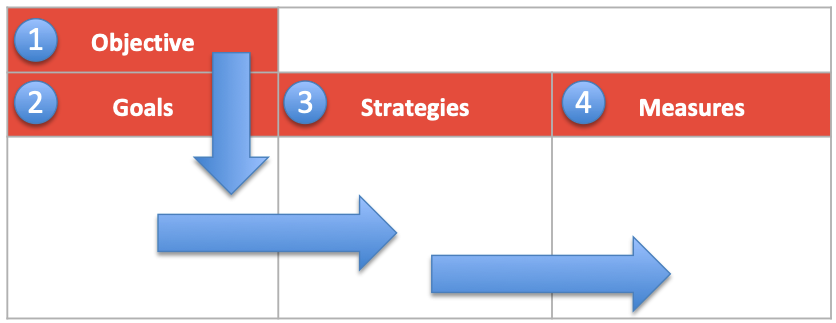
    Developing your strategy using the OGSM metholodoloy is typically a top-down process. You start with your strategic context and your situational analysis to set your objective, followed by the goals, the strategies, and the measures. 

    OGSM flow top down

    The objective is the destination of your business – what you aim to achieve over a chosen timeframe. This timeframe is typically 3-5 years for strategic planning or 12 months for annual operating planning. The objective is a qualitative statement describing the future destination.

    The goals are the qualitative translation of your objective statement. Goals are typically SMART goals to make them clear, measurable and unambiguous.

    The objective and goals jointly describe what you aim to achieve. 

    The strategies are the major initiatives that will take your business towards the objective and goals. These are qualitative statements about how you will devote your organization’s resources to achieving the objective.

    The measures are the detailed metrics and actions that quantify success and determine progress of the strategies. The measures clarify who does what and by when to execute the strategic plan.

    The OGSM is a logical flow and each ensuing step builds on the decisions of the prior step from top-to-bottom and left-to-right. 

    Check out Rock Your Strategy’s resources about OGSM and how to create effective strategic plans that deliver results. You can read a general introduction about OGSM here. The article includes links to deep dives into each element of the OGSM: objectives, goals, strategies, and measures.

    7. Review your plan bottom-up

    While you build your OGSM top-down, you review your OGSM bottom-up

    OGSM review flow bottom up

    Start your review with your Measures. Review your initiatives and your metrics and check where you are behind expectations. Direct your attention first to those initiatives which are not meeting their commitments. Then review the remaining initiatives. 

    Then move yourself up to the Strategies and confirm that you are overall on track to achieving your business’ objective and goals. 

    Where needed discuss countermeasures and agree on actions in the team

    During your review, regularly check your external environment for changes that may influence your ability to execute your OGSM and achieve your objective and goals.

    Read more about how to conduct quarterly in-depth OGSM reviews and how to do monthly check-ins to keep up with executing your plan.

    8. Cascade the OGSM

    The Merriam-Webster dictionary defines a ‘cascade’ as “something arranged or occurring in a series or in a succession of stages so that each stage derives from or acts upon the product of the preceding” (source).

    In business, “cascading” a strategy means arranging the strategy along the organization’s hierchary so that the organization is fully aligned behind the organization’s objective and works together to achieve it. 

    The OGSM methodoloy is a great way to cascade your business strategy. The approach to define objectives, goals, strategies, and measures lends itself excellently to cascading the strategy vertically and horizontally.

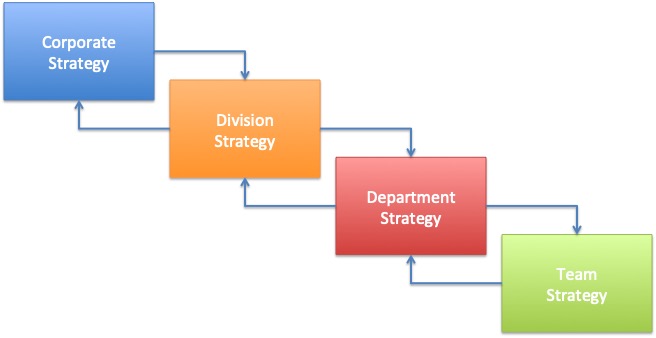
    Vertical cascading means breaking down the strategy from a higher level of the organizational hierarchy to a lower level.

    For example, the corporate strategy is broken down into the divisional strategies or the divisional strategy into departmental strategies. Cascading means that the individual lower level strategies together roll back up into the higher level strategy. Hence, successfully achieving the divisional strategies would result in the successful delivery of the corporate strategy. 

    Vertical cascade
    Cascading vertically

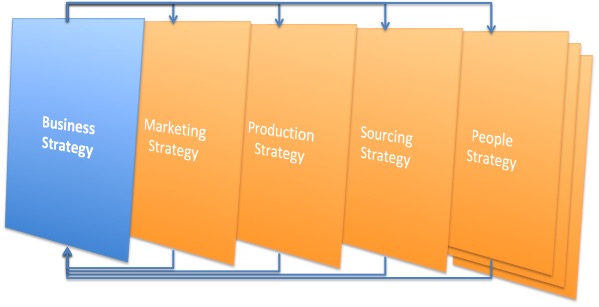
    Horizontal cascading means breaking down a business strategy into the various functions that work together to deliver the business strategy.

    For example, a divisional strategy is broken down into the sales & marketing strategy, production strategy, sourcing strategy and people strategy. Again, delivery of each of the functional strategies would ensure that the overall business strategy is achieved. 

    Horizontal cascade
    Cascading horizontally

    In practice, cascading a strategy is typically a mix of vertical and horizontal cascading. The important part is that the strategies perfectly align to ensure that the organization works together to achieve the overall business objective and goals

    One more thing: as you can see in the illustrations above as well, cascading strategy is a reiterative process. The higher level strategy gives input to the lower level strategy. And it also receives feedback and modifications based on realities in the business, feasibility, and availability of resources.

    This reiterative process is important to align the strategy and make it realistic. 

    9. Conduct monthly reviews

    When executing your OGSM, it is important to conduct brief monthly reviews to track your progress. During the monthly reviews, focus on your measures and actions. Check which initiatives are on track or where you are falling behind. Direct your organization’s attention towards those initiatives which are behind expectations and formulate countermeasures.

    Make sure to capture the actions discussed with clear caretakers and timelines for appropriate follow up to correct the course where necessary. 

    It really helps to implement a ‘traffic light’ system to track your OGSM. Ahead of the OGSM review, color the initiatives that are ‘on track’ in green, the ones that ‘need attention’ in yellow and the ones ‘at risk’ of missing its targets in red. Then during the session, jump to the red and yellow traffic lights first to identify root causes and decide on countermeasures. 

    For best practice, build the monthly OGSM reviews into your company’s regular schedule. In fact, integrate strategy implementation into your organization’s culture and make execution and meeting commitments your habit. And remember, execution culture starts at the top!  

    Read more about monthly OGSM reviews here

    10. Renew OGSM annually

    Once a year, conduct a strategic planning workshop to overhaul your OGSM for the coming year. 

    In your annual OGSM renewal session, address the following questions: 

    • What’s working? What’s not working? Review your OGSM from the current year and critically assess where you have been successful and where you haven’t. 
    • What’s changed? Re-scan the internal and the external environments and seek out any changes that will have an influence on your business and its ability to live its mission and achieve its vision. 
    • What do we need to add? What do we need to take out? Identify strategies, initiatives, resources or capabilities that your business needs to eliminate, reduce, raise or create to sustain success or become more successful.

    By revisiting your existing strategic plan and building onto it, you are developing a continuous storyline in pursuit of your longer-term vision instead of re-inventing the strategy every year. Your team will thank you for painting a consistent picture over time. 

    This doesn’t mean you shouldn’t make significant changes if this is required. In case there are drastic changes in your external environment or inside your business, you certainly need to (re-)act accordingly. In that case however instead of conducting an annual OGSM renewal exercise, go for a more fundamental strategic review. 

    When is the best time to renew your OGSM? This may differ from business to business. In my experience a good time to renew the OGSM is during your annual budgeting process. Setting your financial goals for the coming year shouldn’t happen in isolation but should directly be linked with the actions you plan to take to achieve those goals. 

    Unfortunately, that’s exactly what many businesses do: they run a complicated financial budgeting process and only later plan their activities (if at all). Don’t be one of those businesses.

    When you conduct your annual OGSM review, assemble your team, run a 2-3 day workshop, and work through the questions above together. A great way to do this is to refine your SWOT analysis. Use your findings to review your objective, set new goals, translate these into 3-5 strategies and set 2-3 measures for each strategy. Cascade the reviewed OGSM throughout your organization and finalize all strategic plans prior to the beginning of the next year.

    In my experience, if your longer-term business strategy doesn’t change, the annual OGSM does not change drastically either. I usually revist my objective to set a particular focus for a year and re-align my goals and strategies accordingly. But the most changes happen in the measures where I set specific actions for a given year as I drive execution towards the longer-term objective and goals.


    There you have it. These are our top 10 OGSM tips.

    We hope you find these tips useful in helping you to simplify your strategy and deliver excellent results. If you have any questions or comments, why not drop us a line below? We’d love to hear from you.

    See These Tips in Action: OGSM Examples by Industry

    The best way to see how these 10 tips apply in practice is to look at real OGSM examples across different business contexts. We’ve built out detailed examples for four industries — each one illustrating how a different type of organisation applies the framework, makes strategic choices, and builds an execution plan around its measures.

    • OGSM Example: B2B SaaS — a pipeline analytics company using PLG, enterprise CS, and ABM strategies to scale from $2M to $8M ARR
    • OGSM Example: AI Startup — a Series A document intelligence company building a repeatable sales motion and deepening product-market fit in the legal sector
    • OGSM Example: E-commerce / DTC Brand — a sustainable home goods company reducing paid acquisition dependence while improving contribution margin
    • OGSM Example: Non-Profit — an education foundation aligning programme growth, funding diversification, and impact measurement into one strategy
    • OGSM Example: Tony’s Pizza — the classic OGSM case study, illustrating all four components from objective to measures

    Ready to put these tips into practice? Give yourself the best possible foundation with a pre-formatted, fully customizable OGSM template. Download the OGSM Template for PowerPoint or the OGSM Template for Excel from the Rock Your Strategy shop and start building your strategy today.

  • How To Conduct A Monthly OGSM Review?

    How To Conduct A Monthly OGSM Review?

    A plan is only as good as its execution. And to keep up with execution of your OGSM, it’s important to conduct timely and engaging review sessions to stay on track. But with a full schedule of meetings already in the calendar, how do you make the most of your OGSM review?

    When conducting a monthly OGSM review, invite your senior team to a 60-min meeting in which to review the OGSM from bottom to top. Review your Measures’ key initiatives and metrics first and then move up to the Strategies. Discuss countermeasures for those initiatives ‘at risk’ or which ‘need attention’. Take down all agreed actions for follow up.

    This monthly review is however not only a meeting. It requires some preparation up front and diligent follow up thereafter. Here’s how you get the most out of your monthly OGSM review.

    Monthly OGSM Reviews

    When using the OGSM methodology for your annual operating plans, it is important to conduct monthly reviews to keep on track with execution. 

    The reason I propose a monthly review cadence (instead of quarterly for example) is to have the ability to act and respond timely to implementation progress (or lack thereof) in your senior team. This allows you to make timely decisions to double-down on what is working and pivot on what is not. Doing this only once a quarter may put the plan at risk as countermeasures may not result in desired outcomes in time. 

    Plan Ahead

    In order not to miss a session, I like scheduling out all monthly reviews ahead of time. Go ahead at the beginning of the year and send out recurring invitations for 12 sessions. That way they are in the calendar ahead of time and do not get in the way of day-to-day scheduling difficulties. 

    Having all 12 sessions scheduled out also allows you and your team to plan ahead and prepare. A well-prepared OGSM review is significantly more effective than if people need to rush an update on short notice. If the OGSM review is every second Tuesday of the month for example, there are no surprises when the next one comes around. 

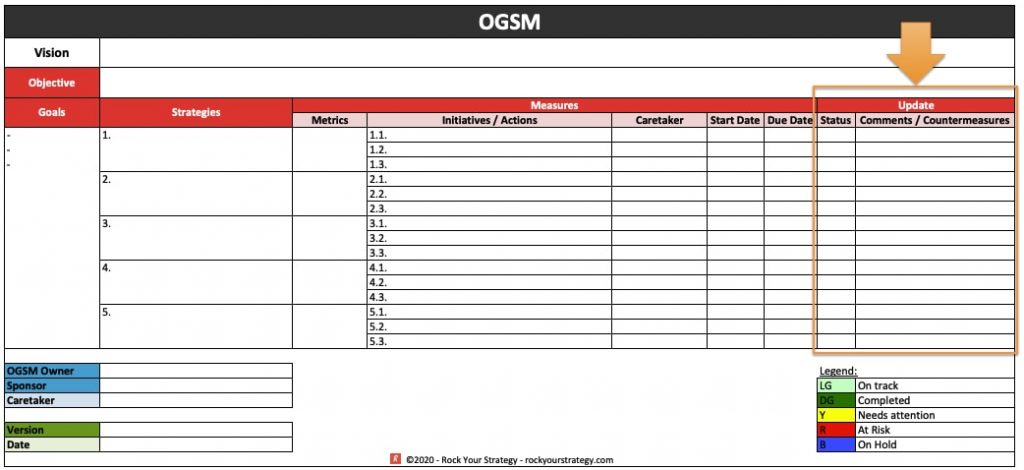
    Speaking of preparation, in my experience it really helps to have an OGSM caretaker who keeps the document current and helps prepare for the reviews. This caretaker updates the financials and key figures ahead of the review meeting and reminds strategy and initiative owners to provide their updates directly on the OGSM document (see image below). 

    OGSM Update
    OGSM Template with Update Section

    Go into the meeting with an updated and current OGSM document.

    An important word about status colors

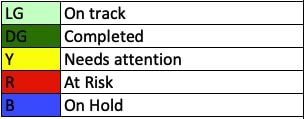
    On the OGSM document, record the status of each initiative and a brief update comment incl. proposed countermeasures (as necessary). For status, I typically use the following color-coded setting which has served me well: 

    Status Colors
    Status Update Colors
    ColorStatusDescription
    Light Green (LG)On TrackItem is in progress and on track to achieving it’s targets.
    Dark Green (DG)CompletedItem is done and targets are met.
    Yellow (Y)Needs AttentionItem needs attention by the organization or its senior team in order to stay on track and not fall behind.
    Red (R)At RiskItem is at risk of missing its targets and needs urgent attention and action. 
    Blue (B)On HoldItem has been placed on hold, postponed or deprioritized. 

    Regarding the color-coding, I always emphasize that these status settings are meant to be forward-looking and action-oriented and not punitive. A red color is not bad by itself. It does not mean that someone is getting fired. Encourage your team to use ‘yellow’ and ‘red’ statuses to signal that urgent action is needed

    We have become so accustomed that ‘yellow’ and ‘red’ on business reports are bad. What a bunch of baloney. Take active steps to take your team’s fear from using ‘yellow’ and ‘red’. Emphasize that these are signal colors to direct attention to where it is most needed. Nobody gains from beautifying or hiding the true status of an initiative just because we are trained to prefer to see ‘green’. 

    Good! Now that we got that straight, let’s dive into the OGSM review itself.

    Rundown of the OGSM review meeting

    A monthly review is not an in-depth strategy review but a monthly check-in to make sure your plan is on track. I have found a duration of 60 minutes most effective. One hour is long enough to review the performance indicators, identify key issues and decide on countermeasures. It is also short enough to make it a monthly staple without taking too much time out of operations. A concise 60-minute session keeps the group engaged and the OGSM on track. 

    During the monthly OGSM review, follow a structured agenda that guides the team through the review process. 

    Start with a review of the financials and key performance indicators. Identify where you are on track and where you are lagging behind expectations. Discuss in the team what the drivers of performance are and identify the reasons for missing the mark. 

    Then review the individual Measures starting with those which are behind expectations. Follow the colors. Begin with the ‘red’ initiatives, followed by ‘yellow’. 

    Initiatives marked ‘red’ are at risk and need urgent attention and action. Identify why you are behind. Discuss in the team effective countermeasures that you can take to adjust the course and get back on track. Agree on the actions to be taken by whom and by when and record the actions on an action item list. Then move on to the next item. 

    Let me pause here for a moment. That was brief but important! The whole purpose of doing the OGSM review is to identify where you are behind, why you are behind and to correct the course. So be candid and thorough here. The purpose is not to assign blame or search for fault. You are looking to identify where improvement is needed and then go do it. 

    Reasons why a measure is behind might be numerous: the external environment has changed, customer needs have changed, competitors are more effective, the action is not well-resourced, the team does not have the knowledge or skills needed to succeed, other unforeseen hurdles or challenges are preventing the team from making progress. 

    As with the color-coding above, when you are in session, create an atmosphere that invites the team to be candid and direct. You want everyone to be as straight as an arrow. 

    After all ‘red’ and ‘yellow’ items are discussed, review the ‘green’ initiatives which are on track. Check whether any major milestones are coming up or decisions are needed. Only discuss those ‘green’ initiatives worth discussing

    With 10 minutes left in the meeting, wrap up the initiative review and confirm all the countermeasures and actions agreed on in the meeting. Double-check that each action has a caretaker, a timeline, and that everyone is clear about the expected deliverables. Take note of all actions on the action item list. 

    At the 60-minute mark, thank everyone for their contributions and their constructive review before closing the meeting. 

    Follow up

    After the OGSM review session has ended, send a short note to all participants and OGSM stakeholders. Confirm the OGSM as it was discussed and share the action item list for everyone’s information and action. Now the focus shifts back to operations, executing your OGSM and implementing the agreed corrective actions. 

    Until the next monthly review. 

    What does the agenda of a monthly review meeting look like?

    For easy reference, this is what the agenda of a monthly OGSM review meeting might look like. Feel free to copy this out and into the invitation of your monthly OGSM review meeting. 

    TimeTopicCaretaker
    10 minReview Financials & key Performance IndicatorsBusiness Leader or OGSM Caretaker/facilitator
    10 min Review actions from previous OGSM reviewOGSM caretaker/facilitator
    20 minReview initiatives ‘at risk’ and ‘need attention’ and discuss countermeasuresInitiative owner
    10 minReview ‘on track’ initiativesInitiative owner
    10 minConfirm actions from this OGSM reviewBusiness Leader or OGSM Caretaker/facilitator
    Meeting adjourned
    Sample Agenda of a Monthly OGSM Review Meeting

    When to schedule a monthly review? 

    There is no hard or fast rule when to schedule a monthly review. I have found it most useful to schedule the meeting in the second week of the month. By the second week, you may have had a chance to review the financials from the previous month and update the OGSM document. 

    Getting the OGSM review done in the second week of the month then leaves the rest of the month to focus on operations and drive execution. 

    Consider picking a fixed day for your regular reviews, for example every second Tuesday of the month. Then your team can build a regular rhythm about the review and there is no surprise when it comes around. 

    Schedule out all 12 monthly sessions at the beginning of the year. Most calendar software such as Microsoft Outlook or Google Calendar allow you to set recurring invitations identifying the chosen day of the month. That makes scheduling the meetings easy and straightforward. Include the agenda in the invitation so everyone knows what to expect ahead of time. 

    What is the difference between a monthly and a quarterly OGSM review? 

    I like to make a clear distinction between frequent monthly OGSM reviews and more thorough quarterly OGSM reviews. 

    As described above, the purpose of the monthly OGSM review is to track the execution of the measures and to agree on corrective actions for those initiatives which are ‘at risk’ or ‘need attention’. The discussion is brief, candid and solution-oriented. The monthly OGSM review only takes about 60 minutes. 

    The purpose of the quarterly OGSM review is a more in-depth review of the OGSM to confirm whether the business is on track to achieving its overall objective and goals

    For the quarterly OGSM review, I schedule a 2-3 hour session (based on progress) which reviews each initiative and strategy. Each initiative owner provides an update on progress, milestones, challenges, and next steps. 

    The review includes an assessment of each strategy to confirm that the path chosen is still the right one to move the business towards its overall objectives. 

    If required, countermeasures are discussed and agreed on. As during the monthly review, all actions are recorded with caretakers and timelines. 

    How to create an OGSM for your business? 

    We have now been speaking about implementing your OGSM and keeping on track with your execution via monthly review meetings. But how do you actually create an OGSM in the first place? 

    Check out Rock Your Strategy’s resources about OGSM and how to create effective strategic plans that deliver results. You can read a general introduction about OGSM here. The article includes links to deep dives into each element of the OGSM: objectives, goals, strategies, and measures

    Conclusion

    The purpose of the monthly OGSM review is to ensure that the implementation of your plan is on track. The review starts with preparation already before the actual meeting. 

    Prepare all key figures and status updates prior to the OGSM review meeting to facilitate an effective session. 

    During the meeting, address those initiatives first that are “at risk” or “need attention”. Identify root causes and agree on countermeasures. 

    Record all action items, caretakers, and due dates and ensure diligent follow up after the meeting. 

    What experiences have you made with your OGSM review? If you liked this article or have any questions or comments, why not leave us a reply below? We’d love to hear from you. 

  • What Are Dos And Don’ts Of OGSM?

    What Are Dos And Don’ts Of OGSM?

    OGSM stands for Objective, Goals, Strategies, and Measures and is a simple but sophisticated approach to strategic planning. Using OGSM allows you to define on a single page what you aim to achieve and how you are going to achieve it.

    When using the OGSM approach to strategy, there are things you can do to vastly improve the effectiveness of your strategy. There are however also a few things to avoid in order not to undermine the advantages of OGSM.

    Not yet familiar with the framework itself? The Complete OGSM Framework Guide covers all four components, how they connect, and common pitfalls — a good starting point before these dos and don’ts.

    Here is our list of Dos and Don’ts of OGSM from our experience over the past decade. We will continue to update this list as we learn over time.

    Dos of OGSM

    • Introduce the OGSM: If you intend to deploy the OGSM approach to strategy, plan to take time to introduce the tool and it’s pros and cons so people are familiar with the methodology. We can help: read more about OGSM here.
    • Involve your team: if you have team members, involve them in the strategic planning process to receive their input and expertise. This also helps to create understanding and clarity in the team early on what strategic priorities are.
    • Get leadership involved: if you deploy OGSM in your business, make sure your senior leadership is aligned with your objective, goals, and strategies. Involve them early and check in along the way.
    • Conduct OGSM workshops: in our experience it is most effective to deploy the OGSM method in a strategic planning workshop. Learn more about such workshops here. Consider going off site where you are uninterrupted and free to think strategically.
    • Take sufficient time for discussion: when creating the OGSM, allocate enough time to allow for open discussions and reflection. In our experience, strategies that arise from candid strategic discussions are far more effective.
    • Include an external perspective: when creating your strategic plan, seek an outside-in perspective. Learn what customers, suppliers, partners think about your business.
    • Set a clear timeframe: be clear about the time frame for your strategy. Are you planning 3, 5, or 10 years ahead? Are you creating an annual operating plan for one year? Make sure that your objective, goals, strategies and measures align with this timeframe.
    • Be specific: use language that applies solely to your business and your situation and leaves no ambiguity or room for interpretation.
    • Use the “what-by-how” format: When writing your objective, strategies, and measures, use the “what-by-how” format to incorporate in one statement “what” you intend to do and “how” you intend to do it. This makes the statement much more clear and makes it easier to take action. Learn about the “what-by-how” method in this short YouTube video.
    • Create SMART goals: make sure your OGSM goals are specific, measurable, ambitious, realistic, and time-bound. Do include financial goals. Learn more about how to set clear goals here.
    • Create goals for the “what” and “how”: define SMART goals for the “what”-part of the objective and the “how”-part. This defines both the success of the destination and keeps track of your progress in the right direction. Learn more about the “what-by-how” method in this short YouTube video.
    • Limit yourself to 3-5 strategies: Seek to deploy no more than 3-5 high impact strategies to reach your objective and goals. Learn more about why and how to develop strategies that work here.
    • Limit yourself to 2-3 initiatives per strategy: Similarly, limit yourself to only 2-3 high impact actions or initiatives per strategy to allow sufficient focus without putting all your eggs in one basket. Read more about how to set effective measures for OGSM here.
    • Split measures into metrics and initiatives: we have found it very helpful to distinguish each measure into SMART metrics and an action plan.
    • Test your strategies and measures: check for clarity, sufficiency, alignment and resource sufficiency.
    • Assign owners: assign an “owner” for each strategy. This person is accountable that the strategy is being implemented but may not necessarily be responsible for all actions.
    • Keep the OGSM simple: OGSM is a straight-forward approach to strategic planning. Keep it neat and tidy and restrict yourself to one clear objective statement, few meaningful goals, 3-5 strategies and 2-3 measures per strategy.
    • Conduct a SWOT: use the SWOT analysis to inform your strategic process and identify high impact strategies during OGSM creation. Read more about how to conduct a SWOT analysis right and find templates here.
    • Ask tough questions: be candid and realistic about your business, its situation, its strengths and weaknesses. Have the courage to be critical.
    • Resource your OGSM: make sure you have the resources available or can build them in time to successfully execute your OGSM. Resources means funds, knowledge, and skills.
    • Agree on a governance process: Confirm at time of OGSM creation how you will follow up on execution. Set a cadence of e.g. quarterly reviews for 3-5 year strategies and e.g. monthly reviews for annual operating plans.
    • Schedule all reviews in advance: fill the calendar with all review meetings ahead of time for the duration of the year. Make the meetings mandatory for the business team responsible for execution.
    • Check in regularly: during OGSM implementation, check in regularly with your team on progress of each initiative – during formal reviews and “offline” in between. Make sure they have the information and resources they need to succeed.
    • Use OGSM for communication: the OGSM format lends itself well for communicating your strategy. The OGSM shows where you are heading and how you are going to get there. All priorities on a single page!
    • Make the OGSM transparent: allow everyone in your business to see the OGSM to understand what the priorities are and how everyone can contribute to achieving the business’ objective and goals.
    • Practice! Practice makes progress. We have learned the OGSM approach over many reiterations. We realized how the plans and their execution got better and better over time.
    • Follow through: the success of your OGSM and your strategic plan depends entirely on how it is executed and followed up on.

    Don’ts of OGSM

    • Don’t use OGSM for the sake of using OGSM: be meaningful about selecting the strategic planning approach that works best for your business.
    • Refrain from generalizations: Avoid platitudes that could apply to any business or any time. Make the OGSM specific to your business and your situation.
    • Don’t create a laundry list of actions: avoid spreading your resources too thinly across too many initiatives. Read more about how many initiatives a strategy should have here.
    • Don’t create the OGSM in isolation: top-down strategies often lack commitment and buy-in. OGSM works best when created and executed in the team and with clear strategic context. Anchor the OGSM in your business processes as described in these top 10 OGSM tips.
    • Don’t skip a step: OGSM is most effective when O-G-S-M are all addressed in order from left to right. Don’t just go through the motions but sufficiently address each step.
    • Don’t keep the OGSM a mystery: be open about the OGSM methodology and what the OGSM for your business looks like. Transparency wins! This is one of the ways you avoid the 7 deadly sins of business strategy.
    • Don’t delegate responsibility for the OGSM: the OGSM should be the strategic plan for the entire business and should be owned by the business leader. It may help to have a facilitator who reminds people of their commitments. But the overall responsibility must be with the business leader and the leadership team to avoid strategic failure.
    • Avoid perfectionism: Don’t get lost in details about the looks or the wording of your OGSM. Make sure that the statements are clear and unambiguous but then move on. It’s more important to execute than to reiterate the wording.
    • Don’t forget to execute! The OGSM or any strategic plan is only that: a plan. Use the approach to drive execution in your business.
    • Don’t cascade too far: Avoid creating individual OGSMs for every organizational hierarchy or every individual employee. OGSM is most powerful when it captures the overall priorities of a business or a function.
    • Don’t debate methodology: refrain from discussing the strategic process itself and rather focus on content and what the realities of your business are. Agree on the approach and then execute it.
    • Don’t forget to celebrate successes! Celebrate every initiative, every action, and every progress towards achieving your overall objective and goals.
    • Don’t compromise: when making strategic choices, avoid compromising if you are in disagreement. Make hard choices. Strategies need to be sharp and clear. No one wins when resources are spread too thinly to be effective.
    • Don’t create individual plans: avoid creating disconnected strategies in your business. Connect and align the strategies towards your overall objective and goals.
    • Don’t be afraid to hire external help: OGSM is simple but having an experienced facilitator or consultant can help move the business along the learning curve faster.
    • Don’t rush strategic planning: ensure you have sufficient time to prepare for a strategic review. Collect data, seek input from key stakeholders, and create a setting that allows strategic thinking. Plan a strategic workshop to run a structured strategy process.
    • Don’t confuse strategy with operations: avoid mixing day-to-day operations with the strategic initiatives that drive change and move your business towards its overall objective. Avoid including in the OGSM the activities that belong in a job description.
    • Don’t forget the action plan: each initiative under measures must have a caretaker, timeline and clear milestones. Ensure accountability and deliverables are clear.
    • Don’t include ‘nice-to-have’ initiatives: focus your OGSM on the ‘must-have’ strategies and initiatives to achieve our objective. Avoid including ‘nice-to-haves’ and running the risk of losing focus.
    • Don’t forget to monitor implementation: don’t skip the review meetings or let people off the hook. Have a regular monthly or quarterly cadence for follow up and ensure people live up to their commitments. Find draft agendas and meeting minute templates on our resources page.
    • Don’t give up on your plan too easily. Things might change in the external environment or inside the business. Don’t fold your OGSM too quickly but regularly review its implementation. Pivot where needed, but stick to your guns.

    Phew, that was a long list. Click here to find a downloadable and printable version of this ‘Dos & Don’ts of OGSM’ list.

    If you’d like to learn more about the OGSM approach to strategy, read our introduction to OGSM here. 

    What dos and don’ts have you experienced when using OGSM in your business? Let us know in the comments below. We would love to hear from you.

    Ready to put these dos and don’ts into practice? Start with the right tool. The OGSM Template Bundle gives you both the PowerPoint and Excel OGSM templates in one download — pre-formatted, fully customizable, and available at just $7.99 (save 20% vs. buying separately).

    See These Principles in Action: OGSM Examples by Industry

    The dos and don’ts above are most powerful when you can see them applied in context. We’ve built detailed, worked OGSM examples for four industries that illustrate how real organisations apply these principles — including where the common mistakes show up and how to avoid them.

    • OGSM Example: B2B SaaS — a pipeline analytics company scaling from $2M to $8M ARR, with explicit trade-offs in each strategy and a full measures table linking actions to owners
    • OGSM Example: AI Startup — a Series A company showing how to focus on one segment rather than spreading across all verticals — one of the most common don’ts in practice
    • OGSM Example: E-commerce / DTC Brand — a sustainable home goods company whose OGSM forces the hard conversation about SKU rationalisation and owned vs. paid growth
    • OGSM Example: Non-Profit — an education foundation whose strategy addresses both programme reach and funding sustainability — neither in isolation
    • OGSM Example: Tony’s Pizza — the classic OGSM case study, still the clearest illustration of how all four components work together
  • How Many Initiatives Should My Strategy Have?

    How Many Initiatives Should My Strategy Have?

    When using the OGSM approach to strategy, I often come across the question of how many initiatives a strategy should have. In the following, I summarize what works best in my experience.

    When developing the implementation plan for your strategy, define about 2-3 initiatives per strategy.  This gives sufficient focus without relying too heavily on a single action without alternative.

    There are a few things to look out for however when selecting the initiatives to implement your strategy. I’ll provide an approach to selecting and testing your initiatives below to ensure that the 2-3 initiatives you pick are the right ones.   

    Defining the initiatives to implement your strategy

    A good strategic plan not only describes clearly what you are aiming to achieve. It also describes how you are going to achieve it. The OGSM methodology allows you to describe your strategic plan on one page detailing out your objective, your goals, your strategies and your measures. The objective and the goals together define what you intend to achieve. The strategies and measures together define how you are going to achieve it. 

    For the purpose of this article, I will not dive deeper into OGSM. But you can read our introduction to OGSM here.

    Once you have defined your objective, your goals, and your strategies, you begin thinking about your implementation plan – your measures. I like to break down my measures into two parts: metrics and initiatives. 

    The metrics are the quantifiable targets and performance indicators that define success for each strategy. The initiatives are the actions and projects that will drive implementation of the strategy and lead you to success. 

    The reason I like to separate the two is clarity. When I first started using the OGSM approach about a decade ago, I noticed how my team and I often used “measures” and “metrics” interchangeably to describe the “M” in OGSM. We were wondering what the difference was and whether it made a difference at all. It did! 

    We understood measures quite literally to be things that we’d “measure”. Hence the metrics. So we defined a number of metrics for each strategy and left it at that. 

    However, during implementation during the year, we noticed that we were not quite sure whether we were on track to achieving the metrics by year end. We took a run rate (i.e. a lucky guess really as it didn’t account for seasonality) and figured that we must be about on track. Anyway, in the end things always work out, right? 

    Wrong. We had no clue. We were missing a clear articulation of what we needed to do to turn the strategy into reality and check whether we were on track or not. We needed a clear translation of the strategies into measures which included both metrics and an action plan. The metrics would allow us to track progress and keep us on track and the action plan would clearly articulate what had to be done by whom and by when to achieve the metrics. 

    From then on out, we always defined measures as both metrics and initiatives

    So then how many initiatives are right? 

    In the first couple of years that we split metrics and initiatives in our annual operating plan, our OGSM was basically a large action plan. We probably had about 5-8 actions per strategy – sometimes more than 10. All actions started in January, ran in parallel and ended in December. So across the entire OGSM with 1 objective, 6 goals, 4 strategies and about 5-8 measures per strategy, we ended up with close to 30 actions! This was not only a massive effort to implement, it was a massive effort to keep track of! We didn’t know better and proceeded. 

    It quickly became clear however that this was not going to be effective. Our OGSM reviews took 8 hours every month. We were committed to action and accountability and wanted to go through each initiative and confirm we were on track. When we weren’t, we wanted to know why and what we had to do to get back on track. With close to 40 initiatives one year, this took forever. 

    We had noticed that many of the initiatives we tracked were actions we had to do anyway during daily operations. We defined actions such as “visit 10 customers per quarter”. The action was specific, measurable, ambitious, realistic and time-bound. It was however also exactly what was expected of our customer service team anyway during a typical sales process.

    We had also noticed that we described different actions under different strategies that actually contributed to the same projects. For example, one strategy had to do with driving growth, another strategy had to do with innovating. We noticed that we duplicated several initiatives that were counted under growth and under innovation. We were looking at the same topics over and over again just from different perspectives. That was redundant and a waste of time. So the following year we changed our approach. 

    In order to streamline our annual operating plan, we decided to define no more than 2-3 initiatives per strategy. Two or three initiatives per strategy meant we had max 12 initiatives overall, which was plenty for my team to handle. And we immediately noticed a change in how we implemented. 

    • We were much more focused. Fewer initiatives allowed us to allocate more resources for each initiative. It became easier to keep track of our OGSM. And it was easier to communicate and remind each other what was important.  
    • We were much more effective. We noticed that greater focus led to greater achievement of milestones and progress towards our goals and objectives. We had to put things on hold less often or pivot to change our approach.
    • We were much more efficient. We noticed that we spent much less time reporting and discussing progress updates of the action items. Monthly reviews were much more efficient and took less time. 
    • We were much more successful. When we conducted our year-end review and looked at our achievements, a couple of colleagues were quick to point out that they felt our success was directly linked to our much more focused execution. This felt really good!

    Since then, I always guide my teams to define no more than 2-3 initiatives when designing the measures for the OGSM. This avoids building a laundry list of actions. Instead, fewer initiatives keep the team on track, allow greater concentration of resources for each initiative, and vastly increase the chances of success. 

    How do I select my initiatives? 

    OK, got it. So I am only supposed to choose 2-3 initiatives for each strategy. But how do I choose those initiatives? How do I know which ones are the right ones? Excellent, those are the right questions. Unfortunately there is no hard and fast rule. But this is what has worked well for me. 

    During the strategic planning process, I conduct a SWOT exercise for my business. In the team, we reflect on our core strengths and our biggest weaknesses, we look at the most promising opportunities and the largest threats. We do this by conducting an internal assessment but we also use our customer satisfaction feedback to get an external perspective. This gives us valuable insights into what we need to do differently. The SWOT informs our strategies and then the detailed initiatives with which we implement our strategies

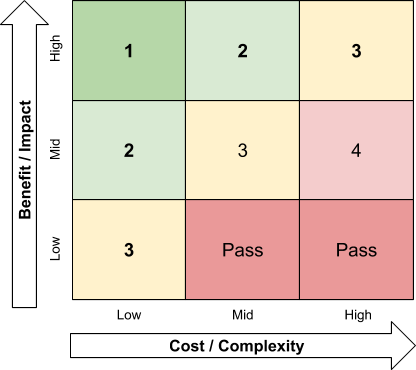
    The SWOT analysis is probably my primary source for initiatives. In addition, we may conduct a brainstorming exercise with a cross-functional team to come up with additional ideas. All ideas are then ranked based on cost vs. benefit or impact vs. complexity. We choose those initiatives with the largest impact towards our metrics and goals with the smallest strain on resources

    After you have chosen your initiatives, write the initiatives in the ‘what-by-how’ format. This means structuring the sentence that describes the action in two parts: the ‘what’-part and the ‘how’-part. The ‘what’-part describes what needs to get done. The ‘how’-part describes how it will get done. Here are a couple of simple examples: 

    • Win new customers by launching a targeted social media marketing campaign
    • Save costs by combining trips wherever possible 

    These are just examples to illustrate the ‘what-by-how’ method. I first learned about the ‘what-by-how’-format from the practical OGSM guide “The 1 Page Business Strategy” by Van Eck & Leenhouts. It’s a great way to write your initiatives as clearly and measurable as possible. Make them unambiguous. Leave nothing to chance.

    Finally, make sure that each initiative has a caretaker and a clearly defined timeline and milestones. Ask the caretakers whether they understand what is expected of them. Ask them to describe their initiative in their own words. Clarify when and how you expect them to report on progress and what successful delivery looks like. Check whether they have the resources, knowledge and skills to be successful. Remember, nothing gets done unless accountability is clear and caretakers buy in. 

    How do I test my initiatives? 

    After you have selected the initiatives for your strategic plan, conduct a test to check whether the initiatives are indeed the right ones. Do four checks: 

    • Check for alignment 
    • Check for sufficiency 
    • Check for clarity
    • Check for resource sufficiency

    Check for alignment to ensure that each chosen initiative directly supports implementing the strategy and achieving the desired goals and objectives for your strategy. This tests whether the initiative is actually effective in achieving the targeted goals in part or in full.

    Check for sufficiency means reviewing all initiatives together and checking whether they fully implement all aspects of the strategy. This tests whether the chosen 2-3 initiatives fully address the purpose of the strategy and whether all measures and metrics can be accomplished. If aspects of the strategy are not yet sufficiently addressed, choose another initiative or swap for one with greater impact. 

    Check for clarity means confirming that the initiative is fully understood by the organization. Especially the people responsible for implementation must know exactly what is expected of them. Make sure that for each initiative there is a caretaker, clear actions, timelines and milestones defined. Ask team members to repeat in their own words what the initiative aims to achieve to check understanding and clarity. Rephrase the initiative in the strategic plan if needed to be absolutely clear. 

    Check for resource sufficiency means confirming that you or the team have the resources needed to successfully complete the action or initiative. Resources may mean money (e.g. cash, capital etc), time (e.g. number of employees / FTEs), knowledge (e.g. access to data or information), or skills (e.g. expertise, experience). Confirm that you already have access to the needed resources or can build them in time. Be realistic about this! This is not the time to be overly optimistic or try to be a hero.

    Pro-tip: conduct the 4 checks with your team or if you are a sole business owner with a mentor or board member. It has always paid off for me to get a second pair of eyes on my implementation plan. Discussing the implementation plan in the team allows you to collect feedback, questions and concerns and further create clarity and commitment. 

    What if I have more than 2-3 initiatives? 

    When you choose your initiatives and you conduct your test and you realize that you need four or even five initiatives to implement the strategy, then go with four or five. 

    Each business is different and each strategy is unique. If you need five initiatives to successfully implement your strategy and achieve your goals and objectives – and you have the resources to do it – then decide on five. The purpose is to be successful and deliver results. No one will celebrate you for having followed the OGSM rules and having limited yourself to 2-3 initiatives if you fail to implement your strategy (spoiler alert: there are no rules). 

    The reason why I go with 2-3 is to force choices and to make trade-offs. More often than not, we tend to throw more resources at a problem than necessary. I call this ‘tossing spaghetti against the wall’ to see which ones stick. As so often in business, try to do more with less. If you can accomplish your strategy with only 3 initiatives, then you do not need number 4. If you need more than 3 to be successful, that’s perfectly ok too.

    Conclusion

    When developing the implementation plan for your strategy, choose 2-3 initiatives per strategy. This allows sufficient focus without putting all your eggs in one basket. 

    Conducting a SWOT analysis or brainstorming are effective ways to come up with initiatives. Prioritize initiatives by analyzing cost vs. benefit or impact vs. complexity. 

    For each initiative ensure you define a caretaker, timeline, and expected deliverables. 

    Conduct four tests on your initiatives to confirm they are the right ones: check for alignment, sufficiency, clarity, and resource sufficiency. 

    I hope you find this article useful and wish you success with implementing your strategy. If you have any questions or comments, why not leave a reply below. Would love to hear from you! 

    References

    Van Eck, Marc & Leenhouts, Ellen (2014). The 1 Page Business Strategy – Streamline Your Business Plan In 4 Simple Steps. Pearson Benelux.

  • Should Small Businesses Do Strategic Planning?

    Should Small Businesses Do Strategic Planning?

    In small businesses strategic planning is often brushed aside as being too costly and time-consuming and taking too much attention away from operations. However, without a strategic plan, a business would lack the clear sense of direction it needs to be successful. So as an aspiring small business owner myself, I explored the question whether a small business really should do strategic planning or not and I found some interesting answers.

    In short, strategic planning is not only for large corporations but for small businesses too. Clarity about the vision of the business, its objectives, where to play and how to win are critical for any business. A well-crafted, well-communicated, one-page strategic plan is however sufficient for a small business to succeed.

    Such a one-page strategic plan does not need a lot of time or money to create. It only takes some strategic thinking about a few key questions. I’ll explore these questions in the following but first let’s understand why small businesses should do strategic planning. 

    Why small businesses should do strategic planning

    The easy answer to the question whether small businesses should do strategic planning is of course: yes! But why really? Strategy is about making choices. But when you are just getting started, you don’t have much of a choice and pretty much jump at every opportunity you get to gain a customer and make a sale. 

    But even as a small business your resources are finite, your time is limited and there are millions of ways you can spend your time. You want to make sure your time and talents are directed towards those activities that will help you reach your objectives – fast. And for that you need a plan. 

    A plan helps you define what success means for you and how you are going to achieve it. Anyone who has ever aimed to reach any objective will tell you that any endeavor with a plan is more likely to succeed than one without. I’m sure you have the same experience. This is why football coaches create game plans and why my dad always looked at the route planner before setting off to drive the family to our vacation destination. 

    And that really is what a strategy is: a clear direction or plan of actions that will help you get to a goal or destination. So why wouldn’t you want to have a strategy for your business?  

    Truth is many small business owners feel they don’t have the time or the resources to create a complex strategic plan. Any time away from customers and operations feels like you are not making progress. And I feel the same way. Every time I don’t publish, I feel like I am wasting my time. 

    However, how do you know that you’re spending your precious time on the right activities? How do you know whether the customers you are pursuing are the right ones? And does everyone in your business from shareholders to employees understand why those activities and customers are the right ones? Are they spending their time on activities that are aligned with your objectives as well? 

    This is where a well-crafted, simple strategic plan comes in. First it helps to clarify why you are in business and what your main objective is. This is something I no longer take for granted. Even to remind myself why I got started in the first place is quite helpful to stay focused and keep motivated. When I hit a roadblock or have had a frustrating day, reminding myself why I am in business gets me back up to try again and keep going. 

    Next, having a strategic plan that clearly articulates the initiatives and metrics that need to be accomplished to succeed will actually get you there. A plan without execution is only that: a plan. So having a plan with clear initiatives and measures that articulates what actions need to be taken, how resources are allocated, and keeps track of execution will lead to success. 

    Finally, a simple but effective strategic plan aligns the team with the overall vision and objective. A plan that not only paints an inspiring vision or desirable destination but also shows a path how to get there really gets the team fired up and moves the team into motion. And you want the team to be as clear as you are about the business’ direction to be fully engaged and committed to do whatever it takes to achieve success.  

    A great way to summarize such a strategic plan is the OGSM methodology. OGSM stands for Objective, Goals, Strategies, and Measures and is a one-page business plan that defines where you are heading and how you are going to get there. It’s simple, it works well to get the team involved and it builds-in the execution plan. In my experience the OGSM is a great way for small businesses to create their strategic plan, drive execution and achieve the  desired results. 

    What are elements of a strategic plan? 

    So what then are the strategic questions you need to answer for your small business strategic plan? Explore the following: 

    • Why are you in business? Don’t take this for granted or laugh it off. Being clear about why you are in business gives you and your company a purpose, a “raison d’etre”. What is it that made you start your business in the first place? How does running your company achieve that purpose? For me it helps to remind myself that I am in business to provide for my family and to inspire growth. That’s what gets me out of bed in the morning and what keeps me going when I hit a rough patch.
    • Where are you heading? What is the vision and the objective for your business? The vision is your longer term aspiration while the objective is a concrete statement about what you want to achieve in a given period of time, e.g. 3 years or the next 12 months. Define unambiguous SMART goals that allow you to quantify your objective and measure success. 
    • How are you going to get there? Audit your external environment for opportunities and threats and assess your personal and your business’ strengths and weaknesses. Check how they match up and identify the ‘sweet spot’ where your purpose, vision, objective, strengths and opportunities overlap. Identify a small number of concrete customers or customer segments and product or service offerings in this focus area and figure out how to use your strengths to create a competitive advantage. Create 3-5 strategies that move you towards your objective and achieve your goals. The key point here is focus. You won’t be able to do everything for everyone. Double down on the ‘sweet spot’ and give it all your focus and energy.  
    • What obstacles could prevent you from achieving your objective? Go back to the threats and weaknesses you identified in your external and internal analyses and review your competition. Identify concrete risks that could prevent you from reaching your goals. Create mitigation measures to proactively address and overcome the most likely and most devastating risks. 
    • What key actions are you going to take every day to move towards your objective and achieve your goals? Now pull your key strategies and risk mitigating measures together and create a concrete action plan. Each action must have a timeline and caretaker. Make sure that the actions are sufficient to cover all strategies and achieve all goals. Review for clarity and get buy-in and commitment from your team.
    • How are you keeping track of your progress to stay on course? Create a governance procedure, such as reviewing your action plan once per month and reviewing your strategies and risks every six months. Make a commitment to yourself and to your team to get at it and do not let off. 

    Capture the answers to these questions in your OGSM. If your OGSM is well-aligned following the above strategic questions, then you can fully focus on your customers and execute your action plan in daily operations knowing that it will lead you to achieving your strategic objectives. 

    And then go at it and execute, execute, execute. 

    To learn more about the OGSM approach to strategy, click here to read my introduction to OGSM and review each step in detail. 

    Why do small businesses ignore strategic planning?

    Whether evident or not but every business has a strategy. Some businesses are more explicit about their strategy while others more implicit. Every business does somehow allocate resources and does decide which customers or projects to pursue to achieve results. Not every business however goes through a deliberate planning process and documents their strategy. And this can have several different reasons. 

    • Too busy – small businesses and their owners might be so consumed with keeping the business afloat that taking a step back and planning ahead seems like an impossible task. I always have to think of this cartoon in which two people are busting their guts pulling a cart with square wheels. When another person arrives and suggests round wheels they decline saying they are too busy to entertain his idea. Sometimes it can be very useful to take a step back to look at the bigger picture and confirm that you are still going in the right direction. 
    • Not sure how – some small businesses may simply lack the knowledge and expertise about how to do strategic planning or how to do it effectively. Strategy does not need to be rocket science though but can be a simple plan that sets priorities for the business. 
    • Fast changes – many businesses nowadays operate in rapidly changing environments in which a strategic plan may appear outdated as soon as it is decided. Even in those environments however it pays to be clear about what the objectives of the business are and how results are measured and achieved. Especially when there is a large team at work, when things change quickly, you want to reiterate your plans quickly and have everyone involved so that everyone knows at all times what’s important and how you plan to succeed. 
    • Owner led – a small business may be led by an owner with strong strategic skills who is able to mastermind the strategy and direct the team. Great industry knowledge or foresight may allow the owner to anticipate changes and adjust the course proactively. Nevertheless, making the strategy transparent and creating clarity about how everyone contributes to its successful implementation creates engagement and engagement creates results. In my experience an effective team is always stronger than an effective individual. 

    Whatever the reason may be, if you have not considered taking a step back for your small business to review the bigger picture and create a strategic plan, I would encourage you to do so. One of the worst things that can happen to a small business and its owner is to be surprised and unprepared in the face of an unforeseen event.

    If you are still not sure where to start, don’t worry, you have come to the right place! Learn here how to create a business strategy that delivers results in 6 simple steps.  

    Common mistakes small companies make in strategic planning

    While some small businesses ignore strategic planning, others have tried and failed. In fact, a Forbes Insights study of 163 CEOs revealed that more than a third of all strategies fail. Here are some common mistakes I have seen in practice and how you can make sure they don’t happen to you. 

    • Pursuing someone else’s strategy – reading strategy books and autobiographies of successful business owners and entrepreneurs can be inspiring. And copying someone else’s strategy can be a good idea. However it must fit your business. It must be an approach that you can apply and customize to your business and your situation. It’s fine to seek inspiration and motivation from successful reference cases. Reality is not every business will be the next Apple or the next Tesla. Blaze your own trail. Build a strategy that fits for you and your business.
    • Spreading too thinly – No, I am not speaking about spreading Nutella too thinly on a slice of bread even though that would be a mistake as well (the ratio must be 2:1!). Lack of direction and lack of focus lead to spreading your resources across too many activities. You are much more effective if you can devote your entire attention and energy to delivering one thing instead of trying to deliver four, five or six things simultaneously. When developing your strategy, focus your attention on those initiatives with the biggest impact and highest likelihood of success towards your objective and goals. Do those first activities first that take you 90% there and then optimize later to take you the rest of the way. 
    • Working on the wrong things – If you are like me, it’s easy to get distracted by customers who yell the loudest or innovations or technical gadgets that seem most interesting. Resist the urge. Do not fall prey to “shiny objects”. Check your biases towards recent events, availability of information, or most memorable experiences. Focus on those things that matter most to your purpose, vision, and objectives.
    • Lack of communication – what good does a strategic plan do when it lands in a drawer after it’s designed and doesn’t see the light of day? Make your strategic plan transparent to your business, your employees and key stakeholders. Over-communicate. Make sure everyone is absolutely clear what the priorities of the business are and how everyone contributes to the achievement of your objective – from management team to part-time aid. 
    • Starting with PowerPoint – when thinking about “strategy”, have you ever caught yourself thinking about presentation slides and strategy tools rather than an actual action plan? If you are planning a strategic review, do not first open your slideshow software. Start instead by talking to your customers and your employees about their challenges and what they would love to be able to do or achieve. Use the insights to design your strategy process.
    • The most common mistake I have experienced though is not executing! Whether in large corporations or small businesses, the biggest issue with strategic plans is not doing what you said you were going to do. If this sounds familiar to you, don’t worry, you are in good company. And there are a million reasons for this: things change, quality issues get in the way, tragedy strikes, or you run out of cash. A strategy should never be carved in stone to remain flexible to adjust to changes in the internal or external environment. But be deliberate about building in the execution plan and review cadence and follow through ruthlessly. Pivot when you need to. But execute, execute, execute. 

    Now you know! And because knowledge is power you can now make sure that the same mistakes don’t happen to you.

    Conclusion

    Yes, strategic planning is not only for large corporations but for small businesses too. Strategy gives a business the direction it needs to be successful by defining where to play and how to win. 

    Developing a strategy does not need to be costly and time-consuming. It could be as simple as a conversation in your team about where you are heading and how you are going to get there. Whatever you do, document your objective, goals, strategies and measures on a one-page strategic plan, involve your team, over-communicate with your employees, and execute, execute, execute 

    Now over to you. How does your small business do strategic planning? If you have any questions or comments, why not drop us a reply below. We would love to hear from you.

  • OGSM Example: How Tony Turns His Pizza Parlor Into An Italian Restaurant

    OGSM Example: How Tony Turns His Pizza Parlor Into An Italian Restaurant

    Have you wondered how to use the OGSM methodology in practice or have been looking for an instructional OGSM example? Meet Tony! Tony is a fictional character who has applied the OGSM approach to strategy in his restaurant business. 

    OGSM stands for Objective, Goals, Strategies and Measures and is a one-page business plan that defines ‘what’ you aim to achieve and ‘how’ you are going to achieve it. As part of a strategy process, the framework guides through setting the objective and the goals first (the what) and then defining the strategies and measures (the how).

    In this fictional example you will learn step-by-step how to apply the OGSM methodology to strategic planning in a small business. You can download the example as PDF document for free at the end of this article or download a pre-formatted, fully customizable template to create your own OGSM here.

    OGSM example for small business

    Tony is the owner of a small chain of pizza restaurants called Tony’s Pizza. There are two locations in the tri-state area. After weeks of wondering whether small businesses should do strategic planning, Tony has gathered his team to review their strategy and identify new areas of growth. Having subscribed to Rock Your Strategy, Tony is beginning with a discussion of the mission of the business. 

    “Easy!”, exclaims Stefano, head chef of the chain and designer of its menu. “All we have to do is expand the menu beyond pizza. We are an Italian family restaurant after all! Diners want antipasti and secondi!”. 

    “Italian family restaurant?” asks Jen confused. Jen is Tony’s wife and takes care of the company’s finances. “Honestly, we are a pizza parlor. We make pizza and sell pizza. People come here because we have the best pizza at the best prices. People don’t come here for the ‘dining experience’”.

    Brian, the part-time delivery driver, looks up from his smartphone. “Actually, I do get asked occasionally when I deliver pizzas whether we are only a pizza delivery service or whether we have a sit-in restaurant as well. It seems customers are not aware of our two restaurant locations.”

    Tony realizes that this is going to be more difficult than he had expected. Ten minutes into the meeting and there is no consensus about what kind of business they are actually running today: a family restaurant, a pizza parlor, or a pizza delivery service? Tony senses that clarity about today’s business is needed before they can discuss how to identify future opportunities for growth. 

    Setting the objective

    Reviewing the business had been an exciting journey for Tony and his team so far. They studied their business financials and customer feedback. They reviewed local economic data and sifted through competitive insights. Tony and Jen even dined a couple of times in different restaurants in the city to see what other restaurants were doing. 

    Tony was pleased to read how much customers loved their pizza. Particularly their pizza dough and his family’s secret pizza sauce received rave reviews. Tony had introduced his grandmother’s Sicilian recipe four years ago and since then their pizzas almost sold themselves.

    In their analysis, Tony was surprised to see population growth figures in the tri-state area and rising GDP per capita. It’s true, more and more young families had moved to their town from the city over the past 5 years ever since the new interstate was built. But he hadn’t realized how much bigger the town had become. 

    Speaking with the mayor, the chamber of commerce and other small business owners, Tony learned that their town had become a popular dwelling for families who sought more space outside the city but were not willing to give up their modern city lifestyles. The only thing missing really was more dining choices. There were a couple of pizza restaurants, fast-food chains, and a steakhouse. After all, they had been doing well in this setting with their pizza parlor for many years. But Tony was curious whether a proper sit-down family restaurant with Italian cuisine would be a popular niche not yet served. 

    After further studying the possibility, Tony and his team made a decision. They were to transform one of their pizza parlors into a family restaurant. Tony captured their objective: 

    Tony’s aims to expand beyond its delicious pizzas to become a trusted Italian restaurant where families feel at home by offering enjoyable, freshly cooked Italian meals. 

    Tony looked up and felt proud. This sounded like a great objective. He could already see the smiles on happy customer faces and smell the intoxicating scent of fresh Italian dishes being served.

    OGSM Example - Objective
    Tony’s OGSM with Objective Statement

    Defining the goals

    Tony had decided to sleep over his freshly drafted objective statement. This is something he had learned from his late mother: important decisions should not be made lightly. Tony could still remember the ring of her voice in his ears, “a good night’s sleep will bring clarity and determination.” And that was the case. 

    Coffee in hand, Tony and his team resumed discussion on their new strategy. They sought to create 3-5 strong strategic initiatives that would help them turn their pizza parlor into an Italian restaurant local residents would love. 

    But first, Tony reminded his team, it was important to translate the objective statement into quantifiable goals so that they knew what success looked like and could measure their progress. 

    Tony had read on Rock Your Strategy that translating the objective into goals meant creating clearly measurable SMART goals for every aspect of the objective statement. So they went to work. 

    First they divided the objective statements into several parts and wrote each part on a flipchart. Then for each part, they defined 1-2 SMART goals. 

    Tony’s aims to expand beyond its delicious pizzasRevenue $50K / month,>50% of revenue from non-pizza items
    to become a trusted Italian restaurant >30% of people in tri-state area are aware of Tony’s new Italian restaurant>70% of customers are local repeat customers from the tri-state area
    where families feel at home>80% of customers recognize Tony’s as “family-friendly” and “homely”
    by offering enjoyable, freshly cooked meals.>80% of customers indicate “high food quality”>90% of customers indicate they “enjoy” their meals<1% of dishes are returned

    Having defined the objective statement and broken it down into 8 concrete goals, Tony filled them into the OGSM template which he had brought to the discussion. 

    OGSM Example - Goals
    Tony’s OGSM with Goals

    Now that they knew what they wanted to achieve, Tony, Jen, Stefano and Brian turned to how they were going to get there. 

    Choosing strategies

    It had felt odd to Tony at first when Jen had suggested they do a SWOT analysis for their business. They were a family restaurant after all, he had insisted, not a glizzy corporation in the Fortune 500. But Jen had relented, as she usually did. And in the end Tony was glad that she did. When they were brainstorming their strategic initiatives, the SWOT analysis did come in handy

    SWOT Example
    SWOT Analysis of Tony’s Italian

    The team further debated several aspects of successful Italian restaurants they knew. But the longer they discussed, the more they came back to two important principles. They wanted to create a restaurant that remained true to Tony’s roots and values and that reminded people of the cozy pizza parlor heritage. And they wanted to make sure that the restaurant was unique to the tri-state area and incorporated features of the community. 

    Tony paused, “Wow, that’s it! Before we go any further and define our strategies, let’s make this our vision. I think it would be important that we not only define an objective for the next 3 years, but that we have a longer term vision that we strive for. I want everyone at Tony’s to know who we are and what we stand for. And I want our guests to feel it too.” 

    Tony walked to the flip chart and and wrote in big letters:

    The best fresh, authentic Sicillian food at home in the tri-state area.

    Tony took a step back before he approached the flipchart again and underscored the words fresh, authentic, and home. Yes, now they were ready to choose their strategic initiatives

    At the end of the day, they stared at 5 scribbled statements on scattered flipcharts. At that moment they knew they had nailed it. 

    • Offer dishes the entire family will love by developing an authentic Italian menu with Tony’s all-time classics and rotating seasonal specialties
    • Serve great-tasting, freshly cooked food by sourcing most ingredients fresh from the local tri-state area 
    • Turn customers into guests who feel at home by designing a cozy restaurant interior that reminds people of a small-town Italian trattoria.
    • Hire and train experienced employees who embody Tony’s values and make guests feel at home. 
    • Make people in the tri-state area aware of Tony’s new dining experience by implementing marketing initiatives that create interest to give the new Tony’s a try. 

    Jen recorded the strategies on the OGSM template before they called it a day. 

    OGSM Example - Strategies
    Tony’s OGSM with Strategies

    Defining the measures

    It had been a heck of a day. The oven at Tony’s prime location broke just as they were pre-heating in the morning before the busy lunch hour. Thursday was pizza day at one of the larger companies in town and many of the employees usually came in for Tony’s special set lunch that day. 

    The initiative had started 5 years ago shortly after Tony started his first pizza parlor. Tony lost a game of golf to the owner of the business. What was making good on a bet at first had meanwhile grown into a weekly custom: Thursday was pizza day! Today however it was a nightmare. Instead of working on the measures of their strategy as they had hoped, Tony and Jen spent the morning scrambling to get parts to fix their oven. 

    This reminded Tony that strategy was not about getting his head into the clouds but to develop a very real approach to real progress. At the same time, he didn’t want to get discouraged by the mishaps of the day-to-day and continue working on the measures the next day. And so they did.

    When Tony, Jen, Stefano and Brian resumed the next morning they had the task to break down each strategy into meaningful metrics and initiatives that would drive implementation of the strategies. 

    Defining metrics

    After several hours of discussion, they had defined as measures several SMART metrics and 2-3 key initiatives per strategy.

    StrategiesKey MetricsKey Initiatives
    Offer dishes the entire family will love by developing an authentic Italian menu with Tony’s all-time classics and rotating seasonal specialties⅔ of food choices non-pizza

    >5 kids menu items

    10 shareable appetizers

    5 new food items every season

    2 new wines every season
    Create new food menu by reviewing existing menu and adding new Sicilian choices

    Create new drink offering by reviewing existing drink list and adding an Italian wine list 

    Develop new, shareable food items by combining inspirations from the local area and Sicilian food culture
    Serve great-tasting, freshly cooked food by sourcing most ingredients fresh from the local tri-state area80% of customers recognize “freshness”

    75% of ingredients from tri-state area

    Food costs <30% of operating income
    Learn customer tastes & preferences by creating a short survey and asking guests to fill when settling bill  

    Identify new supplier of fresh vegetables by contacting local vendors
    Turn customers into guests who feel at home by designing a cozy restaurant interior that reminds people of a small-town Italian trattoria.80% of customers indicate they “feel at home”

    50% of customers comment on “Italian” feel or experience
    Make guests feel like family by Tony or Stefano greeting guests

    Design restaurant interior with inspirations and family photos from Sicily 
    Hire and train experienced employees who embody Tony’s values and make guests feel at home. 80% of employees have >2 year restaurant experience

    100% of employees indicate they are “happy” at Tony’s and feel like “family”

    100% of employees can tell Tony’s story
    Make employees Tony’s ambassadors by Tony and Stefano personally training each new hire and telling them Tony’s story

    Make employees feel like family by regularly sharing meals and activities
    Make people in the tri-state area aware of Tony’s new dining experience by implementing marketing initiatives that create interest to give the new Tony’s a try. ~5% of sales spent on marketing & local media

    30% of people in tri-state area know of Tony’s

    70% of customers say they know Tony’s story

    >500 facebook shares and likes per month
    Rebrand Tony’s from pizza parlor to Italian family dining by writing and telling Tony’s family story

    Get the word out by creating a facebook page and designing a social media marketing campaign 

    Encourage guests to share their Tony’s experience on facebook by creating little offers and fun prizes

    Creating an action plan

    Jen, as usual dotting the i’s and crossing the t’s, remarked, “we are not done yet! The initiatives don’t have timelines and caretakers yet. Don’t think for a minute that I will do all this alone, boys! We are in this together and I don’t want this plan to land in the drawer. Let’s make sure we all share some of the actions.”

    Before Brian could say anything, Jen shot him a serious if playful look. “Yes, I know you are part-time, Brian. But you are part of the team…”, Jen paused glancing at their strategic plan, “…part of the family.” 

    Tony chimed in, “I agree, Jen. We will only be able to pull this off, if we do this together. Are you guys in?”

    Stefano smiled, got up and walked over to Brian. Giving him a big Italian family hug he exclaimed, “Familia!”

    Brian laughed, gasping for air. “Yes, yes, ok, ok. I’m in. Just let me get some air, please!” Brian reviewed the measures. “I can take care of the marketing and social media part.”

    So they finalized their plan by filling in the OGSM and including caretakers and discussing a timeline to realize their plan. In less than a year they wanted to be operating under their new name and brand. And within three years “Tony’s Italian” was to become a staple in the tri-state area. 

    OGSM Example - Measures
    Tony’s OGSM with Measures

    “There!” Tony was proud. “We have taken the first step to turning Tony’s Pizza into Tony’s Italian family restaurant. This is exciting! I cannot wait to get started.”

    Before they closed their meeting, they agreed to review progress on their plan every second Monday of the month when Tony usually invited all employees to a large family lunch. 

    Jen printed two copies of the OGSM and hung one in their little office and one into the kitchen of their restaurant. If they were to be successful with their plan, she wanted it to be present and visible to everyone at all times. 

    She looked at the large print on the wall. “That was a hard piece of work,” she murmured more to herself, “and the work has only just begun.”  

    Where to go from here?

    Click here to download Tony’s example OGSM as PDF document. Or click here to browse our jam-packed resource page with other free examples, tools & templates and workshop materials to help you get started with your own strategy process.

    Click here to learn how to use an OGSM template to simplify your business strategy.

    Read about the top 13 reasons why successful companies deploy the OGSM methodology or how to avoid the 7 deadly sins of business strategy.

    If you enjoyed this example or have any questions or comments, why not leave us a reply below or sign up to our free newsletter here? We’d love to hear from you. Rock on!
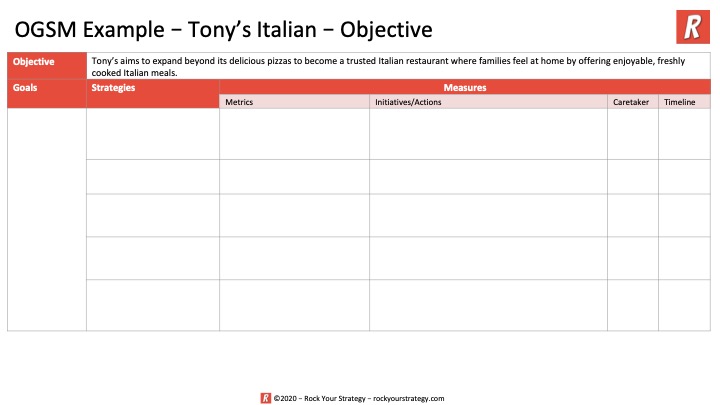
  • How to Set Effective Measures to Implement Your Strategy

    How to Set Effective Measures to Implement Your Strategy

    When using the OGSM methodology or developing any strategic plan, it is important to define strong measures that drive strategy implementation. This is how you turn your strategy into results.

    Measures are the M in OGSM and include key metrics and an action plan that track strategy execution and define who does what by when.

    This is where the rubber hits the road. After deciding your objective and goals and choosing your strategies, the measures move the business towards its objective and tell you whether the strategy is working in practice.

    Divide measures into key metrics and action plan

    When defining the measures for strategy execution, I have found it very helpful to think of them in terms of key metrics on the one hand and key initiatives on the other hand. Key metrics measure progress and quantify achievement. Key initiatives are the actions that drive you forward. Both are critical to success. 

    First, define your key metrics. For each of your strategies, choose 2-3 key metrics that define success for the strategy. Similar to how goals are the translation of the objective into facts & figures, the metrics translate the strategies into numbers. 

    When you wrote your strategies you applied the “what-by-how” format to indicate what needs to be done and how it will be achieved. Now define 1-2 key metrics each for the “what”-part and for the “how”-part. This ensures not only that you know when you have achieved your strategy but also if you are making progress in the right direction while taking action. 

    Similar to the goals defined earlier, use the SMART approach also for choosing your key metrics. The metrics should be specific, measurable, ambitious, realistic, and time-bound. 

    The key metrics should be linked with your goals. When you have defined your key metrics, check back whether that is the case. Delivering all the key metrics should achieve all the goals. Not more, not less.  

    Next, craft your action plan by defining key initiatives. The action plan should be a concise list of key initiatives that turns the strategies into reality.

    Write your initiatives in the “what-by-how” format which you also used when writing the strategies. This again ensures that for each action it is clear what you aim to do and how you are going to do it. For example, “identify new customers by asking existing customers for references.” 

    For each strategy, choose a maximum of 2-3 key initiatives. The point here is focus. These should be the top 2-3 initiatives that really drive the change and deliver the key metrics for the strategy. Beware of including activities that are anyway part of your day-to-day routine. 

    After you have defined your initiatives, check for clarity, feasibility, sufficiency, and alignment. The initiatives must be understandable and unambiguous. The initiatives must be realistic and the resources available or accessible. All initiatives should be sufficient to achieve the intended results of the strategy. And all chosen initiatives must be congruent with each other and not be in conflict. 

    To complete the action plan, define one concrete caretaker for each initiative and set an ambitious but realistic timeline. This is important and unfortunately often forgotten in strategic planning. By setting caretaker and timeline, you assign clear accountability to make sure the job gets done. 

    The caretaker may not be the only person working on this initiative, but this person is the one accountable that the initiative is completed. That’s why it’s important to only define one caretaker so there is no confusion about who is in the lead. It is the caretaker’s responsibility then to assemble the team and the resources needed to execute the action. 

    Finally, capture the measures in the OGSM to complete the one-page business plan. Now you are ready to drive implementation and turn your strategy into results. 

    Why separate key metrics and action plan?

    In their excellent and practical book “The 1 Page Business Strategy”, van Eck & Leenhouts split measures into a dashboard and an action plan. This is a great way to ensure that each strategy is executed by following the concrete action plan and monitoring the dashboard for progress with implementing the strategy.

    I have tried this in practice now multiple times and find the separation extremely helpful. Prior to practicing this approach, I had seen measures interpreted in different ways. Some define the M in OGSM simply as “metrics”. Others have a long list of actions. Neither one individually convinced me to purposefully execute strategies and keep up with the pace of change. You need both. 

    The key metrics on the one hand define in quantitative facts and figures what each of the chosen strategies needs to deliver. As we define key metrics for both the “what”-part and the “how”-part of a strategy, we have ongoing feedback whether we are on the right track. 

    The action plan defines who does what by when to drive implementation. This breaks each strategy down into bite-size action items that can be executed in day-to-day operations. As each action has one caretaker and a due date, clear accountability is assigned. After defining a strategy you don’t want to come back months later wondering how to implement and who should be in charge. 

    By having clearly defined metrics and a solid action plan, you can directly move the business towards executing the strategy. 

    What metrics should I choose? 

    The short answer is “measure what matters” and use as much as possible key metrics that you are already familiar with. 

    The metrics you choose should be directly linked with the purpose and the scope of the strategies and link with the achievement of the goals defined earlier. 

    These can of course be financial metrics such as sales value, units sold, profit margin etc. They are very commonly also operational metrics such as number of products launched, cycle time, yield rate, percentage of satisfied customers, or an employee engagement score. The metrics you choose highly depend on the nature of the strategy.

    So it is less important which exact metric you choose and there is no one-size-fits-all approach. It is more important that you choose a metric that measures what you are looking to achieve. It must give you clear quantifiable feedback whether you are on the right track to achieving your overall goals. 

    When defining a key metric for a strategy, I have found it useful to first look at the many metrics the business already measures to see if one does the job, before creating a new metric that the team is unfamiliar with. You probably already have many key performance indicators. I would try to avoid burdening the business with new metrics unless of course the change of course requires you to do so. 

    If you are struggling to find a suitable metric, consider simply defining “Yes/No” to indicate whether an action has been done at a given time. I’m not recommending this as a best practice. But I have been in situations where there seemed to be no single metric to really define what we wanted to measure. Instead of getting stuck, we decided to define “Yes/No” as a clear binary measure whether the activity is done and move on. 

    Avoid creating a laundry list of actions

    Have you experienced this before? You create an action plan or a to-do-list to achieve an objective and before you know it you have written down 8 or 10 detailed actions. All of a sudden your action plan looks like a laundry list. 

    When implementing strategy, the problem with a laundry list of actions is that you lose focus. You end up spending more time tracking, updating and discussing action plans than actually taking action and driving execution towards your objectives and goals. You don’t want reporting. You want progress. 

    So when defining your action plan, be selective and limit yourself to 2-3 key initiatives per strategy. These should be the must-do actions directly linked to driving execution and delivering the key metrics for the strategy. 

    Beware of the common reflex to include in the action plan day-to-day routines you do anyway. Even if they contribute in small ways to executing the strategy and moving your business towards your objective. “Processing customer orders” is essential for your business, but does not move the needle for executing your strategy. Only include those initiatives that drive change.

    Read more about my thoughts on how many initiatives to choose here.

    I’ve completed my OGSM. What’s next?

    After you have completed your strategic plan, the real work is starting: the execution. 

    All too often in my business experience I have seen wonderful strategic plans being crafted. Many of them created real euphoria in the business about a great future. And that is what a good strategic plan should do! But then after the strategy was created, it was documented, filed and everyone went back to day-to-day operations. Customers called, shipments were delayed, reality struck. Have you experienced this as well? It happens, but it drives me nuts. 

    The most important part of any strategy is its execution. It’s why the strategy was created in the first place. To set a clear direction and destination for the business and decide how to allocate its resources to get there! So now is the time to use the resources, take action, and get there. Here’s what I have found useful to implement my strategic plan. 

    When finalizing your strategic plan, decide on an approach how to implement the plan and when to check in for progress. For a 3-5 year strategy, it makes sense to check on progress once a quarter and to conduct a strategic review once per year

    The purpose of the quarterly reviews is to make sure the strategy is working and that you are progressing on the key initiatives towards your key metrics

    The purpose of the annual strategic review is to check progress towards your objective and your goals and to identify any changes in your strategic context. Review the external environment and internal environment and review the SWOT analysis. Confirm whether previous assumptions still hold or if changes in your environment require you to make changes to your strategic plan.

    For an annual operating plan with objective and goals for one year, check on progress once a month and conduct a more thorough review once per quarter. Again, you are looking for what’s working and what’s not and if adjustments are needed. 

    What if I miss my targets and don’t make progress? 

    First of all, don’t panic. This is why you conduct periodic reviews. This gives you a chance to be proactive and adjust if needed. 

    Start by finding out why you are not making progress. Diagnose whether the problem lies in the strategy or in its implementation. As you have defined key metrics for both the “what”-part of the strategy and the “how”-part, they should give you an indication where the issue is. 

    If the problem lies with the implementation, check through the action plan. Do you have the right people on the job? Are the needed resources available? Is the timeline realistic? Are there challenges the team has met that you can help overcome? This means getting into the weeds a little bit. 

    If the problem lies with the strategy itself, check whether something in the external or internal environment has changed. Were any of your assumptions inaccurate. Have customer preferences changed? Has a new competitor emerged with a better offering? Depending on the answers you find it is either time to double down or to pivot

    No strategic plan should ever be written in stone and pivoting means adjusting your strategic plan. Go back to some of the steps described earlier and adjust your strategies, key metrics and key initiatives in accordance with your findings. If you have a team of employees, conduct strategic pivots together with your team so that they understand what is changing and why. When it comes to strategy, few things are worse than making changes that people don’t understand. 

    When people lose clarity about the strategy, they lose engagement. And a loss of engagement means a loss in productivity. This means your objective and your goals could be at risk. 

    Proactively adjusting your strategic plan and taking your team with you allow you to stay on track to achieving your obejctive and goals.

    Conclusion

    When defining the measures for strategy execution, set up key metrics and key initiatives. Key metrics measure progress and quantify achievement. Key initiatives are the action plan that drive you forward. Define a caretaker and a timeline for each initiative to ensure accountability. 

    Capture your implementation plan in a document such as the OGSM to drive execution. 

    Determine a cadence for reviewing your progress with implementation. This allows you to double down on what’s working or to pivot when it’s not. 

    Congratulations! You have completed all four steps towards creating an OGSM for your business. Now good luck with your execution and turning your strategy into results.

    If you would like to go back to earlier articles about objectives, goals, or strategies, please refer to the respective links. Click here for a general introduction of the OGSM.

    If you enjoyed this article or have questions or comments, why don’t you leave us a reply below? Would love to hear from you!

    References

    Van Eck, Marc & Leenhouts, Ellen (2014). The 1 Page Business Strategy – Streamline Your Business Plan in 4 Simple Steps. Pearson Benelux.

  • How To Develop Strategies That Work?

    How To Develop Strategies That Work?

    Making smart strategic choices is critical for any business, particularly small businesses. But when searching online for guidance on how to develop strategies, I have been frustrated to find mostly theoretical or conceptual answers which are primarily geared towards larger corporations. Here is how I learned to develop strategies in practice.

    Developing effective strategies is a 5-step process to make choices about how to achieve desired results:

    1. Set objectives and goals as your destination
    2. Develop strategic alternatives using SWOT analysis
    3. Prioritize 3-5 strategies 
    4. Check that chosen strategies are aligned, sufficient, and clear
    5. Set measures and create action plan to drive implementation

    Especially in small businesses, there is little time and resources for a structured strategic planning process. The focus of the business and its owner is on customers, delivering products or services, and getting paid. Cash flow is king. Yet, also small businesses benefit from a clear strategy.  So in order to avoid sounding too theoretical myself, let’s drill into the details of the five steps and add practical tips and examples. 

    Strategy means making choices about where to focus resources to achieve results

    First of all, strategies are not developed in isolation. There is always a context within which a business operates and there are people involved who handle the day-to-day aspects of the business. Both context and people should be considered and included in the process. 

    What do I mean by context? My business operates in an industry, in a market, in a regulatory environment. There are forces external to my business which I have little influence over. They can be a source of opportunity or threat. I need to understand these influences and gauge the impact they might have on my business. 

    In addition, there is an internal context. My business should have a purpose. It has certain capabilities and limited financial means. It is important to understand the internal strengths and weaknesses of the business. Together these form the context within which I operate and which sets the stage for developing strategies. 

    People run the business, make decisions and allocate resources. As far as you can, involve your people in the strategic process. This will create greater clarity about the context, why choices are made, and how everyone can contribute to the success of the business. Clarity creates engagement and engagement creates results. So involve the team in formulating the strategy. If it’s just you, this will be easy. However, I’d still recommend going through the 5-step process. 

    Step 1: Begin with the end in mind

    In order to formulate strategies, begin with the end in mind. Set the objective and define measurable goals that you aim to achieve over a given time frame – typically 3-5 years

    The objective should be a clear and concise, qualitative statement about the direction of the business. The goals are the quantitative translation of the objective into measurable facts and figures. Learn more about how to write a great objective and set clear goals via the respective links. 

    Step 2: Develop strategic alternatives using SWOT

    SWOT stands for Strengths, Weaknesses, Opportunities and Threats. It is a simple but very effective tool to get a handle on your internal strengths and weaknesses and external opportunities and threats. This is what a simple SWOT framework looks like: 

    Strengths: 
    – …
    – …
    – …
    Weaknesses:
    – …
    – …
    – …
    Opportunities: 
    – …
    – …
    – …
    Threats: 
    – …
    – …
    – …
    Simple SWOT Analysis

    Conduct a brief but thoughtful assessment of your strengths and weaknesses first. Identify the top 3 of each and write them down. 

    Tip: Be brutally honest with yourself. You do not gain anything from this exercise if you beautify weaknesses or underestimate your own strengths. If you are not sure where to start, think about what you do well and why customers buy from you. Check into customer feedback if you have any or conduct a survey among your customers or your employees. If you have a team, conduct this exercise as a brainstorming workshop. 

    Then turn to the outside environment of your business and identify the top 3 opportunities and threats and write them down. Be concise and specific. Refrain from capturing only “competition” as a threat. Yes, competition can be a threat, but which aspect of competition, which product, which competitor particularly etc.? Again, be brief but be precise. Work in a team if you can.

    Bring the 4 SWOT categories together onto one page and do a ‘crossover’ analysis to identify strategic alternatives. Look at the following pairs to derive strategy statements. 

    Crossover Analysis
    Crossover Analysis of SWOT Results
    • Strength-Opportunity Strategies: Can you use any of your strengths to capture an opportunity?
    • Strength-Threat Strategies: Can you use any of your strengths to eliminate or mitigate a threat?
    • Weakness-Opportunity Strategies: Can you use any of your opportunities to improve or mitigate any of your weaknesses? Or could any of your weaknesses prevent you from taking advantage of an opportunity? 
    • Weakness-Threat Strategies: Can you use any of your opportunities to minimize your threats? Or do you need to improve or manage around any of your weaknesses to prevent a threat? 

    Write all strategic alternatives down in the “what-by-how” format. Statements using the “what-by-how” format have two parts that specify what you do and how you are going to do it. For example, “go to work by taking the bus”, or “grow my business by launching a new product.” The benefit of doing this is that you directly specify how you will achieve what you intend to do and have a starting point when formulating your action plan in step 5. 

    Excellent, now you have an option space from which you will choose your strategies next. 

    Step 3: Choose 3-5 strategies 

    This is the hardest and the most fun part! This is where you make choices about how to spend your time and resources to achieve your objective. But exactly how do I do that? 

    FIrst, review all strategic alternatives from step 2 and cluster them by category. (Bear with me for this step. This will become very useful later on.) In my experience it is very helpful to think about strategies in clusters of value-add or how they help drive competitiveness. You will see how in a moment and when checking for sufficiency in step 4. Typical categories of value-add are  

    • Growth: these are strategies regarding focus markets, particular market trends, customers or growth drivers. 
    • Productivity: these are strategies regarding process efficiency, cost improvements, supply chain, lead times, yield, quality and so on. 
    • Product / Service offering: these are strategies regarding product development, innovation, adding new services or content for your customers
    • Positioning / Value Proposition: these are strategies regarding value-add for customers, differentiation from competitors and clarifying how you want to be perceived by your customers
    • People / Organizational Capabilities: these are strategies regarding knowledge, skills or capabilities you need to add or culture and employees.

    If a strategy could fit into multiple categories, just pick one that seems most logical. It is not so critical which category you allocate. It’s more important that the purpose and the value-add of the strategy becomes clear. 

    Next, go back to your objective and your goals and prioritize your list of categorized strategic alternatives. Prioritize the strategic alternatives according to which alternatives fit best with the purpose of your objective and will give you the biggest chance to succeed at the smallest cost. 

    For example, if your objective is to grow the business, review the alternatives in your growth category and check for strategies that help you build the internal processes and skills you need to succeed. If your objective is to drive greater productivity, review the alternatives in your productivity category. If your objective is to build greater customer satisfaction, review the strategies in positioning and so on. 

    If you have developed many alternatives, consider using the following simple tool to prioritize strategies according to cost/benefit. Evaluate each strategy on its cost/complexity/time to implement and its benefit/impact/return on investment. Prioritize strategies in boxes numbered 1, then 2, then 3 etc. Check strategies with low cost and low benefit for potential quick wins, which may help you build momentum. 

    Prioritization Matrix
    Prioritization Matrix

    Your goal in this step is to choose the 3-5 strategies that will create the greatest impact/benefit with the lowest cost/complexity towards achieving your objective and all your goals. 

    Pro Tip: Be conscious of potential cognitive biases in step 3. Make as much as possible rational, logical and data-driven choices. Avoid getting caught up in biases towards most recent projects (recency bias), personal beliefs (confirmation bias), or the first information you find (availability bias). Look outside your comfort zone. Conduct your research and seek multiple sources of data if necessary. The best strategy may just be the one that you had not thought of before.

    Step 4: Check alignment, sufficiency & clarity

    You are almost there. Now review your top 3-5 strategies once more to make sure they are the right ones. Do three checks:

    • Check for alignment
    • Check for sufficiency
    • Check for clarity

    Checking for alignment means ensuring that the chosen strategies are congruent with each other. All chosen strategies need to move the business in the same direction, namely towards your objective. If you have chosen two strategies that are in conflict with each other or pull in opposing directions, review if there is not a better alternative. 

    For example, it could be problematic if two strategies required the full attention of the same resource. Imagine you only had access to one web designer and the capacity of the web designer was fully occupied by one of the strategies. That would put the second strategy at risk. 

    Checking for sufficiency means ensuring that the chosen strategies satisfy the objective and all the goals. If an aspect of your objective or any of the goals are not sufficiently addressed by the strategies, go back to your strategic alternatives and either select an additional one or swap for one with greater impact. 

    Checking for clarity means ensuring that the chosen strategies are 100% understandable and unambiguous. Review the strategies with your team. Ask the team to rephrase the strategies in their own words to check for understanding. I cannot stress this point enough. Different people read the same word but have two completely different understandings of what it means. Adjust the wording until everything is clear. Invest in clarity, over-communicate. Everyone must be clear what is expected of them to be successful.

    Important: only move on from this step once the chosen 3-5 strategies are rock solid. Anything less than that will get you in trouble when driving execution. 

    Side pocket from my personal experience

    I once facilitated a strategy workshop with a team of senior managers at a large corporation. We formulated ambitious objectives and goals and chose 5 well aligned strategies. Until one manager spoke up and said he didn’t agree with one of the strategies. 

    A 3-hour discussion ensued. The manager tried hard to convince his colleagues of his concerns but everyone else was not on board. After some time I felt something did not seem right. There might be a misunderstanding. How could there be such a vast difference in opinion on this strategy? 

    It turns out, the manager misunderstood what the purpose of the strategy was. Once that misunderstanding was resolved, we were able to decide on the five strategies and come to a quick conclusion.

    Imagine this had happened during the execution and this manager would have worked on a project that was completely irrelevant to the objective? It could have placed the strategic plan in jeopardy or at least would have been a complete waste of resources. 

    In a small business with few people and limited resources, this could have spelled disaster. 

    Please note that due to confidentiality I cannot be more specific about this example. Sorry!

    Step 5: Set measures and create action plan

    Finally, create the implementation plan. A former mentor and friend once said, “a strategy is only as good as its execution.” So this is when you plan that execution. 

    First, define 2-3 measures for each strategy that guide your implementation. Measures translate the strategy into quantifiable facts and figures that allow you to track the progress and success of your strategy. These can of course be financial figures, such as sales, cost budgets, or units sold etc. Or these could be operational metrics such as yield rate, customer satisfaction, or cycle time. 

    Next, clarify who does what by when. For each strategy, create an action plan that specifies 2-3 initiatives with caretakers and timeline. Make sure that the chosen initiatives are aligned, sufficient, and clear to execute the strategy and achieve each of the metrics.

    Once this is completed, check once more that resources are sufficient to achieve everything you have developed and that there is absolute clarity about what you aim to achieve and how you are going to do it. 

    Finally, write down and summarize your strategic plan in a clean and clear document. A great way to do so is to use the OGSM format.  

    Done! Give yourself and/or your team members a big hand. Now that you have developed your strategic plan, the real work can begin. 

    What is the importance of making strategic choices? 

    Earlier I said it was important to choose only 3-5 strategies. But why? Why not choose all relevant strategies and increase my chances of success? And if you had endless time and resources that may be a good idea. However, resources are finite and if you are like me, you want to earn the highest possible return on investment. So you need to prioritize and choose.

    The reason we pick three to five strategies is to focus. Focus enables you to concentrate your resources on those strategies most likely to succeed. Focus allows you to follow through and not get distracted. Focus allows your team to keep track of those strategies most important to your business. In an age of constant news and information flow, it is easy to get sidetracked or to get excited about new opportunities and activities. If you are serious about executing your strategies, however, you need focus. 

    In my experience, three to five strategies are just right. If you choose more than five, you spread your resources too thinly and have to keep track of too many activities. If you choose less than three, you are heavily dependent on success in all of them. If one of them fails, your entire objective is immediately in jeopardy. 3-5 strategies achieve the right balance between diversification and focus.  

    How is strategy different in small business? 

    If you are anything like me, then at the beginning of my business, I did not concern myself much with strategy. I had picked a target market, I had an idea for a product, and then it was GO GO GO. My total focus was on creating that product – as quick and as many as I could.

    When I realized however that I was not quite meeting customer needs and that my product had to adapt, I had to make a strategic decision which path to pursue next to drive cash flow. As a small business owner that’s what it’s all about: cash. Of course it is also about customer satisfaction and growth and managing costs etc. But the primary goal for a small business is to be cash flow positive. So I pivoted and modified the product to drive sales and with that cash flow. 

    In essence, in a small business, when it’s just you, you go through the strategic process above lightning fast in your mind. As soon as you have a partner or employee, it makes sense to discuss through the process with the other person. The more people you have or the more products you sell or the more markets and customers you serve, the more formal or more explicit you want to be in working through the strategic process. 

    Do not lose sight of why you do it though. The purpose of reviewing your strategy is to get back to making products, creating content, and delivering services for your customers. So do not spend too much time on the strategic review. Be pragmatic. Review the strategy to make sure you focus on the right products, the right content, and the right customers. Write those priorities down so they are explicit to yourself and to your employees and stakeholders. 

    Things that are written down create clarity and commitment. If it’s not just you, discuss through the process, write down your strategies, and make sure that everyone in your business is clear about where you are heading and how you are going to get there. 

    How do I execute the strategy effectively to achieve results? 

    The most effective way to turn strategy into results is

    • Having clear objectives and tangible goals,
    • Having a clearly written down strategies and measures,
    • Having a clear action plan with timeline and caretakers (even if that is yourself)
    • And then execution, execution, execution.

    This is not rocket science. But it does take focus and discipline. The best strategic plan is not worth the paper it’s written on if you do not believe in it and do not execute it ruthlessly.  

    A great way to turn strategy into results is to use the OGSM methodology. OGSM stands for Objectives, Goals, Strategies, and Measures. It is a one-page business plan which connects WHAT you want to achieve with HOW you are going to do it. The OGSM builds the execution plan directly into the strategy. 

    What I really like about the OGSM is that it creates clarity about what needs to be done to achieve the goals. It also doesn’t take a lot of time to set up. And it neatly aligns strategies and measures with objectives and goals. This alignment means that in day-to-day operations I can focus entirely on executing my action plan knowing that it will lead me to delivering the desired results.

    Commit yourself to regularly reviewing your OGSM and making sure that you do what you said you would do. A good cadence to review your action plan for your 3-5 year strategy is on a quarterly basis. An annual operating plan should be reviewed monthly. Take an hour every month to check whether you are keeping up with your commitments. Double down on what’s working. Pivot where it’s not – and you will stay well on track to executing your strategy and achieving results. 

    Conclusion

    Strategies are the key initiatives you undertake to realize your objective and achieve your goals. 

    Whether for large businesses or small ones, developing effective strategies is a 5-step process to make choices about how to achieve desired results:

    1. Set objectives and goals as your destination
    2. Develop strategic alternatives using SWOT analysis
    3. Prioritize 3-5 strategies 
    4. Check that chosen strategies are aligned, sufficient, and clear
    5. Set measures and create action plan to drive implementation

    Especially in small businesses, there is little time and resources for a structured strategic planning process. The focus of the business is on customers, products or services, and getting paid. Cash flow is king. Yet, small businesses also benefit from a clear strategy and the OGSM methodology is a pragmatic way to achieve that.

    If you’d like to learn more about the OGSM methodology, click here

    If you enjoyed this article or have any questions or comments, please leave us a comment below. Would love to hear from you! 

  • How To Set Clear Goals For Your Strategic Plan?

    How To Set Clear Goals For Your Strategic Plan?

    During our annual planning meeting earlier this year, my team asked some really good questions about setting strategic goals and I decided to write down the answers because they vastly improved our strategic plan for this year. Here they are. But first, let’s define what strategic goals are. 

    In the context of strategic planning, goals are quantifiable metrics that translate your objective into expected, measurable results. Goals should be specific, measurable, achievable, relevant, and time-bound and should cover both financial and operational targets. Goals help you track whether you are making progress towards achieving your strategic objectives. 

    It is critical to set meaningful goals because “what gets measured gets done”. That by itself however is not good enough. So how exactly do we set clear goals that drive achievement of our strategic objective?  

    How To Set SMART Strategic Goals?

    In my business we are using the OGSM methodology to define our annual strategic plan. The OGSM is a one-page business plan that describes what we are aiming to achieve and how we are going to get there. The objectives and goals (O and G) together describe the ‘WHAT’ while the strategies and measures (S and M) together describe the ‘HOW’. 

    While the objective is a qualitative statement about the future direction of your business. The goals are the quantitative description of your objective. Goals should translate your qualitative objective statement into measurable figures. These are the big picture numbers that represent the future state of your business and help you measure whether you are successful. 

    It is important that your goals align with the purpose and the timeframe of your objective. A great way to describe your goals is to apply the SMART approach to goal-setting. Goals must be

    • Specific: the goal must be clear and unambiguous 
    • Measurable: the goal must be quantifiable and progress trackable
    • Achievable: the goal should be ambitious, but it must be attainable
    • Relevant: the goal must be realistic and relevant to your objective
    • Time-bound: the goal must have a clear timeline and target end point.

    When we set strategic goals, we look at our objective statement and translate each element of the objective into a goal. We make sure that we cover both financial aspects but also high level operational aspects. By applying the SMART logic, each goal is clear and unambiguous. 

    We do this until each element of the objective is captured by at least one or two goals. Then we review the goals and double check that they truly reflect what we aim to achieve. We test whether each of the goals is needed to fully satisfy the objective. If we spot a goal that seems superfluous or not relevant, we drop it. 

    Once the goals are selected, we assign numerical values for the targets we aim to achieve. The numbers should reflect the ambition and the timeframe of the objective. The goals should stretch the team, but should also be rooted in the realities of today so that they are ambitious but achievable.

    How Many Goals Should Your Strategic Plan Have? 

    We typically set 5-8 strategic goals. Why? The goals are the high-level metrics that make the objective of our strategic plan measurable. We prioritize those goals that are truly relevant to the objective and our specified time frame.  

    When writing our strategic objective, we use the “what-by-how” method. This means the objective statement has two parts which together define what we are aiming to achieve and how we will do so. For each of these two parts we set 1-2 dedicated goals. Because this gives us data to determine 

    • when we have achieved our objective, and 
    • how we are tracking along the way. 

    Depending on the length and nature of the strategic statement this usually means we end up with 5-8 goals. 

    Could you be successful with only 2-3 goals? Yes, you probably could as long as they are sufficient to measure success of your strategic objective. Could you be successful with 8-12 goals or more? Yes, you probably could. But now I’d be concerned whether these dozen goals are still the most important high-level goals about the future state of your business, or whether these are already the key performance indicators of your day-to-day operations. Keep only those goals that are relevant to the strategic objective.

    What Are Examples of Strategic Goals? 

    We are running a for-profit business so we must cover the financials. Typical hard and soft financial goals include

    • Revenue (e.g. sales, volume, quantity)
    • Profit (e.g. gross profit, EBIT, EBITDA)
    • Cost (e.g. operating expenses, personnel costs, marketing costs)
    • Market Share
    • Growth (e.g. sales growth, CAGR, growth over market)

    In addition, we may cover important operational aspects such as

    • Innovation
    • Quality
    • Customer satisfaction
    • Employee engagement

    These are typical categories of strategic goals. We pick the goals relevant to our strategic objective. Consider the following two concrete, albeit fictional examples. 

    Example 1: Tony’s Pizza

    Objective: Tony’s aims to expand beyond its delicious pizzas to become a trusted Italian restaurant where families feel at home and share an enjoyable, freshly cooked meal. 

    Goals

    • $$$ Total sales revenue per month 
    • $$$ Gross profit per month
    • >60% sales from non-pizza food & beverage menu
    • 80% of customers indicate they feel at home at Tony’s
    • 95% of customers indicate they feel the food is fresh and enjoyable

    Example 2: Florian’s Fastener Solutions

    Objective: Drive double-digit sales growth to become market leader in fastener solutions by expanding into international markets and launching new category of mechanical fasteners

    Goals

    • $$$ sales/year, 12% compounded annual growth rate (CAGR)
    • >26% market share
    • >40% of customers would indicate Florian’s as a leader in fastener solutions 
    • $$$ sales/year in international markets
    • 20% of sales from new mechanical fastener category
    • 5 product launches/year

    In the examples, Tony and Florian defined 5 and 6 examples, respectively. And both of them ensured that each element of their objective statement were covered.

    Why Are Clear Strategic Goals Important? 

    As mentioned earlier, “what gets measured gets done”. So it is important that you measure what matters. This means that your goals must be clearly aligned with your business purpose and your strategic objective. It is also important that everyone in your business understands these goals and knows how to contribute to their achievement. 

    Consider the following bad example from my business experience. Our objective included to drive sales growth from innovation. So we set the target to launch 5 new products that year, similar to Florian’s fasteners above. That goal was specific, measurable, achievable, realistic, and time-bound. Yet when it came down to the wire, the team ended up launching 5 new products that were barely ready, had not yet completed customer testing, and ended up flopping hard. What had happened? The team was so focused on launching and the number 5 that there was no regard for making sure that the products performed and were actually getting sales. 

    I learned the hard way that if growth or innovation sales is what I am after, then I have to define goals for the product development and the launch (the how) and the sales (the what).

    Clearly defined goals communicate to the organization what the priorities are and where to focus. So reflect on the real purpose or intention of your strategic objective and make sure that your goals clearly reflect what you are aiming to achieve.  

    How Do You Make Sure That The Goals Are Achieved? 

    In the OGSM methodology, the Objectives and Goals describe ‘WHAT’ you aim to achieve, the Strategies and Measures define ‘HOW’ you are going to get there.

    After the goals are set, we move forward to define strategies and measures which will drive implementation of the strategic plan. We usually define 3-5 strategies and check that they align with the objective and goals and do not leave any goal uncovered. 

    Next, we define measures. For each strategy, we define concrete, measurable targets and an action plan with clear caretakers and concrete deadlines

    Finally, we agree on a review cadence and when and how progress is reported. We typically set up a monthly dashboard that covers the measures as key performance indicators. In addition, we set up two different kinds of governance meetings to track implementation. 

    • 60-minute monthly review of issues and underperforming performance indicators
    • 2-3 hour quarterly progress review for all strategies and measures. 

    Note that we do not actually review the objective and goals unless something in the review of the strategies and measures indicates a drastic shift in the market or our business priorities. We usually only review the strategies and measures and thereby ensure that the goals are achieved.  

    Conclusion

    Goals are high-level, quantifiable metrics that translate your strategic objective into expected, measurable results. 

    Set goals using the SMART approach and cover both financial and operational targets. As “what gets measured gets done”, make sure the goals are relevant and sufficient to achieve every element of your objective. Define 3-5 strategies and corresponding measures to ensure implementation and goal achievement. 

    If you would like to learn more about the OGSM approach to strategy and goal-setting, continue here

    Do you have any questions or feedback? We’d love to hear from you. Please leave us a comment below.