Setting goals is easy. Setting goals that actually tell you whether your strategy is working is a different skill entirely.
SMART goals for your OGSM are Specific, Measurable, Achievable, Relevant, and Time-bound targets that sit directly below your Objective and above your Strategies. A well-written OGSM Goal names exactly what you will achieve, by how much, and by when — leaving no room for ambiguity when it comes time to review.
This article walks you through how to write them well, with examples from both corporate and small business contexts.
What Makes a Goal “SMART” in an OGSM Context
The SMART framework predates OGSM, but the two were made for each other. In an OGSM, Goals are the layer that translates your Objective from aspiration into accountability. They answer the question: how will we know if we’ve succeeded?
Here’s what each element means in practice when you’re building an OGSM:
Specific — The goal defines a particular outcome, not a direction. “Grow revenue” is not specific. “Grow recurring revenue from existing customers” is specific.
Measurable — The goal includes a number you can track. Without a number, you cannot review it. “Improve customer satisfaction” is not measurable. “Achieve a Net Promoter Score of 45 or above” is measurable.
Achievable — The goal stretches the team without breaking it. An unachievable goal stops being motivating somewhere around week three. A good test: have you achieved something in this range before, and what would need to change to do it again?
Relevant — The goal connects directly to the Objective. If your Objective is to become the preferred provider in your region, a goal about global market share is probably off-track.
Time-bound — The goal has a deadline. For OGSM purposes, this is usually the end of the year, but quarterly milestones help.
The Structure of a Well-Written OGSM Goal
A useful template for writing OGSM Goals:
[Verb] [metric] from [current baseline] to [target] by [date].
For example:
Increase annual recurring revenue from €1.2M to €1.8M by 31 December 2026.
Reduce customer churn rate from 8% to 5% by Q4 2026.
Grow organic website traffic from 4,000 to 10,000 monthly sessions by year-end.
Each of these passes the SMART test: you can measure it, you know when you’re done, and there’s no ambiguity in the review meeting.
How Many Goals Should an OGSM Have?
Most OGSMs work best with three to five Goals. Fewer than three and you risk missing important dimensions of your strategy. More than five and attention gets diluted.
Think of your Goals as covering the key dimensions of your Objective. A business with a growth Objective might have Goals covering revenue, customer acquisition, customer retention, and market position. A non-profit with a community-impact Objective might have Goals around beneficiaries reached, programme delivery, and fundraising.
The rule: every Goal should be important enough that failing to hit it would make your Objective feel unachieved.
OGSM Goal Examples by Context
Corporate Strategy
Objective: Become the market leader in sustainable packaging in Northern Europe by 2027.
Goals:
Increase market share in sustainable packaging from 12% to 20% in Northern Europe by December 2026.
Grow revenue from sustainable product lines from €8M to €14M by December 2026.
Achieve a customer retention rate of 90% across key accounts by Q4 2026.
Launch two new certified sustainable products to market by June 2026.
Small Business
Objective: Build a profitable consulting practice focused on strategy for mid-sized businesses.
Goals:
Generate €180,000 in consulting revenue by December 2026 (baseline: €95,000).
Secure eight recurring retainer clients by Q3 2026 (baseline: three).
Achieve a client referral rate of 50% of new business by year-end.
Publish 24 articles or resources that drive inbound leads by December 2026.
Non-Profit
Objective: Expand access to financial literacy education in underserved communities.
Goals:
Reach 5,000 programme participants by December 2026 (baseline: 2,200).
Deliver programmes in at least six new partner schools by Q3 2026.
Raise €320,000 in restricted funding for programme delivery by year-end.
Common Mistakes When Writing OGSM Goals
Confusing Goals with Strategies. A Goal is an outcome. A Strategy is a choice about how to achieve it. “Launch a digital marketing campaign” is a Strategy, not a Goal. The Goal is the traffic or lead volume you expect that campaign to produce.
Writing aspirations instead of targets. “Be the best in our market” is an aspiration. It tells you nothing in a review meeting. The Goal version is: “Achieve an NPS of 60+ among enterprise customers by December 2026.”
Setting too many Goals. Seven or eight goals fragment focus. If everything is a priority, nothing is. Cut until you’re left with the goals that genuinely define success.
Ignoring the baseline. A goal without a baseline is hard to contextualise. “Grow revenue by 30%” sounds ambitious or conservative depending on whether you’re starting at €200K or €2M. Always state where you’re starting from.
Making Goals too safe. A Goal that you’re 100% certain you’ll hit isn’t motivating anyone. Aim for a target that requires some stretch — something you believe is achievable if your Strategies work.
Connecting Goals to Measures
In an OGSM, Goals sit alongside Measures — but they’re different things. Goals are your lagging indicators: the outcomes you’re measuring at the end of a period. Measures are your leading indicators: the early signals that tell you whether you’re on track to hit those Goals.
If your Goal is to grow organic website traffic to 10,000 monthly sessions, your related Measures might include: number of new articles published per month, average keyword ranking position for target terms, and backlinks acquired. These Measures tell you mid-year whether you’re heading toward the Goal — without waiting until December to find out.
Getting this distinction right is what makes your OGSM reviewable month to month, not just at year-end.
A Template That Does the Heavy Lifting
Writing SMART Goals gets easier when you’re working in a structure designed for it. The OGSM Template for PowerPoint and OGSM Template for Excel both include pre-built sections for Goals with space for baselines, targets, and RAG status — so your Goals are automatically set up for review. If you’re starting from scratch or want to tighten up an existing OGSM, they’re worth the hour it takes to populate them properly.
Most strategies don’t fail because they’re badly designed. They fail because the people who need to execute them never truly bought in.
Getting your team to follow the strategy comes down to three things: involving them in building it, communicating the why before the what, and making the plan visible and reviewable on a regular cadence. Teams don’t resist good strategies — they resist strategies they didn’t help shape and don’t fully understand.
Here’s a practical guide to closing the gap between the strategy you have and the strategy your team actually executes.
Why Teams Don’t Follow the Strategy
Research consistently shows that around two-thirds of business strategies fail during execution. The most common reasons have nothing to do with the quality of the strategy itself. They have everything to do with people.
The typical failure pattern looks like this: leadership spends weeks or months building a strategy. It gets presented at an all-hands meeting or in a town hall. People nod. The slides go into a shared folder. And then nothing changes — because the day-to-day work continues exactly as before.
The problem isn’t communication. It’s ownership. People don’t execute strategies they don’t feel responsible for. And you can’t create that sense of responsibility by presenting a strategy at someone. You have to build it with them.
Step 1: Involve the Team in Building the Strategy, Not Just Hearing It
This is the single biggest lever available to any leader. Strategies built in isolation — in the boardroom, by the senior leadership team, without input from the people who will execute them — almost always underperform strategies built collaboratively.
It’s not just about buy-in, though that matters enormously. It’s also about quality. The people closest to the work know things that leadership doesn’t. They know which initiatives are realistic and which are wishful thinking. They know where the bottlenecks are. They know what the customer actually says when nobody senior is in the room.
The practical implication: run a strategy workshop that involves your team in shaping the plan, not just hearing it. Use the OGSM process as your backbone — work through the objective, goals, and strategies together. People commit to what they helped create.
This doesn’t mean the final strategy is decided by committee. Leadership still sets the direction. But there’s a world of difference between “here is the strategy” and “we built this strategy together, and here is how your work connects to it.”
Step 2: Communicate the Why Before the What
Most strategy communication starts in the wrong place. It opens with the plan — the goals, the initiatives, the timelines — before ever explaining why the strategy exists and why it matters right now.
People don’t need to memorise the plan. They need to understand the reasoning behind it. When they do, they can make better decisions independently — without waiting to be told what to do in every situation.
Before sharing the OGSM itself, answer these three questions for your team:
Why now? What changed in the market, the business, or the environment that makes this strategy necessary?
Why this direction? What alternatives did you consider, and why did you choose this path over others?
What’s at stake? What happens if the strategy succeeds — and what happens if it doesn’t?
Teams that understand the reasoning behind a strategy are far more likely to adapt intelligently when circumstances change — rather than rigidly following a plan that no longer fits, or abandoning it altogether when they hit the first obstacle.
Step 3: Make the Strategy Visible
One of the great advantages of OGSM is that it fits on a single page. Use that. A strategy that lives in a presentation file and gets opened twice a year isn’t a strategy — it’s an archive.
Pin the OGSM somewhere your team sees it regularly. Print it. Post it in the shared workspace, physical or digital. Open every team meeting with a glance at the relevant strategies and measures. Keep it alive as a working document, not a historical record.
The goal is to make the strategy the natural context for every decision your team makes. When someone proposes a new initiative, the first question should be: which strategy does this support? If it doesn’t support any of them, that’s useful information.
Step 4: Connect Individual Roles to the Strategic Goals
Abstract strategy doesn’t motivate people. Personal relevance does. Every person on your team should be able to answer the question: “What specifically am I doing that contributes to this strategy?”
This is where OGSM’s cascade becomes powerful. Once you have a company-level OGSM, each team or department can build their own — with strategies and measures that connect directly to the level above. An individual’s day-to-day initiatives should be traceable, step by step, all the way up to the company objective.
When people can draw that line from their daily work to the bigger picture, the strategy stops feeling like something leadership does and starts feeling like something everyone is part of.
Step 5: Review It Together, Regularly
A strategy only stays alive if it’s regularly revisited. Build a review cadence into your team’s rhythm — monthly or quarterly — where you look at the OGSM together, assess progress against the measures, identify what’s working and what isn’t, and adjust accordingly.
These reviews serve two purposes. First, they keep the strategy current — adjusting initiatives and measures as the situation evolves. Second, and equally important, they send a consistent signal: this strategy matters, we take it seriously, and we’re accountable to it as a team.
The review meeting is where strategy execution actually happens. Without it, even the best-built OGSM will quietly fade into the background as the urgency of day-to-day work takes over.
Step 6: Celebrate Progress, Not Just Results
Strategy execution is a long game. Annual goals don’t get achieved in a week. If your team only hears about the strategy when something goes wrong or a target is missed, the strategy becomes associated with pressure and criticism — not progress and purpose.
Deliberately acknowledge progress along the way. A strategy that was 20% executed three months ago and is now 60% executed is a team that’s moving. Recognise it. Name the specific initiatives that drove the progress. Connect the dots between the team’s effort and the results on the OGSM.
Momentum is a strategy execution tool. Teams that feel they’re winning keep going. Teams that feel they’re failing — regardless of actual progress — disengage.
The Common Thread: Ownership
Every step in this guide points to the same underlying principle: strategy execution is an ownership problem, not a communication problem.
You can communicate a strategy perfectly — clearly, frequently, in multiple formats — and still see it fail if the people executing it don’t feel personally responsible for its success. Building that ownership requires involvement in the strategy’s creation, clarity about the reasoning behind it, visible connection between individual work and collective goals, and a consistent rhythm of review and recognition.
OGSM is built for exactly this. Its one-page format makes the strategy accessible. Its collaborative creation process builds ownership. Its review structure keeps it alive. When it’s used well, the OGSM isn’t a document your team files away — it’s the plan they work from every day.
Build the Foundation First
If your team doesn’t yet have an OGSM to rally around, that’s the right place to start. Our OGSM Template for PowerPoint and OGSM Template for Excel give you a structured, ready-to-use framework you can build with your team in a single session — and share immediately in a format everyone can work from.
A strategy your team helped build is a strategy your team will execute. Start there.
Most startups have no shortage of ambition. What they’re short on is focus.
OGSM works exceptionally well for startups because it forces strategic focus on a single page — one objective, three to five goals, a handful of clear strategies, and the measures to track them. For a resource-constrained team, that’s not a limitation. It’s the whole point. A well-built startup OGSM replaces lengthy business plans with a living document your whole team can execute from day one.
Here’s how to build one — adapted specifically for the realities of an early-stage or fast-growing business.
Why Startups Avoid Strategy (And Why That’s a Mistake)
The most common objection to strategic planning in startups is speed. Things change too fast. The market shifts. The product pivots. Writing a strategy feels like a waste of time when everything is in flux.
There’s some truth in this — but it misses something important. The problem isn’t strategy. The problem is the wrong kind of strategy.
A 40-page business plan is the wrong kind. It takes weeks to write, goes out of date immediately, and nobody reads it twice. But that’s not what OGSM is.
OGSM is a one-page strategic plan. It takes a few hours to build with your founding team, fits on a single slide, and can be updated in minutes when circumstances change. It doesn’t slow you down. It gives you the clarity to move faster — because everyone on the team knows exactly what they’re optimising for.
The startups that struggle aren’t the ones that plan too much. They’re the ones that move fast in too many directions at once.
Why OGSM Is Particularly Well-Suited to Startups
OGSM has several features that make it especially effective for early-stage businesses.
It’s short. One page forces ruthless prioritisation. You can’t fit everything on one page, which means you have to decide what matters most. That decision is the strategy.
It’s visual. The OGSM is structured as a table — objective at the top, goals and strategies and measures aligned across a single row structure. The entire team can see the plan at a glance. No scrolling through slides. No hunting for the relevant paragraph.
It links ambition to action. The OGSM connects your objective (where you’re going) directly to the initiatives your team works on every week. That connection is what most startup planning lacks. The mission is inspiring but the Monday morning to-do list feels disconnected from it. OGSM closes that gap.
It’s easy to update. When your assumptions change — and in a startup, they will — you update the relevant line of the OGSM and re-share it. A one-page plan adapts in minutes. A 40-page business plan doesn’t.
How to Adapt OGSM for a Startup Context
The standard OGSM structure works well for startups with one adjustment: be more comfortable with uncertainty in your goals and measures early on, and expect to revisit them more frequently than an established business would.
Here’s how to approach each element.
The Objective should describe the future state you’re building toward — not what you do today, but where you’re heading. Keep it to one sentence. Make it specific enough to be meaningful, but broad enough to survive a product pivot. Good startup objectives often describe the problem you’re solving and the customer you’re serving, not just the revenue you want to hit.
The Goals should be 3 to 5 quantitative targets for the next 12 months. In a startup, at least one of these will almost certainly be a revenue or growth target. Others might cover customer acquisition, product milestones, team building, or runway. Be honest with yourself: a goal you can’t measure isn’t a goal, it’s a wish.
The Strategies are where most startups underinvest. A strategy isn’t “grow our customer base.” That’s a goal. A strategy is the specific approach you’ll take: “Grow our customer base by partnering with three complementary SaaS platforms to reach their existing user communities.” The more specific you can be, the more useful the strategy becomes as a decision-making tool — helping your team say no to the things that don’t fit.
The Measures — covering both the metrics you track and the initiatives you’ll execute — should be lean. A startup OGSM typically has two to three initiatives per strategy, not ten. Pick the ones that move the needle. Everything else is noise.
What a Startup OGSM Looks Like in Practice
Here’s a simplified example for an early-stage B2B SaaS startup:
Objective: Become the go-to project management tool for freelance creative agencies by delivering a beautifully simple platform that saves them five hours of admin per week.
Goals:
€500K ARR by December
200 paying customers by Q3
NPS score of 50+ by Q2
Churn rate below 5% monthly
Strategy 1: Win the freelance agency segment by focusing all marketing and product development on their specific workflow needs. Measures: 3 agency partnerships signed, 50 case studies published, product roadmap reviewed quarterly with 5 agency customers
Strategy 2: Drive acquisition through content and community, not paid ads. Measures: 10,000 monthly blog visitors by Q4, 1 active community forum launched, 2 guest posts per month on agency-focused publications
This is a real plan. It fits on one page. The whole founding team can point to it and say: this is what we’re doing and why.
Three Mistakes Startups Make With OGSM
Mistake 1: Setting too many goals. More than five goals dilutes focus. Pick the three to five numbers that genuinely indicate your startup is on the right trajectory, and track those obsessively.
Mistake 2: Writing vague strategies. “Build brand awareness” is not a strategy. “Build brand awareness by publishing two founder-led LinkedIn articles per week targeting our ICP” is. The test: can someone on your team look at a strategy and know exactly what to do on Monday morning?
Mistake 3: Building it in isolation. The OGSM only works if the team that needs to execute it had a hand in creating it. Even in a founding team of two, build it together. The conversation is as valuable as the document.
Start With the Template, Not a Blank Page
If you want to build your startup OGSM quickly, the fastest way to start is with a structured template that gives you the right layout from the beginning. Our OGSM Template for PowerPoint and OGSM Template for Excel are designed to get you from blank page to complete strategic plan in a single working session.
And if you want to see the framework in action before you build your own, our OGSM examples show how real businesses — from a small Italian restaurant to a B2B company — have used it to build plans that actually get executed.
Two of the most popular strategic frameworks in business today. One right answer for your situation.
OGSM is the stronger choice when you need a complete strategic plan that covers both what you want to achieve and how you’ll get there — typically over a 1 to 3 year horizon. OKRs are better suited to teams running fast, short goal-setting cycles — usually quarterly — without needing the full strategic context layer. The key practical difference: OGSM includes an explicit strategy; OKRs do not.
Here’s a full breakdown of both frameworks — how they work, where they shine, where they fall short, and how to decide which one is right for your business.
What Is OGSM?
OGSM stands for Objectives, Goals, Strategies, and Measures. It’s a one-page strategic planning framework that captures your entire business strategy in a single, structured document — from the qualitative ambition at the top to the specific actions and metrics at the bottom.
The four components work together in a deliberate hierarchy:
Objective — a qualitative statement describing where you want to go
Goals — 3 to 5 quantitative targets that define what success looks like
Strategies — the specific approaches you’ll take to achieve those goals
Measures — the metrics and initiatives that tell you whether your strategies are working
OGSM was developed in the 1950s and has been used by large multinationals — Procter & Gamble, Unilever, Mars, and many others — to align strategy across complex organisations. Today it’s just as effective for small businesses and individual teams as it is for global corporations.
What Are OKRs?
OKRs stands for Objectives and Key Results. The framework was developed by Andy Grove at Intel in the 1970s, then popularised at Google by investor John Doerr in the late 1990s. Since then it has become the framework of choice in Silicon Valley and the broader startup world.
An OKR consists of two parts:
Objective — an inspiring, qualitative statement of what you want to achieve
Key Results — typically 3 to 5 measurable outcomes that define what achieving the objective looks like
OKRs are usually set quarterly, reviewed regularly, and graded at the end of each cycle. The framework is designed to move fast: set ambitious targets, execute quickly, learn, and reset.
OGSM vs OKR: The Key Differences
Both frameworks start with an objective. After that, they diverge significantly.
1. Strategy vs Results
This is the most important difference. OGSM includes an explicit layer for strategies — the specific approaches, choices, and methods you’ll use to achieve your goals. OKRs skip this layer entirely. An OKR tells you what you want to achieve and how you’ll measure success, but not how you’ll actually get there.
For businesses that need to make real strategic choices — which markets to enter, which customer segments to prioritise, which capabilities to build — the absence of a strategy layer in OKRs is a genuine limitation.
2. Time Horizon
OGSM is designed for medium to long-term strategic planning — typically one to three years. It gives your organisation a stable north star to execute against over time.
OKRs are built for speed. Most organisations run OKRs on a quarterly cycle, which makes them excellent for execution but less suited to long-term strategic direction.
3. Comprehensiveness
An OGSM is a complete strategic plan. It answers the fundamental questions of business strategy in one document: Where are we going? What does success look like? How will we get there? How will we know we’re on track?
OKRs answer the first two and the last, but leave the third — the “how” — undefined. This works well for organisations where strategy is set separately and OKRs are used purely as an execution and alignment tool.
4. Origin and Culture
OGSM has roots in classic corporate planning and is most commonly used in large, established organisations — particularly in consumer goods, pharma, and professional services.
OKRs emerged from the tech world and are deeply embedded in startup culture. They reflect a philosophy of ambition, experimentation, and rapid iteration that suits fast-growing companies better than a methodical annual planning process.
5. Cascade
Both frameworks can cascade through an organisation — from company level to department to team to individual. OGSM cascades through the strategy layer: each department or team writes its own OGSM that aligns with the strategies above it. OKRs cascade through the key results: a company-level key result becomes the objective for the team below.
In practice, OGSM cascades are more structured and strategic; OKR cascades are faster and more flexible.
When to Choose OGSM
OGSM is the right choice if:
You need a complete strategic plan, not just a goal-setting tool
Your planning horizon is one year or longer
You need to align a team or organisation around both direction and execution
You’re in a more established business where strategic choices and trade-offs matter
You want a single document your entire leadership team can read, debate, and commit to
You need to cascade strategy clearly from the top down
When to Choose OKRs
OKRs are the right choice if:
Your organisation moves fast and needs to reset goals frequently
Strategy is already set and you need a rigorous execution and accountability tool
You’re in a startup or tech company where quarterly cycles fit naturally
You want individual contributors to set their own OKRs aligned to company objectives
You prefer a lighter, more agile framework over a comprehensive strategic plan
Can You Use Both Together?
Yes — and some organisations do. A common approach is to use OGSM for the annual strategic plan (the “what” and “how” over 12 months) and OKRs for the quarterly execution layer within each strategy.
In this model, the OGSM gives you strategic direction and stability. The OKRs give each team a focused, time-bound set of outcomes to drive in the next 90 days. The two frameworks reinforce each other rather than compete.
The risk to watch out for: complexity. Running both frameworks at once requires discipline and clear governance. If the OGSM and OKRs aren’t explicitly connected, teams end up with two sets of priorities that quietly pull in different directions.
Which Should You Choose?
If you’re building or refreshing a strategic plan for your business, OGSM will serve you better. It forces you to make real strategic choices, not just set targets — and that discipline is what separates strategies that get executed from plans that gather dust.
If you already have a clear strategy in place and your primary challenge is execution and team alignment at a fast pace, OKRs are a powerful complement.
When in doubt, start with OGSM. It gives you everything OKRs give you — a clear objective, measurable goals, and a way to track progress — plus the strategic layer that OKRs leave out.
Ready to Build Your OGSM?
If OGSM sounds like the right fit, the best place to start is a clean, ready-to-use template. Our OGSM Template for PowerPoint and OGSM Template for Excel are built for exactly this — a structured, professional framework you can populate in a single session and share with your team immediately.
Still not sure which framework is right for you? Read What Is OGSM? for a deeper look at the methodology, or explore our OGSM examples to see it in action.
Most B2B SaaS strategies collapse under the weight of too many priorities. Product wants to ship features. Sales wants more leads. Finance wants CAC under control. The OGSM framework forces you to resolve that tension on a single page — before it resolves itself in the wrong direction.
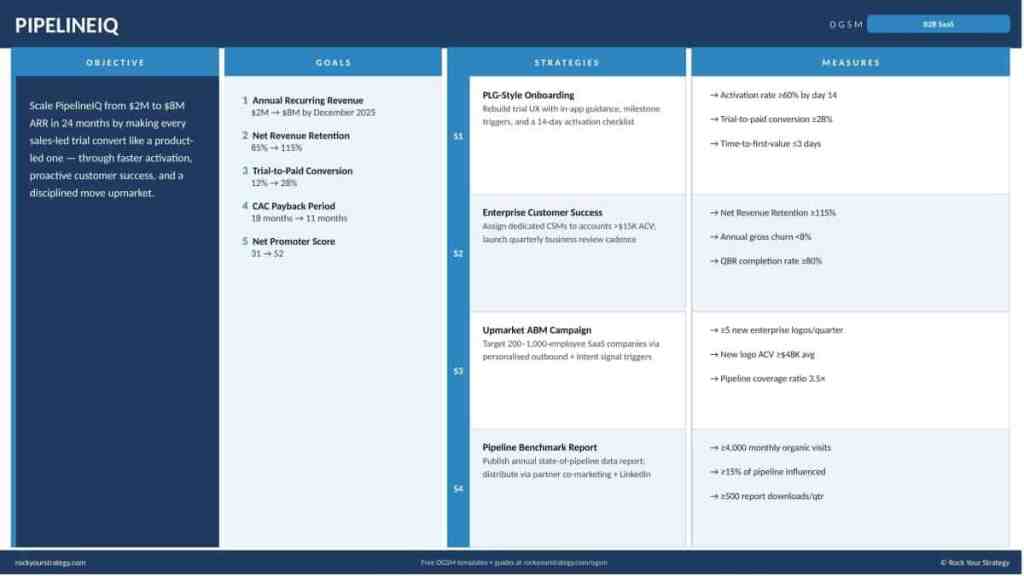
This example shows how a fictional B2B SaaS company — PipelineIQ, a pipeline analytics platform for mid-market sales teams — used the OGSM methodology to align their leadership team around a clear path from $2M to $8M ARR. The numbers, company, and details are illustrative. The strategic logic is real.
PipelineIQ is a B2B SaaS company that helps mid-market sales teams visualize pipeline health, forecast revenue more accurately, and identify deals at risk before they slip. They integrate with Salesforce and HubSpot and sell primarily to VP Sales and RevOps leaders at companies with 50–500 employees.
At the time of this OGSM, PipelineIQ has reached $2M ARR with strong product-market fit signals — high NPS, good retention among customers who fully onboard — but inconsistent trial-to-paid conversion and a growing gap between SMB and enterprise performance. The leadership team needs to decide where to concentrate resources for the next 12 months.
The PipelineIQ OGSM
Objective
Become the leading pipeline analytics platform for mid-market B2B sales teams by accelerating product-led growth and deepening enterprise retention.
Goals
Goals translate the objective into measurable outcomes. PipelineIQ chose five metrics that collectively define what success looks like at the end of the 12-month period.
Goal
Current
Target
Annual Recurring Revenue (ARR)
$2M
$8M
Net Revenue Retention (NRR)
102%
≥115%
Trial-to-paid conversion rate
9%
≥18%
CAC payback period
18 months
≤12 months
Net Promoter Score (NPS)
38
≥50
Strategies
Strategies are the 3–5 high-impact choices that determine where PipelineIQ concentrates its resources. Each is written as a “what-by-how” statement — specific enough to exclude things they won’t do.
Strategy 1: Accelerate trial-to-paid conversion by redesigning the onboarding flow around a fast time-to-value milestone
PipelineIQ’s data shows that users who reach their first “pipeline health score” within 72 hours of signup convert at 3x the rate of those who don’t. The strategy is to rebuild the onboarding sequence around this milestone — removing friction, adding guided prompts, and making the health score the first thing every trial user sees.
Strategy 2: Increase NRR by building a structured customer success motion for accounts above $15K ARR
Churn is concentrated in the $10K–$20K ARR band, typically from accounts that never fully adopted the forecasting module. A dedicated CS motion — quarterly business reviews, adoption scoring, and expansion playbooks — will address this before it compounds.
Strategy 3: Move upmarket into the $20K–$60K ACV segment by targeting RevOps leaders at Series B–D companies through account-based outreach
Mid-market accounts have lower churn, higher NPS, and more expansion potential than SMBs. PipelineIQ will build an ABM programme targeting 200 high-fit accounts per quarter, led by outbound sequences from a newly hired senior AE.
Strategy 4: Build category authority by publishing the annual B2B Pipeline Benchmark Report as the definitive industry reference
Owned research creates durable inbound demand and shortens sales cycles. PipelineIQ will survey 500+ sales leaders, publish findings in Q2, and use the report as the cornerstone of their content and PR strategy for the year.
Measures
Measures define how each strategy will be tracked and executed. For each strategy, PipelineIQ identified 2–3 Key Metrics (the numbers that define success) and 2–3 Actions (the concrete initiatives that will move those numbers).
Survey 500 sales leaders (Q1); Publish with PR push (Q2); Content distribution plan (Q2)
What Makes This OGSM Work
Three things stand out about PipelineIQ’s OGSM that are worth noting for your own strategy work.
The objective resolves a real tension. PipelineIQ could have written a generic objective about “becoming a market leader.” Instead, they named the two specific mechanisms driving growth — product-led growth and enterprise retention — which immediately signals to the team where resources will flow and where they won’t.
The goals are genuinely constraining. An NRR target of ≥115% is not a stretch goal bolted onto an existing plan. It forces a structural change: you can’t hit 115% NRR without a real CS motion. The goal drives the strategy, not the other way around.
The strategies make explicit trade-offs. Strategy 3 targets Series B–D companies specifically — not “all upmarket segments.” Strategy 4 commits to one owned research asset rather than a broad content calendar. These exclusions are as important as the inclusions.
OGSM vs. OKR: Which Framework Works Better for SaaS?
This is a question that comes up often in SaaS leadership teams, especially those that have previously used OKRs.
OGSM
OKR
Output format
One page, full strategy visible at once
Nested list of objectives and key results by team
Strategic choices
Explicit — strategies define what you will and won’t do
Implicit — key results may point in different directions
Execution link
Measures connect each strategy to specific actions and owners
Key results tracked separately; initiatives often disconnected
Cadence
Annual with quarterly measure reviews
Quarterly cycles with annual reset
Best suited for
Full business strategy alignment (board to team)
Team-level goal-setting and performance tracking
Many SaaS companies find that OGSM works better at the business unit or company level precisely because it forces the strategic trade-off conversation. OKRs can sit alongside it at the team or individual level for execution tracking.
Build Your Own OGSM
Use our pre-formatted OGSM templates to build your own one-page strategy. Available for Microsoft PowerPoint (for leadership presentations) and Microsoft Excel (for building, tracking, and updating your plan). Both are fully editable and immediately downloadable.
Strategy has always demanded two things most people are short on: time and objectivity.
You can use AI to build your OGSM at every stage — from drafting your SWOT and stress-testing your objective, to generating strategic options and identifying the right KPIs. Feed an AI tool like ChatGPT or Claude the right context, ask the right questions, and you’ll compress hours of strategic thinking into minutes — without sacrificing quality.
That’s the short version. The rest of this guide shows you exactly how to do it at each step, with practical prompts you can copy and use right now.
First: What AI Is (And Isn’t) Good for in Strategy
Before diving into the how, it helps to be clear about the what.
AI is genuinely good at generating options quickly, structuring and stress-testing ideas, summarising large amounts of information, drafting text, and challenging your thinking with alternative perspectives.
AI is not good at knowing your business the way you do, replacing strategic judgment, validating data it hasn’t seen, or making decisions on your behalf.
The best way to think about it: AI is a fast, well-read sparring partner. It has read everything, remembers everything, and is always available. But it hasn’t lived through your last five years of business. You bring the context. It brings the horsepower.
With that framing in mind, here’s how to use it across each stage of your OGSM.
Step 1: Use AI to Sharpen Your Situational Analysis
Every good OGSM starts before the OGSM itself — with a clear-eyed assessment of where you stand today. That typically means a SWOT analysis, a PESTEL scan, or a review of your competitive position.
This is where AI earns its keep immediately.
Rather than starting with a blank page, give an AI tool like ChatGPT or Claude the key facts about your business — your industry, size, markets, main products or services, and the biggest challenge you’re facing — and ask it to draft a starting-point SWOT. You won’t use the output directly, but it will surface angles you hadn’t considered and give you something concrete to react to, which is always faster than building from scratch.
Try this prompt:
“I run a [type of business] with [X employees] operating in [markets/geographies]. Our main products/services are [X]. We are currently facing [challenge]. Draft a SWOT analysis for my business, and for each point, explain the strategic implication in one sentence.”
Review the output critically. Cross out what doesn’t fit, add what it missed, and you’ll find you’ve completed a quality situational analysis in a fraction of the usual time.
You can apply the same logic to a PESTEL analysis. Ask AI to scan the macro-environment of your industry for political, economic, social, technological, environmental, and legal factors. It won’t know your local context, but it will catch trends you may have overlooked — especially in fast-moving areas like regulation or technology.
Step 2: Use AI to Draft and Test Your Objective
Your OGSM Objective is the most important sentence in your entire strategic plan. It needs to be inspiring, clear, and grounded — and it often takes several rounds of iteration to get right.
AI is useful here in two ways: drafting and stress-testing.
For drafting, describe your ambition in plain language and ask AI to turn it into a crisp strategic objective.
Try this prompt:
“Based on this business context: [paste your context]. Here is my current draft objective for our strategy: [paste it]. Please rewrite this as a sharp, inspiring strategic objective in one sentence. Then give me two alternative versions — one more ambitious, one more conservative.”
For stress-testing, ask AI to challenge what you’ve written.
“Here is our strategic objective: [paste it]. What are the top three weaknesses or blind spots in this objective? What is it not saying that it probably should?”
This kind of challenge is exactly what a good strategy coach would give you in a workshop — and it’s available instantly, at any time.
Step 3: Use AI to Benchmark and Validate Your Goals
Your OGSM Goals translate your qualitative objective into 3 to 5 measurable, quantitative targets. The question most people struggle with isn’t what to measure — it’s what numbers to aim for.
AI can help you benchmark.
“We are a [type of company] in [industry]. We want to grow revenue from [X] to [Y] in [timeframe]. Is this growth rate realistic compared to industry benchmarks? What typical growth rates do companies like ours achieve, and what are the key drivers?”
AI will give you a directional answer based on its training data. It won’t have access to your specific market’s most recent figures, so treat the output as a calibration tool rather than gospel. But it will quickly tell you whether your goals are realistic, stretched, or timid — and that alone is worth the conversation.
Step 4: Use AI to Generate Strategic Options
This is arguably the most powerful use of AI in your OGSM process. When it comes to defining your Strategies — the “how” of your plan — most teams default to the same playbook they’ve used before.
AI breaks that pattern. It has been exposed to thousands of strategic frameworks, case studies, and industry examples, and it can generate a wide range of strategic options quickly. Your job is to filter, refine, and stress-test.
Try this prompt:
“Given this strategic objective [paste it] and these goals [paste them], generate 8 to 10 potential strategies for achieving them. For each strategy, describe it in one sentence using the format: ‘[Verb] [what] by [how]’. Then rate each strategy on a scale of 1 to 5 for both impact and feasibility.”
You won’t use all 8 to 10 options. But the exercise will almost certainly surface one or two angles your team hadn’t considered — and that’s exactly what makes it valuable.
Step 5: Use AI to Define the Right Measures
The Measures column of your OGSM — covering both Metrics (what you track) and Initiatives (what you do) — is where most strategic plans either come to life or fall apart. The biggest risk is choosing measures that are easy to track rather than measures that actually tell you whether your strategies are working.
Here AI can act as a useful check.
“Here is our strategy: [paste it]. What are the best leading and lagging indicators to measure whether this strategy is succeeding? Give me 3 to 5 specific KPIs, and for each one, explain why it matters and what a good result looks like.”
Leading indicators tell you whether you’re on track before the results arrive. Lagging indicators confirm what happened after the fact. A good OGSM uses both — and AI can help you design that balance.
The Three Mistakes to Avoid
Using AI in strategy is still new territory for most businesses, and a few common mistakes are worth calling out.
Mistake 1: Taking the first output at face value. AI generates plausible-sounding content quickly, but “plausible” is not the same as “right.” Always treat the first draft as a starting point, not a finished product. Push back, ask follow-up questions, and test the assumptions.
Mistake 2: Skipping the team conversation. AI is a tool for you, not a replacement for your team’s input. A strategy created in isolation — even a well-crafted one — rarely gets executed well. Use AI to prepare better material for your team discussions, not to skip them.
Mistake 3: Using generic prompts. The quality of your AI output is directly tied to the quality of your input. The more specific context you give — industry, company size, specific challenge, desired format — the more useful the response. Generic prompts produce generic answers.
Putting It All Together
Here is a simple workflow to use AI across a full OGSM build:
Situational Analysis — Use AI to draft your SWOT and PESTEL as a starting point for team discussion.
Objective — Use AI to sharpen your draft and stress-test your thinking.
Goals — Use AI to benchmark your targets against industry norms.
Strategies — Use AI to generate a broad range of options, then filter with your team.
Measures — Use AI to identify the right KPIs and design your leading/lagging indicator mix.
At every step, you’re using AI to do the heavy lifting on the first draft — so your time and your team’s energy goes into the judgment calls that only humans can make.
Start With the Right Foundation
If you want to put this into practice, the best place to start is with a clean, well-structured OGSM template. Our OGSM Template for PowerPoint and OGSM Template for Excel give you the framework to capture everything your AI-assisted analysis surfaces — and to turn it into a one-page strategic plan your whole team can work from.
AI accelerates the thinking. The OGSM gives it structure. Together, they make for a faster, sharper, and more actionable strategy.
And if you would rather run the whole thing as one process than assemble it prompt by prompt, the OGSM Strategy Builder is a Claude Skill that facilitates all eight phases — diagnosis through review — and hands you the finished one-pager in HTML, Excel, PowerPoint and PDF. Here is what that session looks like, phase by phase.
Want to go deeper on OGSM? Read What Is OGSM? or explore our full library of OGSM examples for inspiration.
There are various different types of strategies and many different strategy tools. But which type of strategy is best suited for the OGSM model?
OGSM can be used for various types of strategies, including but not limited to business strategy, marketing strategy, operations strategy, and human resources strategy.
In general, OGSM can be applied to any situation where an organization wants to define and achieve specific outcomes and goals. Let’s explore this further but first clarify what is OGSM?
The OGSM Model
OGSM stands for Objectives, Goals, Strategies, and Measures. It is a management framework that helps organizations define and align their objectives, goals, strategies, and measures in a structured and organized manner. It enables organizations to clearly articulate their desired outcomes and the actions required to achieve them.
The benefits of using OGSM include:
Clarity of purpose: OGSM provides a clear understanding of what the organization wants to achieve and the steps it needs to take to get there.
Alignment of efforts: OGSM ensures that everyone in the organization is working towards the same goals and objectives, fostering better teamwork and collaboration.
Improved decision making: OGSM provides a framework for setting and tracking key performance indicators, enabling organizations to make informed decisions and adjust their strategies as needed.
Increased accountability: OGSM makes it easier to hold individuals and teams accountable for achieving specific goals and objectives.
Better prioritization: OGSM helps organizations prioritize their efforts and allocate resources more effectively, leading to improved efficiency and better outcomes.
Business strategy: OGSM can help businesses define their objectives, set goals, and determine the strategies and measures necessary to achieve their desired outcomes.
Marketing strategy: OGSM can be used to create a structured approach to marketing campaigns, including defining objectives, setting goals, and determining the strategies and measures needed to achieve desired outcomes.
Operations strategy: OGSM can be used to optimize operational processes and procedures, including defining objectives, setting goals, and determining the strategies and measures necessary to achieve desired outcomes.
Human resources strategy: OGSM can be used to develop and implement human resources policies and practices, including defining objectives, setting goals, and determining the strategies and measures necessary to achieve desired outcomes.
Supply chain strategy: OGSM can be used to optimize supply chain and logistics processes, including defining objectives, setting goals, and determining the strategies and measures necessary to achieve desired outcomes.
OGSM for Marketing Strategy
Let’s look at marketing strategies in more detail. OGSM can be a useful tool for developing and implementing a marketing strategy. Here is an example:
Objectives: In the OGSM framework, objectives represent the long-term outcomes that a marketing campaign aims to achieve. For example, an objective for a marketing campaign could be to increase brand awareness among target audiences.
Goals: Goals are specific, measurable, and time-bound targets that support the objectives of a marketing campaign. For example, a goal for the objective mentioned above could be to increase brand awareness by 10% in the next six months.
Strategies: Strategies are the high-level plans for how to achieve the goals set for a marketing campaign. For example, a strategy for the goal mentioned above could be to implement an influencer marketing campaign that reaches the target audience through social media.
Measures: Measures are the metrics used to track the progress and effectiveness of a marketing campaign. For example, a measure for the strategy mentioned above could be the number of followers gained on social media channels as a result of the influencer marketing campaign.
By using OGSM, organizations can create a comprehensive and structured approach to marketing campaigns, ensuring that all efforts are aligned and focused on achieving specific, measurable outcomes. Additionally, by tracking measures, organizations can regularly assess the effectiveness of their marketing strategies and make adjustments as needed to ensure they stay on track to meet their goals.
How to get started with OGSM?
Adopting OGSM can be a straightforward process. Here’s how you can get started:
Define the objective: Start by defining the overall objective for your organization or for a specific initiative. The objective should be a qualitative statement about the desired future state of your business or initiative. Learn more about setting objectives here.
Set goals: Next, set goals that support your objectives. These goals should be SMART (specific, measurable, achievable, relevant, and time-bound) targets that help you achieve your objective. Learn more about setting effective goals here.
Determine strategies: Based on your goals, determine the strategies you will use to achieve them. These strategies should be high-level plans that outline the steps you will take to achieve your goals. Learn more about choosing the right strategies here.
Identify measures: Identify the measures that you will use to track the progress and effectiveness of your strategies. These measures should be quantifiable metrics that help you assess the success of your efforts. Learn more about effective measures here.
Implement and monitor: Implement your strategies and regularly monitor and assess your progress using the measures you have identified. Adjust your strategies as needed to ensure that you are on track to achieve your goals. Learn more about strategy execution here.
Review and refine: Regularly review and refine your OGSM plan to ensure that it remains relevant and effective. Learn more about conducting regular reviews here.
It’s important to keep in mind that OGSM is a flexible framework, and you can adjust it to fit the specific needs of your organization. The key is to ensure that your objectives, goals, strategies, and measures are aligned and support each other.
If you are like me then you may also be wondering if there is a better way to drive strategy execution and achieve business results. When I first came across OKRs and OGSM, I was wondering what’s the difference between OKR and OGSM and which one should I apply? Here’s what I found out.
OKR and OGSM are both goal-setting methodologies that help companies execute their strategies but they differ in scope, timeframe and format.
Let’s explore these differences and their similarities to help you choose which one to apply. I’ll add examples and templates below.
Difference between OKR and OGSM
Before we jump into the details, let’s first find out what OKR and OGSM are.
OKR stands for Objectives and Key Results.
OGSM is short for Objectives, Goals, Strategies, and Measures.
In the OKR methodology, the Objective describes what you want to achieve usually over a monthly or quarterly timeframe and the Key Results describe what achievement would look like.
In the OGSM approach, the Objective and the Goals jointly describe what you aim to achieve and the Strategies and Measures give clarity how you aim to achieve it.
Hence, both OKR and OGSM are goal-setting methodologies that help companies execute their strategies following Peter Drucker’s idea of management by objectives. While OGSM is said to go back to Japanese automotive manufacturers who brought the approach to the United States, OKRs were first implemented at Hewlett-Packard and popularized by their application at Intel and later Google.
Nowadays, OGSM is famously adopted at major consumer staples such as P&G and Coca-Cola, while OKRs are widely practiced in many technology companies and start-ups across the world.
Despite their similarities, there are 3 major differences between OKR and OGSM: scope, timeframe and format.
1. Scope
The first major difference is in scope.
OGSM is well suited for describing strategic plans for large and small businesses alike. The approach is typically applied and aligned top-down from the corporate or business level to individual divisions, product lines, or teams.
OKRs seem better suited for individual and team-level goal-setting. They are often created and aligned bottom-up.
2. Timeframe
The second key difference is in the timeframe or time horizon.
OGSM applies well to longer term strategic plans (over 3-5 years) or annual operating plans (1 year). The objective, goals, strategies, and measures are chosen in line with this longer timeframe.
Once the OGSM is developed, the focus is on implementation and execution. Course adjustments or modifications to the OGSM are made as needed in annual or quarterly reviews.
OKRs typically describe shorter term goals and key results. Objectives and key results are often set quarterly or monthly and aligned accordingly. Once all key results are achieved, new objectives and key results are set.
The application of OKRs is therefore more dynamic and OKRs change more frequently.
3. Format & Terminology
The third and most obvious difference lies in the format of the goal setting approach.
OGSM describes in detail the objective, goals, strategies, and measures. Objectives are words, goals are numbers. Strategies are words, measures are numbers. The OGSM is thereby more elaborate in describing, aligning and quantifying where the business is heading and how it aims to get there. The plan is summarized on a handy, single page overview.
OKRs on the other hand typically describe the objective in qualitative terms and then jump straight to detailed key results which may be qualitative or quantitative. Often no more than 3-5 key results are chosen to define the objective. OKR is therefore simpler in its approach.
The following table illustrates the difference in format and compares the terminology.
OKR
OGSM
Objective
Objective
Goals
Strategies
Key Results
Measures
When analyzing and applying OGSM and OKR, many more detailed differences will become apparent. For the purpose of identifying the key differences and helping to choose which approach to apply, I find that those three distinctions were most critical.
What are advantages and disadvantages of OKR and OGSM?
While both OKR and OGSM are goal setting methodologies, due to their differences in scope, timeframe and format, they each have unique advantages and disadvantages.
Advantages & disadvantages of OKR
The advantages and disadvantages of OKR are summarized in the following table.
Advantages
Disadvantages
– Quick to create and apply bottom-up – Easily adjusted and changed – Can facilitate performance management and feedback
– Lacks the longer term context – Doesn’t describe how to achieve key results – Bottom-up OKR definition can make alignment across company tricky
Advantages & disadvantages of OGSM
The advantages and disadvantages of OGSM are summarized in the following table.
Advantages
Disadvantages
– Simple one-page overview creates clarity about overall business plan – Clearly aligns goals (“what”) with actions (“how”) – Guides execution and follow-through – Highly versatile: can be applied for large & small businesses, organizations and non-work projects
– Not easily changed or adjusted short-term – Requires strong leadership buy-in – Company wide cascading can be perceived as cumbersome and overly bureaucratic if not well managed
One additional advantage of OGSM is that the simple one-page business plan format lends itself well for communication of the business strategy with your team. This is however also an advantage of the OKR methodology as well.
When should I apply OKR or OGSM?
OKRs work well for individuals and teams and when your timeframe to achieve your objectives is rather short such as 1-3 months.
OKRs are thereby particularly well suited for highly dynamic environments where change occurs quickly and where the organization has to remain agile to adapt. This is why many start-ups and technology companies apply OKRs.
OGSM provides a more robust structure which makes it more suitable for overall strategic plans or annual operating plans. While OGSM are well suited for larger companies, they also provide strong guidance for smaller businesses and entrepreneurs.
Tip: OKRs and OGSM can of course be applied in combination. The OGSM can be used to set the overall vision and direction of the company with clear financial goals, strategies and measures. These can be broken down into quarterly OKRs. The OKRs then help to drive quarterly execution in alignment with the strategies and measures.
What are examples of OKR and OGSM?
Applying the OGSM methodology is not difficult. Here are examples to show how to use the OGSM methodology in practice.
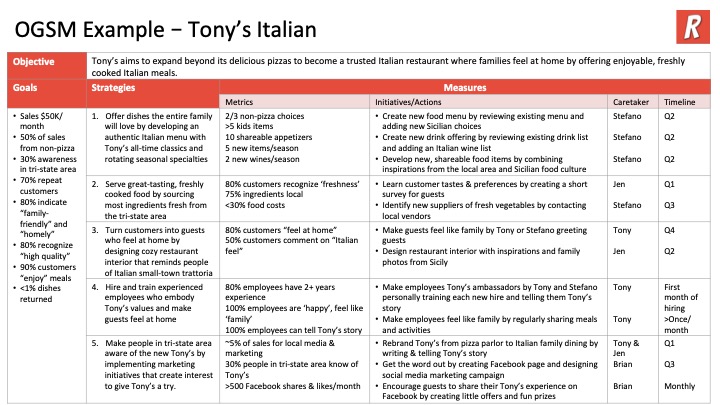
Tony’s Italian OGSM
Tony’s Italian is a fictional story about how Tony turned his pizza parlour into a family restaurant. The example shows how to apply OGSM to a small consumer business. Click here to read the full story of how Tony goes through the strategy process and captures his insights and strategic decisions in the OGSM. Or find the OGSM below.
Tony’s Italian OGSM Example
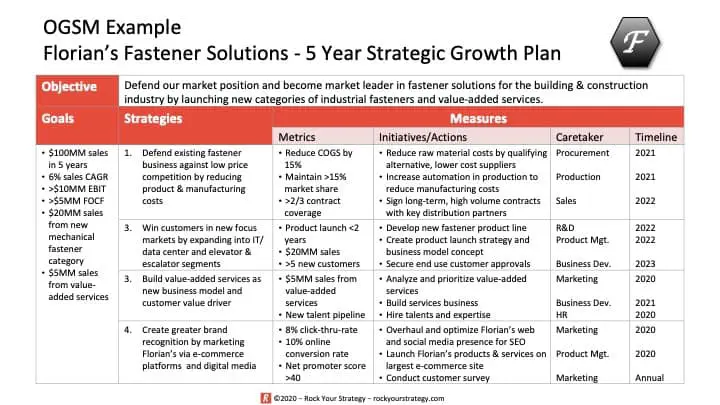
Florian’s Fasteners OGSM
Florian’s Fasteners tells the fictional story of a small B2B business that turned around its fortunes after a strategic review. Click here to read Florian’s story or find the OGSM below.
Florian’s OGSM Example
Examples of OKR
For examples of the OKR methodology, I can really recommend the resources at www.whatmatters.com.
John Doerr, author of the excellent book “Measure What Matters”, and his team go into lots of details and practical examples.
Where can I find OGSM templates?
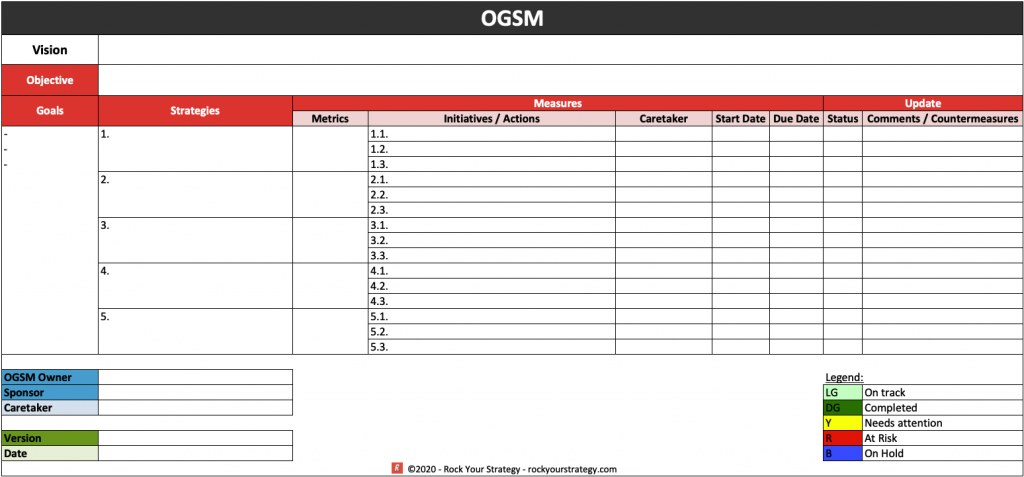
Here are templates of the OGSM to get you started. Click on the following links to download PDF copies of the simpler Microsoft PowerPoint template or the more sophisticated Microsoft Excel template.
OGSM Template in PowerPoint
OGSM Template for Microsoft Excel
If you’d like to learn more about how to use these templates to create your OGSM, check out this article.
And before you go, check out our jam-packed Resource page with more tools and templates to help you simplify your strategy and achieve excellent results. Rock on!
It seems like a question of preference or belief such as Pepsi vs. Coke, Pampers vs. Huggies or Nutella vs. Nusspli. But far from it. Whether in large corporations or small businesses, choosing to put people first or put strategy first can mean the difference between success or failure.
Whether you are leading a small business, a team or a large corporation, always put the people first. Hire the smartest and most agile people you can find who best align with the values of your business. And jointly you will figure out the best possible strategy and execution for your business.
If you are like me, you may find this counterintuitive at first. After all, isn’t it the inspiring vision and well-defined strategy that motivate people to achieve results? And am I not a little dramatic to say that whether to put people first or strategy first can mean the difference between success and failure? Well, yes and no. Let’s explore this further.
People come first
If I had a dollar for every time that a colleague, professor or past superior told me that “structure follows strategy”, I’d have a nice purse collected by now. And there is a point to that statement.
Before you start drawing organizational charts and boxes with names, you do want to figure out where the business is going and how it is going to get there. And then organize according to that strategy. But that is not the question.
When the question is whether to put people first or strategy first, then it’s absolutely people first! People… not organization or structure.
No matter what your endeavor, what your business is, what team or organization you lead, surround yourself with the best people you can find. If you have a team of A-players, a team of movers and shakers, doers and believers, a team that trusts each other, debates each other, and helps each other solve problems, a team which challenges itself to greater heights, you can virtually achieve anything.
When choosing team members, hire for attitude first and aptitude second. I forgot where I first heard this phrase, but when you google it, you find tons of relevant hits. It’s often extended by “hire for attitude, train the skills”. What it means is that you first want to probe for values and character traits which fit your business, your team, and yourself. Don’t get blinded by amazing test scores, knowledge and skills. Those are great, but the hard skills can be trained. Hire for integrity, work ethic, team work, and grit, and then the hard skills are the cherry on top.
When recruiting, never settle for “good enough”. In my experience, you are much better off holding out for the “right” person than hiring the first good person you can find. Don’t settle. Be rigorous in your search, clear in your expectations, and live up to the standard you aim to set.
Who Before What
Now that makes sense but let’s come back to people and strategy. And this is where I like best the analogy from Jim Collins and his classic book “Good to Great”. In “Good to Great”, Jim Collins explains that his extensive research of great companies found a key common denominator: who comes before what.
Collins describes leading a business like driving a bus. The business leader is the bus driver. Typically new business leaders set a direction first and then drive the bus in that direction. Collins’ research however suggests that the greatest companies first figure out who should be on the bus (and who shouldn’t) and in which seats they should be before determining the direction the bus should go.
When I first read “Good to Great” I found this surprising. I myself had always thought that you start by describing a vision for the business so compelling that people wanted to strive to get there. What I had neglected is that I was blessed with teams who inherently were motivated to pursue that vision. But even that wasn’t really the point.
It started making sense to me when further exploring Jim Collins’ analogy. He wrote that people come first because imagine you have people on the bus because of its direction. This works out fine as long as the bus is going towards that direction. What if shortly into the journey you figure out that the business is heading in the wrong direction? What if the environment around you has changed? If people on the bus are only there for its direction, you have a problem. If you have great people on the bus who are there to be with other great people, then you will quickly be able to adapt and change direction.
So get the people off the bus who are there for the direction. Get those people on the bus who are there for the joint journey. Put the right people in the right seats. And then jointly figure out in which direction the bus – or the business – should be going.
In Good to Great Jim Collins argues that the continuous, disciplined approach of putting people first and strategy second was one of the key differences between companies that were merely good and those that were truly great.
According to Collins, great leaders understand that there are three basic truths:
If you first choose the right people, you can more easily adapt to a changing world.
If you have the right people, you don’t need to worry about motivating them.
If you have the wrong people, even the greatest strategy only achieves mediocre results.
So following these principles, spend a major portion of your time and attention on assembling and developing your team. Once you have assembled a great team, then jointly define the strategy and jointly drive execution to deliver great results.
Using OGSM to develop strategy in a great team
When you are ready to develop strategy, consider using the OGSM methodology as a process and catalyst for your strategy.
According to a recent survey(1) a staggering 67% of well-formulated strategies fail during execution. Let that sink in for a moment: two thirds of all strategies fail. With the following 11 secrets of successful strategy execution, your strategy won’t be among them.
Have a clear strategy
Cascade your strategy throughout the business
Communicate your strategy and appeal to your team’s heart and mind
Make execution the leaders’ top priority
Integrate strategy execution into your company culture
Create a dashboard to track your progress
Hold monthly check-ins
Review execution in-depth once per quarter
Communicate progress on execution and celebrate successes
Keep in touch with initiative leaders informally
Review your strategy once per year
Knowing these 11 secrets does not automatically guarantee strategy execution success. You do have to put in the work and actively drive execution. However, by living these 11 secrets, you are a giant step ahead. Read on for a detailed description of each of these secrets to execute your strategy successfully and deliver excellent results.
1. Have a clear strategy
Sure, having a strategy is key to executing it. The emphasis here however is on the word clear. Clarity about the business strategy is in my experience the number one success criteria for successful execution. And this is easier said than done.
It is mission critical that everyone in the business is clear about where the business is going and how it is going to get there – and how everyone in the business contributes to making sure it gets done.
Imagine your team is not clear about where you are going. Imagine your team is not clear how you are going to get there. Everyone might be working very hard but it may seem like a hamster in a wheel: a lot of effort, but little progress. Worse still, different teams may be working on projects that pull in opposing directions. Clarity about the destination and how to get there helps to align everyone’s efforts in the same direction.
When the strategy is not clear and the business is not aligned, execution will feel like sitting in a dragonboat in which the rowers are not synchronized. If you have ever sat in a dragonboat, you will immediately know what I mean.
Dragon boat rowing in sync
Although varying with the size of the dragonboat, there are typically 18-20 rowers in a boat sitting in 9-10 rows of 2. The rowers in a dragonboat aim to synchronize their rowing movements to the beat of a drum. The rowers move the paddle at the same time into the water, leaning back with a deep, long pull, and then taking the paddle out of the water, leaning forward to do the motion again. When all 18 rowers do this motion in exact synchrony, the boat effortlessly glides forward as if floating on top of the water. If the rowers are not in synchrony, the boat sits and drags deep in the water as if pulling a weight.
A clear and well aligned strategy is like the drum in a dragonboat. It synchronizes the organization and ensures it can glide forward towards its destination. When the strategy is not clear, each member of the business may “row” at their own speed and hamper progress towards the organization’s objective and goals.
Here are a few symptoms of unclear strategies
Too high level: the strategy may be defined in terms that are too broad and generic, which leaves too much room for interpretation. Make sure your strategy is defined in unambiguous, self-explanatory terms that apply directly to the situation of your business.
Strategies not broken down into connected activities: The strategy may outline a clear general direction, but the detailed initiatives and actions needed to move the business towards its goals are not clear.
No clear measures what success looks like or when it is reached: The strategy may outline an inspiring future with clear actions but the goals and metrics are not defined. The business may not know what milestones need to be reached by when.
Not clearly communicated: The strategy may be well defined and clearly discussed among the leadership team and the board of directors, but it may not be clearly communicated to the rest of the business.
Not clearly connected to people’s jobs: The strategy may be clearly defined, but people’s roles and responsibilities do not clearly align with what needs to be done to reach the future destination. Make sure that your team understands how each individual’s role aligns with the strategy and can contribute towards its achievement.
Check your strategy for clarity before finalizing and make sure it is understood by the entire organization.
2. Cascade your strategy throughout the business
Cascading your strategy throughout the business is the next important secret to execution success. A cascade is “something arranged or occurring in a series or in a succession of stages so that each stage derives from or acts upon the product of the preceding”(2).
“Cascading” strategy means arranging the strategy along the organization’s hierarchy so that the organization is fully aligned behind the organization’s objective and works together to achieve it.
In essence, this means ensuring that the strategy is translated into meaningful activities that allow each group or function to work towards the overall company objective and goals.
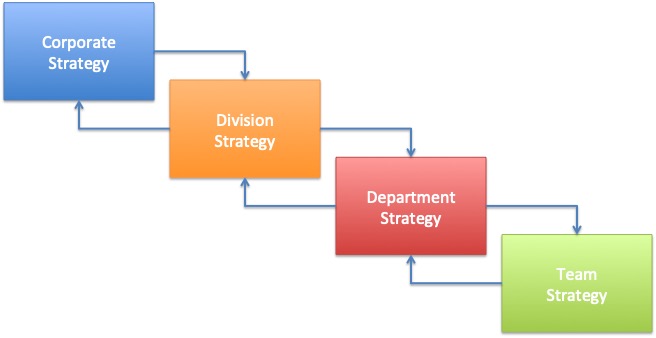
Vertical cascading means breaking down the strategy from a higher level of the organizational hierarchy to a lower level. In large corporations this may look like the graphic below. In small businesses, this might be much simpler but works the same way.
Cascading Vertically
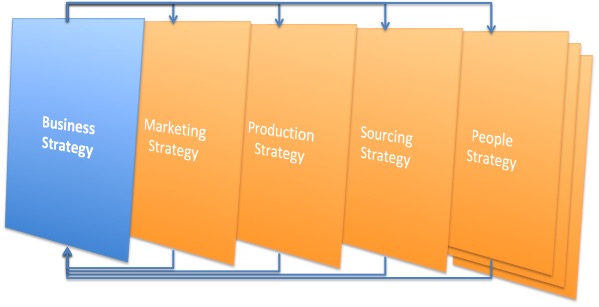
Horizontal cascading means breaking down a business strategy into the various functions that work together to deliver the business strategy. Again, in large corporations this might mean formally cascading across large units or departments of the company. In small business, this might just be across a smaller team or individuals. Irrespective of the size of the business, the key aspect is translating the business strategy into meaningful objectives and initiatives for each function that align with the overall business strategy.
Cascading Horizontally
In practice, cascading a strategy is typically a mix of the vertical and horizontal process. The important part is that the strategies align seamlessly to ensure that the organization works together to achieve the overall business objective and goals.
Strategies align best when cascading the strategy is a reiterative process. The higher level strategy gives input to the lower level strategy. And it also receives feedback and modifications from the lower level based on realities in the business, feasibility, and availability of resources.
This reiterative process makes the strategy more realistic and creates understanding and buy-in.
One more thought: when cascading your strategy, make sure each team or function has the skills, knowledge and resources needed to execute their part of the strategy.
3. Communicate your strategy and appeal to your team’s heart and mind
Communicate, communicate, communicate. When it comes to your strategy, you cannot over-communicate.
In fact, according to the earlier quoted survey(1) on strategy implementation, the top 3 reasons why strategies fail are
Poor communication
Lack of leadership
Using the wrong measures
Poor communication is the top reason why strategies fail! In fact, research described in an article(3) in the Harvard Business Review in 2008 revealed that information mattered most to strategy execution. So when you communicate, include relevant, up-to-date information that covers the following:
Explain what external and internal realities led to this strategy
Explain why this destination is meaningful for the business
Explain what it will look and feel like when the destination is reached
Explain how the business aims to reach its destination
Explain how everyone’s roles and their work contribute to taking the company to its destination
Convey full confidence that the business can and will get there – leave not an iota of doubt
Information by itself however is not sufficient to have the impact that you aim for. Before you communicate anything, you have to make sure that your audience is receptive to what you have to say. Don’t assume that your team will automatically listen because you are the leader or because it’s about the strategy. You need to “open” your audience first by appealing to their hearts and their minds. Make an emotional connection first, then share what you have to say.
When you communicate, consider the following pointers:
Customize your message to your audience – focus on being understood
Make an emotional connection with your audience right away in the beginning before sharing any information
Use practical examples that are meaningful to your particular audience
Summarize the key takeaways at the end of the communication
Include a call-to-action so people know what to do or where to start
In addition, take into consideration that different people learn differently or might be receptive to different types of communication, such as personal interaction, written information, video etc. When planning your communication, explore different media types to get the message across. And if you can afford it, do not only choose one, try to use all media types available to you. You may consider using the following means to communicate your strategy:
Town hall meeting
Personal letter or email
Video recording or animation
Detailed strategy document, such as a white paper
Posters
Infographics etc.
Strategy communication should never be a one-off, but should be a continuous stream of information. Create a clear communication strategy about how you aim to launch your new strategy (as if it was a product launch) and design the communication by audience, message, timing, and media. Communicate thoroughly and consistently over time about your strategy and its progress during implementation.
If your strategy requires a transformational change in your company, it is particularly important to communicate clearly and consistently so that your team understands why the change is necessary and how it will impact them.
In that case focus on “selling” the problem first, before offering the solution, i.e. the new strategic direction.
4. Make execution the leaders’ top priority
It’s the job of the business leader and his or her most senior team to drive strategy execution. Period. If execution is not on the leadership’s agenda, it will fall off the team’s agenda as well.
I have seen this time and again in my personal experience – both when driving execution as a mid-level manager in a large company myself and when consulting with other business leaders. When the strategy and its execution is top of mind of the business leaders, the implementation progresses. When the leadership’s attention turns elsewhere and does not come back to strategy execution, the organization will turn accordingly.
Battle Ropes
This is like whipping ropes in your local gym. The movement of the end of the rope travels throughout the rope like a wave. This is like the motion created by the leader of an organization. If the leader moves in one direction, the business will eventually follow. If the leader moves away from execution, the rest of the business will as well.
But what does that actually look like being “top of mind of the business leader”?
Put strategy execution on the agenda of every leadership meeting
The business leader personally runs formal strategy execution reviews (more on that later)
Key initiatives are led by the business leader personally
The business leader informally checks on execution progress when “walking the shop floor”
The business leader uses every opportunity to touch on the strategy and execution during communications such as round tables, town halls, one-on-ones, business trips, site visits, even customer/supplier/partner meetings (as appropriate)
It is important that the business leader holds him-/herself and the team accountable for doing what they said they would do in the strategy. The business leader has to walk that talk, or no one else will.
5. Integrate strategy execution into your company culture
For strategy execution to be a sustaining priority, it must become deeply ingrained into your company culture. But what is culture exactly and how can strategy execution become part of it?
According to businessdictionary.com, organizational culture refers to “the values and behaviors that contribute to the unique social and psychological environment of an organization”(4). Investopia.com says “corporate culture refers to the beliefs and behaviors that determine how a company’s employees and management interact and handle outside business transactions”(5).
I always simply like to say that culture is “how things are done around here”. Hence, culture encompasses the norms and behaviors deemed expected and acceptable for people and by people working in an organization. In companies and especially in small businesses, the culture is strongly influenced by the values and behaviors of the business leader. So integrating strategy execution into company culture is actually closely tied to the previous point of making execution the business leaders’ priority.
For execution to become part of the culture, execution has to become a norm and expectation that plans are implemented, activities are finished, and work is getting done. A high sense of responsibility and accountability must exist in the organization and it starts from the business leader and does not only apply to strategy. This holds true for all actions:
Do what you say you will do
Honor promises and commitments
Follow through on activities
Bring things to an end
Hold others’ accountable for their actions and commitments
For strategy execution to become part of the culture, similarly make it an expected norm and behavior that strategy execution is prioritized and followed through on. How? Consider the following pointers:
For each strategic initiative assign a clear caretaker, targets, timeline and milestones.
Make sure each strategic initiative is well resourced and the team has the necessary knowledge, skills and tools to get the job done.
Follow up at regular intervals and make sure the work gets done.
Rigorously prioritize what the business is working on. Move up the activities that lead the business towards its strategic objective and goals. Move down or eliminate the activities that don’t.
Check how each new idea, project or initiative helps bring the business closer to its destination.
Celebrate successes and reward achievements towards the strategic objectives.
Read more about how to drive execution in your business in the book “Execution – The Discipline of Getting Things Done”. Find this and other book recommendations on our resource page here.
Most important of all, however, culture is about people. Be there for your people and help them execute. Listen to their needs, their questions, their concerns, their difficulties, and their aspirations. Be present, be available, be genuine and act on what you learn. Take them with you on this journey of strategy execution and together execution will become part of the culture.
6. Create a dashboard to track your progress
“If you can’t measure it, you can’t improve it.”
Peter Drucker
Reality is that what you measure gets done. But measuring alone will not be sufficient. It takes three things:
Measure those metrics critical to your strategy execution
Make those metrics transparent in a dashboard
Create practices around reviewing the dashboard regularly and taking appropriate actions
In his insightful book “Measure What Matters”, John Doerr emphasizes the importance of setting goals – the right goals – and tracking those metrics that are directly linked with your strategy and achieving your objectives.
Carefully select those metrics that directly measure your business’ performance towards implementing your strategic initiatives. In other words: measure what really matters. Let go of the notion that you must measure and report everything. Deprioritize those metrics that are nice to have, but do not provide the necessary information to move the business towards its strategic goals.
Create a dashboard that tracks all selected metrics and reports your performance on a monthly basis.
For each metric on the dashboard, define a clear target. This is important so that the organization is clear about the expected performance. This also sets a clear standard for acceptable performance and guides the team in what is expected from them.
Add to the dashboard a traffic light system that highlights in green, yellow, and red how each measure performs versus its target. This allows you to quickly identify those metrics that require your attention.
I have done well with the following classification, but feel free to create your own based on your business’ needs.
Performance
Color
Meaning
Metric meets or exceeds target
Green
On Track
Metric <10% below target
Yellow
Needs Attention
Metric >10% below target
Red
At Risk – Urgent Action Needed
Traffic Light System for Dashboards
It is important that clear accountability is established for each metric on the dashboard. This is the person who is responsible for the metric’s performance. So assign clear accountabilities for each measure and make sure that the respective person has the ability to influence the metric and is clear about what is expected of him or her.
Make the dashboard available to your team so that its performance is transparent and can jointly be monitored. Consider to hang a print out in the pantry or coffee corner. Put it where people get together and where they can see it. Do weigh off confidentiality vs. transparency. If you are concerned about showing certain metrics, consider whether they were the right metrics to begin with.
Be clear what is expected to happen when the dashboard indicates that a measure is not on track. Discuss with the team and identify appropriate actions to get back on track.
Finally and just as importantly: Celebrate successes! Compliment the the team behind metrics that are on track and clearly exceeding its targets. Likewise identify the drivers for performance and thank the team for its efforts and its success.
7. Hold monthly check-ins
A monthly check-in is a monthly review of the progress you are making in executing your strategy. The purpose of the check-in is to monitor progress, identify roadblocks or concerns and decide on appropriate actions and countermeasures.
The monthly check-in should be attended by the team responsible for strategy execution. That certainly must include the business owner and the most senior leadership team as well as the strategic initiative caretakers.
Monthly check-ins are typically 60-120 minutes long depending on the nature of the business and the magnitude of the change your strategy is driving. Larger changes or strategy implementation processes that are facing significant challenges might require a bit more time. Strategy execution processes that are running smoothly might require less time.
Center the discussion of the monthly check-in on your strategy execution dashboard. Let the traffic lights guide your discussion, starting with the red lights first, then discussing the yellow lights and finally looking at the green lights. Your primary focus here should be on those metrics and initiatives that are ‘at risk’ or require urgent attention.
During your discussion of the metrics, focus on understanding what drives performance. Identify the root causes why certain metrics are falling behind or why others are ahead. Once you have identified the root causes, identify effective actions to improve the metrics. Ensure for each action that you have clarity about what is expected, that there is a caretaker and a timeline for action.
Hold your monthly check-ins on a fixed schedule. For example devote one hour every second Tuesday of the month to reviewing progress with strategy execution. The advantage of a fixed schedule is to create a habit in your business to review strategy execution. It allows you to plan ahead. There are no surprise meetings or sudden requests. There are also no excuses for not being prepared to discuss the performance of your metric. Set a date and stick with it.
Once you have fixed a regular date, plan ahead for the entire calendar year or fiscal year. Set reminders or send out recurring calendar invites to all participants. That way the date is blocked in everyone’s calendars ahead of time and you can avoid short notice schedule conflicts.
For the monthly check-ins to be effective, make sure to follow through on agreed actions. Start each check-in by reviewing the actions from the previous month and ensure all actions have been closed. Strong follow up is critical to establishing an execution culture as noted before.
In addition to monthly check-ins, conduct in-depth reviews of your strategy execution once per quarter. While monthly check-ins are brief reviews which focus on initiatives and measures that require attention and corrective actions. The purpose of the quarterly review is to monitor progress of the entire strategic plan in more depth, addressing progress of each initiative.
In order to conduct the quarterly review, plan for 2-3 hours to half-day to have sufficient time to cover the entire plan. Similar to the monthly check-in, participants must include the business owner, the most senior leadership team and the caretakers of the strategic plan and its initiatives.
While a strategic plan is typicallybuilt top-down, starting with long-term objective and goals of the business and then designing strategic initiatives and actions to get there. The review of the strategic plan is conducted bottom-up beginning with a review of key metrics and actions and then moving up to strategic initiatives and finally reviewing and confirming the long-term direction.
As such, the owners of each initiative report on the progress of their initiatives highlighting the following key points:
Objective and status of the initiative
Progress and achievements of the initiative to date
Challenges or roadblocks that need to be overcome
Next steps or next actions
Support needed from the leadership
The update of each initiative should not take longer than 10 minutes and should be crisp and to the point. Encourage the initiative owners to report openly and transparently on the status of the initiative. No sugar-coating or exaggerations. A simple one-page template for each initiative can help support initiative owners with their update and keeping things on track.
Depending on progress, the team agrees for each initiative on appropriate actions and countermeasures. Should any of your strategic initiatives hit major roadblocks, consider whether a pivot is needed. A pivot is simply a change of direction and the very reason why you conduct the quarterly review. Document any changes in your strategic plan.
As part of the initiative review, conduct a review of the needed resources to ensure that each initiative is well funded and able to achieve its objectives – especially when changes are needed. Again, make sure that the initiative owners are aware what is expected from them for the quarter ahead. Define clear caretakers and timelines for all agreed actions.
During the quarterly review, include a brief assessment whether your assumptions about the external environment and the internal situation of the business are still valid or whether anything has changed. Confirm that the long-term objective and goals are still in tact and achievable.
9. Communicate progress on execution and celebrate successes
An important part of strategy execution is keeping everyone in your business apprised of progress. Communicate frequently and openly to maintain clarity about the direction of the business and uphold momentum.
Include in your regular communication the following highlights:
Achievements/accomplishments to date
Challenges and countermeasures
Dashboard and traffic lights
Priorities for the upcoming quarter
Potential market news or changes in the external environment
In your communication, place a particular emphasis on celebrating successes! Make accomplishments as public as appropriate and reward the team for their achievements.
Make celebrations an integral part of your execution plan. Successes – large and small – build positive momentum for your strategy execution. Even small victories can be important to create confidence and solicit buy-in. Strategy execution is a movement and every successful step in the right direction helps.
A great way to provide a platform for successes and to reward the behaviors needed for the strategy to succeed is to create awards that are directly linked to the strategic initiatives.
For example, if sales growth is an important measure for your business, consider creating an award that celebrates the most successful customer projects or largest closed deals. If cost savings are critical for your business, reward cost saving ideas. You get the point: again measure what matters and reward the right behaviors that lead to success. And when you’re having success: celebrate!
Celebrate successes – large & small!
The importance of celebration cannot be underestimated. You don’t need to throw a major party every month – even though that can certainly help shape your company culture… A small nod to recognize a person or a team for reaching a milestone or delivering a project or achieving a goal can go a long way!
Regularly stop what everyone’s doing to celebrate successes: a closed deal, a new sale, a dollar saved, a target achieved. Buy a cake, invite the team for lunch, have flowers delivered, or simply write a “thank you”-note (hand-written notes will never go out of style!). The point is to catch someone doing the right thing and to create a joyful moment or postitive experience to recognize the success. Besides, celebrations are fun and a great team-building activity!
Celebrate your successes and speak about them. As my grandma would have said: do good and talk about it.
In order to communicate effectively, consider to publish a regular internal newsletter shortly after the quarterly reviews. Or consider sending a brief email update to the business after the monthly check-ins. Don’t leave your team wondering what’s going on and how the business is doing.
Here are a few examples that have served me well:
Internal newsletter devoted to strategy execution
Email updates from the business leader
Quarterly town halls or “all hands on deck” team meetings
Webcasts or video conferences for remote team meetings
Installation of a physical strategy execution board in the pantry or cafeteria
When it comes to strategy execution you almost cannot over-communicate. Be creative, involve your team. But whatever you do, communicate often, regularly and frequently, celebrate successes and take your team on the journey with you.
10. Keep in touch with initiative leaders informally
In addition to more formal monthly and quarterly reviews, keep in touch with initiative leaders informally. Be present, support execution, ask how things are going.
The key point here is to be available to initiative leaders, to lend support and to know what’s going on in the business outside of what’s formally reported in the monthly or quarterly reviews.
When you are well-connected and you know what’s going on in the business, you have the ability to sense when challenges are brewing or support is needed. Even in a very open culture, not everyone in your business may be comfortable to speak up or may know when to ask for help. By keeping in touch with your colleagues, you get to know when help is needed.
Keeping in touch with colleagues from all across the business also allows you to put into perspective what is being reported in the formal monthly or quarterly business reviews. You have a better understanding about the situation of the business and can take more meaningful and appropriate action.
Catch up informally
A great opportunity to keep in touch with initiative leaders informally is to “walk the shop floor” or engage in social activities. Invite your colleague for lunch or sit down over a cup of coffee. Create chance encounters in the pantry or cafeteria. Create opportunities for the initiative leaders to share information about their project, the progress they are making, or obstacles they are facing.
When you are having an informal chat, create an open and comfortable atmosphere. Ask open questions and let the other person lead the conversation.
Caution: do not micromanage! When you frequently check in with your initiative leaders, you may come across as controlling and micro-managing. Your colleagues need space to execute. Don’t be overbearing with control and oversight. Even though different people require different degrees of freedom to operate, nobody likes a micro-manager. When you micro-manage you effectively communicate that you do not trust the other person with completing the task. That’s the opposite of what you want.
So when you have informal encounters with your initiative leaders, focus on being available, focus on listening and go with the flow of the conversation.
11. Review your strategy once per year
Last but not least, the 11th secret to successful strategy execution is to review your strategy once per year. The purpose is to review the overall direction of the business and your strategy.
So once per year, gather your senior team to conduct an in-depth review of the external and internal environment, your objective and goals, your strategic choices, and the progress you have made thus far.
The purpose is not to re-invent the strategy every year. The purpose is to confirm that you are on the right track. Having said that, if your analysis shows significant changes in the external or internal environment or the progress of your execution, this is very much the time to revisit whether a change in direction is needed.
In my experience, devoting 1-2 days per year to this exercise is helpful. It’s an intensive workshop that requires good preparation and optimally the help of professional facilitation.
I like to schedule the annual strategic review in mid-year – typically July or early August. It’s a good time to take stock and to review your course before planning for the following year begins.
The strategic review follows the strategy process and revists in turn the situation of the business, the external environment, the internal environment, the long-term objective, the strategic choices and the strategic plan. In short, review where to play and how to win.
I can recommend from experience to follow this process for any business – large and small.
Strategic Process
When your analysis suggests that you are on the right track and that your fundamental assumptions about the market, your competitors, and your products & services hold up, the annual review should result in few changes.
When you see significant changes however, plan to take more time and to re-do the strategic process in more depth.
In any case, go through the full process every 3-5 years to re-cast your strategic direction and set sail to new horizons.
Winning at strategy and winning at business are not rocket science. However, companies fail time and again to execute their strategy and deliver the intended results.