Looking for inspiration on how to structure your strategic plan? Or just looking for an OGSM example? Get to know Andy and learn how he applies the OGSM methodology to his small B2B company.
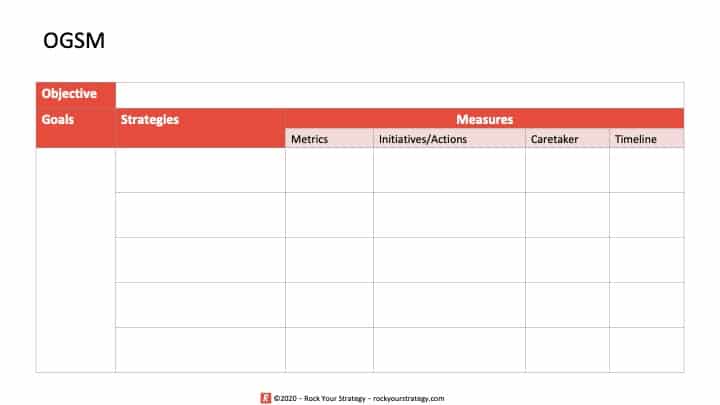
OGSM stands for Objective, Goals, Strategies and Measures and is a one-page business plan that defines ‘what’ you aim to achieve and ‘how’ you are going to achieve it. It is a simple but powerful method that enables strategic clarity, alignment and execution. The OGSM can be applied to large companies and small businesses alike.
This fictional story tells the tale about how small business owner Andy used the OGSM methodology to breathe new life into his father’s old business. Scroll to the bottom of this article if you want to skip the story and head straight to the OGSM.
Introduction
Andy hadn’t been able to sleep. Cold sweat on his forehead, he had been tossing back and forth all night. He stared at the marred face in the mirror: tired eyes with deep black rings underneath stared back at him. Andy counted the worry lines engraved on his forehead. His mind was racing. How would he be able to save his company? How would they be able to defend their share – never mind achieve their growth objective? What was he going to tell his investors?
Ever since Competitech had entered the market for fasteners the previous spring, their market share had dwindled. Florian’s Fastener Solutions had been the market leader for nuts, bolds, washers, and screws throughout the entire Northeast ever since his late father had built the company five decades ago. The iconic F-logo was well known in hardware stores and construction sites across the region. Now everything seemed to change. If they didn’t do something fast, they might be running out of cash in 12-18 months.

The annual Board of Directors meeting was coming up in less than 3 weeks. Andy wasn’t sure if he could wait that long. He had to refine his plan and discuss it again with his team.
Andy showered, got dressed, and paused just before descending the stairs. He peeked through the children’s bedroom door. All quiet. He could only hear the steady breathing of his two daughters still fast asleep. “If only you knew how stressful and fearsome this world can be”, he thought to himself. Andy blew kisses to both and rushed downstairs.
Just as he grabbed his bag and ran out to the car his phone rang. “Andy, you up?” asked the familiar voice of his head of finance on the other end of the line. “Good morning, Frank. Yeah, I’m on my way to the office. What’s up?”
“Good! Get down here. The report is back. It’s worse than we thought.”
Founding of an industry icon
Florian’s Fastener Solutions was founded by Florian Walterman in 1965. The son of German immigrants who had fled to the US in the 1930s, Florian worked his way through college by taking any construction job he could find. By the time he graduated, he had made a name for himself as being hard-working, gritty, and determined. No job was too tough. No task was too dirty. If you wanted something done, you asked for Flo. And it was these traits that he infused into his company right from the start.
It was not an easy start however. For the first few years, Florian had a hard time making ends meet. He had to take out a massive loan to afford the heavy equipment. The small shop he rented produced nuts and bolts for some of the construction outfits he had worked for during college. However at the back end of the American construction boom of the 1950s and 60s, there were fewer projects and Florian had to be creative.
Florian began experimenting with different materials and production processes. He tried new metals and blends and added new products. His goal was to make the best fasteners money could buy. If you needed bonding, Florian was determined that it had to be his products to do the job. That also explained his early slogan: Florian’s will fix it!

Through sheer will and hard work, Florian persevered. His breakthrough came when a new chain store for hardware and gardening equipment approached him for an exclusive contract. The chain’s plan was to expand all across the Northeast and wanted to carry Florian’s fastener products. When they even offered to fund Florian’s needed expansion through an upfront payment, Florian readily agreed.
In the following years, the chain rapidly grew into American suburbia and with it Florian’s fasteners. Working hard to keep up with demand, Florian built a second site, purchased more equipment and hired more staff. As sales grew, so did the company. But Florian remained as hard nosed, down to earth, and gritty as he had always been.
Florian’s became a household name and its italic F on the bold head a well-known sign of quality and craftsmanship. An industry icon was born.
Family business
Andy had never wanted to get into the family business. Florian’s was his dad’s. It even carried his name. No, ever since being a little boy he wanted to go out to see the world. He wanted to help people who were less privileged than himself.
During high school he worked on a project in Puerto Rico. He was blessed with his dad’s workmanship and strong hands and was glad to put them to good use. In the summer after graduating he led a group of friends to Tanzania to build a school and teach English. He knew he wanted to devote his life to helping others and his choice of college degree was easy.
One day in Fall, Andy had just settled into his 3rd year at the Stanford University social sciences program, his mother called. “Andy, it’s your dad. He had a stroke. Can you come home?”
Shocked how anything could harm his steadfast father, Andy took the first Eastbound flight the following day. When his rental car pulled up the driveway, the last sun rays of the day peaked through the tall pine trees behind his parents’ house as dusk began to settle. Andy had this eerie feeling that more than a day was coming to an end.
“Thank you for coming home, Andy.” said his mother after a long, warm embrace. “Your father is at St. Mary’s hospital. The doctors say he may not make it.” Andy had always had a difficult relationship with his father. Not wanting to continue the business had driven a wedge between them. At this moment however, Andy felt overwhelmed with sadness and regret. All these years he was away while his father was consumed by work. They had not really had a chance to open up about their feelings for each other.
“He always wanted you to be here, you know”, his mother continued. “He loved you very much. He had made plans for you to carry on the company after he retired…” His mother’s voice trembled and tears began streaming down her cheeks. “But retirement never came… and now he’s…”
Andy held his mother tightly. “Let’s go see him”, he said gently.
At the hospital, Andy and his mother sat around his father’s bed. His eyes were closed. It was quiet in the room except for the beeping of the ECG and the hissing of the respirator. The doctors had prepared Andy for what to expect before they entered the room. “Your father has been waiting for you, Andy. He’s not conscious but he can hear you. He doesn’t have much time left. He’ll be happy that you’re here.”
Sitting by his father’s bedside, tears filled Andy’s eyes. He carefully took his father’s hand and whispered close to his ear, “I’m here, Dad. And I’m here to stay. Thank you for everything. I love you very much.” Andy thought he felt a twitch in his father’s hand. It was as if he wanted to say “I hear you, son. I love you.”
Andy looked up at his mother, “I’m ready, Mom. I’ll stay. We’ll get through this together.”
Departure and a new beginning
The funeral of Florian Walterman took place 3 weeks later. It was a beautiful ceremony. Many friends and life companions of the Walterman’s paid their respects.
Afterwards, Andy, his mother and Frank, Florian’s head of finance and Florian Walterman’s right hand man, sat together laughing and telling tales from Florian’s life and achievements.
Suddenly, Frank became serious. “Andy, your father left an envelope with me and asked me to pass to you should he ever leave. The time has come that I pass this letter to you. It includes a copy of his will and his wishes for the handover of the company. It was his wish that the two of you take over the reigns of the company. Please read the letter carefully and let me know if you have any questions. Know that I’m there for you whenever you need me.”
Frank handed Andy the letter, padded him on the shoulder, thanked Andy and his mother for the wonderful ceremony and left.
Andy took a deep breath and opened the letter. His mother knew the contents and looked at Andy while he studied each line and each word.
When Andy looked up, his mother said, “Andy, it’s your company now. I will head the Board of Directors but you run the day-to-day operations. Frank has looked after everything for the last weeks. The company is in good shape but a number of challenges are ahead. We need your foresight, your energy, and your care to take the company into the new millennium.”
Competitech
While Andy was driving to the office, he had to think back to the day 15 years ago, when he took over Florian’s from his father.
The first day in the company after the funeral had been strange for him. His father’s office still had had the musky smell of his old man’s cologne. There had been piles of paper everywhere and it had taken him some time to get sorted. Frank was there for him every step of the way. Frank had introduced him to the team, the operations, and the state of the business. He had taken him by the hand and made sure that Andy learned as quickly as he could. Andy was grateful for Frank’s mentorship. No, Frank was more than a mentor. Frank was like family.
And now Frank was waiting for him at the office with the fateful news he had been dreading all night.
Andy parked his car in front of the building and wished that he had stopped for coffee. Lost in thoughts he drove right by his usual morning coffee stop. “What’s wrong with me?”, he murmured as he stumbled up the steps to the office.
“Andy, finally.” Frank wasn’t much of a small talker, especially not in the morning. “We have an hour until the team gets in. Read this.”
Andy gave Frank a blank stare, took the report from his hand and walked into his office. “Give me the highlights, Frank.”
“Competitech is making much faster progress than we thought. They have taken 2 more retailers on the West coast and are working hard to get into our home base. Stan at Home Improv called me last night. He has Competitech calling him twice a day with new offers. He says he won’t be able to convince his head of purchasing to dodge their prices much longer.”
Andy spun around in his chair, suddenly wide awake. “Frank, I think we have to approach this differently. Let’s stop playing defense. I think we have to take this head on. It’s time to go into offense.”
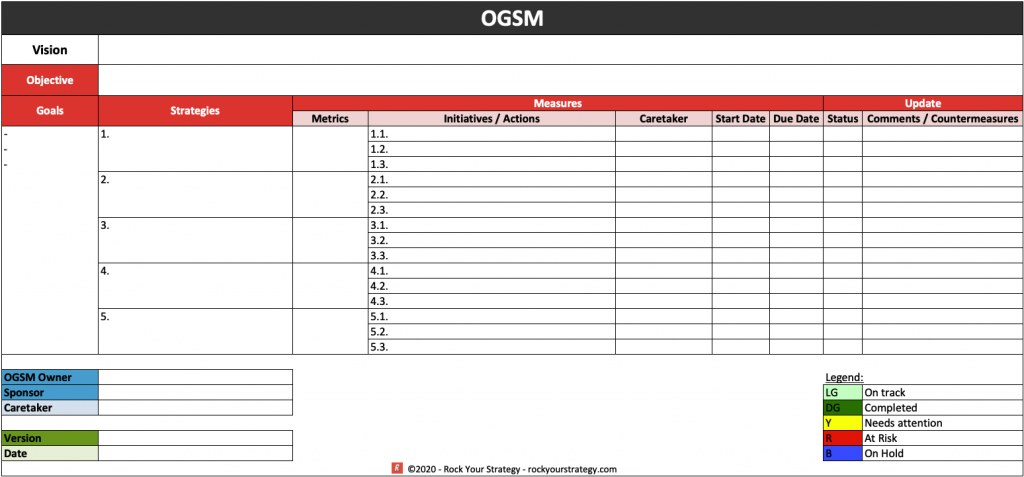
OGSM Template for Excel
Pre-formatted, easy-to-use OGSM template for Microsoft Excel.
Andy shared with Frank what he had been thinking about all night. When he was finished Frank let out a long sigh. “And you are convinced this will fly?”
“I’m not, Frank. But I think it’s our only chance. Let’s discuss the idea with the team. And then let’s hash out a plan that can beat Competitech, restore our path to growth and convince the Board of Directors and our organization to come on board for the ride.”
Staging a turnaround
It was 8 a.m. by the time the last person sat down in the conference room. Murmurs of “G’morning” made the round. The entire leadership team had followed Andy’s call for the all-hands meeting. The small conference room seemed to be bursting at the seams with all seven leaders in attendance.
There was Frank, of course, the head of finance, who was seated right next to Andy. Next to him was Dan, head of operations, followed by Sharon, head of sales & marketing. Unlike in many other companies, Dan and Sharon usually stuck together. Next to Sharon was Alisha, the head of R&D. On the opposite side of the table, Tom, head of procurement, and Sarah, head of HR, sat in their usual seats.
Florian’s Fastener Solutions leadership team in late 2010s
| Managing Director | Andy Walterman |
| Finance | Frank |
| Operations (incl. manufacturing & supply chain) | Dan |
| Sales & Marketing | Sharon |
| Research & Development (R&D) | Alisha |
| Procurement | Tom |
| Human Resources (HR) | Sarah |

Andy opened, “Good morning, everyone. Thank you for joining this early on a Monday. We have some important news to share and then some critical topics to discuss.”
Chatter erupted in the room. There was a crinkling of suspense and worry in the air.
“Please guys, let me explain.” Andy cleared his throat. “The market report we commissioned came back this morning… We lost further market share and are now at 15%. Competitech continues its march across the country and is rolling up customers state by state. Their share has swelled to 26%. This needs to stop. If we lose Home Improv or any of our main retail customers here in the Northeast, we will run out of cash as early as next year. I don’t need to explain what that would mean to our company and to the legacy my father has built together with all of you.”
Andy paused and looked around the room. He had everyone’s undivided attention. “Look, I am not going to sugarcoat this. This situation is dire. Competitech is significantly larger than us, offers cut throat prices with their cheap imports, and has a much wider portfolio of fasteners, screws, nails, and other metal products. Competitech is targeting large retailers and wholesalers and is already knocking on Home Improv’s door. If we simply wait and do nothing, they will wash over us like a tsunami. But we will not let that happen!”
Sharon spoke up first, “How do you plan to do that, Andy? Competitech is everywhere. They have a much larger sales force and their prices are 20% lower than hours. My guys are running out of arguments.” Dan nodded. “We cannot compete with their costs. We have optimized our processes over the last years as much as we could. There are no quick wins here.”
Chatter erupted once again as the team began talking over each other. Frank raised his hand and the room fell silent. The sign Florian had established still worked like a charm. “Andy had an idea. It’s risky financially but it’s worth considering. Give him a chance to explain.”
“Thanks, Frank.” Andy continued. “Sharon, Dan, I hear you. You guys have done your utmost to put us – and keep us – in a competitive position. That has contained the impact so far. Thank you for that. However what got us here, will not help us going forward. We have to rethink our strategy and refocus our resources.”
Frank picked up the market report which had been printed and laid out for each team member. “Besides the current market shares and competitive positions, the report also offers an outlook for different sectors of the market in future.” Frank tapped on a graph on page 7 of the report.
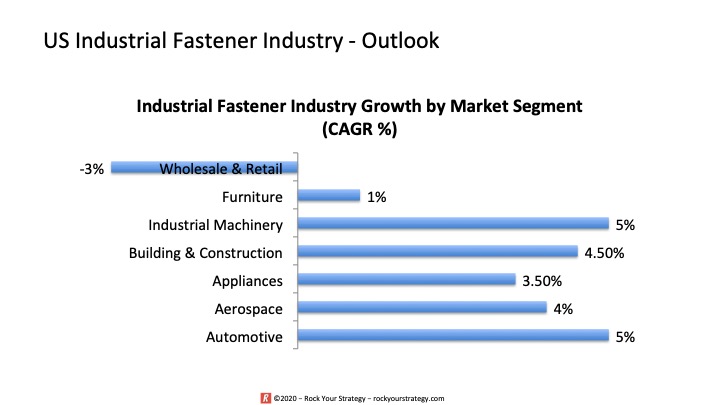
“While the overall fastener industry in the US is growing 2%, the wholesale & retail sector which has been our home market for all these years is going to decline faster in the years ahead”.
Sharon sighed, “I’ve been telling you this, Frank. Retail is dead in the water. No one is fixing up their houses anymore. Young people want to live in the cities. They play on their smartphones all day and have two left hands when it comes to swinging a hammer…”
“You have,” acknowledged Andy. “And we need to direct our attention to what is growing. Look at the chart. Construction, our other main market, remains robust. Automotive, Aerospace, Industrial Machinery are all showing positive growth for the coming years.”
“This is interesting!” Alisha exclaimed. She had skipped ahead in the report and read about the market trends within each of the sectors. “Some of the drivers of growth in Building & Construction are the building of data centers and elevators & escalators. Have we looked at this in more detail yet?”
“You hit the nail on the head, Alisha.” Andy smiled for the first time that day. “We are a small company. We will not be able to take on Competitech with their size. Nor will we be able to satisfy the Automotive industry’s requirement for scale and JIT. Why not use our size to our advantage and focus our attention on growing industries that require custom made products and value-adding services? Such as the IT and Elevator industries.”
The team began discussing the various market segments and debating which ones best fit their capabilities and size. After an hour of reviewing the facts they indeed honed in on IT and Elevators.
“Sounds to me like these are the industries with the highest growth rates in the next few years and for which we are uniquely positioned with our expertise here in the Northeast,” concluded Tom.
“But the industries are still small”, said Dan. “They alone will not be able to sustain us.”
Andy agreed, “It will take time for us to prepare entering those markets. We will need to add new products and new skills. And meanwhile, we must not give up our fortress. We will need to work on our cost position and secure our largest customers. The cash flow from our sales today will need to fund our sales of the future.”
“We will need additional resources for what you have in mind, Andy. We have good standing with our banks, but we will need a clear plan to convince them”, remarked Frank.
“We will need to convince our teams first, Frank. People are nervous. They see our sales declining and are worried that their jobs are at risk.” Sarah reminded everyone what was at stake.
“No one will lose their jobs. We will need everyone if we want to pull this off: you, your teams, the Board, everyone. We need to go back to the values my father instilled in this business to stage a turnaround. Let’s take a break and then resume to make a plan.”
Making a strategic plan
When the team returned to the conference room, Andy had already set up 2 flip charts. On the one in front of the room he had written a timeline.
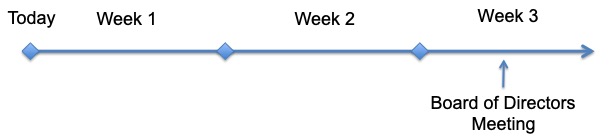
Andy rolled up his sleeves. “Alright, folks. We have less than three weeks to put together the plan. I suggest we start right away today by setting the framework and then work over the next 2 weeks with our teams to flesh out the details. If we want broad buy-in from the team, we need to involve them as we always have.”
Andy flipped over the flip chart, revealing a process chart. “My dad had sworn by this process. Let’s use it again to guide our discussions. We had a good starting point this morning, but we need to dig deeper into those market segments to better understand their dynamics, customer needs, and competition.”
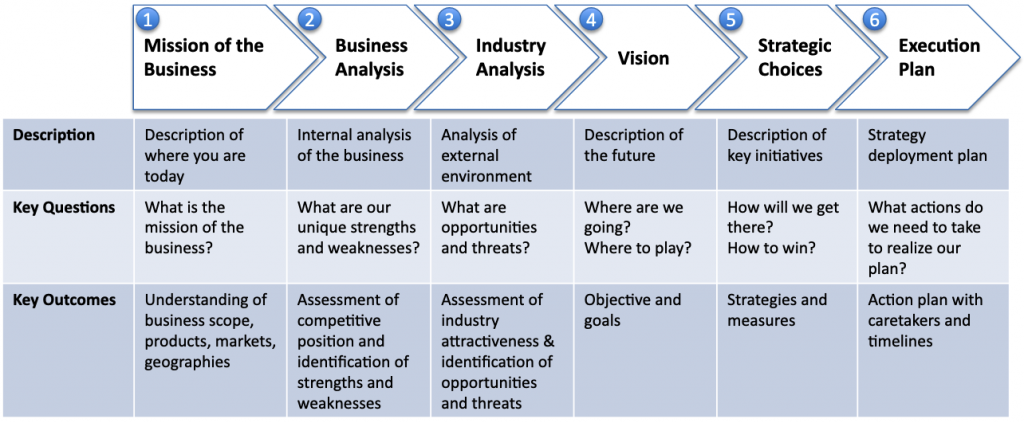
“I suggest we approach it as follows.” Andy pointed to the strategy process. “Let’s focus today on the Mission and Business Analysis steps. Sharon, can you then work with your team on the Industry Analysis until the end of the week? Let’s then resume next Monday with the Vision and Strategic Choices parts before we then develop the Execution Plans with our teams for the remainder of that week. Goal must be to have a plan ready by the end of next week. That’s 10 days, 12 with the weekend. Are you guys ok with that?”
“Wow, that’s a tight timeline, Andy!” Dan was not usually the one to point out the obvious.
“Yes, it is, Dan. This is not going to be easy. I am open to alternative ideas if you have any.” Andy scanned the room, but no one had a suggestion.
“Then let’s get started,” said both Alisha and Sarah in unison. They looked at each other and giggled. “Yes, let’s get started”, confirmed Andy, glad that the mood had lightened. “Frank, can you take over and facilitate?”
Intimately familiar with the strategy process, Frank was happy to. He got up and walked to the front of the room.
OGSM example – the 5 year growth plan
The Leadership team of Florian’s Fastener Solutions went to work. And over the next two weeks worked out a detailed plan with their teams. They summarized their strategy in a simple one-page business plan they called their OGSM.
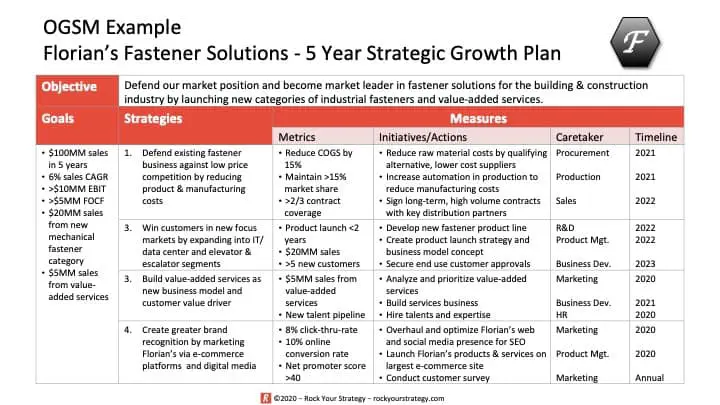
Click here for a downloadable PDF copy of Florian’s OGSM.
What is OGSM?
OGSM stands for Objective, Goals, Strategies and Measures and is a one-page business plan which details what you aim to achieve and how you are going to achieve it.
Read more about the OGSM methodology and how it can help you simplify your strategy and deliver results here.
Andy knew his dad had used the OGSM methodology for years. He had liked its simplicity and the clarity it created. Combining the what and the how moved the team from planning to execution and aligned everyone behind the overall direction of the company.
“If you want your team to follow you, Andy, your team needs clarity where you’re headed!” he had always implored on him. Andy heard his father’s voice ring through his head. He could remember a treasure trove of bumper sticker-like one-liners from his childhood. He barely ever listened to his dad when he talked about work at the dinner table. When Andy took over Florian’s however he had been glad for the lessons his dad had taught him.
- “Making the numbers is not a strategy. Strategy is about making choices!”
- “Appeal to your people’s hearts and their minds and they will take you anywhere.”
- “Take care of your people and they will take care of your customers.”
- “A plan is only as good as its execution!”
Andy sat in his office, eyes locked on a copy of the freshly minted OGSM in front of him. He felt good about their plan. Not only did the leadership team work on it with enthusiasm. But the entire organization had pitched in. He was surprised at the commitment everyone had shown. It was as if they had just been waiting to be asked to contribute. And maybe they had been…
Andy felt exhausted as he dialled his mother’s phone number. He wanted to set up a meeting to jointly review the final plan. He had kept her apprised of progress over the past two weeks. Being the chairlady of the Board of Directors, Andy made sure she was in lockstep with the team every step of the way.
With the Board of Directors meeting now days away and the change they proposed significant, Andy did not want to leave anything up to chance. The transformation itself would be enough of a gamble.
Epilogue
Sarah raised a glass. “Andy, on behalf of the leadership team, I would like to thank you! If it wasn’t for your dedication, your optimism and your continued reinforcement of the plan and its execution, I’m not sure whether we’d be here today.” The rest of the team joined in cajoling and shouts of encouragement and appreciation. Sarah threw an icy look before bursting out into laughter. “Quiet, I am not finished yet!”
Florian’s Fastener Solutions leadership team was sitting together on the farmhouse patio of the little vineyard which Florian Walterman had bought years ago. Overlooking Cayuga Lake, the vineyard at Finger Lakes had become a favorite get-away for company events and team celebrations.
It was a beautiful late Summer evening. A slight breeze made the warm air comfortable. Bottles of the vineyard’s signature Riesling were nestled in the ice bucket next to the large table. Andy had invited the team to the vineyard to celebrate the latest contract Sharon had signed the previous week and the progress the company had made in executing their plan.
“When we embarked on this journey three years ago, I was frankly not convinced that we would be able to turn things around.” Sarah said honestly. “Of course I was hopeful. I had faith in our abilities and our team members. But I was not convinced.”
“Boooooh”, Sharon and Dan interrupted Sarah with wide smiles. “Shush, you two”, she responded with an equally wide grin.
“Andy, you kept us going. You convinced your mother and the Board of Directors, you got the funding from the bank, and you led the meticulous execution of our plan every quarter and every month. Here we are 3 years in. We are not done yet. But we are on track and have returned to growth again! Cheers to you! Cheers to Florian’s!”
The team raised their glasses in celebration and the rings of clinking glass could be heard reverberating across the valley. As the sun was setting over Cayuga Lake, the seven leaders kept chatting while enjoying the wins they had achieved. They knew they were not yet at their destination and that more challenges lay ahead. But tonight they enjoyed the wine and each other’s company.
Final Notes
While this story is totally fictional, the learnings can be real. If you would like to learn more about the OGSM methodology, read our introduction to the OGSM methodology here. You can explore other examples and templates via the respective links.
Florian’s Fastener Solutions, all characters and all data points are completely fictional and the brain child of the author. Any resemblance to real life events or circumstances is not intended and may be coincidental. Please excuse us if some data seems contradictory or far-fetched. The story intends to introduce the OGSM methodology and its application. It is not the purpose to provide actual industry information or a real world case study.
If you have any questions or comments, why not leave us a note in the comment box below or sign up to our free newsletter here. We’d love to hear from you.

10-Page Strategy Presentation Template
Fully customizable strategy presentation template for Microsoft Powerpoint