Tag: strategy tools

  • The OGSM Strategy Builder: Build Your Whole Strategy With Claude, One Phase at a Time

    The OGSM Strategy Builder: Build Your Whole Strategy With Claude, One Phase at a Time

    You downloaded the template. You opened it on a Sunday morning with a coffee, and you got as far as the box marked Objective.

    Then you sat there.

    Not because you don’t know your business — you know it better than anyone. But because a blank box doesn’t ask you anything. It doesn’t ask why you’re doing this now. It doesn’t ask what you’d have to stop doing to make room. It doesn’t notice when you write “deliver growth” and let it stand.

    A template gives you a format. What most people actually need is a facilitator.

    That’s what we’ve built. It’s called the OGSM Strategy Builder, it’s available in the shop, and this post explains exactly what it does — and what it deliberately does not do.

    What is the OGSM Strategy Builder?

    It’s a paid Claude Skill that turns Claude into an OGSM facilitator and walks you through building a complete, execution-ready strategic plan in eight phases.

    You install it once. Then you open Claude, say something like “help me build our strategy for next year”, and it takes over: asking questions, pushing back on vague answers, drafting options for you to choose between, and saving your progress as you go. At the end you get a finished OGSM one-pager in the format you want, plus a workbook recording every decision and every option you rejected.

    It is built on the same method taught across this blog — the OGSM as described in what OGSM stands for — and on the Seven Cardinal Sins of Strategy from The Strategy Lie, the free ebook on this site.

    It does not write your strategy. I’ll come back to that, because it’s the whole design.

    What problem does it actually solve?

    The gap between a template and a process.

    We sell a $4.99 Excel template and a PowerPoint version, and they do their job well. Thousands of people have used them. But a template assumes you already know how to run the thinking — how to tell a Strategy from a Goal, how to spot an activity metric wearing an outcome metric’s coat, when to stop adding and start cutting.

    Most people don’t. Not because they’re not smart enough, but because nobody ever showed them. And so the classic thing happens: the plan gets written, the boxes get filled, and three months later nobody can remember what was in it. The plan isn’t bad. The process behind it never happened.

    The other half of the problem is that a facilitator is expensive. A good strategy consultant to run a two-day session costs more than most small businesses will ever spend on strategy. So the choice has been: a blank template, or a five-figure invoice.

    This sits in between. It’s the process, not just the page.

    What is a Claude Skill, and do I need to be technical?

    No. A Skill is a folder of instructions you add to your Claude account — Claude.ai, Claude Code or Cowork. Once it’s installed, Claude reads it and follows it whenever the topic comes up. You install it once, the way you’d install an app, and after that you just talk to Claude normally.

    There’s no coding, no API key, no subscription to anything except Claude itself. If you can download a file and drag it into a browser window, you can install this.

    What happens across the eight phases?

    The order matters. OGSM works left to right, and each element is built on the one before it. Skip a phase and the phase after it inherits the gap.

    Phase 0 — Set-up and Diagnosis

    Scope, time horizon (a 3–5 year strategic plan and a 1-year operating plan are different animals), and who has to agree. Then two diagnostics: the Five-Answer Test — ask five of your leaders separately what the strategy is and count how many different answers you get — and the Seven Sins self-diagnosis. It finishes by asking you to list everything the business currently has in flight. That list comes back to bite in Phase 5, which is the point.

    Phase 1 — Reality

    Key figures first, then a SWOT built by conversation rather than form-filling — the approach in how to do a SWOT right. Where your situation warrants it, it offers deeper analysis: PESTEL, market trends, Porter’s Generic Strategies, Five Forces, the 5P marketing mix. Where it doesn’t, it doesn’t offer them. Nobody needs a Five Forces analysis to decide whether to hire a second van.

    Phase 2 — Objective

    One qualitative, what-by-how statement. It drafts three genuinely different options — different bets, not different wordings — shows you what each one commits you to and what each one rules out, and makes you pick. Then it sharpens the one you picked and runs it through the tests in how to write a great objective. Expect to spend real time here. This is the sentence everything else hangs from.

    Phase 3 — Goals

    Three to five SMART goals, each with a baseline, at least one financial, and coverage of both halves of your objective — the “what” and the “how”. Then the gate: if we achieve exactly these goals and nothing else, have we succeeded? It’s the most useful question in the method and it’s in how to write SMART goals for your OGSM.

    Phase 4 — Strategies

    Three to five what-by-how choices, each with a named owner. Then the We WILL / We will NOT list, which is the exercise that turns a set of intentions into a decision. This is the uncomfortable phase, and if it isn’t uncomfortable it hasn’t worked.

    Phase 5 — Measures

    Per strategy, two structurally different things kept explicitly apart: a Dashboard of 2–4 KPIs, each with baseline, target, frequency and a data owner, at least one leading and one lagging — and an Action Plan of 2–3 initiatives, each with a caretaker and dates. Then the capacity conversation: your Phase 0 workload list comes back and every item gets sorted into continues, paused or stopped. If everything stays, you execute nothing. The full method is in the complete guide to OGSM Measures.

    Phase 6 — Stress Test

    The finished draft is run against the quality rules and the seven failure modes, and reported back in three parts: what holds, what it would challenge, and what it cannot verify.

    Phase 7 — Deliver and Cascade

    The one-pager in your chosen formats, plus cascade guidance (a higher-level Measure becomes a lower-level Goal — see how to cascade OGSM), a communication plan, and the review calendar with actual dates in it. Not “quarterly, we’ll find dates”. Dates.

    Phase 8 — Review (and this one repeats)

    The plan is built. Now comes the part that decides whether any of it mattered.

    Before each monthly or quarterly review, you bring the workbook back. The skill walks the plan strategy by strategy, updates the numbers and statuses with whatever you know, works out whether each goal is actually on the path you set — not just whether it moved — and checks the question almost nobody asks out loud: has anything on your “we will not” list quietly started happening again?

    That last check is the one that earns its keep. Strategies rarely get reversed in a meeting. They get reversed one exception at a time, and nobody notices until the trade-off that made the plan real has been eroded entirely.

    You come out with a prepared agenda, at-risk items first, and the two or three things that genuinely need a decision rather than a status update. Afterwards you come back, say what was decided, and it goes into the workbook.

    What do you get at the end?

    Three things.

    The OGSM one-pager, in HTML, Excel, PowerPoint or PDF — you pick, and most people take at least two. HTML is the living version you share by link. Excel is the one your OGSM caretaker updates each month. PowerPoint is what you present. PDF is what you print and pin up.

    The Strategy Workbook, which captures the reasoning: the options you rejected and why, the trade-offs, the accepted risks. This is more valuable than it sounds. At your first review, when someone asks “why did we decide that?”, the answer is written down.

    A cascade and communication pack — who hears what, how, when, and from whom, plus the review calendar.

    The skill also ships two scripts. One generates the four output formats. The other validates any plan against the OGSM rules: counts, what-by-how form, missing owners, targets without baselines, activity metrics masquerading as outcomes, and an empty “will not” list. You can run that validator against a plan you wrote years ago, on your own, without doing any of the rest.

    What happens if you have to stop halfway?

    You stop.

    The skill writes your progress to a workbook file at the end of every phase and hands it to you. Stop after Phase 2 on a Tuesday, come back three weeks later, hand the file back, and it tells you in two sentences where you left off and carries on. Nothing gets redone.

    This is deliberate. A strategy built over four evenings is worth more than one rushed in an afternoon, and pretending otherwise is how you end up with a plan that was really just a long meeting.

    What does the stress test actually check — and what can’t it check?

    The mechanical checks are easy and mostly automated: goal counts, missing baselines, strategies without owners, initiatives that are really operational routines, vanity metrics.

    The judgement checks are the interesting ones. Would five people read this page the same way? Could someone who joined three weeks ago say what the business is trying to do? Swap in your main competitor’s name — does the plan still read as sensible? If yes, you haven’t chosen anything. Is there anything in this plan that costs someone something specific? Do the strategies plausibly deliver the goals, or is the goal 28% growth against three efficiency initiatives?

    And then the part I insisted on: what it cannot verify.

    Every stress test ends with a section naming the assumptions it has taken on trust — your market size, a competitor’s intent, your team’s real capacity, whether the person who has to carry Strategy 3 actually believes in it. It has read everything and lived none of it. Those are the things you check before the plan goes live.

    An AI strategy review produces observations, not decisions. A tool that pretends otherwise is selling you confidence you haven’t earned.

    Who is this for — and who is it not for?

    It’s for you if: you run or lead a business and need a real plan; you’ve tried a template and stalled; you have a strategy nobody can repeat; you’re a functional leader who has to build a plan that connects upward; you want a sparring partner who won’t agree with you to keep the peace. It works for a five-person firm and for a division of four hundred — see OGSM for small business if you’re at the smaller end.

    It’s not for you if you want a plan written for you in two minutes. It will refuse. It will draft options and make you choose, and it will ask you what you’re going to stop doing, and it will keep asking until you answer. If that sounds like more work than you were hoping for — it is. That’s not a bug, and post three in this series explains why at length.

    It also won’t do the political work. If your real problem is that two directors disagree and everyone knows it, no document fixes that. It will name it. It can’t settle it.

    The honest summary

    This is a facilitator, not an oracle. It brings the method, the discipline, the questions and the standard. You bring the business, the judgement and the decisions.

    Your strategy doesn’t need to be complex to be good. It needs to be clear, owned, and reviewed. This is a structured way to get there in an afternoon or four evenings, instead of another year of meaning to.

    Ready to stop staring at the blank Objective box? The OGSM Strategy Builder is available now in the shop — install it once, and build your strategy the next time you can give it an afternoon.

    Founding price — $49 until 31 October 2026. After that it goes to $99, and stays there. Founding customers keep every future update at no extra cost, including the new phases and worked examples already planned for the next version.

    For scale: one facilitated strategy session starts at around $2,000, and five seats of the cheapest OGSM software is roughly €480 a year. This is $49, once.

    Rock on.

  • How to Use AI to Build Your OGSM: A Practical Guide for 2026

    How to Use AI to Build Your OGSM: A Practical Guide for 2026

    Strategy has always demanded two things most people are short on: time and objectivity.

    You can use AI to build your OGSM at every stage — from drafting your SWOT and stress-testing your objective, to generating strategic options and identifying the right KPIs. Feed an AI tool like ChatGPT or Claude the right context, ask the right questions, and you’ll compress hours of strategic thinking into minutes — without sacrificing quality.

    That’s the short version. The rest of this guide shows you exactly how to do it at each step, with practical prompts you can copy and use right now.

    First: What AI Is (And Isn’t) Good for in Strategy

    Before diving into the how, it helps to be clear about the what.

    AI is genuinely good at generating options quickly, structuring and stress-testing ideas, summarising large amounts of information, drafting text, and challenging your thinking with alternative perspectives.

    AI is not good at knowing your business the way you do, replacing strategic judgment, validating data it hasn’t seen, or making decisions on your behalf.

    The best way to think about it: AI is a fast, well-read sparring partner. It has read everything, remembers everything, and is always available. But it hasn’t lived through your last five years of business. You bring the context. It brings the horsepower.

    With that framing in mind, here’s how to use it across each stage of your OGSM.

    Step 1: Use AI to Sharpen Your Situational Analysis

    Every good OGSM starts before the OGSM itself — with a clear-eyed assessment of where you stand today. That typically means a SWOT analysis, a PESTEL scan, or a review of your competitive position.

    This is where AI earns its keep immediately.

    Rather than starting with a blank page, give an AI tool like ChatGPT or Claude the key facts about your business — your industry, size, markets, main products or services, and the biggest challenge you’re facing — and ask it to draft a starting-point SWOT. You won’t use the output directly, but it will surface angles you hadn’t considered and give you something concrete to react to, which is always faster than building from scratch.

    Try this prompt:

    “I run a [type of business] with [X employees] operating in [markets/geographies]. Our main products/services are [X]. We are currently facing [challenge]. Draft a SWOT analysis for my business, and for each point, explain the strategic implication in one sentence.”

    Review the output critically. Cross out what doesn’t fit, add what it missed, and you’ll find you’ve completed a quality situational analysis in a fraction of the usual time.

    You can apply the same logic to a PESTEL analysis. Ask AI to scan the macro-environment of your industry for political, economic, social, technological, environmental, and legal factors. It won’t know your local context, but it will catch trends you may have overlooked — especially in fast-moving areas like regulation or technology.

    Step 2: Use AI to Draft and Test Your Objective

    Your OGSM Objective is the most important sentence in your entire strategic plan. It needs to be inspiring, clear, and grounded — and it often takes several rounds of iteration to get right.

    AI is useful here in two ways: drafting and stress-testing.

    For drafting, describe your ambition in plain language and ask AI to turn it into a crisp strategic objective.

    Try this prompt:

    “Based on this business context: [paste your context]. Here is my current draft objective for our strategy: [paste it]. Please rewrite this as a sharp, inspiring strategic objective in one sentence. Then give me two alternative versions — one more ambitious, one more conservative.”

    For stress-testing, ask AI to challenge what you’ve written.

    “Here is our strategic objective: [paste it]. What are the top three weaknesses or blind spots in this objective? What is it not saying that it probably should?”

    This kind of challenge is exactly what a good strategy coach would give you in a workshop — and it’s available instantly, at any time.

    Step 3: Use AI to Benchmark and Validate Your Goals

    Your OGSM Goals translate your qualitative objective into 3 to 5 measurable, quantitative targets. The question most people struggle with isn’t what to measure — it’s what numbers to aim for.

    AI can help you benchmark.

    “We are a [type of company] in [industry]. We want to grow revenue from [X] to [Y] in [timeframe]. Is this growth rate realistic compared to industry benchmarks? What typical growth rates do companies like ours achieve, and what are the key drivers?”

    AI will give you a directional answer based on its training data. It won’t have access to your specific market’s most recent figures, so treat the output as a calibration tool rather than gospel. But it will quickly tell you whether your goals are realistic, stretched, or timid — and that alone is worth the conversation.

    Step 4: Use AI to Generate Strategic Options

    This is arguably the most powerful use of AI in your OGSM process. When it comes to defining your Strategies — the “how” of your plan — most teams default to the same playbook they’ve used before.

    AI breaks that pattern. It has been exposed to thousands of strategic frameworks, case studies, and industry examples, and it can generate a wide range of strategic options quickly. Your job is to filter, refine, and stress-test.

    Try this prompt:

    “Given this strategic objective [paste it] and these goals [paste them], generate 8 to 10 potential strategies for achieving them. For each strategy, describe it in one sentence using the format: ‘[Verb] [what] by [how]’. Then rate each strategy on a scale of 1 to 5 for both impact and feasibility.”

    You won’t use all 8 to 10 options. But the exercise will almost certainly surface one or two angles your team hadn’t considered — and that’s exactly what makes it valuable.

    Step 5: Use AI to Define the Right Measures

    The Measures column of your OGSM — covering both Metrics (what you track) and Initiatives (what you do) — is where most strategic plans either come to life or fall apart. The biggest risk is choosing measures that are easy to track rather than measures that actually tell you whether your strategies are working.

    Here AI can act as a useful check.

    “Here is our strategy: [paste it]. What are the best leading and lagging indicators to measure whether this strategy is succeeding? Give me 3 to 5 specific KPIs, and for each one, explain why it matters and what a good result looks like.”

    Leading indicators tell you whether you’re on track before the results arrive. Lagging indicators confirm what happened after the fact. A good OGSM uses both — and AI can help you design that balance.

    The Three Mistakes to Avoid

    Using AI in strategy is still new territory for most businesses, and a few common mistakes are worth calling out.

    Mistake 1: Taking the first output at face value. AI generates plausible-sounding content quickly, but “plausible” is not the same as “right.” Always treat the first draft as a starting point, not a finished product. Push back, ask follow-up questions, and test the assumptions.

    Mistake 2: Skipping the team conversation. AI is a tool for you, not a replacement for your team’s input. A strategy created in isolation — even a well-crafted one — rarely gets executed well. Use AI to prepare better material for your team discussions, not to skip them.

    Mistake 3: Using generic prompts. The quality of your AI output is directly tied to the quality of your input. The more specific context you give — industry, company size, specific challenge, desired format — the more useful the response. Generic prompts produce generic answers.

    Putting It All Together

    Here is a simple workflow to use AI across a full OGSM build:

    1. Situational Analysis — Use AI to draft your SWOT and PESTEL as a starting point for team discussion.
    2. Objective — Use AI to sharpen your draft and stress-test your thinking.
    3. Goals — Use AI to benchmark your targets against industry norms.
    4. Strategies — Use AI to generate a broad range of options, then filter with your team.
    5. Measures — Use AI to identify the right KPIs and design your leading/lagging indicator mix.

    At every step, you’re using AI to do the heavy lifting on the first draft — so your time and your team’s energy goes into the judgment calls that only humans can make.

    Start With the Right Foundation

    If you want to put this into practice, the best place to start is with a clean, well-structured OGSM template. Our OGSM Template for PowerPoint and OGSM Template for Excel give you the framework to capture everything your AI-assisted analysis surfaces — and to turn it into a one-page strategic plan your whole team can work from.

    AI accelerates the thinking. The OGSM gives it structure. Together, they make for a faster, sharper, and more actionable strategy.

    And if you would rather run the whole thing as one process than assemble it prompt by prompt, the OGSM Strategy Builder is a Claude Skill that facilitates all eight phases — diagnosis through review — and hands you the finished one-pager in HTML, Excel, PowerPoint and PDF. Here is what that session looks like, phase by phase.


    Want to go deeper on OGSM? Read What Is OGSM? or explore our full library of OGSM examples for inspiration.

  • SWOT Analysis Template & Examples: How To Do A SWOT Right?

    SWOT Analysis Template & Examples: How To Do A SWOT Right?

    How do you get a quick but profound assessment of the situation of your business? Conduct a SWOT analysis!  

    SWOT stands for strengths, weaknesses, opportunities, and threats and evaluates the situation of a business, project or organization. Conducting a SWOT analysis is a 5-step process:

    1. Decide the objective of your analysis
    2. Identify strengths, weaknesses, opportunities, and threats
    3. Challenge and prioritize your results
    4. Make a plan
    5. Take action 

    The SWOT analysis is a simple but very powerful tool. You can use it stand alone or as part of a strategy process. Read on for a step-by-step guide how to create an impactful SWOT analysis and download our free templates and examples to help you get started.

    How to do SWOT Analysis? 

    The SWOT analysis is an intimate view of your business, project, or venture. 

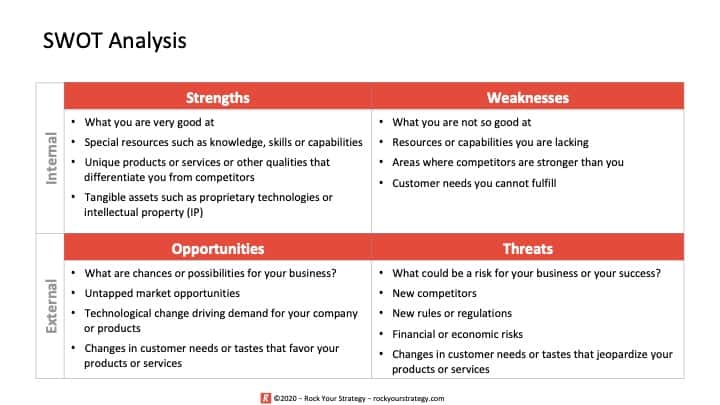
    Strengths and weaknesses are internal to your business. This means they describe the business itself or the internal situation. These are factors, such as products, services, capabilities, skills, knowledge, etc. that you are good at or not so good at. You can directly influence these internal factors. 

    Opportunities and threats are external to your business, which means these are factors outside of your business that you are exposed to. These can be market trends, the political, economic, socio-cultural, technological, environmental, legal/regulatory environments (PESTEL), or of course competitors, suppliers, and customers. Usually, you cannot directly influence external factors. 

    SWOT Analysis
    SWOT Analysis

    The SWOT analysis is often conducted as part of a strategic review process. But it can also help to obtain a quick overview of the health of a project or the prospects of a new venture. It can be conducted for the entire business or on a product or team level. 

    The SWOT is typically depicted in a 2×2 matrix that looks as follows. 

    StrengthsWeaknesses
    – …
    – …
    – …
    – …
    – …
    – …
    OpportunitiesThreats
    – …
    – …
    – …
    – …
    – …
    – …
    Simple 2×2 SWOT Analysis Matrix

    In order to conduct a SWOT analysis, take the following 5 steps. 

    1. Decide the objective of your analysis

    What is the purpose of your SWOT analysis? Is this SWOT for your entire business or for a subset such as a product, division or team? Are you analyzing your SWOT as part of a strategic review or for another reason? 

    Be clear and deliberate about why you conduct the analysis before you begin. This is often overlooked and may cause confusion during the analysis or ambiguous results. Your purpose gives context to the analysis and allows you to be more specific in your assessment.

    2. Identify strengths, weaknesses, opportunities, and threats

    Conduct a brainstorm about each of the four elements of the SWOT. List down all the aspects you can come up with. The following questions may help. Your answers can be qualitative or quantitative but try to be as specific as you can. 

    Strengths

    • What are you particularly good at? 
    • What makes you and your business unique in the marketplace? 
    • What are you distinctively better at than your competition? 
    • What special resources such as knowledge, skills or competencies do you have? 
    • What tangible assets give you an advantage such as proprietary technologies, intellectual property? 
    • What do customers love about you? Why do customers buy from you? 

    Weaknesses

    • What are you less good at? 
    • What resources, knowledge or skills are you lacking? 
    • What are your competitors better at than you? 
    • What complaints or feedback do customers have about your products or services? 
    • What processes or procedures need improvement?

    Opportunities

    • What chances or possibilities exist for your business? 
    • What market trends could positively influence your business? 
    • Are there technological trends that could drive demand for your products or services? 
    • Are there customers or sales channels you are not yet fully exploring? 

    Threats

    • What could be risks for your business or for your success? 
    • Are there emerging competitors or alternative products or services? 
    • What changes in customer needs or tastes could jeopardize demand for your products or services
    • Are there supply side risks to availability of raw materials or services you source? 
    • Are there changes to rules or regulations which could affect your business? 
    • What are financial or economic risks you face? 

    As you go through each of the four elements in turn, be brutally honest with yourself. Don’t sugarcoat the weaknesses or undermine your strengths. Consider using a PESTEL analysis to complement your external assessment. Be realistic and focus on getting to the truth. 

    3. Challenge and prioritize your results

    After you have gone through each element in turn, take a step back and review your list of strengths, weaknesses, opportunities and threats. 

    For each element, highlight the top 3 to maximum 5 identified aspects. If you can, work on this in a team. It really helps to review your list from different angles and debate your outcome. Challenge yourself to identify really only the top 3-5 aspects relevant to the purpose of your SWOT analysis. Then transfer these prioritized items into the 2 x 2 SWOT matrix.

    Why only the top 3-5 aspects? In my experience, it really helps to focus your attention on the top results. Think about it. If a strength doesn’t make it into your top 5, is it really a key strength? If a threat doesn’t make it into your top 5, should you really devote significant resources to it? 

    4. Make a plan

    When the SWOT analysis is complete, turn your insights into a plan of action. In order to do this, conduct a crossover analysis, plotting your strengths and weaknesses against your opportunities and threats. Formulate strategies by asking yourself the following questions: 

    • What strengths can you deploy to take advantage of your opportunities? 
    • What strengths can you use to mitigate or eliminate your threats? 
    • What weaknesses do you need to improve to benefit from an opportunity? 
    • What weaknesses do you need to act on to overcome a threat? 

    Write down your strategies in a clear action plan including caretakers and timeline. Discuss and align the plan with your team. Ensure that everyone is clear about the plan’s objectives and actions and everyone’s roles and responsibilities. 

    Go back to your original purpose of the SWOT analysis and confirm that all objectives are met. 

    5. Take action

    Now take action and execute your plan! Set up regular reviews at which you check on progress of your plan to make sure you are on track to achieving your objective and goals. 

    What to do with SWOT analysis results?

    Once the SWOT analysis is completed, formulate strategies to act on the insights gained. In order to do this, conduct a crossover analysis, plotting your strengths and weaknesses against your opportunities and threats. 

    This may look as follows.

    OpportunitiesThreats
    StrengthsStrength-Opportunity StrategiesWhat strengths help you take advantage of the identified opportunities? Strength-Threat StrategiesWhat strengths help you overcome the identified threats? 
    WeaknessesWeakness-Opportunity StrategiesWhat weaknesses to improve to benefit from opportunities? What opportunities might help you overcome a weakness? Weakness-Threat StrategiesWhat weaknesses to improve to minimize a threat? 
    Crossover Analysis of SWOT Results

    Write out 2-3 strategies for each crossover pair for a total of 8-12 strategies. Then prioritize your strategies based on your objective and goals. Aim to identify the 3-5 strategies that optimize your chance of success or with the best return on investment.

    Then turn your strategies into an action plan with clear initiatives, caretakers, and timeline. Conduct regular reviews to make sure you are on track to achieving your objective and goals. 

    Why conduct a SWOT analysis?

    The SWOT analysis is a simple but powerful tool to assess the internal and external situation of your business, project or organization. 

    It can be conducted quickly and easily without creating major costs or devoting significant resources. The SWOT analysis can be performed alone or in a team. It can be applied at various levels of an organization: to the business as a whole or to individual teams or products. 

    The results of a SWOT analysis can immediately be acted on. Or they can be integrated into a larger business strategy process. 

    Should small businesses use SWOT analysis?

    The SWOT analysis is a simple but powerful tool to assess the situation of your business. As it can be conducted quickly and easily without creating major costs to the business, it is a great tool for small businesses to evaluate their strengths, weaknesses, opportunities, and threats. 

    All you really need is a pen and paper to follow the simple 5-step process. Or download one of our free templates to help you get started! 

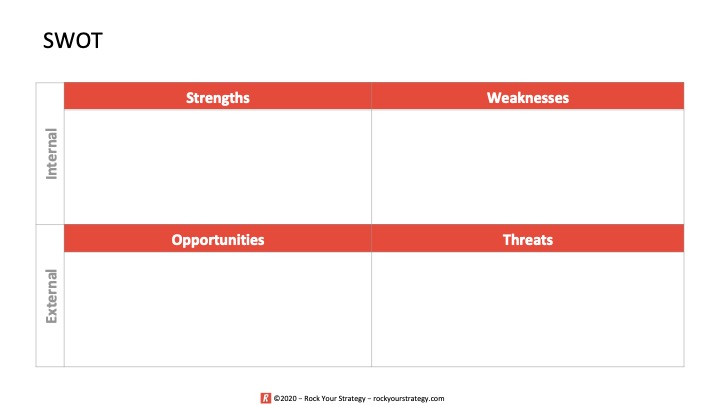
    SWOT template

    Begin your SWOT analysis by downloading our free SWOT analysis template. 

    SWOT Analysis Template
    SWOT Analysis Template

    Make sure to check out our resource page where you can find many other useful tools and templates to help you win at strategy and at business. 

    SWOT examples

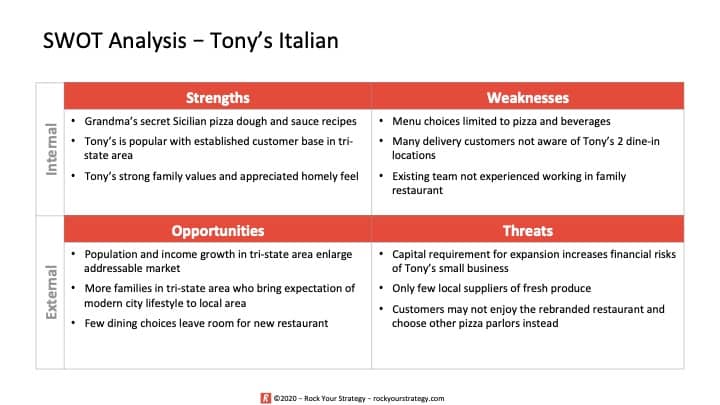
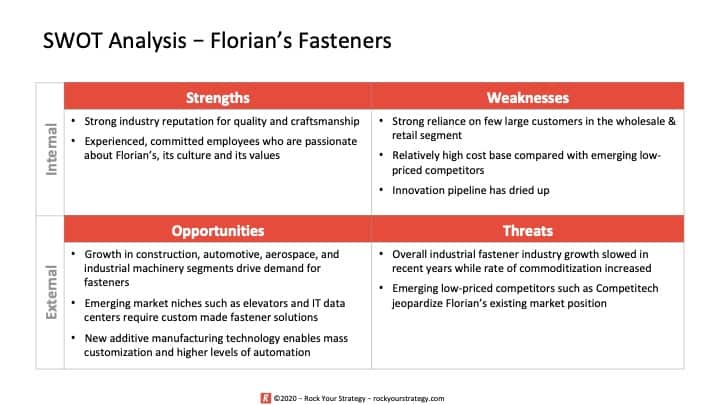
    In the following are two examples of SWOT analyses applied in practice. The first is a B2C example of Tony’s Italian restaurant. The second is a B2B example of Florian’s Fastener Solutions. Both of these examples are fictional to protect confidential information but the insights and learning can be real. 

    Tony’s Italian SWOT analysis

    SWOT Example
    SWOT Analysis of Tony’s Italian

    Read more about the OGSM Example of Tony’s Italian by clicking here.

    Florian’s Fastener Solutions SWOT analysis

    SWOT Analysis of Florian’s Fastener Solutions

    Read more about the OGSM Example of Florian’s Fastener Solutions by clicking here.

    What to do next? 

    If you’re researching SWOT analysis to help create a strategy for your business, project or venture, make sure to check out our other articles on strategic planning. 

    Our resource page with examples, tools & templates, workshop materials, book recommendations and glossary may also be of value to you. 

    If you have any questions or comments, why not leave us a comment below or sign up to our free newsletter here. We’d love to hear from you. Rock on!