Tag: strategy execution

  • How to Run an OGSM Strategy Review Meeting That Actually Moves the Needle

    How to Run an OGSM Strategy Review Meeting That Actually Moves the Needle

    Most strategy review meetings end with a slide deck nobody looks at again and a vague promise to “do better next quarter.”

    An effective OGSM strategy review meeting follows a fixed agenda: review your measures first, diagnose why goals are on or off track, agree on one to three concrete actions, and assign ownership before anyone leaves the room. Done monthly or quarterly, a 60–90 minute meeting is enough to keep a team aligned and a strategy alive.

    The difference between a review that drives change and one that just takes up calendar space is structure. Here’s exactly how to run it.

    Why Most Strategy Reviews Fail

    Strategy reviews fail for predictable reasons. The meeting is too long, too unfocused, or too comfortable. Teams report on what happened without asking why it happened — and leave without agreeing on what to do differently.

    The OGSM framework actually makes this easier to fix. Because OGSM separates your Objective (direction), Goals (measurable targets), Strategies (choices), and Measures (leading indicators), you always have a clear agenda. You’re not reviewing a vague “progress update.” You’re reviewing specific numbers against specific targets and asking specific questions.

    Who Should Be in the Room

    Keep it small. A strategy review is not an all-hands or a status report. It’s a decision-making session.

    The right people are those who own a Goal or a Strategy on the OGSM — typically your leadership team or department heads. If you’re a small business owner, this might just be you and one or two key team members.

    A useful rule: if someone can’t directly act on what’s discussed, they probably don’t need to be there.

    The Agenda That Works

    Step 1: Open With the Objective (5 minutes)

    Start every meeting by reading the Objective out loud. Not as a ritual — as a reset. It refocuses the room on direction before anyone dives into numbers.

    Ask one question: “Are we still headed in the right direction?” If the answer is genuinely no, the agenda changes. Otherwise, move on.

    Step 2: Review the Measures (15–20 minutes)

    Your Measures are the leading indicators that tell you whether your Strategies are working before it’s too late to adjust. Go through them one by one.

    For each Measure, ask:

    • What is the current status versus the target?
    • Is it green, amber, or red?
    • If it’s amber or red, why?

    Keep this factual. No blame, no defensiveness. You’re diagnosing, not judging.

    Step 3: Review the Goals (15–20 minutes)

    Goals are your lagging indicators — the outcomes you’re working toward. They tell you whether your Strategies are delivering results.

    Walk through each Goal:

    • Where do we stand against the target?
    • Are we on track for the period-end figure?
    • Which Strategies are contributing, and which aren’t?

    This is where the connection between strategy and outcome becomes visible. If a Measure is green but the related Goal is red, something in your diagnosis or strategy logic is off.

    Step 4: Agree on Actions (15–20 minutes)

    This is the most important part of the meeting — and the one most often rushed.

    Based on what you’ve just reviewed, agree on one to three specific actions to take before the next meeting. Not themes. Not intentions. Actions, with a named owner and a due date.

    A useful format:

    “By [date], [name] will [specific action] in order to [expected impact on Goal or Measure].”

    Three concrete actions with owners will do more for your strategy than ten discussion points with no follow-through.

    Step 5: Update the OGSM (10 minutes)

    Before the meeting closes, update your OGSM document with:

    • Current status on each Measure and Goal (RAG rating)
    • Actions agreed, with owners and dates
    • Any changes to a Strategy if one has clearly stopped working

    This keeps your OGSM a living document rather than a snapshot from last quarter. If you’re working from a shared template — a PowerPoint or Excel version — update it during the meeting so everyone leaves with the same picture.

    Step 6: Close With One Sentence (5 minutes)

    End every review with a one-sentence summary: “Our strategy is [on track / needs attention in one area / requires a course correction] — our priority action is [X].”

    It sounds simple, but a clear verbal close does two things: it reinforces alignment, and it gives anyone who needs to communicate the outcome to their teams a ready-made message.

    How Often Should You Meet?

    For most teams, a monthly rhythm works well during the first year of an OGSM cycle. Monthly is frequent enough to catch issues early, and infrequent enough to allow time for actions to take effect.

    If your strategy is in a critical period — a turnaround, a major launch, a tight quarter — move to bi-weekly. If things are running smoothly and your Measures are consistently green, quarterly is fine.

    The worst cadence is no cadence. A strategy that’s only reviewed when something goes wrong is a strategy that exists on paper only.

    Common Pitfalls to Avoid

    Reporting instead of reviewing. There’s a difference between presenting a slide of numbers and genuinely asking why those numbers are what they are. Push for the “why” every time.

    Skipping the action step. If the meeting ends without agreed actions, it wasn’t a review — it was a briefing. Always leave with ownership.

    Changing the strategy too often. If a Strategy changes every month, you never find out whether it was working. Give strategies at least two or three review cycles before you adjust them.

    Making it too long. Ninety minutes is enough for most teams. If you regularly run over, the problem is usually unclear preparation, not insufficient time.

    Prepare Before You Meet

    A strategy review is only as good as the data going into it. Before the meeting:

    • Update Measure and Goal data against targets
    • Flag any items that need discussion (not just reporting)
    • Share the updated OGSM with participants at least 24 hours in advance

    If participants walk into the room seeing the numbers for the first time, the first half of the meeting is wasted on comprehension rather than diagnosis.

    The Right Tool Makes It Easier

    Running an effective strategy review is much easier when your OGSM is in a format that’s built for it — one where Measures, Goals, and RAG status are all visible on one page, and where the whole team is looking at the same document.

    If you’re still managing your OGSM in a general-purpose template or a text document, consider moving to a structured format designed for this purpose. The OGSM Template for PowerPoint and OGSM Template for Excel are both built to support exactly this kind of review — with clear layout, RAG indicators, and a structure your team can update in real time. When your tool matches your meeting rhythm, the review practically runs itself.


  • How to Get Your Team to Actually Follow the Strategy

    How to Get Your Team to Actually Follow the Strategy

    Most strategies don’t fail because they’re badly designed. They fail because the people who need to execute them never truly bought in.

    Getting your team to follow the strategy comes down to three things: involving them in building it, communicating the why before the what, and making the plan visible and reviewable on a regular cadence. Teams don’t resist good strategies — they resist strategies they didn’t help shape and don’t fully understand.

    Here’s a practical guide to closing the gap between the strategy you have and the strategy your team actually executes.

    Why Teams Don’t Follow the Strategy

    Research consistently shows that around two-thirds of business strategies fail during execution. The most common reasons have nothing to do with the quality of the strategy itself. They have everything to do with people.

    The typical failure pattern looks like this: leadership spends weeks or months building a strategy. It gets presented at an all-hands meeting or in a town hall. People nod. The slides go into a shared folder. And then nothing changes — because the day-to-day work continues exactly as before.

    The problem isn’t communication. It’s ownership. People don’t execute strategies they don’t feel responsible for. And you can’t create that sense of responsibility by presenting a strategy at someone. You have to build it with them.

    Step 1: Involve the Team in Building the Strategy, Not Just Hearing It

    This is the single biggest lever available to any leader. Strategies built in isolation — in the boardroom, by the senior leadership team, without input from the people who will execute them — almost always underperform strategies built collaboratively.

    It’s not just about buy-in, though that matters enormously. It’s also about quality. The people closest to the work know things that leadership doesn’t. They know which initiatives are realistic and which are wishful thinking. They know where the bottlenecks are. They know what the customer actually says when nobody senior is in the room.

    The practical implication: run a strategy workshop that involves your team in shaping the plan, not just hearing it. Use the OGSM process as your backbone — work through the objective, goals, and strategies together. People commit to what they helped create.

    This doesn’t mean the final strategy is decided by committee. Leadership still sets the direction. But there’s a world of difference between “here is the strategy” and “we built this strategy together, and here is how your work connects to it.”

    Step 2: Communicate the Why Before the What

    Most strategy communication starts in the wrong place. It opens with the plan — the goals, the initiatives, the timelines — before ever explaining why the strategy exists and why it matters right now.

    People don’t need to memorise the plan. They need to understand the reasoning behind it. When they do, they can make better decisions independently — without waiting to be told what to do in every situation.

    Before sharing the OGSM itself, answer these three questions for your team:

    • Why now? What changed in the market, the business, or the environment that makes this strategy necessary?
    • Why this direction? What alternatives did you consider, and why did you choose this path over others?
    • What’s at stake? What happens if the strategy succeeds — and what happens if it doesn’t?

    Teams that understand the reasoning behind a strategy are far more likely to adapt intelligently when circumstances change — rather than rigidly following a plan that no longer fits, or abandoning it altogether when they hit the first obstacle.

    Step 3: Make the Strategy Visible

    One of the great advantages of OGSM is that it fits on a single page. Use that. A strategy that lives in a presentation file and gets opened twice a year isn’t a strategy — it’s an archive.

    Pin the OGSM somewhere your team sees it regularly. Print it. Post it in the shared workspace, physical or digital. Open every team meeting with a glance at the relevant strategies and measures. Keep it alive as a working document, not a historical record.

    The goal is to make the strategy the natural context for every decision your team makes. When someone proposes a new initiative, the first question should be: which strategy does this support? If it doesn’t support any of them, that’s useful information.

    Step 4: Connect Individual Roles to the Strategic Goals

    Abstract strategy doesn’t motivate people. Personal relevance does. Every person on your team should be able to answer the question: “What specifically am I doing that contributes to this strategy?”

    This is where OGSM’s cascade becomes powerful. Once you have a company-level OGSM, each team or department can build their own — with strategies and measures that connect directly to the level above. An individual’s day-to-day initiatives should be traceable, step by step, all the way up to the company objective.

    When people can draw that line from their daily work to the bigger picture, the strategy stops feeling like something leadership does and starts feeling like something everyone is part of.

    Step 5: Review It Together, Regularly

    A strategy only stays alive if it’s regularly revisited. Build a review cadence into your team’s rhythm — monthly or quarterly — where you look at the OGSM together, assess progress against the measures, identify what’s working and what isn’t, and adjust accordingly.

    These reviews serve two purposes. First, they keep the strategy current — adjusting initiatives and measures as the situation evolves. Second, and equally important, they send a consistent signal: this strategy matters, we take it seriously, and we’re accountable to it as a team.

    The review meeting is where strategy execution actually happens. Without it, even the best-built OGSM will quietly fade into the background as the urgency of day-to-day work takes over.

    Step 6: Celebrate Progress, Not Just Results

    Strategy execution is a long game. Annual goals don’t get achieved in a week. If your team only hears about the strategy when something goes wrong or a target is missed, the strategy becomes associated with pressure and criticism — not progress and purpose.

    Deliberately acknowledge progress along the way. A strategy that was 20% executed three months ago and is now 60% executed is a team that’s moving. Recognise it. Name the specific initiatives that drove the progress. Connect the dots between the team’s effort and the results on the OGSM.

    Momentum is a strategy execution tool. Teams that feel they’re winning keep going. Teams that feel they’re failing — regardless of actual progress — disengage.

    The Common Thread: Ownership

    Every step in this guide points to the same underlying principle: strategy execution is an ownership problem, not a communication problem.

    You can communicate a strategy perfectly — clearly, frequently, in multiple formats — and still see it fail if the people executing it don’t feel personally responsible for its success. Building that ownership requires involvement in the strategy’s creation, clarity about the reasoning behind it, visible connection between individual work and collective goals, and a consistent rhythm of review and recognition.

    OGSM is built for exactly this. Its one-page format makes the strategy accessible. Its collaborative creation process builds ownership. Its review structure keeps it alive. When it’s used well, the OGSM isn’t a document your team files away — it’s the plan they work from every day.

    Build the Foundation First

    If your team doesn’t yet have an OGSM to rally around, that’s the right place to start. Our OGSM Template for PowerPoint and OGSM Template for Excel give you a structured, ready-to-use framework you can build with your team in a single session — and share immediately in a format everyone can work from.

    A strategy your team helped build is a strategy your team will execute. Start there.


    Related: What Is OGSM? | Top 10 OGSM Tips | OGSM for Startups

  • What’s The Difference Between OKR and OGSM?

    What’s The Difference Between OKR and OGSM?

    If you are like me then you may also be wondering if there is a better way to drive strategy execution and achieve business results. When I first came across OKRs and OGSM, I was wondering what’s the difference between OKR and OGSM and which one should I apply? Here’s what I found out.

    OKR and OGSM are both goal-setting methodologies that help companies execute their strategies but they differ in scope, timeframe and format. 

    Let’s explore these differences and their similarities to help you choose which one to apply. I’ll add examples and templates below. 

    Difference between OKR and OGSM

    Before we jump into the details, let’s first find out what OKR and OGSM are. 

    OKR stands for Objectives and Key Results

    OGSM is short for Objectives, Goals, Strategies, and Measures

    In the OKR methodology, the Objective describes what you want to achieve usually over a monthly or quarterly timeframe and the Key Results describe what achievement would look like. 

    In the OGSM approach, the Objective and the Goals jointly describe what you aim to achieve and the Strategies and Measures give clarity how you aim to achieve it. 

    Hence, both OKR and OGSM are goal-setting methodologies that help companies execute their strategies following Peter Drucker’s idea of management by objectives. While OGSM is said to go back to Japanese automotive manufacturers who brought the approach to the United States, OKRs were first implemented at Hewlett-Packard and popularized by their application at Intel and later Google. 

    Nowadays, OGSM is famously adopted at major consumer staples such as P&G and Coca-Cola, while OKRs are widely practiced in many technology companies and start-ups across the world. 

    Despite their similarities, there are 3 major differences between OKR and OGSM: scope, timeframe and format

    1. Scope

    The first major difference is in scope

    OGSM is well suited for describing strategic plans for large and small businesses alike. The approach is typically applied and aligned top-down from the corporate or business level to individual divisions, product lines, or teams.

    OKRs seem better suited for individual and team-level goal-setting. They are often created and aligned bottom-up.

    2. Timeframe

    The second key difference is in the timeframe or time horizon. 

    OGSM applies well to longer term strategic plans (over 3-5 years) or annual operating plans (1 year). The objective, goals, strategies, and measures are chosen in line with this longer timeframe. 

    Once the OGSM is developed, the focus is on implementation and execution. Course adjustments or modifications to the OGSM are made as needed in annual or quarterly reviews

    OKRs typically describe shorter term goals and key results. Objectives and key results are often set quarterly or monthly and aligned accordingly. Once all key results are achieved, new objectives and key results are set. 

    The application of OKRs is therefore more dynamic and OKRs change more frequently.

    3. Format & Terminology

    The third and most obvious difference lies in the format of the goal setting approach. 

    OGSM describes in detail the objective, goals, strategies, and measures. Objectives are words, goals are numbers. Strategies are words, measures are numbers. The OGSM is thereby more elaborate in describing, aligning and quantifying where the business is heading and how it aims to get there. The plan is summarized on a handy, single page overview. 

    See below for OGSM examples and OGSM templates

    OKRs on the other hand typically describe the objective in qualitative terms and then jump straight to detailed key results which may be qualitative or quantitative. Often no more than 3-5 key results are chosen to define the objective. OKR is therefore simpler in its approach. 

    The following table illustrates the difference in format and compares the terminology.

    OKROGSM
    ObjectiveObjective
    Goals
    Strategies
    Key Results Measures

    When analyzing and applying OGSM and OKR, many more detailed differences will become apparent. For the purpose of identifying the key differences and helping to choose which approach to apply, I find that those three distinctions were most critical. 

    What are advantages and disadvantages of OKR and OGSM? 

    While both OKR and OGSM are goal setting methodologies, due to their differences in scope, timeframe and format, they each have unique advantages and disadvantages. 

    Advantages & disadvantages of OKR

    The advantages and disadvantages of OKR are summarized in the following table. 

    AdvantagesDisadvantages
    – Quick to create and apply bottom-up
    – Easily adjusted and changed
    – Can facilitate performance management and feedback
    – Lacks the longer term context
    – Doesn’t describe how to achieve key results
    – Bottom-up OKR definition can make alignment across company tricky

    Advantages & disadvantages of OGSM

    The advantages and disadvantages of OGSM are summarized in the following table. 

    AdvantagesDisadvantages
    – Simple one-page overview creates clarity about overall business plan
    – Clearly aligns goals (“what”) with actions (“how”)
    – Guides execution and follow-through
    – Highly versatile: can be applied for large & small businesses, organizations and non-work projects
    – Not easily changed or adjusted short-term
    – Requires strong leadership buy-in
    – Company wide cascading can be perceived as cumbersome and overly bureaucratic if not well managed 

    One additional advantage of OGSM is that the simple one-page business plan format lends itself well for communication of the business strategy with your team. This is however also an advantage of the OKR methodology as well.

    When should I apply OKR or OGSM?

    OKRs work well for individuals and teams and when your timeframe to achieve your objectives is rather short such as 1-3 months

    OKRs are thereby particularly well suited for highly dynamic environments where change occurs quickly and where the organization has to remain agile to adapt. This is why many start-ups and technology companies apply OKRs.

    OGSM provides a more robust structure which makes it more suitable for overall strategic plans or annual operating plans. While OGSM are well suited for larger companies, they also provide strong guidance for smaller businesses and entrepreneurs. 

    The OGSM methodology can be applied well in combination with a business strategy process or as the outcome of a strategic review of your business. Read more about the strategy process and how OGSM can help here

    Tip: OKRs and OGSM can of course be applied in combination. The OGSM can be used to set the overall vision and direction of the company with clear financial goals, strategies and measures. These can be broken down into quarterly OKRs. The OKRs then help to drive quarterly execution in alignment with the strategies and measures. 

    What are examples of OKR and OGSM? 

    Applying the OGSM methodology is not difficult. Here are examples to show how to use the OGSM methodology in practice. 

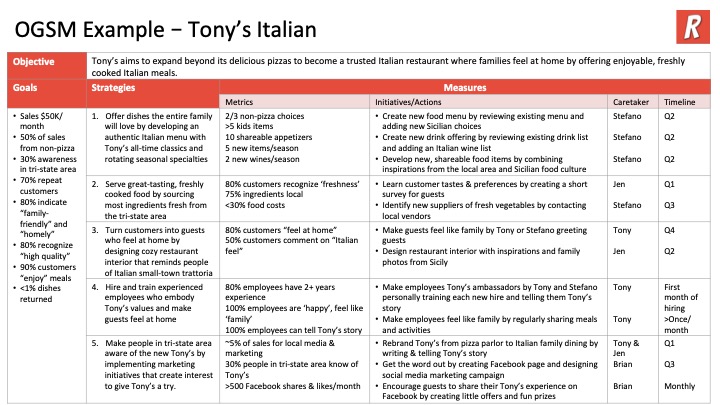
    Tony’s Italian OGSM

    Tony’s Italian is a fictional story about how Tony turned his pizza parlour into a family restaurant. The example shows how to apply OGSM to a small consumer business. Click here to read the full story of how Tony goes through the strategy process and captures his insights and strategic decisions in the OGSM. Or find the OGSM below.

    Tonys Italian OGSM
    Tony’s Italian OGSM Example

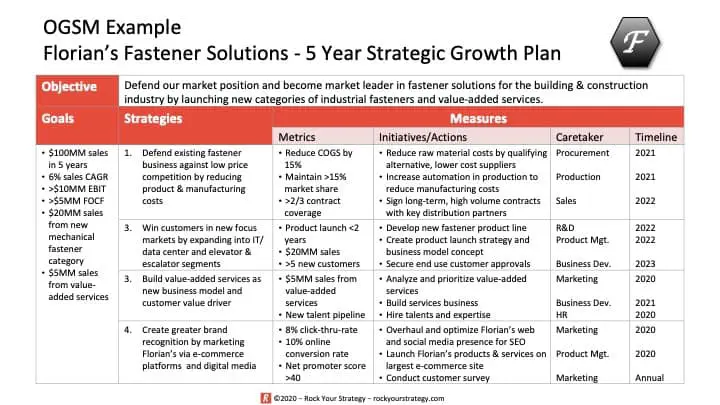
    Florian’s Fasteners OGSM

    Florian’s Fasteners tells the fictional story of a small B2B business that turned around its fortunes after a strategic review. Click here to read Florian’s story or find the OGSM below. 

    Florian's OGSM
    Florian’s OGSM Example

    Examples of OKR

    For examples of the OKR methodology, I can really recommend the resources at www.whatmatters.com

    John Doerr, author of the excellent book “Measure What Matters”, and his team go into lots of details and practical examples.  

    Where can I find OGSM templates? 

    Here are templates of the OGSM to get you started. Click on the following links to download PDF copies of the simpler Microsoft PowerPoint template or the more sophisticated Microsoft Excel template.

    OGSM Template
    OGSM Template in PowerPoint
    OGSM Template for Excel
    OGSM Template for Microsoft Excel

    If you’d like to learn more about how to use these templates to create your OGSM, check out this article

    You may also be interested to read about our Do’s and Don’ts of OGSM here or find out what the 7 Deadly Sins of Business Strategy are here.

    And before you go, check out our jam-packed Resource page with more tools and templates to help you simplify your strategy and achieve excellent results. Rock on!

  • Why Good Strategies Fail And How To Avoid That Yours Does Too

    Why Good Strategies Fail And How To Avoid That Yours Does Too

    Shockingly, 1 out of 3 business strategies fails and only about 50% of strategic initiatives are considered successful. This is a massive waste of resources and could sink a business. So why do so many strategies fail and what can you do to avoid the same fate?

    According to studies by Forbes Insights and EIU, business strategies fail because of lack of leadership attention, changes in the external environment, lack of the right capabilities and resources, lack of understanding, and a lack of tracking and accountability. In other words, the main reasons why strategies fail are lack of leadership and execution.

    Many of the reasons why strategies fail are preventable. In this article, I will describe six key principles and four success factors that lead to strategy success. But first let’s understand better why good strategies fail. 

    How good strategies fail

    Allow me to take you on a journey. Imagine you were in a strategy meeting. You discussed the future direction of the business. You analyzed the external market environment and identified opportunities for growth. You debated internal strengths and weaknesses and defined core capabilities. With a match between core strengths and market opportunities, you decided on ambitious objectives and goals and laid out an exciting strategic plan. 

    There was great euphoria in the room about what it would feel like to reach your vision and deliver such ambitious results. You felt good about yourself and about your chances of success. And then the meeting ended and everyone went back to work. One month, two months, three months passed and nothing had changed. Instead reality happened and the exciting plan was still that – just a plan. But no worries, you thought, the meeting organizer was surely still working on the follow up actions and soon something would happen. But nothing did happen. 

    Nine months later, the great unveiling. The strategy was communicated with a massive Powerpoint deck. Senior leadership was excited and explained with great fanfare how this strategy would change everything. Now things would be clear and better times were ahead. However, what was described seemed old, outdated and in some parts different from was discussed previously. You feel like you were teleported back to a time 9 months ago, when market realities were different. 

    Meanwhile, the world had turned about 270 times. The strategy meeting was long ago. The euphoria was a distant memory. Competitors had already made their move and put pressure on prices. You had meanwhile slugged out the day-to-day and moved on. You wondered what had happened and if the objectives and goals which once seemed so exciting were now still attainable…

    If this sounds familiar, you are not alone. This story is not hypothetical. It has actually happened to me and it felt deflating and demotivating. All the work we had done a year prior in analyzing the market and understanding our own competitive position was basically outdated – and in retrospect a waste of time. And the worst part – I later learned – the delay of 9 months was due to our own internal processes and entirely avoidable. Had we moved faster to implement our strategy, we would have been 1 year ahead and 1 year closer to reaching our objective. Instead we were spinning the hamster wheel, running in place. But what had happened? 

    Instead of moving straight into execution after the strategy workshop, when information was up-to-date and motivation was highest, a long process of documentation and alignment ensued. This is what happened:

    After the strategy workshop had ended, the facilitators began typing down the flip charts. Some action items on the flip charts were not clearly legible and had to be clarified. Unfortunately, the person who wrote the notes was on vacation and couldn’t be reached for two weeks. The business leader was meanwhile traveling and insisted on reviewing the strategy documentation. By now a month had passed.

    Before anything was shared the business leader wanted to present the workshop findings in an upcoming leadership meeting to get the leadership’s blessing before giving the green light.

    At the leadership meeting however, doubt was uttered whether the strategic goals were realistic. It was also revealed that the business division was slated for a larger strategic review with corporate. Since the larger review would take place over the next six months, it was decided to hold the strategic implementation until the divisional strategy was reviewed. Eight months later, during the great unveiling, the original strategy seemed no longer relevant. The implementation that ensued was haphazard and largely ineffective.

    Reasons for failure

    Unfortunately, the story above is not a seldom occurrence in large corporations. Also small businesses are not immune from strategy failure. In the story, there were a number of things that went wrong: 

    • Slow follow-up: it took way too long to move from plan to action. So long in fact that momentum fizzled and the original strategy was no longer implemented.
    • Lack of leadership support: the business leader sought buy-in from the next level leadership team only after the strategy meeting. Support was not immediately received and leadership alignment took another 8 months.
    • Changes in the market: While the company was conducting another strategic review, competitors had already moved-in and occupied the position the company had sought to obtain.
    • Strategy itself was flawed: when the strategy was finally rolled out as part of the division’s strategic plan, the strategy was altered and no longer timely. The original strategic intent had changed.
    • The team no longer believed in the strategy: the strategy which was finally presented barely resembled the strategy which the team had originally prepared. Even though it was a great idea to initially involve the team in strategy development, the team later felt it was no longer their strategy. The team was disengaged and not motivated to drive implementation.

    Studies confirm why good strategies fail

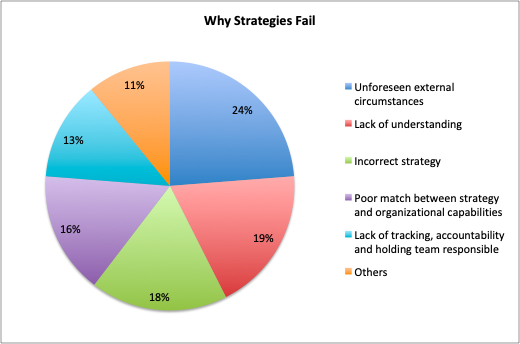
    A survey1 of 163 CEOs, senior strategists and communications professionals conducted by Forbes Insights and FD in conjunction with the Association for Strategic Planning and the Council of Public Relations Firms in 2009 revealed that about one-third of strategies fail. And the reasons for failure are mainly five-fold:  

    Source: Forbes Insights
    • Unforeseen external circumstances (24%) refer to changes in the external environment or economic downturns
    • Lack of understanding (19%) among the team involved in developing the strategy and about what they need to do to make it successful
    • Incorrect strategy (18%) means the strategy itself is flawed
    • Poor match between the strategy and the core competencies of the organization (16%), i.e. the business does not have the capabilities needed to succeed
    • Lack of tracking, accountability and holding the team responsible (13%)
    • Others (11%)

    A report2 by The Economist Intelligence Unit published in 2013 largely confirmed these findings and added an important further insight: the role of leadership. On behalf of the Project Management Institute, EIU surveyed 587 senior executives globally and further conducted in-depth interviews with the following findings: 

    • Importance of strategy implementation recognized, but efforts often fall short
      • 88% of respondents said executing strategic initiatives successfully will be essential or very important for their organization’s competitiveness
      • 61% acknowledge that their firms struggle to turn strategy formulation into day-to-day implementation
      • Only 56% of strategic initiatives considered successful in previous 3 years
      • Companies whose business model is poorly aligned with strategy report weaker financial results than their peers.
    • Leadership often missing in action
      • Leadership buy-in and support considered number one reason for success of strategic initiatives
      • Only 50% of respondents said strategy implementation received appropriate senior leadership attention
      • 28% admit that individual strategy implementation projects do not obtain necessary senior leadership support
    • Majority of companies lack the skills or failed to deploy necessary personnel 
      • Only 41% of respondents said their companies provide sufficiently skilled personnel
      • Only 18% said hiring of people with necessary skills or leadership talent to implement strategy was a very high priority at their firms
      • Only 11% said developing those skills among existing team was a priority
      • Companies that hired and developed the needed skills succeeded in 62% of strategic initiatives.

    So when summarizing the two studies and reflecting on my own 15-year business experience, the primary reasons why good strategies fail are a lack of leadership and a lack of execution. 

    Business leaders have to lead from the front and spearhead both the strategy formulation and the strategy implementation. It is not sufficient to sponsor strategies when they are developed and communicated and then not drive the organizational change required for implementation.

    When strategies fail, senior management is responsible. In small businesses that’s the owner or the managing direction and the most senior team. In larger corporations that the C-suite all the way to divisional heads and to team supervisors. 

    Business leaders are responsible for making realistic assessments of organizational capabilities and to either build or hire the skills and knowledge needed to succeed. Business leaders are also responsible for making available the resources needed to succeed. This may be human resources or funds for capital investments.

    Senior leadership support is the single most important factor in successful strategy execution. But that alone is not sufficient. In the following, I’ll detail six principles needed to avoid strategies from failing. 

    How to avoid strategies from failing

    Apply the following six principles during your strategic planning and implementation to avoid your strategy from failing. This is how you become part of the two-thirds who succeed. 

    • 1. Structured process
      • Whether you are in a large company or a small business, a disciplined strategic planning process is critical to success
      • Be deliberate about strategy development and implementation
      • As the leader, make sure the business has the time and the space to conduct a proper strategic review
      • Follow a strategic process such as our 6-step process to create business strategies that deliver results
    • 2. Engagement
      • If you have a team, involve your employees in the strategic planning and the implementation process
      • Involving your team not only sends a clear message of appreciation, but also helps with anticipating potential obstacles and preparing accordingly
      • Your team knows the day-to-day challenges and help with a realistic assessment of opportunities and capabilities.
      • Involvement creates buy-in and buy-in creates engagement. Engaged teams create better results.
    • 3. Buy-In & Alignment
      • Seek three kinds of alignment: vertically, horizontally, and the strategy itself.
      • First, when developing your strategy, make sure your objectives, goals, strategies, and measures are congruent with each other. Check whether strategies and measures are sufficient to achieve the objective and goals. 
      • Second, seek systematic buy-in and alignment of objectives and strategies across functions of your organization. Make sure each function is involved and understands what it takes to be successful. Make sure each function has the resources and capabilities to support the strategy. Only if the entire organization is aligned, can you successfully execute and achieve the desired results.
      • Third, systematically break down objective and goals and cascade them throughout the organization. Ensure that every level in the organization is aligned, empowered and pulls in the same direction. 
    • 4. Communication
      • Clarity about objective, goals and strategic priorities is of utmost importance. You cannot execute a strategy you do not understand. 
      • Build communication as an integral part into strategy formulation and execution. 
      • When it comes to strategy, you cannot over-communicate. Consistently explain how initiatives and actions fit with the overall strategy and how they help to achieve the objective and goals. 
      • Communication is an important responsibility of the business leader. But also team leaders and communication professionals need to consistently beat the drum.
    • 5. Accountability
      • While the business leader is ultimately accountable for success or failure of the strategy, the strategic plan must be the common objective for the entire business
      • Set clear expectations for each function and team and clarify how each contributes to moving the business in the right direction and delivering results. 
      • Hold people responsible for implementing strategic initiatives and delivering expected results
      • Be a cheerleader for your team and allow no excuses 
    • 6. Execution
      • Implementation must be considered a strategic initiative, not an operational task
      • Install a clear cadence when reviews take place and what actions have to be completed by whom and by when
      • Ensure that key initiatives are prioritized and resourced appropriately with the needed manpower and skills

    What are success factors for business strategies? 

    In their excellent book “Execution: The Discipline Of Getting Things Done”, Larry Bossidy and Ram Charan describe what it takes to be successful in leading a business and implementing strategy. And – spoiler alert – it is execution!

    In order to understand execution, Bossidy and Charan recommend to keep three things in mind: 

    • Execution is a discipline and integral to strategy
      • When planning the strategy, the organization’s ability to execute it must already be taken into account
      • During execution, constantly and systematically expose internal and external realities and act on them. 
    • Execution is the major job of the business leader
      • The leader must be immersed in the company and in charge of execution
      • Leaders run 3 core processes: picking other leaders, setting the strategic direction, and conducting operations
      • Leaders must be intimately and intensely involved with their people and operations. They know the realities and talk about them. They know the details and are excited about what they’re doing. They are passionate about getting results. 
    • Execution must be a core element of the organization’s culture. 
      • Dialogue is the core of culture and the basic unit of work. How people talk to each other determines how well the organization functions
      • Leaders who execute set the tone for the rest of the organization – they lead by example
      • Leaders who execute assemble an architecture of execution including processes for execution and promoting people who get things done
      • Leaders who execute look for gaps between desired and actual outcomes and work to close the gap and raise the bar higher still. 

    All this is a tall order but by executing and getting things done, strategies get implemented and results are achieved. 

    As such, I see these three elements as key success factors for implementing strategy and delivering results and would add a fourth.

    Here are my four key success factors: 

    1. 1. Make execution integral to your strategy 
    2. 2. Make execution part of your business culture 
    3. 3. As the business leader drive execution on a daily basis 
    4. 4. Make realistic assessments about capabilities and devote the right type and amount of resources to strategy implementation.

    How do I drive strategy execution without micromanaging?

    When leaders are deeply involved in strategy execution what do they actually do? And how do they keep from micromanaging and getting caught up in daily firefighting? 

    Focus your leadership attention on the right initiatives. Areas in which senior leaders have the most impact are general oversight and management of execution, communication and support for strategic initiatives, and providing concerted focus for key activities.

    Speak with your team, ask tough questions and expect candid answers. Do this not only while chairing business reviews and regular implementation review meetings but also in between. Go see your team, be available to them, know what’s going on. Help the team reflect where most of the attention is needed. Support action and swift decision-making, remove obstacles and help the team succeed.

    Focus on your team members. Make sure that the right type and amount of resources are available to successfully implement the key initiatives. Reward the doers and achievers. Coach the ones who fall behind.

    Driving strategy execution is the full-time job of the business leader. Do not delegate this responsibility. As the business leader, it’s your job to show up and lead from the front. 

    Conclusion

    Many reasons why strategies fail are preventable. Most commonly strategies fail due to a lack of leadership and lack of execution. 

    Businesses can avoid this fate by following six key principles and paying attention to four success factors. 

    What is your experience with good strategies that fail? If you have any questions or comments, why not leave us a reply below? We’d love to hear from you.

    References

    1) “The Powerful Convergence Of Strategy, Leadership, and Communications: Getting It Right” by Forbes Insights and FD, 2009. https://www.forbes.com/forbesinsights/FDStrategy/index.html

    2) “Why Good Strategies Fail – Lessons for the C-Suite” by The Economist Intelligence Unit, 2013. https://www.pmi.org/-/media/pmi/documents/public/pdf/learning/thought-leadership/why-good-strategies-fail-report.pdf

    3) Bossidy, L., Charan, R. (2002). Execution: The Discipline Of Getting Things Done. New York: Crown Business.

  • What Is OGSM?

    What Is OGSM?

    Have you ever come across the acronym OGSM and wondered what it meant? Here’s what it stands for.

    OGSM stands for Objectives, Goals, Strategies, and Measures. It is a one-page strategic business plan that outlines WHAT you want to achieve and HOW you are going to achieve it.

    The OGSM methodology has been popularized by its deployment at corporate staples such as P&G or Coca-Cola. And you can adopt it for your business too!

    → Want the complete OGSM reference? The Complete OGSM Framework Guide covers all four components in depth, real-world examples by industry, a comparison to OKRs and the Balanced Scorecard, and step-by-step build instructions.

    OGSM: the one-page business strategy

    The OGSM approach is great, because it simplifies a potentially complex concept into a simple framework that cuts through the clutter and shows clearly the choices that form your strategic direction.

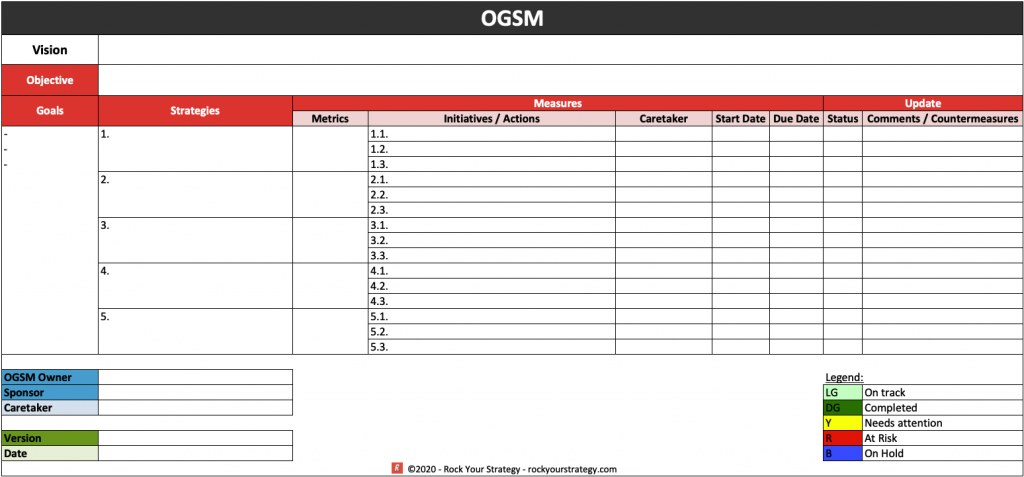
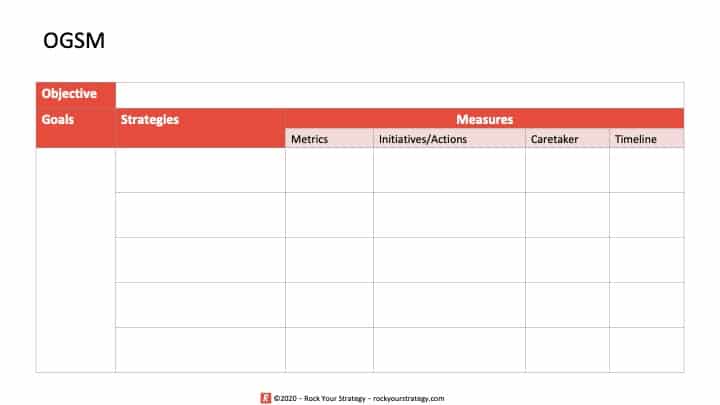
    The OGSM framework may look something like this:

    OGSM Template

    The OGSM may be the deliverable of a strategic process that discusses through the objectives, goals, strategies, and measures. Or it may very well facilitate that process. I have done both and I really like the OGSM’s ability to facilitate the process, force choices and capture the output.

    Because of its simplicity and its complete overview, the OGSM is also a great tool to communicate the strategy to employees, the wider organization and other stakeholders.

    Download a pre-formatted, fully customizable OGSM template for Microsoft PowerPoint or Microsoft Excel here.

    Let’s go through each component in turn.

    O stands for Objectives

    The objective is a qualitative statement about your ambition. It describes the future state of your organization. It is the destination of your journey.

    The objective should be quite specific and spell out in no unmistakable terms what you are aiming to achieve over a chosen time horizon. For annual business plans this may be 1 year or for longer term strategies typically 3-5 years.

    Examples might include “Become the recognized category leader in up-market shoe cream” or “Double our market share in coal-powered mobile phones” (even though I am not sure that’s a sustainable segment to target… But more about targeting later).

    Note that this is not a vision or mission statement or an open-ended dream. It may be however a priority or major milestone in the pursuit of your vision. In fact, for annual business plans, I personally like to think of the objective as being a focus area for the year as I aim to realize my vision.

    Regardless of the time horizon, clarity about the objective is absolutely critical as it guides the rest of the OGSM. It is important that all stakeholders understand and agree with the objective.

    As the saying goes…

    “If you don’t know where you are going, any road will take you there.”

    INSPIRED BY LEWIS CARROLL’S ‘ALICE IN WONDERLAND’

    Click here to learn more about how to write a great objective statement for your strategic plan.

    G stands for Goals

    The goals are the quantitative description of your objective. Goals should translate your qualitative objective statement into measurable figures. These are the numbers that represent the future state and help you to measure whether you are successful.

    The objective and goals together describe WHAT you are aiming to achieve.

    Examples of goals are concrete revenue, growth or profitability targets. Other examples may include cost savings, market share or service level targets. In more operational plans this could simply be the number of new customers acquired or a process cycle time.

    The key point is that your goals need to align with the purpose and the timeframe of your objective. If your objective is to achieve break-neck revenue growth, choose goals such as sales turnover, market share, leads or opportunity pipeline. If your objective is to improve productivity, choose return on capital, operating expense ratio or inventory turns for example.

    In order to be meaningful, I like to choose no more than 3-5 goals. These should be the key indicators whether you meet your objective. They do not need to represent every KPI you have on your operating dashboard. Measure what matters. No more, no less.

    Click here to learn more about how to set clear goals for your strategic plan.

    S stands for Strategies

    The strategies are the key initiatives you undertake to realize your objective and achieve your goals. Strategies are the qualitative description of your roadmap to success. These are the choices you make to win.

    Or said differently, if there are “1000 ways to Rome”, then the strategies describe the way you choose to take.

    When it comes to strategies, the word choice is critical. Your time is limited, your resources are finite. You cannot do everything. Besides, the OGSM is a one-page plan. So choosing the most effective, most probable strategies that allow you to succeed is important.

    From my experience, focusing on 3-5 strategies is best. This allows sufficient focus without putting all your eggs in one basket.

    Click here to learn more about how to develop strategies that work.

    M stands for Measures

    The measures describe the concrete action plan and metrics for each strategy. Measures quantify the strategies and clarify who does what by when.

    In fact, I have sometimes heard people spell out OGSM as Objectives, Goals, Strategies and Metrics.

    In their excellent and practical book “The 1 Page Business Strategy”, van Eck & Leenhouts actually split measures into a dashboard and an action plan. This is a very helpful way to ensure that each strategy is executed by implementing the concrete action plan and monitoring the dashboard for progress with chosen key performance indicators.

    I highly recommend the book and following this practice.

    Click here to learn more about how to set effective measures to implement your strategy.

    How to create an OGSM for your business

    When using the OGSM to draft a strategic plan or annual operating plan for your business, follow the O-G-S-M sequence to build up your plan.

    Begin with a strong objective statement that clearly describes the future direction of the business. Then translate the qualitative objective into 3-5 relevant quantitative goals. The objective and goals together describe WHAT you are aiming to achieve.

    Subsequently, make choices about 3-5 strategies that determine how resources are deployed to achieve the objectives and goals. Check that the strategies sufficiently address all goals and are congruent with the objective.

    Finally, for each strategy, create relevant measures that allow you to quantify each strategy and drive implementation. Translate each strategy into 2-3 metrics that define success and draft 2-3 initiatives that help you turn strategy into action. For each initiative, define caretaker and timeline.

    Capture the complete OGSM on a one-page business plan to clearly visualise the business’ priorities and how objectives will be achieved. Read more about creating an OGSM for your business here.

    Ultimately a plan is only as good as its execution. In order to achieve your objective and goals, regularly review progress of executing your OGSM on a quarterly basis. In order to do this well, read about the 11 secrets of successful strategy execution here.

    OGSM Examples

    We discussed that OGSM stands for Objectives, Goals, Strategies and Measures. While the objectives and goals describe WHAT you aim to achieve. The strategies and measures describe HOW you will get there. But what does an OGSM actually look like? Here are a few examples.

    Tonys Italian OGSM
    Tony’s Italian OGSM Example
    Florian's OGSM
    Florian’s OGSM Example

    The OGSM translates the strategic objective of a business, organization or project into practical day-to-day steps. By focusing on your daily action plan you ensure progress towards your longer term goals.

    Want to see how OGSM applies across different industries and business types? We’ve built detailed, worked examples for four business contexts that reflect today’s most common strategic planning challenges:

    • OGSM Example: B2B SaaS — a pipeline analytics company building a strategy from $2M to $8M ARR, covering PLG onboarding, enterprise CS, upmarket expansion, and benchmark content
    • OGSM Example: AI Startup — a Series A document intelligence company transitioning from research-led to revenue-driven with a repeatable sales motion in the legal sector
    • OGSM Example: E-commerce / DTC Brand — a sustainable home goods company building profitable growth by reducing paid acquisition dependence and growing owned audience channels
    • OGSM Example: Non-Profit — an education foundation aligning programme reach, funding diversification, and impact measurement into one three-year strategy
    • OGSM Example: Tony’s Pizza — the classic case study that walks through all four OGSM components in a simple, accessible context

    OGSM Templates

    If you have seen enough and want to get started on your own OGSM, see below for free, downloadable OGSM templates or visit our shop to download pre-formatted, fully customizable templates.

    OGSM Template
    OGSM Template
    OGSM Template
    OGSM Template

    By the way, the OGSM is not only for large corporations. Its simplicity makes it well suited also for small businesses, entrepreneurs and even non-work projects. Should small businesses even do strategic planning? Click on the link to find out.


    Bonus Tip: Cascading The OGSM

    If you are part of a larger organization with different business units, product lines or functional organizations, you will appreciate that the OGSM can easily be cascaded into departments or teams.

    The set-up of qualitative objectives with quantitative goals and qualitative strategies with quantitative measures helps to translate a corporate strategy into a division’s objective or a product line strategy into a functional department objective.

    The higher level organization’s strategy becomes the lower level organization’s objective. The higher level organization’s measures become the lower level organization’s goals and so on.

    A well-cascaded OGSM thereby ensures that each team’s (or even each individual’s) activities are well aligned with the overall organization’s objectives and goals.


    If you’d like to learn more about OGSM, check out our Dos and Don’ts of OGSM or the 7 Deadly Sins of Business Strategy. More practical tools and templates, workshop guides and book recommendations can be found in our jam-packed resource section. Rock on!

    Get started and download your pre-formatted, fully customizable OGSM template here.

    References

    Van Eck, Marc & Leenhouts, Ellen (2014). The 1 Page Business Strategy – Streamline Your Business Plan In 4 Simple Steps. Pearson Benelux.