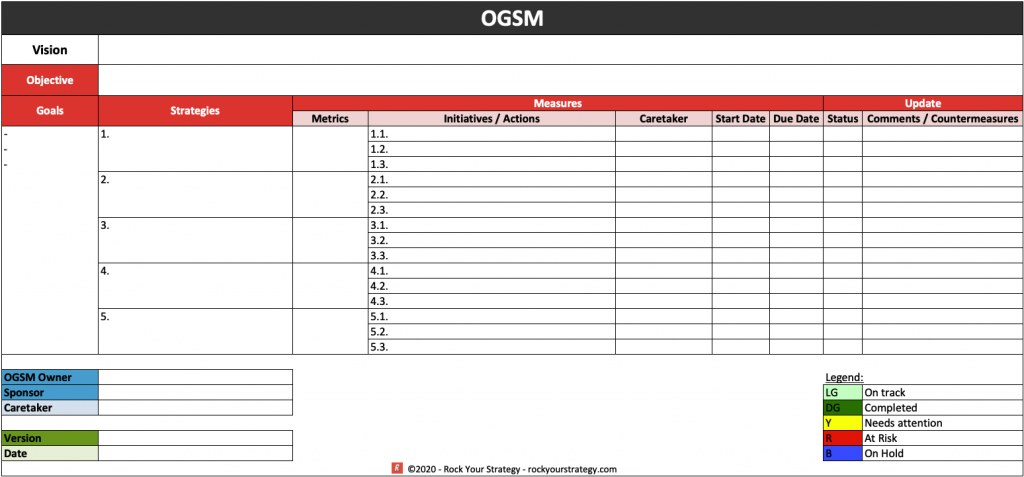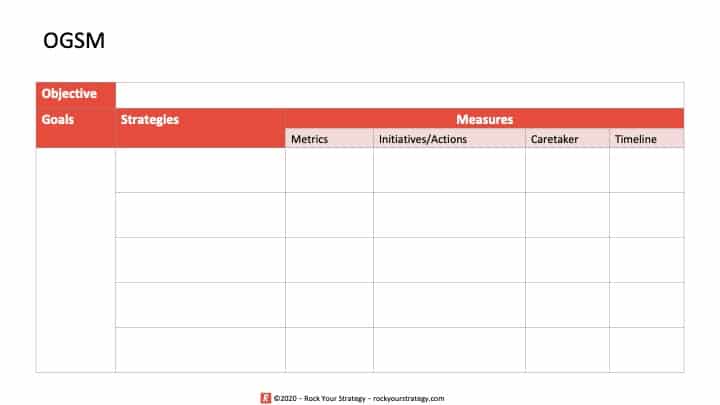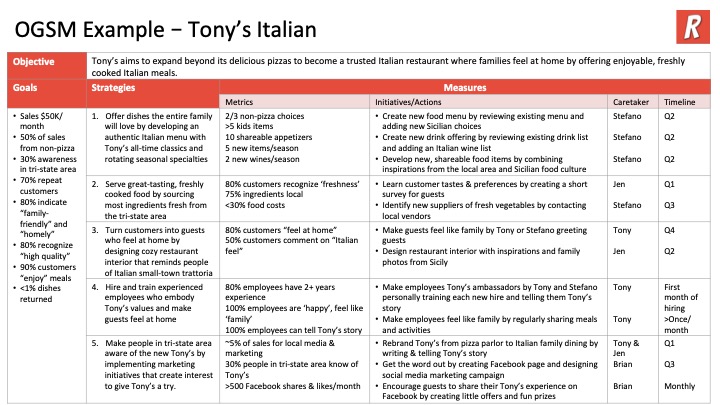
You downloaded the template. You opened it on a Sunday morning with a coffee, and you got as far as the box marked Objective.
Then you sat there.
Not because you don’t know your business — you know it better than anyone. But because a blank box doesn’t ask you anything. It doesn’t ask why you’re doing this now. It doesn’t ask what you’d have to stop doing to make room. It doesn’t notice when you write “deliver growth” and let it stand.
A template gives you a format. What most people actually need is a facilitator.
That’s what we’ve built. It’s called the OGSM Strategy Builder, it’s available in the shop, and this post explains exactly what it does — and what it deliberately does not do.
What is the OGSM Strategy Builder?
It’s a paid Claude Skill that turns Claude into an OGSM facilitator and walks you through building a complete, execution-ready strategic plan in eight phases.
You install it once. Then you open Claude, say something like “help me build our strategy for next year”, and it takes over: asking questions, pushing back on vague answers, drafting options for you to choose between, and saving your progress as you go. At the end you get a finished OGSM one-pager in the format you want, plus a workbook recording every decision and every option you rejected.
It is built on the same method taught across this blog — the OGSM as described in what OGSM stands for — and on the Seven Cardinal Sins of Strategy from The Strategy Lie, the free ebook on this site.
It does not write your strategy. I’ll come back to that, because it’s the whole design.
What problem does it actually solve?
The gap between a template and a process.
We sell a $4.99 Excel template and a PowerPoint version, and they do their job well. Thousands of people have used them. But a template assumes you already know how to run the thinking — how to tell a Strategy from a Goal, how to spot an activity metric wearing an outcome metric’s coat, when to stop adding and start cutting.
Most people don’t. Not because they’re not smart enough, but because nobody ever showed them. And so the classic thing happens: the plan gets written, the boxes get filled, and three months later nobody can remember what was in it. The plan isn’t bad. The process behind it never happened.
The other half of the problem is that a facilitator is expensive. A good strategy consultant to run a two-day session costs more than most small businesses will ever spend on strategy. So the choice has been: a blank template, or a five-figure invoice.
This sits in between. It’s the process, not just the page.
What is a Claude Skill, and do I need to be technical?
No. A Skill is a folder of instructions you add to your Claude account — Claude.ai, Claude Code or Cowork. Once it’s installed, Claude reads it and follows it whenever the topic comes up. You install it once, the way you’d install an app, and after that you just talk to Claude normally.
There’s no coding, no API key, no subscription to anything except Claude itself. If you can download a file and drag it into a browser window, you can install this.
What happens across the eight phases?
The order matters. OGSM works left to right, and each element is built on the one before it. Skip a phase and the phase after it inherits the gap.
Phase 0 — Set-up and Diagnosis
Scope, time horizon (a 3–5 year strategic plan and a 1-year operating plan are different animals), and who has to agree. Then two diagnostics: the Five-Answer Test — ask five of your leaders separately what the strategy is and count how many different answers you get — and the Seven Sins self-diagnosis. It finishes by asking you to list everything the business currently has in flight. That list comes back to bite in Phase 5, which is the point.
Phase 1 — Reality
Key figures first, then a SWOT built by conversation rather than form-filling — the approach in how to do a SWOT right. Where your situation warrants it, it offers deeper analysis: PESTEL, market trends, Porter’s Generic Strategies, Five Forces, the 5P marketing mix. Where it doesn’t, it doesn’t offer them. Nobody needs a Five Forces analysis to decide whether to hire a second van.
Phase 2 — Objective
One qualitative, what-by-how statement. It drafts three genuinely different options — different bets, not different wordings — shows you what each one commits you to and what each one rules out, and makes you pick. Then it sharpens the one you picked and runs it through the tests in how to write a great objective. Expect to spend real time here. This is the sentence everything else hangs from.
Phase 3 — Goals
Three to five SMART goals, each with a baseline, at least one financial, and coverage of both halves of your objective — the “what” and the “how”. Then the gate: if we achieve exactly these goals and nothing else, have we succeeded? It’s the most useful question in the method and it’s in how to write SMART goals for your OGSM.
Phase 4 — Strategies
Three to five what-by-how choices, each with a named owner. Then the We WILL / We will NOT list, which is the exercise that turns a set of intentions into a decision. This is the uncomfortable phase, and if it isn’t uncomfortable it hasn’t worked.
Phase 5 — Measures
Per strategy, two structurally different things kept explicitly apart: a Dashboard of 2–4 KPIs, each with baseline, target, frequency and a data owner, at least one leading and one lagging — and an Action Plan of 2–3 initiatives, each with a caretaker and dates. Then the capacity conversation: your Phase 0 workload list comes back and every item gets sorted into continues, paused or stopped. If everything stays, you execute nothing. The full method is in the complete guide to OGSM Measures.
Phase 6 — Stress Test
The finished draft is run against the quality rules and the seven failure modes, and reported back in three parts: what holds, what it would challenge, and what it cannot verify.
Phase 7 — Deliver and Cascade
The one-pager in your chosen formats, plus cascade guidance (a higher-level Measure becomes a lower-level Goal — see how to cascade OGSM), a communication plan, and the review calendar with actual dates in it. Not “quarterly, we’ll find dates”. Dates.
Phase 8 — Review (and this one repeats)
The plan is built. Now comes the part that decides whether any of it mattered.
Before each monthly or quarterly review, you bring the workbook back. The skill walks the plan strategy by strategy, updates the numbers and statuses with whatever you know, works out whether each goal is actually on the path you set — not just whether it moved — and checks the question almost nobody asks out loud: has anything on your “we will not” list quietly started happening again?
That last check is the one that earns its keep. Strategies rarely get reversed in a meeting. They get reversed one exception at a time, and nobody notices until the trade-off that made the plan real has been eroded entirely.
You come out with a prepared agenda, at-risk items first, and the two or three things that genuinely need a decision rather than a status update. Afterwards you come back, say what was decided, and it goes into the workbook.
What do you get at the end?
Three things.
The OGSM one-pager, in HTML, Excel, PowerPoint or PDF — you pick, and most people take at least two. HTML is the living version you share by link. Excel is the one your OGSM caretaker updates each month. PowerPoint is what you present. PDF is what you print and pin up.
The Strategy Workbook, which captures the reasoning: the options you rejected and why, the trade-offs, the accepted risks. This is more valuable than it sounds. At your first review, when someone asks “why did we decide that?”, the answer is written down.
A cascade and communication pack — who hears what, how, when, and from whom, plus the review calendar.
The skill also ships two scripts. One generates the four output formats. The other validates any plan against the OGSM rules: counts, what-by-how form, missing owners, targets without baselines, activity metrics masquerading as outcomes, and an empty “will not” list. You can run that validator against a plan you wrote years ago, on your own, without doing any of the rest.
What happens if you have to stop halfway?
You stop.
The skill writes your progress to a workbook file at the end of every phase and hands it to you. Stop after Phase 2 on a Tuesday, come back three weeks later, hand the file back, and it tells you in two sentences where you left off and carries on. Nothing gets redone.
This is deliberate. A strategy built over four evenings is worth more than one rushed in an afternoon, and pretending otherwise is how you end up with a plan that was really just a long meeting.
What does the stress test actually check — and what can’t it check?
The mechanical checks are easy and mostly automated: goal counts, missing baselines, strategies without owners, initiatives that are really operational routines, vanity metrics.
The judgement checks are the interesting ones. Would five people read this page the same way? Could someone who joined three weeks ago say what the business is trying to do? Swap in your main competitor’s name — does the plan still read as sensible? If yes, you haven’t chosen anything. Is there anything in this plan that costs someone something specific? Do the strategies plausibly deliver the goals, or is the goal 28% growth against three efficiency initiatives?
And then the part I insisted on: what it cannot verify.
Every stress test ends with a section naming the assumptions it has taken on trust — your market size, a competitor’s intent, your team’s real capacity, whether the person who has to carry Strategy 3 actually believes in it. It has read everything and lived none of it. Those are the things you check before the plan goes live.
An AI strategy review produces observations, not decisions. A tool that pretends otherwise is selling you confidence you haven’t earned.
Who is this for — and who is it not for?
It’s for you if: you run or lead a business and need a real plan; you’ve tried a template and stalled; you have a strategy nobody can repeat; you’re a functional leader who has to build a plan that connects upward; you want a sparring partner who won’t agree with you to keep the peace. It works for a five-person firm and for a division of four hundred — see OGSM for small business if you’re at the smaller end.
It’s not for you if you want a plan written for you in two minutes. It will refuse. It will draft options and make you choose, and it will ask you what you’re going to stop doing, and it will keep asking until you answer. If that sounds like more work than you were hoping for — it is. That’s not a bug, and post three in this series explains why at length.
It also won’t do the political work. If your real problem is that two directors disagree and everyone knows it, no document fixes that. It will name it. It can’t settle it.
The honest summary
This is a facilitator, not an oracle. It brings the method, the discipline, the questions and the standard. You bring the business, the judgement and the decisions.
Your strategy doesn’t need to be complex to be good. It needs to be clear, owned, and reviewed. This is a structured way to get there in an afternoon or four evenings, instead of another year of meaning to.
Ready to stop staring at the blank Objective box? The OGSM Strategy Builder is available now in the shop — install it once, and build your strategy the next time you can give it an afternoon.
Founding price — $49 until 31 October 2026. After that it goes to $99, and stays there. Founding customers keep every future update at no extra cost, including the new phases and worked examples already planned for the next version.
For scale: one facilitated strategy session starts at around $2,000, and five seats of the cheapest OGSM software is roughly €480 a year. This is $49, once.
Rock on.