Most B2B SaaS strategies collapse under the weight of too many priorities. Product wants to ship features. Sales wants more leads. Finance wants CAC under control. The OGSM framework forces you to resolve that tension on a single page — before it resolves itself in the wrong direction.
This example shows how a fictional B2B SaaS company — PipelineIQ, a pipeline analytics platform for mid-market sales teams — used the OGSM methodology to align their leadership team around a clear path from $2M to $8M ARR. The numbers, company, and details are illustrative. The strategic logic is real.
If you’re new to the framework, read the Complete OGSM Framework Guide first. If you’re ready to apply it, download our OGSM templates for PowerPoint and Excel and use this example as your reference.
About PipelineIQ
PipelineIQ is a B2B SaaS company that helps mid-market sales teams visualize pipeline health, forecast revenue more accurately, and identify deals at risk before they slip. They integrate with Salesforce and HubSpot and sell primarily to VP Sales and RevOps leaders at companies with 50–500 employees.
At the time of this OGSM, PipelineIQ has reached $2M ARR with strong product-market fit signals — high NPS, good retention among customers who fully onboard — but inconsistent trial-to-paid conversion and a growing gap between SMB and enterprise performance. The leadership team needs to decide where to concentrate resources for the next 12 months.
The PipelineIQ OGSM
Objective
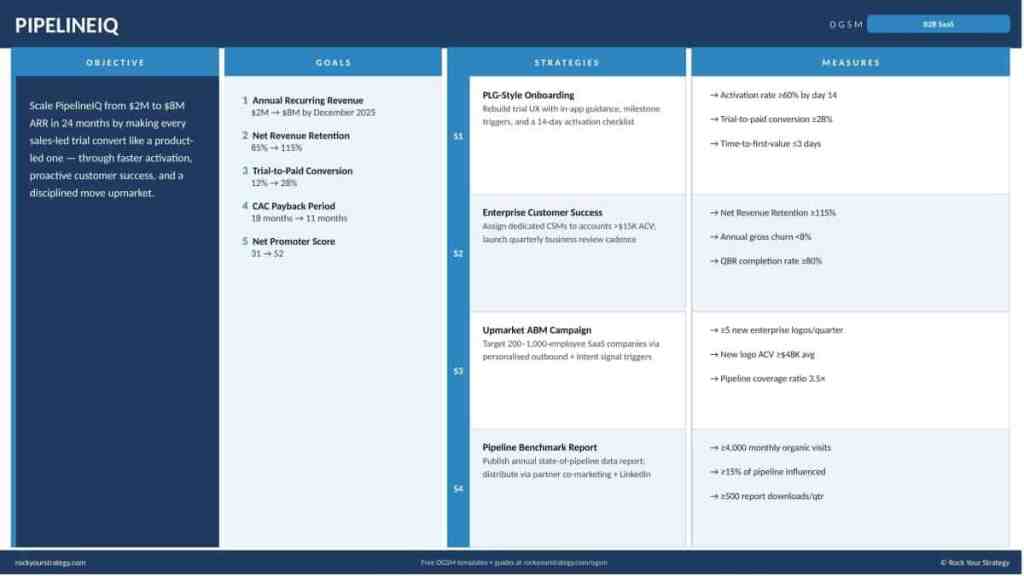
Become the leading pipeline analytics platform for mid-market B2B sales teams by accelerating product-led growth and deepening enterprise retention.
Goals
Goals translate the objective into measurable outcomes. PipelineIQ chose five metrics that collectively define what success looks like at the end of the 12-month period.
| Goal | Current | Target |
|---|---|---|
| Annual Recurring Revenue (ARR) | $2M | $8M |
| Net Revenue Retention (NRR) | 102% | ≥115% |
| Trial-to-paid conversion rate | 9% | ≥18% |
| CAC payback period | 18 months | ≤12 months |
| Net Promoter Score (NPS) | 38 | ≥50 |
Strategies
Strategies are the 3–5 high-impact choices that determine where PipelineIQ concentrates its resources. Each is written as a “what-by-how” statement — specific enough to exclude things they won’t do.
Strategy 1: Accelerate trial-to-paid conversion by redesigning the onboarding flow around a fast time-to-value milestone
PipelineIQ’s data shows that users who reach their first “pipeline health score” within 72 hours of signup convert at 3x the rate of those who don’t. The strategy is to rebuild the onboarding sequence around this milestone — removing friction, adding guided prompts, and making the health score the first thing every trial user sees.
Strategy 2: Increase NRR by building a structured customer success motion for accounts above $15K ARR
Churn is concentrated in the $10K–$20K ARR band, typically from accounts that never fully adopted the forecasting module. A dedicated CS motion — quarterly business reviews, adoption scoring, and expansion playbooks — will address this before it compounds.
Strategy 3: Move upmarket into the $20K–$60K ACV segment by targeting RevOps leaders at Series B–D companies through account-based outreach
Mid-market accounts have lower churn, higher NPS, and more expansion potential than SMBs. PipelineIQ will build an ABM programme targeting 200 high-fit accounts per quarter, led by outbound sequences from a newly hired senior AE.
Strategy 4: Build category authority by publishing the annual B2B Pipeline Benchmark Report as the definitive industry reference
Owned research creates durable inbound demand and shortens sales cycles. PipelineIQ will survey 500+ sales leaders, publish findings in Q2, and use the report as the cornerstone of their content and PR strategy for the year.
Measures
Measures define how each strategy will be tracked and executed. For each strategy, PipelineIQ identified 2–3 Key Metrics (the numbers that define success) and 2–3 Actions (the concrete initiatives that will move those numbers).
| Strategy | Key Metrics | Actions |
|---|---|---|
| PLG onboarding | Trial-to-paid ≥18%; Time-to-health-score <72hrs; Onboarding completion >60% | Rebuild onboarding flow (Q1); Launch in-app guidance (Q1); A/B test activation emails (Q2) |
| Enterprise CS motion | NRR ≥115%; Churn in $15K+ band <5%; QBR completion >80% | Hire CS Manager (Q1); Build adoption scoring (Q1); Launch expansion playbook for top 50 accounts (Q2) |
| Upmarket ABM | Pipeline from ABM ≥$3M; ACV of new logos ≥$25K; ABM win rate ≥25% | Hire senior AE (Q1); Build 200-account target list (Q1); Launch outbound sequences (Q2) |
| Benchmark report | Downloads ≥2,000; MQLs attributed ≥150; Press mentions ≥10 | Survey 500 sales leaders (Q1); Publish with PR push (Q2); Content distribution plan (Q2) |
What Makes This OGSM Work
Three things stand out about PipelineIQ’s OGSM that are worth noting for your own strategy work.
The objective resolves a real tension. PipelineIQ could have written a generic objective about “becoming a market leader.” Instead, they named the two specific mechanisms driving growth — product-led growth and enterprise retention — which immediately signals to the team where resources will flow and where they won’t.
The goals are genuinely constraining. An NRR target of ≥115% is not a stretch goal bolted onto an existing plan. It forces a structural change: you can’t hit 115% NRR without a real CS motion. The goal drives the strategy, not the other way around.
The strategies make explicit trade-offs. Strategy 3 targets Series B–D companies specifically — not “all upmarket segments.” Strategy 4 commits to one owned research asset rather than a broad content calendar. These exclusions are as important as the inclusions.
OGSM vs. OKR: Which Framework Works Better for SaaS?
This is a question that comes up often in SaaS leadership teams, especially those that have previously used OKRs.
| OGSM | OKR | |
|---|---|---|
| Output format | One page, full strategy visible at once | Nested list of objectives and key results by team |
| Strategic choices | Explicit — strategies define what you will and won’t do | Implicit — key results may point in different directions |
| Execution link | Measures connect each strategy to specific actions and owners | Key results tracked separately; initiatives often disconnected |
| Cadence | Annual with quarterly measure reviews | Quarterly cycles with annual reset |
| Best suited for | Full business strategy alignment (board to team) | Team-level goal-setting and performance tracking |
Many SaaS companies find that OGSM works better at the business unit or company level precisely because it forces the strategic trade-off conversation. OKRs can sit alongside it at the team or individual level for execution tracking.
Build Your Own OGSM
Use our pre-formatted OGSM templates to build your own one-page strategy. Available for Microsoft PowerPoint (for leadership presentations) and Microsoft Excel (for building, tracking, and updating your plan). Both are fully editable and immediately downloadable.
Browse OGSM templates in the shop →
More OGSM Examples
See how the OGSM framework applies across different business contexts:
- OGSM Example: AI Startup — Series A company navigating from research to revenue
- OGSM Example: E-commerce / DTC Brand — sustainable home goods company scaling past $5M revenue
- OGSM Example: Non-Profit — education foundation aligning programmes with funding strategy
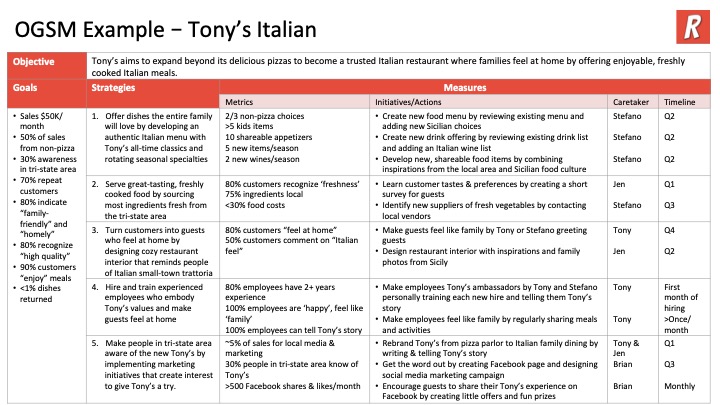
- OGSM Example: Tony’s Pizza — the classic OGSM case study
Questions or comments? Drop them below, or sign up to our free newsletter for practical strategy tips. Rock on!