OGSM is one of the most practical strategic planning frameworks available for small businesses — and it is almost certainly better suited to your needs than OKRs. In a single page, OGSM forces you to define your Objective, the measurable Goals that prove you’re achieving it, the Strategies you’ll pursue, and the Measures that track progress. No software required, no quarterly review cycles with twenty stakeholders, no alphabet soup of HR frameworks. Just a one-page plan you can actually run a business from.
Why Do OKRs Keep Failing Small Businesses?
OKRs were invented at Intel and popularised by Google. That lineage should tell you something. If your business has fewer people than Google has people on its Snacks Procurement Team, OKRs probably aren‘t your best fit.
Here’s why they keep failing for smaller teams:
Too many layers. OKRs are designed to cascade – company OKRs feed into team OKRs which feed into individual OKRs. At a 500-person company that’s appropriate. At a 12-person company, you’re creating coordination overhead for its own sake. You don’t have three levels of reporting hierarchy, so why build a three-level planning framework?
They require dedicated tooling. Every OKR implementation I’ve seen at small businesses eventually hits the same wall: where do we track these? The answer is always some combination of spreadsheets, Notion databases, and a SaaS subscription that three people actually log into. That’s not strategy execution – that’s tool management.
They weren’t designed for one-page clarity. OKRs produce lists of objectives. A properly done OKR cycle at a 30-person business might generate 40+ key results across the organization. That’s not a plan. That’s a backlog.
What Is OGSM? (In Plain Language)
OGSM stands for Objective, Goals, Strategies, Measures. It was developed at Procter & Gamble and has been used by companies from global multinationals to ambitious independents for decades. The core idea is elegantly simple: your entire strategy fits on one page.
Here’s what each element does:
Objective: Your qualitative, inspiring destination. Where are you going and why does it matter?
Goals: Specific, measurable outcomes that define success. These are your proof points – when you hit these numbers, you know you’ve achieved the Objective.
Strategies: The choices you’re making about how to get there. Not actions – choices. What will you do, and what will you deliberately not do?
Measures: The metrics and milestones you’ll track to know your Strategies are working.
A small landscaping company might set an Objective of becoming the most trusted residential landscaping provider in their county. Their Goals might include reaching $1.2M revenue and 78% repeat customer rate by year-end. Their Strategies might include referral-only new business acquisition and a premium maintenance contract product. Their Measures would track referral conversion rates, contract renewal percentages, and monthly recurring revenue.
That’s a complete strategy. One page. Thirty minutes to build the first draft.
If you want a deeper walkthrough of the framework itself, our complete OGSM guide covers every element in detail.
Why OGSM Suits Small Businesses Specifically
I’ve helped businesses of all sizes implement strategic frameworks. The smaller the business, the more OGSM tends to outperform everything else. Three reasons:
One page forces the right conversations. When your strategy has to fit on a single page, you can’t hide behind complexity. You have to make real choices about what matters and what doesn’t. Most small business strategies fail not because of poor execution but because everything is a priority, which means nothing is. The OGSM’s constraint is its greatest feature.
No software required. Your OGSM lives in a shared Google Doc, Excel or printed on the wall of the office. There’s no onboarding process, no admin permissions to manage, no SaaS renewal to argue about at budget time. The simplest possible format is almost always a well-structured one-page document.
It runs at the right cadence. OKRs typically operate on quarterly cycles with complex scoring rituals. Most small businesses I work with can’t sustain that overhead – especially when the founders are also doing the delivery work. OGSM reviews are typically monthly or quarterly, but they’re conversations, not ceremonies. You look at your Measures, you discuss what’s working, you adjust.
Building Your First Small Business OGSM: A Walkthrough
Let me walk you through how a fictional SME – let’s call them Clearview Accounting, a 15-person regional accounting firm – would build their first OGSM.
Step 1: Start with the Objective. The founders want to stop competing on price and become the firm of choice for e-commerce businesses in their region. Their Objective: “Become the leading specialist accounting partner for e-commerce businesses in the North West by 2027”
Step 2: Set measurable Goals. The Goals need to define what “cleading specialist partner” actually means in numbers. Clearview lands on three Goals:
Grow e-commerce client billings to 60% of total revenue (from 22% today)
Achieve a Net Promoter Score of 65+ from e-commerce clients
Reach $2.4M total revenue
Step 3: Define Strategies. This is where most small businesses need to do the hardest thinking. Clearview decides their Strategies are:
Reposition all marketing and content around e-commerce specialism
Build a referral network with Shopify and WooCommerce development agencies
Develop a fixed-price e-commerce accounting package to replace hourly billing
Notice what they’re not doing: they are not chasing retail clients, not competing on price, not expanding into payroll services. Strategy is as much about what you say “no” to.
Step 4: Track the right Measures. Clearview’s Measures include: monthly e-commerce client billings as a % of total, NPS survey results (quarterly), referral conversations generated per month, and package conversion rate.
The whole thing fits on a single page. Every member of the leadership team can see exactly where the business is going and why. That’s OGSM in practice.
You can grab our free OGSM template to build your own version in under an hour.
Common Objections Answered
“Our business is too simple for a strategic framework.”
If your business has a revenue target and more than one way to achieve it, you have a strategy question. OGSM doesn’t add complexity – it removes it. The discipline of completing a one-pager will surface assumptions you didn’t know you were making.
“We tried something like this before and it just sat in a drawer.”
That’s a review cadence problem, not a framework problem. The OGSM document only works if you schedule a monthly 30-minute review where someone is accountable for the Measures. Without that, any framework gathers dust. Build the review into your rhythm before you build the plan.
“OGSM vs OKRs – can’t I just use both?”
You can, but you probably shouldn’t. Mixing frameworks tends to dilute accountability rather than strengthen it. If you want the full comparison, we’ve covered OGSM vs OKRs in depth – but the short version is: OKRs are built for scale, OGSM is built for clarity. For most small businesses, clarity is the more pressing need.
How Can You Start Using OGSM This Afternoon?
You don’t need a strategy day, an offsite, or a consultant to start your OGSM. Here’s how to begin:
Block 90 minutes with your co-founder or leadership team. Open a blank document with four sections: Objective, Goals, Strategies, Measures.
Start with your Objective. Finish this sentence: “By [year], we will be known as the [description] in [market/geography].” Don’t overthink it – a draft Objective is better than no Objective.
Set three Goals maximum. Ask: if we achieve our Objective, what three numbers will definitely be true? Revenue, customer satisfaction, market share, margin – pick the three that matter most and make them specific.
Define two or three Strategies. Ask: what choices will we make that our competitors aren’t making? Your Strategies should feel slightly uncomfortable – if they don’t, they’re probably not choices at all.
Agree your Measures and schedule the first review. Without this step, the document stays a document. With it, it becomes a management tool.
That’s it. Your first OGSM won’t be perfect. It will still be more useful than anything sitting in a slide deck from the last strategy session you held.
OGSM for Small Business: The Complete Strategic Planning Guide (With Real Examples)
Most strategic planning frameworks were built for companies with dedicated strategy teams, quarterly board reviews, and the kind of budget that covers three-day off-sites. If you run a business with 5 to 200 people, that’s not your world — and borrowing those tools wholesale is one of the fastest ways to waste a month and achieve nothing.
OGSM for small business is different. This guide is the most complete practical resource you’ll find on using OGSM as a small business owner, founder, or general manager. You’ll get the framework explained in plain language, a step-by-step build process, three real-world small business examples, a review cadence you can actually sustain, and a list of the mistakes that derail most first attempts.
By the time you finish reading, you’ll have everything you need to write your first OGSM — or fix the one that isn’t working.
Here’s the strategy planning mistake I see most often in small businesses: the owner spends a weekend writing a 20-page strategic plan, presents it to the team on a Monday, and by Friday nobody can remember what was in it.
The plan isn’t bad. The format is.
Long documents don’t drive execution. They sit in a folder on Google Drive, opened maybe twice before the next planning cycle. Meanwhile, the business runs on gut feel, whatever’s urgent that week, and the priorities of whoever shouts loudest. That’s not a strategy — it’s organised chaos.
Why Complex Frameworks Fail at Small Business Scale
OKRs, Balanced Scorecards, and similar frameworks are genuinely powerful at the right scale. The problem is they’re expensive to run. OKRs require a dedicated quarterly cycle with cascading objectives through layers of the organisation. The Balanced Scorecard needs someone who understands the four perspectives, a way to measure leading indicators, and regular calibration across departments. When you have 12 people and everyone has a day job, that overhead kills adoption.
I’ve watched founders burn out trying to implement OKRs as if they were running Google. The system becomes the work instead of supporting it.
What OGSM Solves
OGSM — Objectives, Goals, Strategies, Measures — was originally developed at Procter & Gamble as a way to fit an entire business strategy on a single page. That constraint is the feature, not the bug.
For small businesses, that single page does three things frameworks like OKR can’t easily do at this scale:
Alignment at a glance. Every person in your business can see the whole strategy, understand where they fit, and hold themselves accountable without a manager explaining the cascade every quarter.
Honest prioritisation. When everything has to fit on one page, you’re forced to choose. Most small businesses don’t have a strategy problem — they have a prioritisation problem. OGSM fixes that.
Low-friction review. You don’t need a strategy function to run a monthly OGSM check-in. A 30-minute team meeting against a shared document is enough.
If you want the deeper comparison between OGSM and other frameworks, read our OGSM vs OKR guide — but for most small businesses, OGSM is the right starting point.
What Is OGSM? The Four Elements Explained for Small Business Owners
OGSM stands for Objective, Goals, Strategies, and Measures. If you’ve never used it before, here’s what each element actually means — and how they fit together.
Objective
Your Objective is a single sentence describing what your business is trying to achieve in the next 12 to 36 months. It’s qualitative, directional, and inspiring. It’s not a revenue target — that comes later.
Think of it as your “why we’re pushing hard right now” statement. A good small business Objective sounds like:
“Become the most trusted supplier of commercial kitchen equipment in the Pacific Northwest.”
One sentence. No metrics. If your Objective needs a paragraph to explain, it’s too complicated.
Goals
Goals are the 3–5 measurable outcomes that define what success looks like for your Objective. This is where numbers enter the OGSM.
Goals are specific, time-bound, and measurable. They make your Objective concrete. For the kitchen equipment business above:
Grow annual revenue to $4.2M by end of year
Achieve net promoter score of 60+ among commercial clients
Expand product range to cover 90% of commercial kitchen categories
Retain 85% of accounts year-over-year
If you hit all four of those, you’re probably the most trusted supplier in the region. That’s the test: do your Goals prove your Objective was achieved?
Strategies
Strategies are how you’ll achieve your Goals. For each Goal, you identify 2–4 Strategies — the specific approaches, initiatives, or capabilities you’ll build.
Strategies answer the question: “What are we actually going to do?” They’re more directional than to-do lists but more concrete than vague intentions.
Goal: Grow revenue to $4.2M → Strategies: Launch outbound sales programme targeting hospitality groups; build preferred supplier agreements with three commercial kitchen designers; expand service contract offering to existing accounts.
Measures
Measures are how you’ll know your Strategies are working. Each Strategy should have at least one lead indicator (a measure of activity you control) and ideally a lag indicator (a measure of outcome).
This is where OGSM gets sharp. Most strategies fail not because they’re wrong but because nobody ever checks whether they’re working. Measures force that discipline.
Strategy
Lead Measure
Lag Measure
Outbound sales programme
Calls made per week
New accounts opened per quarter
Preferred supplier agreements
Agreements signed
Revenue from partner channel
For real-world examples of strong lead and lag Measures across different business types, our OGSM measures examples guide is worth bookmarking. For a deeper explanation of how Goals and Measures differ — and why confusing them is the most common OGSM mistake — read our OGSM Goals vs Measures guide.
The Worked Example: Coastal Home Cleaning Co.
Let me pull this together with a fictional small business so you can see how it looks in practice.
Business: Coastal Home Cleaning Co. — 18-person residential cleaning service, 3 years old, founder wants to expand to a second city within two years.
OGSM:
Objective: Become the premium home cleaning brand in our region, known for reliability and trust, ready to scale to a second market.
Goals:
Reach $1.8M annual revenue by end of Year 1
Maintain 4.8+ star average across all review platforms
Build a waitlist of 50+ qualified residential clients in Target City B
Reduce staff turnover to below 20% annually
Strategies (selected):
For Revenue Goal: Launch referral programme targeting existing 5-star accounts; introduce quarterly deep-clean packages at premium price point
For Expansion Goal: Hire city lead for Target City B by Q2; run localised digital ads in Target City B from Q3
For Retention Goal: Introduce team lead structure and performance bonus tied to client satisfaction scores
Measures:
Weekly: referral sign-ups; new bookings from ads
Monthly: revenue vs. target; review score; staff turnover YTD
That’s a complete OGSM. It fits on one page, every team member can understand it, and you can review it in 20 minutes.
How to Build Your OGSM: Step-by-Step
Building your first OGSM takes longer than maintaining one, but even a first attempt shouldn’t take more than a few focused hours — or a single 90-minute workshop. Here’s the process.
Step 1: Write Your Objective
Start here. Don’t try to write Goals first or you’ll anchor too quickly on today’s numbers and miss the bigger picture.
Ask yourself: what does winning look like for this business in the next 12–24 months? Write a sentence that captures that ambition. It should be inspiring enough to motivate people but honest enough to be credible.
Avoid objectives that are really Goals in disguise. “Reach £2M revenue” is a Goal. “Be the go-to accountancy firm for tech startups in London” is an Objective.
If you get stuck, try the formula: [Verb] + [Who/What] + [Qualifier].
“Become the most recommended [category] in [geography]”
“Build [business type] that [distinctive position]”
Step 2: Write 3–5 Goals
Now make it measurable. For each dimension of your Objective, identify one concrete Goal. Most small businesses need Goals in three to five areas:
Revenue / financial performance
Customer satisfaction / retention
Operational capability
Team / people
Market position / growth
Don’t write more than five. Five Goals means five things you’re truly committed to. More than that and you don’t have priorities — you have a wish list.
Each Goal needs a number and a timeframe. “Grow revenue” isn’t a Goal. “Grow revenue to $2.5M by December 31” is.
Step 3: Identify 2–4 Strategies Per Goal
For each Goal, ask: what do we need to do differently to achieve this? Strategies are not business-as-usual activities — they’re the moves that make the difference.
A useful stress-test: if you kept doing everything you’re currently doing but added nothing new, would you hit this Goal? If yes, you don’t need a Strategy there — just execution. Strategy is for the gaps.
Write each Strategy as a clear action phrase: “Launch X,” “Build Y,” “Partner with Z,” “Discontinue A.”
Limit yourself to 2–4 Strategies per Goal. Small businesses don’t have the bandwidth for more.
Step 4: Assign Measures With Owners
For each Strategy, set a lead and lag measure, and put someone’s name next to it. Unowned Measures don’t get tracked.
Lead measures matter more than most people think. Revenue is a lag measure — by the time it moves, the ship has already turned. Your lead measures tell you whether the ship is turning now. For a sales strategy, the lead might be “number of discovery calls per week.” For a retention strategy, it might be “NPS survey sent and response rate.”
Name the owner. In a small business, this is usually straightforward: the founder, a team lead, or a manager who will stand up in the review meeting and report the number.
The 90-Minute OGSM Workshop Agenda
If you want to build your OGSM with your team (recommended), here’s a workshop format that works:
Time
Activity
0–15 min
Framing: where we are now, what’s changed, what’s at stake
15–30 min
Draft Objective: each person writes one, group votes and refines
30–50 min
Goals: generate candidates, pressure-test with “does this prove the Objective?”
50–70 min
Strategies: breakout by Goal owner, rapid-fire, filter to 2–4 each
70–85 min
Measures: assign lead/lag for each Strategy, name owners
85–90 min
Review the full OGSM on one page: does it hang together?
You don’t need a facilitator. You need a shared document, a timer, and someone willing to kill ideas that don’t belong on the page.
What Do Real OGSM Examples for Small Businesses Look Like?
Three complete examples across different sectors. These are fictional businesses, but the numbers and strategies reflect what I’ve seen in real-world small business planning contexts.
Objective: Build a profitable direct-to-consumer brand with a loyal community of customers who buy more than once.
Goals:
Reach $900K annual revenue with 30% gross margin
Grow repeat purchase rate to 35%
Build email list to 25,000 active subscribers
Launch in two new product categories without compromising hero line margin
Strategies:
Revenue/margin: Reduce reliance on paid social by 20%; negotiate better COGS through bulk order commitments
Repeat purchase: Build post-purchase email sequence; launch loyalty programme with early access perk
Email list: Run quarterly lead magnet campaigns; partner with 10 micro-influencers on co-created content
New categories: Test two categories with limited drops before committing to stock; gate expansion on hero margin holding above 32%
Measures (selected): Weekly: email sign-ups, ad ROAS, inventory turns. Monthly: revenue, GM%, repeat rate, list size.
Example 3: The Salt Room (Hospitality — Boutique Hotel, 22 staff)
Objective: Position The Salt Room as the destination coastal stay in our region, with strong direct booking and a reputation that outlasts any single review platform.
Goals:
Achieve 80% average annual occupancy (up from 67%)
Grow direct bookings to 60% of total (currently 38%)
Occupancy: Target shoulder season with “slow travel” packages; build corporate retreat offering
Direct bookings: Launch loyalty programme; invest in SEO and email capture on website; reduce OTA commission by shifting incentives
Rating: Introduce guest experience check-in call at 24 hours; empower front desk to resolve issues on the spot up to £50
Events: Partner with local food/drink producers for quarterly events; test monthly supper club format
Measures: Weekly: bookings by channel, occupancy forecast. Monthly: occupancy, direct booking %, review scores, events revenue.
How Do You Run an OGSM Review?
The OGSM you write in January is only as good as the reviews you run in February, March, and beyond. The review rhythm is where most small businesses fall down — not the planning.
The Monthly OGSM Check-In (30 minutes)
Once a month, bring together whoever owns the Measures and run through the numbers. Keep it short. The agenda:
RAG status (5 min): For each Goal, is it green (on track), amber (risk), or red (off track)?
Lead measure review (10 min): Are activity levels where they should be? If a lag measure is red, check the leads first.
Blockers (10 min): What’s preventing progress? Who needs to make a decision?
Next 30 days (5 min): Confirm priority actions per Strategy.
No presentations. Pull up the OGSM document, go row by row. If something is amber or red, talk about it. If it’s green, move on.
The Quarterly Review (90–120 minutes)
Every quarter, do a proper review. This is where you decide whether your Strategies are still the right ones — not just whether you’re executing them.
The monthly tells you how fast you’re running. The quarterly tells you whether you’re running in the right direction.
Agenda additions vs. monthly:
Is each Strategy still valid, or has the market shifted?
Do Goals need adjusting based on what you’ve learned?
Any new Strategies to add? Any to retire?
This is also the moment to celebrate wins. Small businesses underdo recognition. If a Goal was hit, mark it.
The Annual Reset
Once a year, start fresh. Don’t just roll your existing OGSM forward. Ask the harder question: is the Objective still right?
Markets change. Businesses evolve. The Objective you wrote 12 months ago may no longer be the right ambition — or you may have achieved it and need a new one.
The annual reset is a full workshop. Bring your full leadership team (even if that’s just you and two others), block a half-day, and rebuild from the Objective down.
What Tools and Templates Do You Need for OGSM?
You don’t need software to run OGSM. A shared Google Doc or spreadsheet works perfectly for most small businesses with fewer than 50 people.
That said, the right template makes a real difference to first-time adoption. We have a free OGSM template designed specifically for small businesses — structured so your team can fill it in during the workshop, with built-in Measures tracking for monthly reviews. Download the free OGSM template here.
When You Don’t Need Software
If you have fewer than 30 people, a shared document and a monthly meeting is enough. Don’t buy strategy software to run a one-page framework. The overhead will kill the habit before it forms.
When Software Starts to Help
Once you have multiple teams or departments, each with their own strategies and measures, a dedicated tool makes alignment easier. You can cascade the top-level OGSM into team-level plans, link Measures to dashboards, and run reviews asynchronously.
At that point, you’re moving toward the enterprise OGSM model — and our main OGSM guide has what you need.
What Are the Most Common OGSM Mistakes Small Businesses Make?
These are the mistakes I see specifically in small business OGSM attempts — different from the errors enterprise teams make.
1. Writing the Objective Last
Most small business founders start with Goals (because they’ve been thinking about revenue targets for months) and then reverse-engineer an Objective. The result is an Objective that’s really just a restatement of the Goals in vague language.
Start with the Objective. It should be hard to write. If it comes easily, it’s probably not ambitious enough.
2. Confusing Strategies With Tasks
“Update the website” is not a Strategy. “Build direct booking capability to reduce OTA dependency” is. Strategies describe the approach — the how-we-win logic. Tasks sit inside Strategies. If your OGSM looks like a project plan, you’ve gone one level too deep.
3. Not Assigning Measure Owners
“We’ll track revenue monthly” is not a Measure with an owner. “Maria tracks revenue monthly, reports in team standup by the 5th” is. Without ownership, Measures don’t get reported, which means Strategies don’t get reviewed, which means the OGSM is just a document.
4. Too Many Goals
I’ve seen small business OGSMs with 9 Goals. That’s not a strategy — it’s a bucket list. With 9 Goals, you have no priorities. Everything is equally important, which means nothing is. Three to five Goals is the discipline that gives OGSM its power.
5. Treating the OGSM as a Once-a-Year Exercise
Writing the OGSM is not the work. Running the reviews is the work. A perfect OGSM that’s reviewed twice a year is less valuable than a decent OGSM that gets reviewed monthly by an engaged team. Build the review habit before you worry about OGSM perfection.
6. Hiding the OGSM From the Team
Some founders treat the OGSM as a leadership document and share a watered-down version with the team. That kills the alignment benefit entirely. If you’re worried about a Goal being sensitive (e.g. acquisition planning), leave it off the shared version — but share as much as you can. The team has to know what winning looks like to help you win.
FAQ
How long does it take to build an OGSM for the first time? Budget 90 minutes with your team for the first draft, plus 30 minutes of solo refinement after. Don’t try to make it perfect on day one. A 70% OGSM reviewed monthly beats a 100% OGSM that sits in a drawer.
How often should I update my OGSM? Review monthly. Adjust Strategies and Measures quarterly if needed. Reset the Objective and Goals annually, or when something significant changes in the business or market.
What’s the difference between OGSM Goals and KPIs? Goals are the finite outcomes that prove your Objective was achieved — you set them once per cycle and they don’t change month to month. KPIs (or Measures, in OGSM language) are the ongoing tracking metrics that tell you whether your Strategies are working. One Goal may have multiple Measures. For more on this distinction, see our OGSM Goals vs Measures guide.
Can I use OGSM for just one department or team? Yes. Team-level OGSMs work well when they cascade from a company-level OGSM. The team’s Objective should support one or more of the company’s Goals. If your team’s OGSM has nothing to do with the company’s Objectives, you’re not aligned — you’re just busy.
What if I’m a solo founder — is OGSM still useful? Yes, but simplify the format. You don’t need 5 Goals and 4 Strategies each. One page with a clear Objective, 3 Goals, and 2–3 Strategies per Goal is enough. The value is still the forced prioritisation and monthly review habit.
Is OGSM better than OKRs for small businesses? For most small businesses with fewer than 50 people, yes — OGSM is simpler to implement and easier to sustain. OKRs require quarterly cycles and often a dedicated champion to avoid drifting. If you want a detailed comparison, read our OGSM vs OKR guide.
Your strategy doesn’t need to be complex to be good. It needs to be clear, owned, and reviewed. OGSM gives small businesses exactly that — a one-page framework that fits how you actually work, forces real prioritisation, and builds the review habit that turns planning into execution.
Start with the Objective. Make it honest. Then build from there.
An OGSM Strategy is a deliberate choice about how your organization will achieve its Goals. It sits between the ambition (Objective and Goals) and the proof (Measures) — and it’s the element most teams get wrong, either writing vague generalities or confusing Strategies with tasks. This article gives you 30 concrete OGSM strategy statement examples across six industries, the rules for writing one properly, and the tests to apply before you lock in your own.
What an OGSM Strategy Actually Is (vs. a Goal)
Before diving into the examples, the distinction matters.
A Goal tells you what you want to achieve: “Grow revenue to £10m by year 3.” It’s a measurable outcome with a timeline. A Strategy tells you how you’ve chosen to get there: “Build a direct-to-consumer channel to remove distributor margin and shorten the feedback loop with buyers.” It’s a directional choice — something you’ve consciously decided to do instead of other things you could have done.
If you’re new to the framework, what OGSM actually means is worth reading before this article. The distinction between Strategies and Measures is also subtle — the OGSM Measures guide covers that in full.
The most common mistake teams make: writing OGSM Strategies that are actually Goals (“Increase market share”) or tasks (“Launch a website”). A well-written Strategy is a choice. It implies a trade-off. It gives the team direction without dictating the detail.
The 3 Rules for Writing a Good OGSM Strategy Statement
Rule 1: A Strategy implies a choice. Every real Strategy has an implicit “instead of.” “Build a direct sales team” implies “instead of relying on resellers.” “Focus on enterprise accounts” implies “instead of chasing SME volume.” If your Strategy doesn’t have an implicit trade-off, it’s probably a platitude — something everyone would agree with, which means it’s not a decision, it’s a wish.
Rule 2: A Strategy is directional, not granular. A Strategy sets a course. The plans, campaigns, and tasks that execute it live underneath in project management tools, not in the OGSM. If your strategy statement runs to three sentences and includes timelines and deliverables, you’ve written an action plan. Aim for one crisp sentence that a new team member could use to make daily prioritisation decisions without needing further instruction.
Rule 3: A Strategy connects to a Goal. Every OGSM Strategy should answer the question: “Which Goal does this primarily help us hit?” If you can’t make that connection, either the Strategy is irrelevant to your plan, or you’re missing a Goal that should be there. Both are worth resolving before you finalise the OGSM.
Keep three to five Strategies on the page. More than five and you’ve stopped making choices — you’ve listed everything you could do and dressed it up as direction.
30 OGSM Strategy Examples by Industry
The examples below are grouped by sector. Each one is a single strategy statement — the format it would appear in an actual OGSM. They’re intentionally specific: generic statements like “improve customer experience” aren’t strategies, they’re aspirations. A strategy tells you how and implies what you’re choosing to do instead.
Retail and E-Commerce
The pressure on retail margins and the shift to direct-to-consumer channels makes strategy choices sharper here. These five examples reflect the kinds of real choices retail and e-commerce businesses are making now.
Launch a loyalty programme that rewards repeat buyers with early access to new product drops and exclusive pricing, to increase purchase frequency in the existing customer base.
Shift 30% of the product range to own-brand labels to improve gross margin and reduce dependence on third-party suppliers with competing distribution strategies.
Open a flagship experiential store in a high-footfall city location to drive brand awareness and build a direct offline data capture capability.
Build a personalised email recommendation engine using purchase history data to surface relevant products at the right moment and increase average order value.
Partner with independent creators in the sustainable living space to reach a first-time buyer audience that paid and organic search channels aren’t converting.
Professional Services and Consulting
For consultancies and professional services firms, Strategies often centre on market positioning, talent leverage, and building thought leadership as a pipeline driver. The choices here determine whether a firm competes on price or on expertise.
Develop a proprietary benchmarking tool that gives prospects a free assessment of their operational maturity against industry peers, to generate qualified pipeline from buyers at the research stage.
Narrow our market positioning to the financial services vertical and deprioritise generalist mandates to sharpen credibility with target buyers and improve win rates.
Build a structured internal training and certification programme to reduce delivery dependency on senior consultants and improve our ability to scale engagements without margin erosion.
Launch a fixed-price entry-level diagnostic service to attract SME clients who can’t afford full engagements, and create a natural upsell pathway to multi-phase work.
Publish a quarterly sector insights report to build credibility with C-suite buyers in target verticals before they enter a formal procurement process.
SaaS and Technology
Growth Strategies in SaaS hinge on a small number of pivotal choices: which segment to target, what the acquisition motion looks like, and how to retain customers through product experience. These five examples reflect strategies at different growth stages.
Build a native Salesforce integration to eliminate the primary implementation barrier cited by enterprise prospects during the sales process.
Launch a freemium tier with deliberate feature gating to capture self-serve users in the SME segment and convert them through in-app upgrade prompts.
Redesign the onboarding flow end-to-end to reduce median time-to-first-value from 14 days to under 48 hours, making early retention the primary growth lever.
Establish a customer advisory board drawn from our top-ten power users to co-develop the product roadmap and reduce feature mismatch as a driver of early churn.
Enter the European market through an established regional reseller network rather than building a direct sales team, to test market fit before making a fixed-cost commitment.
Manufacturing and Operations
Operations Strategies are often about cost structure, supply chain resilience, and quality. The choices made here determine whether a business competes on efficiency, consistency, or capability.
Consolidate from six suppliers to two preferred partners across core materials to reduce procurement complexity, lower unit costs, and improve quality control through closer relationships.
Implement a lean manufacturing programme across all production lines over 18 months, targeting the six highest-waste processes first, to reduce rework and improve throughput.
Automate the three most labour-intensive assembly stages to reduce per-unit cost and create a consistent output quality that manual processes can’t sustain at volume.
Develop a direct-to-customer fulfilment channel for a curated range of products to reduce dependence on distributors and capture margin currently lost in the channel.
Pursue ISO 14001 environmental management certification to meet the procurement requirements of key European customers and position ahead of incoming regulatory requirements.
Non-Profit and Charity
The Strategies that work for charities look different from commercial businesses — the constraint is usually unrestricted funding and volunteer capacity rather than market share. These examples reflect real choices non-profit leaders make.
Build a corporate partnership programme targeting 10 mid-sized businesses in the region for multi-year unrestricted funding commitments, reducing dependence on grant income.
Launch a peer-to-peer fundraising platform to activate the existing supporter base as active fundraisers, not just passive donors, for major annual campaigns.
Expand service delivery into three new regional areas by partnering with established local organisations rather than building direct delivery capacity, to grow reach without adding fixed costs.
Develop a fee-generating social enterprise arm that provides commercial services to businesses, using surplus to cross-subsidise core charitable activities.
Create a structured volunteer development pathway — induction, role progression, recognition — to improve 12-month retention and reduce the cost of ongoing volunteer recruitment.
Healthcare and Wellness
Healthcare Strategies must balance clinical quality, patient experience, and the operational realities of capacity and regulation. These examples span both clinical and commercial dimensions.
Introduce a hybrid care model that combines in-person initial consultations with structured remote follow-up, to increase practitioner capacity without proportional headcount growth.
Build a formal referral partnership programme with GP surgeries in the catchment area to increase new patient registrations through a trusted clinical channel.
Launch a corporate wellness subscription programme targeting local employers of 50 or more staff, to diversify revenue beyond direct patient fees and smooth the income curve.
Develop a digital self-management tool for patients to use between appointments, to improve adherence to clinical recommendations and reduce avoidable re-attendance.
Pursue a quality excellence accreditation by embedding a continuous improvement programme across all clinical and operational teams, to differentiate on quality and meet rising commissioner expectations.
Common OGSM Strategy Mistakes
Even experienced leaders get these wrong. Here’s what to watch for.
Strategies that are actually Goals. “Increase market share” is a Goal. “Launch a mid-market product tier at 60% of our flagship price to compete for volume buyers we’re currently losing to lower-cost alternatives” is a Strategy. If your Strategy sounds like a target, it belongs in the Goals row.
Strategies that are actually tasks. “Redesign the website” is a task. “Shift our primary acquisition channel from outbound to inbound by building a content and SEO programme targeting mid-funnel buyers” is a Strategy. Tasks belong in project plans. The OGSM holds the choices that determine which tasks are worth doing at all.
Too many Strategies. Three to five is right. If you have ten Strategies, you haven’t made choices — you’ve listed everything you could do. That’s not a strategy; it’s a backlog. The OGSM template builds in the constraint to keep you disciplined.
Strategies that nobody disagrees with. If every person in the room reads your Strategy and immediately nods — no pushback, no alternative view — it’s probably not a real choice. Real Strategies generate healthy debate because they imply trade-offs. If there’s no debate, push harder.
Changing Strategies every quarter. Strategies should be stable for the planning horizon — typically 12 to 36 months. If you’re revising them every 90 days, you’re either reacting to noise or the original choices weren’t credible. Measures should update more frequently. Strategies should not.
How to Pressure-Test Your OGSM Strategies
Once you’ve drafted your Strategies, run each one through these four checks before locking them in.
The choice test. Complete this sentence: “We chose this instead of \_\_\_\_.” If you can’t fill in the blank with a plausible alternative, the Strategy isn’t real enough. A real choice always has a real alternative.
The Goal connection test. Identify which Goal each Strategy primarily supports. If a Strategy doesn’t connect to any Goal, either remove it or add the Goal you forgot to write. Orphaned Strategies are a sign of incomplete thinking.
The granularity test. Read your Strategy out loud. If it sounds like a campaign brief, a project plan, or a specification document, it’s too granular. A Strategy should be something a team lead can use to make a daily prioritisation decision — without needing to ask the CEO what it means.
The disagreement test. Ask someone outside your immediate leadership team whether they’d make a different strategic choice to achieve the same Goal. If they immediately agree with your Strategy without hesitation, probe further. Real choices have real alternatives, and the best strategies have been genuinely tested before they’re locked in.
If your Strategies pass all four tests, you’ve done the hard thinking. From here, the cascade process takes each Strategy and translates it into team-level plans. Read how to cascade OGSM through your organisation for the full step-by-step.
Writing OGSM Strategy Statements: The Short Version
A strong OGSM Strategy is:
One crisp sentence
A genuine choice with an implicit trade-off
Directly connected to a Goal
Stable enough to guide decisions for a year or more
Start with your Goals. Ask “how?” for each one. Write down every reasonable path. Then make the call — which two or three of those paths represent the best route forward given your resources, your market, and your competitive reality? Those are your Strategies. Everything else — campaigns, projects, roadmaps, tactics — lives underneath them.
The most common OGSM mistakes are writing strategies that are actually tactics, using vague measures that can’t be tracked, and treating the framework as a one-time exercise rather than a living document. These three errors alone account for the majority of OGSM failures I’ve seen across organisations of every size. Fix them — along with the four others in this list — and your OGSM will do what it’s supposed to: get everyone moving in the same direction with clarity and accountability.
Mistake #1: Confusing Strategies with Tactics
What it looks like: Your Strategies row reads like a project plan. “Launch new CRM system.” “Run Q3 sales training.” “Redesign the website.” These are activities, not strategies.
Why it happens: Strategies are genuinely hard to write. Tactics feel concrete and action-oriented, so they sneak in. The team wants to feel like they’re already executing.
The fix: A Strategy should answer how you intend to compete or win, not what you’re going to do next Tuesday. It describes a deliberate choice about where to focus resources. Ask: “Could a competitor do the opposite of this and still be a viable business?” If yes, you’ve got a real strategic choice.
Before:“Launch new CRM system” After:“Build a retention-first sales model by deepening existing account relationships over new acquisition”
Mistake #2: Measures That Can’t Be Measured
What it looks like: Your Measures row includes entries like “Improved customer satisfaction,” “Better team engagement,” or “Stronger brand awareness.” These aren’t measures. They’re wishes.
Why it happens: Teams often know what outcome they want but haven’t done the work to define how they’ll know when they’ve got it. Vague measures feel safer — they’re harder to fail against.
The fix: Every Measure needs a number, a unit, and a deadline. If you can’t articulate the current baseline and the target you’re aiming for, you don’t have a measure yet. Replace vague outcomes with specific indicators: NPS score, revenue per account, churn rate, hiring lead time.
Before:“Improved customer satisfaction” After:“NPS ≥ 45 by end of Q4 (baseline: 31)”
Mistake #3: No Owner on Each Strategy
What it looks like: The OGSM looks great on paper. Everyone nods in the all-hands presentation. Six months later, three strategies haven’t moved and nobody’s quite sure whose job it was to drive them.
Why it happens: OGSM is typically built as a leadership team exercise, and accountability assignments feel awkward in that setting. Nobody wants to call out colleagues in front of the group.
The fix: Every Strategy needs a named owner — one person, not a team or a department. That person isn’t necessarily doing all the work, but they are accountable for progress and for raising blockers. Build ownership into the OGSM document itself, not into a separate RACI somewhere that nobody reads. For a deeper walkthrough of how ownership fits into a well-built OGSM, see our complete OGSM guide.
Mistake #4: OGSM Done Once, Never Reviewed
What it looks like: The strategy gets built in January. It lives in a slide deck or a shared drive. By March, nobody’s looking at it. By June, teams are making decisions that directly contradict it — not maliciously, just because it’s become wallpaper.
Why it happens: Building the OGSM is the visible, exciting part. Review cycles feel like admin. Without a structured cadence, they get deprioritised.
The fix: Build your review rhythm into the OGSM itself. Quarterly reviews for the full document, monthly check-ins on Measures. The review meeting should answer three questions: Are our measures on track? Are our strategies still valid? Do we need to adjust anything? If the OGSM is right, reviews are short. If something’s off, you want to know now — not in December.
Mistake #5: Too Many Strategies
What it looks like: The Strategies section has nine, eleven, sometimes fourteen rows. Every function of the business managed to get its pet initiative onto the document.
Why it happens: OGSM builds are often participatory exercises. Inclusion feels important. Leaders don’t want to be seen dismissing colleagues’ priorities, so everything makes the cut.
The fix: A real strategy requires trade-offs. If everything is a priority, nothing is. Three to five Strategies is the right range for most organisations. If you have more than five, you don’t have a strategy — you have a wish list. Run a forced-ranking exercise and cut ruthlessly. The strategies that survive are the ones the business is genuinely willing to resource and protect.
Before:Eleven strategy rows covering marketing, HR, operations, finance, and digital transformation After:Three strategies directly linked to the Objective, with clear owners and measurable outcomes
Mistake #6: Objectives Written as Activities
What it looks like: The Objective reads: “Develop a high-performing culture” or “Implement a digital transformation programme.” These describe things you’re going to do, not what you’re trying to become.
Why it happens: Activities are easy to agree on. Outcomes require the leadership team to commit to something they might not achieve — which is uncomfortable.
The fix: An Objective should describe a future state of the organisation — inspiring, directional, qualitative. It answers: “What kind of business are we trying to become?” Think of it as the headline on your strategy story. “Become the most trusted logistics partner in Southeast Asia” is an Objective. “Implement a digital transformation programme” is a project plan.
Mistake #7: Cascade Failure — L2 OGSM Not Aligned to L1
What it looks like: The corporate OGSM is built. Functional teams then build their own OGSMs — but they’re working from their own priorities, not from the strategic choices made at Level 1. By the time you get to Level 2 or Level 3, the OGSMs are pointing in different directions.
Why it happens: Cascade is often treated as a communications exercise rather than a design exercise. The L1 OGSM gets shared, and then teams are told to “build theirs.” Without a structured handoff, each team builds what makes sense to them.
The fix: Before any team builds an L2 OGSM, they need to understand which L1 Strategies they are responsible for supporting — and how. The L2 Objective should directly enable a specific L1 Strategy. The Measures at L2 should roll up into the Measures at L1. If a team’s OGSM could exist without the L1 OGSM mattering at all, it hasn’t been cascaded — it’s been parallel-planned. For a full breakdown of how to cascade correctly, read our article on OGSM cascade and alignment.
The Pattern Behind Every OGSM Mistake
Most OGSM problems share a common root: the framework was treated as a documentation exercise rather than a thinking exercise. The grid gets filled in, but the hard strategic conversations — what are we not doing, who is accountable, how will we actually know if it’s working — never happen.
If your OGSM feels like it’s not pulling its weight, go back through this list and check which of these seven mistakes you’re carrying. Pick the one that’s doing the most damage and fix it this week. Don’t try to overhaul the whole document at once — that’s how OGSMs get abandoned.
One broken row, fixed cleanly, does more for strategy execution than a perfect document that no one uses.
Setting goals is easy. Setting goals that actually tell you whether your strategy is working is a different skill entirely.
SMART goals for your OGSM are Specific, Measurable, Achievable, Relevant, and Time-bound targets that sit directly below your Objective and above your Strategies. A well-written OGSM Goal names exactly what you will achieve, by how much, and by when — leaving no room for ambiguity when it comes time to review.
This article walks you through how to write them well, with examples from both corporate and small business contexts.
What Makes a Goal “SMART” in an OGSM Context
The SMART framework predates OGSM, but the two were made for each other. In an OGSM, Goals are the layer that translates your Objective from aspiration into accountability. They answer the question: how will we know if we’ve succeeded?
Here’s what each element means in practice when you’re building an OGSM:
Specific — The goal defines a particular outcome, not a direction. “Grow revenue” is not specific. “Grow recurring revenue from existing customers” is specific.
Measurable — The goal includes a number you can track. Without a number, you cannot review it. “Improve customer satisfaction” is not measurable. “Achieve a Net Promoter Score of 45 or above” is measurable.
Achievable — The goal stretches the team without breaking it. An unachievable goal stops being motivating somewhere around week three. A good test: have you achieved something in this range before, and what would need to change to do it again?
Relevant — The goal connects directly to the Objective. If your Objective is to become the preferred provider in your region, a goal about global market share is probably off-track.
Time-bound — The goal has a deadline. For OGSM purposes, this is usually the end of the year, but quarterly milestones help.
The Structure of a Well-Written OGSM Goal
A useful template for writing OGSM Goals:
[Verb] [metric] from [current baseline] to [target] by [date].
For example:
Increase annual recurring revenue from €1.2M to €1.8M by 31 December 2026.
Reduce customer churn rate from 8% to 5% by Q4 2026.
Grow organic website traffic from 4,000 to 10,000 monthly sessions by year-end.
Each of these passes the SMART test: you can measure it, you know when you’re done, and there’s no ambiguity in the review meeting.
How Many Goals Should an OGSM Have?
Most OGSMs work best with three to five Goals. Fewer than three and you risk missing important dimensions of your strategy. More than five and attention gets diluted.
Think of your Goals as covering the key dimensions of your Objective. A business with a growth Objective might have Goals covering revenue, customer acquisition, customer retention, and market position. A non-profit with a community-impact Objective might have Goals around beneficiaries reached, programme delivery, and fundraising.
The rule: every Goal should be important enough that failing to hit it would make your Objective feel unachieved.
OGSM Goal Examples by Context
Corporate Strategy
Objective: Become the market leader in sustainable packaging in Northern Europe by 2027.
Goals:
Increase market share in sustainable packaging from 12% to 20% in Northern Europe by December 2026.
Grow revenue from sustainable product lines from €8M to €14M by December 2026.
Achieve a customer retention rate of 90% across key accounts by Q4 2026.
Launch two new certified sustainable products to market by June 2026.
Small Business
Objective: Build a profitable consulting practice focused on strategy for mid-sized businesses.
Goals:
Generate €180,000 in consulting revenue by December 2026 (baseline: €95,000).
Secure eight recurring retainer clients by Q3 2026 (baseline: three).
Achieve a client referral rate of 50% of new business by year-end.
Publish 24 articles or resources that drive inbound leads by December 2026.
Non-Profit
Objective: Expand access to financial literacy education in underserved communities.
Goals:
Reach 5,000 programme participants by December 2026 (baseline: 2,200).
Deliver programmes in at least six new partner schools by Q3 2026.
Raise €320,000 in restricted funding for programme delivery by year-end.
Common Mistakes When Writing OGSM Goals
Confusing Goals with Strategies. A Goal is an outcome. A Strategy is a choice about how to achieve it. “Launch a digital marketing campaign” is a Strategy, not a Goal. The Goal is the traffic or lead volume you expect that campaign to produce.
Writing aspirations instead of targets. “Be the best in our market” is an aspiration. It tells you nothing in a review meeting. The Goal version is: “Achieve an NPS of 60+ among enterprise customers by December 2026.”
Setting too many Goals. Seven or eight goals fragment focus. If everything is a priority, nothing is. Cut until you’re left with the goals that genuinely define success.
Ignoring the baseline. A goal without a baseline is hard to contextualise. “Grow revenue by 30%” sounds ambitious or conservative depending on whether you’re starting at €200K or €2M. Always state where you’re starting from.
Making Goals too safe. A Goal that you’re 100% certain you’ll hit isn’t motivating anyone. Aim for a target that requires some stretch — something you believe is achievable if your Strategies work.
Connecting Goals to Measures
In an OGSM, Goals sit alongside Measures — but they’re different things. Goals are your lagging indicators: the outcomes you’re measuring at the end of a period. Measures are your leading indicators: the early signals that tell you whether you’re on track to hit those Goals.
If your Goal is to grow organic website traffic to 10,000 monthly sessions, your related Measures might include: number of new articles published per month, average keyword ranking position for target terms, and backlinks acquired. These Measures tell you mid-year whether you’re heading toward the Goal — without waiting until December to find out.
Getting this distinction right is what makes your OGSM reviewable month to month, not just at year-end.
A Template That Does the Heavy Lifting
Writing SMART Goals gets easier when you’re working in a structure designed for it. The OGSM Template for PowerPoint and OGSM Template for Excel both include pre-built sections for Goals with space for baselines, targets, and RAG status — so your Goals are automatically set up for review. If you’re starting from scratch or want to tighten up an existing OGSM, they’re worth the hour it takes to populate them properly.
Most startups have no shortage of ambition. What they’re short on is focus.
OGSM works exceptionally well for startups because it forces strategic focus on a single page — one objective, three to five goals, a handful of clear strategies, and the measures to track them. For a resource-constrained team, that’s not a limitation. It’s the whole point. A well-built startup OGSM replaces lengthy business plans with a living document your whole team can execute from day one.
Here’s how to build one — adapted specifically for the realities of an early-stage or fast-growing business.
Why Startups Avoid Strategy (And Why That’s a Mistake)
The most common objection to strategic planning in startups is speed. Things change too fast. The market shifts. The product pivots. Writing a strategy feels like a waste of time when everything is in flux.
There’s some truth in this — but it misses something important. The problem isn’t strategy. The problem is the wrong kind of strategy.
A 40-page business plan is the wrong kind. It takes weeks to write, goes out of date immediately, and nobody reads it twice. But that’s not what OGSM is.
OGSM is a one-page strategic plan. It takes a few hours to build with your founding team, fits on a single slide, and can be updated in minutes when circumstances change. It doesn’t slow you down. It gives you the clarity to move faster — because everyone on the team knows exactly what they’re optimising for.
The startups that struggle aren’t the ones that plan too much. They’re the ones that move fast in too many directions at once.
Why OGSM Is Particularly Well-Suited to Startups
OGSM has several features that make it especially effective for early-stage businesses.
It’s short. One page forces ruthless prioritisation. You can’t fit everything on one page, which means you have to decide what matters most. That decision is the strategy.
It’s visual. The OGSM is structured as a table — objective at the top, goals and strategies and measures aligned across a single row structure. The entire team can see the plan at a glance. No scrolling through slides. No hunting for the relevant paragraph.
It links ambition to action. The OGSM connects your objective (where you’re going) directly to the initiatives your team works on every week. That connection is what most startup planning lacks. The mission is inspiring but the Monday morning to-do list feels disconnected from it. OGSM closes that gap.
It’s easy to update. When your assumptions change — and in a startup, they will — you update the relevant line of the OGSM and re-share it. A one-page plan adapts in minutes. A 40-page business plan doesn’t.
How to Adapt OGSM for a Startup Context
The standard OGSM structure works well for startups with one adjustment: be more comfortable with uncertainty in your goals and measures early on, and expect to revisit them more frequently than an established business would.
Here’s how to approach each element.
The Objective should describe the future state you’re building toward — not what you do today, but where you’re heading. Keep it to one sentence. Make it specific enough to be meaningful, but broad enough to survive a product pivot. Good startup objectives often describe the problem you’re solving and the customer you’re serving, not just the revenue you want to hit.
The Goals should be 3 to 5 quantitative targets for the next 12 months. In a startup, at least one of these will almost certainly be a revenue or growth target. Others might cover customer acquisition, product milestones, team building, or runway. Be honest with yourself: a goal you can’t measure isn’t a goal, it’s a wish.
The Strategies are where most startups underinvest. A strategy isn’t “grow our customer base.” That’s a goal. A strategy is the specific approach you’ll take: “Grow our customer base by partnering with three complementary SaaS platforms to reach their existing user communities.” The more specific you can be, the more useful the strategy becomes as a decision-making tool — helping your team say no to the things that don’t fit.
The Measures — covering both the metrics you track and the initiatives you’ll execute — should be lean. A startup OGSM typically has two to three initiatives per strategy, not ten. Pick the ones that move the needle. Everything else is noise.
What a Startup OGSM Looks Like in Practice
Here’s a simplified example for an early-stage B2B SaaS startup:
Objective: Become the go-to project management tool for freelance creative agencies by delivering a beautifully simple platform that saves them five hours of admin per week.
Goals:
€500K ARR by December
200 paying customers by Q3
NPS score of 50+ by Q2
Churn rate below 5% monthly
Strategy 1: Win the freelance agency segment by focusing all marketing and product development on their specific workflow needs. Measures: 3 agency partnerships signed, 50 case studies published, product roadmap reviewed quarterly with 5 agency customers
Strategy 2: Drive acquisition through content and community, not paid ads. Measures: 10,000 monthly blog visitors by Q4, 1 active community forum launched, 2 guest posts per month on agency-focused publications
This is a real plan. It fits on one page. The whole founding team can point to it and say: this is what we’re doing and why.
Three Mistakes Startups Make With OGSM
Mistake 1: Setting too many goals. More than five goals dilutes focus. Pick the three to five numbers that genuinely indicate your startup is on the right trajectory, and track those obsessively.
Mistake 2: Writing vague strategies. “Build brand awareness” is not a strategy. “Build brand awareness by publishing two founder-led LinkedIn articles per week targeting our ICP” is. The test: can someone on your team look at a strategy and know exactly what to do on Monday morning?
Mistake 3: Building it in isolation. The OGSM only works if the team that needs to execute it had a hand in creating it. Even in a founding team of two, build it together. The conversation is as valuable as the document.
Start With the Template, Not a Blank Page
If you want to build your startup OGSM quickly, the fastest way to start is with a structured template that gives you the right layout from the beginning. Our OGSM Template for PowerPoint and OGSM Template for Excel are designed to get you from blank page to complete strategic plan in a single working session.
And if you want to see the framework in action before you build your own, our OGSM examples show how real businesses — from a small Italian restaurant to a B2B company — have used it to build plans that actually get executed.
Most B2B SaaS strategies collapse under the weight of too many priorities. Product wants to ship features. Sales wants more leads. Finance wants CAC under control. The OGSM framework forces you to resolve that tension on a single page — before it resolves itself in the wrong direction.
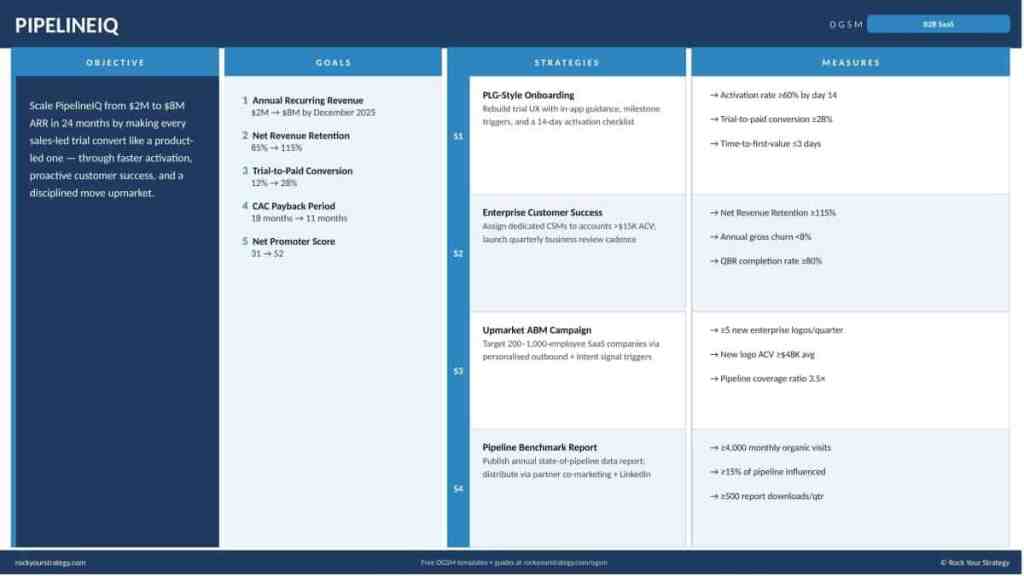
This example shows how a fictional B2B SaaS company — PipelineIQ, a pipeline analytics platform for mid-market sales teams — used the OGSM methodology to align their leadership team around a clear path from $2M to $8M ARR. The numbers, company, and details are illustrative. The strategic logic is real.
PipelineIQ is a B2B SaaS company that helps mid-market sales teams visualize pipeline health, forecast revenue more accurately, and identify deals at risk before they slip. They integrate with Salesforce and HubSpot and sell primarily to VP Sales and RevOps leaders at companies with 50–500 employees.
At the time of this OGSM, PipelineIQ has reached $2M ARR with strong product-market fit signals — high NPS, good retention among customers who fully onboard — but inconsistent trial-to-paid conversion and a growing gap between SMB and enterprise performance. The leadership team needs to decide where to concentrate resources for the next 12 months.
The PipelineIQ OGSM
Objective
Become the leading pipeline analytics platform for mid-market B2B sales teams by accelerating product-led growth and deepening enterprise retention.
Goals
Goals translate the objective into measurable outcomes. PipelineIQ chose five metrics that collectively define what success looks like at the end of the 12-month period.
Goal
Current
Target
Annual Recurring Revenue (ARR)
$2M
$8M
Net Revenue Retention (NRR)
102%
≥115%
Trial-to-paid conversion rate
9%
≥18%
CAC payback period
18 months
≤12 months
Net Promoter Score (NPS)
38
≥50
Strategies
Strategies are the 3–5 high-impact choices that determine where PipelineIQ concentrates its resources. Each is written as a “what-by-how” statement — specific enough to exclude things they won’t do.
Strategy 1: Accelerate trial-to-paid conversion by redesigning the onboarding flow around a fast time-to-value milestone
PipelineIQ’s data shows that users who reach their first “pipeline health score” within 72 hours of signup convert at 3x the rate of those who don’t. The strategy is to rebuild the onboarding sequence around this milestone — removing friction, adding guided prompts, and making the health score the first thing every trial user sees.
Strategy 2: Increase NRR by building a structured customer success motion for accounts above $15K ARR
Churn is concentrated in the $10K–$20K ARR band, typically from accounts that never fully adopted the forecasting module. A dedicated CS motion — quarterly business reviews, adoption scoring, and expansion playbooks — will address this before it compounds.
Strategy 3: Move upmarket into the $20K–$60K ACV segment by targeting RevOps leaders at Series B–D companies through account-based outreach
Mid-market accounts have lower churn, higher NPS, and more expansion potential than SMBs. PipelineIQ will build an ABM programme targeting 200 high-fit accounts per quarter, led by outbound sequences from a newly hired senior AE.
Strategy 4: Build category authority by publishing the annual B2B Pipeline Benchmark Report as the definitive industry reference
Owned research creates durable inbound demand and shortens sales cycles. PipelineIQ will survey 500+ sales leaders, publish findings in Q2, and use the report as the cornerstone of their content and PR strategy for the year.
Measures
Measures define how each strategy will be tracked and executed. For each strategy, PipelineIQ identified 2–3 Key Metrics (the numbers that define success) and 2–3 Actions (the concrete initiatives that will move those numbers).
Survey 500 sales leaders (Q1); Publish with PR push (Q2); Content distribution plan (Q2)
What Makes This OGSM Work
Three things stand out about PipelineIQ’s OGSM that are worth noting for your own strategy work.
The objective resolves a real tension. PipelineIQ could have written a generic objective about “becoming a market leader.” Instead, they named the two specific mechanisms driving growth — product-led growth and enterprise retention — which immediately signals to the team where resources will flow and where they won’t.
The goals are genuinely constraining. An NRR target of ≥115% is not a stretch goal bolted onto an existing plan. It forces a structural change: you can’t hit 115% NRR without a real CS motion. The goal drives the strategy, not the other way around.
The strategies make explicit trade-offs. Strategy 3 targets Series B–D companies specifically — not “all upmarket segments.” Strategy 4 commits to one owned research asset rather than a broad content calendar. These exclusions are as important as the inclusions.
OGSM vs. OKR: Which Framework Works Better for SaaS?
This is a question that comes up often in SaaS leadership teams, especially those that have previously used OKRs.
OGSM
OKR
Output format
One page, full strategy visible at once
Nested list of objectives and key results by team
Strategic choices
Explicit — strategies define what you will and won’t do
Implicit — key results may point in different directions
Execution link
Measures connect each strategy to specific actions and owners
Key results tracked separately; initiatives often disconnected
Cadence
Annual with quarterly measure reviews
Quarterly cycles with annual reset
Best suited for
Full business strategy alignment (board to team)
Team-level goal-setting and performance tracking
Many SaaS companies find that OGSM works better at the business unit or company level precisely because it forces the strategic trade-off conversation. OKRs can sit alongside it at the team or individual level for execution tracking.
Build Your Own OGSM
Use our pre-formatted OGSM templates to build your own one-page strategy. Available for Microsoft PowerPoint (for leadership presentations) and Microsoft Excel (for building, tracking, and updating your plan). Both are fully editable and immediately downloadable.
Two-thirds of all business strategies fail during implementation. And just like the seven cardinal sins, when strategies fail in business often one or more of the seven deadly sins of strategy are at work.
The seven deadly sins of business strategy:
Ignorance – not knowing
Incongruity – not fitting
Confusion – not understanding
Doubt – not believing
Discord – not uniting / not aligning
Incompetence – not able
Inertia – not acting
Become aware of these seven sins of business strategy and how to avoid them and you are on your way to business success. Here’s how.
Ignorance
The first sin is ignorance or not knowing.
Merriam-Webster defines ignorance as “the state or fact of being ignorant: lack of knowledge, […] or awareness”.1
When thinking of ignorance I cannot help but think of the three wise monkeys and the famous maxime “see no evil, hear no evil, speak no evil”. However when it comes to business strategy, it would obviously not be advisable to stick your head in the sand and pretend the world around you does not exist.
Running a successful business and developing effective strategies require staring the truth in the eye, relentlessly asking questions, and thoroughly analyzing and understanding the situation you are in.
In his classic book “Good To Great”, Jim Collins calls this “confronting the brutal facts”2. Collins argues that you cannot make good decisions without confronting the brutal facts of reality. You want to create an atmosphere where people are encouraged to raise issues and speak their minds. You want a climate where the truth is heard. How? According to Collins:
Lead with questions, not answers
Engage in dialogue and debate, not coercion.
Conduct autopsies, without blame.
Build “red flag” mechanisms that surface information that cannot be ignored.
Every good strategy process begins with an analysis of the current internal and external business environment in order to situate the strategy in the realities of the business.
Ignorance will set you up for failure. Knowledge, awareness and facing the facts will set you up for success.
Incongruity
The second sin of business strategy is incongruity or not fitting.
Merriam-Webster says incongruity refers to “something that is incongruous”, i.e. “something that is inconsistent within itself”.3
A business strategy can only be effective in delivering results when it fits the situation the business is in. Every business is different. Every strategy is different. Different strategies may be effective at different times. Along those lines, a strategy that may fit another business or at another time does not necessarily fit yours – and now.
I have seen businesses emulating other successful businesses’ strategies hoping that such a strategy would also work for them. Or I have seen new leaders coming to new businesses and attempting to implement the strategies that made their previous businesses successful. I’m not saying that this may never work. But I am saying that the specific strategy must fit the business and the situation that it’s in. If possible, check and adapt.
One important aspect of congruence is that your business must have the necessary knowledge, resources, skills and capabilities to implement the chosen strategy. If that is not the case, the strategy is incongruent with the business and bound to fail.
Starting your strategy process with an analysis of the current internal and external environment and truly understanding what strengths and weaknesses your business has, helps make sure that the strategy you develop fits your business and its situation.
One more important aspect that has served me well over the years: involve your team in the strategy process. Their insights and real day-to-day experiences will help test assumptions and guide the discussions towards the right priorities. Make sure however as noted above that the truth is heard.
With that you set yourself up to develop and execute a strategy that uniquely fits your business and your situation.
Confusion
The third sin is confusion or not understanding.
Merriam-Webster defines confusion as “the act of confusing” or the “state of being confused” and further describes these “to disturb in mind or purpose” or “to fail to differentiate from an often similar or related other”.4
In other words, related to business strategy, the strategy is unclear or not fully understood. And what could be worse than to develop a carefully designed strategy, nestled in the realities of the business, vetted over months, if in the end your team does not understand it.
Being unclear about the company’s strategy or not understanding how one’s own role contributes to the mission of the business are key reasons for employee disengagement. And when your team is not engaged, it is not effective in moving your company towards its objective and goals.
In order to create clarity about your strategy, consider the following three aspects:
Involve your team in the strategy process. Integrating your team’s insights and expertise when deciding where to play and how to win builds in their understanding of what you are trying to achieve.
Keep the strategy simple. Duh, this sounds obvious. But it is actually really hard to do. Calibrating your strategy so that it is not high in the clouds and disconnected from your business while anchoring it in the day-to-day realities without cluttering it with details is the ultimate challenge. Work with your team, follow a structured process, challenge yourself to reiterate until you can boil your strategy down to its simplest essence. Check for clarity, sufficiency, alignment before finalizing.
Communicate, communicate, communicate. Throughout the entire strategy process, communicate with your team. Share your thoughts, test assumptions, possibly involve customers.
A 2009 survey by Forbes Insights and FD revealed that a lack of understanding was the number 2 reason why strategies failed during execution5. What’s the number 1 reason? Unforeseen external circumstances (see Ignorance above).
So invest in clarity and involve your team and you should be well on your way.
Doubt
The fourth sin is doubt or not believing.
According to Merriam-Webster, doubt means “to call into question the truth of” something or “to lack confidence in” something.6
When thinking of business strategy, doubt is sewn when the strategy is not compelling, when the strategy does not have a clear destination or when the destination seems unattractive or out of reach.
A business strategy must spell out the purpose of the business and why moving the business towards its destination is an attractive, worthy cause. It’s strategies that appeal to a larger cause than the products of the company or a financial goal that inspire people and make people believe.
For example, a strategy that aims to “achieve profit X” or to “build product Y” are clear and realistic, but not inspiring. Instead, connect these goals to a larger cause such as serving a key customer need, solving a major problem or overcoming an industry challenge.
A strategy must clearly articulate a vision, a destination so compelling that it moves people to action.
Besides being connected to the realities of the business and being clear and understandable, therefore, a business strategy must inspire people to believe.
Discord
The fifth sin is discord or not uniting or aligning.
Merriam-Webster says discord refers to the “lack of agreement or harmony (as between persons, things, or ideas)”.7
Say you have defined a vision for your business. You have turned that inspiring vision into clear objectives and goals and you have rallied your team to join you on that journey. But what if it is not clear how you will reach your destination or worse what if there is disagreement about how to reach the destination? The energy you created deflates.
The same way there are “a thousand ways to Rome”, there are many ways for a business to reach its objectives. An effective strategy doesn’t only spell out what it aims to achieve, but also how it is going to achieve it. As Lafley and Martin say in “Playing to Win” it’s where to play AND how to win.
Strategy is all about making choices. It’s about allocating your finite resources to those initiatives that give you the highest chance of success. It’s about deciding which ventures to fund, which products to build, which services to offer, and which competencies & skills to develop.
It should not be your ambition to make everyone agree with the strategy. It’s ok to agree to disagree. It’s more important that everyone unites and gets behind the strategy to direct the company’s resources fully towards its vision and strategic objectives. How do you achieve that? Alignment.
During the strategy process, work with your team to translate the objective and goals into strategies that translate your ambitions into results. The strategies describe the ‘how’, the trade-offs, the resource allocation decisions. Then further work with your team on cascading the strategies into objectives and goals for each division, function, and team. In a small business with only a few people, the same process holds. Translate the strategies into clear objectives, goals, and initiatives for each person. The initiatives and actions of each team or person must align with the larger cause like one cogwheel in a system grabbing into another.
When the business is united behind the strategy and your team is aligned on how to reach your destination, you can fully direct your energy towards achieving your goals.
Incompetence
The sixth sin is incompetence or not being able to.
Merriam-Webster defines incompetence as “the state of being incompetent”, i.e. “lacking the qualities needed for effective action”.8
Incompetence or the lack of ability to do something is likely the easiest sin to understand and also the easiest to overcome. Yet, in my experience, incompetence is also the most underestimated.
When defining a strategy and setting the course for your business, it is important to confirm whether your business has the necessary knowledge, skills, and experiences to implement the strategy and achieve the goals. It’s worth reviewing these terms individually. For our intents and purposes, let’s define the terms as follows.
Knowledge – refers to knowing what to do. This means having acquired theoretical and practical knowledge through professional training, university, school or self study. Books are a wonderful source of knowledge.
Skills – refers to knowing how to do it. These are the competencies and techniques needed to complete a job, task or activity. These include hard skills and soft skills as well as generic skills and domain specific skills. Practice or training is a great way to acquire and hone skills.
Experience – refers to having done it before. This means having applied the acquired knowledge and skills in real life. Having faced and overcome the exact situation you aim to master.
Consider a sports example. Knowledge means you have read all about football, you have watched it on TV and have been told what football is and how to play it. Skill means you have practiced football. You have handled the ball, you have trained together with your team members. Experience means you have played the game and have been on the field in the competitive situation of winning or losing.
Having and honing all three, knowledge, skills, and experiences, vastly improve your chances of success and overcoming inertia.
This doesn’t mean that you cannot succeed if you lack any or all of them. Learning by doing or tackling a new challenge that no one has ever faced can be powerful ways to move people to action. Just know that lack of knowledge, skills and experiences can be a reason why your strategy is not progressing.
So audit yourself during the strategy process and check you have the necessary knowledge, skills, and experiences to do what you aim to do. If not, seek to understand whether this is critical for success. If yes, invest in building the necessary knowledge, skills and experiences before setting off on your journey.
Finally, make sure that your key initiatives critical to success are well resourced. Even if you have the necessary abilities, there is no guarantee for success. Ensure you have enough of them and that they are applied persistently.
Inertia
The seventh sin is inertia or not acting.
Merriam-Webster says inertia is the “indisposition to motion, exertion, or change” and defines inertness as “very slow to move or act”.9
In business strategy, inertia is an interesting phenomenon. Your strategy is ready, you have communicated with your team, but nothing happens. Progress is slow. Results are pending. What happened?
In physics, the reason for inertia is resistance. In business, the reasons could be manifold and not due to one single reason.
Inertia could be caused by a lack of focus. If you have too many topics on your plate, you may be working a little on all of them, but not sufficiently on any of them to make a difference or bring a topic to the end. Review the number of initiatives in your business. What matters most right now? What matters most long-term? Prioritize and work on what’s important first. Bring those topics to an end.
Inertia could be caused by a sheer insurmountable challenge. Have you had this before? A problem so big you didn’t know where to start? I have certainly been there and it keeps you from moving ahead. If you face such a situation, break it down. Divide the problem, project or initiative into smaller steps or sub-projects. Consult a colleague or mentor to help you with this when you get stuck. Sometimes another perspective can be powerful. Then tackle one topic at a time. Ensure that each sub-project has the resources and expertise to move forward.
Inertia could be caused by a lack of passion. When you find an activity you love doing, it seems no effort at all. You tackle it readily and you don’t seem to notice the time passing. However, when the opposite is true, when you face an activity you cannot get excited about, it seems to become a chore. You are more likely to put it off and choose to get other things done first. This is quite typical and can also happen with your strategic initiatives. When resourcing your initiatives and finding caretakers, make sure to check for interest to find someone who can get passionate about the project. If this is not the case, consider outsourcing. If it’s important to the strategy, but not core to your business or the passion of your business, find someone for whom it is.
Inertia could be caused by a lack of ability. As noted above under incompetence, lacking the necessary knowledge, skills, and experiences may prevent your team from moving forward. Ensure that you have the ability to succeed and that it is well resourced.
And of course, inertia could be caused by resistance. Sometimes outright resistance to the strategic direction, to the objective and goals, to the approach prevents progress. But resistance itself is not the reason. When resistance exists, there are more fundamental concerns in play that must be understood. Dig in! Approach your team, your customers, your stakeholders openly. Ask questions to truly understand their concerns. Fundamental reasons could be fear and anxiety about changes: plant closures, job losses, benefit changes. These concerns can be very personal and it’s critical they are heard and understood to help people cope. Any such reasons are legitimate. Approach them with empathy. Make it your personal mission to truly understand and then work with the people to overcome their underlying reasons for concern.
So how do you change inertia? Just like in physics, you apply force. No, not physical force. But you do need to give an input to create motion. And that input must come from the business leader.
Engage your team throughout the strategy process and ensure key people are involved. Openly and actively listen to questions and concerns. Communicate, communicate, communicate so everyone understands why you are doing what you are doing and how the team can help.
Engagement and understanding create buy-in. And buy-in helps you overcome inertia.
How to avoid the 7 sins of business strategy
Now that we have learned about the 7 sins of business strategy and heard some thoughts about how to avoid them, how do we set ourselves up for success?
In order to succeed in business, apply the following six principles of business strategy during your strategic planning and implementation.
1. Structured process
Whether you are in a large company or a small business, a disciplined strategic planning process is critical to success
Be deliberate about strategy development and implementation
If you have a team, involve your employees in the strategic planning and the implementation process
Involving your team not only sends a clear message of appreciation, but also helps with anticipating potential obstacles and preparing accordingly
Your team knows the day-to-day challenges and helps with a realistic assessment of opportunities and capabilities.
3. Buy-In & Alignment
When developing your strategy, make sure your objectives, goals, strategies, and measures are congruent with each other. Check whether strategies and measures are sufficient to achieve the objective and goals.
Seek systematic buy-in and alignment of objectives and strategies across your organization. Make sure each function is involved, understands what it takes to be successful, and has the resources and capabilities to succeed.
Systematically break down objective and goals and cascade them throughout the organization. Ensure that every level in the organization is aligned, empowered and pulls in the same direction.
4. Communication
Clarity about objective, goals and strategic priorities is of utmost importance. You cannot execute a strategy you do not understand.
Build communication as an integral part into strategy formulation and execution.
Listen to questions and concerns and consistently explain how initiatives and actions fit with the overall strategy and how each individual can help to achieve the objective and goals.
5. Accountability
While the business leader is ultimately accountable for success or failure of the strategy, the strategic plan must be the common objective for the entire business
Set clear expectations for each function and team and clarify how each contributes to moving the business in the right direction and delivering results.
Hold people responsible for implementing strategic initiatives and delivering expected results. Be a cheerleader for your team and allow no excuses.
6. Execution
Implementation must be considered a strategic initiative, not an operational task
Install a clear cadence when reviews take place and what actions have to be completed by whom and by when
Ensure that key initiatives are prioritized and resourced appropriately with the needed manpower and skills
Conclusion
In summary, to avoid the seven sins of business strategy, work with your team to follow the 6 proven principles of business strategy.
The OGSM methodology is one of the most effective antidotes to all seven deadly sins of business strategy — a clear, one-page plan that the whole team can see, understand, and act on. Download a pre-formatted, fully customizable OGSM Template for PowerPoint or OGSM Template for Excel from the Rock Your Strategy shop and build your strategy on solid foundations.
Looking for inspiration on how to structure your strategic plan? Or just looking for an OGSM example? Get to know Andy and learn how he applies the OGSM methodology to his small B2B company.
OGSM stands for Objective, Goals, Strategies and Measures and is a one-page business plan that defines ‘what’ you aim to achieve and ‘how’ you are going to achieve it. It is a simple but powerful method that enables strategic clarity, alignment and execution. The OGSM can be applied to large companies and small businesses alike.
This fictional story tells the tale about how small business owner Andy used the OGSM methodology to breathe new life into his father’s old business. Scroll to the bottom of this article if you want to skip the story and head straight to the OGSM.
Introduction
Andy hadn’t been able to sleep. Cold sweat on his forehead, he had been tossing back and forth all night. He stared at the marred face in the mirror: tired eyes with deep black rings underneath stared back at him. Andy counted the worry lines engraved on his forehead. His mind was racing. How would he be able to save his company? How would they be able to defend their share – never mind achieve their growth objective? What was he going to tell his investors?
Ever since Competitech had entered the market for fasteners the previous spring, their market share had dwindled. Florian’s Fastener Solutions had been the market leader for nuts, bolds, washers, and screws throughout the entire Northeast ever since his late father had built the company five decades ago. The iconic F-logo was well known in hardware stores and construction sites across the region. Now everything seemed to change. If they didn’t do something fast, they might be running out of cash in 12-18 months.
Florian’s Logo
The annual Board of Directors meeting was coming up in less than 3 weeks. Andy wasn’t sure if he could wait that long. He had to refine his plan and discuss it again with his team.
Andy showered, got dressed, and paused just before descending the stairs. He peeked through the children’s bedroom door. All quiet. He could only hear the steady breathing of his two daughters still fast asleep. “If only you knew how stressful and fearsome this world can be”, he thought to himself. Andy blew kisses to both and rushed downstairs.
Just as he grabbed his bag and ran out to the car his phone rang. “Andy, you up?” asked the familiar voice of his head of finance on the other end of the line. “Good morning, Frank. Yeah, I’m on my way to the office. What’s up?”
“Good! Get down here. The report is back. It’s worse than we thought.”
Founding of an industry icon
Florian’s Fastener Solutions was founded by Florian Walterman in 1965. The son of German immigrants who had fled to the US in the 1930s, Florian worked his way through college by taking any construction job he could find. By the time he graduated, he had made a name for himself as being hard-working, gritty, and determined. No job was too tough. No task was too dirty. If you wanted something done, you asked for Flo. And it was these traits that he infused into his company right from the start.
It was not an easy start however. For the first few years, Florian had a hard time making ends meet. He had to take out a massive loan to afford the heavy equipment. The small shop he rented produced nuts and bolts for some of the construction outfits he had worked for during college. However at the back end of the American construction boom of the 1950s and 60s, there were fewer projects and Florian had to be creative.
Florian began experimenting with different materials and production processes. He tried new metals and blends and added new products. His goal was to make the best fasteners money could buy. If you needed bonding, Florian was determined that it had to be his products to do the job. That also explained his early slogan: Florian’s will fix it!
Ad in local newspaper in the late 1960s
Through sheer will and hard work, Florian persevered. His breakthrough came when a new chain store for hardware and gardening equipment approached him for an exclusive contract. The chain’s plan was to expand all across the Northeast and wanted to carry Florian’s fastener products. When they even offered to fund Florian’s needed expansion through an upfront payment, Florian readily agreed.
In the following years, the chain rapidly grew into American suburbia and with it Florian’s fasteners. Working hard to keep up with demand, Florian built a second site, purchased more equipment and hired more staff. As sales grew, so did the company. But Florian remained as hard nosed, down to earth, and gritty as he had always been.
Florian’s became a household name and its italic F on the bold head a well-known sign of quality and craftsmanship. An industry icon was born.
Family business
Andy had never wanted to get into the family business. Florian’s was his dad’s. It even carried his name. No, ever since being a little boy he wanted to go out to see the world. He wanted to help people who were less privileged than himself.
During high school he worked on a project in Puerto Rico. He was blessed with his dad’s workmanship and strong hands and was glad to put them to good use. In the summer after graduating he led a group of friends to Tanzania to build a school and teach English. He knew he wanted to devote his life to helping others and his choice of college degree was easy.
One day in Fall, Andy had just settled into his 3rd year at the Stanford University social sciences program, his mother called. “Andy, it’s your dad. He had a stroke. Can you come home?”
Shocked how anything could harm his steadfast father, Andy took the first Eastbound flight the following day. When his rental car pulled up the driveway, the last sun rays of the day peaked through the tall pine trees behind his parents’ house as dusk began to settle. Andy had this eerie feeling that more than a day was coming to an end.
“Thank you for coming home, Andy.” said his mother after a long, warm embrace. “Your father is at St. Mary’s hospital. The doctors say he may not make it.” Andy had always had a difficult relationship with his father. Not wanting to continue the business had driven a wedge between them. At this moment however, Andy felt overwhelmed with sadness and regret. All these years he was away while his father was consumed by work. They had not really had a chance to open up about their feelings for each other.
“He always wanted you to be here, you know”, his mother continued. “He loved you very much. He had made plans for you to carry on the company after he retired…” His mother’s voice trembled and tears began streaming down her cheeks. “But retirement never came… and now he’s…”
Andy held his mother tightly. “Let’s go see him”, he said gently.
At the hospital, Andy and his mother sat around his father’s bed. His eyes were closed. It was quiet in the room except for the beeping of the ECG and the hissing of the respirator. The doctors had prepared Andy for what to expect before they entered the room. “Your father has been waiting for you, Andy. He’s not conscious but he can hear you. He doesn’t have much time left. He’ll be happy that you’re here.”
Sitting by his father’s bedside, tears filled Andy’s eyes. He carefully took his father’s hand and whispered close to his ear, “I’m here, Dad. And I’m here to stay. Thank you for everything. I love you very much.” Andy thought he felt a twitch in his father’s hand. It was as if he wanted to say “I hear you, son. I love you.”
Andy looked up at his mother, “I’m ready, Mom. I’ll stay. We’ll get through this together.”
Departure and a new beginning
The funeral of Florian Walterman took place 3 weeks later. It was a beautiful ceremony. Many friends and life companions of the Walterman’s paid their respects.
Afterwards, Andy, his mother and Frank, Florian’s head of finance and Florian Walterman’s right hand man, sat together laughing and telling tales from Florian’s life and achievements.
Suddenly, Frank became serious. “Andy, your father left an envelope with me and asked me to pass to you should he ever leave. The time has come that I pass this letter to you. It includes a copy of his will and his wishes for the handover of the company. It was his wish that the two of you take over the reigns of the company. Please read the letter carefully and let me know if you have any questions. Know that I’m there for you whenever you need me.”
Frank handed Andy the letter, padded him on the shoulder, thanked Andy and his mother for the wonderful ceremony and left.
Andy took a deep breath and opened the letter. His mother knew the contents and looked at Andy while he studied each line and each word.
When Andy looked up, his mother said, “Andy, it’s your company now. I will head the Board of Directors but you run the day-to-day operations. Frank has looked after everything for the last weeks. The company is in good shape but a number of challenges are ahead. We need your foresight, your energy, and your care to take the company into the new millennium.”
Competitech
While Andy was driving to the office, he had to think back to the day 15 years ago, when he took over Florian’s from his father.
The first day in the company after the funeral had been strange for him. His father’s office still had had the musky smell of his old man’s cologne. There had been piles of paper everywhere and it had taken him some time to get sorted. Frank was there for him every step of the way. Frank had introduced him to the team, the operations, and the state of the business. He had taken him by the hand and made sure that Andy learned as quickly as he could. Andy was grateful for Frank’s mentorship. No, Frank was more than a mentor. Frank was like family.
And now Frank was waiting for him at the office with the fateful news he had been dreading all night.
Andy parked his car in front of the building and wished that he had stopped for coffee. Lost in thoughts he drove right by his usual morning coffee stop. “What’s wrong with me?”, he murmured as he stumbled up the steps to the office.
“Andy, finally.” Frank wasn’t much of a small talker, especially not in the morning. “We have an hour until the team gets in. Read this.”
Andy gave Frank a blank stare, took the report from his hand and walked into his office. “Give me the highlights, Frank.”
“Competitech is making much faster progress than we thought. They have taken 2 more retailers on the West coast and are working hard to get into our home base. Stan at Home Improv called me last night. He has Competitech calling him twice a day with new offers. He says he won’t be able to convince his head of purchasing to dodge their prices much longer.”
Andy spun around in his chair, suddenly wide awake. “Frank, I think we have to approach this differently. Let’s stop playing defense. I think we have to take this head on. It’s time to go into offense.”
OGSM Template for Excel
Pre-formatted, easy-to-use OGSM template for Microsoft Excel.
Andy shared with Frank what he had been thinking about all night. When he was finished Frank let out a long sigh. “And you are convinced this will fly?”
“I’m not, Frank. But I think it’s our only chance. Let’s discuss the idea with the team. And then let’s hash out a plan that can beat Competitech, restore our path to growth and convince the Board of Directors and our organization to come on board for the ride.”
Staging a turnaround
It was 8 a.m. by the time the last person sat down in the conference room. Murmurs of “G’morning” made the round. The entire leadership team had followed Andy’s call for the all-hands meeting. The small conference room seemed to be bursting at the seams with all seven leaders in attendance.
There was Frank, of course, the head of finance, who was seated right next to Andy. Next to him was Dan, head of operations, followed by Sharon, head of sales & marketing. Unlike in many other companies, Dan and Sharon usually stuck together. Next to Sharon was Alisha, the head of R&D. On the opposite side of the table, Tom, head of procurement, and Sarah, head of HR, sat in their usual seats.
Florian’s Fastener Solutions leadership team in late 2010s
Andy opened, “Good morning, everyone. Thank you for joining this early on a Monday. We have some important news to share and then some critical topics to discuss.”
Chatter erupted in the room. There was a crinkling of suspense and worry in the air.
“Please guys, let me explain.” Andy cleared his throat. “The market report we commissioned came back this morning… We lost further market share and are now at 15%. Competitech continues its march across the country and is rolling up customers state by state. Their share has swelled to 26%. This needs to stop. If we lose Home Improv or any of our main retail customers here in the Northeast, we will run out of cash as early as next year. I don’t need to explain what that would mean to our company and to the legacy my father has built together with all of you.”
Andy paused and looked around the room. He had everyone’s undivided attention. “Look, I am not going to sugarcoat this. This situation is dire. Competitech is significantly larger than us, offers cut throat prices with their cheap imports, and has a much wider portfolio of fasteners, screws, nails, and other metal products. Competitech is targeting large retailers and wholesalers and is already knocking on Home Improv’s door. If we simply wait and do nothing, they will wash over us like a tsunami. But we will not let that happen!”
Sharon spoke up first, “How do you plan to do that, Andy? Competitech is everywhere. They have a much larger sales force and their prices are 20% lower than hours. My guys are running out of arguments.” Dan nodded. “We cannot compete with their costs. We have optimized our processes over the last years as much as we could. There are no quick wins here.”
Chatter erupted once again as the team began talking over each other. Frank raised his hand and the room fell silent. The sign Florian had established still worked like a charm. “Andy had an idea. It’s risky financially but it’s worth considering. Give him a chance to explain.”
“Thanks, Frank.” Andy continued. “Sharon, Dan, I hear you. You guys have done your utmost to put us – and keep us – in a competitive position. That has contained the impact so far. Thank you for that. However what got us here, will not help us going forward. We have to rethink our strategy and refocus our resources.”
Frank picked up the market report which had been printed and laid out for each team member. “Besides the current market shares and competitive positions, the report also offers an outlook for different sectors of the market in future.” Frank tapped on a graph on page 7 of the report.
US Industrial Fastener Market Report (Source: fictional)
“While the overall fastener industry in the US is growing 2%, the wholesale & retail sector which has been our home market for all these years is going to decline faster in the years ahead”.
Sharon sighed, “I’ve been telling you this, Frank. Retail is dead in the water. No one is fixing up their houses anymore. Young people want to live in the cities. They play on their smartphones all day and have two left hands when it comes to swinging a hammer…”
“You have,” acknowledged Andy. “And we need to direct our attention to what is growing. Look at the chart. Construction, our other main market, remains robust. Automotive, Aerospace, Industrial Machinery are all showing positive growth for the coming years.”
“This is interesting!” Alisha exclaimed. She had skipped ahead in the report and read about the market trends within each of the sectors. “Some of the drivers of growth in Building & Construction are the building of data centers and elevators & escalators. Have we looked at this in more detail yet?”
“You hit the nail on the head, Alisha.” Andy smiled for the first time that day. “We are a small company. We will not be able to take on Competitech with their size. Nor will we be able to satisfy the Automotive industry’s requirement for scale and JIT. Why not use our size to our advantage and focus our attention on growing industries that require custom made products and value-adding services? Such as the IT and Elevator industries.”
The team began discussing the various market segments and debating which ones best fit their capabilities and size. After an hour of reviewing the facts they indeed honed in on IT and Elevators.
“Sounds to me like these are the industries with the highest growth rates in the next few years and for which we are uniquely positioned with our expertise here in the Northeast,” concluded Tom.
“But the industries are still small”, said Dan. “They alone will not be able to sustain us.”
Andy agreed, “It will take time for us to prepare entering those markets. We will need to add new products and new skills. And meanwhile, we must not give up our fortress. We will need to work on our cost position and secure our largest customers. The cash flow from our sales today will need to fund our sales of the future.”
“We will need additional resources for what you have in mind, Andy. We have good standing with our banks, but we will need a clear plan to convince them”, remarked Frank.
“We will need to convince our teams first, Frank. People are nervous. They see our sales declining and are worried that their jobs are at risk.” Sarah reminded everyone what was at stake.
“No one will lose their jobs. We will need everyone if we want to pull this off: you, your teams, the Board, everyone. We need to go back to the values my father instilled in this business to stage a turnaround. Let’s take a break and then resume to make a plan.”
Making a strategic plan
When the team returned to the conference room, Andy had already set up 2 flip charts. On the one in front of the room he had written a timeline.
Andy rolled up his sleeves. “Alright, folks. We have less than three weeks to put together the plan. I suggest we start right away today by setting the framework and then work over the next 2 weeks with our teams to flesh out the details. If we want broad buy-in from the team, we need to involve them as we always have.”
Andy flipped over the flip chart, revealing a process chart. “My dad had sworn by this process. Let’s use it again to guide our discussions. We had a good starting point this morning, but we need to dig deeper into those market segments to better understand their dynamics, customer needs, and competition.”
rockyourstrategy.com Strategy Process
“I suggest we approach it as follows.” Andy pointed to the strategy process. “Let’s focus today on the Mission and Business Analysis steps. Sharon, can you then work with your team on the Industry Analysis until the end of the week? Let’s then resume next Monday with the Vision and Strategic Choices parts before we then develop the Execution Plans with our teams for the remainder of that week. Goal must be to have a plan ready by the end of next week. That’s 10 days, 12 with the weekend. Are you guys ok with that?”
“Wow, that’s a tight timeline, Andy!” Dan was not usually the one to point out the obvious.
“Yes, it is, Dan. This is not going to be easy. I am open to alternative ideas if you have any.” Andy scanned the room, but no one had a suggestion.
“Then let’s get started,” said both Alisha and Sarah in unison. They looked at each other and giggled. “Yes, let’s get started”, confirmed Andy, glad that the mood had lightened. “Frank, can you take over and facilitate?”
Intimately familiar with the strategy process, Frank was happy to. He got up and walked to the front of the room.
OGSM example – the 5 year growth plan
The Leadership team of Florian’s Fastener Solutions went to work. And over the next two weeks worked out a detailed plan with their teams. They summarized their strategy in a simple one-page business plan they called their OGSM.
OGSM stands for Objective, Goals, Strategies and Measures and is a one-page business plan which details what you aim to achieve and how you are going to achieve it.
Andy knew his dad had used the OGSM methodology for years. He had liked its simplicity and the clarity it created. Combining the what and the how moved the team from planning to execution and aligned everyone behind the overall direction of the company.
“If you want your team to follow you, Andy, your team needs clarity where you’re headed!” he had always implored on him. Andy heard his father’s voice ring through his head. He could remember a treasure trove of bumper sticker-like one-liners from his childhood. He barely ever listened to his dad when he talked about work at the dinner table. When Andy took over Florian’s however he had been glad for the lessons his dad had taught him.
“Making the numbers is not a strategy. Strategy is about making choices!”
“Appeal to your people’s hearts and their minds and they will take you anywhere.”
“Take care of your people and they will take care of your customers.”
“A plan is only as good as its execution!”
Andy sat in his office, eyes locked on a copy of the freshly minted OGSM in front of him. He felt good about their plan. Not only did the leadership team work on it with enthusiasm. But the entire organization had pitched in. He was surprised at the commitment everyone had shown. It was as if they had just been waiting to be asked to contribute. And maybe they had been…
Andy felt exhausted as he dialled his mother’s phone number. He wanted to set up a meeting to jointly review the final plan. He had kept her apprised of progress over the past two weeks. Being the chairlady of the Board of Directors, Andy made sure she was in lockstep with the team every step of the way.
With the Board of Directors meeting now days away and the change they proposed significant, Andy did not want to leave anything up to chance. The transformation itself would be enough of a gamble.
Epilogue
Sarah raised a glass. “Andy, on behalf of the leadership team, I would like to thank you! If it wasn’t for your dedication, your optimism and your continued reinforcement of the plan and its execution, I’m not sure whether we’d be here today.” The rest of the team joined in cajoling and shouts of encouragement and appreciation. Sarah threw an icy look before bursting out into laughter. “Quiet, I am not finished yet!”
Florian’s Fastener Solutions leadership team was sitting together on the farmhouse patio of the little vineyard which Florian Walterman had bought years ago. Overlooking Cayuga Lake, the vineyard at Finger Lakes had become a favorite get-away for company events and team celebrations.
It was a beautiful late Summer evening. A slight breeze made the warm air comfortable. Bottles of the vineyard’s signature Riesling were nestled in the ice bucket next to the large table. Andy had invited the team to the vineyard to celebrate the latest contract Sharon had signed the previous week and the progress the company had made in executing their plan.
“When we embarked on this journey three years ago, I was frankly not convinced that we would be able to turn things around.” Sarah said honestly. “Of course I was hopeful. I had faith in our abilities and our team members. But I was not convinced.”
“Boooooh”, Sharon and Dan interrupted Sarah with wide smiles. “Shush, you two”, she responded with an equally wide grin.
“Andy, you kept us going. You convinced your mother and the Board of Directors, you got the funding from the bank, and you led the meticulous execution of our plan every quarter and every month. Here we are 3 years in. We are not done yet. But we are on track and have returned to growth again! Cheers to you! Cheers to Florian’s!”
The team raised their glasses in celebration and the rings of clinking glass could be heard reverberating across the valley. As the sun was setting over Cayuga Lake, the seven leaders kept chatting while enjoying the wins they had achieved. They knew they were not yet at their destination and that more challenges lay ahead. But tonight they enjoyed the wine and each other’s company.
Final Notes
While this story is totally fictional, the learnings can be real. If you would like to learn more about the OGSM methodology, read our introduction to the OGSM methodology here. You can explore other examples and templates via the respective links.
Florian’s Fastener Solutions, all characters and all data points are completely fictional and the brain child of the author. Any resemblance to real life events or circumstances is not intended and may be coincidental. Please excuse us if some data seems contradictory or far-fetched. The story intends to introduce the OGSM methodology and its application. It is not the purpose to provide actual industry information or a real world case study.
If you have any questions or comments, why not leave us a note in the comment box below or sign up to our free newsletter here. We’d love to hear from you.
10-Page Strategy Presentation Template
Fully customizable strategy presentation template for Microsoft Powerpoint