Tag: strategic planning

  • OGSM vs Hoshin Kanri: Same DNA, Different Operating System

    OGSM vs Hoshin Kanri: Same DNA, Different Operating System

    OGSM and Hoshin Kanri are both strategy-execution frameworks with Japanese roots, and both are built to align an entire organisation behind a shared strategic direction. The core difference is operating model.

    OGSM is a single-page, top-down document that prioritises speed and clarity; Hoshin Kanri is a more complex, bidirectional planning system built for large organisations with mature continuous improvement cultures. For most teams, OGSM gets you further, faster. For enterprise manufacturing environments already running Lean or Six Sigma, Hoshin Kanri may be the natural fit.

    In this article we introduce each strategy framework, describe their differences, and explore when to use either one.

    What Is Hoshin Kanri?

    Hoshin Kanri — sometimes called Policy Deployment — emerged in Japan in the 1960s, drawing on the quality management work of pioneers like Kaoru Ishikawa and Yoji Akao. The name roughly translates as “direction management” or “compass needle management.” Its purpose is to cascade strategic intent from the C-suite all the way to the shop floor, ensuring every level of the organisation is pulling in the same direction.

    The hallmark of Hoshin Kanri is the catchball process. Unlike top-down cascades, catchball is a dialogue: leadership throws a strategic objective down to the next level, that level responds with their capacity and constraints, and the objective is refined before being thrown again. It is iterative, consensus-building, and time-intensive — by design. Done well, catchball surfaces operational constraints that leadership teams simply cannot see from the boardroom.

    The X-matrix is Hoshin Kanri’s primary tool. It maps the relationships between long-term breakthrough objectives, annual priorities, improvement activities, and metrics on a single page. It is a powerful instrument in the right hands. In the wrong hands, it produces a complex document that nobody reads after January.

    What Is OGSM?

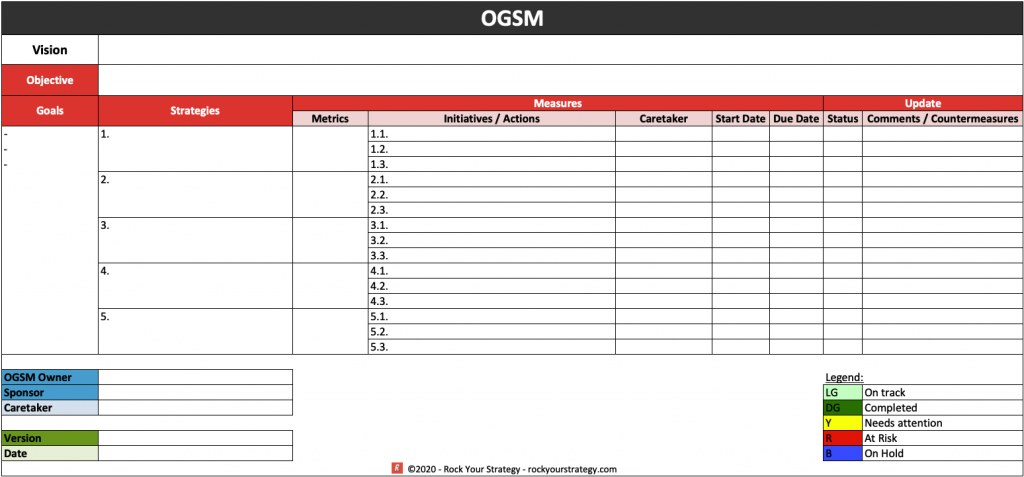
    For readers arriving from a Hoshin Kanri background: OGSM stands for Objective, Goals, Strategies, Measures. It originated in Procter & Gamble’s Japan operations in the 1980s — ironically, influenced by the same TQM tradition that shaped Hoshin Kanri — and was designed for speed and portability. The entire plan fits on one page. One Objective (the qualitative ambition), several Goals (the quantitative targets), Strategies (the choices you are making), and Measures (how you will track whether those choices are working). That is it.

    OGSM’s simplicity is not naivety — it is a deliberate constraint. You cannot hide strategic confusion in a one-page document.

    How Do OGSM and Hoshin Kanri Differ?

    Both frameworks are trying to answer the same question: how do we turn strategy into coordinated action at every level? They answer it very differently.

    Dimension OGSM Hoshin Kanri
    Structure One-page linear document (O -> G -> S -> M) X-matrix with cross-linked relationships
    Cascade method Top-down Bidirectional (catchball)
    Time to implement Days to weeks Months (first full cycle)
    Required expertise Low — any team can learn it High — Lean/Six Sigma facilitation typically needed
    Documentation Minimal Extensive
    Review cadence Flexible (quarterly is common) Structured monthly reviews built into the system

    The biggest practical difference is implementation friction. An SME leadership team can learn and run OGSM in a day. A full Hoshin Kanri deployment typically takes a full planning cycle to bed in, and it demands trained facilitators to keep the catchball process honest and productive. That is not a flaw in Hoshin Kanri — it is a design trade-off. The depth of engagement produces better cascade alignment. But it requires an organisation that is ready and resourced for it.

    When Should You Choose OGSM?

    OGSM is the right call when speed and simplicity matter more than elaborate cascade mechanics. Consider it if you are:

    • A small or mid-sized business building strategic discipline for the first time
    • A team or business unit that needs a fast alignment tool without organisational bureaucracy
    • An organisation that has tried and failed with overly complex planning frameworks
    • A leadership team that wants one document everyone can hold in their head

    The one-page constraint is OGSM’s greatest strength. It forces the clarity that most strategy processes never achieve. I have seen organisations spend six months on a Hoshin Kanri rollout and still not be able to articulate their strategy in a sentence. That does not happen with a well-built OGSM — the format will not let you hide behind vagueness.

    For a full walkthrough of the format, read our complete OGSM guide. If you are also evaluating OKRs, our OGSM vs OKRs breakdown covers that head-to-head in detail.

    When Should You Choose Hoshin Kanri?

    Hoshin Kanri earns its complexity premium in specific conditions. It is the right choice when:

    • You are running a large manufacturing or industrial organisation with established Lean or Six Sigma programmes already embedded in the culture
    • Frontline input into strategy is genuinely essential — the catchball process is superior at surfacing operational constraints that senior leaders cannot see from above
    • You have multi-year transformation programmes where annual cycles must stay explicitly locked to long-range breakthrough objectives
    • Your teams already speak the language of continuous improvement, A3 thinking, and structured review cadences

    In these contexts, the X-matrix’s ability to map the explicit relationships between long-term breakthroughs, annual priorities, process-level improvement activities, and metrics is genuinely valuable. Hoshin Kanri is not over-engineered for these environments — it is precisely engineered for them. The infrastructure it requires is justified by the cascade complexity it manages.

    If you are not in that environment, that infrastructure will cost more than it delivers.

    Can You Use OGSM and Hoshin Kanri Together?

    Yes — and some mature organisations do exactly this. The pattern that works is: use OGSM at the leadership level for the annual strategy document, then apply Hoshin Kanri principles for the cascade below it.

    Concretely: the leadership team aligns on the OGSM, then uses a catchball-style dialogue to translate the Strategies and Measures into departmental OGSMs. The X-matrix can serve as a cascade validation tool — mapping which departmental activities connect to which enterprise-level measures — without requiring a full Hoshin Kanri deployment from scratch.

    This hybrid approach gives you OGSM’s clarity at the top and Hoshin Kanri’s cascade rigour below. It is not officially sanctioned by either framework’s purists, but it works in practice. Several organisations I have encountered have landed here after initially trying each framework independently and finding that the extremes of each did not fully serve them.

    OGSM vs Hoshin Kanri: Which Framework Should You Choose?

    Both frameworks exist to solve the same fundamental problem: organisations that set strategy and then fail to execute it. They solve it differently, and neither is universally superior.

    If you want a lean, fast, flexible framework that any team can learn and run without specialist support, choose OGSM. If you are operating in a mature Lean environment and need a system specifically built for complex, multi-level cascade with deep frontline engagement, Hoshin Kanri has capabilities that OGSM does not replicate.

    When in doubt — and for most organisations reading this, doubt is appropriate — start with OGSM. You can always layer in Hoshin Kanri cascade mechanics later as your strategic operating maturity grows. The reverse — simplifying a full Hoshin Kanri deployment that has stalled — is considerably harder and more politically fraught.

    Rock on.

  • How to Use OGSM for a 90-Day Sprint Plan

    How to Use OGSM for a 90-Day Sprint Plan

    Annual strategies are great on paper. The problem is that most people don’t look at them again until it’s too late to change anything.

    To use OGSM for a 90-day sprint plan, take your annual Objective and Goals and break them into a focused sub-OGSM for the quarter: keep the Objective, select the one or two Goals most critical this quarter, define the Strategies you’ll run in this period only, and set Measures with 90-day targets. Review progress every two weeks.

    The 90-day OGSM sits inside your annual strategy, not instead of it. Here’s how to build one that actually works.

    Why 90 Days Is the Right Unit for Execution

    A year is long enough to lose focus, change direction, and still feel like you have time. A week is too short to see any meaningful movement on strategic priorities. Ninety days is the sweet spot — long enough to make real progress, short enough to keep urgency high.

    The 90-day sprint model works just as well with OGSM — and arguably better, because OGSM naturally scales from annual to quarterly without requiring a different framework.

    The Difference Between an Annual OGSM and a 90-Day OGSM

    Your annual OGSM sets the year’s direction. Your 90-day OGSM answers: what do we actually work on in the next three months to move toward that direction?

    Annual OGSM — 3–5 Goals, multiple Strategies, Measures tracked monthly or quarterly.

    90-Day OGSM — 1–2 Goals (the ones where you need the most progress this quarter), 2–3 Strategies (the specific campaigns or initiatives running right now), Measures tracked weekly or bi-weekly.

    You’re not rebuilding your strategy every 90 days. You’re focusing it.

    How to Build Your 90-Day OGSM

    Step 1: Start With Your Annual Objective

    Your 90-day Objective is the same as your annual Objective. Don’t rewrite it. The purpose of the sprint is to make progress toward the annual direction — you don’t need a new destination every quarter.

    If your annual Objective is “Become the go-to provider of OGSM training for European mid-market businesses,” that’s also your 90-day Objective. The sprint just defines what “progress” means for this quarter.

    Step 2: Select Your 90-Day Focus Goals

    Look at your annual Goals and ask: which one or two of these are most important to make progress on right now?

    In Q1, you might focus on building awareness and pipeline. In Q3, you might focus on revenue conversion and retention. Not all Goals are equally urgent in all quarters.

    Choose a maximum of two Goals for the sprint. For each, set a 90-day sub-target — a milestone rather than the full-year figure.

    For example, if your annual Goal is “Grow organic website traffic from 4,000 to 10,000 monthly sessions by December,” your Q2 sub-target might be “Reach 6,500 monthly sessions by 30 June.”

    Step 3: Define Your Strategies for This Quarter

    Your 90-day Strategies are the specific initiatives you’ll run during this sprint. Be more specific here than in your annual OGSM.

    Annual Strategy: “Build thought-leadership content to drive inbound traffic.”

    90-Day Strategy: “Publish eight SEO-optimised blog articles targeting OGSM search terms; promote each via LinkedIn and email list.”

    The more specific your 90-day Strategies, the easier it is to assign work and track progress.

    Step 4: Set Weekly or Bi-Weekly Measures

    Your 90-day Measures should update every one to two weeks — not monthly. At 90 days, you don’t have time for monthly check-ins to reveal you’re off-track.

    For a content-focused sprint, your Measures might be:

    • Articles published per week: target 2
    • LinkedIn post reach per article: target 800 impressions
    • Email open rate for content newsletter: target 35%
    • Organic sessions: tracking weekly against the 6,500 target

    These aren’t big strategic questions — they’re operational metrics that tell you whether the engine is running. If one drops, you address it quickly rather than discovering the problem at month three.

    Step 5: Review Every Two Weeks

    Block a 30–45 minute review every two weeks for the duration of the sprint. Use the same structure as a full strategy review: Measures first, Goals second, actions third.

    At the end of the 90 days, run a proper sprint retrospective: what worked, what didn’t, and what should inform next quarter’s sprint plan.

    A 90-Day OGSM Example

    Objective: Become the go-to provider of OGSM templates and training for European business strategists.

    90-Day Focus Goals (Q2):

    • Grow organic monthly website traffic to 6,500 sessions by 30 June (from 4,000).
    • Generate €8,000 in template sales by 30 June (from €4,500 in Q1).

    90-Day Strategies:

    • Publish eight SEO-targeted articles focused on OGSM search terms.
    • Run a LinkedIn content series (three posts per week) highlighting OGSM use cases.
    • Launch a promotional campaign to the email list for the Excel template.

    Measures (bi-weekly):

    • Articles published: target 1 per week
    • LinkedIn engagement rate: target 4%+
    • Email click-through rate: target 3%+
    • Weekly organic sessions: tracking toward 6,500 by end of June
    • Weekly shop revenue: tracking toward €8,000 by end of June

    When to Use a 90-Day OGSM

    A 90-day sprint plan works best when:

    You need to rebuild momentum. If a strategy has been dormant or underdelivering, a focused 90-day sprint with a clear end date is better than a vague renewal of commitment to the annual plan.

    You’re in a period of rapid change. If market conditions are shifting fast, a 90-day planning horizon keeps you responsive without abandoning strategic direction.

    Your team needs focus. Annual strategies can feel overwhelming. A 90-day sprint with two goals and three strategies gives people something concrete to work toward.

    You’re testing a new Strategy. If you want to know whether a new approach works before committing to it for the year, run it as a 90-day experiment with clear Measures.

    What to Avoid

    Treating every quarter as a blank slate. Your annual OGSM is the constant. Sprint plans should build on each other, not restart the strategy from scratch every 90 days.

    Adding too many Goals. If you’re trying to make significant progress on four or five Goals in 90 days, you’ll make marginal progress on all of them. Pick two, go deep.

    Setting Measures that update monthly. Monthly Measures in a 90-day sprint leave you with only three data points. Weekly or bi-weekly is the right cadence.

    The Template Makes It Simple

    The cleanest way to run a 90-day OGSM sprint is with a template that lets you work at both levels — annual and quarterly — without juggling two separate documents. The OGSM Template for PowerPoint and OGSM Template for Excel are structured so you can use the same layout for your annual plan and your quarterly sprint, keeping your strategic logic consistent while your operational focus sharpens every 90 days.

  • OGSM for Small Business: Why It Beats OKRs (And How to Start in an Afternoon)

    OGSM for Small Business: Why It Beats OKRs (And How to Start in an Afternoon)

    OGSM is one of the most practical strategic planning frameworks available for small businesses — and it is almost certainly better suited to your needs than OKRs. In a single page, OGSM forces you to define your Objective, the measurable Goals that prove you’re achieving it, the Strategies you’ll pursue, and the Measures that track progress. No software required, no quarterly review cycles with twenty stakeholders, no alphabet soup of HR frameworks. Just a one-page plan you can actually run a business from.


    Why Do OKRs Keep Failing Small Businesses?

    OKRs were invented at Intel and popularised by Google. That lineage should tell you something. If your business has fewer people than Google has people on its Snacks Procurement Team, OKRs probably aren‘t your best fit.

    Here’s why they keep failing for smaller teams:

    Too many layers. OKRs are designed to cascade – company OKRs feed into team OKRs which feed into individual OKRs. At a 500-person company that’s appropriate. At a 12-person company, you’re creating coordination overhead for its own sake. You don’t have three levels of reporting hierarchy, so why build a three-level planning framework?

    They require dedicated tooling. Every OKR implementation I’ve seen at small businesses eventually hits the same wall: where do we track these? The answer is always some combination of spreadsheets, Notion databases, and a SaaS subscription that three people actually log into. That’s not strategy execution – that’s tool management.

    They weren’t designed for one-page clarity. OKRs produce lists of objectives. A properly done OKR cycle at a 30-person business might generate 40+ key results across the organization. That’s not a plan. That’s a backlog.


    What Is OGSM? (In Plain Language)

    OGSM stands for Objective, Goals, Strategies, Measures. It was developed at Procter & Gamble and has been used by companies from global multinationals to ambitious independents for decades. The core idea is elegantly simple: your entire strategy fits on one page.

    Here’s what each element does:

    • Objective: Your qualitative, inspiring destination. Where are you going and why does it matter?
    • Goals: Specific, measurable outcomes that define success. These are your proof points – when you hit these numbers, you know you’ve achieved the Objective.
    • Strategies: The choices you’re making about how to get there. Not actions – choices. What will you do, and what will you deliberately not do?
    • Measures: The metrics and milestones you’ll track to know your Strategies are working.

    A small landscaping company might set an Objective of becoming the most trusted residential landscaping provider in their county. Their Goals might include reaching $1.2M revenue and 78% repeat customer rate by year-end. Their Strategies might include referral-only new business acquisition and a premium maintenance contract product. Their Measures would track referral conversion rates, contract renewal percentages, and monthly recurring revenue.

    That’s a complete strategy. One page. Thirty minutes to build the first draft.

    If you want a deeper walkthrough of the framework itself, our complete OGSM guide covers every element in detail.


    Why OGSM Suits Small Businesses Specifically

    I’ve helped businesses of all sizes implement strategic frameworks. The smaller the business, the more OGSM tends to outperform everything else. Three reasons:

    One page forces the right conversations. When your strategy has to fit on a single page, you can’t hide behind complexity. You have to make real choices about what matters and what doesn’t. Most small business strategies fail not because of poor execution but because everything is a priority, which means nothing is. The OGSM’s constraint is its greatest feature.

    No software required. Your OGSM lives in a shared Google Doc, Excel or printed on the wall of the office. There’s no onboarding process, no admin permissions to manage, no SaaS renewal to argue about at budget time. The simplest possible format is almost always a well-structured one-page document.

    It runs at the right cadence. OKRs typically operate on quarterly cycles with complex scoring rituals. Most small businesses I work with can’t sustain that overhead – especially when the founders are also doing the delivery work. OGSM reviews are typically monthly or quarterly, but they’re conversations, not ceremonies. You look at your Measures, you discuss what’s working, you adjust.


    Building Your First Small Business OGSM: A Walkthrough

    Let me walk you through how a fictional SME – let’s call them Clearview Accounting, a 15-person regional accounting firm – would build their first OGSM.

    Step 1: Start with the Objective. The founders want to stop competing on price and become the firm of choice for e-commerce businesses in their region. Their Objective: “Become the leading specialist accounting partner for e-commerce businesses in the North West by 2027”

    Step 2: Set measurable Goals. The Goals need to define what “cleading specialist partner” actually means in numbers. Clearview lands on three Goals:

    • Grow e-commerce client billings to 60% of total revenue (from 22% today)
    • Achieve a Net Promoter Score of 65+ from e-commerce clients
    • Reach $2.4M total revenue

    Step 3: Define Strategies. This is where most small businesses need to do the hardest thinking. Clearview decides their Strategies are:

    • Reposition all marketing and content around e-commerce specialism
    • Build a referral network with Shopify and WooCommerce development agencies
    • Develop a fixed-price e-commerce accounting package to replace hourly billing

    Notice what they’re not doing: they are not chasing retail clients, not competing on price, not expanding into payroll services. Strategy is as much about what you say “no” to.

    Step 4: Track the right Measures. Clearview’s Measures include: monthly e-commerce client billings as a % of total, NPS survey results (quarterly), referral conversations generated per month, and package conversion rate.

    The whole thing fits on a single page. Every member of the leadership team can see exactly where the business is going and why. That’s OGSM in practice.

    You can grab our free OGSM template to build your own version in under an hour.


    Common Objections Answered

    “Our business is too simple for a strategic framework.”

    If your business has a revenue target and more than one way to achieve it, you have a strategy question. OGSM doesn’t add complexity – it removes it. The discipline of completing a one-pager will surface assumptions you didn’t know you were making.

    “We tried something like this before and it just sat in a drawer.”

    That’s a review cadence problem, not a framework problem. The OGSM document only works if you schedule a monthly 30-minute review where someone is accountable for the Measures. Without that, any framework gathers dust. Build the review into your rhythm before you build the plan.

    “OGSM vs OKRs – can’t I just use both?”

    You can, but you probably shouldn’t. Mixing frameworks tends to dilute accountability rather than strengthen it. If you want the full comparison, we’ve covered OGSM vs OKRs in depth – but the short version is: OKRs are built for scale, OGSM is built for clarity. For most small businesses, clarity is the more pressing need.


    How Can You Start Using OGSM This Afternoon?

    You don’t need a strategy day, an offsite, or a consultant to start your OGSM. Here’s how to begin:

    Block 90 minutes with your co-founder or leadership team. Open a blank document with four sections: Objective, Goals, Strategies, Measures.

    Start with your Objective. Finish this sentence: “By [year], we will be known as the [description] in [market/geography].” Don’t overthink it – a draft Objective is better than no Objective.

    Set three Goals maximum. Ask: if we achieve our Objective, what three numbers will definitely be true? Revenue, customer satisfaction, market share, margin – pick the three that matter most and make them specific.

    Define two or three Strategies. Ask: what choices will we make that our competitors aren’t making? Your Strategies should feel slightly uncomfortable – if they don’t, they’re probably not choices at all.

    Agree your Measures and schedule the first review. Without this step, the document stays a document. With it, it becomes a management tool.

    That’s it. Your first OGSM won’t be perfect. It will still be more useful than anything sitting in a slide deck from the last strategy session you held.

    Rock on.

  • How to Write SMART Goals for Your OGSM (With Examples)

    How to Write SMART Goals for Your OGSM (With Examples)

    Setting goals is easy. Setting goals that actually tell you whether your strategy is working is a different skill entirely.

    SMART goals for your OGSM are Specific, Measurable, Achievable, Relevant, and Time-bound targets that sit directly below your Objective and above your Strategies. A well-written OGSM Goal names exactly what you will achieve, by how much, and by when — leaving no room for ambiguity when it comes time to review.

    This article walks you through how to write them well, with examples from both corporate and small business contexts.

    What Makes a Goal “SMART” in an OGSM Context

    The SMART framework predates OGSM, but the two were made for each other. In an OGSM, Goals are the layer that translates your Objective from aspiration into accountability. They answer the question: how will we know if we’ve succeeded?

    Here’s what each element means in practice when you’re building an OGSM:

    Specific — The goal defines a particular outcome, not a direction. “Grow revenue” is not specific. “Grow recurring revenue from existing customers” is specific.

    Measurable — The goal includes a number you can track. Without a number, you cannot review it. “Improve customer satisfaction” is not measurable. “Achieve a Net Promoter Score of 45 or above” is measurable.

    Achievable — The goal stretches the team without breaking it. An unachievable goal stops being motivating somewhere around week three. A good test: have you achieved something in this range before, and what would need to change to do it again?

    Relevant — The goal connects directly to the Objective. If your Objective is to become the preferred provider in your region, a goal about global market share is probably off-track.

    Time-bound — The goal has a deadline. For OGSM purposes, this is usually the end of the year, but quarterly milestones help.

    The Structure of a Well-Written OGSM Goal

    A useful template for writing OGSM Goals:

    [Verb] [metric] from [current baseline] to [target] by [date].

    For example:

    • Increase annual recurring revenue from €1.2M to €1.8M by 31 December 2026.
    • Reduce customer churn rate from 8% to 5% by Q4 2026.
    • Grow organic website traffic from 4,000 to 10,000 monthly sessions by year-end.

    Each of these passes the SMART test: you can measure it, you know when you’re done, and there’s no ambiguity in the review meeting.

    How Many Goals Should an OGSM Have?

    Most OGSMs work best with three to five Goals. Fewer than three and you risk missing important dimensions of your strategy. More than five and attention gets diluted.

    Think of your Goals as covering the key dimensions of your Objective. A business with a growth Objective might have Goals covering revenue, customer acquisition, customer retention, and market position. A non-profit with a community-impact Objective might have Goals around beneficiaries reached, programme delivery, and fundraising.

    The rule: every Goal should be important enough that failing to hit it would make your Objective feel unachieved.

    OGSM Goal Examples by Context

    Corporate Strategy

    Objective: Become the market leader in sustainable packaging in Northern Europe by 2027.

    Goals:

    • Increase market share in sustainable packaging from 12% to 20% in Northern Europe by December 2026.
    • Grow revenue from sustainable product lines from €8M to €14M by December 2026.
    • Achieve a customer retention rate of 90% across key accounts by Q4 2026.
    • Launch two new certified sustainable products to market by June 2026.

    Small Business

    Objective: Build a profitable consulting practice focused on strategy for mid-sized businesses.

    Goals:

    • Generate €180,000 in consulting revenue by December 2026 (baseline: €95,000).
    • Secure eight recurring retainer clients by Q3 2026 (baseline: three).
    • Achieve a client referral rate of 50% of new business by year-end.
    • Publish 24 articles or resources that drive inbound leads by December 2026.

    Non-Profit

    Objective: Expand access to financial literacy education in underserved communities.

    Goals:

    • Reach 5,000 programme participants by December 2026 (baseline: 2,200).
    • Deliver programmes in at least six new partner schools by Q3 2026.
    • Raise €320,000 in restricted funding for programme delivery by year-end.

    Common Mistakes When Writing OGSM Goals

    Confusing Goals with Strategies. A Goal is an outcome. A Strategy is a choice about how to achieve it. “Launch a digital marketing campaign” is a Strategy, not a Goal. The Goal is the traffic or lead volume you expect that campaign to produce.

    Writing aspirations instead of targets. “Be the best in our market” is an aspiration. It tells you nothing in a review meeting. The Goal version is: “Achieve an NPS of 60+ among enterprise customers by December 2026.”

    Setting too many Goals. Seven or eight goals fragment focus. If everything is a priority, nothing is. Cut until you’re left with the goals that genuinely define success.

    Ignoring the baseline. A goal without a baseline is hard to contextualise. “Grow revenue by 30%” sounds ambitious or conservative depending on whether you’re starting at €200K or €2M. Always state where you’re starting from.

    Making Goals too safe. A Goal that you’re 100% certain you’ll hit isn’t motivating anyone. Aim for a target that requires some stretch — something you believe is achievable if your Strategies work.

    Connecting Goals to Measures

    In an OGSM, Goals sit alongside Measures — but they’re different things. Goals are your lagging indicators: the outcomes you’re measuring at the end of a period. Measures are your leading indicators: the early signals that tell you whether you’re on track to hit those Goals.

    If your Goal is to grow organic website traffic to 10,000 monthly sessions, your related Measures might include: number of new articles published per month, average keyword ranking position for target terms, and backlinks acquired. These Measures tell you mid-year whether you’re heading toward the Goal — without waiting until December to find out.

    Getting this distinction right is what makes your OGSM reviewable month to month, not just at year-end.

    A Template That Does the Heavy Lifting

    Writing SMART Goals gets easier when you’re working in a structure designed for it. The OGSM Template for PowerPoint and OGSM Template for Excel both include pre-built sections for Goals with space for baselines, targets, and RAG status — so your Goals are automatically set up for review. If you’re starting from scratch or want to tighten up an existing OGSM, they’re worth the hour it takes to populate them properly.

  • How to Get Your Team to Actually Follow the Strategy

    How to Get Your Team to Actually Follow the Strategy

    Most strategies don’t fail because they’re badly designed. They fail because the people who need to execute them never truly bought in.

    Getting your team to follow the strategy comes down to three things: involving them in building it, communicating the why before the what, and making the plan visible and reviewable on a regular cadence. Teams don’t resist good strategies — they resist strategies they didn’t help shape and don’t fully understand.

    Here’s a practical guide to closing the gap between the strategy you have and the strategy your team actually executes.

    Why Teams Don’t Follow the Strategy

    Research consistently shows that around two-thirds of business strategies fail during execution. The most common reasons have nothing to do with the quality of the strategy itself. They have everything to do with people.

    The typical failure pattern looks like this: leadership spends weeks or months building a strategy. It gets presented at an all-hands meeting or in a town hall. People nod. The slides go into a shared folder. And then nothing changes — because the day-to-day work continues exactly as before.

    The problem isn’t communication. It’s ownership. People don’t execute strategies they don’t feel responsible for. And you can’t create that sense of responsibility by presenting a strategy at someone. You have to build it with them.

    Step 1: Involve the Team in Building the Strategy, Not Just Hearing It

    This is the single biggest lever available to any leader. Strategies built in isolation — in the boardroom, by the senior leadership team, without input from the people who will execute them — almost always underperform strategies built collaboratively.

    It’s not just about buy-in, though that matters enormously. It’s also about quality. The people closest to the work know things that leadership doesn’t. They know which initiatives are realistic and which are wishful thinking. They know where the bottlenecks are. They know what the customer actually says when nobody senior is in the room.

    The practical implication: run a strategy workshop that involves your team in shaping the plan, not just hearing it. Use the OGSM process as your backbone — work through the objective, goals, and strategies together. People commit to what they helped create.

    This doesn’t mean the final strategy is decided by committee. Leadership still sets the direction. But there’s a world of difference between “here is the strategy” and “we built this strategy together, and here is how your work connects to it.”

    Step 2: Communicate the Why Before the What

    Most strategy communication starts in the wrong place. It opens with the plan — the goals, the initiatives, the timelines — before ever explaining why the strategy exists and why it matters right now.

    People don’t need to memorise the plan. They need to understand the reasoning behind it. When they do, they can make better decisions independently — without waiting to be told what to do in every situation.

    Before sharing the OGSM itself, answer these three questions for your team:

    • Why now? What changed in the market, the business, or the environment that makes this strategy necessary?
    • Why this direction? What alternatives did you consider, and why did you choose this path over others?
    • What’s at stake? What happens if the strategy succeeds — and what happens if it doesn’t?

    Teams that understand the reasoning behind a strategy are far more likely to adapt intelligently when circumstances change — rather than rigidly following a plan that no longer fits, or abandoning it altogether when they hit the first obstacle.

    Step 3: Make the Strategy Visible

    One of the great advantages of OGSM is that it fits on a single page. Use that. A strategy that lives in a presentation file and gets opened twice a year isn’t a strategy — it’s an archive.

    Pin the OGSM somewhere your team sees it regularly. Print it. Post it in the shared workspace, physical or digital. Open every team meeting with a glance at the relevant strategies and measures. Keep it alive as a working document, not a historical record.

    The goal is to make the strategy the natural context for every decision your team makes. When someone proposes a new initiative, the first question should be: which strategy does this support? If it doesn’t support any of them, that’s useful information.

    Step 4: Connect Individual Roles to the Strategic Goals

    Abstract strategy doesn’t motivate people. Personal relevance does. Every person on your team should be able to answer the question: “What specifically am I doing that contributes to this strategy?”

    This is where OGSM’s cascade becomes powerful. Once you have a company-level OGSM, each team or department can build their own — with strategies and measures that connect directly to the level above. An individual’s day-to-day initiatives should be traceable, step by step, all the way up to the company objective.

    When people can draw that line from their daily work to the bigger picture, the strategy stops feeling like something leadership does and starts feeling like something everyone is part of.

    Step 5: Review It Together, Regularly

    A strategy only stays alive if it’s regularly revisited. Build a review cadence into your team’s rhythm — monthly or quarterly — where you look at the OGSM together, assess progress against the measures, identify what’s working and what isn’t, and adjust accordingly.

    These reviews serve two purposes. First, they keep the strategy current — adjusting initiatives and measures as the situation evolves. Second, and equally important, they send a consistent signal: this strategy matters, we take it seriously, and we’re accountable to it as a team.

    The review meeting is where strategy execution actually happens. Without it, even the best-built OGSM will quietly fade into the background as the urgency of day-to-day work takes over.

    Step 6: Celebrate Progress, Not Just Results

    Strategy execution is a long game. Annual goals don’t get achieved in a week. If your team only hears about the strategy when something goes wrong or a target is missed, the strategy becomes associated with pressure and criticism — not progress and purpose.

    Deliberately acknowledge progress along the way. A strategy that was 20% executed three months ago and is now 60% executed is a team that’s moving. Recognise it. Name the specific initiatives that drove the progress. Connect the dots between the team’s effort and the results on the OGSM.

    Momentum is a strategy execution tool. Teams that feel they’re winning keep going. Teams that feel they’re failing — regardless of actual progress — disengage.

    The Common Thread: Ownership

    Every step in this guide points to the same underlying principle: strategy execution is an ownership problem, not a communication problem.

    You can communicate a strategy perfectly — clearly, frequently, in multiple formats — and still see it fail if the people executing it don’t feel personally responsible for its success. Building that ownership requires involvement in the strategy’s creation, clarity about the reasoning behind it, visible connection between individual work and collective goals, and a consistent rhythm of review and recognition.

    OGSM is built for exactly this. Its one-page format makes the strategy accessible. Its collaborative creation process builds ownership. Its review structure keeps it alive. When it’s used well, the OGSM isn’t a document your team files away — it’s the plan they work from every day.

    Build the Foundation First

    If your team doesn’t yet have an OGSM to rally around, that’s the right place to start. Our OGSM Template for PowerPoint and OGSM Template for Excel give you a structured, ready-to-use framework you can build with your team in a single session — and share immediately in a format everyone can work from.

    A strategy your team helped build is a strategy your team will execute. Start there.


    Related: What Is OGSM? | Top 10 OGSM Tips | OGSM for Startups

  • OGSM for Startups: How to Build a One-Page Strategy When Resources Are Tight

    OGSM for Startups: How to Build a One-Page Strategy When Resources Are Tight

    Most startups have no shortage of ambition. What they’re short on is focus.

    OGSM works exceptionally well for startups because it forces strategic focus on a single page — one objective, three to five goals, a handful of clear strategies, and the measures to track them. For a resource-constrained team, that’s not a limitation. It’s the whole point. A well-built startup OGSM replaces lengthy business plans with a living document your whole team can execute from day one.

    Here’s how to build one — adapted specifically for the realities of an early-stage or fast-growing business.

    Why Startups Avoid Strategy (And Why That’s a Mistake)

    The most common objection to strategic planning in startups is speed. Things change too fast. The market shifts. The product pivots. Writing a strategy feels like a waste of time when everything is in flux.

    There’s some truth in this — but it misses something important. The problem isn’t strategy. The problem is the wrong kind of strategy.

    A 40-page business plan is the wrong kind. It takes weeks to write, goes out of date immediately, and nobody reads it twice. But that’s not what OGSM is.

    OGSM is a one-page strategic plan. It takes a few hours to build with your founding team, fits on a single slide, and can be updated in minutes when circumstances change. It doesn’t slow you down. It gives you the clarity to move faster — because everyone on the team knows exactly what they’re optimising for.

    The startups that struggle aren’t the ones that plan too much. They’re the ones that move fast in too many directions at once.

    Why OGSM Is Particularly Well-Suited to Startups

    OGSM has several features that make it especially effective for early-stage businesses.

    It’s short. One page forces ruthless prioritisation. You can’t fit everything on one page, which means you have to decide what matters most. That decision is the strategy.

    It’s visual. The OGSM is structured as a table — objective at the top, goals and strategies and measures aligned across a single row structure. The entire team can see the plan at a glance. No scrolling through slides. No hunting for the relevant paragraph.

    It links ambition to action. The OGSM connects your objective (where you’re going) directly to the initiatives your team works on every week. That connection is what most startup planning lacks. The mission is inspiring but the Monday morning to-do list feels disconnected from it. OGSM closes that gap.

    It’s easy to update. When your assumptions change — and in a startup, they will — you update the relevant line of the OGSM and re-share it. A one-page plan adapts in minutes. A 40-page business plan doesn’t.

    How to Adapt OGSM for a Startup Context

    The standard OGSM structure works well for startups with one adjustment: be more comfortable with uncertainty in your goals and measures early on, and expect to revisit them more frequently than an established business would.

    Here’s how to approach each element.

    The Objective should describe the future state you’re building toward — not what you do today, but where you’re heading. Keep it to one sentence. Make it specific enough to be meaningful, but broad enough to survive a product pivot. Good startup objectives often describe the problem you’re solving and the customer you’re serving, not just the revenue you want to hit.

    The Goals should be 3 to 5 quantitative targets for the next 12 months. In a startup, at least one of these will almost certainly be a revenue or growth target. Others might cover customer acquisition, product milestones, team building, or runway. Be honest with yourself: a goal you can’t measure isn’t a goal, it’s a wish.

    The Strategies are where most startups underinvest. A strategy isn’t “grow our customer base.” That’s a goal. A strategy is the specific approach you’ll take: “Grow our customer base by partnering with three complementary SaaS platforms to reach their existing user communities.” The more specific you can be, the more useful the strategy becomes as a decision-making tool — helping your team say no to the things that don’t fit.

    The Measures — covering both the metrics you track and the initiatives you’ll execute — should be lean. A startup OGSM typically has two to three initiatives per strategy, not ten. Pick the ones that move the needle. Everything else is noise.

    What a Startup OGSM Looks Like in Practice

    Here’s a simplified example for an early-stage B2B SaaS startup:

    Objective: Become the go-to project management tool for freelance creative agencies by delivering a beautifully simple platform that saves them five hours of admin per week.

    Goals:

    • €500K ARR by December
    • 200 paying customers by Q3
    • NPS score of 50+ by Q2
    • Churn rate below 5% monthly

    Strategy 1: Win the freelance agency segment by focusing all marketing and product development on their specific workflow needs.
    Measures: 3 agency partnerships signed, 50 case studies published, product roadmap reviewed quarterly with 5 agency customers

    Strategy 2: Drive acquisition through content and community, not paid ads.
    Measures: 10,000 monthly blog visitors by Q4, 1 active community forum launched, 2 guest posts per month on agency-focused publications

    This is a real plan. It fits on one page. The whole founding team can point to it and say: this is what we’re doing and why.

    Three Mistakes Startups Make With OGSM

    Mistake 1: Setting too many goals. More than five goals dilutes focus. Pick the three to five numbers that genuinely indicate your startup is on the right trajectory, and track those obsessively.

    Mistake 2: Writing vague strategies. “Build brand awareness” is not a strategy. “Build brand awareness by publishing two founder-led LinkedIn articles per week targeting our ICP” is. The test: can someone on your team look at a strategy and know exactly what to do on Monday morning?

    Mistake 3: Building it in isolation. The OGSM only works if the team that needs to execute it had a hand in creating it. Even in a founding team of two, build it together. The conversation is as valuable as the document.

    Start With the Template, Not a Blank Page

    If you want to build your startup OGSM quickly, the fastest way to start is with a structured template that gives you the right layout from the beginning. Our OGSM Template for PowerPoint and OGSM Template for Excel are designed to get you from blank page to complete strategic plan in a single working session.

    And if you want to see the framework in action before you build your own, our OGSM examples show how real businesses — from a small Italian restaurant to a B2B company — have used it to build plans that actually get executed.


    Related: What Is OGSM? | How To Write A Great Objective For A Strategic Plan | OGSM vs OKR

  • OGSM vs OKR: Which Strategic Framework Is Right for Your Business?

    OGSM vs OKR: Which Strategic Framework Is Right for Your Business?

    Two of the most popular strategic frameworks in business today. One right answer for your situation.

    OGSM is the stronger choice when you need a complete strategic plan that covers both what you want to achieve and how you’ll get there — typically over a 1 to 3 year horizon. OKRs are better suited to teams running fast, short goal-setting cycles — usually quarterly — without needing the full strategic context layer. The key practical difference: OGSM includes an explicit strategy; OKRs do not.

    Here’s a full breakdown of both frameworks — how they work, where they shine, where they fall short, and how to decide which one is right for your business.

    What Is OGSM?

    OGSM stands for Objectives, Goals, Strategies, and Measures. It’s a one-page strategic planning framework that captures your entire business strategy in a single, structured document — from the qualitative ambition at the top to the specific actions and metrics at the bottom.

    The four components work together in a deliberate hierarchy:

    • Objective — a qualitative statement describing where you want to go
    • Goals — 3 to 5 quantitative targets that define what success looks like
    • Strategies — the specific approaches you’ll take to achieve those goals
    • Measures — the metrics and initiatives that tell you whether your strategies are working

    OGSM was developed in the 1950s and has been used by large multinationals — Procter & Gamble, Unilever, Mars, and many others — to align strategy across complex organisations. Today it’s just as effective for small businesses and individual teams as it is for global corporations.

    What Are OKRs?

    OKRs stands for Objectives and Key Results. The framework was developed by Andy Grove at Intel in the 1970s, then popularised at Google by investor John Doerr in the late 1990s. Since then it has become the framework of choice in Silicon Valley and the broader startup world.

    An OKR consists of two parts:

    • Objective — an inspiring, qualitative statement of what you want to achieve
    • Key Results — typically 3 to 5 measurable outcomes that define what achieving the objective looks like

    OKRs are usually set quarterly, reviewed regularly, and graded at the end of each cycle. The framework is designed to move fast: set ambitious targets, execute quickly, learn, and reset.

    OGSM vs OKR: The Key Differences

    Both frameworks start with an objective. After that, they diverge significantly.

    1. Strategy vs Results

    This is the most important difference. OGSM includes an explicit layer for strategies — the specific approaches, choices, and methods you’ll use to achieve your goals. OKRs skip this layer entirely. An OKR tells you what you want to achieve and how you’ll measure success, but not how you’ll actually get there.

    For businesses that need to make real strategic choices — which markets to enter, which customer segments to prioritise, which capabilities to build — the absence of a strategy layer in OKRs is a genuine limitation.

    2. Time Horizon

    OGSM is designed for medium to long-term strategic planning — typically one to three years. It gives your organisation a stable north star to execute against over time.

    OKRs are built for speed. Most organisations run OKRs on a quarterly cycle, which makes them excellent for execution but less suited to long-term strategic direction.

    3. Comprehensiveness

    An OGSM is a complete strategic plan. It answers the fundamental questions of business strategy in one document: Where are we going? What does success look like? How will we get there? How will we know we’re on track?

    OKRs answer the first two and the last, but leave the third — the “how” — undefined. This works well for organisations where strategy is set separately and OKRs are used purely as an execution and alignment tool.

    4. Origin and Culture

    OGSM has roots in classic corporate planning and is most commonly used in large, established organisations — particularly in consumer goods, pharma, and professional services.

    OKRs emerged from the tech world and are deeply embedded in startup culture. They reflect a philosophy of ambition, experimentation, and rapid iteration that suits fast-growing companies better than a methodical annual planning process.

    5. Cascade

    Both frameworks can cascade through an organisation — from company level to department to team to individual. OGSM cascades through the strategy layer: each department or team writes its own OGSM that aligns with the strategies above it. OKRs cascade through the key results: a company-level key result becomes the objective for the team below.

    In practice, OGSM cascades are more structured and strategic; OKR cascades are faster and more flexible.

    When to Choose OGSM

    OGSM is the right choice if:

    • You need a complete strategic plan, not just a goal-setting tool
    • Your planning horizon is one year or longer
    • You need to align a team or organisation around both direction and execution
    • You’re in a more established business where strategic choices and trade-offs matter
    • You want a single document your entire leadership team can read, debate, and commit to
    • You need to cascade strategy clearly from the top down

    When to Choose OKRs

    OKRs are the right choice if:

    • Your organisation moves fast and needs to reset goals frequently
    • Strategy is already set and you need a rigorous execution and accountability tool
    • You’re in a startup or tech company where quarterly cycles fit naturally
    • You want individual contributors to set their own OKRs aligned to company objectives
    • You prefer a lighter, more agile framework over a comprehensive strategic plan

    Can You Use Both Together?

    Yes — and some organisations do. A common approach is to use OGSM for the annual strategic plan (the “what” and “how” over 12 months) and OKRs for the quarterly execution layer within each strategy.

    In this model, the OGSM gives you strategic direction and stability. The OKRs give each team a focused, time-bound set of outcomes to drive in the next 90 days. The two frameworks reinforce each other rather than compete.

    The risk to watch out for: complexity. Running both frameworks at once requires discipline and clear governance. If the OGSM and OKRs aren’t explicitly connected, teams end up with two sets of priorities that quietly pull in different directions.

    Which Should You Choose?

    If you’re building or refreshing a strategic plan for your business, OGSM will serve you better. It forces you to make real strategic choices, not just set targets — and that discipline is what separates strategies that get executed from plans that gather dust.

    If you already have a clear strategy in place and your primary challenge is execution and team alignment at a fast pace, OKRs are a powerful complement.

    When in doubt, start with OGSM. It gives you everything OKRs give you — a clear objective, measurable goals, and a way to track progress — plus the strategic layer that OKRs leave out.

    Ready to Build Your OGSM?

    If OGSM sounds like the right fit, the best place to start is a clean, ready-to-use template. Our OGSM Template for PowerPoint and OGSM Template for Excel are built for exactly this — a structured, professional framework you can populate in a single session and share with your team immediately.

    Still not sure which framework is right for you? Read What Is OGSM? for a deeper look at the methodology, or explore our OGSM examples to see it in action.


    Related: Top 10 OGSM Tips To Rock Your Strategy | What Type of Strategies Are Best for OGSM?

  • How to Use AI to Build Your OGSM: A Practical Guide for 2026

    How to Use AI to Build Your OGSM: A Practical Guide for 2026

    Strategy has always demanded two things most people are short on: time and objectivity.

    You can use AI to build your OGSM at every stage — from drafting your SWOT and stress-testing your objective, to generating strategic options and identifying the right KPIs. Feed an AI tool like ChatGPT or Claude the right context, ask the right questions, and you’ll compress hours of strategic thinking into minutes — without sacrificing quality.

    That’s the short version. The rest of this guide shows you exactly how to do it at each step, with practical prompts you can copy and use right now.

    First: What AI Is (And Isn’t) Good for in Strategy

    Before diving into the how, it helps to be clear about the what.

    AI is genuinely good at generating options quickly, structuring and stress-testing ideas, summarising large amounts of information, drafting text, and challenging your thinking with alternative perspectives.

    AI is not good at knowing your business the way you do, replacing strategic judgment, validating data it hasn’t seen, or making decisions on your behalf.

    The best way to think about it: AI is a fast, well-read sparring partner. It has read everything, remembers everything, and is always available. But it hasn’t lived through your last five years of business. You bring the context. It brings the horsepower.

    With that framing in mind, here’s how to use it across each stage of your OGSM.

    Step 1: Use AI to Sharpen Your Situational Analysis

    Every good OGSM starts before the OGSM itself — with a clear-eyed assessment of where you stand today. That typically means a SWOT analysis, a PESTEL scan, or a review of your competitive position.

    This is where AI earns its keep immediately.

    Rather than starting with a blank page, give an AI tool like ChatGPT or Claude the key facts about your business — your industry, size, markets, main products or services, and the biggest challenge you’re facing — and ask it to draft a starting-point SWOT. You won’t use the output directly, but it will surface angles you hadn’t considered and give you something concrete to react to, which is always faster than building from scratch.

    Try this prompt:

    “I run a [type of business] with [X employees] operating in [markets/geographies]. Our main products/services are [X]. We are currently facing [challenge]. Draft a SWOT analysis for my business, and for each point, explain the strategic implication in one sentence.”

    Review the output critically. Cross out what doesn’t fit, add what it missed, and you’ll find you’ve completed a quality situational analysis in a fraction of the usual time.

    You can apply the same logic to a PESTEL analysis. Ask AI to scan the macro-environment of your industry for political, economic, social, technological, environmental, and legal factors. It won’t know your local context, but it will catch trends you may have overlooked — especially in fast-moving areas like regulation or technology.

    Step 2: Use AI to Draft and Test Your Objective

    Your OGSM Objective is the most important sentence in your entire strategic plan. It needs to be inspiring, clear, and grounded — and it often takes several rounds of iteration to get right.

    AI is useful here in two ways: drafting and stress-testing.

    For drafting, describe your ambition in plain language and ask AI to turn it into a crisp strategic objective.

    Try this prompt:

    “Based on this business context: [paste your context]. Here is my current draft objective for our strategy: [paste it]. Please rewrite this as a sharp, inspiring strategic objective in one sentence. Then give me two alternative versions — one more ambitious, one more conservative.”

    For stress-testing, ask AI to challenge what you’ve written.

    “Here is our strategic objective: [paste it]. What are the top three weaknesses or blind spots in this objective? What is it not saying that it probably should?”

    This kind of challenge is exactly what a good strategy coach would give you in a workshop — and it’s available instantly, at any time.

    Step 3: Use AI to Benchmark and Validate Your Goals

    Your OGSM Goals translate your qualitative objective into 3 to 5 measurable, quantitative targets. The question most people struggle with isn’t what to measure — it’s what numbers to aim for.

    AI can help you benchmark.

    “We are a [type of company] in [industry]. We want to grow revenue from [X] to [Y] in [timeframe]. Is this growth rate realistic compared to industry benchmarks? What typical growth rates do companies like ours achieve, and what are the key drivers?”

    AI will give you a directional answer based on its training data. It won’t have access to your specific market’s most recent figures, so treat the output as a calibration tool rather than gospel. But it will quickly tell you whether your goals are realistic, stretched, or timid — and that alone is worth the conversation.

    Step 4: Use AI to Generate Strategic Options

    This is arguably the most powerful use of AI in your OGSM process. When it comes to defining your Strategies — the “how” of your plan — most teams default to the same playbook they’ve used before.

    AI breaks that pattern. It has been exposed to thousands of strategic frameworks, case studies, and industry examples, and it can generate a wide range of strategic options quickly. Your job is to filter, refine, and stress-test.

    Try this prompt:

    “Given this strategic objective [paste it] and these goals [paste them], generate 8 to 10 potential strategies for achieving them. For each strategy, describe it in one sentence using the format: ‘[Verb] [what] by [how]’. Then rate each strategy on a scale of 1 to 5 for both impact and feasibility.”

    You won’t use all 8 to 10 options. But the exercise will almost certainly surface one or two angles your team hadn’t considered — and that’s exactly what makes it valuable.

    Step 5: Use AI to Define the Right Measures

    The Measures column of your OGSM — covering both Metrics (what you track) and Initiatives (what you do) — is where most strategic plans either come to life or fall apart. The biggest risk is choosing measures that are easy to track rather than measures that actually tell you whether your strategies are working.

    Here AI can act as a useful check.

    “Here is our strategy: [paste it]. What are the best leading and lagging indicators to measure whether this strategy is succeeding? Give me 3 to 5 specific KPIs, and for each one, explain why it matters and what a good result looks like.”

    Leading indicators tell you whether you’re on track before the results arrive. Lagging indicators confirm what happened after the fact. A good OGSM uses both — and AI can help you design that balance.

    The Three Mistakes to Avoid

    Using AI in strategy is still new territory for most businesses, and a few common mistakes are worth calling out.

    Mistake 1: Taking the first output at face value. AI generates plausible-sounding content quickly, but “plausible” is not the same as “right.” Always treat the first draft as a starting point, not a finished product. Push back, ask follow-up questions, and test the assumptions.

    Mistake 2: Skipping the team conversation. AI is a tool for you, not a replacement for your team’s input. A strategy created in isolation — even a well-crafted one — rarely gets executed well. Use AI to prepare better material for your team discussions, not to skip them.

    Mistake 3: Using generic prompts. The quality of your AI output is directly tied to the quality of your input. The more specific context you give — industry, company size, specific challenge, desired format — the more useful the response. Generic prompts produce generic answers.

    Putting It All Together

    Here is a simple workflow to use AI across a full OGSM build:

    1. Situational Analysis — Use AI to draft your SWOT and PESTEL as a starting point for team discussion.
    2. Objective — Use AI to sharpen your draft and stress-test your thinking.
    3. Goals — Use AI to benchmark your targets against industry norms.
    4. Strategies — Use AI to generate a broad range of options, then filter with your team.
    5. Measures — Use AI to identify the right KPIs and design your leading/lagging indicator mix.

    At every step, you’re using AI to do the heavy lifting on the first draft — so your time and your team’s energy goes into the judgment calls that only humans can make.

    Start With the Right Foundation

    If you want to put this into practice, the best place to start is with a clean, well-structured OGSM template. Our OGSM Template for PowerPoint and OGSM Template for Excel give you the framework to capture everything your AI-assisted analysis surfaces — and to turn it into a one-page strategic plan your whole team can work from.

    AI accelerates the thinking. The OGSM gives it structure. Together, they make for a faster, sharper, and more actionable strategy.

    And if you would rather run the whole thing as one process than assemble it prompt by prompt, the OGSM Strategy Builder is a Claude Skill that facilitates all eight phases — diagnosis through review — and hands you the finished one-pager in HTML, Excel, PowerPoint and PDF. Here is what that session looks like, phase by phase.


    Want to go deeper on OGSM? Read What Is OGSM? or explore our full library of OGSM examples for inspiration.

  • What Should The Agenda Of A Strategic Planning Meeting Look Like?

    What Should The Agenda Of A Strategic Planning Meeting Look Like?

    If you have been asked to prepare the agenda of a strategic planning meeting but are not sure what to include, look no further. I have scoured over the many strategy workshops I have held to consolidate my insights into one agenda guide. 

    The agenda of a strategic planning meeting should follow the strategy process and should generally have six parts: 

    • Current Situation
    • Internal Analysis 
    • External Analysis
    • Future Destination
    • Strategy Development
    • Execution Plan

    Depending on the length of the meeting, the agenda may span one, two, or three days and include opening statements, ice breakers, and summaries as needed. 

    Let’s explore further what the agenda of an excellent meeting should concretely look like, followed by examples which you can use for your meeting.

    Strategic Planning Meeting Agenda

    First things first, the planning of a strategy meeting usually does not start with writing the agenda. There are few things I would recommend to do before that. I have written all about it in this 14-step preparation guide for strategy meetings. For the purpose of this article though, allow me to focus straight away on the agenda itself. 

    Whether you are organizing a one, two, or three-day strategic planning meeting, the agenda for such meetings generally looks quite similar. The agenda typically follows the strategy process or strategy framework you have chosen for your strategic review. The difference between the one, two or three-day agenda is the amount of time you have to dive deeper into analyses, invite outside input or include discussion and get-to-know sessions. 

    I have led and facilitated one, two, and three-day meetings and I would recommend making the length of the meeting dependent on the type of strategic challenge, the familiarity of the group, and the amount of change your business is facing. The higher the stakes and the less the group knows each other, the more you will benefit from a longer session. 

    As such, one-day meetings are great for brief, annual reviews of the strategic direction of the business. Two and three-day sessions are preferred for more in-depth reviews and larger strategic overhauls. Now let’s finally look at the actual agenda. 

    I like to structure the agenda of the strategy meeting according to the strategy process and add kick-off and summary sessions. In addition, depending on how much time is available, I’ll add introduction sessions and ice-breakers. These are valuable if the group does not know each other well but will need to work effectively in a trusting environment for the duration of the meeting. 

    In the beginning is a Welcome & Introduction session. The purpose of this session is to set the expectations for the meeting including meeting objectives, desired outcomes, meeting rules and the agenda itself. If time allows, I’d follow this with an introduction round giving each person the opportunity to introduce themselves and share their expectations for the meeting. 

    Pro Tip: consider kicking off the meeting with a personal story that allows you to grab the attention of the participants and connect them with the objective of the meeting. This sets the tone and breaks the ice. 

    Bonus Tip: If needed, include an introduction to the strategic process. This session familiarizes the team with the strategy process and the strategy framework & tools that will be applied. This will help demystify what strategy is and what participants are expected to do for the rest of the meeting. 

    The first content point is the Current Situation of the business. Use this session to clarify the mission and purpose of the business and its historic development to the present day. Some of this information should be prepared up front and the depth of the discussion should be in line with the significance of the strategic review. In a one-day annual review, this session can be short and focus more on recent financials. In a turn-everything-upside-down company overhaul, this could be an extensive soul-searching session. 

    Next, the agenda features the Internal Analysis. This session aims to review the business’ core strengths and weaknesses and a significant amount of time should be devoted to this discussion. Similarly, the External Analysis should receive sufficient attention to identify changes in the external environment including opportunities and threats. You may consider holding these discussions in break-out groups for each group to dive deeper into their task and report back with their findings.  

    Pro-Tip: Include sufficient break time in your agenda between these sessions to allow participants to refresh, get some air or digest the discussions. Providing time to look into emails and allow side discussions keeps participants focused and present during the meeting time. 

    The purpose of the next session is to define the Future Direction. This is arguably the most interesting session requiring the most creative thinking. Ensure that there is sufficient time and space to have this discussion. Avoid heading straight into this session after a lunch break or in the evening when people enter their “food coma” or feel tired from a long day. The best time of day for this session is early morning or mid-afternoon after an energy booster.

    Strategy Development is the next session that requires a clear mind and strong decision making. Setting the strategy is all about making strategic choices about how you will get from A to B. If well prepared and well structured, this discussion may not take as long as the situational analysis. But the risk of getting lost in the nitty-gritty details poses a challenge for time management. 

    After the future destination and the key strategies are confirmed, the purpose of the next part is to confirm the detailed Execution Plan. This session often does not receive enough attention and is rushed at the end of a meeting. Take sufficient time for this session! …or risk not implementing what you have spent so much time discussing during this meeting. It does help to schedule this session towards the end of the meeting to create a sense of urgency and gain commitment from participants. But do not skip this. 

    Finally, make a point to Wrap Up in order to summarize key take-aways, review the action items, and lay out the next steps. Use this session also to confirm that meeting objectives were met and that each participant had a chance to address his or her expectations. 

    Pro-Tip: If time allows, include a feedback round at the end of the meeting to learn how the meeting was perceived and what can be improved next time around. 

    One more thought about timing. If possible, I personally prefer to keep detailed session times flexible instead of scheduling hard start and end times. Especially for two or three-day meetings, I’ll set only start time in the mornings and finish time in the evenings. Other times are indications based on meeting progress. If the discussions are effective and producing results, I try not to interrupt just because the agenda says “break at 10:30am”. This of course depends on the setting, meeting venue, and food & beverage arrangements. If possible, plan ahead to allow such flexibility.  

    There you have it: this is the rundown for a strategy meeting. Read on for examples and additional insights for your strategy meeting agenda design.

    What does the agenda of a 3-day strategic planning meeting look like? 

    A 3-day setting allows for in-depth discussions and creative use of timeslots. In a 3-day setting, I only set daily start time, finish time and lunch time and allow the rest of the timing to be dictated by the flow of the meeting. 

    This is what a sample agenda for a 3-day meeting looks like. 

    Day 1Day 2Day 3
    Morning~8:30:
    Welcome & Introductions
    ~9:30:
    Introduction to Strategy Process
    ~10:30:
    Current Situation
    ~8:30:
    Recap Day 1 and rundown Day 2
    ~9:00:
    Future Destination
    ~8:30:
    Recap Day 2 and rundown Day 3
    ~9:00:
    Execution Plan
    Lunch~12:30: 
    Lunch
    ~12:30:
    Lunch
    ~12:30:
    Lunch
    Afternoon~13:30: 
    Internal Analysis
    External Analysis
    ~17:00: 
    Wrap Up Day 1
    ~13:30:
    Strategy Development
    ~17:00:
    Wrap Up Day 2
    ~13:30:
    Open questions / parking lot
    ~14:30: 
    Actions and Next Steps
    ~16:00:
    Feedback
    ~17:00:
    Wrap Up
    Evening~18:00:
    Group Dinner

    What does the agenda of a 2-day strategic planning meeting look like? 

    The rundown of a 2-day strategy meeting is similar to a 3-day meeting in terms of seeking in-depth discussions and keeping individual time slots more flexible. However, in a 2-day setting, the agenda is overall more dense. 

    This is what a sample agenda for a 2-day meeting looks like. 

    Day 1Day 2
    Morning~8:30:
    Welcome & Introductions
    ~9:30:
    Current Situation
    ~11:00:
    Internal Analysis 
    ~8:30:
    Recap Day 1 and rundown Day 2
    ~9:00:
    Strategy Development
    ~11:00:
    Execution Plan
    Lunch~12:30: 
    Lunch
    ~13:00:
    Lunch
    Afternoon~13:30:
    External Analysis
    ~15:30: 
    Future Destination
    ~17:30: 
    Wrap Up Day 1
    ~14:00:
    Open questions / parking lot
    ~15:00: 
    Actions and Next Steps
    ~16:00:
    Feedback
    ~17:00:
    Wrap Up
    Evening~19:00:
    Group Dinner

    Can I do a strategic planning meeting in only 1 day? 

    Yes, it is possible to conduct a strategic planning meeting in only one day. However, in a one-day setting, detailed analysis and in-depth discussions are less feasible. 

    A one-day session is most effective for annual strategic review meetings in which to confirm the long-term future of the business and ongoing strategy execution. A one-day agenda also works really well for annual operating planning meetings. 

    When choosing a one-day setting, I prefer to be more structured and adhere to more fixed time slots. This helps to ensure that discussions do not overrun and that meeting objectives can be met. 

    A one-day strategy meeting agenda looks like this:

    Day 1
    Morning8:00: Welcome & Introductions
    8:30: Current Situation: Highlights & Lowlights
    9:30: Internal & External Analysis Break-out sessions (incl. break)
    11:00: Situational Analysis Report Out Presentations
    11:30: Review of Future Destination
    Lunch13:00: Lunch
    Afternoon14:00: Review of Strategic Choices & Progress 
    15:30: Adjustments to Execution Plan
    16:30: Actions & Next Steps
    17:30: Wrap Up 
    Evening19:00: Group Dinner

    How do I plan for a strategic planning meeting? 

    Creating the agenda of a strategy meeting is just one part of the preparation. Based on my experience running strategy workshops, I have written a 14-step guide about how to prepare for a strategic planning meeting. This has helped me save vast amounts of time and ensure that I do not forget anything. 

    You can find my introduction to this 14-step approach here including a printable one-page checklist. 

    In addition, take a look at our resource page with tools, templates and examples as well as a handy workshop material shopping lists. 

    Conclusion

    The agenda of a strategic planning meeting largely depends on the type of strategic challenge, amount of change the business is facing and the familiarity of the participants. 

    Generally, the agenda of a strategy meeting follows the strategy process and additionally includes opening statements, ice breakers, and summaries as needed. Strategy meetings typically last between one and three days. 

    If you found this article helpful or have any questions or comments, why not leave us a reply below? We’d be happy to hear from you. 

  • What is The Role Of The Facilitator In A Strategic Planning Workshop?

    What is The Role Of The Facilitator In A Strategic Planning Workshop?

    Good strategic plans and strong organizational commitment arise from strategy workshops that allow open, candid, and inclusive discussions. An expert facilitator can help you achieve that.

    The role of the facilitator in a strategy workshop is four-fold: 

    • manage the agenda and ensure meeting objectives are met
    • lead through the strategy process and help formulate a clear strategic direction
    • ask open-ended questions and get everyone involved 
    • create an action plan and gain commitment for execution

    For years I have both facilitated strategic planning workshops and have been responsible for their outcome as business leader. In the following I’d like to share with you the great value a facilitator can add and some tips & tricks I have picked up along the way.

    Role of the facilitator: stimulate a better discussion

    The role of the facilitator in a strategic planning workshop is no other than to stimulate a better discussion that leads to better results than the group could have achieved without the facilitator. Sounds simple but in order to achieve that, the work of the facilitator already begins long before the actual workshop. 

    If you have been asked to facilitate a strategy workshop, clarify with the business leader up front the objectives for the workshop and the situation of the business. Understand the business’ strategic direction and what its major challenges are. Ask who should be involved and what team dynamics to be aware of.

     Tip: clarify the business leader’s expectations towards a facilitator. What is the facilitator exactly expected to do and to accomplish? What role would the business leader like to take during the session? This will avoid any misunderstandings during the workshop.

    Bonus Tip: If possible, try to meet with workshop participants up front as well to build rapport and receive their input and expectations. This will make it easier to build trust during the workshop. 

    Based on the input, the facilitator develops the meeting agenda, selects the strategic framework, plans facilitation tools and techniques, and aligns once more with the business leader.

    Finally the workshop is here. In the meeting, the facilitator is responsible for a smooth workshop experience  and achieving all meeting objectives – on time. This includes taking charge of the agenda and time management. And depending on the length of the workshop and the scheduled sessions, this also includes sensing when the group needs a break. Fresh and focused participants are much more productive than distracted or tired participants. 

    Bonus Tip: Know the ins-and-outs of the venue: where the restrooms are, the escape route in case of emergency, where to go for a smoke. You want to be as helpful as you can be. 

    As the facilitator, your role is to create an open, trusting environment in which participants feel encouraged and safe to speak up, provide their input, and share their thoughts. Ice breakers are great tools to loosen the atmosphere and build rapport with participants. 

    Throughout the workshop, be a good listener, capture input on flipcharts and paraphrase to ensure understanding.

    As the purpose of the workshop is strategic planning, the facilitator leads through the strategy process. Where necessary, the facilitator introduces the strategy tools which may not be familiar to all participants and explains why they are used. The tools aim to provide a framework to think about various aspects of the business and to open up strategic choices. 

    Want to learn more about the strategy process?

    Click here to learn more about how to develop effective strategies that delivers results in 6 simple steps

    During this process, the facilitator asks open-ended questions that encourage big thinking

    Here it is important to get everyone involved and receive a diversity of views. The facilitator uses facilitation tools and techniques to encourage everyone to speak openly and share thoughts, questions and concerns. Everyone needs to feel involved because involvement creates commitment and commitment leads to results. Remember, the aim here is to stimulate a better discussion. 

    During every part of the workshop, the facilitator gauges progress against the workshop objectives, summarizes inputs and accomplishments, and provides an outlook on what still needs to be achieved. This gives orientation to participants and keeps them engaged. 

    At the end of each session the facilitator summarizes key take-aways to build up the strategic plan for the business. 

    After completing the strategic process, the facilitator goes through the strategic plan which has been created during the discussions. The purpose is to check for understanding, clarity, and sufficiency. The facilitator helps the business leader gain buy-in and commitment for the strategic plan from all participants at this time. 

    Afterwards, an implementation plan is discussed and the facilitator captures all actions and clarifies caretakers and timelines including key milestones and due dates. 

    At the end of the workshop, the facilitator confirms that all meeting objectives have been met. It is good practice to conduct a feedback round at this time to check whether the expectations of all participants have been met, whether there are any open questions and to receive feedback regarding the quality of the meeting and the facilitation.

    One more thought: I have always found it important to emphasize that a facilitator should be an impartial participant in the workshop. As the name suggests, the facilitator “facilitates” the discussions and seeks to influence and stimulate the participants to achieve better workshop results. Remaining neutral however, the facilitator does not “own” the results. Content ownership remains with the business leader and the workshop participants

    What facilitation tools to use for strategic planning? 

    While there are many creative facilitation tools out there, it has served me well to create a short-list of go-to tools that I have become very familiar with and deploy over and over again. 

    ToolDescriptionWhen to use
    BrainstormingGroup discussion technique to create as many ideas as possible in a short period of time. Participants shout out their ideas which the facilitator captures. Important: no judging, no debating, just ideas. All you need is post-its and a marker.When many ideas are needed and quantity is more important than qualityIdeas can subsequently be sorted, grouped, consolidated.
    BrainwritingVariation of brainstorming. Instead of people shouting out their ideas, everyone writes their ideas on post-its in silence and puts them on the wall. All you need is post-its and markers for everyone.When many ideas are needed, quantity is more important than quality, and individual group members may overpower others 
    Break-outsSmall group work or small group discussions. Break large workshop group into smaller groups of 2-3 persons to explore different topics in more depth. Small group may report out its findings to bigger group at the end.When diving deeper into a topic, when parallel-work helps to save time, or when intimacy in a smaller group can help bring out better discussion results.
    Flip chartsLarge poster-like papers to write on during workshops for everyone to see. It’s useful to have multiple flip chart stands (2-3) for a strategic planning workshopAll the time! Write down everything important and hang on walls for everyone to see
    Parking LotCollect and “park” open questions or issues on a flip chart and come back to them at another time of the workshop or during the follow upWhen an issue or question pops up which needs to be addressed but blocks progress at this time.
    Pro/ConA simple table comparing
    advantages vs. disadvantages,
    benefits vs. costs,
    pro vs. con
    When comparing options or choosing a course of action

    In addition, the facilitator obviously needs to be familiar with the strategy process and the chosen strategy framework that will be applied. 

    This includes being familiar with the most commonly used strategy tools such as SWOT, Porter’s Five Forces, and Porter’s Generic Strategy Framework. You can read more about these strategic tools here.

    What are important skills for a facilitator?

    Being a good facilitator is a matter of practice and experience and being able to call on the following set of skills. 

    • Strong communication: facilitators tend to be good verbal and non-verbal communicators who are strong at building rapport and lead discussions
    • Active listening: facilitators need good listening skills and need to be fully present and attentive at all times. Summarizing, paraphrasing and “reframing” are good ways to actively listen to participants and ensure that all contributions are included.
    • Resourcefulness: facilitators are good at “thinking on their feet” and finding clever ways to resolve problems and overcome difficulties, e.g. moving a discussion along that has become stuck. A bag of facilitation tools & techniques is helpful here.  
    • Consensus-building: facilitators need to identify synergies, create teamwork and bring participants to making effective decisions during the workshop
    • Time-management: facilitators always need to keep an eye on the time and operate well under pressure to make sure that workshop results can be met. 
    • Questioning: facilitators are comfortable asking big, open questions and allow the answers to lead them into the discussion. Good follow up questions are important. 
    • Humor: good facilitators operate well under pressure but never lose their cool and their sense of humor. Even if something unforeseen happens, they can laugh at the mishap and move on. Keeping a positive outlook and staying relaxed and composed keeps participants engaged and leads to best results. 

    In my experience, these skills can be learned and are not specific to facilitators only. Good leaders display these qualities as well. 

    So if you are looking to hire an external facilitator or considering to pick someone from your team, look out for these qualities and skills. 

    Should I hire a facilitator to lead my workshop or can I do it myself?

    Facilitating and leading at the same time is possible, however, mixes two distinct roles. 

    The leader is ultimately accountable for the strategy of the business, has a vested interest in the workshop result and most likely a history or bias regarding his or her leadership of the business and the workshop participants. 

    The facilitator should optimally be a third-party without a stake in the business, who can bring in an outside perspective, can ask the tough questions and may not need to worry about long-term relationships with the participants. 

    So when thinking about whether to hire an outside facilitator or to conduct the session yourself, consider the following aspects: 

    Decision CriteriaBusiness LeaderFacilitator
    ContentSubject-matter expertPotentially unfamiliar but bringing an outside perspective
    SkillAccustomed to leading meetings and taking ownership but not a neutral partyTrained facilitator with expert facilitation skills
    Nature of strategic challengeMay have vested interest in current situation Can ask the tough questions and encourage “outside the box thinking” for large change
    CostNo additional costHiring a professional facilitator will incur costs. Costs will vary greatly with experience of facilitator and duration of meeting

    In principle, I have found it quite useful to ask another person to facilitate my strategy workshops. This has allowed me to observe the discussions, participate when I need to and make decisions when I have to. 

    The benefits of having an outside facilitator have in my experience greatly outweighed the costs. The facilitator’s ability to lift the discussion to another level and ensure that the right strategic questions are asked has made it well worth the investment. 

    Having said that, a strong, experienced facilitator will not be cheap so make sure you consider that in your budget. Ask around for references, seek quotations, and meet with the facilitator before you decide which way to go. That’s perfectly ok. As the business leader, you have to feel comfortable with your choice. After all, it’s about the future of your business. 

    Practical tips for facilitators

    I promised practical tips and tricks and here are a few more tips for facilitators from my experience. 

    • Take flash breaks when you feel the energy in the room sinking. A quick “bio-break” (i.e. washroom break) or a “seventh inning stretch” can go a long way to get the energy back up. Acknowledge that you feel that the energy is low and ask whether others feel the same. Consider a brief exercise as an energy booster or encourage participants to go for a short walk. Allowing the brain to switch off and to recharge on oxygen is important
    • Be clear about workshop rules. Different people feel differently about establishing formal rules up front. In my experience it has usually helped to allow the participants to define their own workshop rules and to capture them on a flip chart. Display them prominently in the room as a reminder and get everyone’s commitment to abide by their rules. 
    • Stay strict with starting and closing times but remain flexible with the running agenda. Strategy workshop discussions are in my experience very fluid and durations of individual sessions hard to predict. When the team is in a “flow”, don’t interrupt the discussion because the agenda says it’s time for a break. Keep an eye on the time and communicate openly with the team about timing and logical breaks. Inquire about participants’ availability and be respectful of participants’ prior commitments during scheduled breaks.
    • Demand participation and engagement. This one might be a bit controversial. As the facilitator your role is to stimulate the discussion to help the participants achieve their desired results. You are not there for your own sake but for the participants’ sake. In my view, it’s perfectly okay to remind the participants that it’s their workshop and their results if you feel they are disengaged and not present. Be polite about it, but I think it’s ok to be firm. 

    These are a few tips to get you started, however, I will continue to add to these in the future. If you have any practical tips, you’d like to add, please leave me a comment below! 

    How to prepare for facilitating a strategy workshop

    I have developed a thorough 14-point checklist to help you prepare for a strategy workshop step-by-step. You can find this checklist here.

    Read more about how to prepare for facilitating a strategy workshop in this article.

    If you are wondering what materials and equipment to prepare for your strategy workshop, you can find my material list here.

    Conclusion

    The role of the facilitator in a strategic planning workshop is to stimulate a better discussion that leads to better results than the group could have achieved by themselves.

    This includes: 

    • manage the agenda and ensure meeting objectives are met
    • lead through the strategy process and help formulate a clear strategic direction
    • ask open-ended questions and get everyone involved 
    • create an action plan and gain commitment for execution

    Effective facilitators display 7 qualities: strong communication, active listening, resourcefulness, consensus-building, time-management, questioning, and a good sense of humor.

    I hope you have found this article useful. If you have any questions or feedback, why not leave us a comment below? Would love to hear from you! 

    Read more about my thoughts on strategy and how to use the OGSM methodology to simplify strategies that deliver results.