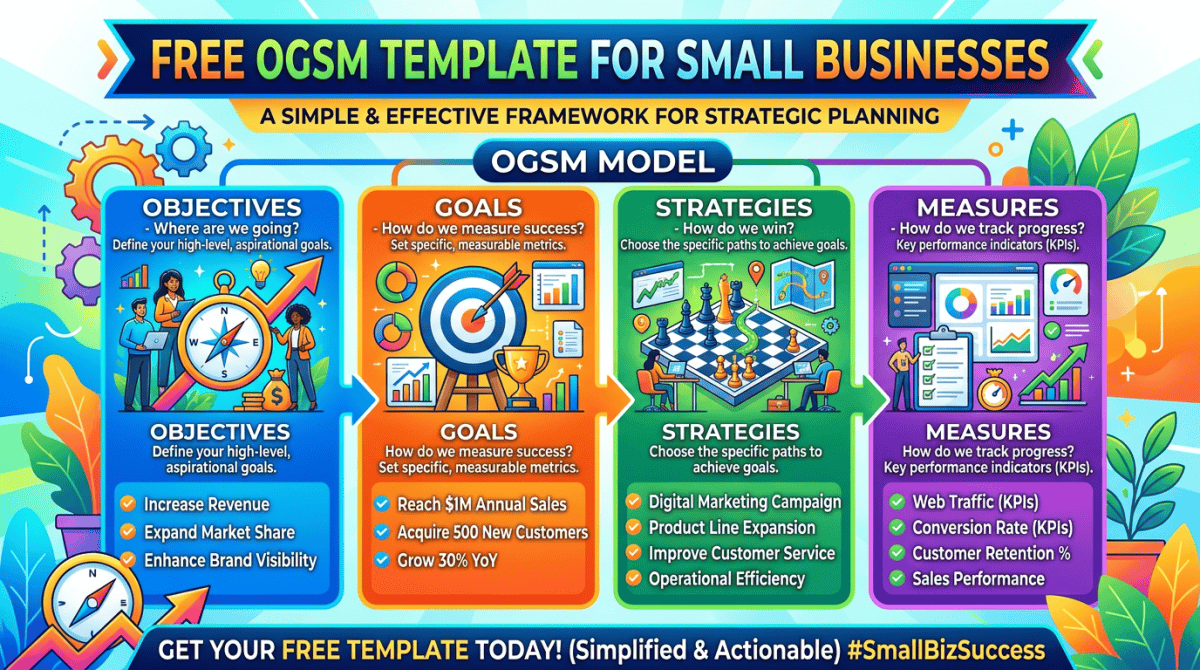
If you want a free OGSM template, this is the right page.
This page gives you a free one-page OGSM template in three formats — Google Sheets, Excel, and Word — ready to download and use today. Below the downloads you will find a section-by-section guide to filling in each part correctly, a completed example using a fictional small business, and the most common mistakes to avoid. Whether you are a CEO building your first strategic plan, a department head aligning your team to company goals, or a consultant who needs a clean working document — this template will get you started.
Everything you need is free and right here — download your preferred format below, then use the guide to make sure you fill each section correctly.
Download the Free OGSM Template
Here are the three formats. Grab whichever fits your workflow.
Google Sheets (recommended) \[Google Sheets template link] — open it in your browser, then go to File > Make a copy to save your own editable version. No account required once you have the link. Ideal for collaborative editing with a distributed team.
Excel \[Excel template download link] — download the .xlsx file and open in Microsoft Excel, LibreOffice Calc, or any compatible spreadsheet app. Best if your organization is already working inside the Microsoft 365 ecosystem.
Word / Printable \[Word template download link] — a clean .docx version if you prefer working in Word or want a printable OGSM template you can fill in by hand during a planning workshop or leadership off-site.
All three are single-page templates. The OGSM is designed to live on one page — if your strategy is spilling onto three pages, that is a planning problem, not a formatting one.
What Is an OGSM? (Quick Primer)
If you landed here knowing exactly what an OGSM is, skip ahead to the how-to section below. If you’re new to the framework, here’s the short version.
OGSM stands for Objectives, Goals, Strategies, Measures. It’s a one-page strategic planning tool originally developed at Procter & Gamble and now used widely across industries — from multinationals to small owner-managed businesses. The idea is simple: get your entire strategy on a single page, with each element visibly connected to the next.
- Objective — the qualitative ambition: where are you headed and why?
- Goals — the quantitative targets: how will you know you’ve arrived?
- Strategies — the choices: what will you do (and not do) to get there?
- Measures — the dashboard: how will you track whether the strategies are working?
The template forces these four elements to be visible at once. A strategy that fits on one page and shows how each piece connects is more useful than a 40-slide deck that no one opens after the away-day. I’ve been making that case for a long time, and the argument only gets easier with every strategy presentation I sit through that didn’t need to exist.
If you want the full background on how OGSM works and when to use it, read our \[complete OGSM guide on rockyourstrategy.com] before you start filling in the template.
How to Use the OGSM Template: Section by Section
Most people download the template, stare at it for ten minutes, then write something vague in the Objective box and abandon the rest. Here’s how to fill in each section properly.
Objective
The Objective is a single qualitative statement of where you want your organization to be — typically looking three to five years ahead. It should be inspiring enough to give people a genuine direction and specific enough to exclude things you’re not trying to do.
Apply this test: could a direct competitor legitimately claim the same Objective? If yes, yours is too generic. “Be the leading provider of innovative solutions” fails the test. “Become the most trusted financial planning firm for UK freelancers under 40” passes it. Specificity is not the enemy of ambition — vagueness is.
In the template: write one sentence. Two at most. Not a paragraph, not a mission statement, not a list.
Goals
Goals are the measurable outcomes that define what achieving the Objective actually looks like. Think of them as the scoreboard. They need to be quantified, time-bound, and directly connected to the Objective — not a recycled collection of KPIs from last year’s performance review.
Aim for three to five Goals. More than that and you are not prioritizing — you are listing things you hope happen. Fewer than three often means you haven’t been concrete enough about what success actually looks like.
Format them clearly: \[Metric] + \[Direction] + \[Target] + \[by When]. For example:
- Revenue reaches £2M by December 2027
- Net Promoter Score above 50 by end of Year 2
- Client retention rate of 85% or higher by Year 1
In the template: list each Goal in the Goals row. Include the current baseline figure alongside the target where possible — it makes quarterly reviews considerably less contentious.
Strategies
Strategies are the choices you’re making about how you’ll achieve the Goals. This is where most teams struggle, because real strategic choices require genuine prioritization — and prioritization means saying no to things people are attached to.
A Strategy is not a task, not a project, and not a values statement. “We will build genuine relationships with our clients” is not a Strategy — it’s a sentiment. “We will acquire 80% of new clients through professional referrals and invest nothing in outbound cold calling” is a Strategy. It tells you what you’re doing and, implicitly, what you’re not doing.
Each Strategy should map to at least one Goal. If a Strategy doesn’t connect to a Goal, either it doesn’t belong in your OGSM, or your Goals are incomplete. Either way, that disconnect is a useful signal worth investigating before you proceed.
In the template: write each Strategy as a short, declarative sentence. Use the mapping column to show which Goal each Strategy serves. Those connections are half the point of the whole exercise.
Measures
Measures are how you track whether your Strategies are working — not whether the Goals are being hit (that’s what Goals are for), but whether the strategic work is on track.
If one of your Strategies is “grow exclusively through referrals,” your Measure might be “number of referral conversations initiated per month.” If a Strategy is “launch a premium service tier by Q3,” your Measure tracks whether the launch is on schedule and what early adoption looks like in the first 90 days.
This distinction matters because Goals are lagging indicators — they tell you after the fact. Measures are leading indicators — they give you enough warning to correct course before a Goal is missed. Getting this right is one of the trickier parts of building a strong OGSM. For a detailed guide, see our \[guide to OGSM measures on rockyourstrategy.com].
In the template: link each Measure to the Strategy it tracks. Set a target threshold so you can tell at a glance whether you’re on track, behind, or ahead.
Completed OGSM Template Example
Here’s a filled-in OGSM for a fictional business: Norwood & Clark, an independent accountancy firm with eight staff based in the East Midlands, planning for a three-year transformation.
Objective Become the most trusted accountancy partner for owner-managed businesses in the East Midlands, recognized for proactive strategic advice rather than reactive compliance work.
Goals
| GoalCurrentTargetByAnnual recurring revenue£680K£1.2MDec 2027% of revenue from advisory services25%70%Year 3Client Net Promoter Score4260+End of Year 2Staff attrition rate18%Below 10%Year 1 onwards |
|---|
Strategies
Reposition from compliance-led to advisory-led — change how we talk about our work, how we price it, and what we lead with in new client conversations.
Build a referral network with 20 local solicitors, IFAs, and business coaches who regularly interact with our target client profile.
Invest in advisory capability: one senior accountant completes CFO advisory training per year.
Standardize client onboarding and quarterly business reviews so delivery quality is consistent regardless of which team member leads the engagement.
Measures
| MeasureStrategyTargetFrequency% revenue from advisory work170% by Year 3MonthlyNew client source: referral vs. other260% referral by Year 2MonthlyAdvisory training completions31 per yearAnnualQuarterly reviews completed on time4100%QuarterlyNet Promoter ScoreAll60+Bi-annual |
|---|
Notice what makes this OGSM work. The Objective is geographically specific and names a clear positioning — proactive advice, not reactive compliance. The Goals include baselines so progress is measurable from day one. Each Strategy is a genuine directional choice, not a vague aspiration. And the Measures map to specific Strategies rather than being bolted on as an afterthought.
That is the standard to aim for. Use this example as a reference while you fill in your own template.
Common OGSM Template Mistakes
Even with a template in front of them, most teams fall into the same traps. Watch for these:
- Confusing Goals with Measures. Revenue growth is a Goal. Monthly referral conversations initiated is a Measure. Conflating the two collapses the internal logic of the OGSM. Goals define success at the top; Measures track the strategic work that gets you there.
- Writing Strategies that are actually tasks. “Launch new website by Q2” belongs in a project plan. A Strategy is a sustained directional choice — something that shapes how you operate over months and years, not a one-off deliverable.
- Too many items in every section. If you have eight Strategies, you have zero real priorities. Three focused Strategies executed well will outperform eight scattered ones every time. The template has space for more — resist filling it.
- No named owners. Once the OGSM is agreed, assign a named individual to each Strategy and each Measure. Without ownership, the document sits in a shared folder and gathers dust until the next planning cycle.
For a broader look at what goes wrong when organizations try to execute strategy, our \[OGSM mistakes article on rockyourstrategy.com] covers the full list.
Running Your First OGSM Quarterly Review
The template is where strategy starts. The quarterly review is where it either lives or dies.
Every 90 days, pull the OGSM out and work through each Measure. What is the current status — on track, behind, or ahead? For any Measure that is amber or red, the question is simple: is the Strategy not working, or is the Strategy not being executed? Those require different responses. If the Strategy is wrong, update the OGSM. If the execution is lagging, that is an operational conversation, not a strategic one.
Keep the review meeting to 60–90 minutes. The OGSM is one page — you don’t need a half-day workshop to review it. Bring the numbers, name the problems, make decisions, and move on.
When to Upgrade to a Premium Template
The free template gives you everything you need to build a solid OGSM from scratch. But there are situations where a paid version earns its keep quickly.
You’re facilitating a leadership team. The free template is a working document. If you’re running an OGSM workshop with a senior leadership team, a structured workbook — with separate tabs for each planning stage, prompts built into the cells, and a facilitation guide — keeps the session from going sideways.
You want quarterly reviews built in. A premium OGSM workbook includes review tabs with traffic-light status tracking, structured commentary fields, and version history. The free version leaves all of that to you — which works for one review cycle and becomes increasingly painful by the third.
You’re presenting upward. If the OGSM needs to go to a parent company, board, or investors, it needs to look polished. The premium templates are designed to present cleanly without requiring you to spend an afternoon reformatting a spreadsheet.
You can find the full range of premium OGSM templates — including single-page versions, full planning workbooks, and facilitation packs — in \[our template shop on rockyourstrategy.com].
Keep It to One Page
Before you close this tab: keep it to one page. That’s not a design preference — it’s the discipline the OGSM framework is built on. A strategy that fits on a single page is a strategy you’ve actually made choices about. The moment it creeps to two pages, you’re collecting options rather than setting direction.
Print the completed template. Stick it somewhere the team can see it. Review it every quarter. If the OGSM still makes sense six months from now, you’ve built something worth building.
Rock on.
Leave a Comment