How do you get a quick but profound assessment of the situation of your business? Conduct a SWOT analysis!
SWOT stands for strengths, weaknesses, opportunities, and threats and evaluates the situation of a business, project or organization. Conducting a SWOT analysis is a 5-step process:
- Decide the objective of your analysis
- Identify strengths, weaknesses, opportunities, and threats
- Challenge and prioritize your results
- Make a plan
- Take action
The SWOT analysis is a simple but very powerful tool. You can use it stand alone or as part of a strategy process. Read on for a step-by-step guide how to create an impactful SWOT analysis and download our free templates and examples to help you get started.
How to do SWOT Analysis?
The SWOT analysis is an intimate view of your business, project, or venture.
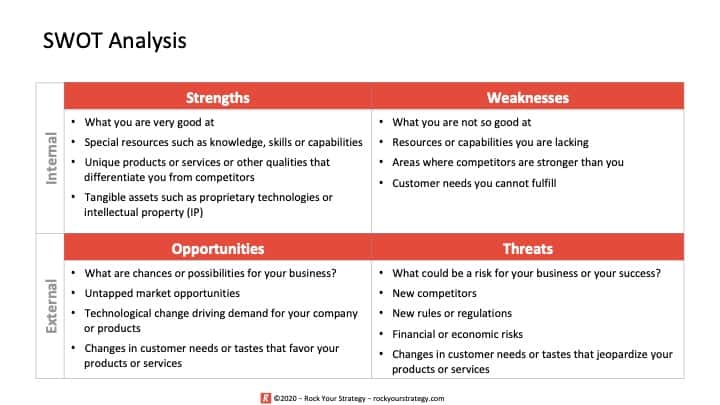
Strengths and weaknesses are internal to your business. This means they describe the business itself or the internal situation. These are factors, such as products, services, capabilities, skills, knowledge, etc. that you are good at or not so good at. You can directly influence these internal factors.
Opportunities and threats are external to your business, which means these are factors outside of your business that you are exposed to. These can be market trends, the political, economic, socio-cultural, technological, environmental, legal/regulatory environments (PESTEL), or of course competitors, suppliers, and customers. Usually, you cannot directly influence external factors.
The SWOT analysis is often conducted as part of a strategic review process. But it can also help to obtain a quick overview of the health of a project or the prospects of a new venture. It can be conducted for the entire business or on a product or team level.
The SWOT is typically depicted in a 2×2 matrix that looks as follows.
| Strengths | Weaknesses |
| – … – … – … | – … – … – … |
| Opportunities | Threats |
| – … – … – … | – … – … – … |
In order to conduct a SWOT analysis, take the following 5 steps.
1. Decide the objective of your analysis
What is the purpose of your SWOT analysis? Is this SWOT for your entire business or for a subset such as a product, division or team? Are you analyzing your SWOT as part of a strategic review or for another reason?
Be clear and deliberate about why you conduct the analysis before you begin. This is often overlooked and may cause confusion during the analysis or ambiguous results. Your purpose gives context to the analysis and allows you to be more specific in your assessment.
2. Identify strengths, weaknesses, opportunities, and threats
Conduct a brainstorm about each of the four elements of the SWOT. List down all the aspects you can come up with. The following questions may help. Your answers can be qualitative or quantitative but try to be as specific as you can.
Strengths
- What are you particularly good at?
- What makes you and your business unique in the marketplace?
- What are you distinctively better at than your competition?
- What special resources such as knowledge, skills or competencies do you have?
- What tangible assets give you an advantage such as proprietary technologies, intellectual property?
- What do customers love about you? Why do customers buy from you?
Weaknesses
- What are you less good at?
- What resources, knowledge or skills are you lacking?
- What are your competitors better at than you?
- What complaints or feedback do customers have about your products or services?
- What processes or procedures need improvement?
Opportunities
- What chances or possibilities exist for your business?
- What market trends could positively influence your business?
- Are there technological trends that could drive demand for your products or services?
- Are there customers or sales channels you are not yet fully exploring?
Threats
- What could be risks for your business or for your success?
- Are there emerging competitors or alternative products or services?
- What changes in customer needs or tastes could jeopardize demand for your products or services
- Are there supply side risks to availability of raw materials or services you source?
- Are there changes to rules or regulations which could affect your business?
- What are financial or economic risks you face?
As you go through each of the four elements in turn, be brutally honest with yourself. Don’t sugarcoat the weaknesses or undermine your strengths. Consider using a PESTEL analysis to complement your external assessment. Be realistic and focus on getting to the truth.
3. Challenge and prioritize your results
After you have gone through each element in turn, take a step back and review your list of strengths, weaknesses, opportunities and threats.
For each element, highlight the top 3 to maximum 5 identified aspects. If you can, work on this in a team. It really helps to review your list from different angles and debate your outcome. Challenge yourself to identify really only the top 3-5 aspects relevant to the purpose of your SWOT analysis. Then transfer these prioritized items into the 2 x 2 SWOT matrix.
Why only the top 3-5 aspects? In my experience, it really helps to focus your attention on the top results. Think about it. If a strength doesn’t make it into your top 5, is it really a key strength? If a threat doesn’t make it into your top 5, should you really devote significant resources to it?
4. Make a plan
When the SWOT analysis is complete, turn your insights into a plan of action. In order to do this, conduct a crossover analysis, plotting your strengths and weaknesses against your opportunities and threats. Formulate strategies by asking yourself the following questions:
- What strengths can you deploy to take advantage of your opportunities?
- What strengths can you use to mitigate or eliminate your threats?
- What weaknesses do you need to improve to benefit from an opportunity?
- What weaknesses do you need to act on to overcome a threat?
Write down your strategies in a clear action plan including caretakers and timeline. Discuss and align the plan with your team. Ensure that everyone is clear about the plan’s objectives and actions and everyone’s roles and responsibilities.
Go back to your original purpose of the SWOT analysis and confirm that all objectives are met.
5. Take action
Now take action and execute your plan! Set up regular reviews at which you check on progress of your plan to make sure you are on track to achieving your objective and goals.
What to do with SWOT analysis results?
Once the SWOT analysis is completed, formulate strategies to act on the insights gained. In order to do this, conduct a crossover analysis, plotting your strengths and weaknesses against your opportunities and threats.
This may look as follows.
| Opportunities | Threats | |
| Strengths | Strength-Opportunity StrategiesWhat strengths help you take advantage of the identified opportunities? | Strength-Threat StrategiesWhat strengths help you overcome the identified threats? |
| Weaknesses | Weakness-Opportunity StrategiesWhat weaknesses to improve to benefit from opportunities? What opportunities might help you overcome a weakness? | Weakness-Threat StrategiesWhat weaknesses to improve to minimize a threat? |
Write out 2-3 strategies for each crossover pair for a total of 8-12 strategies. Then prioritize your strategies based on your objective and goals. Aim to identify the 3-5 strategies that optimize your chance of success or with the best return on investment.
Then turn your strategies into an action plan with clear initiatives, caretakers, and timeline. Conduct regular reviews to make sure you are on track to achieving your objective and goals.
Why conduct a SWOT analysis?
The SWOT analysis is a simple but powerful tool to assess the internal and external situation of your business, project or organization.
It can be conducted quickly and easily without creating major costs or devoting significant resources. The SWOT analysis can be performed alone or in a team. It can be applied at various levels of an organization: to the business as a whole or to individual teams or products.
The results of a SWOT analysis can immediately be acted on. Or they can be integrated into a larger business strategy process.
Should small businesses use SWOT analysis?
The SWOT analysis is a simple but powerful tool to assess the situation of your business. As it can be conducted quickly and easily without creating major costs to the business, it is a great tool for small businesses to evaluate their strengths, weaknesses, opportunities, and threats.
All you really need is a pen and paper to follow the simple 5-step process. Or download one of our free templates to help you get started!
SWOT template
Begin your SWOT analysis by downloading our free SWOT analysis template.
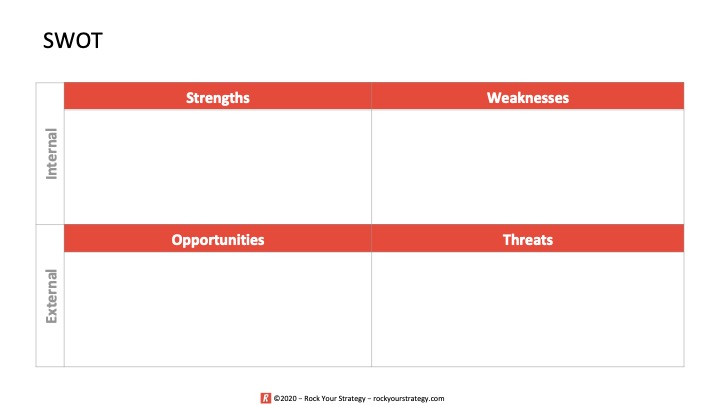
Make sure to check out our resource page where you can find many other useful tools and templates to help you win at strategy and at business.
SWOT examples
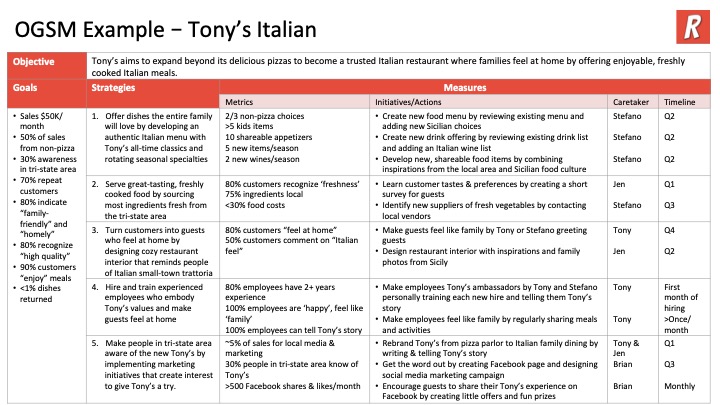
In the following are two examples of SWOT analyses applied in practice. The first is a B2C example of Tony’s Italian restaurant. The second is a B2B example of Florian’s Fastener Solutions. Both of these examples are fictional to protect confidential information but the insights and learning can be real.
Tony’s Italian SWOT analysis
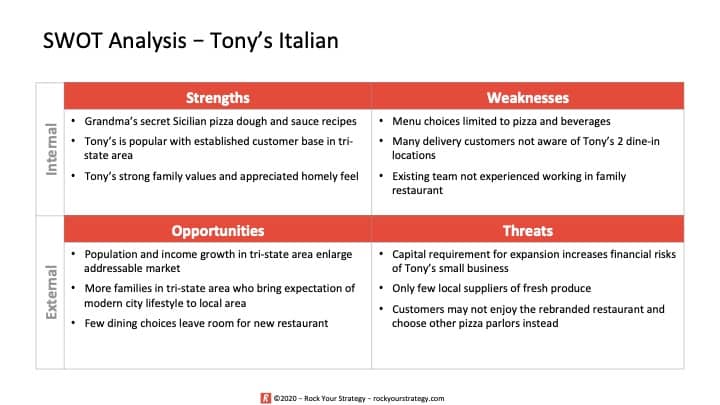
Read more about the OGSM Example of Tony’s Italian by clicking here.
Florian’s Fastener Solutions SWOT analysis
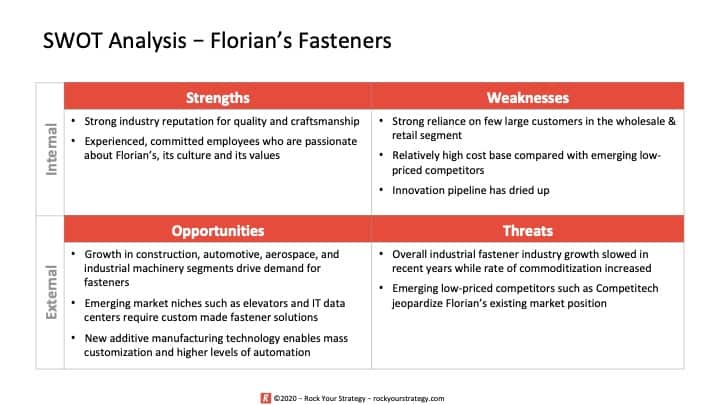
Read more about the OGSM Example of Florian’s Fastener Solutions by clicking here.
What to do next?
If you’re researching SWOT analysis to help create a strategy for your business, project or venture, make sure to check out our other articles on strategic planning.
Our resource page with examples, tools & templates, workshop materials, book recommendations and glossary may also be of value to you.
If you have any questions or comments, why not leave us a comment below or sign up to our free newsletter here. We’d love to hear from you. Rock on!