Most HR strategies live in a slide deck that no one else in the business reads, references, or holds the HR function accountable to.
OGSM for HR works by translating your company’s Strategies into people-function Goals and Measures. Instead of a standalone HR plan that runs parallel to the business, you build an HR OGSM that cascades directly from the corporate OGSM — so every people initiative traces back to a strategic bet the organisation has already made.
This guide shows you how to build an HR OGSM that cascades directly from the corporate plan — with worked Goal examples, HR-specific Strategies, and a section on how to use it in budget and leadership conversations.
HR strategy has a credibility problem. Not because HR leaders lack strategic thinking — it’s because the formats HR typically uses to communicate strategy (the 40-slide annual deck, the values posters, the competency framework) don’t connect to how the rest of the business plans. The CFO has a financial plan. The CPO has a product roadmap. The CHRO has a presentation.
OGSM changes that. A one-page HR OGSM, built from the same framework the board uses for corporate strategy, is something every executive in the room can read, challenge, and hold the HR function accountable to. That shift — from HR as a support function with a deck to HR as a strategic function with a plan — is what most people-leaders are actually trying to achieve.
Why Does HR Need a Strategy Framework at All?
The honest answer: because people decisions are strategic decisions, and right now most organisations don’t treat them that way.
Think about what’s actually inside an HR strategy: hiring plans, capability development, culture, performance management, compensation. These aren’t administrative choices — they’re the mechanisms by which a company builds the capacity to execute its strategy. Hire the wrong profiles and your growth plan stalls. Let attrition go unmanaged and your institutional knowledge walks out the door.
The problem is that annual HR decks tend to list activities — programmes, initiatives, policies to update — rather than outcomes. The result is that HR leadership spends a lot of time defending budget for things that are hard to connect to business results.
OGSM solves this by forcing the HR function to answer the same questions every other part of the business answers: What are we trying to achieve? How will we know if we’ve achieved it? What are we doing to get there? Expressed in a format that sits comfortably next to the corporate plan, not in a separate binder that only gets opened at the annual people review.
I’ve seen HR teams go from defending headcount in budget reviews to setting the strategic agenda, simply by putting a one-page OGSM in front of the leadership team. The framework doesn’t change what HR does — it changes how clearly HR can show why it matters.
How Do You Build an HR OGSM?
The process follows the same four-layer logic as any OGSM, but each layer is interpreted through the lens of the people function. If your leadership team needs a shared grounding in the framework first, the full OGSM guide is the right starting point — then come back here for the HR-specific application.
Step 1: Derive your HR Objective from the company Objective.
Your HR Objective should be a direct expression of what the HR function needs to achieve for the company to hit its corporate Objective. If the company Objective is “become the most responsive B2B software provider in the UK mid-market,” the HR Objective might be: “Build the hiring engine and talent capability to power our scale — attracting, developing, and retaining the people the company needs to win.”
The Objective is qualitative and aspirational, but it should be specific to your planning horizon. “Attract and retain great people” is not an Objective — it’s a job description. In my experience, the most common mistake at this stage is writing an HR Objective that sounds inspirational but doesn’t trace back to anything specific in the corporate plan.
Step 2: Set Goals in people metrics.
Goals in an HR OGSM are the quantified outcomes you’re committing to by year-end. They should be directly measurable and clearly linked to business impact. Good HR Goals typically come from three categories:
Retention and engagement: attrition rate, employee Net Promoter Score (eNPS), regrettable loss rate
Capability: internal promotion rate, learning and development hours, performance distribution
Aim for three to five Goals. Too many and the function loses focus. Too few and you’re probably not capturing the full scope of what’s at stake.
Step 3: Define Strategies as people programmes and directional choices.
HR Strategies are the choices you’re making about how you’ll move the needle on your Goals. They should be specific enough to brief a programme against, and they should map back to the company Strategies — each HR Strategy is the people-function response to a business-level strategic bet.
For a company scaling aggressively into a new market, an HR Strategy might be: “Build a structured talent acquisition capability, shifting from reactive hiring to a proactive talent pipeline in our three key skill families.” That’s a directional choice that implies resourcing, tooling, and process decisions.
Step 4: Set Measures as the KPIs you’ll track to know if the Strategies are working.
Measures in an HR OGSM are the leading indicators — the data points that tell you whether your Strategies are executing before you can see it in the Goal outcomes. If your Strategy is building a talent pipeline, the Measure isn’t “time-to-hire” (that’s the Goal) — it’s “number of qualified candidates in active pipeline by role family” or “percentage of hires from proactive pipeline vs. reactive posting.”
What Do Good HR OGSM Measures Look Like?
This is where many HR OGSMs stall — not for lack of data, but for lack of agreed benchmarks. Here are five HR KPIs that work well as OGSM Measures, with the ranges I’d treat as credible targets for a scaling organisation.
Time-to-hire: ≤21 days. Measured from job approval to accepted offer. Anything above 30 days in a competitive talent market is costing you candidates. The benchmark tightens for senior roles, but 21 days is a solid target for the majority of hires.
Employee Net Promoter Score (eNPS): ≥30. Measured quarterly via a simple survey (“How likely are you to recommend this company as a place to work? 0–10”). A score of 30 puts you in the “good” range for most industries. Above 50 is excellent. Below 0 is a serious retention risk.
Internal promotion rate: ≥25%. The percentage of open roles filled by internal candidates. Below 20% is a signal that either your development programmes aren’t working or your hiring managers don’t trust internal talent. Above 40% may indicate you’re not bringing in enough external perspective.
L&D hours per employee per year: ≥20 hours. Twenty hours is roughly one learning day per quarter — achievable without dedicated learning infrastructure. Below 10 hours suggests learning is something the organisation talks about but doesn’t fund in practice.
Retention rate: ≥88%. Equivalently, voluntary attrition below 12%. Above 15% in most sectors becomes structurally expensive — replacement costs typically run 50–150% of salary when you factor in hiring, onboarding, and lost productivity.
These are starting points, not universal standards. Industry, company stage, and role mix all affect what “good” looks like in your context. But having explicit targets agreed at the start of the year changes the nature of the people review from a discussion about activity to a review of performance against plan.
How Do You Connect Your HR OGSM to the Company OGSM?
The connection is through cascade logic: every HR Strategy should trace back to a company Strategy. If you can’t make that link, the HR Strategy either doesn’t belong in the current year’s plan, or you need to go back to the corporate OGSM and ask whether it’s capturing the right things.
In practice, the cascade works like this. The corporate OGSM includes a Strategy: “Scale our commercial team to triple revenue in the DACH region.” That Strategy implies a set of people requirements: specific hiring profiles, a different onboarding model, possibly new compensation structures for a European market. The HR OGSM captures those requirements as HR Strategies and Goals — not in a generic way, but in direct response to the specific business bet.
This is the mechanism that gives HR strategy its credibility. When the CFO asks “why are we investing in this capability development programme?”, the answer isn’t “because L&D is important” — it’s “because Strategy 2 in the corporate OGSM requires us to build the product capability our current team doesn’t have, and this programme is the specific bet we’re making to close that gap.” That’s a different conversation.
For a deeper look at how cascade logic works across the whole organisation, the OGSM cascade guide is worth reading before you build the first draft of your HR OGSM. And if you want a template to work from, the OGSM template includes a format that translates directly to HR use.
The people function doesn’t need a separate strategy process. It needs to be built into the same one everyone else is using.
There’s a version of OGSM that works before product-market fit — and it fits on a whiteboard.
Most strategic frameworks were built for organisations that already know what they’re doing. OGSM is no exception — it was designed for Procter & Gamble, not for a two-person team pivoting every 90 days. But that doesn’t mean it’s useless before you hit product-market fit. It means you have to strip it back.
This post walks through what pre-PMF OGSM looks like in practice, what to cut, and when you should forget OGSM entirely.
Can OGSM Work Before You Have Product-Market Fit?
Yes — with significant caveats.
OGSM’s strength is alignment. It forces a team to agree on one Objective, a small number of Goals that define what success looks like, a handful of Strategies that describe how you’ll get there, and Measures that tell you whether your Strategies are working.
At the pre-PMF stage, the alignment problem is real. Co-founders argue about whether to prioritise the enterprise deal or the self-serve funnel. The first engineer builds for scale while the founders are still testing whether anyone wants the product. A one-page strategic document can cut through that noise faster than any amount of Slack discussion.
But here’s where it gets complicated. In a mature organisation, every element of an OGSM is grounded in data — historical performance, market research, validated positioning. Pre-PMF, you don’t have that. Your Objective, Goals, and Strategies are all hypotheses. Nothing is validated. The market may tell you in month three that your core assumption was wrong, and you’ll need to rewrite the whole thing.
That’s fine. The OGSM is not a contract — it’s a shared bet. The value is the alignment it creates now, not the accuracy it guarantees later. But to get that value without the overhead, your pre-PMF OGSM needs to feel less like a three-year plan and more like a focused hypothesis for the next six months. Horizon matters enormously here. Cut it to 90–180 days maximum and commit to reviewing it at the end of that window.
What Does a Pre-PMF OGSM Actually Look Like?
Here’s a worked example for a pre-revenue B2B SaaS startup building a compliance automation tool for SMEs.
Objective: Become the compliance automation tool that professional services SMEs trust to manage their audit trails.
Goals:
Achieve 10 paying customers (minimum £99/month) by end of month five
Reach NPS > 50 among pilot users after 60 days of use
Strategies:
Direct outreach to compliance managers in legal and accounting firms via founder-led LinkedIn outreach — 20 targeted messages per founder per week, no automation
Ship fortnightly based on pilot feedback — biweekly releases tied directly to the highest-friction moments identified in customer interviews
Run a 30-day free pilot with white-glove onboarding — reduce time-to-value so pilots convert before fatigue sets in
Measures:
Outreach response rate (target: ≥15%)
Pilot-to-paid conversion rate (target: ≥40%)
Weekly active users among pilot cohort (target: ≥70%)
Notice what this OGSM is doing — and what it isn’t.
The Objective is qualitative and directional. It describes the position you want to own in your market, not a number you want to hit by a date. That logic belongs in Goals. Goals are where the measurable commitments live — 10 customers, NPS above 50. They tell you whether you’re on track to reach the Objective.
Each Strategy is a real bet: a specific channel, a specific cadence, a specific go-to-market mechanism. There’s no hedging. If you chose LinkedIn outreach, you chose it over cold email, paid ads, and inbound SEO. That trade-off is the strategy. If every option still looks equally valid, you haven’t made a decision yet.
The Measures are leading indicators, not lagging ones. Outreach response rate tells you whether your messaging is resonating before you know whether it converts. Pilot-to-paid conversion tells you whether the product earns its price before you’ve closed enough deals to know if the model works. That’s the point — Measures should give you signal early enough to change course.
That’s it. One Objective. Two Goals. Three Strategies. A handful of Measures. It fits on one page. It could fit on a whiteboard. Nothing here requires a planning retreat or a strategy consultant — just a shared answer to the question: what are we actually trying to prove, and how?
What Should You Strip Out of a Pre-PMF OGSM?
Cascading Measures. In a full OGSM implementation, every Strategy has its own Measure set, and you may cascade further down into team or function-level Measures. Skip this entirely. You don’t have enough stable KPIs yet, and you’ll spend more time debating which metric belongs to which Strategy than you will running experiments. At this stage, pick three to five Measures that collectively tell you whether the Objective is on track — and leave it there. (For reference on what strong Measures look like at a later stage, see 7 OGSM Mistakes That Kill Your Strategy — the most common one is Measures that are outputs, not leading indicators.)
More than three Strategies. If you have five or six Strategies pre-PMF, you’re either hedging or you haven’t made a real bet yet. Three Strategies is a hard cap. Preferably two. Each Strategy should represent a real trade-off — something you’re choosing to do instead of something else. If every option looks equally valid, you haven’t done the hard prioritisation work. Pick the bets with the most signal-per-effort and cut the rest.
More than three Goals. Your Goals define what success looks like. Two to three Goals forces you to get specific about what actually matters in the next 90–180 days. More than that and you’re writing a wish list, not a strategy. If you have five Goals and they’re all “critical,” none of them are. Ruthlessly narrow it down to the two outcomes that would genuinely change what you do next.
Long time horizons. Don’t write a three-year OGSM at the pre-PMF stage. You don’t have the data to justify it, and it will be out of date before the ink is dry. Stick to 90–180 days. Review it at the end of that period. If your hypothesis has changed — and it probably will — update your Objective and reset.
How Do You Build Your First Pre-PMF OGSM?
You don’t need a facilitated off-site. You need a half-day session with your co-founders and a shared document. Here’s a simple sequence that works.
Start with the Objective. Before anything else, spend 30–45 minutes on the Objective alone. Write it individually, then compare. The Objective should describe the strategic position you’re trying to own — qualitative, directional, no dates. If you and your co-founder write different Objectives, that’s the most important conversation you’ll have all quarter. Don’t paper over it by merging both into a long sentence. Decide.
Draft the Goals together. Once the Objective is agreed, Goals follow relatively quickly. Goals answer: what does success look like in numbers, by when? Aim for two Goals maximum at this stage. If you find yourself wanting a third, ask whether it’s really a Measure in disguise.
Challenge every Strategy. For each proposed Strategy, ask: what is this instead of? If you can’t answer that, it’s not a Strategy — it’s a preference. A genuine Strategy has an opportunity cost. Write the alternative you rejected next to each Strategy you kept, and make sure the team understands why you chose this one.
Set your Measures last. Measures are often written first because they feel concrete and comfortable. Write them last. Start from your Strategies and ask: what would tell us, within 30 days, whether this Strategy is working? The answer to that question is your Measure. If you can’t answer it, your Strategy isn’t specific enough yet.
The whole session should take three to four hours maximum. If it’s taking longer, you’re probably arguing about the Objective — which means you skipped the most important step.
What If You Don’t Know Your Objective Yet?
This is the real test.
OGSM’s entire structure hangs on the Objective. Everything else — Goals, Strategies, Measures — is in service of that one sentence. If you can’t write a clear Objective that your co-founders agree on, you’re not ready for OGSM yet.
And that’s not a failure. It’s useful information.
If you and your co-founder spend 45 minutes trying to write the Objective and can’t agree, you’ve just uncovered a misalignment that would have derailed any planning process. The OGSM template has done its job without you completing it.
Common pre-PMF blockers to a clear Objective:
Disagreement about whether you’re targeting enterprises or SMEs
Uncertainty about whether you’re selling a product or a service
No shared view of the time horizon you’re planning against
An Objective that’s really a Goal (“grow to 100 customers”) rather than a directional statement (“become the default compliance tool for UK professional services firms”)
That last one trips up a lot of founding teams. An Objective describes a position — where you want to be in the market, and for whom. A Goal describes a result — what you will achieve by a specific date. If your Objective has a number in it, it’s probably a Goal. For worked examples of how to write a strong OGSM Objective at different stages, see OGSM Objectives Examples.
If you’re still stuck, don’t force the OGSM. Work on the Objective first — even if that means a half-day offsite with your co-founders before you open the template.
What’s the Alternative at the Very Earliest Stage?
If your team is fewer than five people, you’ve spoken to fewer than twenty potential customers, and you’re still testing your core value hypothesis — you might not need OGSM at all yet.
Two simpler tools worth trying first:
A one-pager. One sentence on the problem you’re solving, one sentence on the customer you’re solving it for, one sentence on your hypothesis about the solution, and three bullet points on what you’ll do in the next 30 days to test it. Fits in Notion. Can be updated in five minutes. Does not require a planning process.
A hypothesis map. A simple visual structure: your assumption (customers in segment X will pay for Y to solve Z), the experiments you’re running to test it, and what you’ll conclude from each outcome. This is close enough to strategic planning for the very early stage without the overhead of a full OGSM structure.
Neither of these replaces OGSM. They’re pre-OGSM — the planning work you do before you have enough signal to build a real strategy. Think of them as the foundation you lay so that, when you do write your first OGSM, it’s grounded in real customer understanding rather than founder assumptions.
When Should You Graduate to a Full OGSM?
Watch for three signals:
1. A validated Objective. You know who your customer is, what job they’re hiring your product to do, and you have paying customers (not just pilots) who confirm it. Your Objective is no longer a hypothesis — it’s a direction the business has already started moving in.
2. Stable KPIs. Your core metrics aren’t changing every sprint. You’ve settled on the two or three numbers that actually tell you whether the business is working — churn, CAC payback, NRR, whatever fits your model. Stable Measures are the prerequisite for a meaningful Measures cascade. If your definition of a “good week” changes month to month, you’re not there yet.
3. A team that needs alignment. If it’s two co-founders and a contractor, informal alignment is probably fine. Once you’re hiring fast enough that people are making decisions without full context, OGSM starts earning its overhead. The first sign is usually when you realise two team members have conflicting assumptions about the strategy — and neither of them is wrong, they just never compared notes.
Once you hit those three signals, you’re ready for the full version — Goals that cascade into team-level goals, Measures for each Strategy, and a quarterly planning process that involves the whole leadership team. For a detailed guide to what that looks like at the 20–100 person stage, see Is OGSM Right for Your Scale-Up?.
OGSM is a focused tool. Used at the pre-PMF stage, it works best when it’s small, honest about uncertainty, and reviewed often. The goal isn’t to have a perfect strategy. It’s to have a shared bet — one that everyone on the founding team can recite from memory and hold each other accountable to.
The OGSM template looks deceptively simple — four boxes — and most teams fill it in wrong in exactly the same predictable ways.
The most common OGSM mistakes aren’t about formatting — they’re about thinking. Most teams fill in the template correctly but miss the logic underneath: one clear Objective, a single measurable Goal, Strategies that genuinely guide decisions, and Measures that tell you whether the strategy is working. Fix the thinking, and the template takes care of itself.
If you’ve read our complete OGSM guide, you already know what a well-built OGSM looks like. But knowing the framework and executing it cleanly are two very different things. I’ve reviewed hundreds of OGSMs over the years — from scrappy startups to global multinationals — and the same mistakes show up again and again. Here are the seven I see most often, and exactly how to fix them.
Are you confusing Strategies with Goals?
This is the mistake that derails more OGSM sessions than anything else. Teams write their Strategies as if they’re Goals — big aspirational statements with no clear direction — or they write their Goal as if it’s a Strategy, detailing how they’ll achieve it before they’ve defined what success looks like.
Here’s the distinction in plain English: your Goal is the specific, quantifiable outcome you’re aiming for this year. Your Strategies are the few critical choices you’re making about how to get there.
“Grow revenue by 20%” is a Goal. “Focus exclusively on enterprise accounts in financial services” is a Strategy. “Launch a digital marketing programme” is not a Strategy — it’s a tactic pretending to be one (more on that shortly).
If your Strategy could have been written by any company in your industry, it’s not a strategy. It needs to reflect a genuine choice — one that implies you’re not doing something else.
Are your Measures tracking activity instead of outcomes?
This one is subtle and absolutely kills the usefulness of your OGSM.
Activity metrics tell you what your team did. Outcome metrics tell you whether it worked. “Number of customer meetings held” is activity. “Pipeline value generated from new customer meetings” is outcome. “Blog posts published per month” is activity. “Organic traffic from target keyword cluster” is outcome.
I see teams build Measures columns full of activity metrics and then wonder why their OGSM doesn’t feel connected to real performance. It’s because they’re measuring effort, not impact.
The fix is simple but requires honesty: for every Measure on your OGSM, ask “could we hit this number while the strategy completely fails?” If yes, it’s an activity metric. Find the outcome it’s supposed to drive and measure that instead.
Your Measures should make you slightly uncomfortable — they should be the honest test of whether your Strategies are actually working.
Do you have too many Goals?
OGSM stands for Objective, Goal (singular), Strategies, Measures. Not Goals. One Goal.
I know — you have a lot of priorities. So does every leadership team I’ve ever worked with. But the discipline of committing to a single, primary Goal for the year is precisely where the OGSM earns its keep. If you have five Goals, you don’t have a strategy — you have a list.
The Goal should be the one number that tells you, at year end, whether you succeeded. Everything else — margin, customer satisfaction, team engagement — should either roll up into that Goal or show up as Measures: the guardrails that confirm the Goal was achieved the right way.
When a leadership team pushes back and says “we can’t possibly have just one Goal,” I ask them: if you could only hit one of your five goals, which would it be? That’s your Goal. The rest are constraints or secondary measures.
Are you cascading your OGSM by copying instead of translating?
One of the most powerful things about OGSM is how it cascades through an organisation. The executive team’s OGSM becomes the brief that each function uses to build their own. But there’s a mistake I see constantly: teams just copy the parent OGSM and change the header.
That’s not a cascade. That’s a photocopy.
When you cascade an OGSM, each team needs to ask: “Given our parent’s Strategies, what is our contribution? What does our team uniquely need to achieve, and what choices do we need to make to deliver it?” The team-level OGSM should look different from the company-level one — different Goal, Strategies specific to that function, Measures that track what that team can actually control.
If your sales team’s OGSM and your marketing team’s OGSM have the same Strategies, something has gone wrong. See our guide to OGSM measures for examples of how this plays out in practice at the team level.
Does each Measure have a named owner?
A Measure without an owner is a wish, not a commitment.
This is the accountability gap I see in almost every OGSM that’s struggling to get traction. The team agrees on Measures in the planning session, everyone nods, the document gets saved to the shared drive — and then three months later, nobody can tell you where those numbers stand because nobody was specifically responsible for tracking and reporting them.
Fix it in the planning session itself: before you leave the room, every Measure gets a name next to it. That person is accountable for knowing the number, updating it in your quarterly review, and flagging when it’s off track. It doesn’t mean they’re doing all the work to move the number — it means they’re the one making sure it doesn’t get forgotten.
Are you setting it and forgetting it?
This is the OGSM mistake that makes all the others worse.
An OGSM built in January and reviewed in December isn’t a strategic management tool — it’s an expensive planning exercise. The value of the OGSM is in the quarterly rhythm: stopping to ask “are our Strategies still the right ones?”, “what are our Measures telling us?”, “do we need to adapt?”
I built the discipline of quarterly OGSM reviews into every leadership team I’ve worked with, and it consistently changes the quality of conversation. Instead of “how are we doing against targets?”, the question becomes “is our strategy working?” Those are very different conversations, and the second one is where the real leadership thinking happens.
Build your quarterly review into the calendar on day one. Protect it. Use the Measures column as your agenda. If a Measure is green, move fast. If it’s red, dig into whether you have an execution problem or a strategy problem — that distinction matters enormously, and the OGSM is the tool that surfaces it.
Are your Strategies actually tactics in disguise?
Strategies that are really just big tactics — this is the OGSM common mistake that makes me wince most often.
A Strategy should answer the question: “What is the critical choice we’re making about how we compete or operate?” A tactic answers: “What specific action are we taking?” The problem is that tactics masquerade as strategies all the time.
“Invest in digital marketing” is a tactic. “Own the consideration phase of the buyer journey through content, before competitors engage” is a Strategy. “Hire three enterprise sales reps” is a tactic. “Win by relationship depth rather than price competition” is a Strategy.
The test I use: if your Strategy still leaves the question “but how will you do that?” unanswered, you’ve got a real Strategy. If it fully describes the execution, it belongs in your project plan, not your OGSM.
Getting this right takes practice. The first time most leadership teams write Strategies, they come out as tactics. That’s fine — the conversation about the difference is itself valuable. Push through it.
OGSM common mistakes are almost always thinking mistakes, not template mistakes. The format is simple. The discipline — the honest single Goal, the real Strategies, the outcome Measures, the ownership, the review cadence — that’s what separates teams who use OGSM as a living management tool from those who treat it as an annual ritual. Start with our complete OGSM guide if you’re building from scratch, and use this list as your quality check before you hit publish.
A strategy that only lives at the top of the organisation isn’t really a strategy — it’s a set of senior leadership intentions that nobody else acts on.
Cascading your OGSM means translating the company-level Objective, Goals, Strategies, and Measures into department-level OGSMs that support the parent plan. Each department keeps the same Objective, then builds its own Goals, Strategies, and Measures that contribute directly to the company’s. Done well, every team member can trace their work back to the organisation’s direction.
Here’s how to cascade without losing alignment — or your team’s sanity.
Why Cascading Matters
Most strategy failures aren’t failures of planning. They’re failures of translation. The executive team agrees on an excellent strategy, it gets presented, and then people go back to their desks and continue doing more or less what they were already doing.
The OGSM cascade solves this by creating a direct line of sight between the company’s Objective and every team’s day-to-day work. When someone in operations can look at their team’s OGSM and see exactly how it connects to the company-level Goals, strategy stops being something that happens in boardrooms and starts being something that shapes how people prioritise their week.
The Structure of a Cascade
Think of it as a tree:
Level 1 — Company OGSM: The overall Objective, Goals, Strategies, and Measures for the organisation.
Level 2 — Division or Function OGSMs: HR, Finance, Marketing, Sales, Operations each build their own OGSM. Same Objective. Different Goals and Strategies that reflect what their function contributes.
Level 3 — Team or Project OGSMs (optional): In larger organisations, individual teams or major projects may have their own sub-OGSMs cascaded from the division level.
The cascade doesn’t require all three levels. Many organisations work well with just two. What matters is that every level’s Goals visibly contribute to the level above it.
How to Build the Cascade
Step 1: Lock the Company OGSM First
Don’t start building department OGSMs until the company-level plan is finalised. This sounds obvious, but cascading before the top-level plan is locked leads to department Goals that point in slightly different directions.
The company OGSM is the fixed point. Everything below it aligns to it — not the other way around.
Step 2: Identify Each Department’s Contribution
For each department, ask: which company Goals does this function directly influence?
Marketing influences awareness, traffic, and pipeline Goals. Sales influences revenue and customer acquisition Goals. Operations may influence quality, retention, and cost Goals. HR influences capability and culture Goals that underpin almost everything else.
A department doesn’t need to contribute to every company Goal — just the ones where it genuinely has influence. A cascaded OGSM with three relevant Goals is better than one with six watered-down contributions.
Step 3: Write the Department Goals
Department Goals should be outcomes that directly feed the company-level Goals above them.
If the company Goal is “Grow annual recurring revenue from €5M to €8M by December 2026,” the Sales department Goal might be “Close €2.4M in new ARR from inbound leads by December 2026.” The Marketing department Goal might be “Generate 1,200 qualified leads for the sales team by year-end.”
Both contribute to the same company Goal. Neither duplicates the other.
Step 4: Define Department Strategies
Department Strategies are the specific choices that department will make to hit their Goals. These are usually more operational and specific than the company-level Strategies.
Company Strategy: “Invest in content marketing to drive inbound demand.”
Marketing’s Strategy (cascaded): “Publish two SEO-targeted articles per week; run monthly LinkedIn campaigns to drive article traffic; build a lead magnet to convert organic visitors.”
Step 5: Set Department Measures
Department Measures track progress on the department’s Strategies — and should be reviewed at the same cadence as company Measures (usually monthly).
The head of the department owns the department OGSM review. The company-level review draws from these department inputs.
Making the Cascade Visible
One of the most powerful things you can do with a cascade is make the connections visible — literally. In your OGSM template, cross-reference department Goals back to the company Goal they support.
For example, in the Marketing OGSM, next to each Goal, note the company Goal it feeds: “Feeds: Company Goal 2 — Revenue €8M.” This keeps the alignment explicit rather than assumed, and it gives every review a natural “so what” test: if we hit this department Goal, which company Goal moves?
Common Cascade Mistakes
Building department OGSMs in silos. If departments build their own OGSMs without referencing the company-level plan, you get local optimisation rather than aligned execution. Heads of department should build their plans in a facilitated session, ideally with the company OGSM on the wall.
Allowing too much divergence. Some flexibility in department-level Goals is fine. But if a department’s Goals don’t clearly contribute to any company Goal, they’re not cascading — they’re operating a separate strategy.
Treating the cascade as a one-time exercise. The cascade is a living system. When the company OGSM changes mid-year because of market conditions, the department OGSMs need to update too. Build in a review trigger: whenever the company-level plan changes significantly, review department plans within the following month.
Cascading too deep too soon. For most organisations, two levels is enough. A third level of team-level OGSMs makes sense only when teams are large and distinct enough to genuinely need their own planning. Don’t create complexity for its own sake.
Cascade in a Small Business
Cascading isn’t only for large organisations. Even a three-person business benefits from making the connection explicit between the business-level strategy and each person’s role.
If your business OGSM has a Goal of growing revenue 40% this year, a simple cascade might mean:
Person A’s individual plan focuses on sales and client relationships.
Person B’s plan focuses on delivery quality and retention.
Person C’s plan focuses on operations and cost efficiency.
Each person knows exactly how their work contributes to the shared Goal, and the monthly review becomes a two-level check: are we hitting our individual Measures, and is that moving the business Goal?
The Right Format for a Cascade
Cascading works best when all levels use the same template format. If the company OGSM is in PowerPoint, department OGSMs should be in the same template. If it’s in Excel, same. Consistency of format makes it easy to review across levels and keeps the visual alignment clear.
The OGSM Template for PowerPoint and OGSM Template for Excel are built for exactly this — you can use the same template at company and department level, adjust the Goals and Measures for each, and keep the whole cascade on the same page layout. That consistency makes cascade reviews much faster and alignment much more visible.
Yes — if you’re between 30 and 200 people and your strategy is starting to slip through the cracks, OGSM is almost certainly the right framework for where you are right now.
OGSM is a one-page strategic planning tool that forces alignment across a leadership team that can no longer hold the entire company direction in their heads. The OGSM framework perfectly suits small businesses for its simplicity, clarity, and ease of use.
Here’s how to know for sure, and what building one looks like in practice.
When does OGSM actually fit a scale-up?
OGSM — Objective, Goals, Strategies, and Measures — is a one-page strategic planning framework originally developed at Procter & Gamble. It’s since become widely used across SMEs and multinationals that want every team member reading from the same page of strategy, literally.
For scale-ups specifically, OGSM fits well when three conditions are true:
You’re in the £5M–£50M revenue range (or roughly 30–200 people). Below this, the founder’s instincts and weekly all-hands meetings do the job. Above it, you typically need something more sophisticated. In the middle, OGSM’s single-page constraint forces clarity without adding bureaucratic weight.
You’re transitioning from founder-led intuition to structured strategy. The classic scale-up inflection point is when the leadership team can no longer hold the entire strategy in their heads. Decisions start getting made in silos. Sales pursues a segment the product team isn’t building for. Marketing campaigns features that engineering has de-prioritised. OGSM gives you a shared document that every department head can point to when making trade-offs.
You’re hiring fast enough that alignment is becoming a friction cost. Onboarding a new Head of Finance or VP of Sales is dramatically faster when you can hand them a single page that captures the company’s direction, the three or four strategies you’re betting on, and the specific numbers you’re tracking to know if it’s working.
If you recognise your company in those three conditions, OGSM is worth a serious look.
When do OKRs make more sense?
I’m not anti-OKR. They’re the right tool for the right context, and it’s worth being clear about when that context applies.
OKRs work best when:
You need fast iteration cycles. OKRs run quarterly, which suits product organisations that ship continuously and need to recalibrate every 90 days based on user feedback.
Teams are largely self-organising. OKRs push goal-setting downward. Individual contributors write their own Key Results and align them to company-level Objectives. That’s energising in a high-autonomy culture.
You want bottom-up accountability. The OKR model is built on transparency — everyone can see everyone else’s goals. That fosters peer accountability in flat organisations.
Where OKRs can struggle at scale-up stage: the quarterly cadence can create a wall of sticky notes that no one looks at after week three. Without a longer-horizon strategy document anchoring the OKRs, teams can hit their quarterly numbers and still drift from the company’s three-year direction. OGSM doesn’t replace the quarterly rhythm — but it provides the strategic spine that OKRs hang from.
Many scale-ups that thrive with OGSM use it to set the 12–18 month strategic frame, then run OKRs within each strategy pillar for quarterly execution. The two aren’t mutually exclusive.
What does a scale-up OGSM look like in practice?
Company: Findr — a 35-person B2B SaaS business helping professional services firms track project profitability. Revenue: £8M ARR. Growing at 40% YoY. Headcount doubled in 18 months.
The problem: Three VPs were making independent resourcing decisions. The Head of Engineering was building an enterprise SSO integration. The Head of Marketing was doubling down on SME content. Sales was pitching mid-market. Nobody was wrong — but the company was pulling in three directions.
Two half-day sessions with the seven-person leadership team produced this:
Objective: Become the go-to profitability tool for professional services firms in the UK, trusted by 500 firms within three years.
Goals:
Reach £15M ARR by end of FY26
Achieve NPS of 45+ across the customer base by Q4
Reduce average time-to-value for new customers from 45 days to 20 days by end of FY26
Strategies (the specific choices about where and how to compete):
Double down on accountancy and legal verticals — not generic SME, not enterprise
Build a referral-first growth model via existing customer champions
Invest in onboarding, not acquisition, until time-to-value hits target
Measures (leading indicators for each strategy):
% of new ARR from accountancy + legal (target: 70% by Q4)
% of new pipeline sourced from referrals (target: 35% by Q3)
Average onboarding completion rate (target: 85%)
It fit on one page. Every leadership decision since has been tested against it: Does this serve Strategy 1, 2, or 3? If not, why are we doing it?
The SSO integration was deprioritised. The SME content was refocused on accountancy and legal pain points. Sales aligned its ICP to match.
What are the most common scale-up OGSM mistakes?
1. Too many Strategies. A five-strategy OGSM is not a strategy — it’s a list of things you plan to do. OGSM forces hard choices. If you can’t cut it to three or four strategies, you haven’t made the choices yet. Go back to the Objective and ask which two or three bets would most directly deliver it.
2. Objectives that are still Goals. “Grow revenue by 40%” is a Goal, not an Objective. An Objective is directional and qualitative: what kind of company are you becoming? Goals are the measurable milestones that prove you’re getting there. Mixing the two is the most common first-draft error. See the 7 OGSM Mistakes guide for a full breakdown.
3. Measures no one owns. A Measure without an owner is a wish, not a metric. Every Measure in your OGSM needs a named person who updates it at your monthly leadership review. Without ownership, Measures become decorative — and the OGSM stops being a live management tool and starts being a document that lives in a Notion page no one opens.
How do you get started with OGSM this quarter?
Step 1: Download a template and run a draft solo. Before you book a team session, write a rough draft of your OGSM yourself. It doesn’t need to be right — it needs to surface the assumptions and gaps that will fuel the real conversation. The free OGSM template gives you the structure to do this in under two hours.
Step 2: Book two half-day sessions with your leadership team. Don’t try to do this in one four-hour block. End the first session at the Goals. Sleep on it. Return for Strategies and Measures with fresh eyes — the overnight gap changes the conversation quality significantly.
Step 3: Pick your first monthly review date before you leave the room. The OGSM is not a set-and-forget document. It works because leadership teams use it to run monthly strategy reviews. Book the first one before the session ends, assign each Measure an owner, and commit to a 60-minute review cadence.
For more context on whether OGSM suits your specific company stage, compare it with the OGSM for Small Business guide. If you’re already running OKRs and wondering whether to switch, the OGSM vs OKR comparison lays out the trade-offs side by side.
The framework is simple. The discipline is in the choices.
The most important part of the OGSM to get right is the Objective statement. And that’s more difficult than you’d think.
The Objective in an OGSM is the single qualitative statement at the top of your strategy — the directional, aspirational sentence that describes where your organization is going, without a number attached.
Good OGSM objectives examples sound like: “Become the most trusted fitness brand in the US” or “Lead the shift from product supplier to solutions partner.” They’re inspiring, durable, and number-free. If yours has a percentage or a deadline in it, you’ve written a Goal, not an Objective.
In this article we explore what makes a good Objective statement for OGSM, what mistakes to avoid, and provide you with 20 examples for inspiration.
What Makes an OGSM Objective (And What Doesn’t)
The Objective is the hardest line to write in an OGSM. Not because the thinking is complex — but because most leaders have been trained to make everything measurable, and an Objective is deliberately not measurable. That friction is where mistakes happen.
A strong OGSM Objective has three characteristics:
Qualitative. No numbers, percentages, or time-bound targets. Those belong in your Goals row.
Directional. It points your organisation toward a specific destination — not a distance.
Durable. The best Objectives remain meaningful for three to five years, even as the Goals beneath them are refreshed annually.
Think of the Objective as the answer to: “What kind of company are we becoming?” It’s not about what you’ll achieve by a date. It’s about what you’re building toward.
The Number One OGSM Objective Mistake
I’ve reviewed hundreds of OGSMs, from start-ups to global businesses. The error I see most often: writing a Goal in the Objective row.
Here’s what that looks like:
“Grow our customer base by 30% and achieve £50m revenue by 2027.”
That’s two Goals masquerading as an Objective. The moment you attach a number, a percentage, or a deadline, you’ve left Objective territory.
Here’s how that same strategic intent looks written correctly:
“Become the first-choice brand for small business owners in our region.”
The direction is identical. The inspiration is higher. And it gives your leadership team room to set stretching Goals beneath it — which is exactly how OGSM is supposed to work.
If you find yourself reaching for a spreadsheet while writing your Objective, stop. Go qualitative. Save the measurement for the Goals row where it belongs.
20 OGSM Objectives Examples by Industry
These examples span seven sectors. Use them as inspiration — adapt the language to your market, your team, and your ambition. What matters is that each is directional, qualitative, and motivating. Not a single number in sight.
Retail
Retail Objectives tend to focus on brand position, customer loyalty, or market leadership. The challenge is avoiding vague mission-statement language and keeping genuine strategic direction.
Become the destination of choice for sustainable everyday essentials in the UK.
Transform from a transactional retailer into a trusted lifestyle brand that customers return to weekly.
Establish ourselves as the most convenient and personalised shopping experience on the high street.
SaaS / Technology
In SaaS, Objectives often reflect a shift in how the product is perceived — from tool to platform, from feature to workflow anchor.
Be the platform that growing teams trust to run their operations from day one.
Shift from a point solution to the central nervous system of our customers’ workflows.
Become the most recommended project management tool in the professional services sector.
Professional Services
Consultancies and agencies anchor Objectives in reputation and trust — because that’s ultimately what drives their pipeline.
Be recognised as the go-to partner for mid-market companies navigating transformation.
Build a reputation as the most trusted advisory firm in our niche — where clients come for the hard conversations.
Become the consultancy that ambitious founders call first.
Manufacturing
Manufacturing Objectives frequently signal a strategic shift — from commodity supplier to valued partner, or from local player to category leader.
Lead our category through a shift from product supplier to full-service solutions partner.
Build a manufacturing operation that competitors benchmark themselves against.
Establish our brand as synonymous with precision and reliability in European industrial markets.
Non-Profit / Social Enterprise
Non-profit Objectives should be grounded in mission — but ambitious. Avoid the trap of writing something that sounds like your existing service description.
Become the most trusted voice for marginalised young people in our city.
Transform from a service provider into a movement that changes how our community thinks about mental health.
Build the most accessible and impactful financial literacy programme in our region.
Healthcare
Healthcare Objectives often focus on patient experience, workforce quality, or the shift from reactive to proactive care models.
Create a patient experience that people in our community actively recommend to each other.
Lead the shift from reactive care to proactive health management in our practice network.
Become the employer of choice for clinical talent in our county.
Education
Education Objectives focus on outcomes, access, and institutional reputation — the things that define an organisation’s identity over a generation.
Build an institution where every student — regardless of background — believes they can succeed.
Become the regional benchmark for innovative, employer-linked curriculum design.
How to Stress-Test Your OGSM Objective
Once you’ve written a draft, run it through these three questions before it gets locked into the framework:
1. Is it qualitative?
Remove every number and deadline. Does it still make sense? Does it still have direction? If yes, you’re in the right territory. If stripping the numbers leaves you with nothing, you’ve written a Goal, not an Objective.
2. Does it have a three-to-five-year feel?
Your Objective should be stable while your Goals evolve annually. If it would feel outdated in 12 months, it’s too tactical. If it could mean anything indefinitely, it’s too generic. Aim for the sweet spot: specific enough to have a point of view, broad enough to outlast your next planning cycle.
3. Does it move your team?
Read it aloud. Does it land? Would a new joiner immediately understand what kind of organisation this is trying to become? A great Objective creates a feeling, not just a direction. If you get blank stares, rewrite it.
Most first drafts don’t pass all three. That’s normal — the Objective usually takes the longest to settle in any OGSM I’ve worked on.
Objectives vs Goals: The One-Line Distinction
An Objective tells you where you’re going. A Goal tells you whether you’ve arrived.
“Become the most trusted brand in our market” is an Objective. “Achieve a Net Promoter Score of 72 by Q4 2027” is the Goal that proves it. They are two different instruments doing two different jobs, and conflating them is how strategies lose their structure.
If your OGSM has numbers in the Objective row and aspirational language in the Goals row, you’ve flipped them. Swap them back and the whole framework will feel more coherent immediately.
Start with this prompt: “In three to five years, we want to be known as the company that ________.”
Fill in the blank without using a number. Strip the jargon. Run it through the three stress-test questions above. Then check it against your complete OGSM guide to make sure your Goals, Strategies, and Measures build coherently beneath it.
If you want to see complete OGSM examples across all four components in action, 30 OGSM Strategy Examples is a good next stop. And for the Measures row — the other notoriously tricky component — OGSM Measures Examples walks you through it in the same format.
Most strategies don’t fail because they’re badly designed. They fail because the people who need to execute them never truly bought in.
Getting your team to follow the strategy comes down to three things: involving them in building it, communicating the why before the what, and making the plan visible and reviewable on a regular cadence. Teams don’t resist good strategies — they resist strategies they didn’t help shape and don’t fully understand.
Here’s a practical guide to closing the gap between the strategy you have and the strategy your team actually executes.
Why Teams Don’t Follow the Strategy
Research consistently shows that around two-thirds of business strategies fail during execution. The most common reasons have nothing to do with the quality of the strategy itself. They have everything to do with people.
The typical failure pattern looks like this: leadership spends weeks or months building a strategy. It gets presented at an all-hands meeting or in a town hall. People nod. The slides go into a shared folder. And then nothing changes — because the day-to-day work continues exactly as before.
The problem isn’t communication. It’s ownership. People don’t execute strategies they don’t feel responsible for. And you can’t create that sense of responsibility by presenting a strategy at someone. You have to build it with them.
Step 1: Involve the Team in Building the Strategy, Not Just Hearing It
This is the single biggest lever available to any leader. Strategies built in isolation — in the boardroom, by the senior leadership team, without input from the people who will execute them — almost always underperform strategies built collaboratively.
It’s not just about buy-in, though that matters enormously. It’s also about quality. The people closest to the work know things that leadership doesn’t. They know which initiatives are realistic and which are wishful thinking. They know where the bottlenecks are. They know what the customer actually says when nobody senior is in the room.
The practical implication: run a strategy workshop that involves your team in shaping the plan, not just hearing it. Use the OGSM process as your backbone — work through the objective, goals, and strategies together. People commit to what they helped create.
This doesn’t mean the final strategy is decided by committee. Leadership still sets the direction. But there’s a world of difference between “here is the strategy” and “we built this strategy together, and here is how your work connects to it.”
Step 2: Communicate the Why Before the What
Most strategy communication starts in the wrong place. It opens with the plan — the goals, the initiatives, the timelines — before ever explaining why the strategy exists and why it matters right now.
People don’t need to memorise the plan. They need to understand the reasoning behind it. When they do, they can make better decisions independently — without waiting to be told what to do in every situation.
Before sharing the OGSM itself, answer these three questions for your team:
Why now? What changed in the market, the business, or the environment that makes this strategy necessary?
Why this direction? What alternatives did you consider, and why did you choose this path over others?
What’s at stake? What happens if the strategy succeeds — and what happens if it doesn’t?
Teams that understand the reasoning behind a strategy are far more likely to adapt intelligently when circumstances change — rather than rigidly following a plan that no longer fits, or abandoning it altogether when they hit the first obstacle.
Step 3: Make the Strategy Visible
One of the great advantages of OGSM is that it fits on a single page. Use that. A strategy that lives in a presentation file and gets opened twice a year isn’t a strategy — it’s an archive.
Pin the OGSM somewhere your team sees it regularly. Print it. Post it in the shared workspace, physical or digital. Open every team meeting with a glance at the relevant strategies and measures. Keep it alive as a working document, not a historical record.
The goal is to make the strategy the natural context for every decision your team makes. When someone proposes a new initiative, the first question should be: which strategy does this support? If it doesn’t support any of them, that’s useful information.
Step 4: Connect Individual Roles to the Strategic Goals
Abstract strategy doesn’t motivate people. Personal relevance does. Every person on your team should be able to answer the question: “What specifically am I doing that contributes to this strategy?”
This is where OGSM’s cascade becomes powerful. Once you have a company-level OGSM, each team or department can build their own — with strategies and measures that connect directly to the level above. An individual’s day-to-day initiatives should be traceable, step by step, all the way up to the company objective.
When people can draw that line from their daily work to the bigger picture, the strategy stops feeling like something leadership does and starts feeling like something everyone is part of.
Step 5: Review It Together, Regularly
A strategy only stays alive if it’s regularly revisited. Build a review cadence into your team’s rhythm — monthly or quarterly — where you look at the OGSM together, assess progress against the measures, identify what’s working and what isn’t, and adjust accordingly.
These reviews serve two purposes. First, they keep the strategy current — adjusting initiatives and measures as the situation evolves. Second, and equally important, they send a consistent signal: this strategy matters, we take it seriously, and we’re accountable to it as a team.
The review meeting is where strategy execution actually happens. Without it, even the best-built OGSM will quietly fade into the background as the urgency of day-to-day work takes over.
Step 6: Celebrate Progress, Not Just Results
Strategy execution is a long game. Annual goals don’t get achieved in a week. If your team only hears about the strategy when something goes wrong or a target is missed, the strategy becomes associated with pressure and criticism — not progress and purpose.
Deliberately acknowledge progress along the way. A strategy that was 20% executed three months ago and is now 60% executed is a team that’s moving. Recognise it. Name the specific initiatives that drove the progress. Connect the dots between the team’s effort and the results on the OGSM.
Momentum is a strategy execution tool. Teams that feel they’re winning keep going. Teams that feel they’re failing — regardless of actual progress — disengage.
The Common Thread: Ownership
Every step in this guide points to the same underlying principle: strategy execution is an ownership problem, not a communication problem.
You can communicate a strategy perfectly — clearly, frequently, in multiple formats — and still see it fail if the people executing it don’t feel personally responsible for its success. Building that ownership requires involvement in the strategy’s creation, clarity about the reasoning behind it, visible connection between individual work and collective goals, and a consistent rhythm of review and recognition.
OGSM is built for exactly this. Its one-page format makes the strategy accessible. Its collaborative creation process builds ownership. Its review structure keeps it alive. When it’s used well, the OGSM isn’t a document your team files away — it’s the plan they work from every day.
Build the Foundation First
If your team doesn’t yet have an OGSM to rally around, that’s the right place to start. Our OGSM Template for PowerPoint and OGSM Template for Excel give you a structured, ready-to-use framework you can build with your team in a single session — and share immediately in a format everyone can work from.
A strategy your team helped build is a strategy your team will execute. Start there.
How do you get a quick but profound assessment of the situation of your business? Conduct a SWOT analysis!
SWOT stands for strengths, weaknesses, opportunities, and threats and evaluates the situation of a business, project or organization. Conducting a SWOT analysis is a 5-step process:
Decide the objective of your analysis
Identify strengths, weaknesses, opportunities, and threats
Challenge and prioritize your results
Make a plan
Take action
The SWOT analysis is a simple but very powerful tool. You can use it stand alone or as part of a strategy process. Read on for a step-by-step guide how to create an impactful SWOT analysis and download our free templates and examples to help you get started.
How to do SWOT Analysis?
The SWOT analysis is an intimate view of your business, project, or venture.
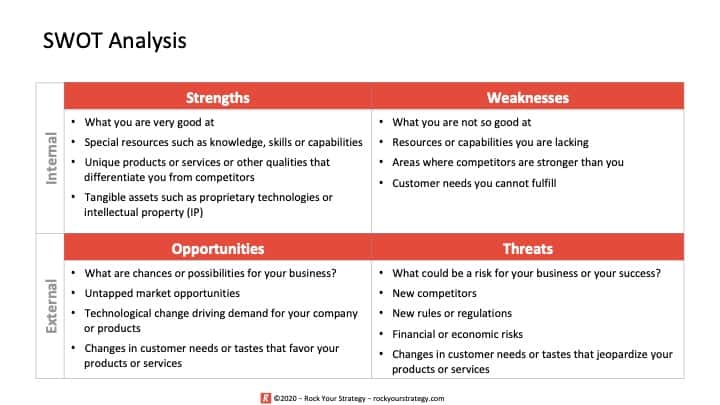
Strengths and weaknesses are internal to your business. This means they describe the business itself or the internal situation. These are factors, such as products, services, capabilities, skills, knowledge, etc. that you are good at or not so good at. You can directly influence these internal factors.
Opportunities and threats are external to your business, which means these are factors outside of your business that you are exposed to. These can be market trends, the political, economic, socio-cultural, technological, environmental, legal/regulatory environments (PESTEL), or of course competitors, suppliers, and customers. Usually, you cannot directly influence external factors.
SWOT Analysis
The SWOT analysis is often conducted as part of a strategic review process. But it can also help to obtain a quick overview of the health of a project or the prospects of a new venture. It can be conducted for the entire business or on a product or team level.
The SWOT is typically depicted in a 2×2 matrix that looks as follows.
Strengths
Weaknesses
– … – … – …
– … – … – …
Opportunities
Threats
– … – … – …
– … – … – …
Simple 2×2 SWOT Analysis Matrix
In order to conduct a SWOT analysis, take the following 5 steps.
1. Decide the objective of your analysis
What is the purpose of your SWOT analysis? Is this SWOT for your entire business or for a subset such as a product, division or team? Are you analyzing your SWOT as part of a strategic review or for another reason?
Be clear and deliberate about why you conduct the analysis before you begin. This is often overlooked and may cause confusion during the analysis or ambiguous results. Your purpose gives context to the analysis and allows you to be more specific in your assessment.
2. Identify strengths, weaknesses, opportunities, and threats
Conduct a brainstorm about each of the four elements of the SWOT. List down all the aspects you can come up with. The following questions may help. Your answers can be qualitative or quantitative but try to be as specific as you can.
Strengths
What are you particularly good at?
What makes you and your business unique in the marketplace?
What are you distinctively better at than your competition?
What special resources such as knowledge, skills or competencies do you have?
What tangible assets give you an advantage such as proprietary technologies, intellectual property?
What do customers love about you? Why do customers buy from you?
Weaknesses
What are you less good at?
What resources, knowledge or skills are you lacking?
What are your competitors better at than you?
What complaints or feedback do customers have about your products or services?
What processes or procedures need improvement?
Opportunities
What chances or possibilities exist for your business?
What market trends could positively influence your business?
Are there technological trends that could drive demand for your products or services?
Are there customers or sales channels you are not yet fully exploring?
Threats
What could be risks for your business or for your success?
Are there emerging competitors or alternative products or services?
What changes in customer needs or tastes could jeopardize demand for your products or services
Are there supply side risks to availability of raw materials or services you source?
Are there changes to rules or regulations which could affect your business?
What are financial or economic risks you face?
As you go through each of the four elements in turn, be brutally honest with yourself. Don’t sugarcoat the weaknesses or undermine your strengths. Consider using a PESTEL analysis to complement your external assessment. Be realistic and focus on getting to the truth.
3. Challenge and prioritize your results
After you have gone through each element in turn, take a step back and review your list of strengths, weaknesses, opportunities and threats.
For each element, highlight the top 3 to maximum 5 identified aspects. If you can, work on this in a team. It really helps to review your list from different angles and debate your outcome. Challenge yourself to identify really only the top 3-5 aspects relevant to the purpose of your SWOT analysis. Then transfer these prioritized items into the 2 x 2 SWOT matrix.
Why only the top 3-5 aspects? In my experience, it really helps to focus your attention on the top results. Think about it. If a strength doesn’t make it into your top 5, is it really a key strength? If a threat doesn’t make it into your top 5, should you really devote significant resources to it?
4. Make a plan
When the SWOT analysis is complete, turn your insights into a plan of action. In order to do this, conduct a crossover analysis, plotting your strengths and weaknesses against your opportunities and threats. Formulate strategies by asking yourself the following questions:
What strengths can you deploy to take advantage of your opportunities?
What strengths can you use to mitigate or eliminate your threats?
What weaknesses do you need to improve to benefit from an opportunity?
What weaknesses do you need to act on to overcome a threat?
Write down your strategies in a clear action plan including caretakers and timeline. Discuss and align the plan with your team. Ensure that everyone is clear about the plan’s objectives and actions and everyone’s roles and responsibilities.
Go back to your original purpose of the SWOT analysis and confirm that all objectives are met.
5. Take action
Now take action and execute your plan! Set up regular reviews at which you check on progress of your plan to make sure you are on track to achieving your objective and goals.
What to do with SWOT analysis results?
Once the SWOT analysis is completed, formulate strategies to act on the insights gained. In order to do this, conduct a crossover analysis, plotting your strengths and weaknesses against your opportunities and threats.
This may look as follows.
Opportunities
Threats
Strengths
Strength-Opportunity StrategiesWhat strengths help you take advantage of the identified opportunities?
Strength-Threat StrategiesWhat strengths help you overcome the identified threats?
Weaknesses
Weakness-Opportunity StrategiesWhat weaknesses to improve to benefit from opportunities? What opportunities might help you overcome a weakness?
Weakness-Threat StrategiesWhat weaknesses to improve to minimize a threat?
Crossover Analysis of SWOT Results
Write out 2-3 strategies for each crossover pair for a total of 8-12 strategies. Then prioritize your strategies based on your objective and goals. Aim to identify the 3-5 strategies that optimize your chance of success or with the best return on investment.
Then turn your strategies into an action plan with clear initiatives, caretakers, and timeline. Conduct regular reviews to make sure you are on track to achieving your objective and goals.
Why conduct a SWOT analysis?
The SWOT analysis is a simple but powerful tool to assess the internal and external situation of your business, project or organization.
It can be conducted quickly and easily without creating major costs or devoting significant resources. The SWOT analysis can be performed alone or in a team. It can be applied at various levels of an organization: to the business as a whole or to individual teams or products.
The results of a SWOT analysis can immediately be acted on. Or they can be integrated into a larger business strategy process.
Should small businesses use SWOT analysis?
The SWOT analysis is a simple but powerful tool to assess the situation of your business. As it can be conducted quickly and easily without creating major costs to the business, it is a great tool for small businesses to evaluate their strengths, weaknesses, opportunities, and threats.
All you really need is a pen and paper to follow the simple 5-step process. Or download one of our free templates to help you get started!
SWOT template
Begin your SWOT analysis by downloading our free SWOT analysis template.
Make sure to check out our resource page where you can find many other useful tools and templates to help you win at strategy and at business.
SWOT examples
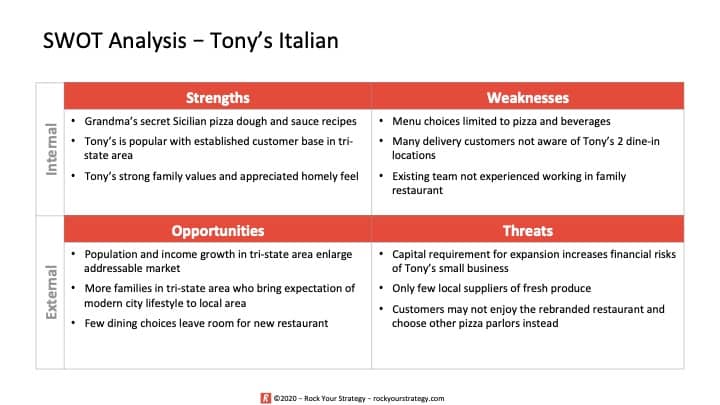
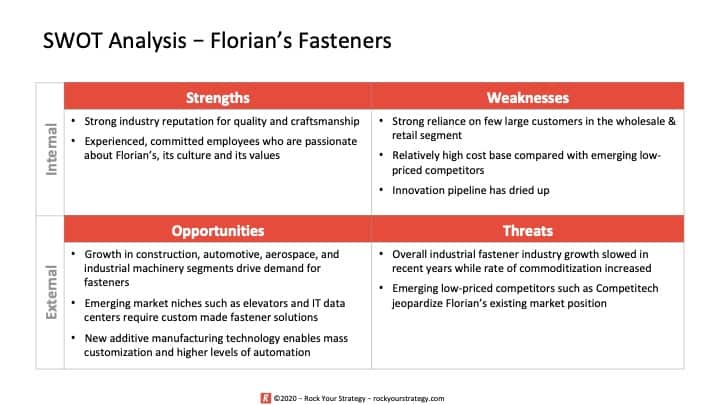
In the following are two examples of SWOT analyses applied in practice. The first is a B2C example of Tony’s Italian restaurant. The second is a B2B example of Florian’s Fastener Solutions. Both of these examples are fictional to protect confidential information but the insights and learning can be real.
If you’re researching SWOT analysis to help create a strategy for your business, project or venture, make sure to check out our other articles on strategic planning.
Our resource page with examples, tools & templates, workshop materials, book recommendations and glossary may also be of value to you.
If you have any questions or comments, why not leave us a comment below or sign up to our free newsletter here. We’d love to hear from you. Rock on!
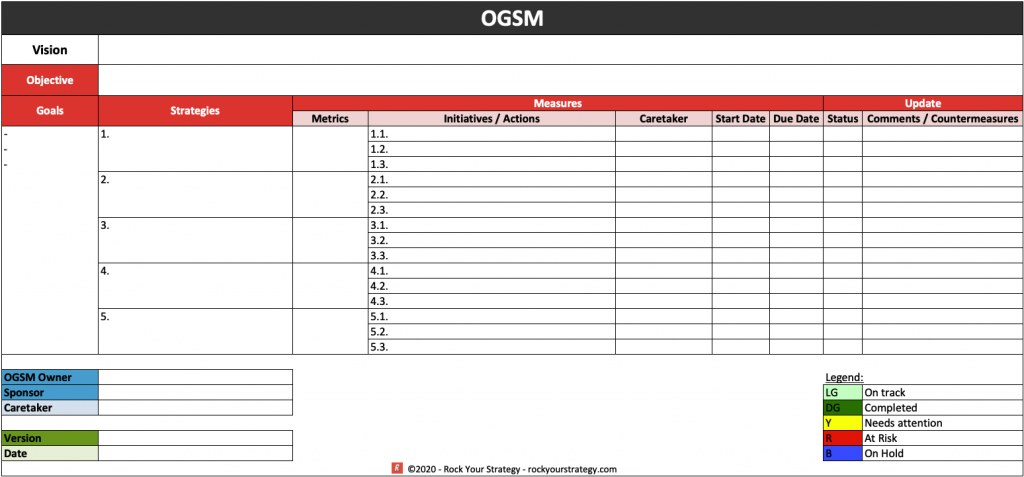
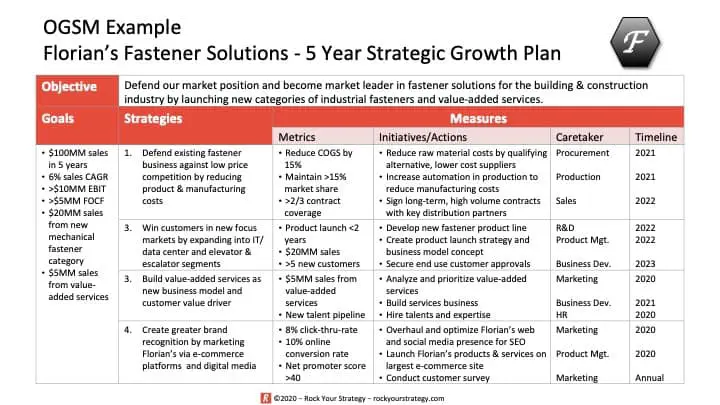
Looking for inspiration on how to structure your strategic plan? Or just looking for an OGSM example? Get to know Andy and learn how he applies the OGSM methodology to his small B2B company.
OGSM stands for Objective, Goals, Strategies and Measures and is a one-page business plan that defines ‘what’ you aim to achieve and ‘how’ you are going to achieve it. It is a simple but powerful method that enables strategic clarity, alignment and execution. The OGSM can be applied to large companies and small businesses alike.
This fictional story tells the tale about how small business owner Andy used the OGSM methodology to breathe new life into his father’s old business. Scroll to the bottom of this article if you want to skip the story and head straight to the OGSM.
Introduction
Andy hadn’t been able to sleep. Cold sweat on his forehead, he had been tossing back and forth all night. He stared at the marred face in the mirror: tired eyes with deep black rings underneath stared back at him. Andy counted the worry lines engraved on his forehead. His mind was racing. How would he be able to save his company? How would they be able to defend their share – never mind achieve their growth objective? What was he going to tell his investors?
Ever since Competitech had entered the market for fasteners the previous spring, their market share had dwindled. Florian’s Fastener Solutions had been the market leader for nuts, bolds, washers, and screws throughout the entire Northeast ever since his late father had built the company five decades ago. The iconic F-logo was well known in hardware stores and construction sites across the region. Now everything seemed to change. If they didn’t do something fast, they might be running out of cash in 12-18 months.
Florian’s Logo
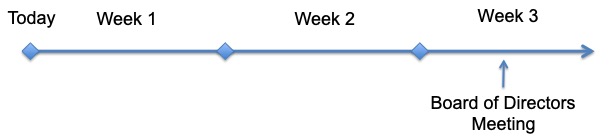
The annual Board of Directors meeting was coming up in less than 3 weeks. Andy wasn’t sure if he could wait that long. He had to refine his plan and discuss it again with his team.
Andy showered, got dressed, and paused just before descending the stairs. He peeked through the children’s bedroom door. All quiet. He could only hear the steady breathing of his two daughters still fast asleep. “If only you knew how stressful and fearsome this world can be”, he thought to himself. Andy blew kisses to both and rushed downstairs.
Just as he grabbed his bag and ran out to the car his phone rang. “Andy, you up?” asked the familiar voice of his head of finance on the other end of the line. “Good morning, Frank. Yeah, I’m on my way to the office. What’s up?”
“Good! Get down here. The report is back. It’s worse than we thought.”
Founding of an industry icon
Florian’s Fastener Solutions was founded by Florian Walterman in 1965. The son of German immigrants who had fled to the US in the 1930s, Florian worked his way through college by taking any construction job he could find. By the time he graduated, he had made a name for himself as being hard-working, gritty, and determined. No job was too tough. No task was too dirty. If you wanted something done, you asked for Flo. And it was these traits that he infused into his company right from the start.
It was not an easy start however. For the first few years, Florian had a hard time making ends meet. He had to take out a massive loan to afford the heavy equipment. The small shop he rented produced nuts and bolts for some of the construction outfits he had worked for during college. However at the back end of the American construction boom of the 1950s and 60s, there were fewer projects and Florian had to be creative.
Florian began experimenting with different materials and production processes. He tried new metals and blends and added new products. His goal was to make the best fasteners money could buy. If you needed bonding, Florian was determined that it had to be his products to do the job. That also explained his early slogan: Florian’s will fix it!
Ad in local newspaper in the late 1960s
Through sheer will and hard work, Florian persevered. His breakthrough came when a new chain store for hardware and gardening equipment approached him for an exclusive contract. The chain’s plan was to expand all across the Northeast and wanted to carry Florian’s fastener products. When they even offered to fund Florian’s needed expansion through an upfront payment, Florian readily agreed.
In the following years, the chain rapidly grew into American suburbia and with it Florian’s fasteners. Working hard to keep up with demand, Florian built a second site, purchased more equipment and hired more staff. As sales grew, so did the company. But Florian remained as hard nosed, down to earth, and gritty as he had always been.
Florian’s became a household name and its italic F on the bold head a well-known sign of quality and craftsmanship. An industry icon was born.
Family business
Andy had never wanted to get into the family business. Florian’s was his dad’s. It even carried his name. No, ever since being a little boy he wanted to go out to see the world. He wanted to help people who were less privileged than himself.
During high school he worked on a project in Puerto Rico. He was blessed with his dad’s workmanship and strong hands and was glad to put them to good use. In the summer after graduating he led a group of friends to Tanzania to build a school and teach English. He knew he wanted to devote his life to helping others and his choice of college degree was easy.
One day in Fall, Andy had just settled into his 3rd year at the Stanford University social sciences program, his mother called. “Andy, it’s your dad. He had a stroke. Can you come home?”
Shocked how anything could harm his steadfast father, Andy took the first Eastbound flight the following day. When his rental car pulled up the driveway, the last sun rays of the day peaked through the tall pine trees behind his parents’ house as dusk began to settle. Andy had this eerie feeling that more than a day was coming to an end.
“Thank you for coming home, Andy.” said his mother after a long, warm embrace. “Your father is at St. Mary’s hospital. The doctors say he may not make it.” Andy had always had a difficult relationship with his father. Not wanting to continue the business had driven a wedge between them. At this moment however, Andy felt overwhelmed with sadness and regret. All these years he was away while his father was consumed by work. They had not really had a chance to open up about their feelings for each other.
“He always wanted you to be here, you know”, his mother continued. “He loved you very much. He had made plans for you to carry on the company after he retired…” His mother’s voice trembled and tears began streaming down her cheeks. “But retirement never came… and now he’s…”
Andy held his mother tightly. “Let’s go see him”, he said gently.
At the hospital, Andy and his mother sat around his father’s bed. His eyes were closed. It was quiet in the room except for the beeping of the ECG and the hissing of the respirator. The doctors had prepared Andy for what to expect before they entered the room. “Your father has been waiting for you, Andy. He’s not conscious but he can hear you. He doesn’t have much time left. He’ll be happy that you’re here.”
Sitting by his father’s bedside, tears filled Andy’s eyes. He carefully took his father’s hand and whispered close to his ear, “I’m here, Dad. And I’m here to stay. Thank you for everything. I love you very much.” Andy thought he felt a twitch in his father’s hand. It was as if he wanted to say “I hear you, son. I love you.”
Andy looked up at his mother, “I’m ready, Mom. I’ll stay. We’ll get through this together.”
Departure and a new beginning
The funeral of Florian Walterman took place 3 weeks later. It was a beautiful ceremony. Many friends and life companions of the Walterman’s paid their respects.
Afterwards, Andy, his mother and Frank, Florian’s head of finance and Florian Walterman’s right hand man, sat together laughing and telling tales from Florian’s life and achievements.
Suddenly, Frank became serious. “Andy, your father left an envelope with me and asked me to pass to you should he ever leave. The time has come that I pass this letter to you. It includes a copy of his will and his wishes for the handover of the company. It was his wish that the two of you take over the reigns of the company. Please read the letter carefully and let me know if you have any questions. Know that I’m there for you whenever you need me.”
Frank handed Andy the letter, padded him on the shoulder, thanked Andy and his mother for the wonderful ceremony and left.
Andy took a deep breath and opened the letter. His mother knew the contents and looked at Andy while he studied each line and each word.
When Andy looked up, his mother said, “Andy, it’s your company now. I will head the Board of Directors but you run the day-to-day operations. Frank has looked after everything for the last weeks. The company is in good shape but a number of challenges are ahead. We need your foresight, your energy, and your care to take the company into the new millennium.”
Competitech
While Andy was driving to the office, he had to think back to the day 15 years ago, when he took over Florian’s from his father.
The first day in the company after the funeral had been strange for him. His father’s office still had had the musky smell of his old man’s cologne. There had been piles of paper everywhere and it had taken him some time to get sorted. Frank was there for him every step of the way. Frank had introduced him to the team, the operations, and the state of the business. He had taken him by the hand and made sure that Andy learned as quickly as he could. Andy was grateful for Frank’s mentorship. No, Frank was more than a mentor. Frank was like family.
And now Frank was waiting for him at the office with the fateful news he had been dreading all night.
Andy parked his car in front of the building and wished that he had stopped for coffee. Lost in thoughts he drove right by his usual morning coffee stop. “What’s wrong with me?”, he murmured as he stumbled up the steps to the office.
“Andy, finally.” Frank wasn’t much of a small talker, especially not in the morning. “We have an hour until the team gets in. Read this.”
Andy gave Frank a blank stare, took the report from his hand and walked into his office. “Give me the highlights, Frank.”
“Competitech is making much faster progress than we thought. They have taken 2 more retailers on the West coast and are working hard to get into our home base. Stan at Home Improv called me last night. He has Competitech calling him twice a day with new offers. He says he won’t be able to convince his head of purchasing to dodge their prices much longer.”
Andy spun around in his chair, suddenly wide awake. “Frank, I think we have to approach this differently. Let’s stop playing defense. I think we have to take this head on. It’s time to go into offense.”
OGSM Template for Excel
Pre-formatted, easy-to-use OGSM template for Microsoft Excel.
Andy shared with Frank what he had been thinking about all night. When he was finished Frank let out a long sigh. “And you are convinced this will fly?”
“I’m not, Frank. But I think it’s our only chance. Let’s discuss the idea with the team. And then let’s hash out a plan that can beat Competitech, restore our path to growth and convince the Board of Directors and our organization to come on board for the ride.”
Staging a turnaround
It was 8 a.m. by the time the last person sat down in the conference room. Murmurs of “G’morning” made the round. The entire leadership team had followed Andy’s call for the all-hands meeting. The small conference room seemed to be bursting at the seams with all seven leaders in attendance.
There was Frank, of course, the head of finance, who was seated right next to Andy. Next to him was Dan, head of operations, followed by Sharon, head of sales & marketing. Unlike in many other companies, Dan and Sharon usually stuck together. Next to Sharon was Alisha, the head of R&D. On the opposite side of the table, Tom, head of procurement, and Sarah, head of HR, sat in their usual seats.
Florian’s Fastener Solutions leadership team in late 2010s
Andy opened, “Good morning, everyone. Thank you for joining this early on a Monday. We have some important news to share and then some critical topics to discuss.”
Chatter erupted in the room. There was a crinkling of suspense and worry in the air.
“Please guys, let me explain.” Andy cleared his throat. “The market report we commissioned came back this morning… We lost further market share and are now at 15%. Competitech continues its march across the country and is rolling up customers state by state. Their share has swelled to 26%. This needs to stop. If we lose Home Improv or any of our main retail customers here in the Northeast, we will run out of cash as early as next year. I don’t need to explain what that would mean to our company and to the legacy my father has built together with all of you.”
Andy paused and looked around the room. He had everyone’s undivided attention. “Look, I am not going to sugarcoat this. This situation is dire. Competitech is significantly larger than us, offers cut throat prices with their cheap imports, and has a much wider portfolio of fasteners, screws, nails, and other metal products. Competitech is targeting large retailers and wholesalers and is already knocking on Home Improv’s door. If we simply wait and do nothing, they will wash over us like a tsunami. But we will not let that happen!”
Sharon spoke up first, “How do you plan to do that, Andy? Competitech is everywhere. They have a much larger sales force and their prices are 20% lower than hours. My guys are running out of arguments.” Dan nodded. “We cannot compete with their costs. We have optimized our processes over the last years as much as we could. There are no quick wins here.”
Chatter erupted once again as the team began talking over each other. Frank raised his hand and the room fell silent. The sign Florian had established still worked like a charm. “Andy had an idea. It’s risky financially but it’s worth considering. Give him a chance to explain.”
“Thanks, Frank.” Andy continued. “Sharon, Dan, I hear you. You guys have done your utmost to put us – and keep us – in a competitive position. That has contained the impact so far. Thank you for that. However what got us here, will not help us going forward. We have to rethink our strategy and refocus our resources.”
Frank picked up the market report which had been printed and laid out for each team member. “Besides the current market shares and competitive positions, the report also offers an outlook for different sectors of the market in future.” Frank tapped on a graph on page 7 of the report.
US Industrial Fastener Market Report (Source: fictional)
“While the overall fastener industry in the US is growing 2%, the wholesale & retail sector which has been our home market for all these years is going to decline faster in the years ahead”.
Sharon sighed, “I’ve been telling you this, Frank. Retail is dead in the water. No one is fixing up their houses anymore. Young people want to live in the cities. They play on their smartphones all day and have two left hands when it comes to swinging a hammer…”
“You have,” acknowledged Andy. “And we need to direct our attention to what is growing. Look at the chart. Construction, our other main market, remains robust. Automotive, Aerospace, Industrial Machinery are all showing positive growth for the coming years.”
“This is interesting!” Alisha exclaimed. She had skipped ahead in the report and read about the market trends within each of the sectors. “Some of the drivers of growth in Building & Construction are the building of data centers and elevators & escalators. Have we looked at this in more detail yet?”
“You hit the nail on the head, Alisha.” Andy smiled for the first time that day. “We are a small company. We will not be able to take on Competitech with their size. Nor will we be able to satisfy the Automotive industry’s requirement for scale and JIT. Why not use our size to our advantage and focus our attention on growing industries that require custom made products and value-adding services? Such as the IT and Elevator industries.”
The team began discussing the various market segments and debating which ones best fit their capabilities and size. After an hour of reviewing the facts they indeed honed in on IT and Elevators.
“Sounds to me like these are the industries with the highest growth rates in the next few years and for which we are uniquely positioned with our expertise here in the Northeast,” concluded Tom.
“But the industries are still small”, said Dan. “They alone will not be able to sustain us.”
Andy agreed, “It will take time for us to prepare entering those markets. We will need to add new products and new skills. And meanwhile, we must not give up our fortress. We will need to work on our cost position and secure our largest customers. The cash flow from our sales today will need to fund our sales of the future.”
“We will need additional resources for what you have in mind, Andy. We have good standing with our banks, but we will need a clear plan to convince them”, remarked Frank.
“We will need to convince our teams first, Frank. People are nervous. They see our sales declining and are worried that their jobs are at risk.” Sarah reminded everyone what was at stake.
“No one will lose their jobs. We will need everyone if we want to pull this off: you, your teams, the Board, everyone. We need to go back to the values my father instilled in this business to stage a turnaround. Let’s take a break and then resume to make a plan.”
Making a strategic plan
When the team returned to the conference room, Andy had already set up 2 flip charts. On the one in front of the room he had written a timeline.
Andy rolled up his sleeves. “Alright, folks. We have less than three weeks to put together the plan. I suggest we start right away today by setting the framework and then work over the next 2 weeks with our teams to flesh out the details. If we want broad buy-in from the team, we need to involve them as we always have.”
Andy flipped over the flip chart, revealing a process chart. “My dad had sworn by this process. Let’s use it again to guide our discussions. We had a good starting point this morning, but we need to dig deeper into those market segments to better understand their dynamics, customer needs, and competition.”
rockyourstrategy.com Strategy Process
“I suggest we approach it as follows.” Andy pointed to the strategy process. “Let’s focus today on the Mission and Business Analysis steps. Sharon, can you then work with your team on the Industry Analysis until the end of the week? Let’s then resume next Monday with the Vision and Strategic Choices parts before we then develop the Execution Plans with our teams for the remainder of that week. Goal must be to have a plan ready by the end of next week. That’s 10 days, 12 with the weekend. Are you guys ok with that?”
“Wow, that’s a tight timeline, Andy!” Dan was not usually the one to point out the obvious.
“Yes, it is, Dan. This is not going to be easy. I am open to alternative ideas if you have any.” Andy scanned the room, but no one had a suggestion.
“Then let’s get started,” said both Alisha and Sarah in unison. They looked at each other and giggled. “Yes, let’s get started”, confirmed Andy, glad that the mood had lightened. “Frank, can you take over and facilitate?”
Intimately familiar with the strategy process, Frank was happy to. He got up and walked to the front of the room.
OGSM example – the 5 year growth plan
The Leadership team of Florian’s Fastener Solutions went to work. And over the next two weeks worked out a detailed plan with their teams. They summarized their strategy in a simple one-page business plan they called their OGSM.
OGSM stands for Objective, Goals, Strategies and Measures and is a one-page business plan which details what you aim to achieve and how you are going to achieve it.
Andy knew his dad had used the OGSM methodology for years. He had liked its simplicity and the clarity it created. Combining the what and the how moved the team from planning to execution and aligned everyone behind the overall direction of the company.
“If you want your team to follow you, Andy, your team needs clarity where you’re headed!” he had always implored on him. Andy heard his father’s voice ring through his head. He could remember a treasure trove of bumper sticker-like one-liners from his childhood. He barely ever listened to his dad when he talked about work at the dinner table. When Andy took over Florian’s however he had been glad for the lessons his dad had taught him.
“Making the numbers is not a strategy. Strategy is about making choices!”
“Appeal to your people’s hearts and their minds and they will take you anywhere.”
“Take care of your people and they will take care of your customers.”
“A plan is only as good as its execution!”
Andy sat in his office, eyes locked on a copy of the freshly minted OGSM in front of him. He felt good about their plan. Not only did the leadership team work on it with enthusiasm. But the entire organization had pitched in. He was surprised at the commitment everyone had shown. It was as if they had just been waiting to be asked to contribute. And maybe they had been…
Andy felt exhausted as he dialled his mother’s phone number. He wanted to set up a meeting to jointly review the final plan. He had kept her apprised of progress over the past two weeks. Being the chairlady of the Board of Directors, Andy made sure she was in lockstep with the team every step of the way.
With the Board of Directors meeting now days away and the change they proposed significant, Andy did not want to leave anything up to chance. The transformation itself would be enough of a gamble.
Epilogue
Sarah raised a glass. “Andy, on behalf of the leadership team, I would like to thank you! If it wasn’t for your dedication, your optimism and your continued reinforcement of the plan and its execution, I’m not sure whether we’d be here today.” The rest of the team joined in cajoling and shouts of encouragement and appreciation. Sarah threw an icy look before bursting out into laughter. “Quiet, I am not finished yet!”
Florian’s Fastener Solutions leadership team was sitting together on the farmhouse patio of the little vineyard which Florian Walterman had bought years ago. Overlooking Cayuga Lake, the vineyard at Finger Lakes had become a favorite get-away for company events and team celebrations.
It was a beautiful late Summer evening. A slight breeze made the warm air comfortable. Bottles of the vineyard’s signature Riesling were nestled in the ice bucket next to the large table. Andy had invited the team to the vineyard to celebrate the latest contract Sharon had signed the previous week and the progress the company had made in executing their plan.
“When we embarked on this journey three years ago, I was frankly not convinced that we would be able to turn things around.” Sarah said honestly. “Of course I was hopeful. I had faith in our abilities and our team members. But I was not convinced.”
“Boooooh”, Sharon and Dan interrupted Sarah with wide smiles. “Shush, you two”, she responded with an equally wide grin.
“Andy, you kept us going. You convinced your mother and the Board of Directors, you got the funding from the bank, and you led the meticulous execution of our plan every quarter and every month. Here we are 3 years in. We are not done yet. But we are on track and have returned to growth again! Cheers to you! Cheers to Florian’s!”
The team raised their glasses in celebration and the rings of clinking glass could be heard reverberating across the valley. As the sun was setting over Cayuga Lake, the seven leaders kept chatting while enjoying the wins they had achieved. They knew they were not yet at their destination and that more challenges lay ahead. But tonight they enjoyed the wine and each other’s company.
Final Notes
While this story is totally fictional, the learnings can be real. If you would like to learn more about the OGSM methodology, read our introduction to the OGSM methodology here. You can explore other examples and templates via the respective links.
Florian’s Fastener Solutions, all characters and all data points are completely fictional and the brain child of the author. Any resemblance to real life events or circumstances is not intended and may be coincidental. Please excuse us if some data seems contradictory or far-fetched. The story intends to introduce the OGSM methodology and its application. It is not the purpose to provide actual industry information or a real world case study.
If you have any questions or comments, why not leave us a note in the comment box below or sign up to our free newsletter here. We’d love to hear from you.
10-Page Strategy Presentation Template
Fully customizable strategy presentation template for Microsoft Powerpoint
If you have been asked to prepare the agenda of a strategic planning meeting but are not sure what to include, look no further. I have scoured over the many strategy workshops I have held to consolidate my insights into one agenda guide.
The agenda of a strategic planning meeting should follow the strategy process and should generally have six parts:
Current Situation
Internal Analysis
External Analysis
Future Destination
Strategy Development
Execution Plan
Depending on the length of the meeting, the agenda may span one, two, or three days and include opening statements, ice breakers, and summaries as needed.
Let’s explore further what the agenda of an excellent meeting should concretely look like, followed by examples which you can use for your meeting.
10-Page Strategy Presentation Template
Fully customizable strategy presentation template for Microsoft Powerpoint
First things first, the planning of a strategy meeting usually does not start with writing the agenda. There are few things I would recommend to do before that. I have written all about it in this 14-step preparation guide for strategy meetings. For the purpose of this article though, allow me to focus straight away on the agenda itself.
Whether you are organizing a one, two, or three-day strategic planning meeting, the agenda for such meetings generally looks quite similar. The agenda typically follows the strategy process or strategy framework you have chosen for your strategic review. The difference between the one, two or three-day agenda is the amount of time you have to dive deeper into analyses, invite outside input or include discussion and get-to-know sessions.
I have led and facilitated one, two, and three-day meetings and I would recommend making the length of the meeting dependent on the type of strategic challenge, the familiarity of the group, and the amount of change your business is facing. The higher the stakes and the less the group knows each other, the more you will benefit from a longer session.
As such, one-day meetings are great for brief, annual reviews of the strategic direction of the business. Two and three-day sessions are preferred for more in-depth reviews and larger strategic overhauls. Now let’s finally look at the actual agenda.
I like to structure the agenda of the strategy meeting according to the strategy process and add kick-off and summary sessions. In addition, depending on how much time is available, I’ll add introduction sessions and ice-breakers. These are valuable if the group does not know each other well but will need to work effectively in a trusting environment for the duration of the meeting.
In the beginning is a Welcome & Introduction session. The purpose of this session is to set the expectations for the meeting including meeting objectives, desired outcomes, meeting rules and the agenda itself. If time allows, I’d follow this with an introduction round giving each person the opportunity to introduce themselves and share their expectations for the meeting.
Pro Tip: consider kicking off the meeting with a personal story that allows you to grab the attention of the participants and connect them with the objective of the meeting. This sets the tone and breaks the ice.
Bonus Tip: If needed, include an introduction to the strategic process. This session familiarizes the team with the strategy process and the strategy framework & tools that will be applied. This will help demystify what strategy is and what participants are expected to do for the rest of the meeting.
The first content point is the Current Situation of the business. Use this session to clarify the mission and purpose of the business and its historic development to the present day. Some of this information should be prepared up front and the depth of the discussion should be in line with the significance of the strategic review. In a one-day annual review, this session can be short and focus more on recent financials. In a turn-everything-upside-down company overhaul, this could be an extensive soul-searching session.
OGSM Template for Excel
Pre-formatted, easy-to-use OGSM template for Microsoft Excel.
Next, the agenda features the Internal Analysis. This session aims to review the business’ core strengths and weaknesses and a significant amount of time should be devoted to this discussion. Similarly, the External Analysis should receive sufficient attention to identify changes in the external environment including opportunities and threats. You may consider holding these discussions in break-out groups for each group to dive deeper into their task and report back with their findings.
Pro-Tip: Include sufficient break time in your agenda between these sessions to allow participants to refresh, get some air or digest the discussions. Providing time to look into emails and allow side discussions keeps participants focused and present during the meeting time.
The purpose of the next session is to define the Future Direction. This is arguably the most interesting session requiring the most creative thinking. Ensure that there is sufficient time and space to have this discussion. Avoid heading straight into this session after a lunch break or in the evening when people enter their “food coma” or feel tired from a long day. The best time of day for this session is early morning or mid-afternoon after an energy booster.
Strategy Development is the next session that requires a clear mind and strong decision making. Setting the strategy is all about making strategic choices about how you will get from A to B. If well prepared and well structured, this discussion may not take as long as the situational analysis. But the risk of getting lost in the nitty-gritty details poses a challenge for time management.
After the future destination and the key strategies are confirmed, the purpose of the next part is to confirm the detailed Execution Plan. This session often does not receive enough attention and is rushed at the end of a meeting. Take sufficient time for this session! …or risk not implementing what you have spent so much time discussing during this meeting. It does help to schedule this session towards the end of the meeting to create a sense of urgency and gain commitment from participants. But do not skip this.
Finally, make a point to Wrap Up in order to summarize key take-aways, review the action items, and lay out the next steps. Use this session also to confirm that meeting objectives were met and that each participant had a chance to address his or her expectations.
Pro-Tip: If time allows, include a feedback round at the end of the meeting to learn how the meeting was perceived and what can be improved next time around.
One more thought about timing. If possible, I personally prefer to keep detailed session times flexible instead of scheduling hard start and end times. Especially for two or three-day meetings, I’ll set only start time in the mornings and finish time in the evenings. Other times are indications based on meeting progress. If the discussions are effective and producing results, I try not to interrupt just because the agenda says “break at 10:30am”. This of course depends on the setting, meeting venue, and food & beverage arrangements. If possible, plan ahead to allow such flexibility.
There you have it: this is the rundown for a strategy meeting. Read on for examples and additional insights for your strategy meeting agenda design.
What does the agenda of a 3-day strategic planning meeting look like?
A 3-day setting allows for in-depth discussions and creative use of timeslots. In a 3-day setting, I only set daily start time, finish time and lunch time and allow the rest of the timing to be dictated by the flow of the meeting.
This is what a sample agenda for a 3-day meeting looks like.
Day 1
Day 2
Day 3
Morning
~8:30: Welcome & Introductions ~9:30: Introduction to Strategy Process ~10:30: Current Situation
~8:30: Recap Day 1 and rundown Day 2 ~9:00: Future Destination
~8:30: Recap Day 2 and rundown Day 3 ~9:00: Execution Plan
Lunch
~12:30: Lunch
~12:30: Lunch
~12:30: Lunch
Afternoon
~13:30: Internal Analysis External Analysis ~17:00: Wrap Up Day 1
~13:30: Strategy Development ~17:00: Wrap Up Day 2
~13:30: Open questions / parking lot ~14:30: Actions and Next Steps ~16:00: Feedback ~17:00: Wrap Up
Evening
~18:00: Group Dinner
What does the agenda of a 2-day strategic planning meeting look like?
The rundown of a 2-day strategy meeting is similar to a 3-day meeting in terms of seeking in-depth discussions and keeping individual time slots more flexible. However, in a 2-day setting, the agenda is overall more dense.
This is what a sample agenda for a 2-day meeting looks like.
Day 1
Day 2
Morning
~8:30: Welcome & Introductions ~9:30: Current Situation ~11:00: Internal Analysis
~8:30: Recap Day 1 and rundown Day 2 ~9:00: Strategy Development ~11:00: Execution Plan
Lunch
~12:30: Lunch
~13:00: Lunch
Afternoon
~13:30: External Analysis ~15:30: Future Destination ~17:30: Wrap Up Day 1
~14:00: Open questions / parking lot ~15:00: Actions and Next Steps ~16:00: Feedback ~17:00: Wrap Up
Evening
~19:00: Group Dinner
Can I do a strategic planning meeting in only 1 day?
Yes, it is possible to conduct a strategic planning meeting in only one day. However, in a one-day setting, detailed analysis and in-depth discussions are less feasible.
A one-day session is most effective for annual strategic review meetings in which to confirm the long-term future of the business and ongoing strategy execution. A one-day agenda also works really well for annual operating planning meetings.
When choosing a one-day setting, I prefer to be more structured and adhere to more fixed time slots. This helps to ensure that discussions do not overrun and that meeting objectives can be met.
A one-day strategy meeting agenda looks like this:
Day 1
Morning
8:00: Welcome & Introductions 8:30: Current Situation: Highlights & Lowlights 9:30: Internal & External Analysis Break-out sessions (incl. break) 11:00: Situational Analysis Report Out Presentations 11:30: Review of Future Destination
Lunch
13:00: Lunch
Afternoon
14:00: Review of Strategic Choices & Progress 15:30: Adjustments to Execution Plan 16:30: Actions & Next Steps 17:30: Wrap Up
Evening
19:00: Group Dinner
How do I plan for a strategic planning meeting?
Creating the agenda of a strategy meeting is just one part of the preparation. Based on my experience running strategy workshops, I have written a 14-step guide about how to prepare for a strategic planning meeting. This has helped me save vast amounts of time and ensure that I do not forget anything.
You can find my introduction to this 14-step approach here including a printable one-page checklist.
In addition, take a look at our resource page with tools, templates and examples as well as a handy workshop material shopping lists.
Conclusion
The agenda of a strategic planning meeting largely depends on the type of strategic challenge, amount of change the business is facing and the familiarity of the participants.
Generally, the agenda of a strategy meeting follows the strategy process and additionally includes opening statements, ice breakers, and summaries as needed. Strategy meetings typically last between one and three days.
If you found this article helpful or have any questions or comments, why not leave us a reply below? We’d be happy to hear from you.
8-Step Communication Planner
Pre-formatted, easy-to-use communication planning template for Microsoft Word.