
If you are like me then you may also be wondering if there is a better way to drive strategy execution and achieve business results. When I first came across OKRs and OGSM, I was wondering what’s the difference between OKR and OGSM and which one should I apply? Here’s what I found out.
OKR and OGSM are both goal-setting methodologies that help companies execute their strategies but they differ in scope, timeframe and format.
Let’s explore these differences and their similarities to help you choose which one to apply. I’ll add examples and templates below.
Difference between OKR and OGSM
Before we jump into the details, let’s first find out what OKR and OGSM are.
OKR stands for Objectives and Key Results.
OGSM is short for Objectives, Goals, Strategies, and Measures.
In the OKR methodology, the Objective describes what you want to achieve usually over a monthly or quarterly timeframe and the Key Results describe what achievement would look like.
In the OGSM approach, the Objective and the Goals jointly describe what you aim to achieve and the Strategies and Measures give clarity how you aim to achieve it.
Hence, both OKR and OGSM are goal-setting methodologies that help companies execute their strategies following Peter Drucker’s idea of management by objectives. While OGSM is said to go back to Japanese automotive manufacturers who brought the approach to the United States, OKRs were first implemented at Hewlett-Packard and popularized by their application at Intel and later Google.
Nowadays, OGSM is famously adopted at major consumer staples such as P&G and Coca-Cola, while OKRs are widely practiced in many technology companies and start-ups across the world.
Despite their similarities, there are 3 major differences between OKR and OGSM: scope, timeframe and format.
1. Scope
The first major difference is in scope.
OGSM is well suited for describing strategic plans for large and small businesses alike. The approach is typically applied and aligned top-down from the corporate or business level to individual divisions, product lines, or teams.
OKRs seem better suited for individual and team-level goal-setting. They are often created and aligned bottom-up.
2. Timeframe
The second key difference is in the timeframe or time horizon.
OGSM applies well to longer term strategic plans (over 3-5 years) or annual operating plans (1 year). The objective, goals, strategies, and measures are chosen in line with this longer timeframe.
Once the OGSM is developed, the focus is on implementation and execution. Course adjustments or modifications to the OGSM are made as needed in annual or quarterly reviews.
OKRs typically describe shorter term goals and key results. Objectives and key results are often set quarterly or monthly and aligned accordingly. Once all key results are achieved, new objectives and key results are set.
The application of OKRs is therefore more dynamic and OKRs change more frequently.
3. Format & Terminology
The third and most obvious difference lies in the format of the goal setting approach.
OGSM describes in detail the objective, goals, strategies, and measures. Objectives are words, goals are numbers. Strategies are words, measures are numbers. The OGSM is thereby more elaborate in describing, aligning and quantifying where the business is heading and how it aims to get there. The plan is summarized on a handy, single page overview.
See below for OGSM examples and OGSM templates.
OKRs on the other hand typically describe the objective in qualitative terms and then jump straight to detailed key results which may be qualitative or quantitative. Often no more than 3-5 key results are chosen to define the objective. OKR is therefore simpler in its approach.
The following table illustrates the difference in format and compares the terminology.
| OKR | OGSM |
| Objective | Objective |
| Goals | |
| Strategies | |
| Key Results | Measures |
When analyzing and applying OGSM and OKR, many more detailed differences will become apparent. For the purpose of identifying the key differences and helping to choose which approach to apply, I find that those three distinctions were most critical.
What are advantages and disadvantages of OKR and OGSM?
While both OKR and OGSM are goal setting methodologies, due to their differences in scope, timeframe and format, they each have unique advantages and disadvantages.
Advantages & disadvantages of OKR
The advantages and disadvantages of OKR are summarized in the following table.
| Advantages | Disadvantages |
| – Quick to create and apply bottom-up – Easily adjusted and changed – Can facilitate performance management and feedback | – Lacks the longer term context – Doesn’t describe how to achieve key results – Bottom-up OKR definition can make alignment across company tricky |
Advantages & disadvantages of OGSM
The advantages and disadvantages of OGSM are summarized in the following table.
| Advantages | Disadvantages |
| – Simple one-page overview creates clarity about overall business plan – Clearly aligns goals (“what”) with actions (“how”) – Guides execution and follow-through – Highly versatile: can be applied for large & small businesses, organizations and non-work projects | – Not easily changed or adjusted short-term – Requires strong leadership buy-in – Company wide cascading can be perceived as cumbersome and overly bureaucratic if not well managed |
One additional advantage of OGSM is that the simple one-page business plan format lends itself well for communication of the business strategy with your team. This is however also an advantage of the OKR methodology as well.
When should I apply OKR or OGSM?
OKRs work well for individuals and teams and when your timeframe to achieve your objectives is rather short such as 1-3 months.
OKRs are thereby particularly well suited for highly dynamic environments where change occurs quickly and where the organization has to remain agile to adapt. This is why many start-ups and technology companies apply OKRs.
OGSM provides a more robust structure which makes it more suitable for overall strategic plans or annual operating plans. While OGSM are well suited for larger companies, they also provide strong guidance for smaller businesses and entrepreneurs.
The OGSM methodology can be applied well in combination with a business strategy process or as the outcome of a strategic review of your business. Read more about the strategy process and how OGSM can help here.
Tip: OKRs and OGSM can of course be applied in combination. The OGSM can be used to set the overall vision and direction of the company with clear financial goals, strategies and measures. These can be broken down into quarterly OKRs. The OKRs then help to drive quarterly execution in alignment with the strategies and measures.
What are examples of OKR and OGSM?
Applying the OGSM methodology is not difficult. Here are examples to show how to use the OGSM methodology in practice.
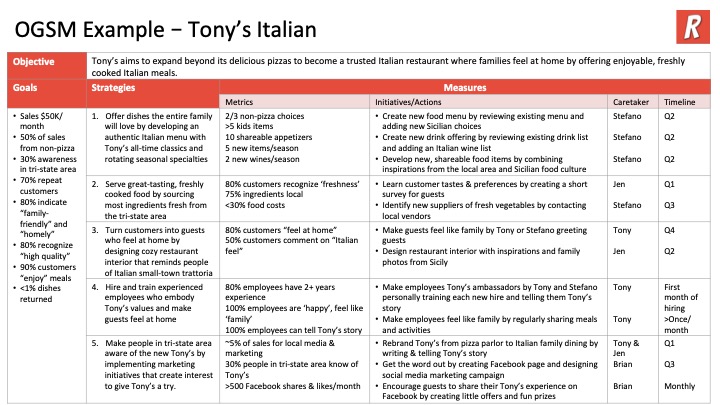
Tony’s Italian OGSM
Tony’s Italian is a fictional story about how Tony turned his pizza parlour into a family restaurant. The example shows how to apply OGSM to a small consumer business. Click here to read the full story of how Tony goes through the strategy process and captures his insights and strategic decisions in the OGSM. Or find the OGSM below.
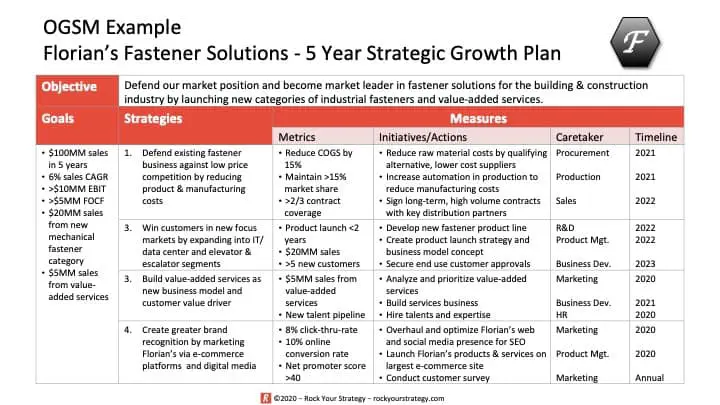
Florian’s Fasteners OGSM
Florian’s Fasteners tells the fictional story of a small B2B business that turned around its fortunes after a strategic review. Click here to read Florian’s story or find the OGSM below.
Examples of OKR
For examples of the OKR methodology, I can really recommend the resources at www.whatmatters.com.
John Doerr, author of the excellent book “Measure What Matters”, and his team go into lots of details and practical examples.
Where can I find OGSM templates?
Here are templates of the OGSM to get you started. Click on the following links to download PDF copies of the simpler Microsoft PowerPoint template or the more sophisticated Microsoft Excel template.

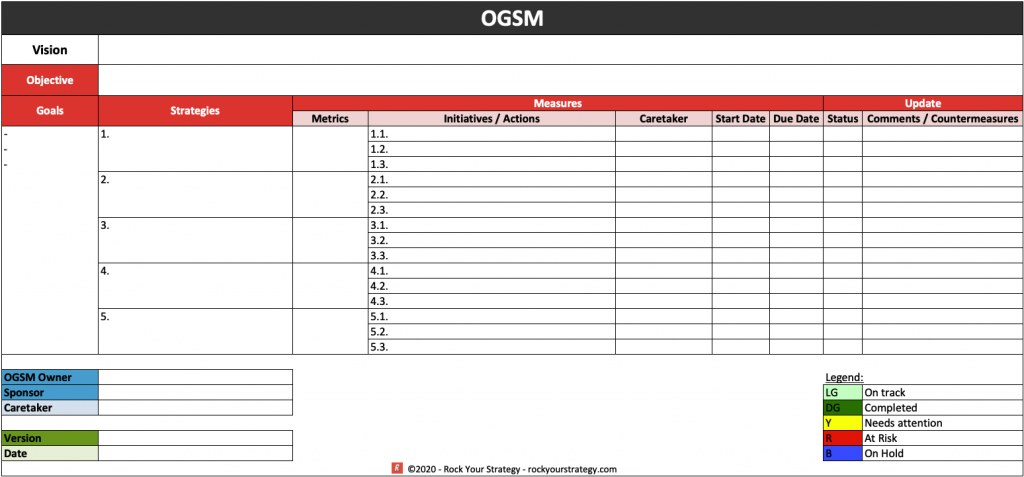
If you’d like to learn more about how to use these templates to create your OGSM, check out this article.
You may also be interested to read about our Do’s and Don’ts of OGSM here or find out what the 7 Deadly Sins of Business Strategy are here.
And before you go, check out our jam-packed Resource page with more tools and templates to help you simplify your strategy and achieve excellent results. Rock on!