Tag: cascading

  • How to Cascade OGSM Through Your Organisation (Step by Step)

    How to Cascade OGSM Through Your Organisation (Step by Step)

    You created a strategy for your business but have the feeling that each team is pulling in a different direction? That’s where cascading comes in.

    Cascading OGSM means translating your company-level Objective, Goals, Strategies, and Measures into aligned plans at division, team, and sometimes individual level — so every part of the business is pulling in the same direction. You start at the top, lock in the corporate OGSM, then work downward: each team builds its own OGSM that directly supports the level above it.

    Done right, it’s the cleanest alignment tool in strategic planning. Done badly — or not done at all — it’s how ambitious strategies die quietly in middle management. This article provides you with the step-by-step approach to ensure you do it right.


    Why Most OGSM Implementations Stop at the Top (and Fail)

    Most organisations treat OGSM as a senior leadership exercise. The CEO and their direct reports gather, build a corporate OGSM, declare victory, and expect the strategy to somehow permeate through dozens of teams who’ve never seen the thing. It doesn’t work.

    I’ve seen this happen in companies of every size. The corporate plan looks brilliant. It gets presented at the all-hands with a nice deck. Then it lands on a department head’s desk with a one-line email: “Here’s the company strategy — please align your team.” Three months later, every team is still doing exactly what it always did.

    The problem isn’t the OGSM. The problem is that nobody built the next level down.

    A strategy that lives only at the top is a wish list. Cascade is what turns it into execution.


    What Does a Full OGSM Cascade Actually Look Like?

    A proper cascade doesn’t stop at the executive suite. It travels through the organisation in layers, each one more specific and operational than the last.

    Level 1 — Company OGSM: Set by the CEO and senior leadership team. This is the master plan — the 1–3 year Objective for the whole business, with ambitious but measurable Goals, three to five Strategies, and the Measures that prove it’s working. If you’re new to the framework, start with what OGSM actually means before cascading it.

    Level 2 — Division OGSM: Each division (Sales, Marketing, Operations, Finance, Product) builds its own OGSM. Every element must connect directly to the company-level OGSM. The division’s Objective usually picks up one of the company Strategies and makes it its own mandate.

    Level 3 — Team OGSM: Within each division, individual teams (demand gen, customer success, fulfilment, content) build their own OGSMs — connecting upward to the division plan. This is where strategy becomes day-to-day decision-making.

    Level 4 — Individual goals (optional): For smaller teams or high-accountability cultures, individual contributors can align their quarterly objectives to the team OGSM. This level works best in companies with mature performance review rhythms.

    Level Who owns it Connects to
    1 — Company CEO / Senior leadership team Board / shareholders
    2 — Division Divisional VP or Director Company OGSM
    3 — Team Team lead / Manager Division OGSM
    4 — Individual Contributor Team OGSM

    The rule is simple: every OGSM must be traceable upward. If you can’t draw a line from a team-level Strategy to a company-level priority, that Strategy doesn’t belong in the plan.


    Step-by-Step: How to Build a Department-Level OGSM from the Company Plan

    Once your company-level OGSM is set and signed off, here’s how to cascade it at each level below.

    Step 1: Share the company OGSM — all of it. Every team lead needs to read the full company OGSM before they build their own. Not a summary. Not a slide. The actual plan. The Strategies are the most important section: department-level OGSMs almost always find their focus there.

    Step 2: Identify which company Strategies your division owns. A Marketing division might own “Grow brand awareness in new markets” and “Increase lead volume by 40%.” Operations might own “Reduce cost-to-serve by 15%.” Each division takes ownership of the company Strategies that fall squarely within their sphere of influence. If a Strategy is shared across divisions, agree on who leads and who supports — before anyone starts writing.

    Step 3: Write the division Objective. The Objective is an inspirational, qualitative statement. It should feel like a natural child of the company Objective — same energy, narrower scope. If the company Objective is “Become the most trusted supplier in the UK market,” the Marketing Objective might be “Build a brand that makes us the obvious first call for procurement directors.”

    Step 4: Set Goals that feed the company scoreboard. Division Goals must connect to company Goals. If the company has a revenue Growth Goal of £50m, the Sales division’s Goal might be “Generate £60m in qualified pipeline.” The logic: if every division hits its Goals, the company hits its Goals. That line of sight has to be visible and tested, not assumed.

    Step 5: Define Strategies that are division-specific. Here’s where real thinking happens. Division Strategies are not paraphrases of company Strategies — they’re the specific choices that division is making to hit its Goals. “Expand into the NHS procurement channel” is a real Marketing Strategy. “Improve our deck” is not a Strategy; it’s a task.

    Step 6: Set Measures with clear ownership. Every Measure needs an owner, a baseline, and a target. If no one is responsible for tracking a Measure, it won’t get tracked. At division level, Measures often feed directly into the company-level scorecard.

    Step 7: Repeat for team level. Once the division OGSM is solid, each team lead runs the same process — connecting their OGSM to the division plan rather than the company plan. The cascade deepens without losing the thread.

    If you want a framework to work from as you go, the OGSM template at each level saves you from starting with a blank page.


    What Has to Line Up — and What Can Your Team Own?

    Cascade doesn’t mean copy-paste. Teams need room to build plans that reflect their operational reality. Here’s what’s non-negotiable and what isn’t.

    Must align (non-negotiable):

    • The Objective must support the level above — it should feel like a natural continuation of the parent plan’s ambition
    • At least one Strategy must directly address a company-level priority
    • Measures must include at least one metric that feeds the parent OGSM’s scoreboard

    Can flex:

    • The tone and framing of the Objective
    • Additional Strategies that address local issues (talent gaps, tooling, process debt) even if they’re not in the parent OGSM — as long as they don’t contradict it
    • Team-specific Measures that are supplementary, not replacements

    The alignment test: if a member of the senior leadership team read your team’s OGSM, could they trace a clear line from your plan up to the company plan within two minutes? If yes, you’re aligned. If they’d have to guess, rebuild.


    Worked Example: A Three-Level Cascade at Brindley & Co

    Let’s make this concrete. Meet Brindley & Co, a mid-sized B2B services business in the compliance sector.

    Company OGSM (Level 1)

    • Objective: Become the dominant provider of compliance services in the UK financial sector
    • Goals: £40m ARR by year 3 | 85% client retention | NPS above 65
    • Strategies: Deepen relationships with Tier 1 banks | Launch a digital self-service platform | Build thought leadership in FCA-regulated markets
    • Measures: Annual recurring revenue | Gross churn rate | Net Promoter Score | Content-sourced pipeline

    Marketing Division OGSM (Level 2)

    • Objective: Make Brindley & Co the go-to name in compliance content and community
    • Goals: Generate 250 MQLs per month | Drive 40% of pipeline from inbound | Grow email list to 25,000
    • Strategies: Publish weekly long-form compliance guides | Host quarterly roundtables for compliance directors | Build an SEO programme targeting FCA search terms
    • Measures: MQL volume | Content-attributed pipeline value | Email subscriber count | Organic traffic growth

    Notice: the Marketing Objective picks up the company Strategy “Build thought leadership in FCA-regulated markets” and makes it a division mandate. The Marketing Goals connect to the company pipeline and retention goals. Alignment visible, no guesswork required.


    Content Team OGSM (Level 3)

    • Objective: Own the digital conversation around FCA compliance for financial services professionals
    • Goals: Publish 4 long-form articles per month | Rank top 3 for 10 priority search terms | Achieve 25% email open rate
    • Strategies: Build a content calendar anchored to the FCA regulatory release schedule | Develop a “compliance explainer” series for senior decision-makers | Optimise existing content for featured snippets
    • Measures: Articles published per month | Keyword rankings | Email open rate | Time-on-page

    The Content Team’s SEO strategy exists because Marketing chose SEO as a division strategy, because the company chose thought leadership as a corporate strategy. That line of sight is cascade working. You can see it in real-world OGSM examples across different sectors — the logic is the same even when the context changes.


    What Are the Most Common Cascade Mistakes?

    I’ve watched smart leaders break cascade in the same ways, repeatedly. Here’s the full list.

    Building in isolation. Division heads disappear into a workshop and write their OGSMs without properly referencing the corporate plan. You end up with five impressive-looking documents that don’t connect. Always share the company OGSM before anyone starts writing at the next level down.

    Cascading Goals but not Strategies. Teams adopt the company’s revenue targets without making the strategic choices about how to hit them. Numbers without direction aren’t strategy — they’re pressure. Cascade the Strategies first; the Goals follow.

    Making lower-level OGSMs too granular. A team OGSM should look like a scaled-down version of the corporate plan, not a project plan. If you’re listing 40 tasks under Strategies, you’ve gone too far. Strategies in a team OGSM should still be big choices, not activities.

    Skipping the alignment conversation. Cascade is not just document creation — it’s dialogue. Division heads need to present their OGSMs to the CEO. Team leads need to present to their division heads. That conversation catches misalignment before it hardens into nine months of wasted effort.

    Treating cascade as a one-time event. OGSMs should be reviewed quarterly. If the company shifts a Strategy mid-year, the cascade needs to be refreshed. A stale cascade actively misleads teams — they’ll be executing against priorities that no longer exist.

    Measuring the wrong things at the wrong level. Each level of cascade should track leading indicators of the level above’s lagging indicators. If the company tracks ARR, Marketing should track pipeline. If Marketing tracks pipeline, the Content Team should track MQL quality. Align the metrics hierarchy as carefully as you align the strategy hierarchy.


    How Do You Stop the Cascade from Going Stale?

    Building the cascade is the hard work. Maintaining it is a discipline.

    Set a quarterly OGSM review rhythm at every level. Division heads review their OGSM with the CEO; team leads review with their division heads. Treat it like a board meeting — prepared data, honest assessment of what’s working, and clear decisions about what changes.

    When company Strategies shift (and they will — markets change, competitors move), communicate upward and downward. Team leads need to know when priorities have moved. Executive leadership needs to hear when team-level data is suggesting a Strategy isn’t working. Cascade isn’t a top-down broadcast; it’s a two-way alignment system.

    For the operational side, a structured OGSM template with built-in hierarchy links makes it easier to see alignment across levels without chasing documents across folders. At scale, that infrastructure matters.


    How to Cascade OGSM: The Summary

    Cascade OGSM through your organisation by:

    Locking in the company OGSM first — cascade can’t start with a draft

    Using the 4-level model: Company → Division → Team → Individual

    Following the step-by-step process at each level, starting with Strategies

    Applying the alignment rules: some elements must connect up, others can flex

    Running the alignment conversation before finalising each level’s plan

    Reviewing the full cascade quarterly — and refreshing it when the company plan changes

    The difference between a company that executes strategy and one that talks about it is almost always found at this level. The corporate OGSM is the easy part. Getting it into every team’s hands — and into their priorities — is where execution is actually won.

    Rock on.

  • How to Cascade an OGSM Across Departments (With Examples)

    How to Cascade an OGSM Across Departments (With Examples)

    Most organisations that struggle with strategy execution don’t have a problem with their top-level OGSM. They have a cascade problem.

    To cascade an OGSM across departments, each team builds their own sub-OGSM by taking one of the company’s Strategies as their Objective. Their Goals, Strategies, and Measures then flow down from that. Done right, every department’s OGSM is a direct expression of the corporate OGSM — not a separate plan bolted on the side.

    This article explores how to do it — and what to avoid.


    What Does It Mean to Cascade an OGSM?

    Cascading means taking a strategy from a higher level and making it the starting point for planning at the next level down. In OGSM terms, the company’s Strategies become department Objectives.

    Think about it this way. Your corporate OGSM has an Objective (where you’re going), Goals (the quantified targets that define success), and three to five Strategies (the choices about where to focus). Each Strategy is a statement of intent: “We will grow through new channel partnerships” or “We will reduce operating costs by automating manual fulfilment.”

    Each of those Strategies needs an owner. That owner — typically a department or business unit — then builds their own OGSM using the Strategy as their Objective. Their Goals quantify what success looks like for that department. Their Strategies describe how they’ll get there. Their Measures track progress.

    The result is a connected hierarchy of plans, each one directly traceable back to the corporate direction. No department is off doing their own thing. Every team can see exactly how their work connects to the overall strategy.


    What Are the Three Types of OGSM Cascade?

    Not every cascade is the same. I’ve seen three patterns used in practice, and the right one depends on your organisation’s structure and planning horizon.

    Vertical cascade (by department or business unit)

    This is the most common approach. You take the corporate OGSM and decompose it by function. Sales, Marketing, Operations, Product — each department takes ownership of the Strategy that most closely matches their remit and builds a sub-OGSM from there.

    Vertical cascade works well in functional organisations where departments have clear ownership of outcomes. If your corporate Strategy is “expand into enterprise accounts,” that becomes the Sales team’s Objective. Sales then sets its own Goals (number of enterprise accounts won, average contract value), its own Strategies (target industry verticals, invest in account-based marketing), and its own Measures.

    Horizontal cascade (across process chains)

    Sometimes a Strategy cuts across functions rather than sitting neatly within one. “Reduce customer onboarding time from 30 days to 7 days” is an Objective that involves Sales, Product, IT, and Customer Success simultaneously. No single department owns it outright.

    In this case, a horizontal cascade creates a cross-functional OGSM shared by all the teams involved. Each team’s contribution is captured in the Measures column, so accountability is visible and distributed. This is harder to manage — you need a clear process owner — but it’s essential for strategic priorities that don’t respect org chart lines.

    Time-based cascade (annual into quarterly)

    The third type isn’t structural, it’s temporal. You take your annual OGSM and break it into quarterly sub-OGSMs. The annual Goals become the targets; the quarterly OGSMs describe the specific actions and milestones that will get you there each quarter.

    I use this approach with leadership teams that find the annual OGSM too abstract for day-to-day decision-making. Quarterly OGSMs keep the team focused on near-term work while remaining anchored to the year’s Goals and Measures.


    What Does a Cascaded OGSM Look Like in Practice?

    Let me show you a worked example. I’ll keep it simple but realistic.

    Corporate OGSM (abbreviated)

    • Objective: Become the market-leading provider of sustainable packaging in Europe by 2028.
    • Goals: Revenue €150M by FY28; Net Promoter Score ≥ 65; >40% market share in key segments.
    • Strategies: S1: Grow through direct enterprise accounts in DACH and Benelux. S2: Launch a certified compostable product line by Q3. S3: Reduce production waste by 25% to fund investment.

    Three departments each take ownership of one Strategy.

    Sales OGSM (from S1)

    • Objective: Grow through direct enterprise accounts in DACH and Benelux.
    • Goals: 40 new enterprise contracts by FY27; €60M revenue from enterprise by FY27; 90% renewal rate.
    • Strategies: Focus outbound on manufacturing and food & beverage; build a partnership channel with two regional distributors; deploy account-based marketing for top 20 targets.
    • Measures: Pipeline value, contracts signed per quarter, renewal rate, partner revenue.

    Product OGSM (from S2)

    • Objective: Launch a certified compostable product line by Q3.
    • Goals: Four SKUs to market by Q3; 95% certification pass rate; COGS within 15% of existing line.
    • Strategies: Partner with two material suppliers already in certification pipelines; run a 90-day pilot with three beta customers; align packaging design to existing brand guidelines.
    • Measures: Certification milestone tracker, beta feedback scores, COGS per unit, Q3 launch date.

    Operations OGSM (from S3)

    • Objective: Reduce production waste by 25% to fund investment.
    • Goals: Waste down from 18% to 13.5% by end of FY27; €2M in savings reinvested into R&D.
    • Strategies: Implement lean production review at two main facilities; renegotiate supplier contracts to reduce off-spec deliveries; automate quality control on Line 4.
    • Measures: Waste % by facility, monthly cost savings, supplier defect rate, Line 4 throughput.

    You can see what’s happening here. Every department Objective is a direct lift from a corporate Strategy. Every department’s success contributes directly to the corporate Goals. The strategy is connected — not fragmented.

    For a structured template to build this out, our OGSM template walks you through each level step by step. And if you want a deeper grounding in how the framework works from first principles, the complete OGSM guide is the right place to start.


    What Are the Most Common Cascade Mistakes?

    I’ve helped organisations cascade OGSMs across dozens of departments. The same mistakes come up every time.

    Copying company Strategies verbatim

    When you ask a department to “just cascade their part,” the path of least resistance is to copy the corporate Strategies into their own OGSM and call it done. It feels compliant. It isn’t. Each department’s OGSM should reflect how they will deliver the higher-level Strategy — their own choices, their own approach. If the Sales OGSM’s Strategies look identical to the corporate Strategies, nobody has actually thought about execution.

    Turning cascade into a rubber-stamp exercise

    This happens when cascade is imposed top-down without real dialogue. Leadership hands down the corporate OGSM, departments fill in the template, and nobody questions whether the split makes sense. The cascade produces paper alignment, not real alignment. The better approach is a working session where departments discuss which corporate Strategy they’re best placed to own, where the overlaps are, and what they’ll need from other teams to succeed.

    No common review cadence

    A cascaded OGSM only works if the connected OGSMs are reviewed together. If the corporate OGSM is reviewed quarterly but department OGSMs are reviewed monthly — or never — the cascade breaks down. Misalignment creeps back in. Build a single review rhythm that runs from department to corporate level, so the connections stay live.

    Forgetting that some strategies are cross-functional

    Not every corporate Strategy belongs to one department. Treating a cross-functional priority as if it belongs to one team creates silos and finger-pointing when delivery falls short. Identify these upfront and build horizontal accountability into the Measures rather than hoping one team carries the load.


    Ready to Start Your OGSM Rollout Across Teams?

    How to cascade an OGSM is genuinely one of those things that sounds straightforward and trips people up in execution. The framework is simple: each department takes a corporate Strategy as their Objective and builds down from there. The hard part is the conversation — who owns what, how you handle cross-functional priorities, and how you build a review cadence that keeps the whole structure honest.

    Start at the top. Make sure your corporate OGSM is solid and your Strategies are clear and distinct. Then bring your department heads together and work through the OGSM cascade departments exercise as a team — not as a form-filling exercise. The difference shows.

    Working at a smaller scale? OGSM for small business covers how to apply the same cascade logic without the enterprise overhead.

    Rock on.

  • How To Cascade Strategy To Deliver Excellent Results

    How To Cascade Strategy To Deliver Excellent Results

    When formulating and executing your business strategy, it is important to ensure that everyone in the company understands the overall direction and that their work is linked with the business’ objective and goals. But how to achieve that exactly? This is where cascading strategy helps to create results. 

    Cascading the business strategy means arranging and translating the strategy along the organization’s structure or processes so that everyone in the organization is fully aligned behind the business’ objective and goals and works together to achieve them. 

    Effectively cascading your strategy can be the difference between a strategy existing only on paper and moving an organization to action – and to results. However this is much easier said than done. Read on to learn how 3 considerations help you cascade your strategy and deliver excellent results. 

    Cascading strategy

    The Merriam-Webster dictionary defines a ‘cascade’ as “something arranged or occurring in a series or in a succession of stages so that each stage derives from or acts upon the product of the preceding” (source).

    In business, cascading means translating strategic priorities from a higher hierarchical level to a lower level or from one function to another. It is a way of aligning the strategy throughout the organization and engaging people in the strategy process.

    Engaging everyone in the business is not only important to communicate the strategy and create transparency, but also to connect each function and job role with strategy execution. Nowadays, people really want to be involved. And a higher level of involvement and engagement has tremendous benefits. 

    A 2016 meta analysis by Gallup found that organizations with high levels of engagement achieved 20% increase in sales, were 21% more profitable and 17% more productive than organizations with low levels of engagement1. 

    A study by LSA Global went one step further and found that highly aligned organizations grew their sales 58% faster and were 72% more profitable2. 

    These are astounding findings. However when reflecting about what happens when people are involved and when they feel fully engaged, the findings are not so surprising at all. Consider the following questions: 

    • Do you remember the last time you felt that you were really clear about how you contributed to the overall business goals? 
    • Can you recall an instance when you felt that the work you did contributed to a larger cause? 
    • Or can you remember how you felt knowing that what you did had meaning to your customers, to your business or to the people you work with? 

    I remember such times vividly. And in most of these occasions I felt significantly more effective.  When I am working on tasks that are directly linked to the success of the business or when I know the meaning of the work I am doing, I am significantly more productive and more happy at work.

    Cascading ensures that each person’s role is connected to the overall business strategy and that everyone has a stake in its implementation and the success of the business. 

    Now that’s profound. How do you create such levels of clarity and engagement via cascading strategy?  

    3 considerations for cascading strategy

    There are three important considerations for cascading your strategy throughout your business:

    • Cascading can take place vertically and/or horizontally
    • Alignment can be direct and/or indirect
    • The process of cascading is reiterative 

    Vertical and Horizontal Cascading

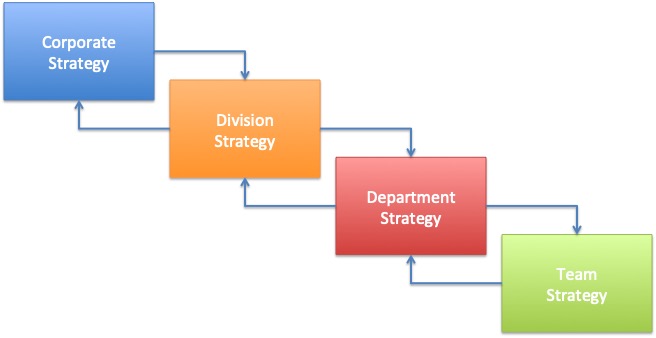
    Vertical cascading means breaking down the strategy from a higher level of the organizational hierarchy to a lower level.

    For example, the corporate strategy is broken down into the divisional strategies or the divisional strategy into departmental strategies. Cascading means that the individual lower level strategies together roll back up into the higher level strategy. Hence, successfully achieving the divisional strategies would result in the successful delivery of the corporate strategy. 

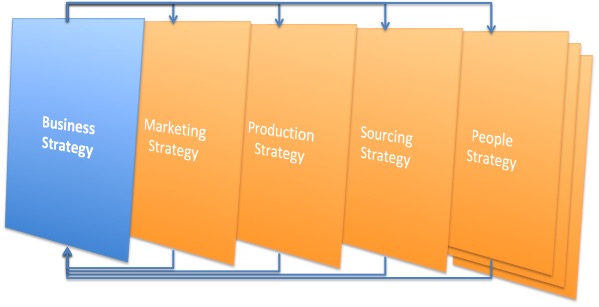
    Horizontal cascading means breaking down a business strategy into the various functions that work together to deliver the business strategy.

    For example, a divisional strategy is broken down into the sales & marketing strategy, production strategy, sourcing strategy and people strategy. Again, delivery of each of the functional strategies would ensure that the overall business strategy is achieved. 

    In practice, cascading a strategy is typically a mix of vertical and horizontal cascading. The important part is that the strategies perfectly align to ensure that the organization works together to achieve the overall business objective and goals. 

    When cascading the strategy, each division, department, team or individual should ask the following questions: 

    • How can I contribute to the achievement of the higher level strategy? 
    • What initiatives and actions can we/I take that result in the achievement of the objective and goals? 

    Direct and Indirect Alignment

    Direct alignment means that everyone is working towards the same goal: a team or individual directly contributes to the achievement of a goal.  

    Consider for example a sales goal. The business aims to achieve $1 million growth in revenue or +10%. The goal is broken down into a sales goals for each business unit or product line as follows: 

    Product Line 1+ 500,000
    Product Line 2+ 300,000
    Product Line 3+ 200,000
    Total Sales Growth+ 1,000,000

    Each of the product lines are now directly aligned with the overall $1 million growth goal. 

    Indirect alignment means that different teams or different individuals are working towards an overall goal in their own specific ways.

    For example, consider the goal to improve customer satisfaction by 10 points. This is a goal several functions need to contribute towards in their own ways, including Sales, Operations, Product Quality etc. 

    • Sales may target to increase customer interactions. 
    • Operations may set a supply chain fulfillment target. 
    • Manufacturing or Product Quality may set a yield or defect rate target.
    • …and so on. 

    No single function may be able to achieve the overall goal by itself, it takes a concerted effort of indirectly aligned goals and initiatives. 

    Reiterative Process

    The process to cascade goals and strategies is reiterative and truly a team effort. 

    In my experience, cascading is most effective when it is not a one-way street. All too often goals are set top-down by a superior passing down her goals to her team. And the team leaders then pass down their goals further to their team members. This way may be quick but may not lead to engagement or buy-in. 

    A more effective way to cascade goals is to build in a feedback loop. The higher organizational level engages in a discussion about its goals with the lower level. Priorities are discussed and clarified. The lower level asks questions and proposes initiatives to achieve the goals and in turn sets goals for its own actions. 

    This reiterative process can be performed vertically, cascading the strategy down the hierarchy, and horizontally, aligning the strategy across functions or divisions.  

    As noted above, people are much more productive when they are engaged. And including everyone in the strategy process is a great way to increase engagement through involvement. 

    Ok – enough theory. So how do you actually cascade? A simple strategic tool such as OGSM can help to document the business strategy and cascade it throughout the organization. Let’s start with what OGSM is and how it can help. 

    Cascading strategy using OGSM

    OGSM stands for Objective, Goals, Strategies and Measures. It is a one-page business plan which depicts what you are aiming to achieve and how you are going to achieve it.

    Whether you are defining a 3-5 strategic plan or an annual operating plan, the OGSM aligns the objective and goals with the strategies, initiatives and actions needed to execute the business strategy. This creates clarity in the organization about the business’ priorities. 

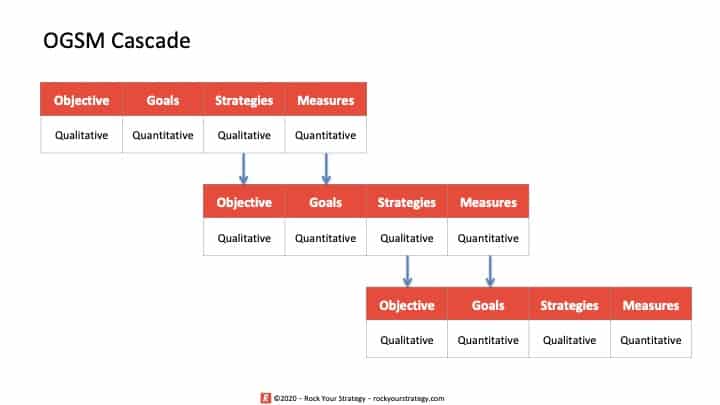
    In addition, the structure of the OGSM excellently lends itself to cascading the strategy. The objective and goals jointly describe what the organization targets are. The strategies and measures jointly define how they are going to be achieved. At the same time, objectives are qualitative, goals are quantitative. Strategies are qualitative, measures are quantitative. 

    ObjectiveGoalsStrategiesMeasures
    QualitativeQuantitativeQualitativeQuantitative

    When cascading the OGSM, the higher level’s strategies and measures become the lower level’s objectives and goals. The following graph depicts this relationship. 

    This allows cascading the business strategy both vertically and horizontally and links every division’s and team’s objectives, goals, strategies and measures with the overall direction of the business. 

    When cascading the OGSM this way, build in the 3 elements above including vertical and horizontal cascading, direct and indirect alignment, and designing the process in a reiterative way in your team. 

    If you would like to learn more about OGSM, click here to read our introduction to the OGSM methodology or explore our OGSM examples.

    Conclusion

    Teams that are clear about the business strategy and understand how they can directly contribute to its implementation are more productive and achieve better results.  

    Cascading your strategy throughout the business ensures clarity and alignment. 

    When cascading your strategy consider vertical and horizontal cascading, direct and indirect alignment, and building in a reiterative feedback loop. 

    The OGSM methodology is a great way to engage your team in the strategy process and effectively cascading the strategy throughout your organization. 

    References

    1. https://www.gallup.com/workplace/236366/right-culture-not-employee-satisfaction.aspx
    2. https://lsaglobal.com/insights/proprietary-methodology/lsa-3x-organizational-alignment-model/